
A complete issue · 20 pages · 1889
Life — May 23, 1889
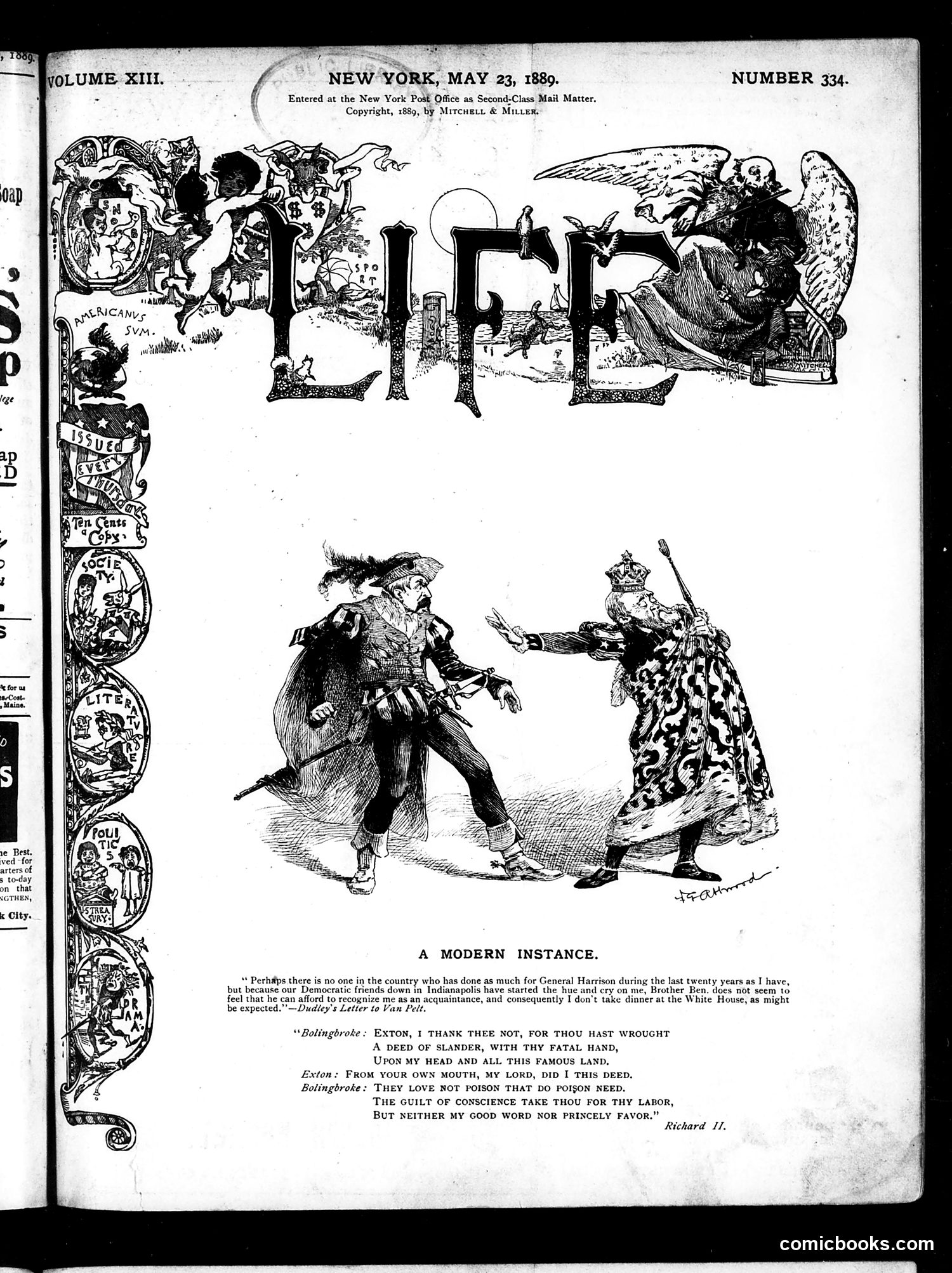
This political cartoon satirizes President Benjamin Harrison's alleged disloyalty to the Democratic Party. The caption references Harrison's twenty years of public service but notes Democratic friends accused him of abandoning party principles, particularly regarding "the Indian question" and White House appointments. The main illustration depicts two figures in conflict—one appears to be a military or political figure being confronted by a crowned figure (likely representing the Democratic Party or its leadership). The dialogue references Shakespeare's *Richard II*, with accusations of "slander" and poisonous words. The satire critiques Harrison as a turncoat who abandoned Democratic positions, making him an example of political betrayal. The elaborate decorative border contains various historical and satirical vignettes typical of Life's ornate Victorian design.
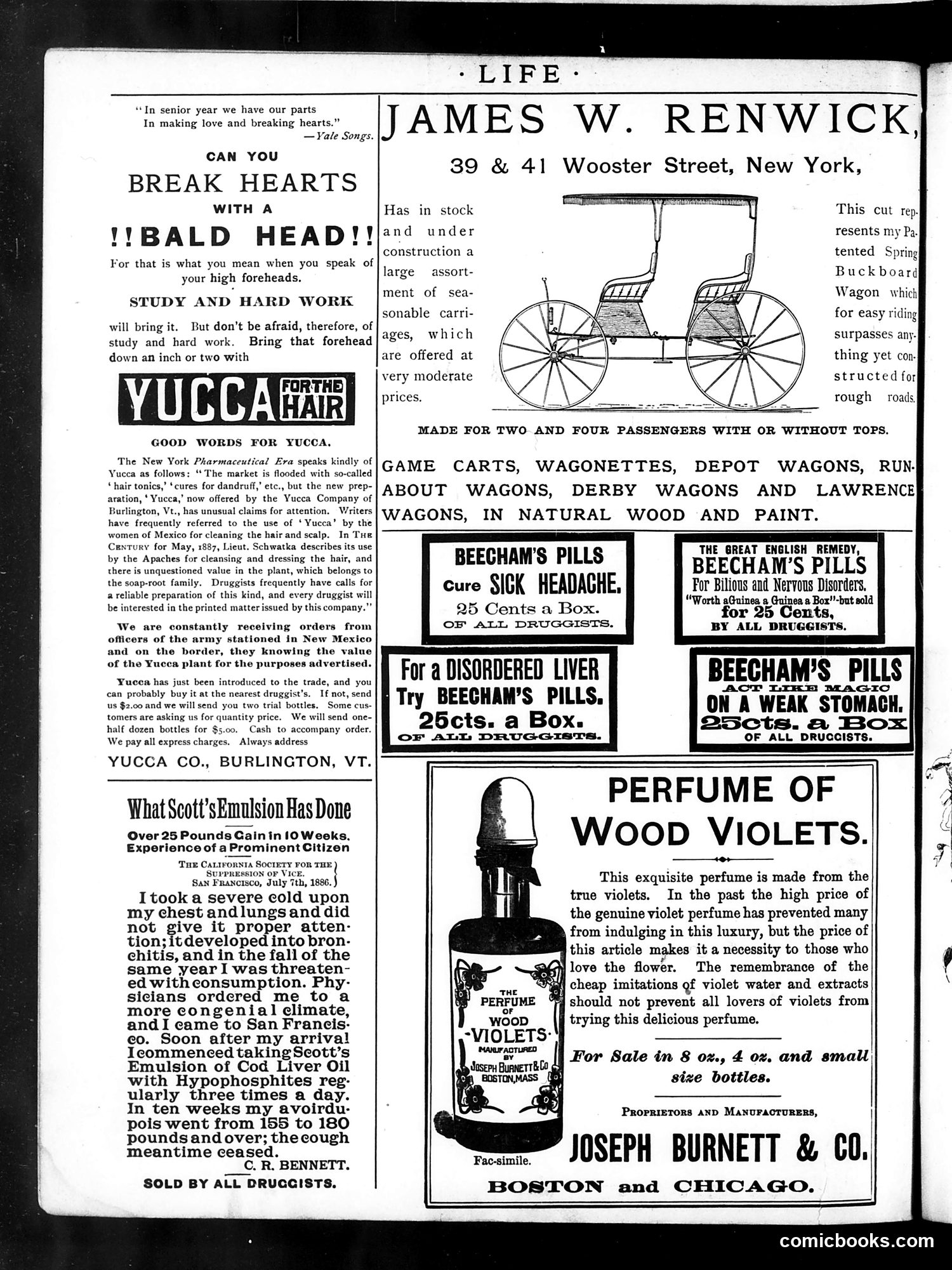
This page is **primarily advertising** with no political cartoons. The content consists of commercial advertisements from the 1880s-1890s era: **Main advertisements include:** - Yucca hair tonic (addressing baldness—a common satirical subject of the era) - James W. Renwick's carriages and wagons (detailed technical description) - Beecham's Pills (multiple ads for various ailments: headaches, liver disorders, weak stomach) - Scott's Emulsion cod liver oil (testimonial from a San Francisco citizen about treating consumption) - Perfume of Wood Violets by Joseph Burnett & Co. The page reflects **late 19th-century patent medicine culture**, where dubious remedies were heavily advertised in magazines. The testimonial format and medical claims are characteristic of the era's unregulated advertising practices. There is **no satirical content or political commentary** visible on this page.
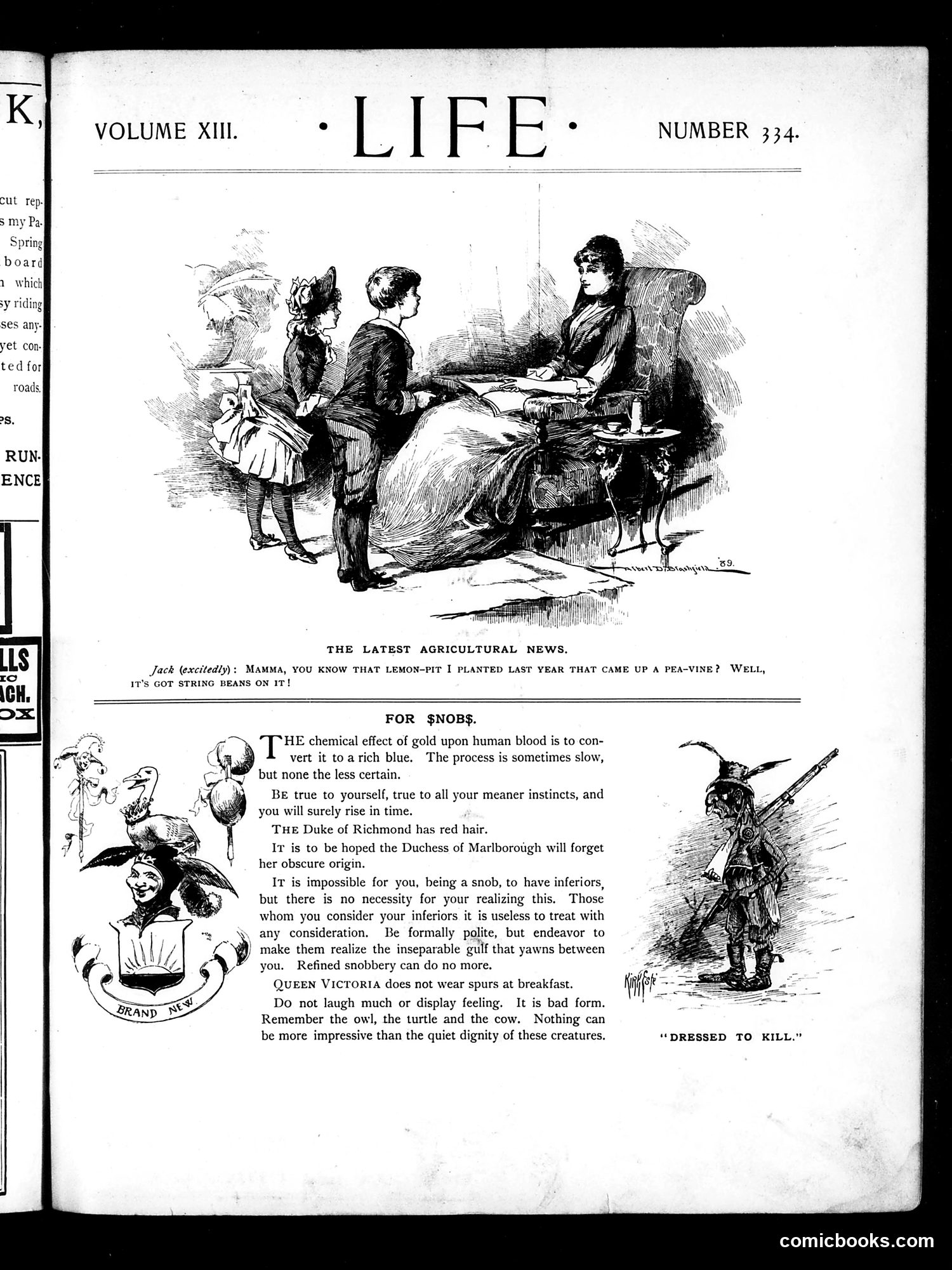
**Top Cartoon:** "The Latest Agricultural News" depicts a conversation about a lemon-pit plant producing pea-vines—an absurd horticultural impossibility presented as humorous agricultural gossip among Victorian ladies and gentlemen. **"For Snobs" Section:** This is satirical etiquette advice mocking upper-class pretension. It ridicules snobbish behavior through mock-serious observations: gold's effect on blood, advice about treating inferiors with cold formality, references to the Duke of Richmond's red hair and the Duchess of Marlborough's "obscure origin," and jabs at Queen Victoria's breakfast habits. The final paragraph compares refined snobs unfavorably to animals (owls, turtles, cows) for their quiet dignity—suggesting snobs lack such natural grace. **Right illustration:** "Dressed to Kill" shows a bird in hunting attire, likely a visual pun on the phrase itself.
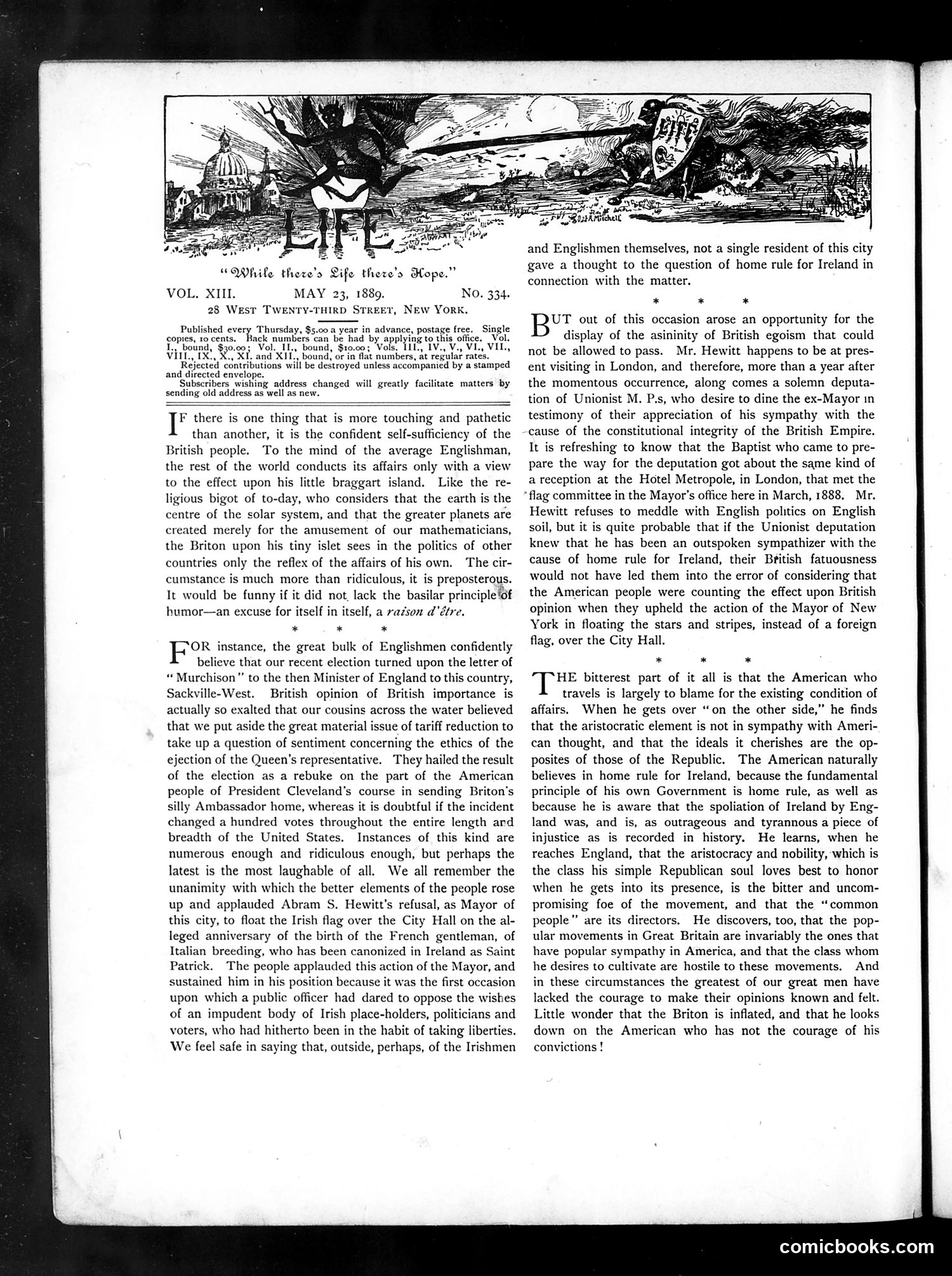
**The Cartoon:** The masthead illustration titled "While there's Life there's Hope" depicts a skeletal figure (Death) confronting a robust man representing Life/vitality, set against a European cityscape. **The Article's Focus:** The text discusses British egoism and the visit of an unnamed American (likely Mayor Gould of New York, based on context) to London. The piece criticizes how British society dismissed Irish home rule concerns while celebrating their own political importance. **Key Satire:** The article mocks British presumption that their affairs matter globally, while they ignore Irish independence movements. It notes Americans were struck by British indifference to these issues, highlighting the hypocrisy of a nation claiming democratic principles while opposing Irish self-determination. The cartoon's "Life vs. Death" theme appears to reference broader vitality and decline metaphorically.
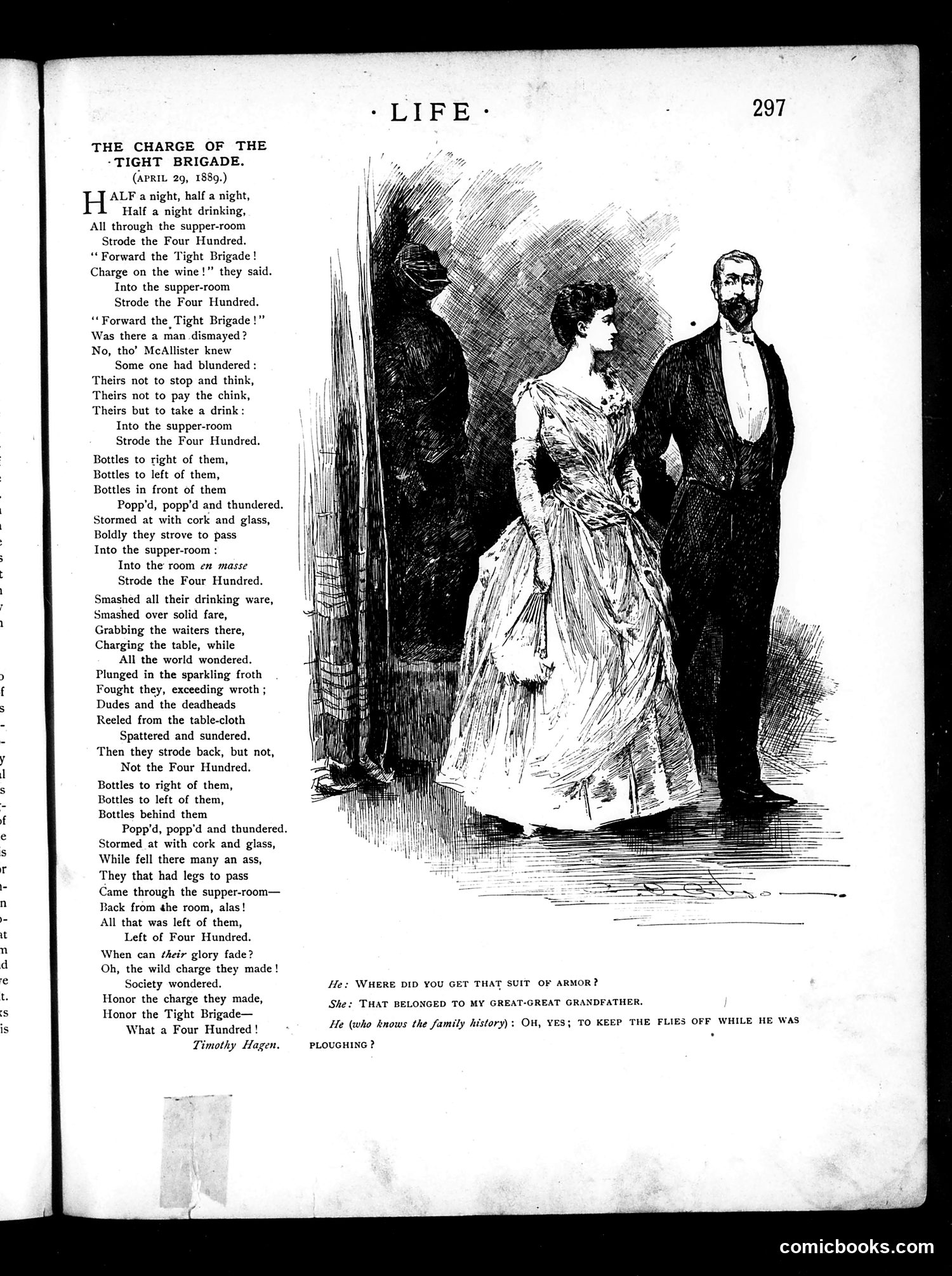
This page parodies Tennyson's famous 1854 poem about a disastrous cavalry charge. The satirical poem describes a chaotic dinner party where guests ("the Four Hundred"—a term for New York's elite social circle) charge into a supper room, creating mayhem with bottles and breaking glassware. The accompanying illustration shows well-dressed socialites in formal attire amid the chaos. The dialogue below reveals the joke: a woman claims her suit of armor belonged to her great-great-grandfather, whom she kept protected from flies while ploughing—absurd pretension masquerading as aristocratic heritage. The satire mocks both high society's pretensions and the reckless behavior of wealthy New York elites at fashionable gatherings.
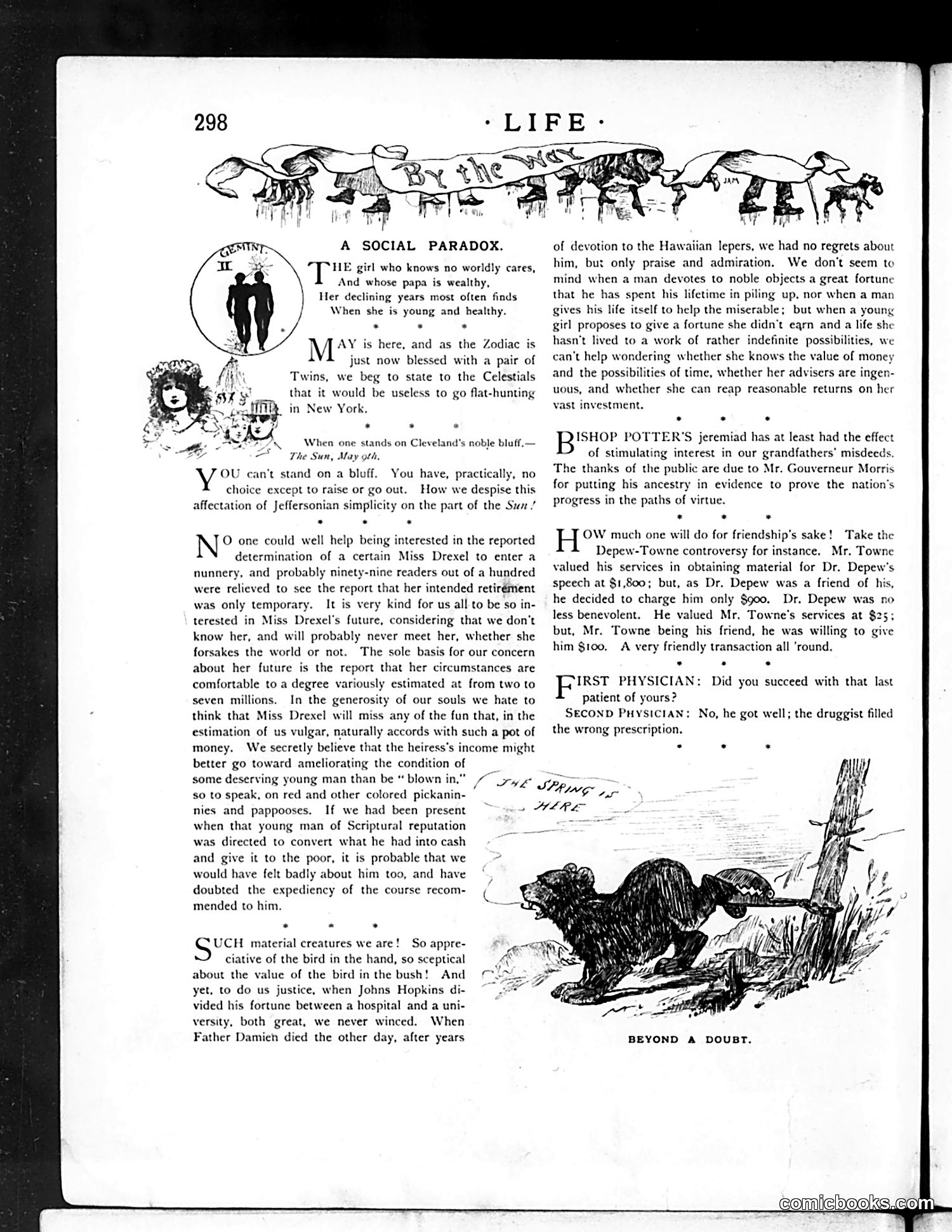
This satirical piece criticizes the contradiction of wealthy young women marrying for love while their fathers are willing to sell family fortunes. The "social paradox" title refers to the tension between romantic ideals and financial realism among the upper class. The circular vignette shows a wealthy couple, likely referencing specific society figures of the era. The text mocks Miss Drexel's reported retirement plans—suggesting skepticism about her commitment given her substantial inheritance. The accompanying anecdotes (Dr. Depew, the physicians' joke) serve as satirical examples of how the wealthy rationalize their contradictory behaviors and self-interested decisions. The illustration "Beyond a Doubt" depicts a dog or similar creature, likely a visual pun commenting on faithlessness or unreliability in these social arrangements.
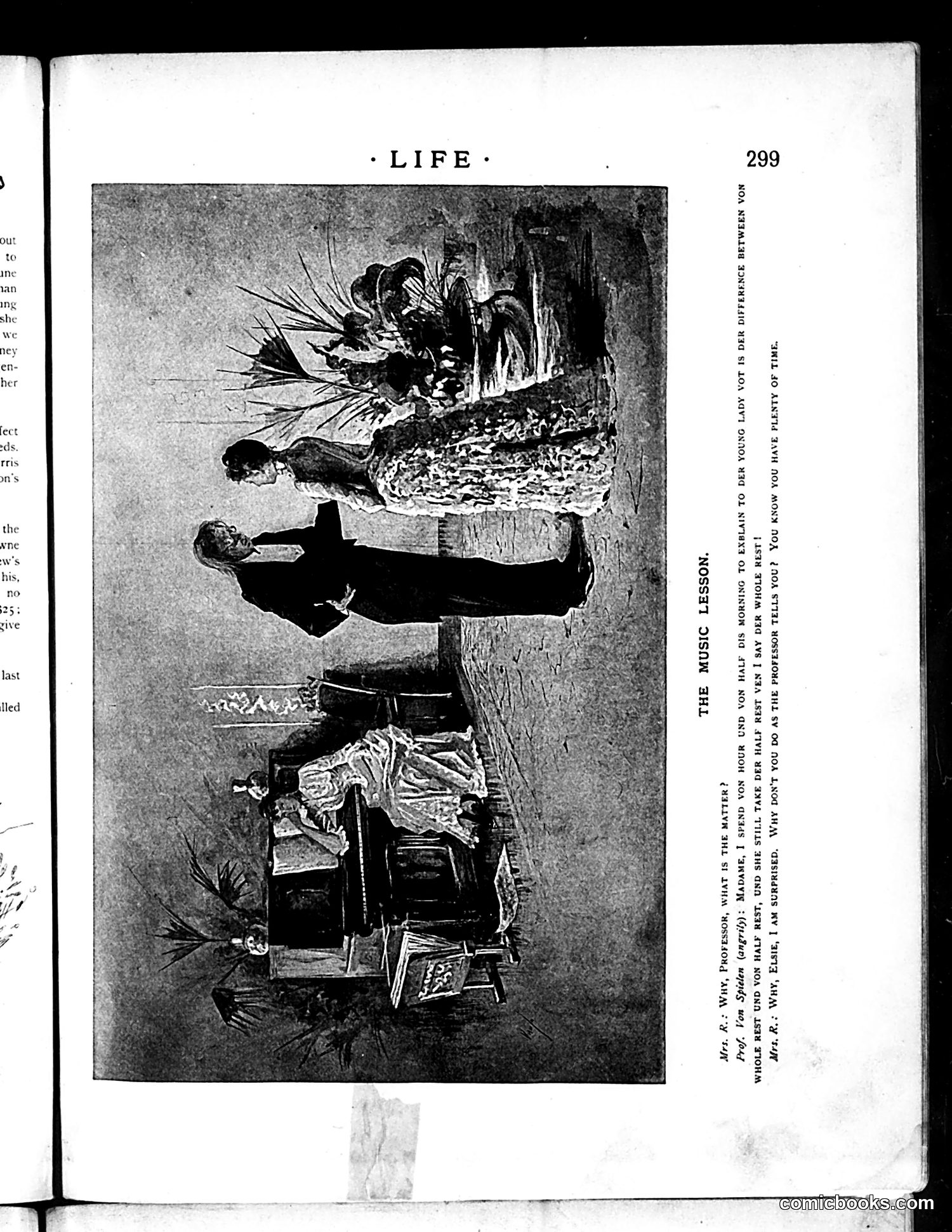
This cartoon appears to depict a music instruction scene, though the image is rotated and somewhat difficult to parse clearly. Based on the caption "THE MUSIC LESSON" and the OCR text mentioning "Why Jackson's warship entered her port," this likely satirizes a contemporary political or social situation using musical instruction as metaphor. The figure in dark clothing appears to be instructing or performing for another figure. Without being able to definitively identify the specific individuals or the exact historical event referenced, I cannot confidently explain the satirical point. The rotated orientation and image quality make precise interpretation difficult. More context about the publication date would be necessary to identify the political figures or events being lampooned.
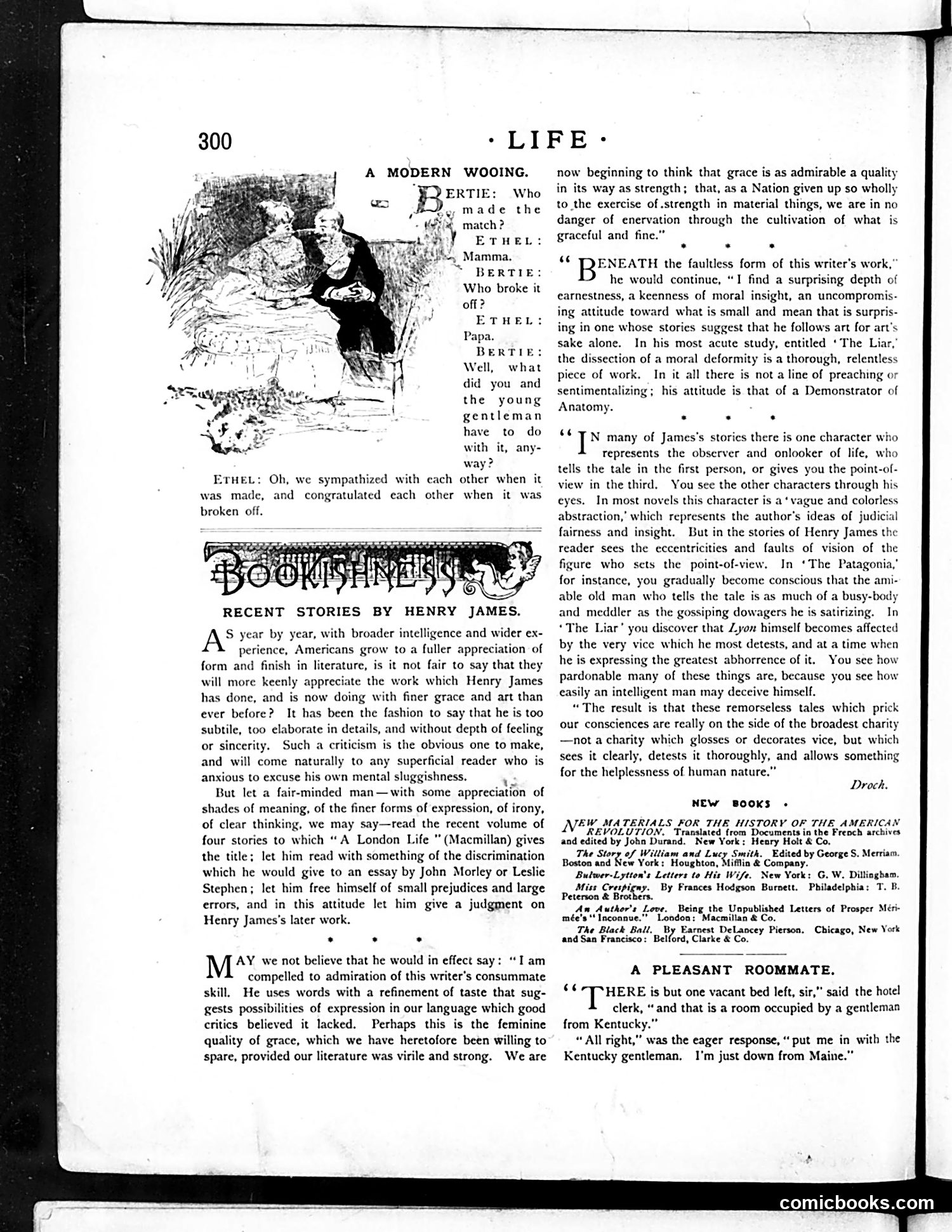
The cartoon titled "A Modern Wooing" depicts a social interaction between a young gentleman and a woman, with two older figures (labeled "Mama" and "Papa") observing. The sketch satirizes courtship rituals of the era—specifically the formal, chaperoned nature of romantic encounters among the upper classes. The humor appears to rest on the awkward formality of the scene: the young man seems stiff or uncomfortable, while parental figures maintain strict oversight. This mocks the rigid social conventions surrounding courtship, where young people had little private interaction and romantic advances required parental approval and presence. The page also contains literary criticism of Henry James's recent story collections, praising his moral insight and character development—unrelated to the cartoon's social satire about dating customs.
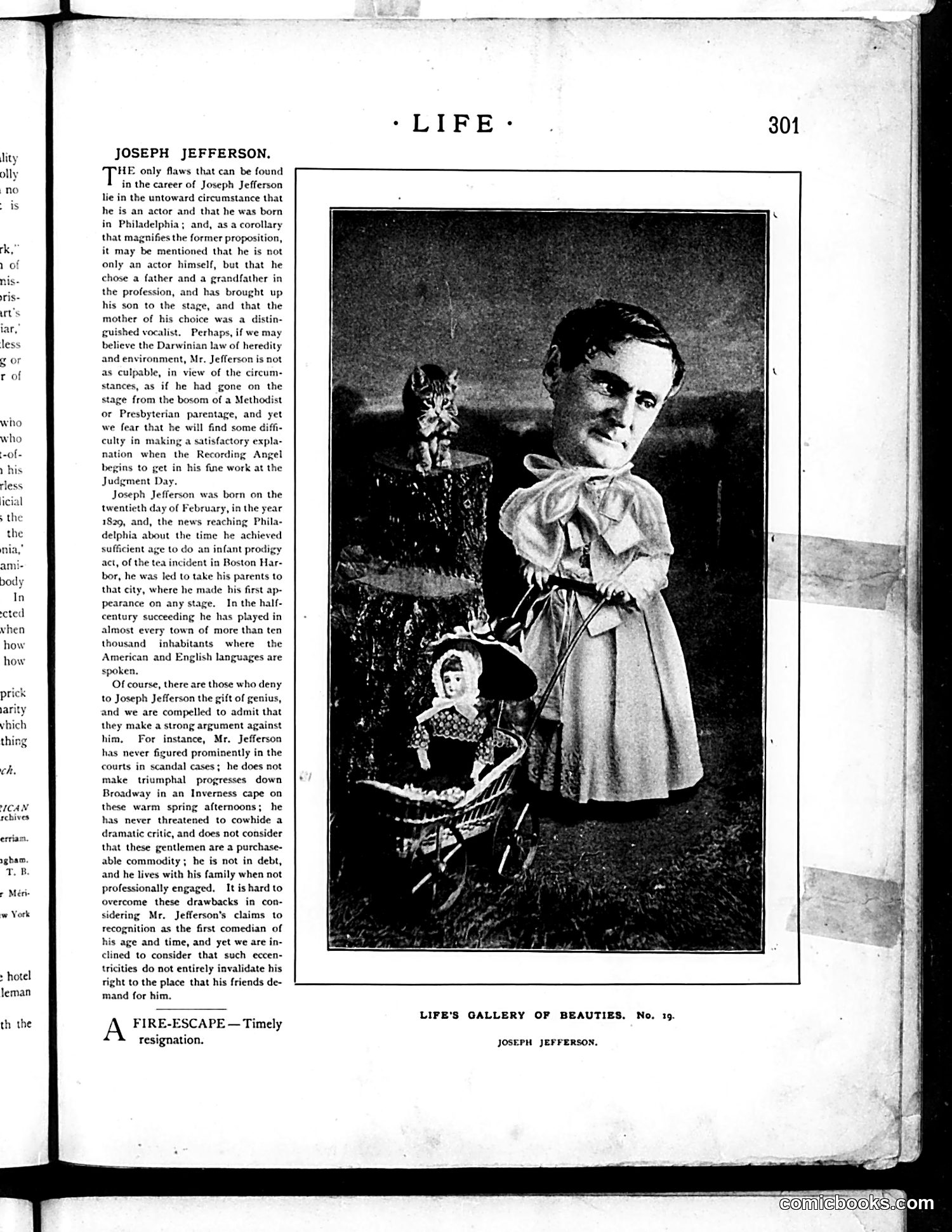
This page from *Life* magazine features a biographical article and photograph of **Joseph Jefferson**, a prominent 19th-century American actor. The text discusses Jefferson's career, noting he was born in Philadelphia and became famous for stage performances across American cities where English and American are spoken. The photograph shows Jefferson in what appears to be a domestic scene with family members, including a child. The caption "A Fire-Escape—Timely Resignation" suggests satirical commentary, likely mocking either Jefferson's acting choices or a recent retirement decision. The article acknowledges both his talents and the "drawbacks" in considering him for certain social recognition, indicating debates about actors' social status during this era.
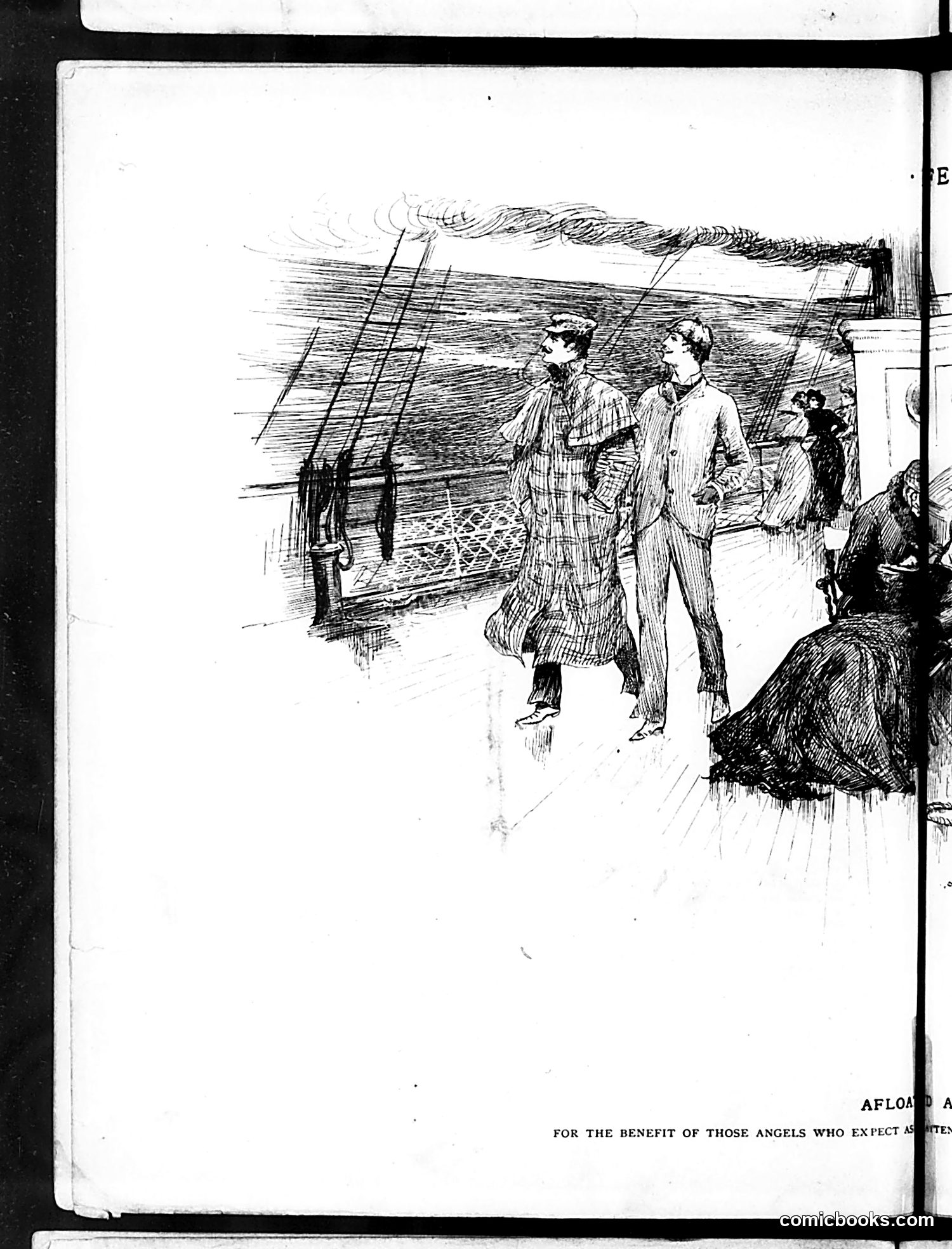
This appears to be a satirical illustration from Life magazine depicting a ship scene. The visible text at the bottom reads "FOR THE BENEFIT OF THOSE ANGELS WHO EXPECT AS[SISTED]" (text cuts off). The sketch shows men in period clothing on what appears to be a ship's deck, with rigging visible above. The partial caption suggests religious or moral satire—likely mocking expectations of divine intervention or assistance in some maritime or commercial context. However, without the complete caption and publication date, I cannot definitively identify the specific political event, figures, or historical incident being satirized. The style suggests late 19th or early 20th century, but determining the precise target of the satire requires additional context I cannot reliably extract from this fragment alone.
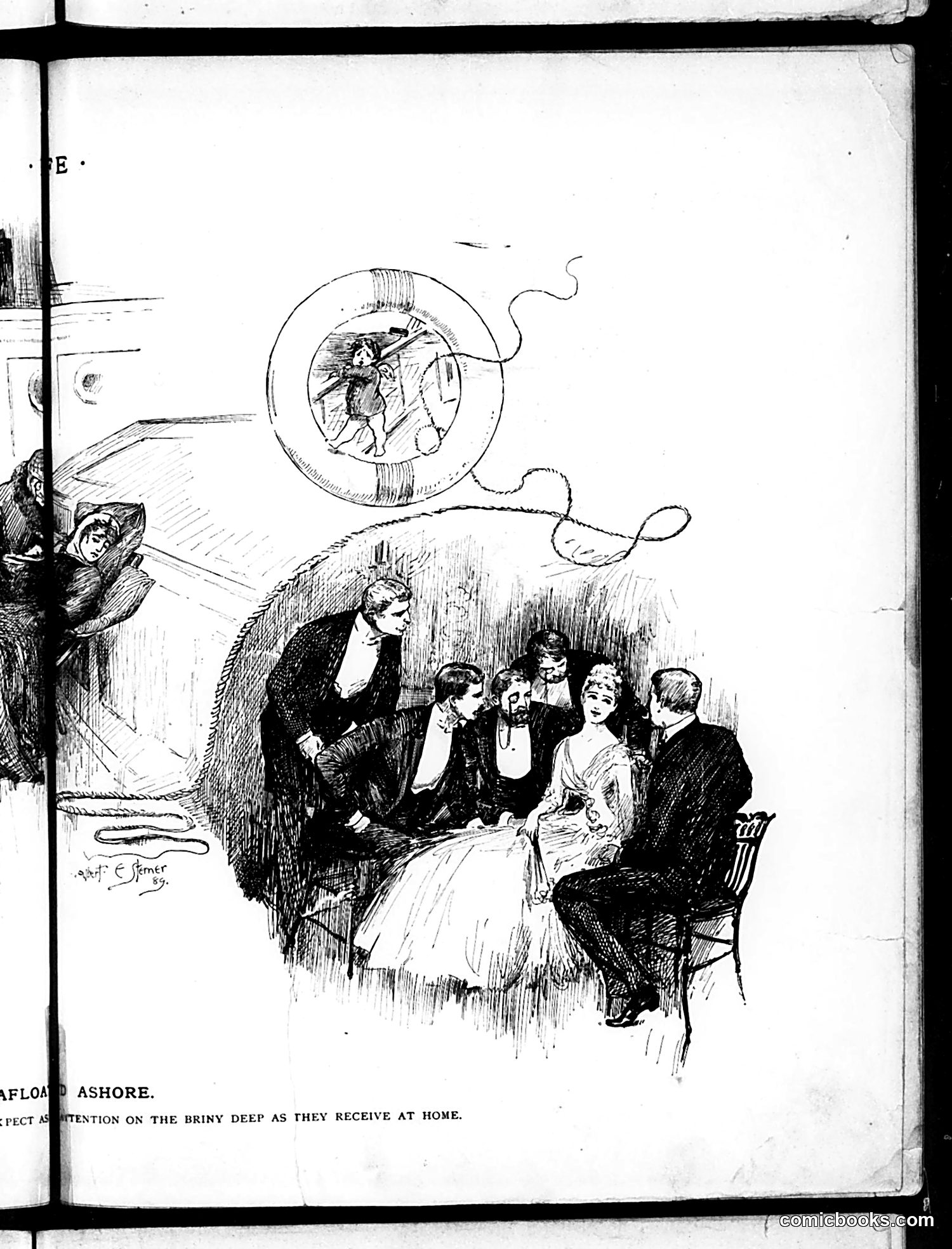
This satirical illustration appears to show a fashionable gathering of well-dressed socialites in a parlor, with a large circular window or porthole above them. The partial caption visible reads "AFLOAT ASHORE" and mentions "ATTENTION ON THE BRINY DEEP AS THEY RECEIVE AT HOME." The satire likely mocks wealthy society women who receive guests while their husbands or male relatives are away at sea. The circular frame above suggests a nautical theme—perhaps depicting a sailor or maritime scene that contrasts with the indoor parlor gathering below. The joke appears to involve the disconnect between domestic social pretension and maritime reality, or possibly commentary on how society women behave when men are absent. The artist's signature appears to read "Cesare" or similar, though it's partially unclear.
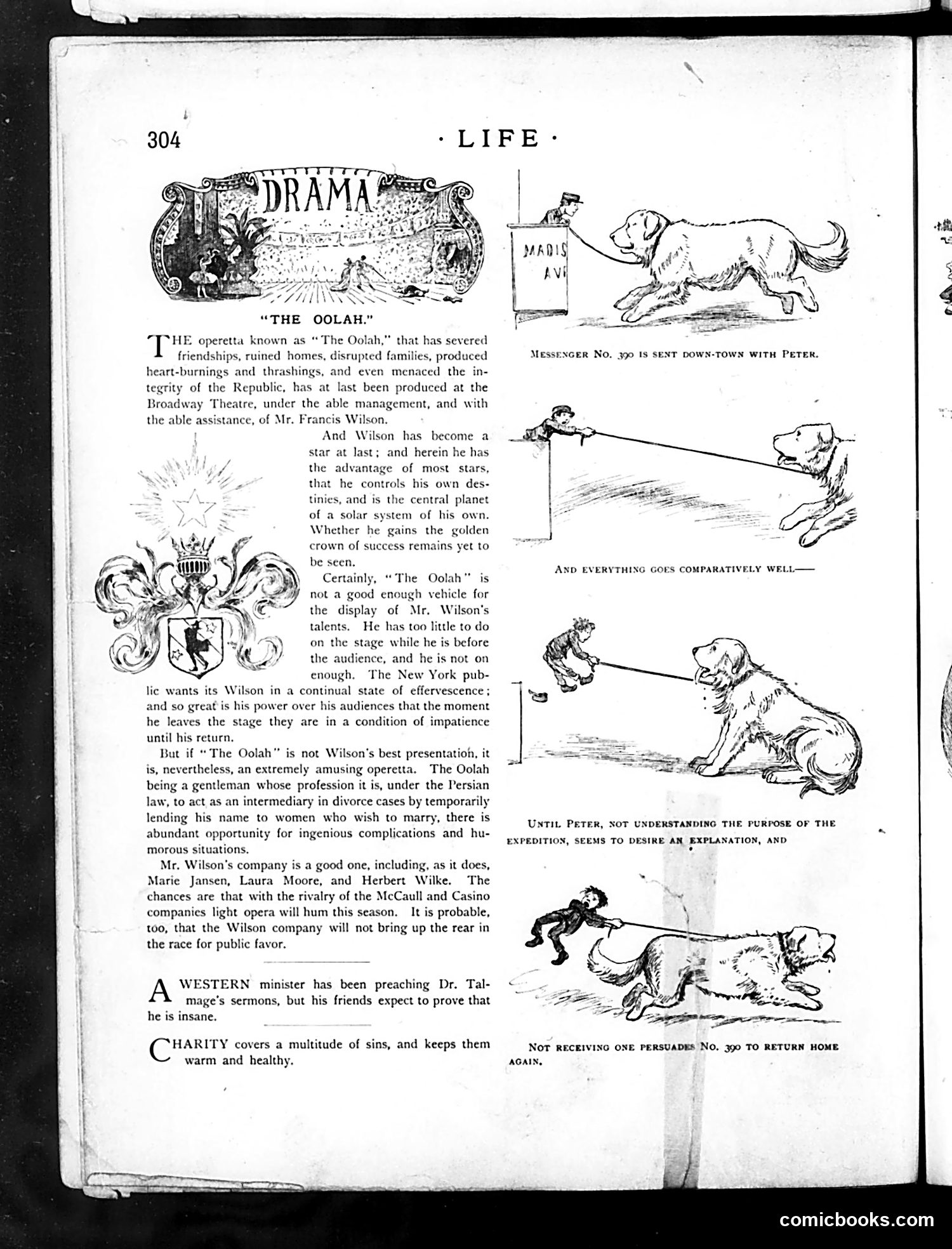
This Life magazine page reviews Francis Wilson's new operetta "The Oolah," which satirizes a Persian legal intermediary who lends his name to facilitate divorces. The text praises Wilson's star power while criticizing the operetta as an inadequate vehicle for his talents—he has too little stage time, leaving audiences impatient for his return. The right-side cartoon humorously depicts a messenger boy (No. 390, named Peter) sent downtown with a task. The sequential panels show Peter being pulled along by a dog, struggling to control the situation, and ultimately failing to return home as instructed—the dog's resistance thwarting his mission. The joke satirizes the unreliability of young messengers and the comic chaos that ensues when circumstances beyond one's control intervene.
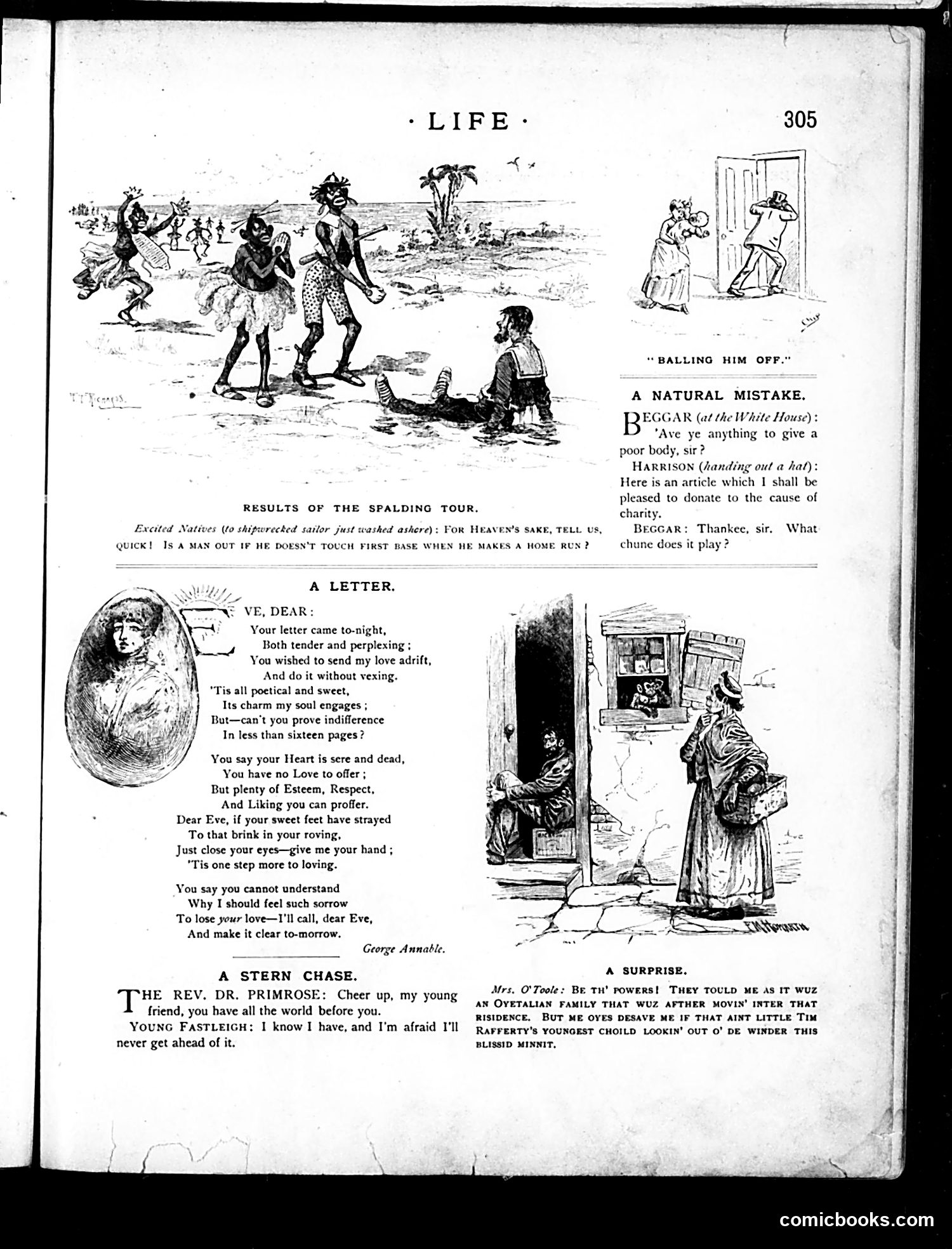
This page contains several unrelated satirical pieces typical of Life magazine's format: **"Balling Him Off"** mocks President Harrison's stingy charity—when a beggar asks for help, Harrison offers only an old hat, misunderstanding the request as literal begging rather than genuine need. **"Results of the Spalding Tour"** references Albert Spalding's 1888-1889 baseball world tour, making a joke about baseball rules to shipwrecked sailors unfamiliar with the sport. **"A Letter"** is sentimental poetry about romantic longing, unrelated to satire. **"A Stern Chase"** and **"A Surprise"** are brief comic dialogues—one involving a clergyman's advice to a young man, the other an Irish character's observation about Italian neighbors. The page primarily showcases Life's mix of political satire (Harrison), sports humor, poetry, and everyday comedic situations rather than unified commentary.
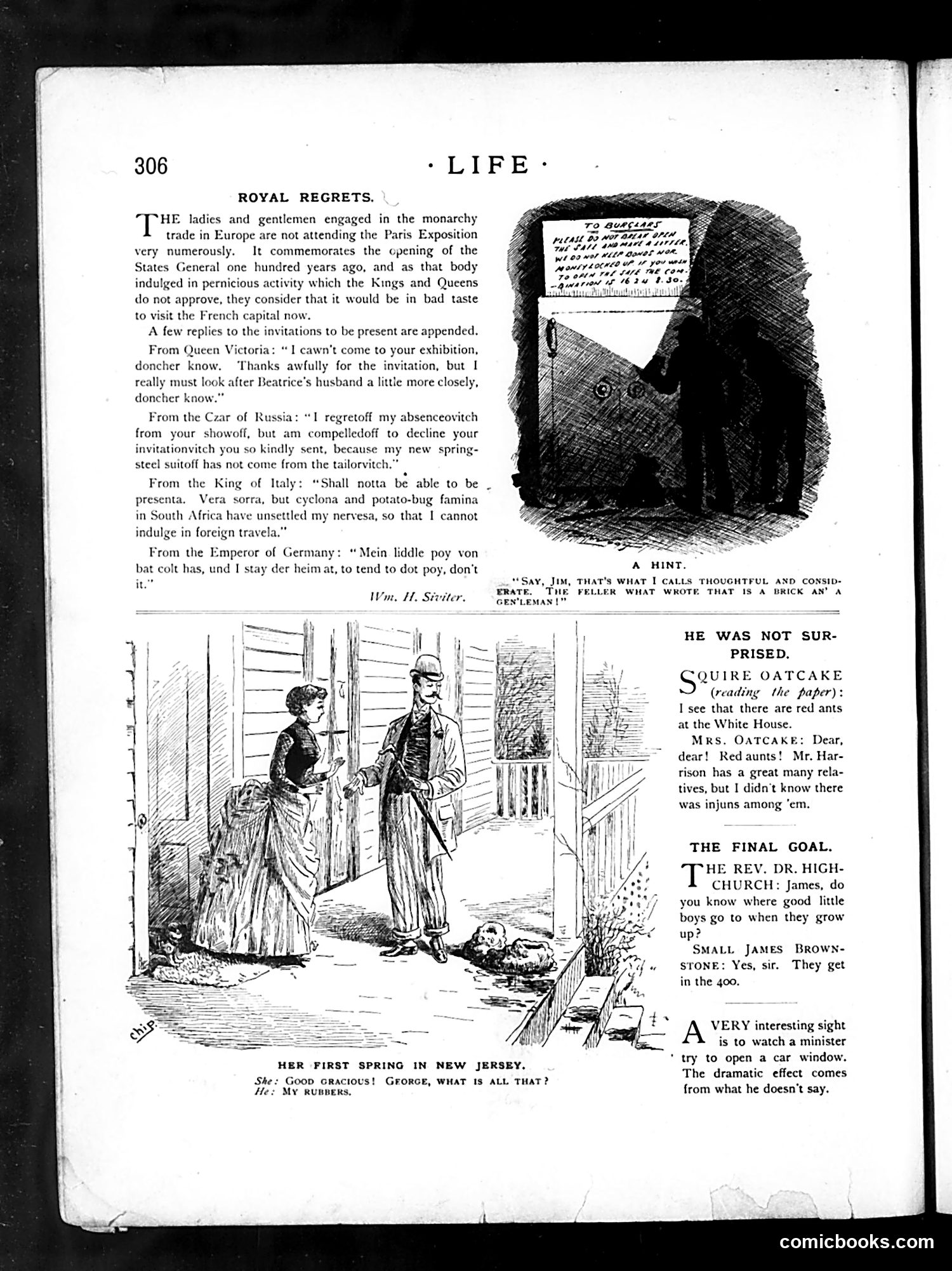
This satirical piece mocks European royalty's excuses for avoiding the 1889 Paris Exposition (which commemorated the French Revolution's centennial). The joke is that monarchs fear attending an event celebrating the overthrow of royal authority. The "replies" use exaggerated ethnic caricatures and mock-foreign accents: - **Queen Victoria** uses affected British dialect, citing domestic duties - **The Russian Czar** employs Russian-inflected English ("absenceovitch," "tailorvitch") - **The King of Italy** offers absurd excuses (potato-bug famine in South Africa) - **The German Emperor** misspells and mangles English, claiming his sick child needs tending The page's secondary cartoons employ class humor and puns unrelated to the main satire. The satire's core point: European monarchies were genuinely uncomfortable celebrating revolutionary ideals that threatened their power.
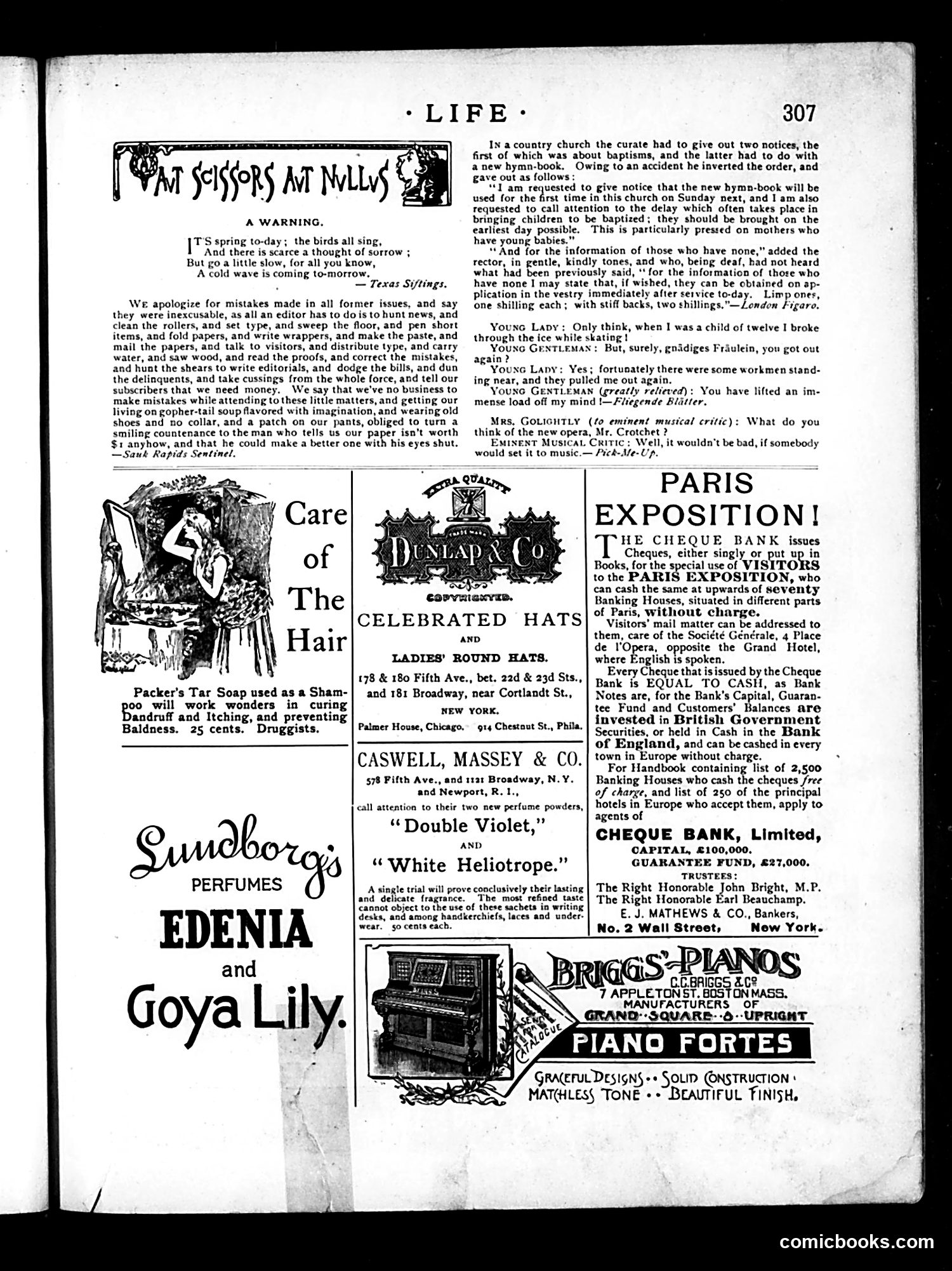
This page is primarily **advertising and humor columns** rather than political cartoons. The title "At Scissors at Nullus" refers to the magazine's editorial practice of cutting and rejecting submissions. The main content includes: 1. **An editor's apology** (satirical) listing absurdly all the mundane tasks editors perform—hunting news, sweeping floors, folding papers, wearing patched pants—to humorously explain why mistakes happen despite their impossibility to excuse. 2. **Three humorous anecdotes** mocking social awkwardness: a clergyman accidentally mixing up baptism and hymn-book notices with absurd results; a young woman's skating accident rescue that relieves a gentleman; and a music critic's backhanded compliment about opera. 3. **Multiple period advertisements** for hats, perfumes, pianos, and financial services for Paris Exposition visitors. The humor is gentle, Victorian-era social comedy—not political satire. It reflects late 19th-century magazine culture emphasizing witty observations about everyday life and social etiquette.
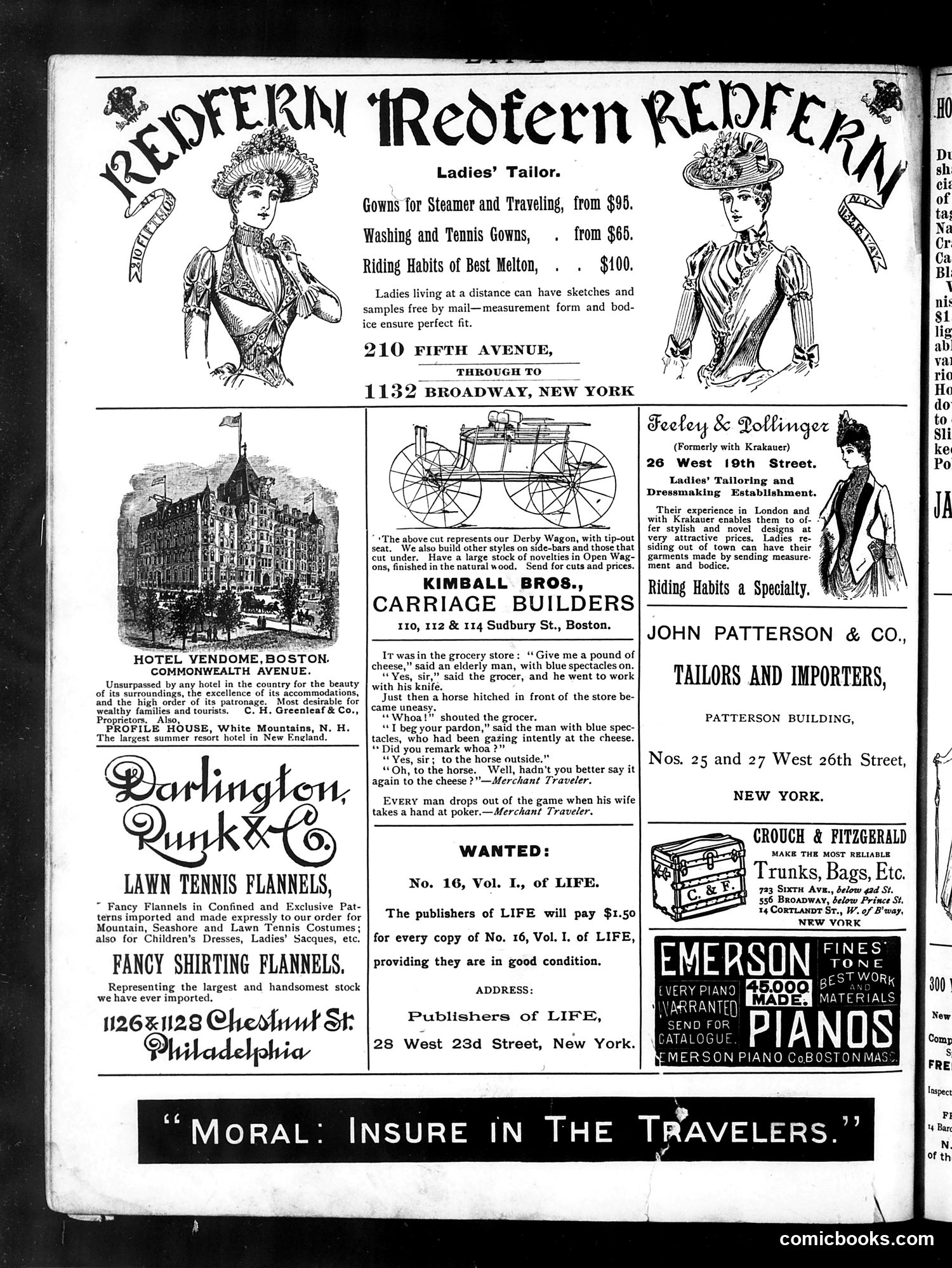
This is primarily an **advertising page**, not a political cartoon. It contains multiple commercial advertisements typical of a late 19th-century American magazine, including: - **Ladies' tailoring services** (Redfern, Feeley & Pöllinger, John Patterson & Co.) advertising riding habits, traveling gowns, and custom dressmaking - **Hotels** (Hotel Vendôme in Boston, Profile House in New Hampshire) - **Luxury goods** (lawn tennis flannels, carriages by Kimball Bros., trunks and bags) - **Pianos** (Emerson brand) The page includes two brief **humorous anecdotes** in the center, both from *Merchant Traveler* publication, making light jokes about grocers and poker—typical period humor unrelated to current events. The bottom features a moral message: "Insure in The Travelers"—an insurance advertisement. No political satire or caricature is present. This reflects the magazine's mix of satirical editorial content with commercial revenue sources.
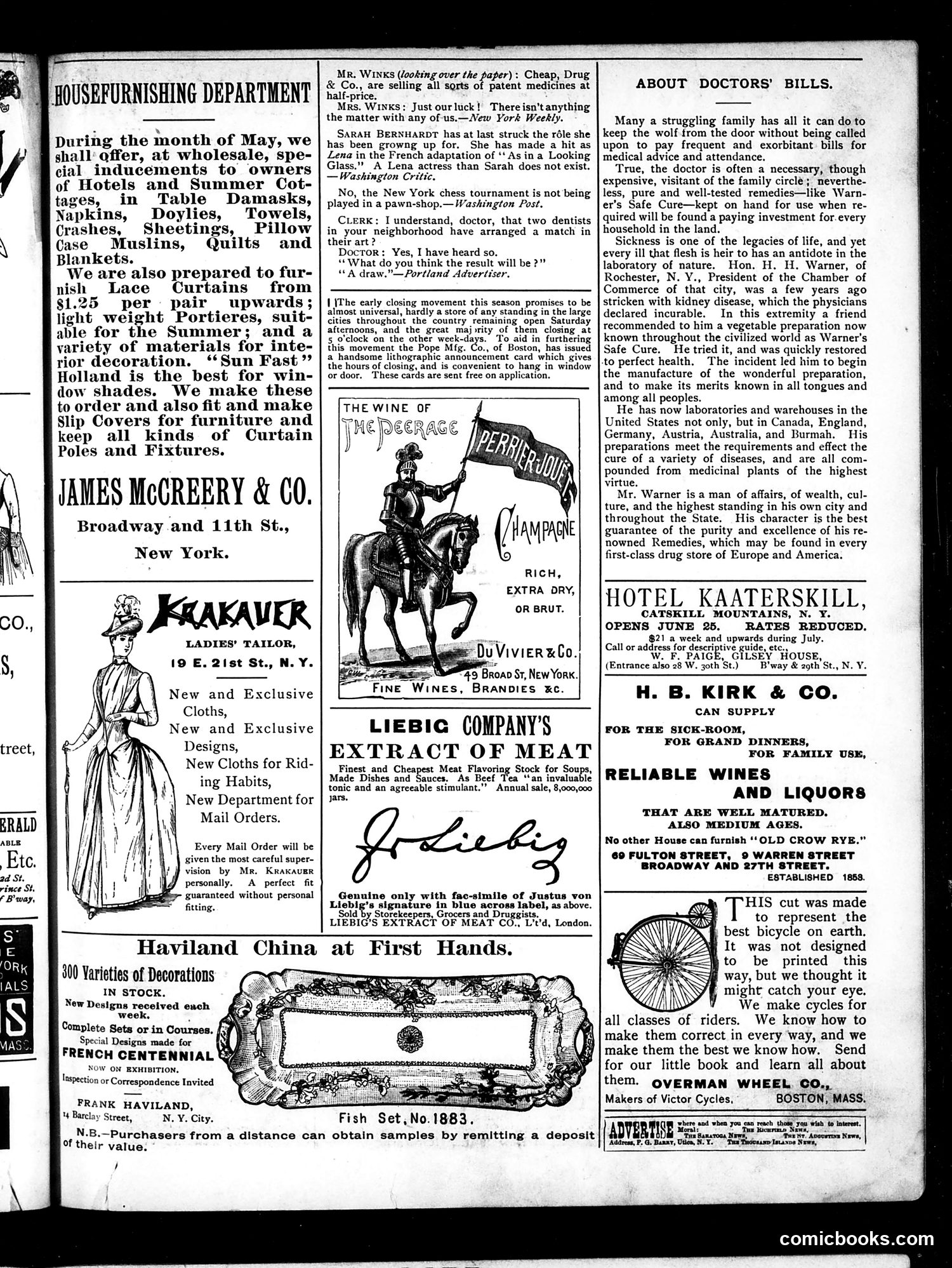
This page is primarily **advertisements** from a late-19th-century *Life* magazine, with brief comic items interspersed. The jokes are mild observations: Mr. and Mrs. Winks find it ironic that patent medicines are on sale when they're healthy; Sarah Bernhardt finally found a suitable role; a chess tournament isn't held in a pawn shop (wordplay); two dentists arranging a "match" will end in a "draw" (dental pun). The bulk of the page advertises household goods (James McCreery & Co.), fashionable clothing (Krakauer's Ladies' Tailor), fine china, wines and champagne, meat extract, and notably **Warner's Safe Cure**—a patent medicine claiming to treat kidney disease. The "About Doctors' Bills" section pitches Warner's Safe Cure as a cheaper alternative to expensive doctors, which was common advertising strategy of the era when medical costs were genuinely burdensome for families. The Overman bicycle advertisement appears at bottom right.
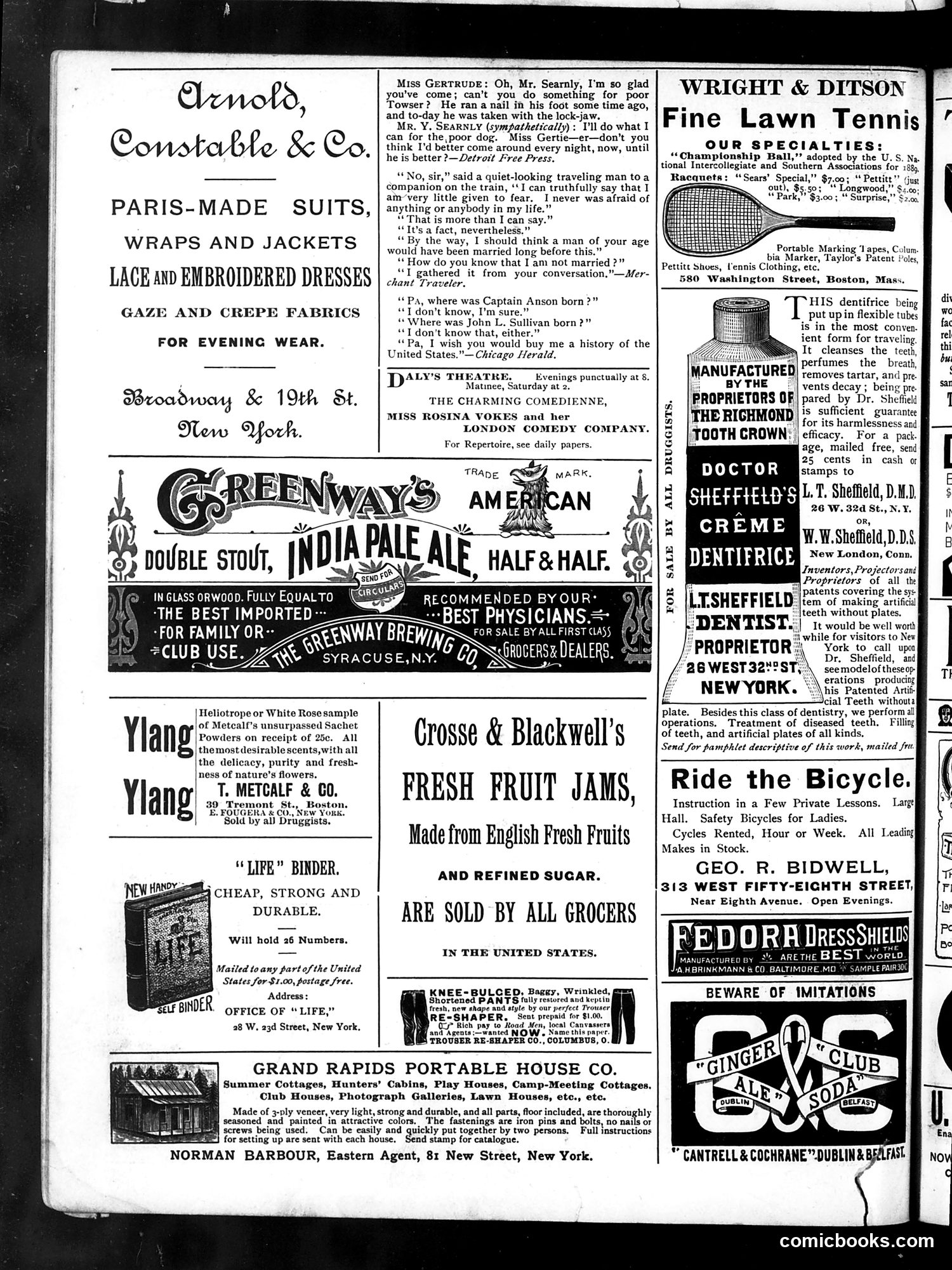
This page is predominantly **advertising**, typical of Life magazine's commercial content in the late 19th century. The small humor pieces are brief anecdotes rather than cartoons: 1. **"The Lock-Jaw" joke**: A young woman (Miss Gertie) asks a veterinarian (Mr. Searnly) to treat her dog's lockjaw. He suggests visiting nightly until the dog recovers—a transparent excuse to court her. The satire mocks transparent romantic scheming disguised as professional concern. 2. **"The Fearless Traveler"**: A man claims he's never been afraid, but admits he's also never married. The joke: he's avoiding commitment despite claiming fearlessness—humorous contradiction. 3. **"History of the United States"**: A boy asks his father about famous people's birthplaces; the father knows nothing, so the boy wants to buy a history book. Light satire on paternal ignorance and the value of education. These are gentle, domestic humor pieces typical of the era, requiring no specialized historical knowledge beyond understanding Victorian-era courting conventions.
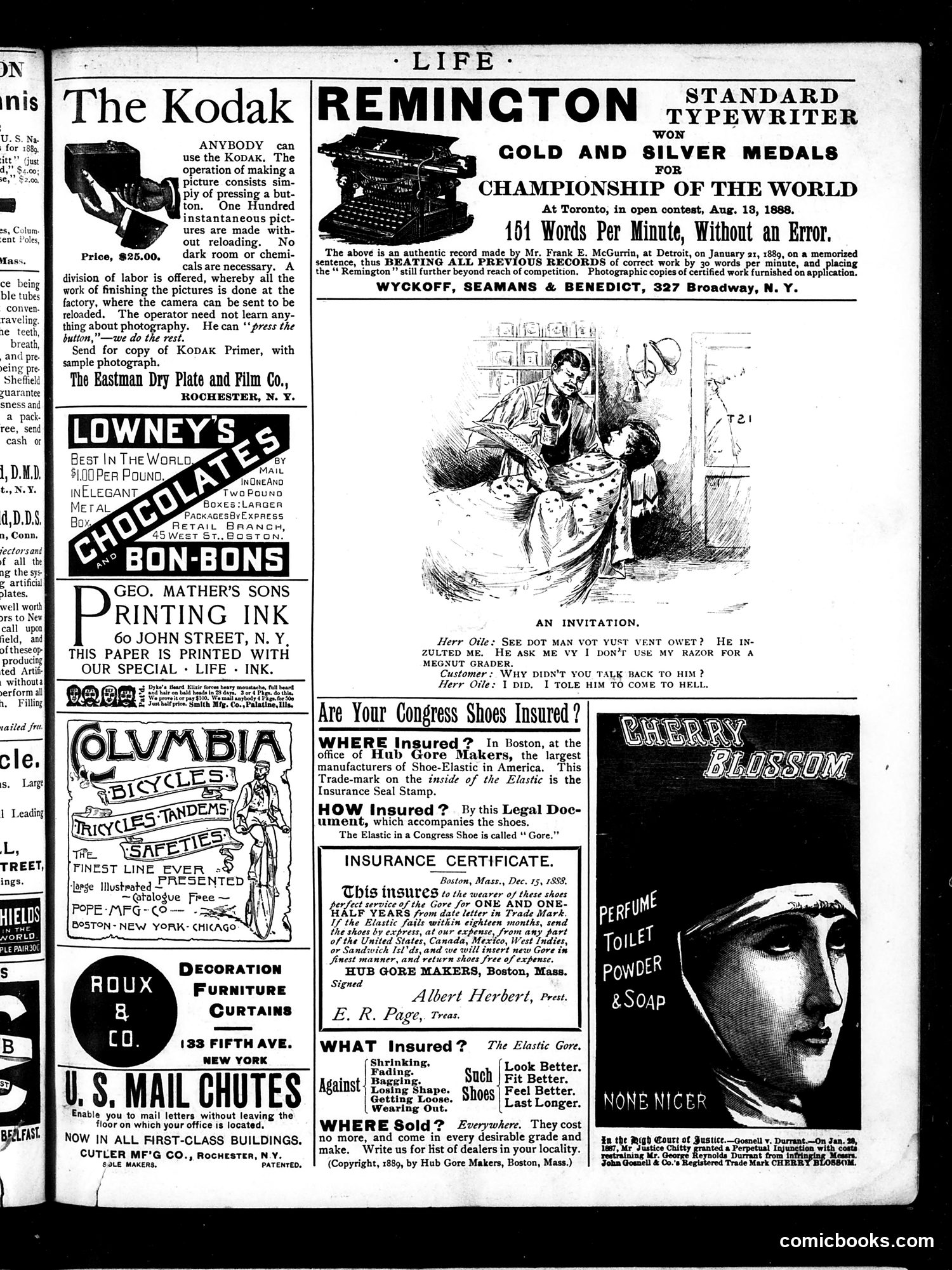
This page is primarily **advertising**, with one small cartoon illustrating a product pitch. The cartoon titled "An Invitation" depicts a German immigrant (identifiable by the dialect spelling: "Herr Otle," "VoT," "VY") confronting another man who insulted him. When asked why he didn't talk back, Herr Otle responds he told the man to "come to hell"—a mild joke playing on the German immigrant's accent and perceived meekness. The page showcases late-1880s consumer goods: Kodak cameras (emphasizing ease-of-use for amateurs), Remington typewriters (advertising a world championship speed record of 151 words per minute), Lowney's chocolates, Columbia bicycles, and Congress Shoes with elastic "Gore" (featuring an insurance certificate guaranteeing the elastic's durability). The ads reflect growing American consumer culture and mass marketing techniques, targeting middle-class readers with convenience and quality assurances. The immigrant stereotype in the cartoon was typical contemporary humor for Life's audience.
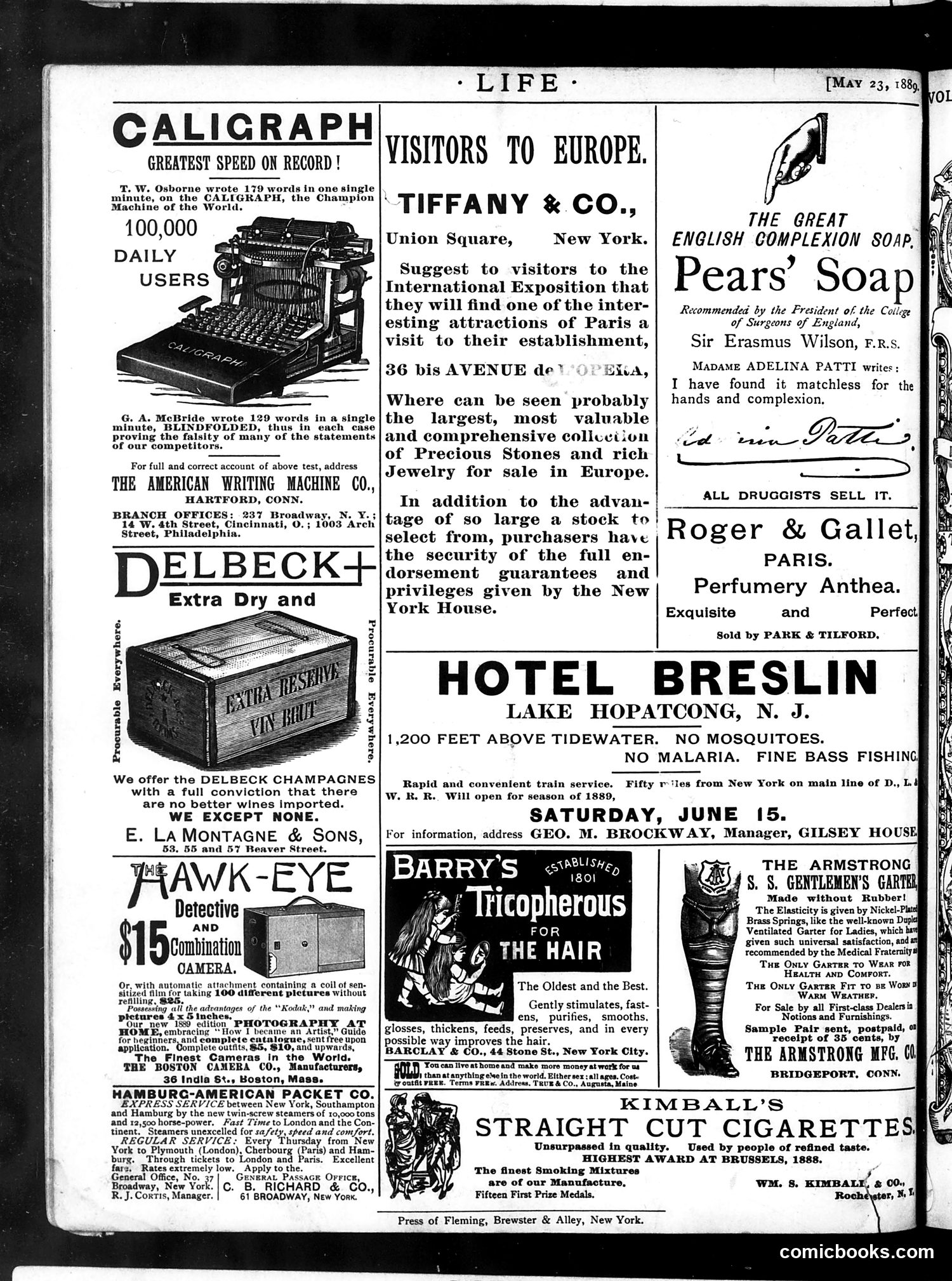
This Life magazine page (May 23, 1888) contains no political cartoons or satirical content to analyze. Instead, it consists entirely of commercial advertisements typical of the era. The ads promote: typewriters (Caligraph, marketing speed records), champagne (Delbeck), jewelry (Tiffany & Co.), soap (Pears'), a resort hotel in Lake Hopatcong, cameras (Hawk-Eye Detective Camera), cigars, garters, hair products, and steamship passage to Europe. The only notable satirical element is subtle: the Caligraph ad emphasizes that one typist worked "blindfolded," sarcastically casting doubt on competitors' claims—a common 19th-century advertising tactic. Otherwise, this is a straightforward commercial page showing what products and services were marketed to readers in 1888.