
Life, 1889-05-23 · page 6 of 20
Life — May 23, 1889 — page 6: what you’re looking at
What you’re looking at
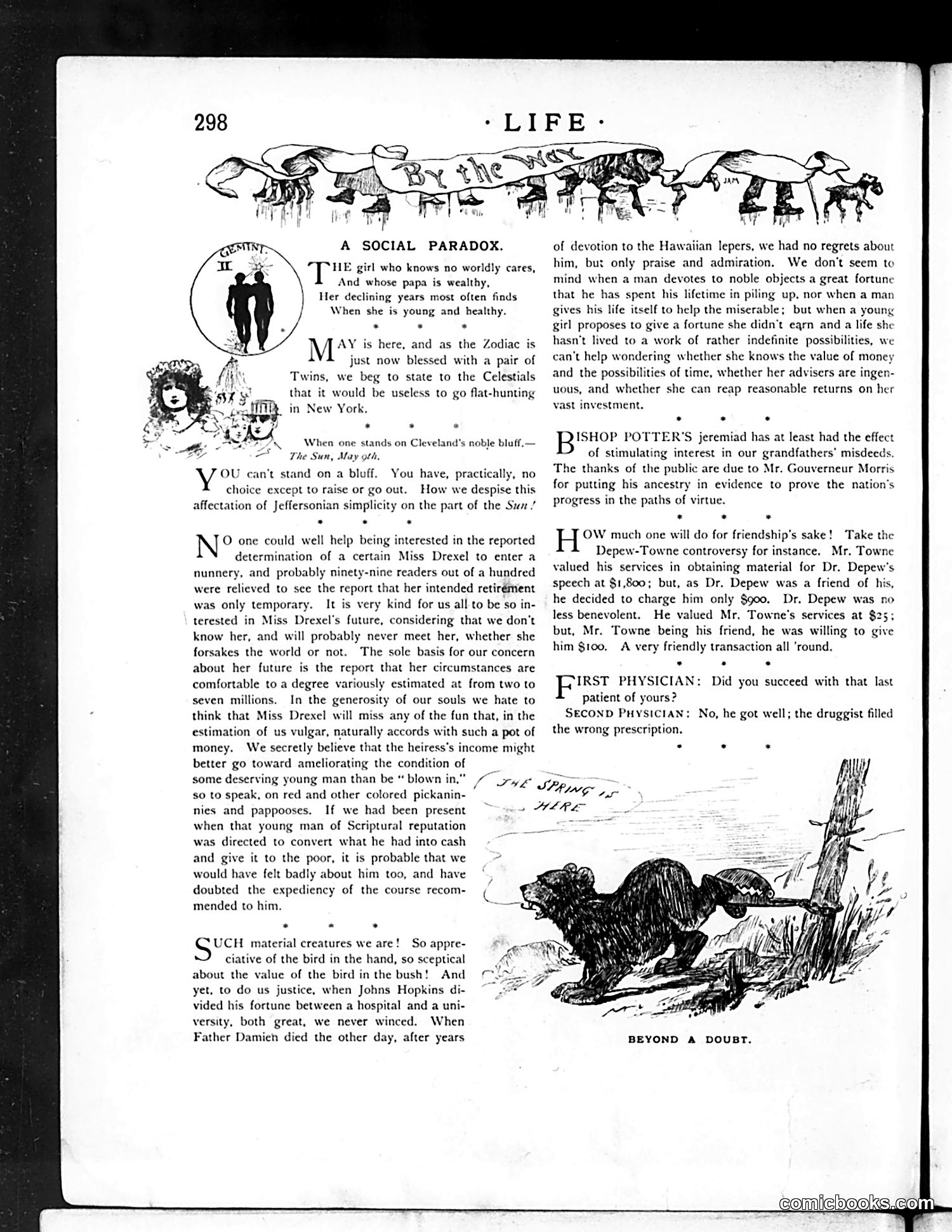
This satirical piece criticizes the contradiction of wealthy young women marrying for love while their fathers are willing to sell family fortunes. The "social paradox" title refers to the tension between romantic ideals and financial realism among the upper class. The circular vignette shows a wealthy couple, likely referencing specific society figures of the era. The text mocks Miss Drexel's reported retirement plans—suggesting skepticism about her commitment given her substantial inheritance. The accompanying anecdotes (Dr. Depew, the physicians' joke) serve as satirical examples of how the wealthy rationalize their contradictory behaviors and self-interested decisions. The illustration "Beyond a Doubt" depicts a dog or similar creature, likely a visual pun commenting on faithlessness or unreliability in these social arrangements.
📄 Transcribed text from this page (OCR, searchable)
Machine-transcribed from the original scan — historical spelling and the odd misread are preserved.
A SOCIAL PARADOX. HE girl who knows no worldly cares, And whose papa is wealthy, Her declining years most often finds When she is young and healthy. M** is here, and as the Zodiac is i just now blessed with a pair of Twins, we beg to state to the Celestials that it would be useless to go flat-hunting g Si. in New York. When one stands on Cleveland's noble bluff. — =" The Sun, May oth. OU can’t stand on a bluff. choice except to raise or go out. affectation of Jeffersonian simplicity on the part of the Si! You have, practically, no How we despise this O one could well help being interested in the reported determination of a certain Miss Drexel to enter a nunnery, and probably ninety-nine readers out of a hundred were relieved to sce the report that her intended retirément was only temporary. It is very kind for us all to be so in- terested in Miss Drexel’s future, considering that we don't know her, and will probably never meet her, whether she forsakes the world or not. The sole basis for our concern about her future is the report that her circumstances are comfortable to a degree variously estimated at from two to seven millions. In the generosity of our souls we hate to think that Miss Drexel will miss any of the fun that, in the estimation of us vulgar, naturally accords with such a pot of money. We secretly believe that the heiress’s income might better go toward ameliorating the condition of some deserving young man than be “ blown in,” so to speak, on red and other colored pickanin- nies and pappooses. If we had been present when that young man of Scriptural reputation was directed to convert what he had into cash and give it to the poor, it is probable that we would have felt badly about him too, and have doubted the expediency of the course recom- mended to him. . “ . ~UCH material creatures we are! So appre- ciative of the bird in the hand, so sceptical about the value of the bird in the bus! And yet, to do us justice, when Johns Hopkins di- vided his fortune between a hospital and a uni- versity, both great, we never winced. When Father Damien died the other day, after years of devotion to the Hawaiian lepers, we had no regrets about him, but only praise and admiration. We don’t seem to mind when a man devotes to noble objects a great fortune spent his lifetime in piling up, nor when a man gives his life itself to help the miserable; but when a young girl proposes to give a fortune she didn’t earn and a life she hasn’t lived to a work of rather indefinite possibilities, we can't help wondering whether she knows the value of money and the possibilities of time, whether her advisers are ingen- uous, and whether she can reap reasonable returns on her vast investment. . . . ISHOP POTTER'S jeremiad has at least had the effect of stimulating interest in our grandfathers’ misdeeds. The thanks of the public are due to Mr. Gouverneur Morris for putting his ancestry in evidence to prove the nation’s progress in the paths of virtue. . . . OW much one will do for friendship’s sake! Take the Depew-Towne controversy for instance. Mr. Towne valued his services in obtaining material for Dr. Depew's speech at $1,800; but, as Dr. Depew was a friend of his, he decided to charge him only $900. Dr. Depew was no less benevolent. He valued Mr. Towne’s services at $: but, Mr. Towne being his friend, he was willing to give him $100. A very friendly transaction all ‘round. . . . IRST PHYSICIAN: Did you succeed with that last patient of yours? SECOND PHYSICIAN: No, he got well; the druggist filled the wrong prescription, [SIE SPhig a a WLR LE BEYOND A DOUBT.