
Life, 1889-05-23 · page 8 of 20
Life — May 23, 1889 — page 8: what you’re looking at
What you’re looking at
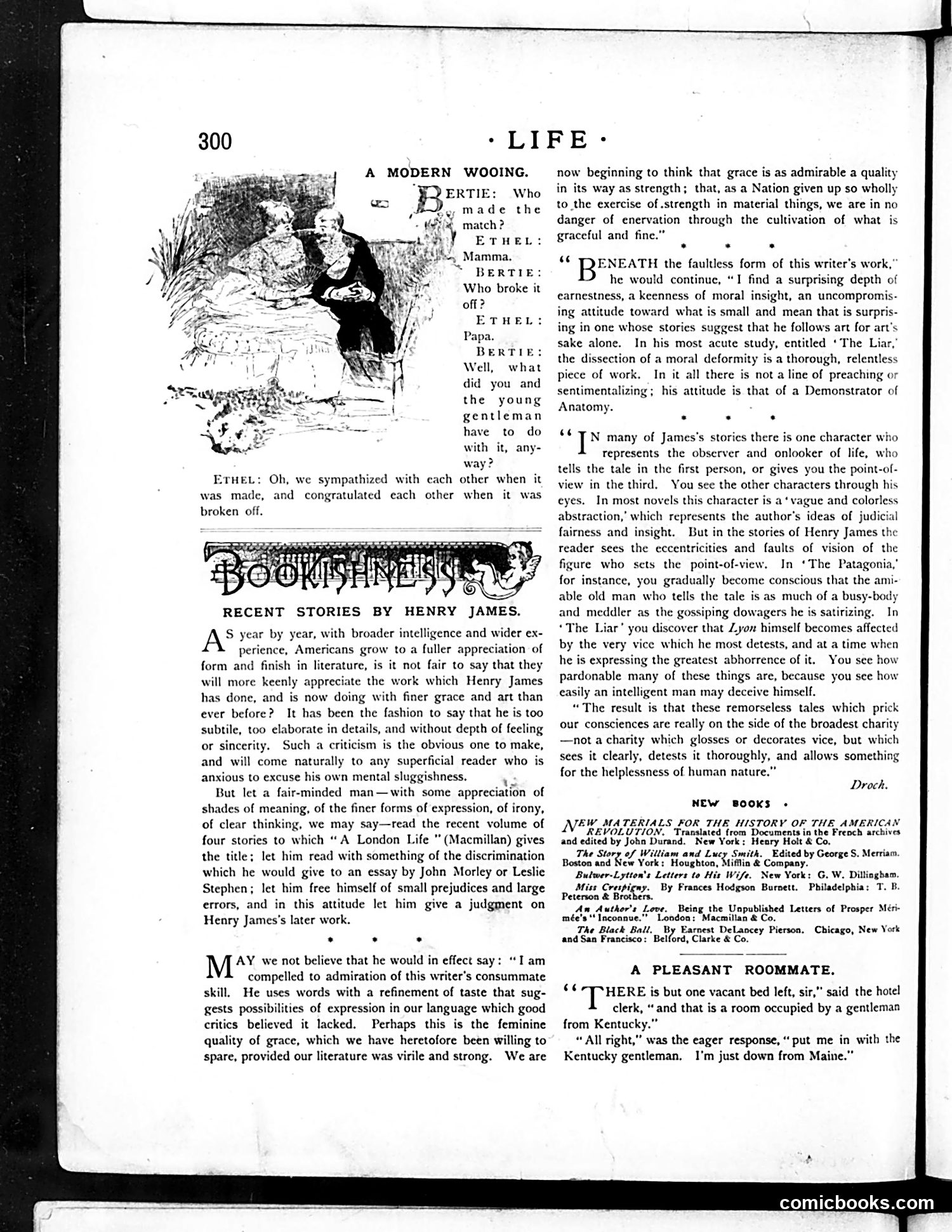
The cartoon titled "A Modern Wooing" depicts a social interaction between a young gentleman and a woman, with two older figures (labeled "Mama" and "Papa") observing. The sketch satirizes courtship rituals of the era—specifically the formal, chaperoned nature of romantic encounters among the upper classes. The humor appears to rest on the awkward formality of the scene: the young man seems stiff or uncomfortable, while parental figures maintain strict oversight. This mocks the rigid social conventions surrounding courtship, where young people had little private interaction and romantic advances required parental approval and presence. The page also contains literary criticism of Henry James's recent story collections, praising his moral insight and character development—unrelated to the cartoon's social satire about dating customs.
📄 Transcribed text from this page (OCR, searchable)
Machine-transcribed from the original scan — historical spelling and the odd misread are preserved.
* LIFE: ERTIE: Who made the match ? ETHEL: Mamma, BERTIE: Who broke it off ? ETHEL: Papa. BERTIE: Well, what did you and the young gentleman have to do with it, any- way? ETHEL: Oh, we sympathized with cach other when it was made, and congratulated cach other when it was broken off. RECENT STORIES BY HENRY JAMES. S year by year, with broader intelligence and wider ex- perience, Americans grow to a fuller appreciation of form and finish in literature, is it not fair to say that they will more keenly appreciate the work which Henry James has done, and is now doing with finer grace and art than ever before? It has been the fashion to say that he is too subtile, too elaborate in details, and without depth of feeling or sincerity, Such a criticism is the obvious one to make, and will come naturally to any superficial reader who is anxious to excuse his own mental sluggishness, But let a fair-minded man—with some appreciation of shades of meaning, of the finer forms of expression, of irony, of clear thinking, we may say—read the recent volume of four stories to which “ A London Life " (Macmillan) gives the title; let him read with something of the discrimination which he would give to an essay by John Morley or Leslie Stephen; let him free himself of small prejudices and large errors, and in this attitude let him give a judgment on Henry James's later work. * . . M** we not believe that he would in effect say: “I am compelled to admiration of this writer's consummate skill. He uses words with a refinement of taste that sug- gests possibilities of expression in our language which good critics believed it lacked. Perhaps this is the feminine quality of grace, which we have heretofore been willing to spare, provided our literature was virile and strong. We are now beginning to think that grace is as admirable a quality in its way as strength; that, as a Nation given up so wholly to the exercise of strength in material things, we are in no danger of enervation through the cultivation of what is graceful and fine.” . . . NEATH the faultless form of this writer's work,’ he would continue, “I find a surprising depth of stness, a keenness of moral insight, an uncompromis- ing attitude toward what is small and mean that is surpris- ing in one whose stories suggest that he follows art for art's sake alone. In his most acute study, entitled ‘The Liar,’ the dissection of a moral deformity is a thorough, relentless piece of work. In it all there is not a line of preaching or sentimentalizing ; his attitude is that of a Demonstrator of Anatomy. ‘© TN many of James's stories there is one character who represents the observer and onlooker of life, who tells the tale in the first person, or gives you the point-of- view in the third, You see the other characters through his eyes. In most novels this character is a‘ vague and colorless abstraction,’ which represents the author's ideas of judicial fairness and insight. But in the stories of Henry James the reader sees the eccentricities and faults of vision of the figure who sets the point-of-view. In ‘The Patagonia, for instance, you gradually become conscious that the ami- able old man who tells the tale is as much of a busy-body and meddler as the gossiping dowagers he is satirizing. In ‘The Liar’ you discover that Lyon himself becomes affected by the very vice which he most detests, and at a time when he is expressing the greatest abhorrence of it, You see how pardonable many of these things are, because you see how easily an intelligent man may deceive himself. “The result is that these remorseless tales which prick our consciences are really on the side of the broadest charity —not a charity which glosses or decorates vice, but which sees it clearly, detests it thoroughly, and allows something for the helplessness of human nature.” Droch. NEW BOOKS - NEW, MATERIALS FOR THE HISTORY OF THE AMERICAN REVOLUTION, Translated from Documents in the French archives and edited by John Durand. New York: Heary Holt & Co. The Story of William and Lucy Smith. Edited by George S. Merriam. Boston and New York: Houghton, Miffia & Company. Bulwer-Lytton's Letters to His Wife. New York: G. W. Dillingham. Miss Crapicny. By Frances Hodgson Burnett. Philadelphia: T. B. Peterson & Brothers. Author's Love. Being the Unpublished Letters of Prosper Méri- mée’s *Inconnue.” London: Macmillan & Co. The Black Ball, By Earnest DeLancey Pierson, Chicago, New York and San Francisco: Belford, Clarke & Co. A PLEASANT ROOMMATE. as HERE is but one vacant bed left, sir,” said the hotel clerk, “and that is a room occupied by a gentleman from Kentucky. “ All right,” was the eager response, “put me in with the Kentucky gentleman, I'm just down from Maine.” comicbooks.com