
Life, 1889-05-23 · page 4 of 20
Life — May 23, 1889 — page 4: what you’re looking at
What you’re looking at
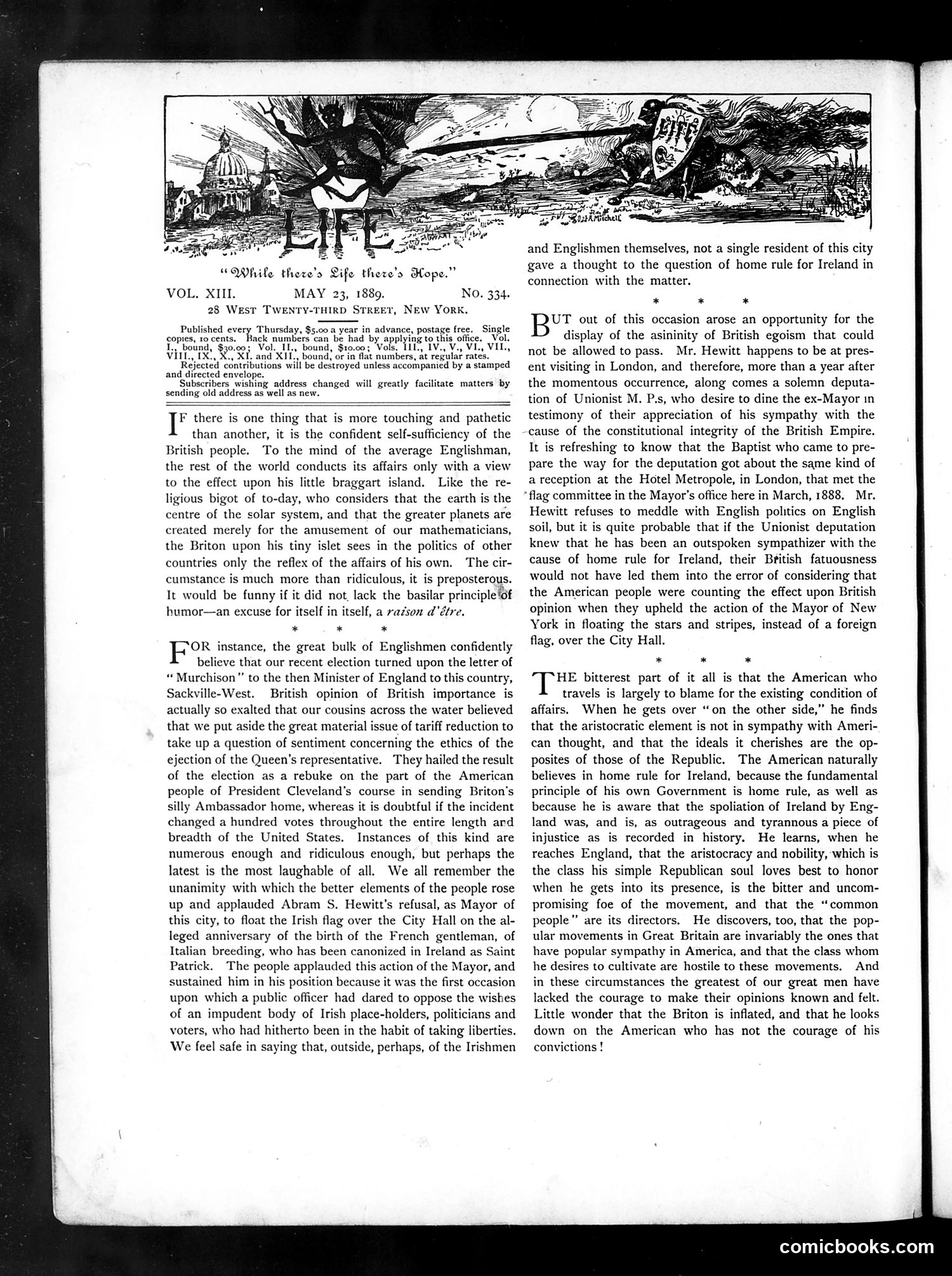
**The Cartoon:** The masthead illustration titled "While there's Life there's Hope" depicts a skeletal figure (Death) confronting a robust man representing Life/vitality, set against a European cityscape. **The Article's Focus:** The text discusses British egoism and the visit of an unnamed American (likely Mayor Gould of New York, based on context) to London. The piece criticizes how British society dismissed Irish home rule concerns while celebrating their own political importance. **Key Satire:** The article mocks British presumption that their affairs matter globally, while they ignore Irish independence movements. It notes Americans were struck by British indifference to these issues, highlighting the hypocrisy of a nation claiming democratic principles while opposing Irish self-determination. The cartoon's "Life vs. Death" theme appears to reference broader vitality and decline metaphorically.
📄 Transcribed text from this page (OCR, searchable)
Machine-transcribed from the original scan — historical spelling and the odd misread are preserved.
“While there's Life there's Hope.” VOL. XIII. MAY 23, 1889. 28 West TWENTY-THIRD STREET, New York. Published ever copies, 10 cents. ‘Thursday, $5.00 a year in advance, postage free. Single Back numbers can be had by applying to this office. Vol. I, bound, $30.00; Vol. Il., bound, $10.00; Vols: Ills, 1V., V., Vix VIL., VILL, IX., X., XI. and X11, bound, or in flat numbers, at regular rates. Rejected contributions will be destroyed unless accompanied by a stamped and directed envelop Subscribers wishing address changed will greatly facilitate matters by sending old address as well as new. F there is one thing that is more touching and pathetic than another, it is the confident self-sufficiency of the British people. To the mind of the average Englishman, the rest of the world conducts its affairs only with a view to the effect upon his little braggart island. Like the re- ligious bigot of to-day, who considers that the earth is the centre of the solar system, and that the greater planets are created merely for the amusement of our mathematicians, the Briton upon his tiny islet sees in the politics of other countries only the reflex of the affairs of his own. The cir- cumstance is much more than ridiculous, it is preposterous. It would be funny if it did not, lack the basilar principle ‘of humor—an excuse for itself in itself, a razson d'étre. * * * OR instance, the great bulk of Englishmen confidently believe that our recent election turned upon the letter of “Murchison” to the then Minister of England to this country, Sackville-West. British opinion of British importance is actually so exalted that our cousins across the water believed that we put aside the great material issue of tariff reduction to take up a question of sentiment concerning the ethics of the ejection of the Queen's representative. They hailed the result of the election as a rebuke on the part of the American people of President Cleveland’s course in sending Briton’s silly Ambassador home, whereas it is doubtful if the incident changed a hundred votes throughout the entire length ard breadth of the United States. Instances of this kind are numerous enough and ridiculous enough, but perhaps the latest is the most laughable of all. We all remember the unanimity with which the better elements of the people rose up and applauded Abram S. Hewitt’s refusal, as Mayor of this city, to float the Irish flag over the City Hall on the al- leged anniversary of the birth of the French gentleman, of Italian breeding, who has been canonized in Ireland as Saint Patrick. The people applauded this action of the Mayor, and sustained him in his position because it was the first occasion upon which a public officer had dared to oppose the wishes of an impudent body of Irish place-holders, politicians and voters, who had hitherto been in the habit of taking liberties. We feel safe in saying that, outside, perhaps, of the Irishmen gs PS Fg bat Be Riakiitat and Englishmen themselves, not a single resident of this city gave a thought to the question of home rule for Ireland in connection with the matter. * * * UT out of this occasion arose an opportunity for the display of the asininity of British egoism that could not be allowed to pass. Mr. Hewitt happens to be at pres- ent visiting in London, and therefore, more than a year after the momentous occurrence, along comes a solemn deputa- tion of Unionist M. P.s, who desire to dine the ex-Mayor in testimony of their appreciation of his sympathy with the cause of the constitutional integrity of the British Empire. It is refreshing to know that the Baptist who came to pre- pare the way for the deputation got about the same kind of a reception at the Hotel Metropole, in London, that met the * flag committee in the Mayor's office here in March, 1888, Mr. Hewitt refuses to meddle with English politics on English soil, but it is quite probable that if the Unionist deputation knew that he has been an outspoken sympathizer with the cause of home rule for Ireland, their British fatuousness would not have led them into the error of considering that the American people were counting the effect upon British opinion when they upheld the action of the Mayor of New York in floating the stars and stripes, instead of a foreign flag, over the City Hall. * * * HE bitterest part of it all is that the American who travels is largely to blame for the existing condition of affairs. When he gets over “on the other side,” he finds that the aristocratic element is not in sympathy with Ameri- can thought, and that the ideals it cherishes are the op- posites of those of the Republic. The American naturally believes in home rule for Ireland, because the fundamental principle of his own Government is home rule, as well as because he is aware that the spoliation of Ireland by Eng- land was, and is, as outrageous and tyrannous a piece of injustice as is recorded in history. He learns, when he reaches England, that the aristocracy and nobility, which is the class his simple Republican soul loves best to honor when he gets into its presence, is the bitter and uncom- promising foe of the movement, and that the “common people” are its directors. He discovers, too, that the pop- ular movements in Great Britain are invariably the ones that have popular sympathy in America, and that the class whom he desires to cultivate are hostile to these movements. And in these circumstances the greatest of our great men have lacked the courage to make their opinions known and felt. Little wonder that the Briton is inflated, and that he looks down on the American who has not the courage of his convictions ! comicbooks.com