
A complete issue · 18 pages · 1889
Life — January 31, 1889
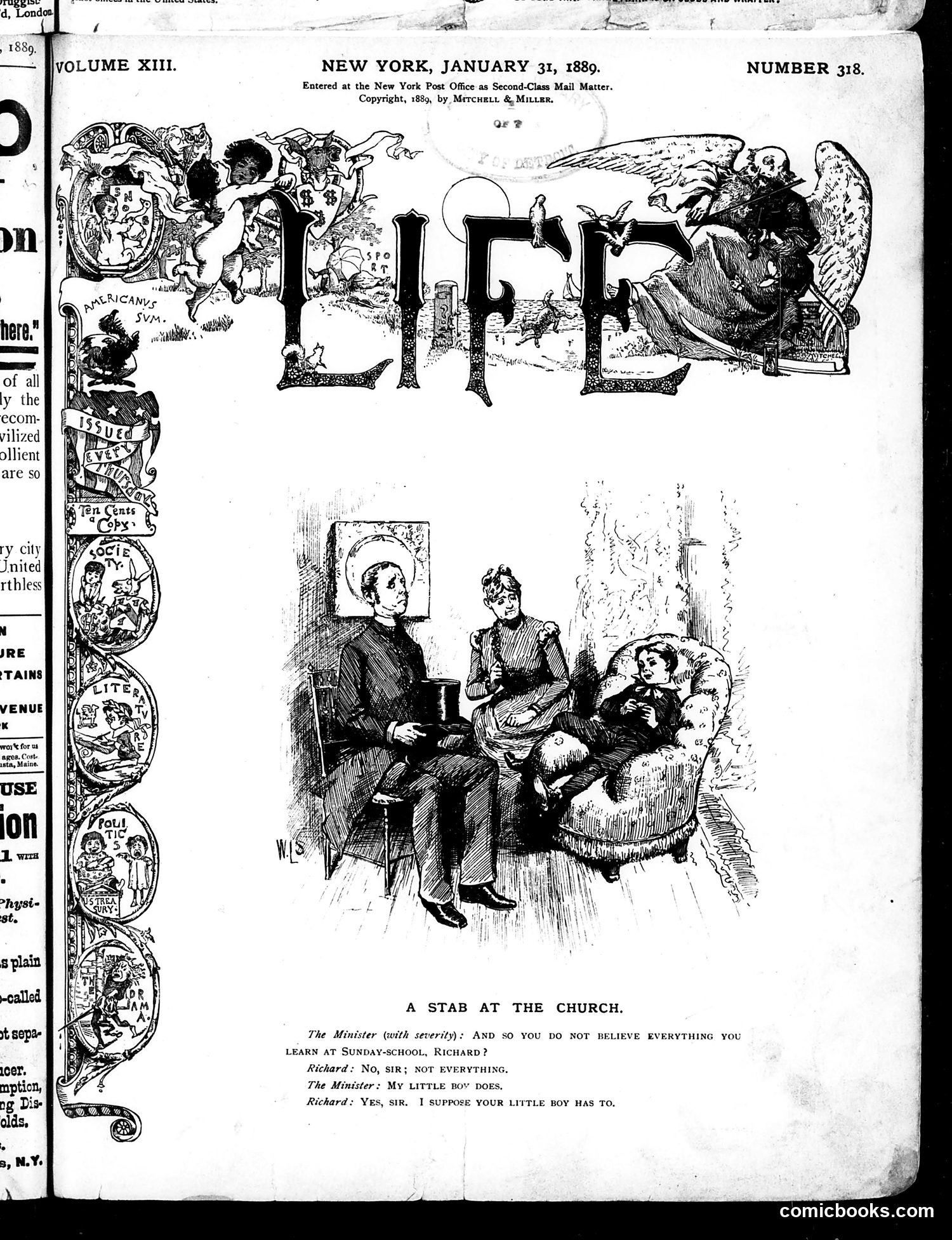
This cartoon satirizes religious instruction in Sunday schools. A minister, speaking "with severity," questions a boy named Richard about whether he believes "everything you learn at Sunday-school." Richard frankly admits "not everything," prompting the minister to assert that surely the boy must believe what his parents teach him. The satire targets the perceived gap between religious doctrine taught in institutions and actual childhood skepticism. The title "A Stab at the Church" suggests Life magazine is critiquing how churches attempt to impose unquestioning faith on children, while the boy's honest answer exposes the unrealistic nature of that expectation. The humor lies in the child's candid admission that contradicts the authority figures' assumptions.
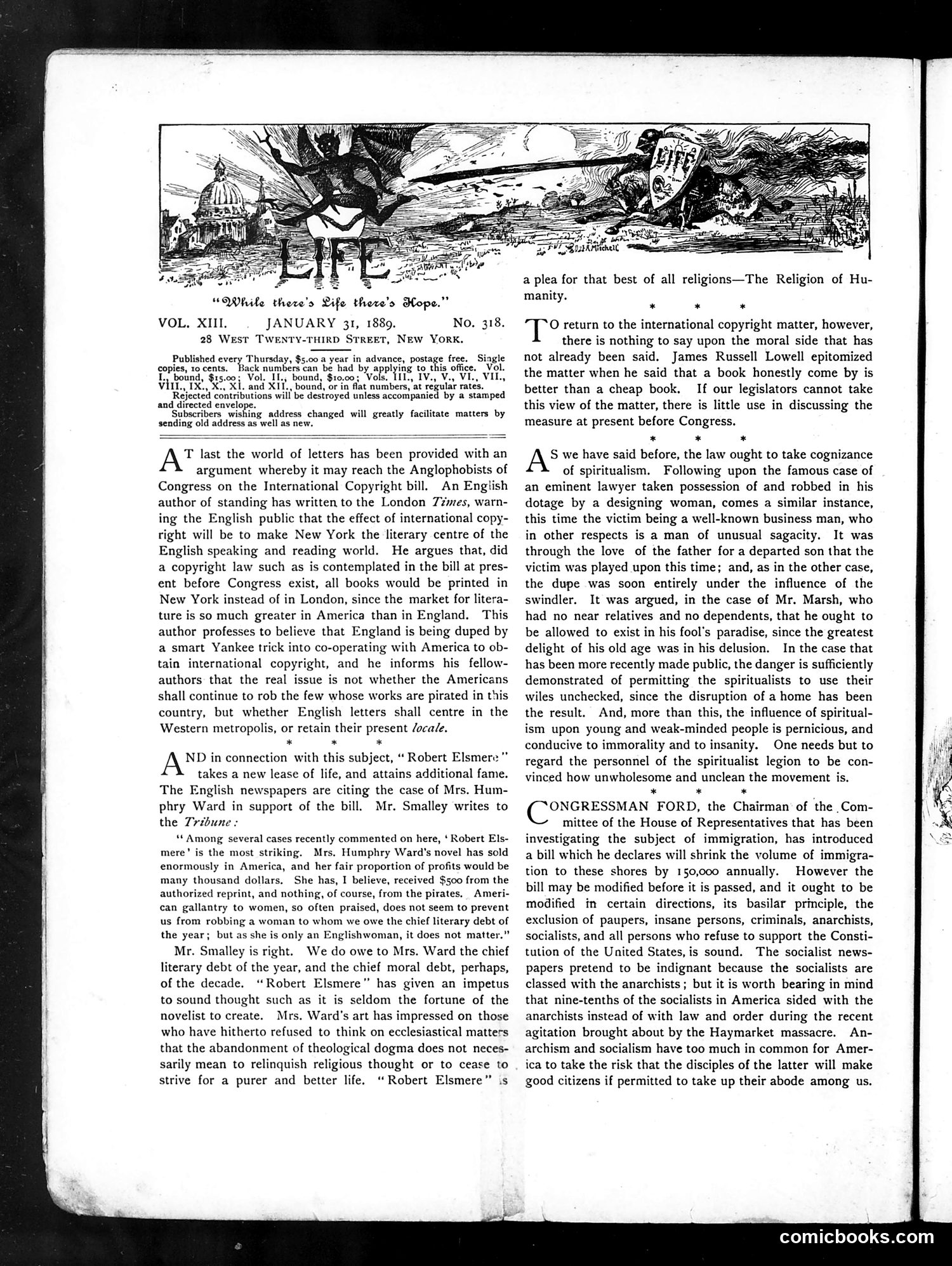
The header cartoon depicts a skeletal figure labeled "Life" sitting beneath a bare tree under moonlight, with the caption "While there's life there's Hope." This appears to be Life magazine's masthead illustration—a recurring artistic motif. The page's text discusses international copyright legislation before Congress. It argues that English authors' works should be printed in America rather than England, and mentions "Robert Elsmere" (a novel by Mrs. Humphry Ward) as a test case. The articles advocate for American literary independence while debating whether stricter copyright protections serve American interests. The final section addresses Congressman Ford's immigration bill, criticizing proposals to exclude "paupers, insane persons, criminals, anarchists, and all socialists" as overly broad and potentially dangerous to American society.
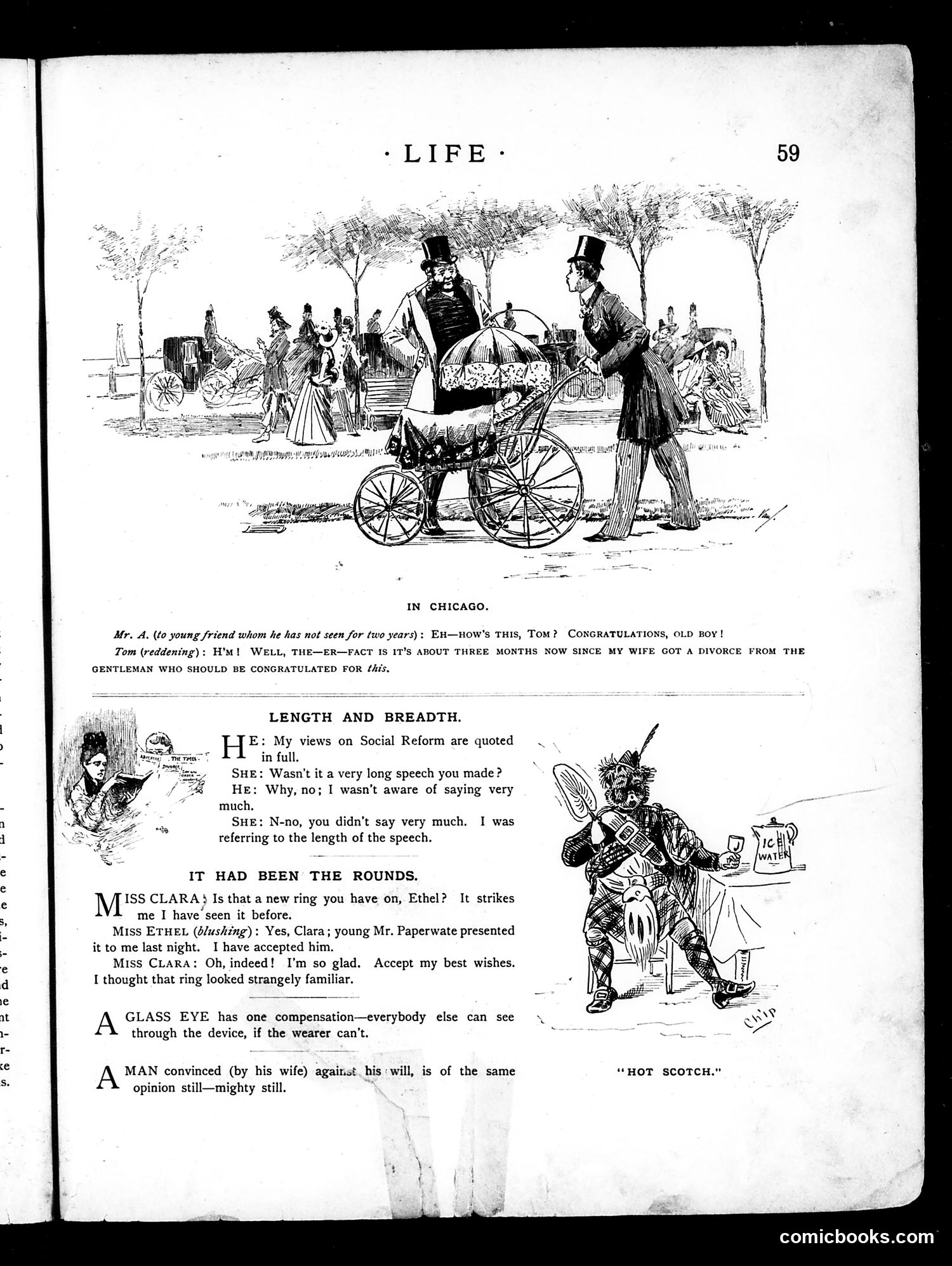
This page contains three separate satirical pieces from an early 20th-century American humor magazine: 1. **"In Chicago"** (top): A cartoon mocking a reunion between old friends, where one congratulates the other on his wife obtaining a divorce from "the gentleman who should be congratulated for this." The satire targets Chicago's reputation for easy divorces and suggests the divorced husband deserves congratulation rather than sympathy. 2. **"Length and Breadth"**: A brief dialogue satirizing pretentious intellectuals—a man's views on social reform are extensively quoted, yet he claims he "wasn't aware of saying very much," leading a woman to clarify she meant the *length* of his speech, not its substance. 3. **"It Had Been the Rounds"** and other short jokes: Quick quips about a woman's new ring, a glass eye's utility, and marital stubbornness. The page exemplifies *Life* magazine's focus on domestic humor and social satire targeting middle-class conventions.
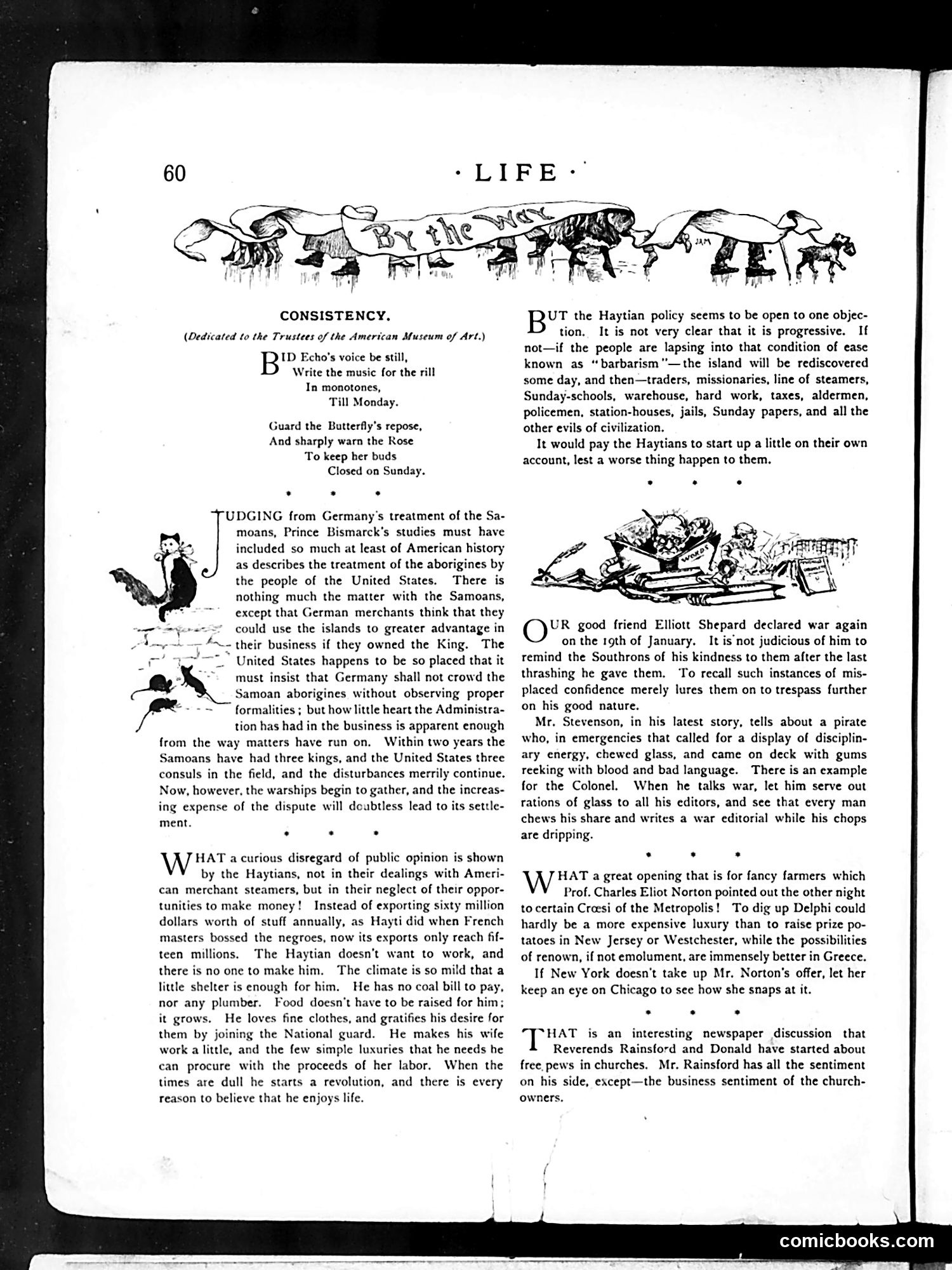
This page contains satirical commentary on contemporary political and social issues rather than traditional political cartoons. The main articles critique: 1. **Haitian Policy**: The text criticizes American diplomatic inconsistency regarding Haiti, arguing the U.S. should pressure Haiti toward "civilization" (infrastructure, law enforcement) rather than allowing "barbarism." 2. **Samoan Affairs**: Commentary on Germany's colonial treatment of Samoans, suggesting American merchants could profit more if the U.S. controlled the islands rather than Germany. 3. **Minor social commentary**: Brief satirical notes on topics including Elliott Shepard's war declaration, Stevenson's pirate story, and debates about free pews in churches. The illustrations are decorative line drawings rather than pointed political caricatures. This appears to be editorial satire reflecting early 20th-century imperialist attitudes.
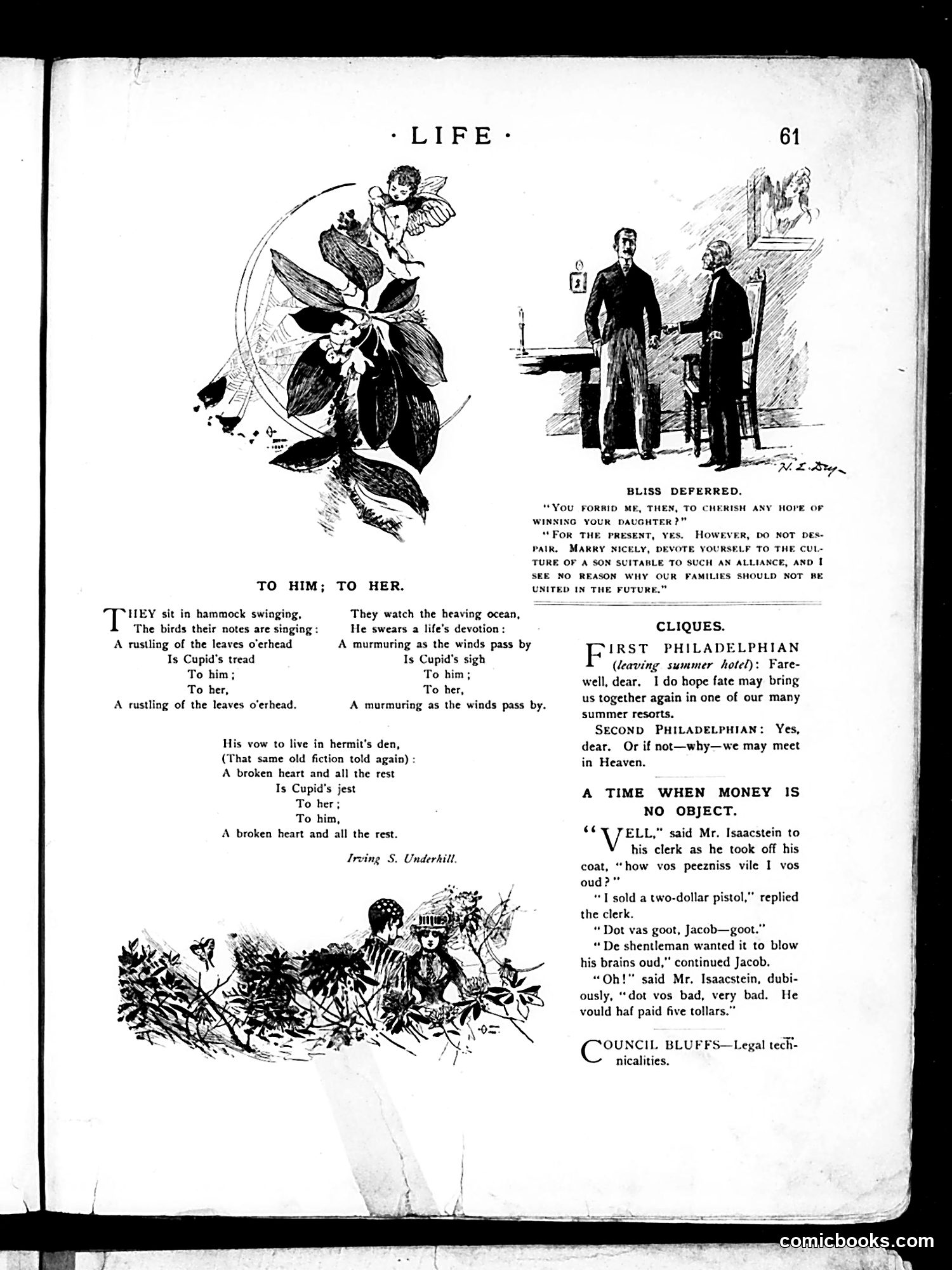
**"To Him; To Her"** (top left): A romantic poem by Irving S. Underhill about lovers in a hammock, with Cupid overhead. This is sentimental verse, not satire. **"Bliss Deferred"** (top right): A social cartoon showing two men (appears to be a father and suitor) discussing marriage prospects. The dialogue satirizes Victorian courtship conventions—the father warns against hasty marriage, insisting the young man prove himself suitable through financial success and character before courting his daughter. This mocks the era's formal, mercenary approach to matrimonial negotiations. **"A Time When Money Is No Object"**: A brief anecdote satirizing a clerk's poor judgment: he sold a valuable pistol for only two dollars when it could have fetched five. The humor targets financial incompetence. **"Council Bluffs"**: A legal humor section header (incomplete on this page).
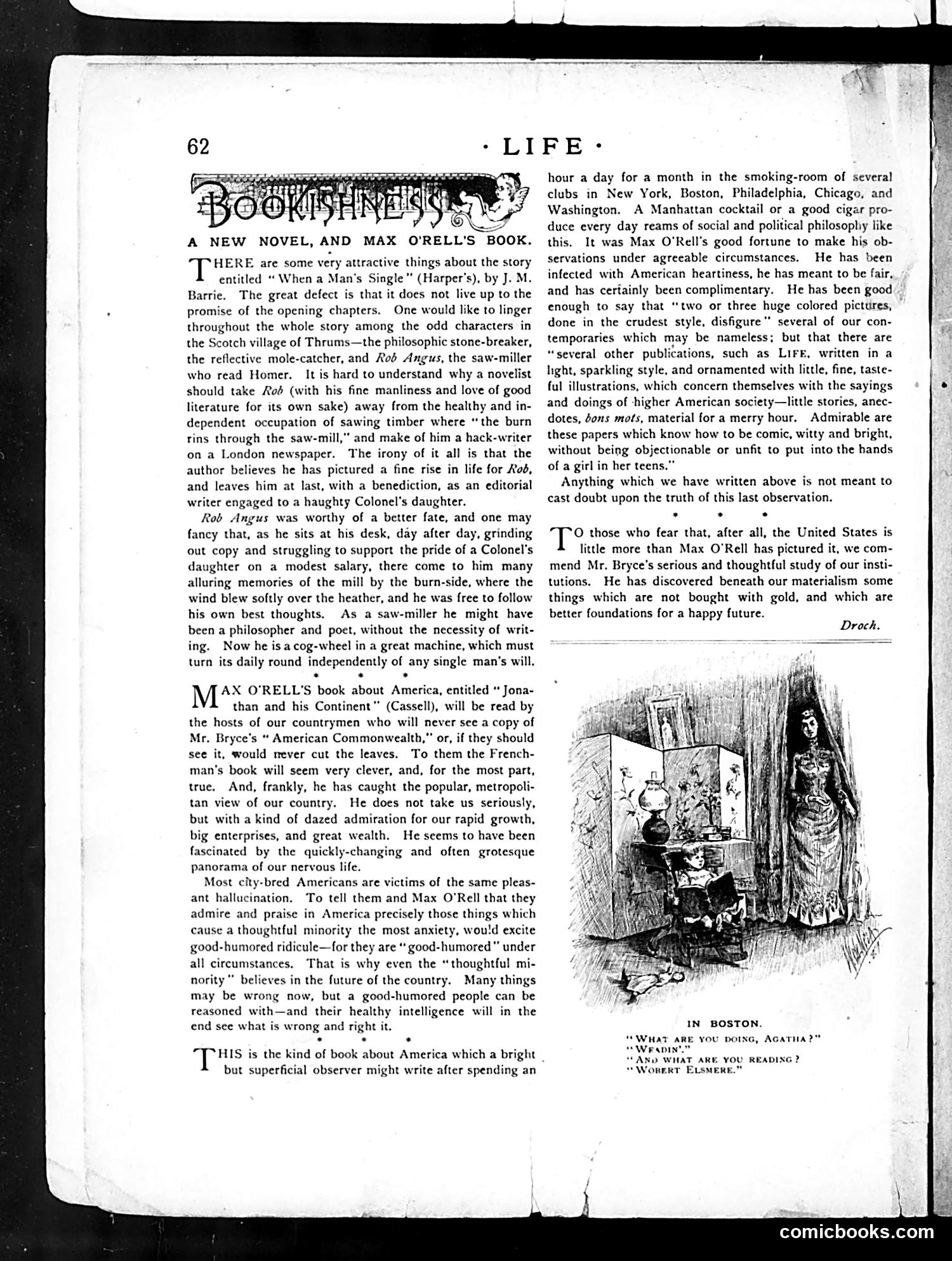
This page is primarily a **book review section** titled "Book Notices," not political cartoons. It reviews three novels: J.M. Barrie's "When a Man's Single," Max O'Rell's "Jonathan and his Continent," and James Bryce's "American Commonwealth." The small illustration labeled "IN BOSTON" appears to be a **social scene sketch** showing figures in Victorian-era dress, with dialogue referencing reading habits. The caption lists character names including "Agatha" and "Worbert Elsmere." The reviews critique American society and institutions with gentle satire—praising Bryce's serious institutional analysis while mocking O'Rell's superficial observations of American "rapid growth" and "nervous life." This reflects late-19th-century literary discourse about American character and society.
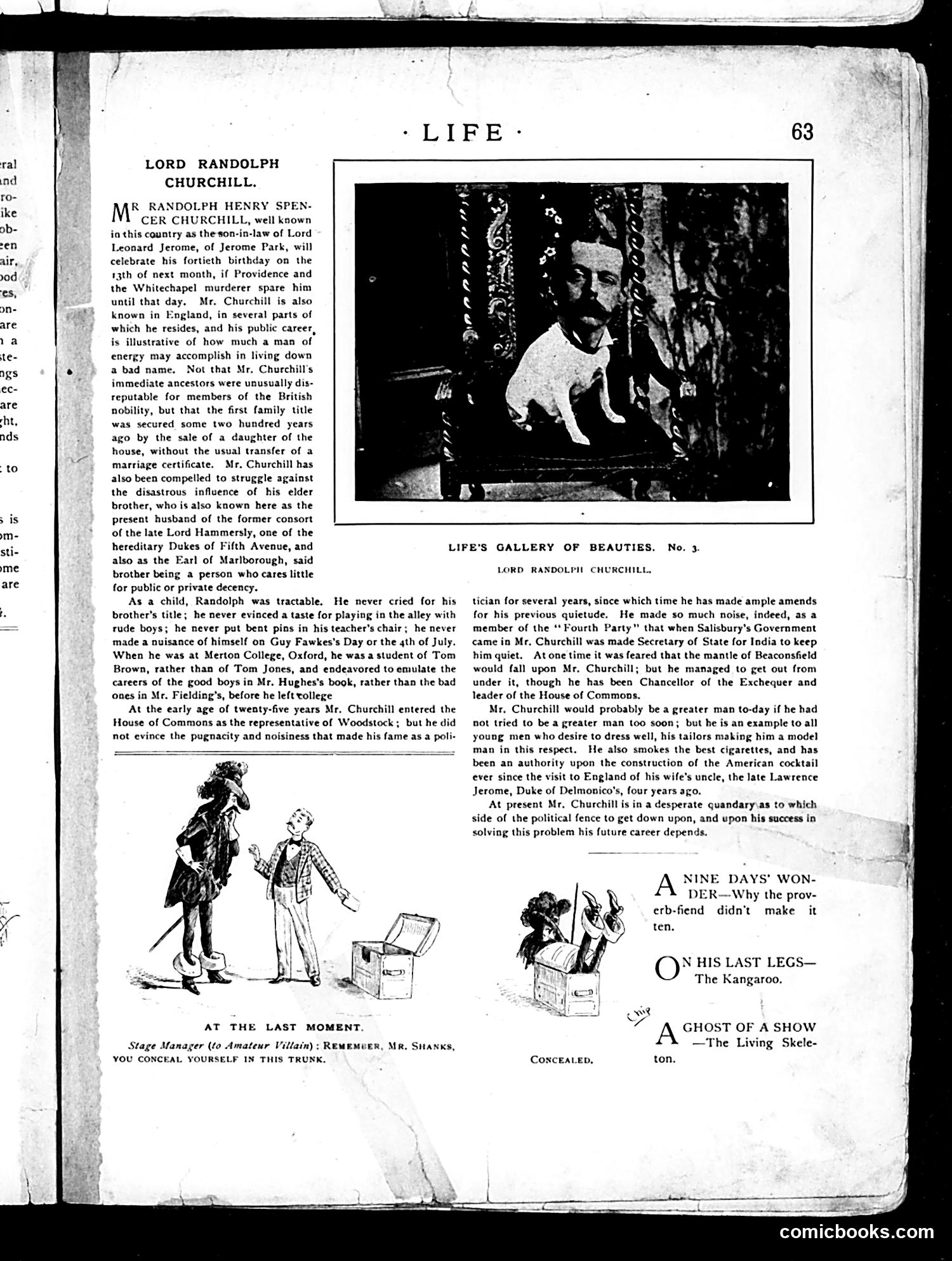
This page profiles Lord Randolph Henry Spencer Churchill, son-in-law of Lord Leonard Jerome. The text describes his political career and personal reputation—noting he's "known in England, in several parts of which he resides" and that his family secured their title "some two hundred years ago by the sale of a daughter of the house." The article emphasizes Churchill's struggle against his elder brother's influence and notes he entered Parliament at Woodstock. It characterizes him as energetic but cautions that great energy can "accomplish much in living down a bad name." The bottom cartoon captioned "At the Last Moment" appears to satirize parliamentary or social maneuvering, though the specific reference is unclear.
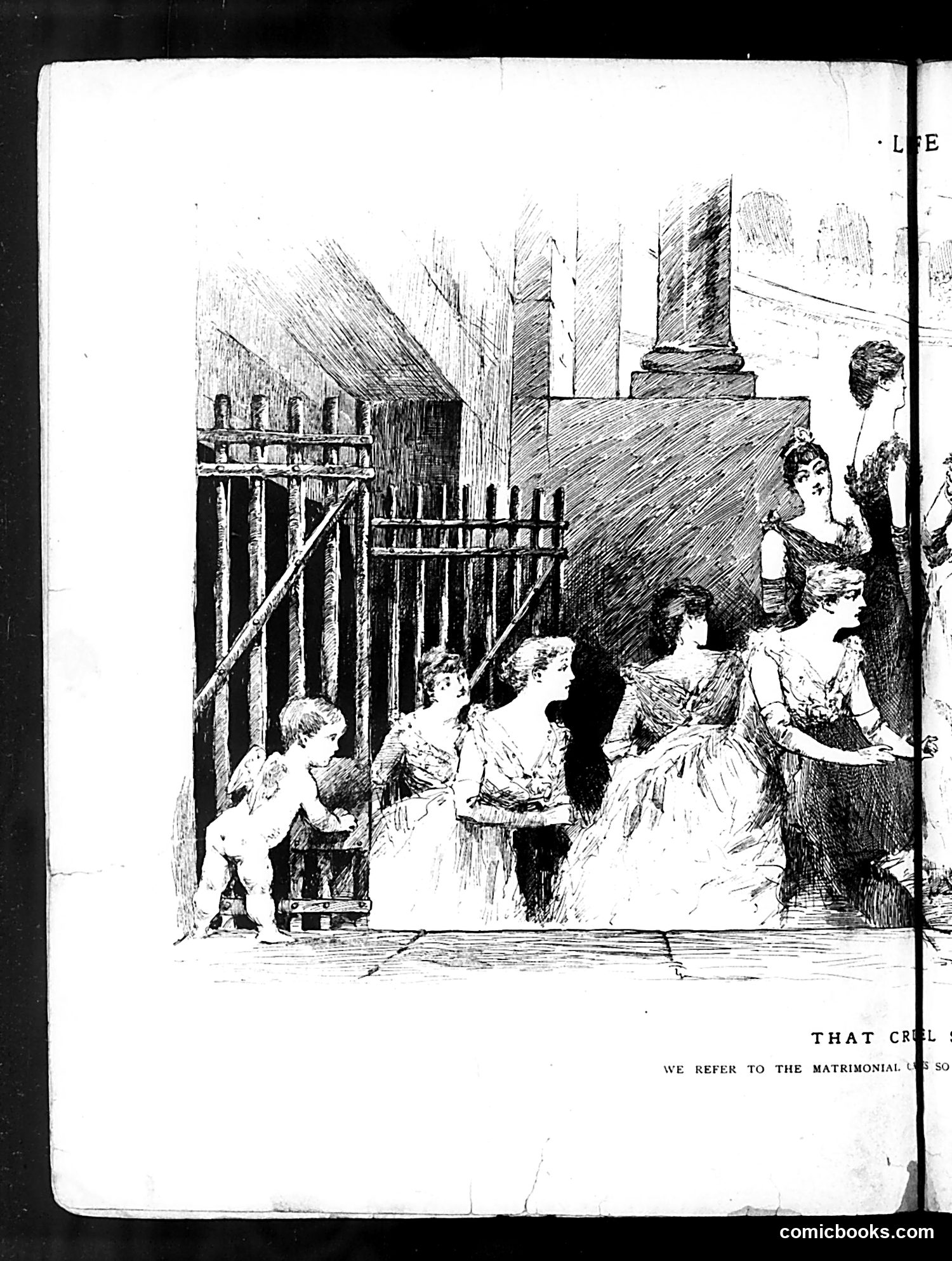
This appears to be a satirical illustration from Life magazine depicting an interior domestic scene. The visible text fragment reads "THAT CRUEL..." and references "THE MATRIMONIAL...," suggesting the cartoon comments on marriage or domestic relations. The illustration shows multiple women in what appears to be late 19th or early 20th-century dress gathered in an ornate interior space. A young child is present on the left. The scene's composition and the caption's reference to matrimonial matters suggest this is social satire about marriage, possibly critiquing either marital cruelty, domestic arrangements, or women's social roles of the era. However, without the complete caption text, I cannot identify the specific point of satire with certainty. The exact figures and precise satirical target remain unclear from the visible portion alone.
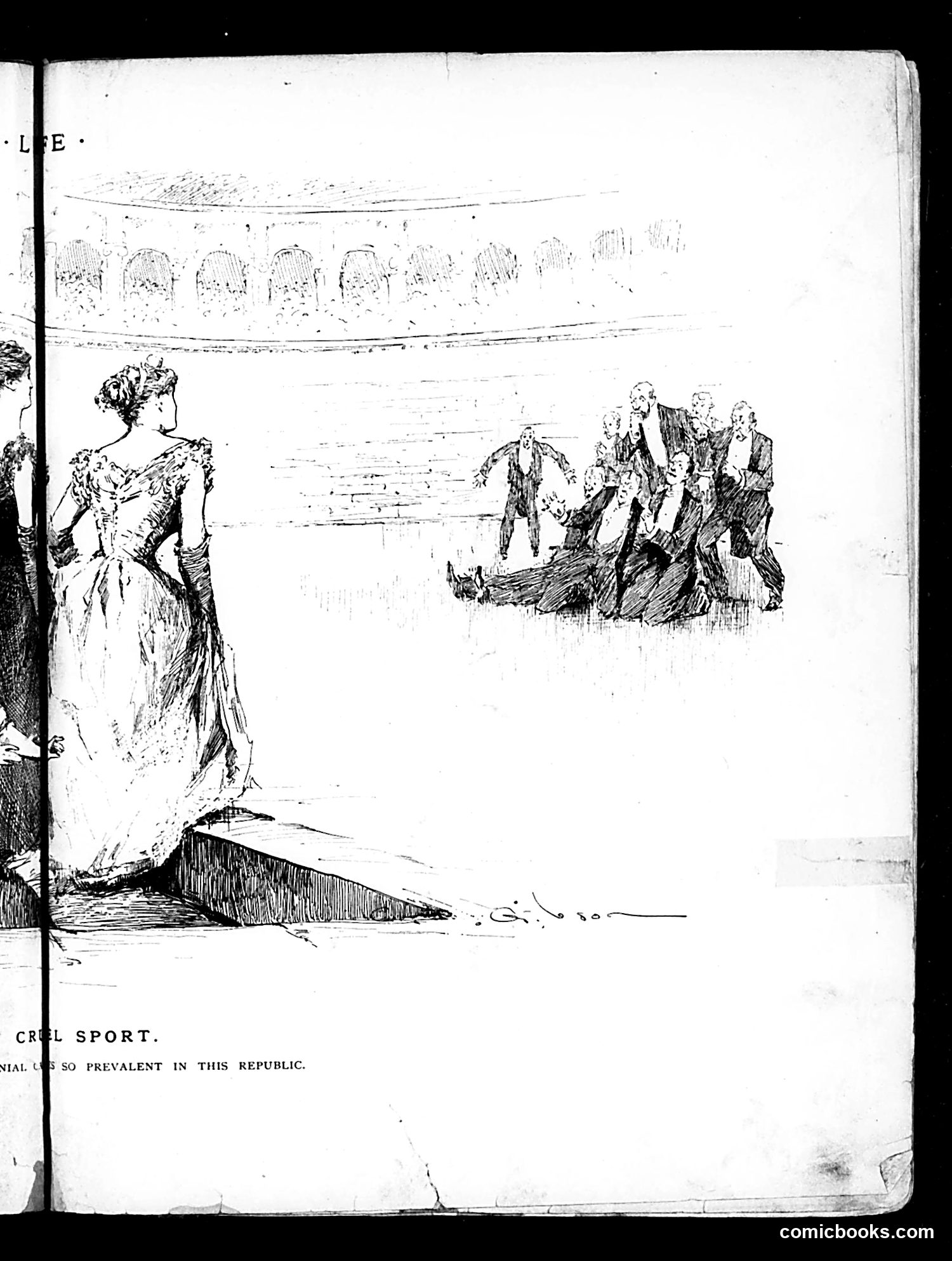
This satirical cartoon criticizes a brutal practice described as "a cruel sport... so prevalent in this republic." The image shows a well-dressed woman observing a group of men engaged in what appears to be a violent or degrading activity involving a prone figure. The cartoon's title and caption suggest the satire targets something socially accepted yet morally questionable within American society. The formal dress and composed demeanor of the observers contrasts sharply with the disturbing scene, implying commentary on how refined society casually tolerates or participates in cruelty. Without additional context about which specific "cruel sport" this references, the exact target remains unclear, though it likely critiques a contemporary practice that Life magazine's editors found objectionable yet widespread in American culture.
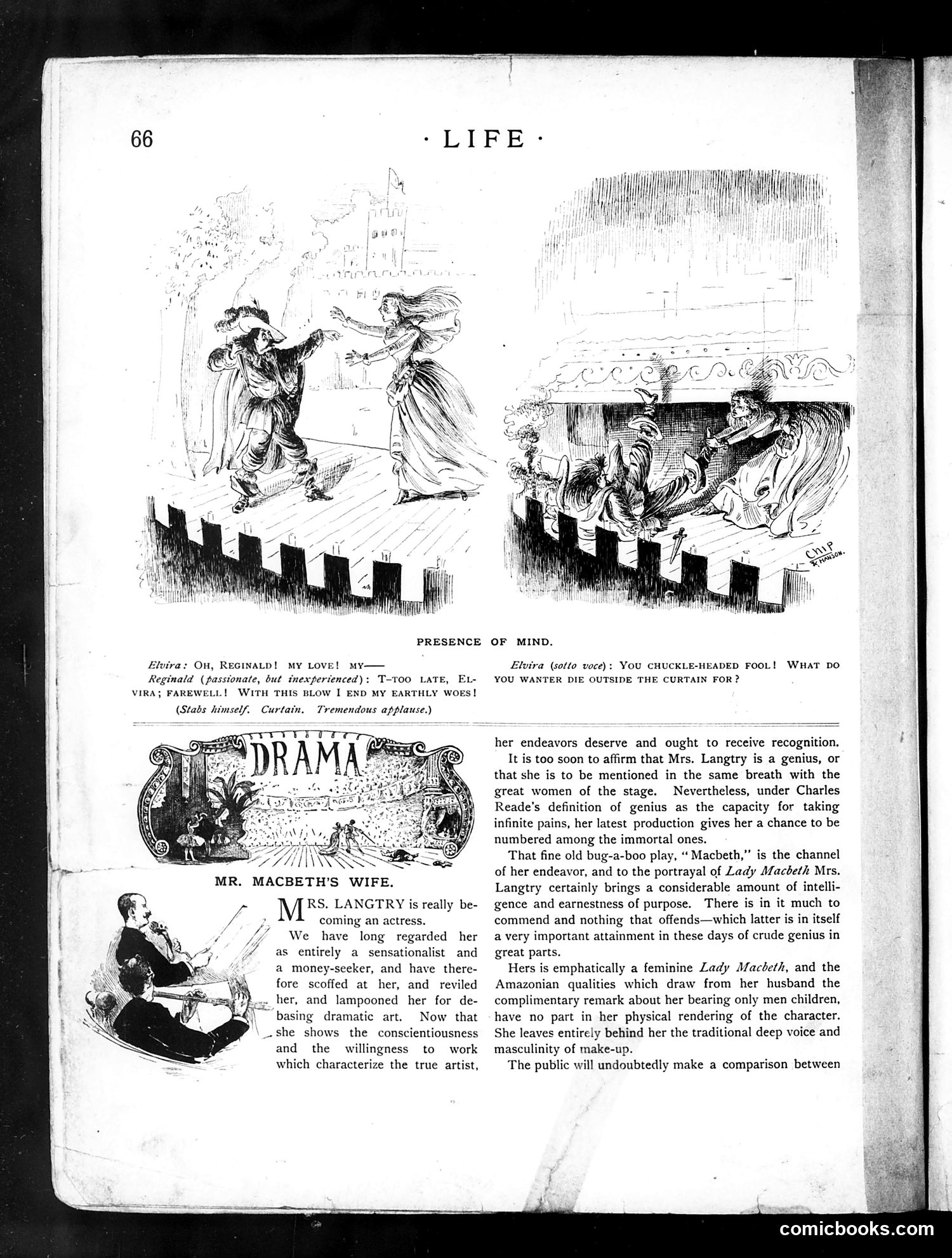
This page contains two theatrical cartoons satirizing theatrical performances, labeled "PRESENCE OF MIND" and "MR. MACBETH'S WIFE." **Top cartoons**: Show domestic/romantic theater scenes with exaggerated reactions. The dialogue mocks melodramatic acting, with a male character passionately gesturing while a woman responds with comic dismissal ("chuckle-headed fool"). **Bottom section**: Reviews Mrs. Langtry's performance as Lady Macbeth. The text criticizes her previous reputation as a "sensationalist" while acknowledging her newfound "conscientiousness and willingness to work." The reviewer suggests she successfully portrays Lady Macbeth's "emphatically feminine" qualities, though she avoids traditional masculine theatrical conventions like deep voice and heavy makeup. The piece compares her interpretation favorably to other productions, noting she deserves recognition as a serious dramatic artist, not merely a celebrity.
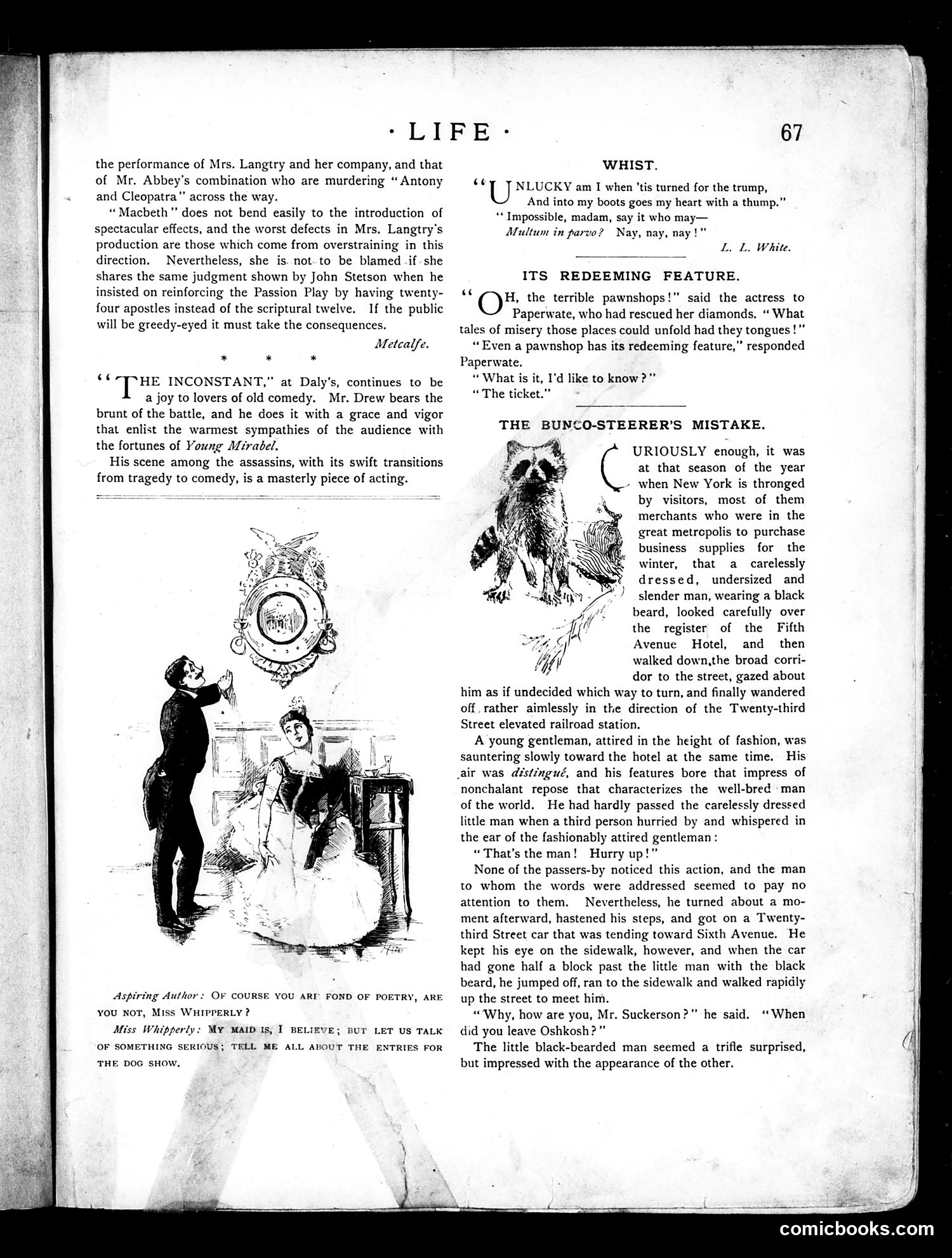
This page contains theatrical reviews and several satirical pieces typical of late 19th-century *Life* magazine humor. The main illustrated story, "The Bunco-Steerer's Mistake," depicts a confidence scheme in New York. A shabby, bearded man (appearing to be a rube or country visitor) exits the Fifth Avenue Hotel while a well-dressed, fashionable gentleman approaches. A third person signals the gentleman that the shabby man is the mark. The "bunco-steerer" (con artist) attempts to befriend "Mr. Suckerson," pretending recognition and asking when he left Oshkosh (Wisconsin)—a classic con-game ploy using false familiarity. The satire mocks urban con-artists who targeted country merchants visiting New York for winter supplies. The irony: the well-dressed man appears to be the actual con artist, now approaching his intended victim. Other items include brief theatrical criticism and a joke where an aspiring author's romantic poetry interest is dismissed by a woman more concerned with dog show entries—satirizing both pretentious literary aspirations and women's supposed shallow interests.
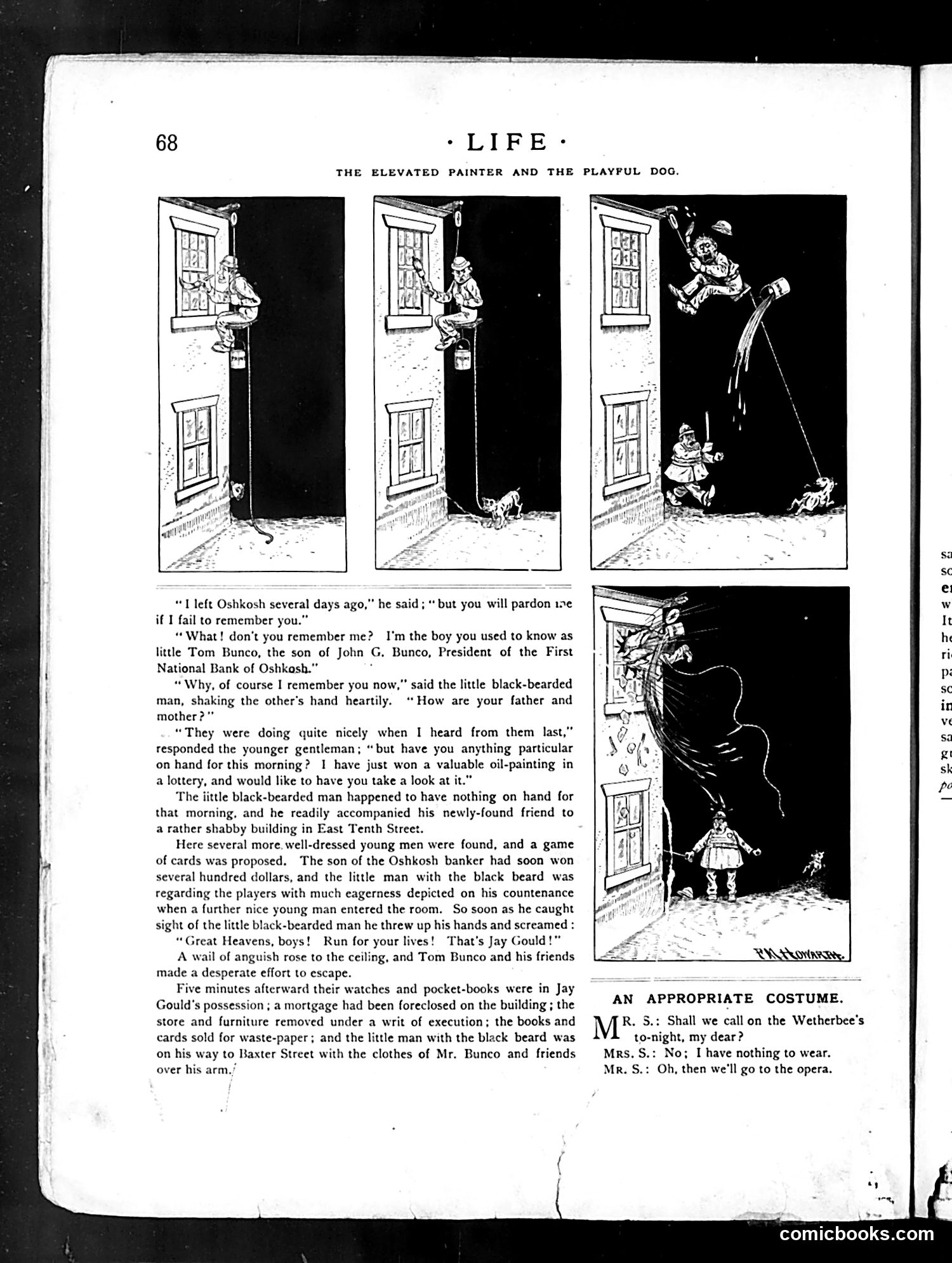
This satirical story mocks **Jay Gould**, the notorious Gilded Age railroad magnate and financier, portrayed as a con artist and swindler. The narrative depicts a confidence game: a well-dressed man ("little Tom Bunco," referencing con-artist slang) befriends a banker's son and invites him to a card game, where accomplices fleece him of money. When someone yells "That's Jay Gould!" everyone panics—suggesting Gould's reputation as a ruthless businessman who destroys fortunes through manipulation and fraud. The punchline equates Gould with a thief who steals not just money but clothes and property through foreclosure and legal maneuvering. The cartoon satirizes how Gould's wealthy elite status allows him to operate with impunity, committing larceny through corporate mechanisms rather than street crime—making him more dangerous than ordinary con men. The bottom item, "An Appropriate Costume," is unrelated wordplay about formal attire for opera.
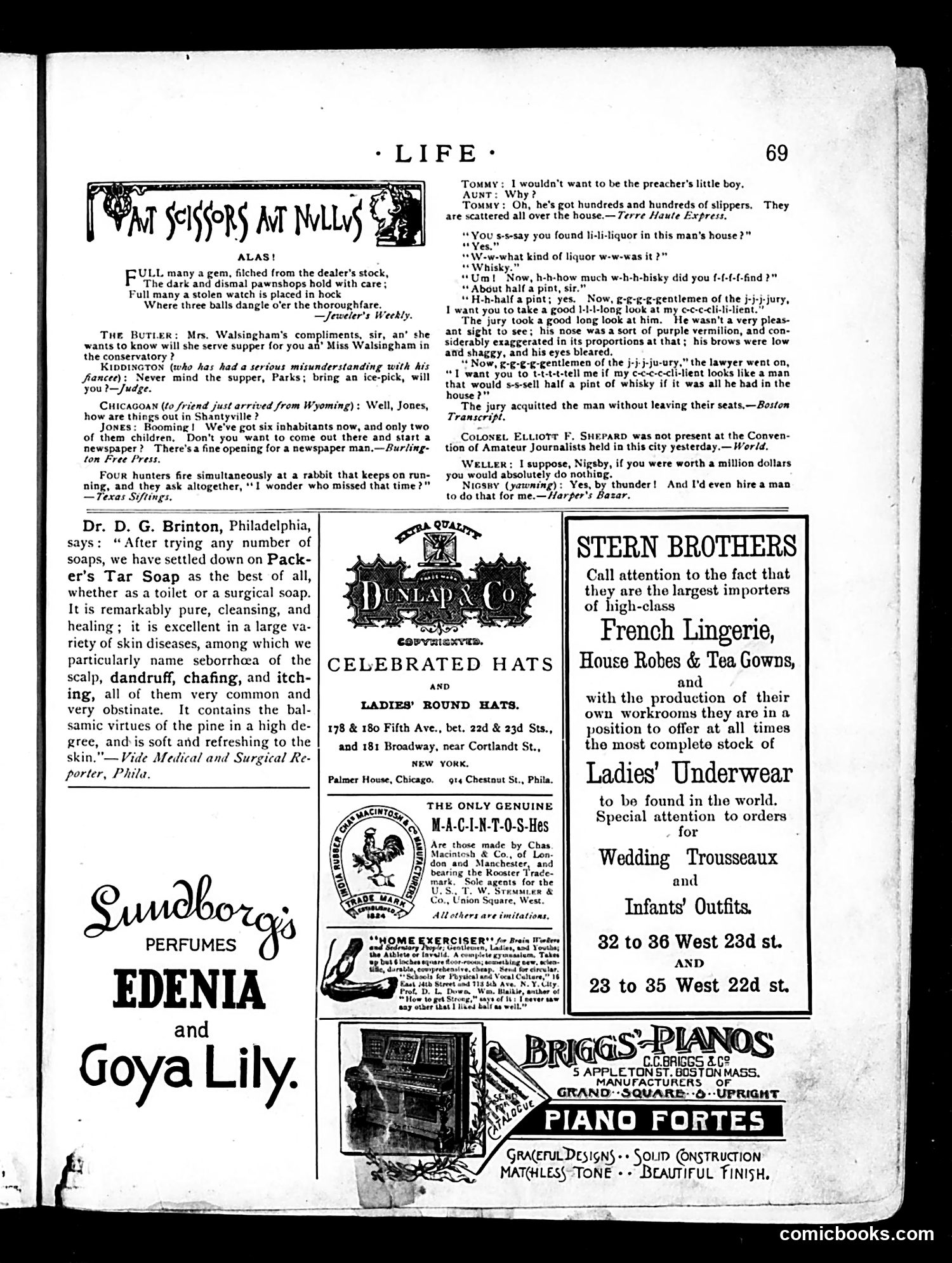
This page from Life magazine contains short satirical jokes typical of the publication's format, along with period advertisements. **Key Satirical Content:** The jokes mock various social situations. One features a lawyer with a visibly alcoholic appearance (purple nose, "bleared" eyes) defending a man accused of selling whisky, arguing the defendant couldn't possibly have sold half a pint if it was all he had—the jury acquits based on this absurd logic. Another joke involves a child noting the preacher's house has "hundreds and hundreds of slippers" scattered about, a euphemistic reference to illicit activity. **Historical Context:** These jokes reflect late 19th/early 20th-century American humor—often crude by modern standards, relying on physical caricature, alcoholism, and double entendres. The lawyer's stuttering representation and the drunk's exaggerated features were common comedic devices of the era. **Advertisements:** The page features luxury goods (French lingerie, pianos, perfumes) targeting wealthy readers, indicating Life's affluent audience.
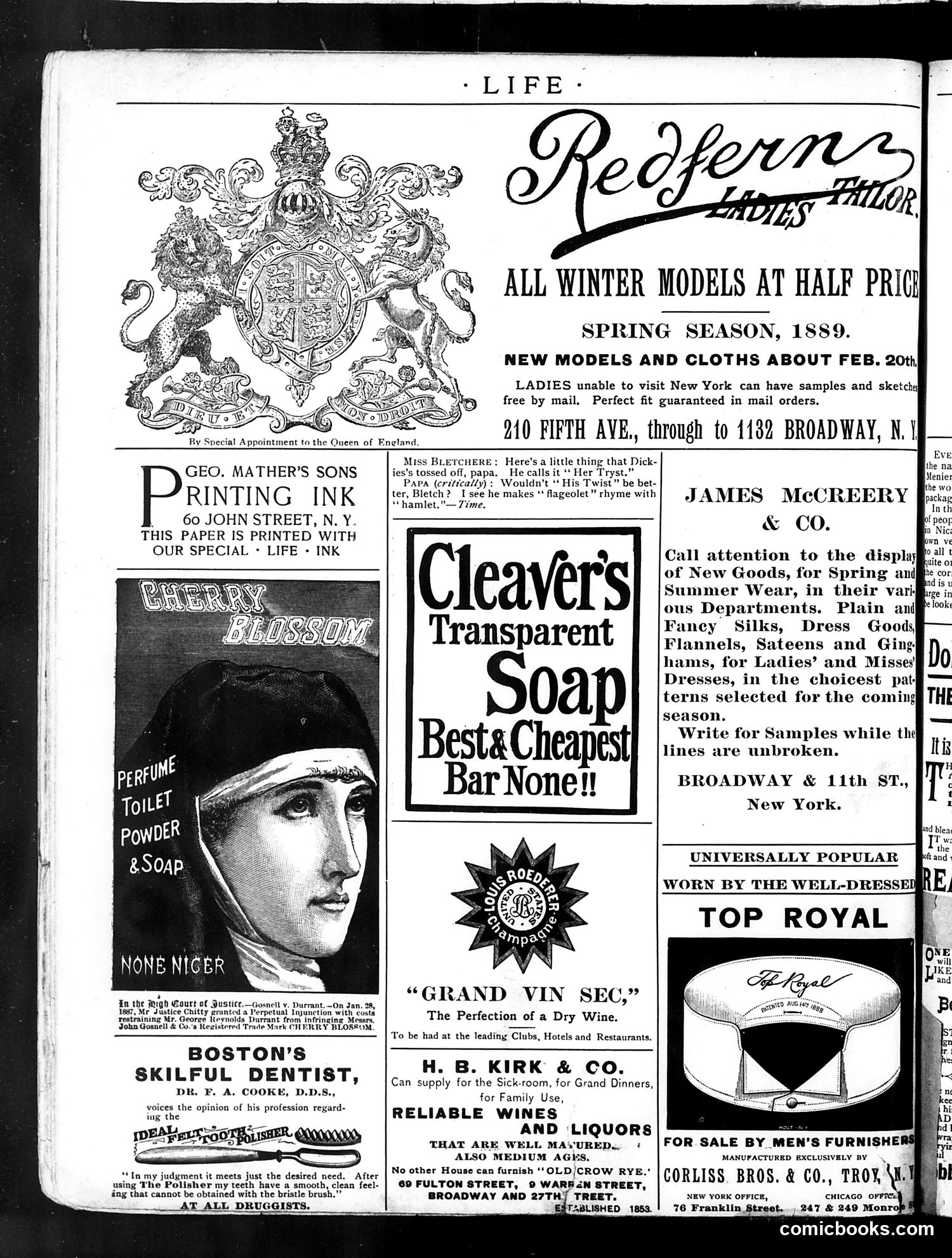
This is primarily an **advertising page** rather than editorial content or political satire. The page contains commercial advertisements for upscale retail and consumer goods typical of 1889 New York. Notable ads include: - **Redfern Ladies' Tailor** (top): A high-end fashion house advertising winter clearance and spring collection - **Cherry Blossom Soap**: Toiletries marketed with a fashionable woman's profile - **Cleaver's Transparent Soap**: Competing soap brand emphasizing value - **James McCreery & Co.**: Department store promoting silks and dress goods - **H.B. Kirk & Co.**: Wine and liquor merchant - **Various other services**: Printing ink, dental work, men's furnishings The only satirical element is a small **Miss Bletchere/Papa dialogue** mocking amateur poetry (criticizing a young man's weak rhyme of "lageolet" with "hamlet"). The page reflects gilded-age consumer culture targeting wealthy urban shoppers, particularly women.
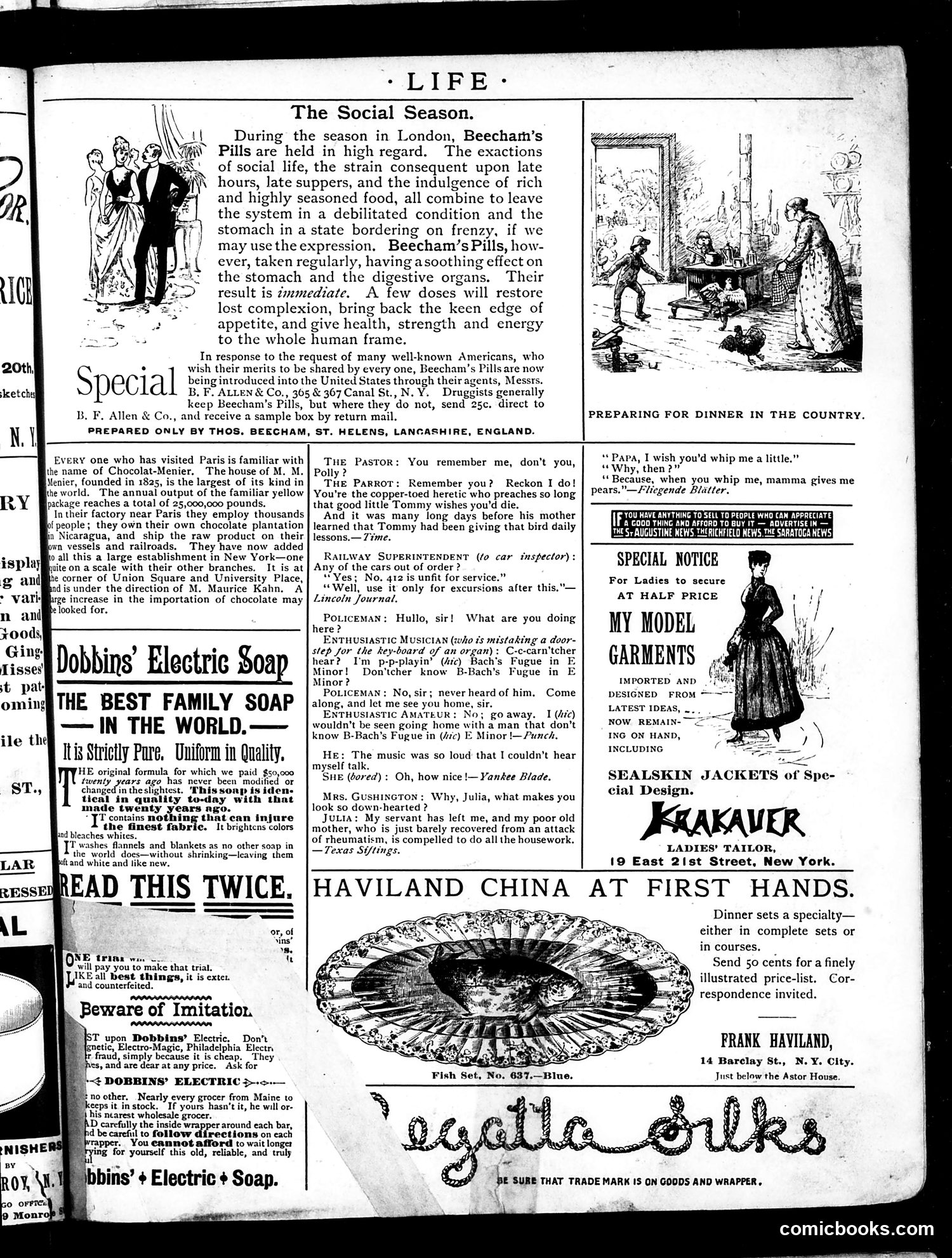
This page combines advertisements with satirical humor typical of early Life magazine. **The Cartoons/Jokes:** The page includes three brief comic exchanges. One depicts a clergyman asking a parrot if it remembers him; the parrot reveals the clergyman's sermons are so tedious that a child listener wishes he'd die—satirizing long-winded preaching. Another shows a railway superintendent told that car No. 412 is unfit for service, then advised to use it only for excursions—mocking bureaucratic indifference to passenger safety. A third appears to involve a musician mistaking a doorstep for something else. **Advertisements:** The dominant content is product advertising: Beecham's Pills (digestive aids for London's exhausting social season), Chocolat-Menier (French chocolate), Dobbins' Electric Soap, Haviland China, and custom garments. These ads reflect turn-of-century consumer culture and class aspirations. The page exemplifies Life's format: mixing social satire targeting contemporary institutions (clergy, bureaucracy) with consumer advertising.
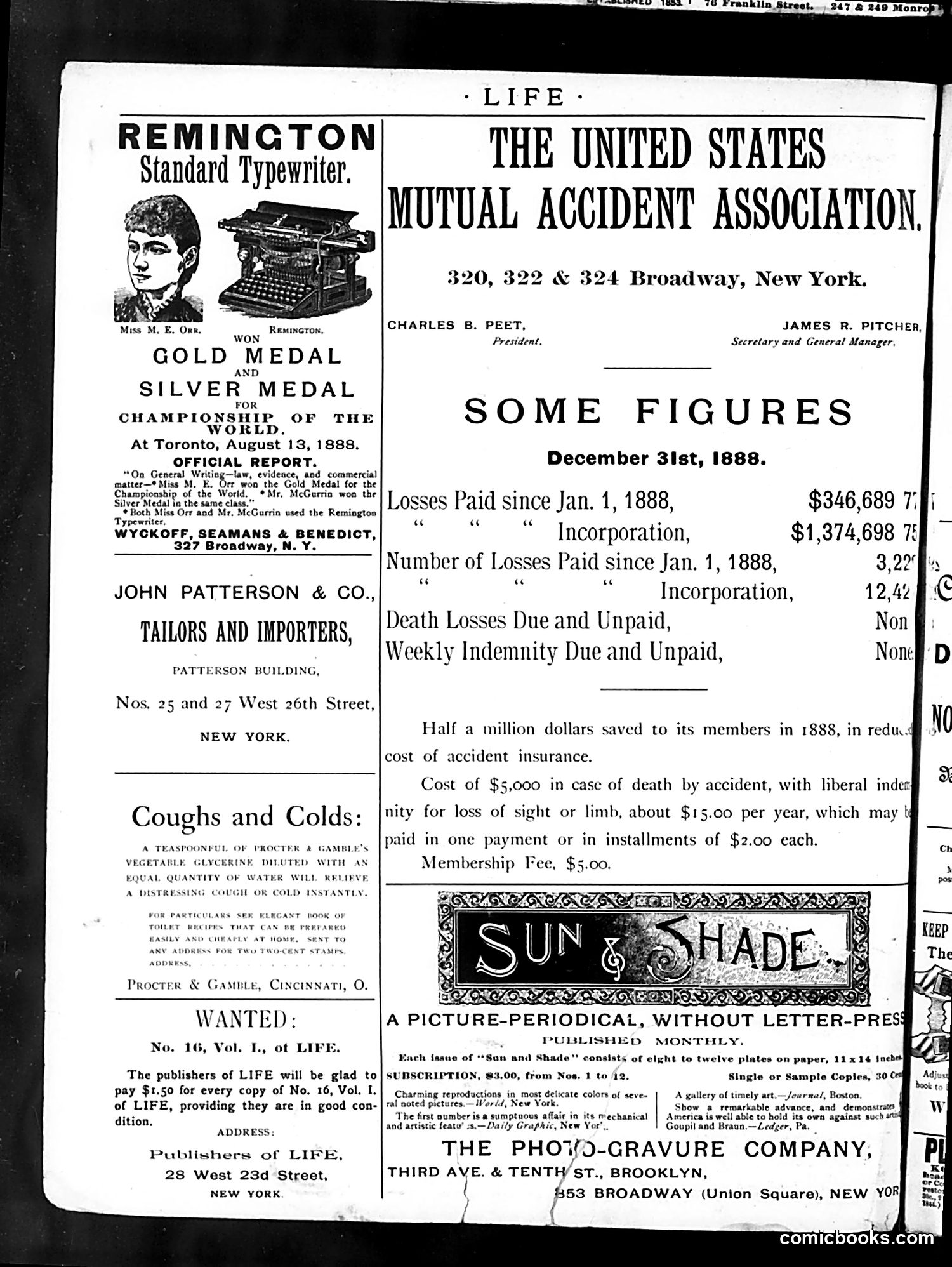
This is primarily an **advertising page**, not a satirical cartoon. The page contains commercial advertisements for various products and services typical of 1888: **Key Advertisements:** - **Remington Typewriter**: Promotes a Gold and Silver Medal won at a Toronto championship in August 1888 by typists Miss M.E. Orr and Mr. McGurrin - **Mutual Accident Association**: Insurance company reporting financial figures for 1888, including $346,689 in losses paid and membership benefits - **John Patterson & Co.**: Tailors and importers - **Procter & Gamble**: Cough remedy - **Sun and Shade**: A monthly picture periodical - **Wanted**: Life magazine seeks back issues The page reflects the commercial culture of 1880s America and the emerging typewriter technology as a competitive business tool. There is no political satire visible on this particular page.
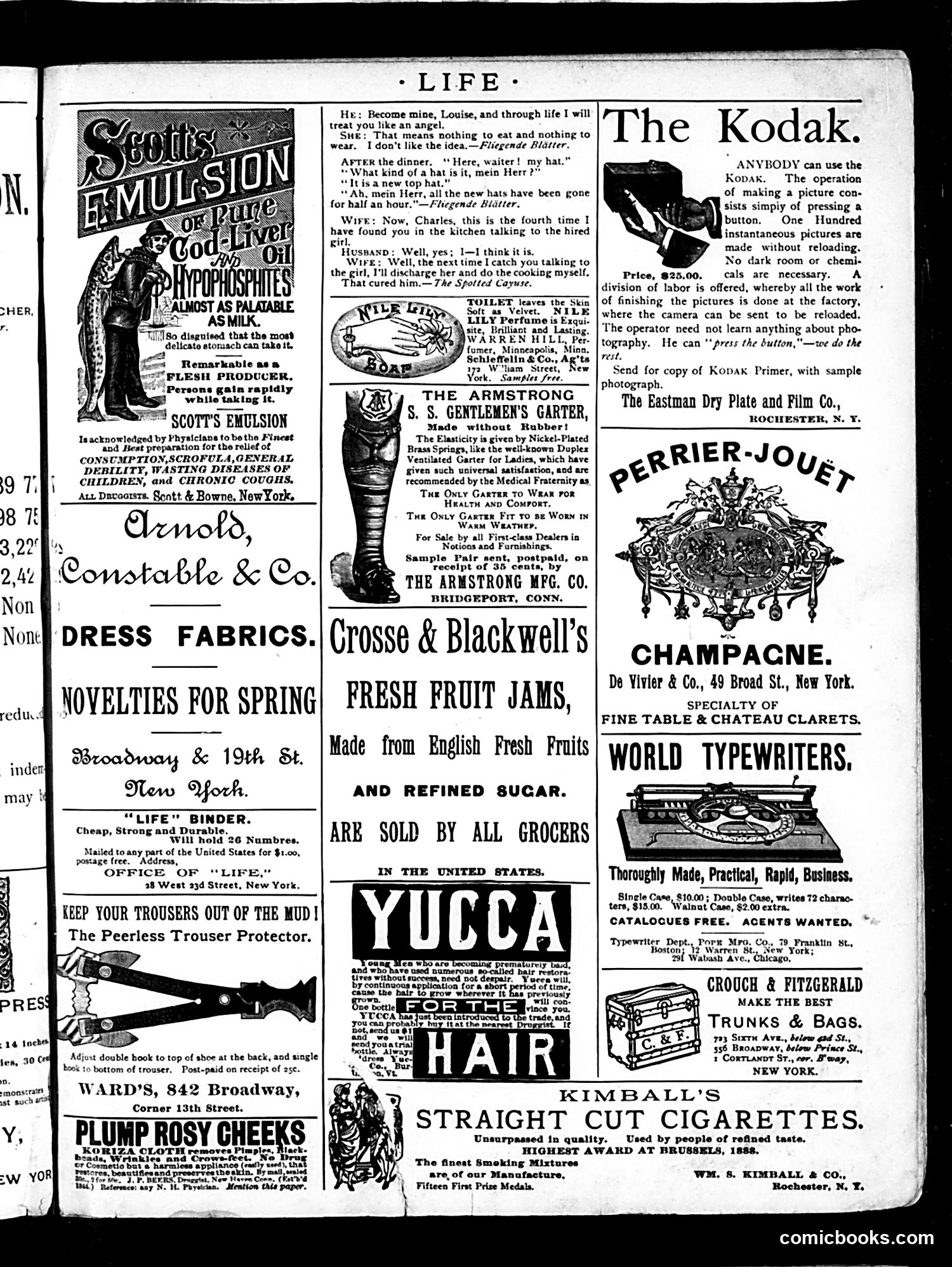
This **Life magazine page is primarily an advertisement section**, not a political cartoon or satirical content. The page contains brief humorous anecdotes—short jokes borrowed from *Fliegende Blätter* (a German satirical publication)—about marriage expectations, restaurant waiters, and domestic jealousy. These are mild, conventional vaudeville-style humor rather than pointed social commentary. The bulk of the page features period product advertisements: Scott's Emulsion (a cod-liver oil tonic), the Kodak camera (emphasizing its ease of use for amateurs), trouser protectors, typewriters, champagne, cigars, and similar consumer goods. **Notable historically**: The Kodak ad's famous slogan "You press the button, we do the rest" reflects the late-19th-century democratization of photography—making image-making accessible to ordinary people rather than professional photographers only. This is typical of *Life*'s mixed content: light humor interspersed with commercial sponsorships that subsidized the magazine's publication.
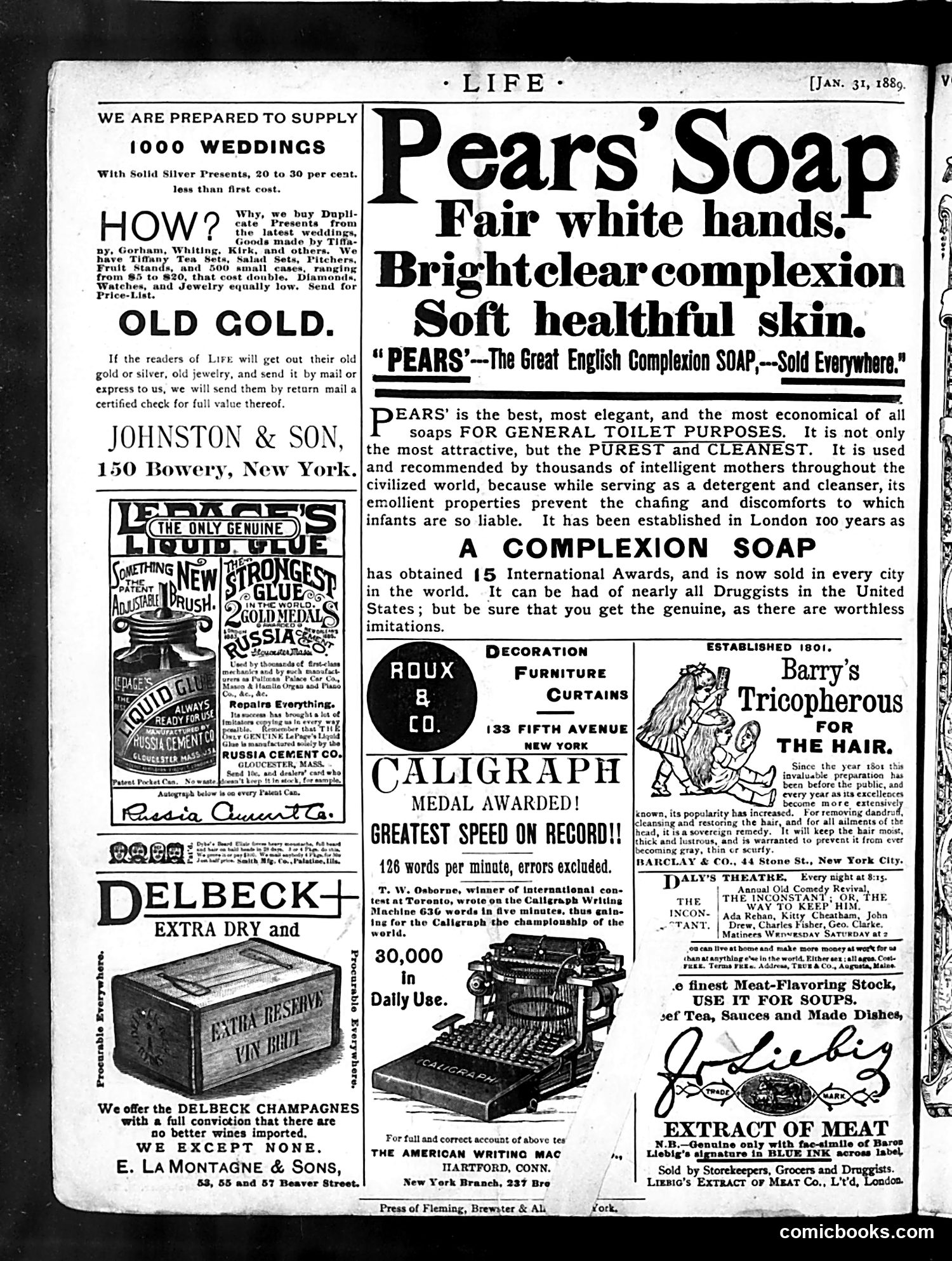
This is primarily a **advertisements page** with no political cartoons or satire. The page consists entirely of commercial notices for late 19th-century products. Notable ads include: - **Pears' Soap**: A British complexion soap emphasizing "fair white hands" and "bright clear complexion"—reflecting Victorian beauty standards prioritizing pale skin - **Johnston & Son**: Buying old gold and jewelry, plus offering duplicate wedding gifts at reduced prices - **Caligraph typewriter**: Advertises "greatest speed on record" at 126 words per minute - **Liebig's Extract of Meat**: A meat-flavoring stock for soups and sauces - **Barry's Tricopherous**: A hair treatment product established 1801 The ads collectively reveal consumer culture, Victorian aesthetic ideals (particularly regarding complexion and hair), and early typewriter technology. There is no satirical content—this is straightforward commercial messaging.