
Life, 1889-01-31 · page 11 of 18
Life — January 31, 1889 — page 11: what you’re looking at
What you’re looking at
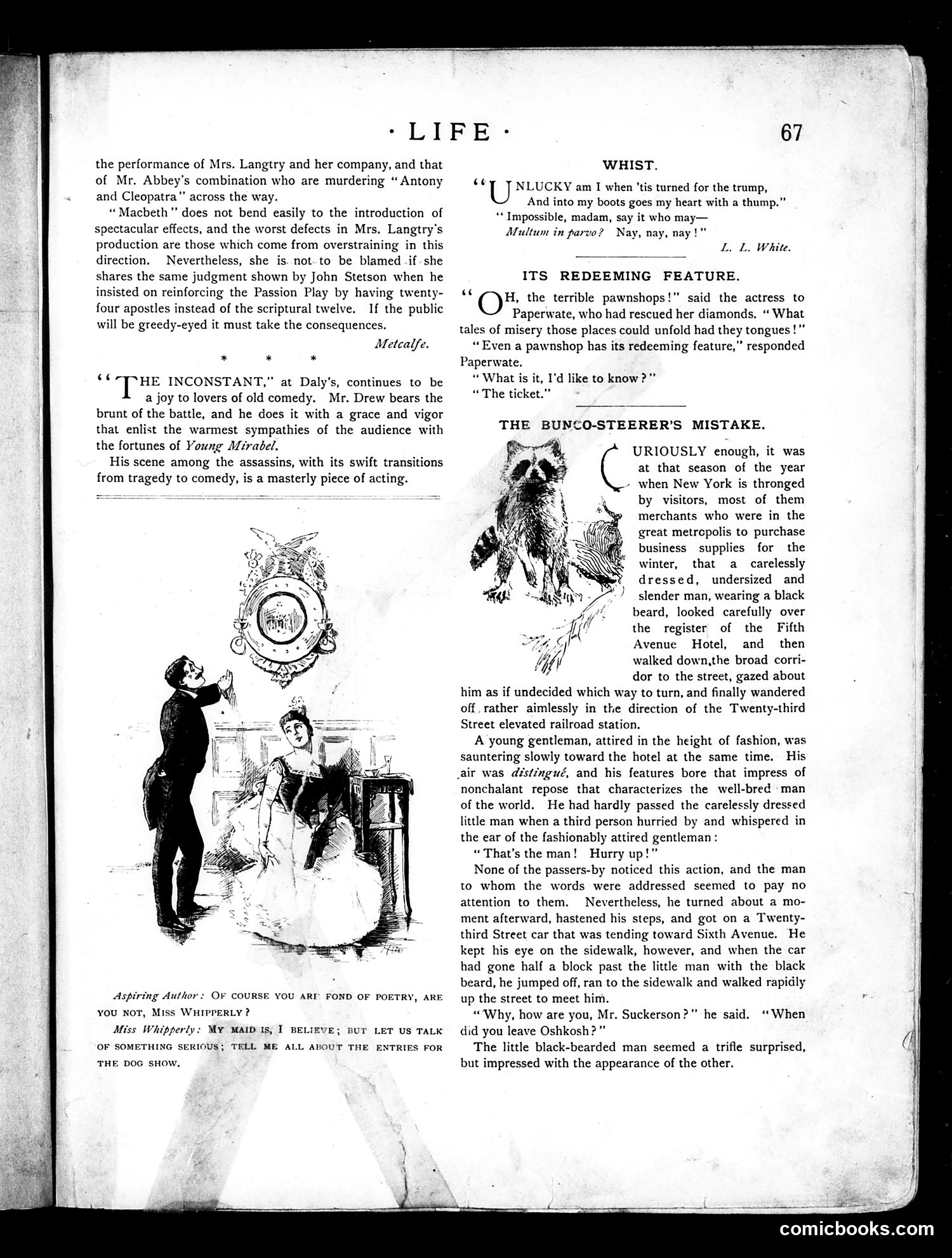
This page contains theatrical reviews and several satirical pieces typical of late 19th-century *Life* magazine humor. The main illustrated story, "The Bunco-Steerer's Mistake," depicts a confidence scheme in New York. A shabby, bearded man (appearing to be a rube or country visitor) exits the Fifth Avenue Hotel while a well-dressed, fashionable gentleman approaches. A third person signals the gentleman that the shabby man is the mark. The "bunco-steerer" (con artist) attempts to befriend "Mr. Suckerson," pretending recognition and asking when he left Oshkosh (Wisconsin)—a classic con-game ploy using false familiarity. The satire mocks urban con-artists who targeted country merchants visiting New York for winter supplies. The irony: the well-dressed man appears to be the actual con artist, now approaching his intended victim. Other items include brief theatrical criticism and a joke where an aspiring author's romantic poetry interest is dismissed by a woman more concerned with dog show entries—satirizing both pretentious literary aspirations and women's supposed shallow interests.
📄 Transcribed text from this page (OCR, searchable)
Machine-transcribed from the original scan — historical spelling and the odd misread are preserved.
* LIFE : the performance of Mrs. Langtry and her company, and that of Mr. Abbey's combination who are murdering “ Antony and Cleopatra” across the way. “Macbeth” does not bend easily to the introduction of spectacular effects, and the worst defects in Mrs. Langtry’s production are those which come from overstraining in this direction. Nevertheless, she is. not-to be blamed -if-she shares the same judgment shown by John Stetson when he insisted on reinforcing the Passion Play by having twenty- four apostles instead of the scriptural twelve. If the public will be greedy-eyed it must take the consequences. Metcalfe. * x * “e HE INCONSTANT,” at Daly’s, continues to be a joy to lovers of old comedy. Mr. Drew bears the brunt of the battle, and he does it with a grace and vigor that enlist the warmest sympathies of the audience with the fortunes of Young Mérabel. His scene among the assassins, with its swift transitions from tragedy to comedy, is a masterly piece of acting. Aspiring Author : OF COURSE YOU ARE FOND OF POETRY, ARE You NoT, Miss WHIPPERLY ? Miss Whipperly: MY MaID 1s, I BELIEVE; BUT LET US TALK OF SOMETHING SERIOUS; TELL ME ALL ABOUT THE ENTRIES FOR THE DOG SHOW, WHIST. NLUCKY am I when ’tis turned for the trump, And into my boots goes my heart with a thump.” “Impossible, madam, say it who may— Multum in parvo? Nay, nay, nay!" L. L. White, ITS REDEEMING FEATURE. H, the terrible pawnshops!” said the actress to Paperwate, who had rescued her diamonds. “ What tales of misery those places could unfold had they tongues!” “Even a pawnshop has its redeeming feature,” responded Paperwate. “What is it, I'd like to know?” “The ticket.” THE BUNCO-STEERER’S MISTAKE, URIOUSLY enough, it was at that season of the year - when New York is thronged by visitors, most of them merchants who were in the great metropolis to purchase business supplies for the winter, that a carelessly dressed, undersized and slender man, wearing a black beard, looked carefully over the the Fifth Avenue Hotel, and then walked down,the broad corri- dor to the street, gazed about him as if undecided which way to turn, and finally wandered off, rather aimlessly in the direction of the Twenty-third Street elevated railroad station. A young gentleman, attired in the height of fashion, was sauntering slowly toward the hotel at the same time. His register of wair was déstingué, and his features bore that impress of nonchalant repose that characterizes the well-bred man of the world. He had hardly passed the carelessly dressed little man when a third person hurried by and whispered in the ear of the fashionably attired gentleman : “That’s the man! Hurry up!” None of the passers-by noticed this action, and the man to whom the words were addressed seemed to pay no attention to them. Nevertheless, he turned about a mo- ment afterward, hastened his steps, and got on a Twenty- third Street car that was tending toward Sixth Avenue. He kept his eye on the sidewalk, however, and when the car had gone half a block past the little man with the black beard, he jumped off, ran to the sidewalk and walked rapidly up the street to meet him. “Why, how are you, Mr. Suckerson?” he said. did you leave Oshkosh?” The little black-bearded man seemed a trifle surprised, but impressed with the appearance of the other. “When