
Life, 1889-01-31 · page 4 of 18
Life — January 31, 1889 — page 4: what you’re looking at
What you’re looking at
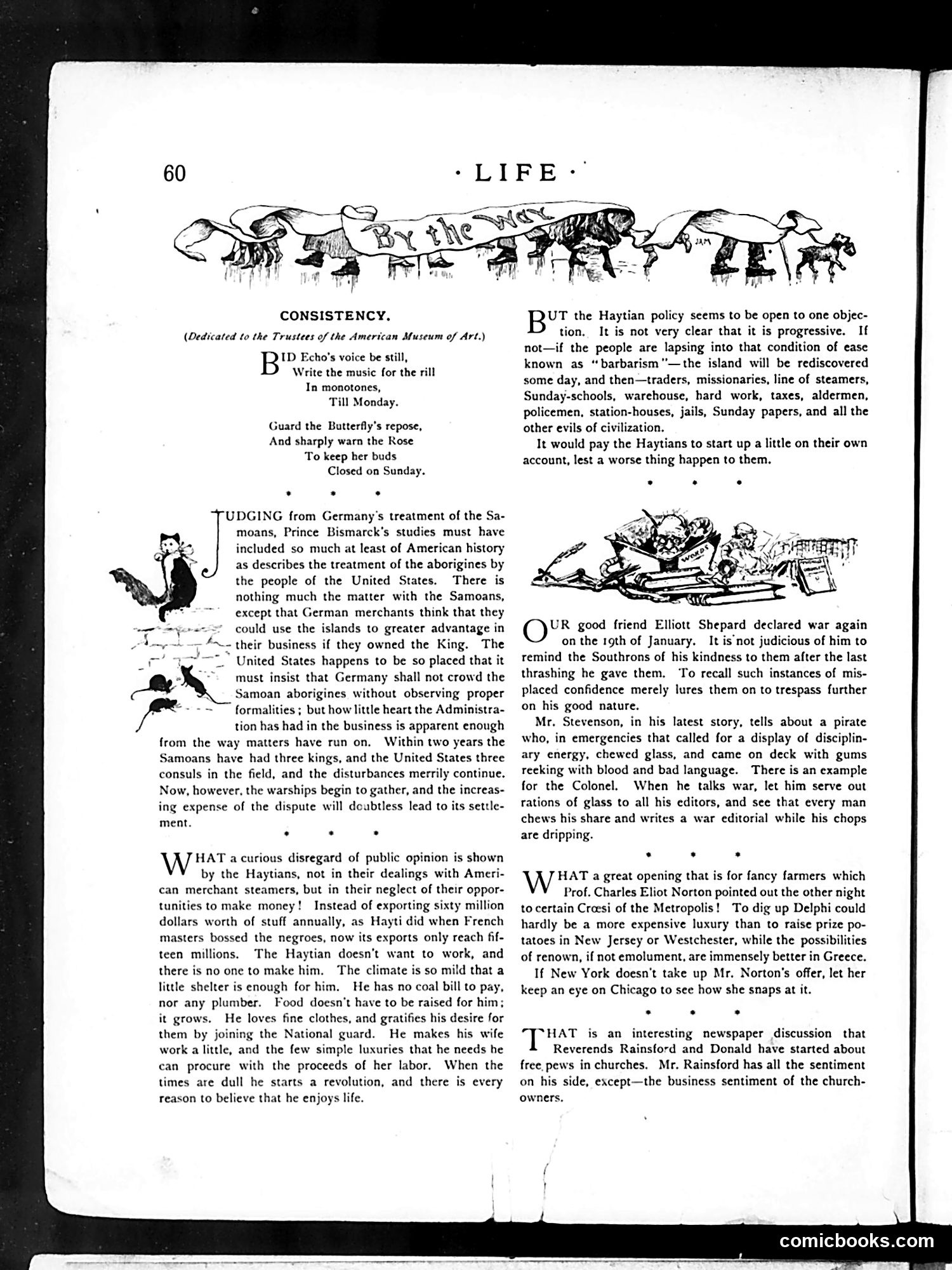
This page contains satirical commentary on contemporary political and social issues rather than traditional political cartoons. The main articles critique: 1. **Haitian Policy**: The text criticizes American diplomatic inconsistency regarding Haiti, arguing the U.S. should pressure Haiti toward "civilization" (infrastructure, law enforcement) rather than allowing "barbarism." 2. **Samoan Affairs**: Commentary on Germany's colonial treatment of Samoans, suggesting American merchants could profit more if the U.S. controlled the islands rather than Germany. 3. **Minor social commentary**: Brief satirical notes on topics including Elliott Shepard's war declaration, Stevenson's pirate story, and debates about free pews in churches. The illustrations are decorative line drawings rather than pointed political caricatures. This appears to be editorial satire reflecting early 20th-century imperialist attitudes.
📄 Transcribed text from this page (OCR, searchable)
Machine-transcribed from the original scan — historical spelling and the odd misread are preserved.
CONSISTENCY, (Dedicated to the Trustees of the American Museum of Art.) ID Echo's voice be still, Write the music for the rill In monotones, Till Monday. Guard the Butterfly’s repose, And sharply warn the Rose To keep her buds Closed on Sunday. . . . UDGING from Germany's treatment of the Sa- moans, Prince Bismarck’s studies must have included so much at least of American history as describes the treatment of the aborigines by the people of the United States. There is nothing much the matter with the Samoans, except that German merchants think that they could use the islands to greater advantage in 4~- their business if they owned the King. The ‘—"* United States happens to be so placed that it ~~~ must insist that Germany shall not crowd the \ Samoan aborigines without observing proper formalities ; but how little heart the Administra- tion has had in the business is apparent enough from the way matters have run on. Within two years the Samoans have had three kings, and the United States three consuls in the field, and the disturbances merrily continue. Now, however, the warships begin to gather, and the increas- ing expense of the dispute will doubtless lead to its settle- ment. . . . HAT acurious disregard of public opinion is shown by the Haytians, not in their dealings with Ameri- can merchant steamers, but in their neglect of their oppor- tunities to make money! Instead of exporting sixty million dollars worth of stuff annually, as Hayti did when French masters bossed the negroes, now its exports only reach fif- teen millions. The Haytian doesn’t want to work, and there is no one to make him, The climate is so mild that a little shelter is enough for him. He has no coal bill to pay, nor any plumber. Food doesn’t have to be raised for him; it grows. He loves fine clothes, and gratifies his desire for them by joining the National guard. He makes his wife work a little, and the few simple luxuries that he needs he can procure with the proceeds of her labor. When the times are dull he starts a revolution, and there is every reason to believe that he enjoys life. But the Haytian policy seems to be open to one objec- tion. It is not very clear that it is progressive. If not—if the people are lapsing into that condition of ease known as “barbarism"—the island will be rediscovered some day, and then—traders, missionaries, line of steamers, Sunday-schools, warehouse, hard work, taxes, aldermen, policemen, station-houses, jails, Sunday papers, and all the other evils of civilization. It would pay the Haytians to start up a little on their own account, lest a worse thing happen to them. UR good friend Elliott Shepard declared war again on the 19th of January. It is'not judicious of him to remind the Southrons of his kindness to them after the last thrashing he gave them. To recall such instances of mis- placed confidence merely lures them on to trespass further on his good nature. Mr. Stevenson, in his latest story, tells about a pirate who, in emergencies that called for a display of disciplin- ary energy, chewed glass, and came on deck with gums reeking with blood and bad language. There is an example for the Colonel. When he talks war, let him serve out rations of glass to all his editors, and see that every man chews his share and writes a war editorial while his chops are dripping. . . . W HAT a great opening that is for fancy farmers which Prof. Charles Eliot Norton pointed out the other night tocertain Croesi of the Metropolis! To dig up Delphi could hardly be a more expensive luxury than to raise prize po- tatoes in New Jersey or Westchester, while the possibilities of renown, if not emolument, are immensely better in Greece. If New York doesn’t take up Mr. Norton's offer, let her keep an eye on Chicago to see how she snaps at it. Te is an interesting newspaper discussion that Reverends Rainsford and Donald have started about free, pews in churches. Mr. Rainsford has all the sentiment on his side, except—the business sentiment of the church- owners. comicbooks.com