
Life, 1889-01-31 · page 2 of 18
Life — January 31, 1889 — page 2: what you’re looking at
What you’re looking at
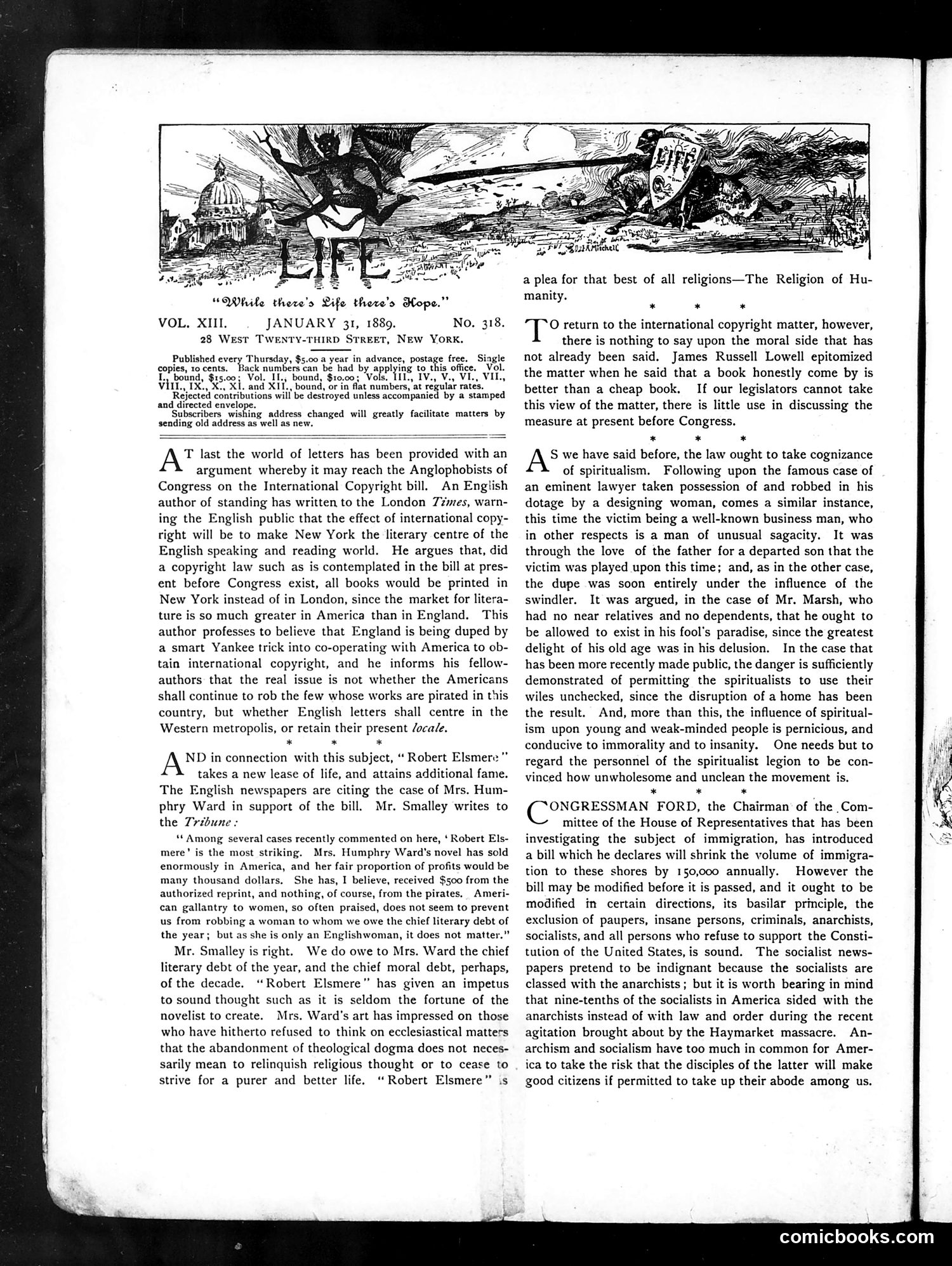
The header cartoon depicts a skeletal figure labeled "Life" sitting beneath a bare tree under moonlight, with the caption "While there's life there's Hope." This appears to be Life magazine's masthead illustration—a recurring artistic motif. The page's text discusses international copyright legislation before Congress. It argues that English authors' works should be printed in America rather than England, and mentions "Robert Elsmere" (a novel by Mrs. Humphry Ward) as a test case. The articles advocate for American literary independence while debating whether stricter copyright protections serve American interests. The final section addresses Congressman Ford's immigration bill, criticizing proposals to exclude "paupers, insane persons, criminals, anarchists, and all socialists" as overly broad and potentially dangerous to American society.
📄 Transcribed text from this page (OCR, searchable)
Machine-transcribed from the original scan — historical spelling and the odd misread are preserved.
“While there's Life there's Hope.” VOL, XIII. JANUARY 31, 1889. No. 318. 28 West TWENTY-THIRD STREET, New YorK. Published every Thursday, $5.00 a year in advance, postage (ree. Single gopies, 1gcents. “Back numbérs can be had by applying to this office. Vol 1, bo . II, bound, $10.00; Vols, III, IV., V., VE, VIL, vitr., 1X’ '., bound, or in flat numbers, at regular rates, Rejected contributions will be destroyed unless accompanied by a stamped and directed envelope. Subscribers wishing address changed will greatly facilitate matters by sending old address as well as new. T last the world of letters has been provided with an argument whereby it may reach the Anglophobists of Congress on the International Copyright bill. An English author of standing has written to the London 7zmes, warn- ing the English public that the effect of international copy- right will be to make New York the literary centre of the English speaking and reading world. He argues that, did a copyright law such as is contemplated in the bill at pres- ent before Congress exist, all books would be printed in New York instead of in London, since the market for litera- ture is so much greater in America than in England. This author professes to believe that England is being duped by a smart Yankee trick into co-operating with America to ob- tain international copyright, and he informs his fellow- authors that the real issue is not whether the Americans shall continue to rob the few whose works are pirated in this country, but whether English letters shall centre in the Western metropolis, or retain their present /oca/e. * * * A®™ in connection with this subject, “ Robert Elsmere” takes a new lease of life, and attains additional fame. The English newspapers are citing the case of Mrs. Hum- phry Ward in support of the bill. Mr. Smalley writes to the Zrzbune : “Among several cases recently commented on here, ‘ Robert Els- mere’ is the most striking. Mrs. Humphry Ward's novel has sold enormously in America, and her fair proportion of profits would be many thousand dollars. She has, I believe, received $500 from the authorized reprint, and nothing, of course, from the pirates. Ameri- can gallantry to women, so often praised, does not seem to prevent us from robbing a woman to whom we owe the chief literary debt of the year; but as she is only an Englishwoman, it does not matter.” Mr. Smalley is right. We do owe to Mrs. Ward the chief literary debt of the year, and the chief moral debt, perhaps, of the decade. “Robert Elsmere” has given an impetus to sound thought such as it is seldom the fortune of the novelist to create. Mrs. Ward's art has impressed on those who have hitherto refused to think on ecclesiastical matters that the abandonment of theological dogma does not neces- sarily mean to relinquish religious thought or to cease to strive for a purer and better life. ‘Robert Elsmere” is NH oi uate, Zr inkhtat a plea for that best of all religions—The Religion of Hu- manity. * * * O return to the international copyright matter, however, there is nothing to say upon the moral side that has not already been said. James Russell Lowell epitomized the matter when he said that a book honestly come by is better than a cheap book. If our legislators cannot take this view of the matter, there is little use in discussing the measure at present before Congress. * * * AS we have said before, the law ought to take cognizance of spiritualism. Following upon the famous case of an eminent lawyer taken possession of and robbed in his dotage by a designing woman, comes a similar instance, this time the victim being a well-known business man, who in other respects is a man of unusual sagacity. It was through the love of the father for a departed son that the victim was played upon this time; and, as in the other case, the dupe was soon entirely under the influence of the swindler. It was argued, in the case of Mr. Marsh, who had no near relatives and no dependents, that he ought to be allowed to exist in his fool's paradise, since the greatest delight of his old age was in his delusion. In the case that has been more recently made public, the danger is sufficiently demonstrated of permitting the spiritualists to use their wiles unchecked, since the disruption of a home has been the result. And, more than this, the influence of spiritual- ism upon young and weak-minded people is pernicious, and conducive to immorality and to insanity. One needs but to regard the personnel of the spiritualist legion to be con- vinced how unwholesome and unclean the movement is. * * * ONGRESSMAN FORD, the Chairman of the Com- mittee of the House of Representatives that has been investigating the subject of immigration, has introduced a bill which he declares will shrink the volume of immigra- tion to these shores by 150,000 annually. However the bill may be modified before it is passed, and it ought to be modified in certain directions, its basilar principle, the exclusion of paupers, insane persons, criminals, anarchists, socialists, and all persons who refuse to support the Consti- tution of the United States, is sound. The socialist news- papers pretend to be indignant because the socialists are classed with the anarchists ; but it is worth bearing in mind that nine-tenths of the socialists in America sided with the anarchists instead of with law and order during the recent agitation brought about by the Haymarket massacre. An- archism and socialism have too much in common for Amer- ica to take the risk that the disciples of the latter will make good citizens if permitted to take up their abode among us. comicbooks.com