
Life, 1889-01-31 · page 6 of 18
Life — January 31, 1889 — page 6: what you’re looking at
What you’re looking at
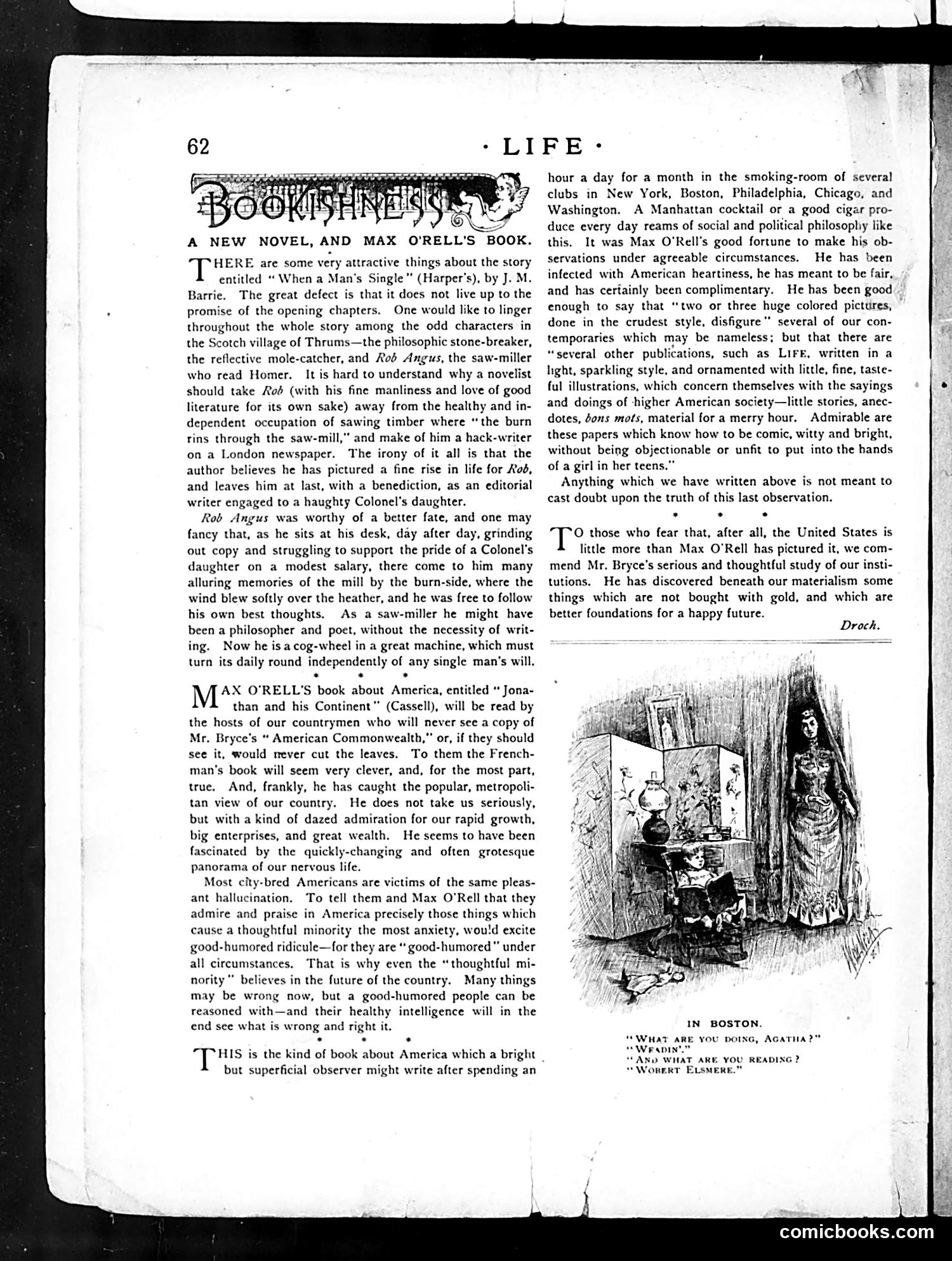
This page is primarily a **book review section** titled "Book Notices," not political cartoons. It reviews three novels: J.M. Barrie's "When a Man's Single," Max O'Rell's "Jonathan and his Continent," and James Bryce's "American Commonwealth." The small illustration labeled "IN BOSTON" appears to be a **social scene sketch** showing figures in Victorian-era dress, with dialogue referencing reading habits. The caption lists character names including "Agatha" and "Worbert Elsmere." The reviews critique American society and institutions with gentle satire—praising Bryce's serious institutional analysis while mocking O'Rell's superficial observations of American "rapid growth" and "nervous life." This reflects late-19th-century literary discourse about American character and society.
📄 Transcribed text from this page (OCR, searchable)
Machine-transcribed from the original scan — historical spelling and the odd misread are preserved.
- LIFE: A NEW NOVEL, AND MAX O'RELL'S ‘BOOK. HERE are some very attractive things about the story entitled “ When a Man's Single" (Harper's), by J. M. Barrie. The great defect is that it does not live up to the promise of the opening chapters, One would like to linger throughout the whole story among the odd characters in the Scotch village of Thrums—the philosophic stone-breaker, the reflective mole-catcher, and Rod Angus, the saw-miller who read Homer. It is hard to understand why a novelist should take Roé (with his fine manliness and love of good literature for its own sake) away from the healthy and in- dependent occupation of sawing timber where “the burn tins through the saw-mill,” and make of him a hack-writer on a London newspaper. The irony of it all is that the author believes he has pictured a fine rise in life for Rod, and leaves him at last, with a benediction, as an editorial writer engaged to a haughty Colonel's daughter. Rob Angus was worthy of a better fate, and one may fancy that, as he sits at his desk, day after day, grinding out copy and struggling to support the pride of a Colonel's daughter on a modest salary, there come to him many alluring memories of the mill by the burn-side, where the wind blew softly over the heather, and he was free to follow his own best thoughts. As a saw-miller he might have been a philosopher and poet, without the necessity of writ- ing. Now he is a cog-wheel in a great machine, which must turn its daily round independently of any single man’s will. . . . AX O'RELL'S book about America, entitled “ Jona- than and his Continent” (Cassell), will be read by the hosts of our countrymen who will never see a copy of Mr. Bryce’s “ American Commonwealth,” or, if they should see it, would mever cut the leaves. To them the French- man's book will seem very clever, and, for the most part, true, And, frankly, he has caught the popular, metropoli- tan view of our country. He does not take us seriously, but with a kind of dazed admiration for our rapid growth, big enterprises, and great wealth. He seems to have been fascinated by the quickly-changing and often grotesque panorama of our nervous life. Most city-bred Americans are victims of the same pleas- ant hallucination. To tell them and Max O'Rell that they admire and praise in America precisely those things which cause a thoughtful minority the most anxiety, wou!d excite good-humored ridicule—for they are “ good-humored" under all circumstances. That is why even the “thoughtful mi- nority” believes in the future of the country. Many things may be wrong now, but a good-humored people can be reasoned with—and their healthy intelligence will in the end see what is wrong and right it. HIS is the kind of book about America which a bright but superficial observer might write after spending an hour a day for a month in the smoking-room of several clubs in New York, Boston, Philadelphia, Chicago, and Washington. A Manhattan cocktail or a good cigar pro- duce every day reams of social and political philosophy like this. It was Max O’Rell’s good fortune to make his ob- servations under agreeable circumstances. He has been infected with American heartiness, he has meant to be fair, and has certainly been complimentary. He has been good enough to say that “two or three huge colored pictures, © done in the crudest style, disfigure" several of our con- temporaries which may be nameless; but that there are “several other publications, such as LIFE, written in a light, sparkling style, and ornamented with little, fine, taste- ful illustrations, which concern themselves with the sayings and doings of -higher American society—little stories, anec- dotes, dons mots, material fora merry hour. Admirable are these papers which know how to be comic, witty and bright, without being objectionable or unfit to put into the hands of a girl in her teens.” Anything which we have written above is not meant to cast doubt upon the truth of this last observation. . . . O those who fear that, after all, the United States is little more than Max O'Rell has pictured it, we com- mend Mr. Bryce’s serious and thoughtful study of our insti- tutions. He has discovered beneath our materialism some things which are not bought with gold, and which are better foundations for a happy future. IN BOSTON. “WHAT ARE You DOING, AGATHA?” + Weapin “AND WHAT ARE YOU READING ? “Wonert ELSMeRe.” comicbooks.com