
A complete issue · 14 pages · 1888
Life — July 5, 1888
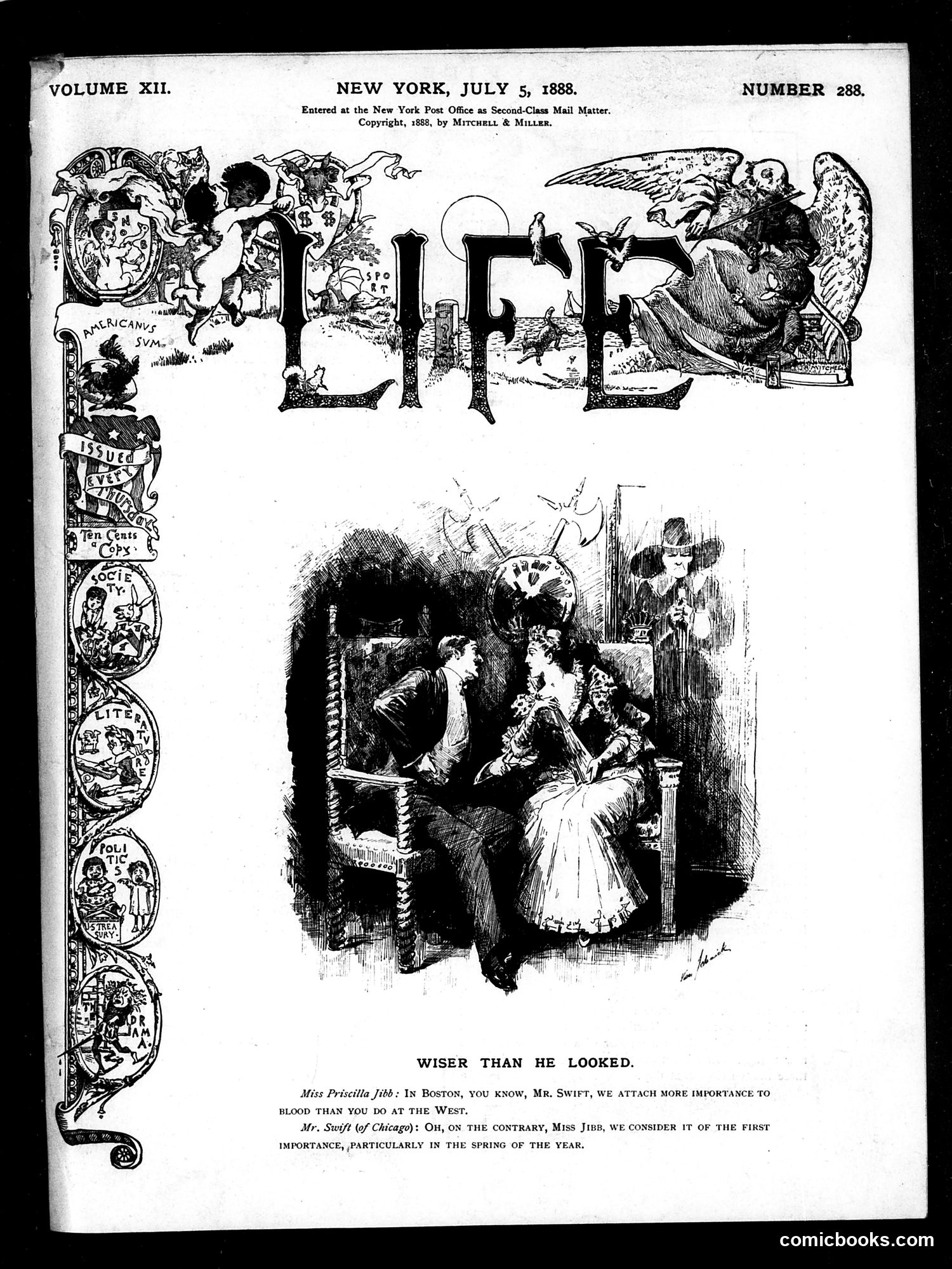
The main cartoon, titled "WISER THAN HE LOOKED," depicts a dialogue between two characters about regional differences. Miss Priscilla Jibb from Boston emphasizes the importance of "blood" (ancestry/breeding) in the East, while Mr. Swift from Chicago counters that the West prioritizes "blood" differently—"particularly in the spring of the year." The joke appears to satirize East-West cultural attitudes: the Boston character represents Eastern aristocratic values centered on family lineage, while the Chicago character makes a crude reference (likely to butchering/meat-packing, Chicago's major industry) to suggest practical, commercial concerns matter more in the West than genteel pedigree.
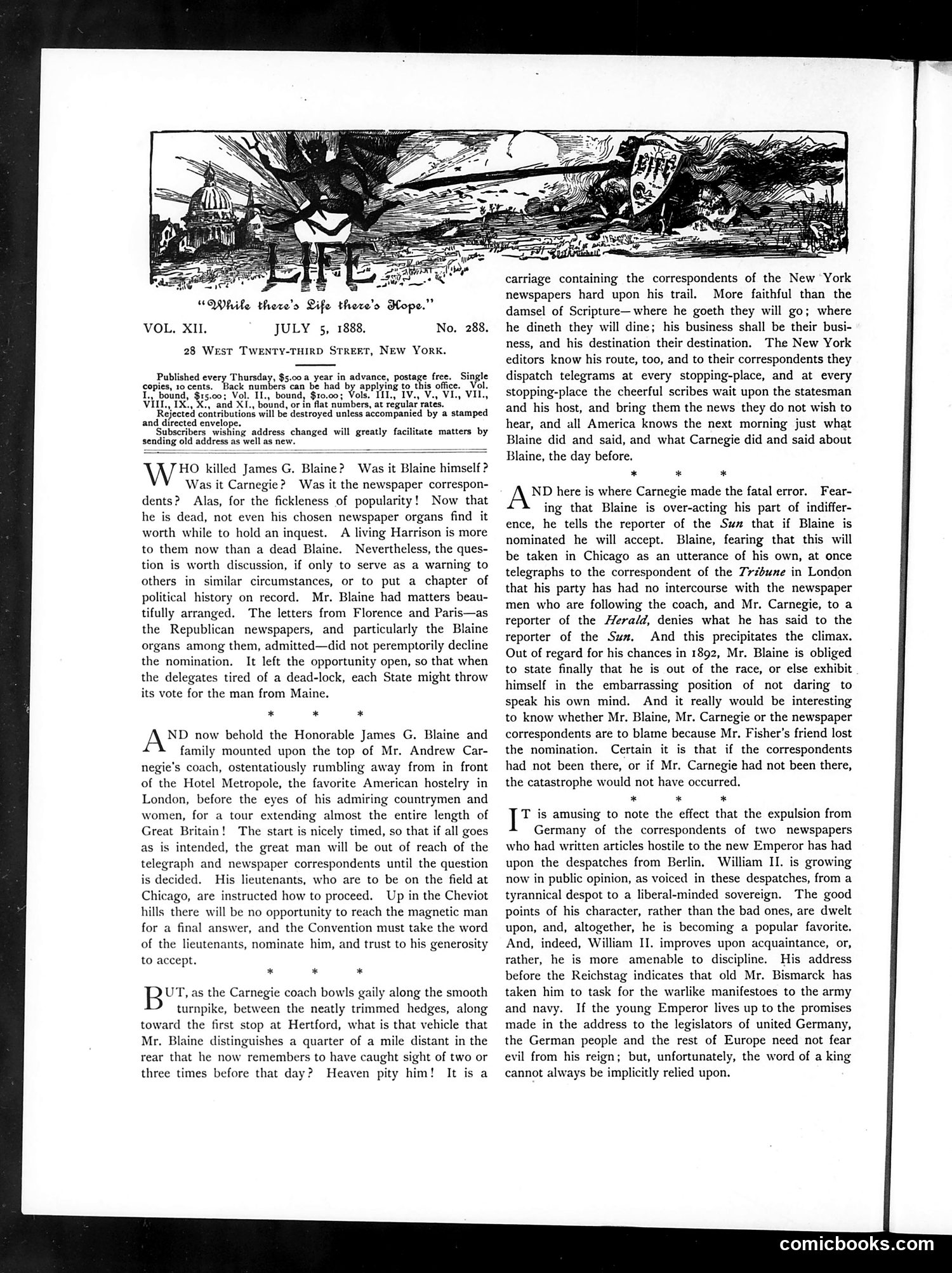
This *Life* magazine article satirizes James G. Blaine's 1892 presidential campaign. The text mocks the excessive media coverage surrounding Blaine's cross-country tour by coach, where newspaper correspondents followed him obsessively. The satire targets how Blaine attempted to manage his public image through the press—telegraphing messages to newspapers and trying to control what reporters wrote about him. The article suggests Blaine's strategist made a "fatal error" by over-managing the candidate's media presence, particularly regarding his relationship with James Carnegie (likely Andrew Carnegie's associate). The piece critiques both Blaine's campaign manipulation and the newspapers' complicity in following him so closely, illustrating the emerging tension between political candidates and press coverage in the Gilded Age.
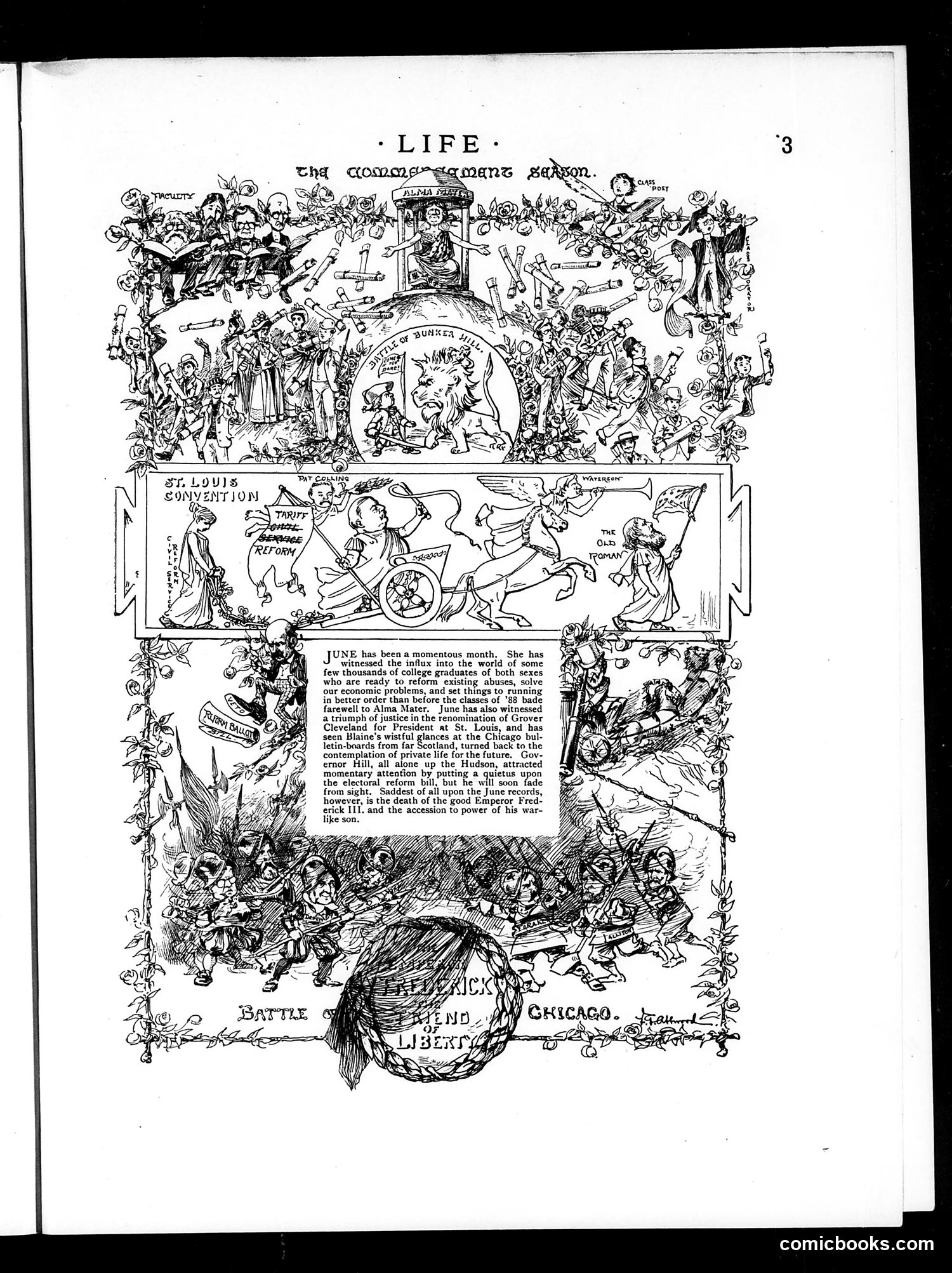
This page satirizes June 1912 political events. The top illustration depicts "The Coming Woman's Season" with competing figures and themes. The middle section references the **St. Louis Convention** and shows political figures (likely including Tariff Reform and related issues). The text mentions significant June events: **Grover Cleveland's** death, **Alma Mater** references, **Chicago bulletin-boards**, and **Hudson River** incidents. Most notably, it references **Emperor Frederick** (likely Wilhelm II's father) and a "son" succeeding to power—possibly alluding to European political succession. The bottom illustration shows a "Battle" scene labeled "Chicago" and "Liberty"—likely depicting the contentious 1912 Republican Convention chaos in Chicago, where Theodore Roosevelt and William Howard Taft competed, ultimately splitting the Republican Party.
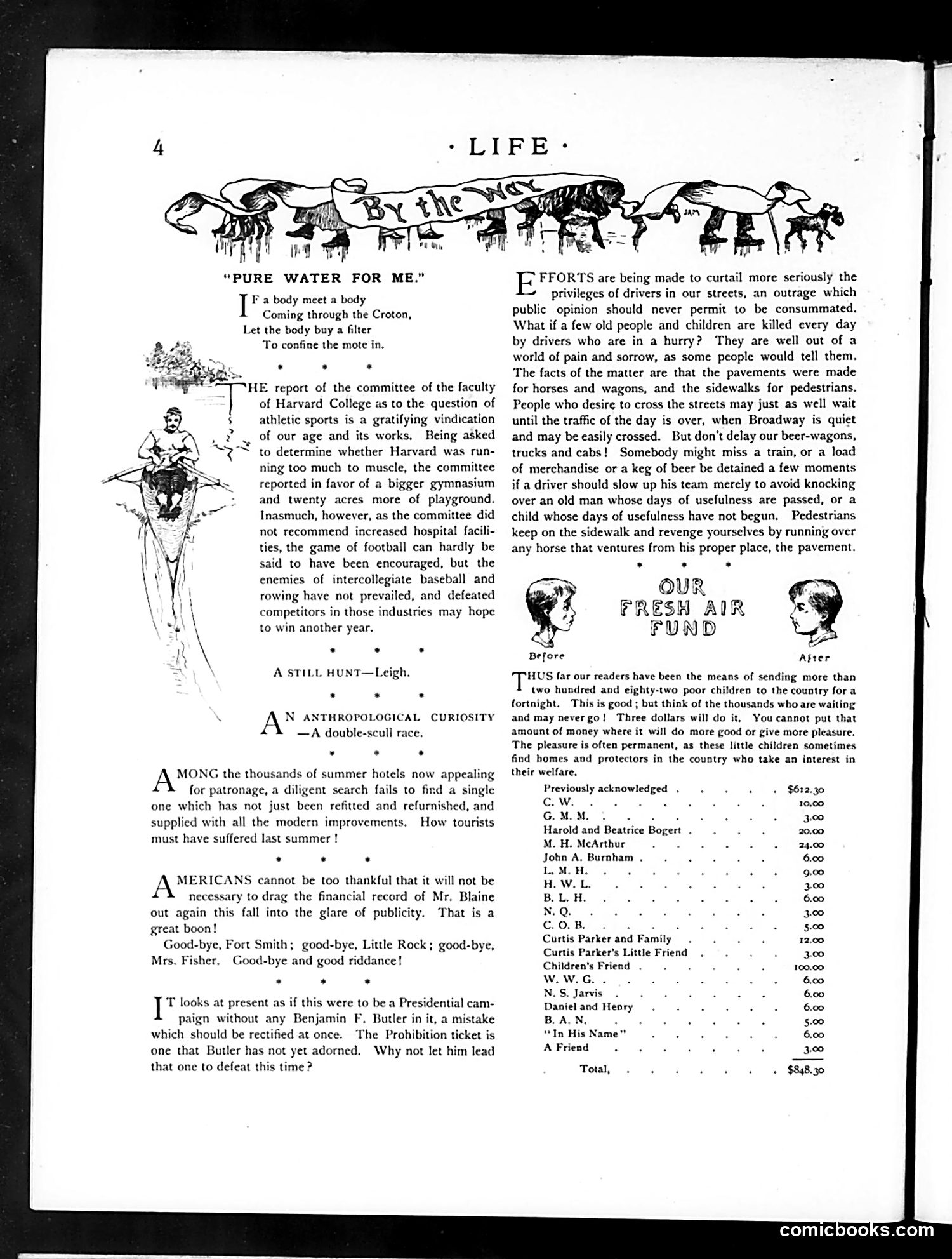
This page contains several satirical pieces from an early 20th-century *Life* magazine: **"Pure Water for Me"**: A short poem mocking someone arriving through the Croton (NYC's water system), humorously suggesting they want only water—likely poking fun at a teetotaler or someone from that region. **Harvard Athletics**: A paragraph criticizing Harvard's sports expansion, noting the committee rejected increased hospital facilities and football encouragement, suggesting misplaced priorities in university spending. **Street Traffic Safety**: A longer section sarcastically addressing reckless drivers killing pedestrians daily. It argues that waiting for traffic to clear is preferable to being struck—dark humor about urban traffic hazards that were apparently serious contemporary problems. **"Our Fresh Air Fund"**: Lists donations to send poor children to the country, with a "before/after" illustration showing apparent improvement. The page reflects Progressive Era concerns: urban safety, educational priorities, and charitable welfare.
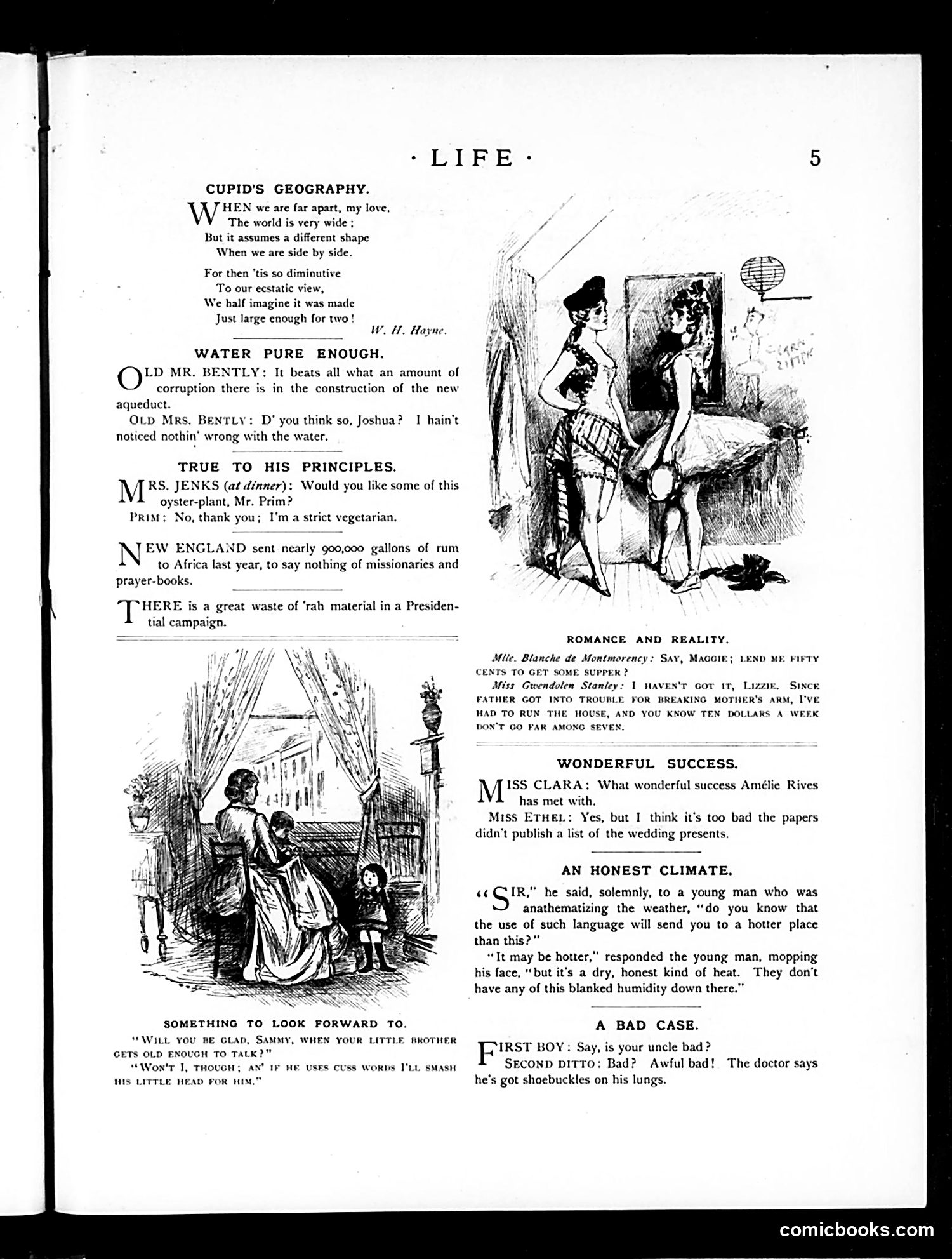
This page contains six brief humorous vignettes typical of early 20th-century satirical humor: **"Cupid's Geography"** and **"Water Pure Enough"** are romantic/domestic jokes requiring no historical context. **"True to His Principles"** mocks a strict vegetarian refusing oyster-plant at dinner—poking fun at dietary activists. **"New England sent nearly 900,000 gallons of rum to Africa"** appears to critique New England's hypocrisy: exporting alcohol while simultaneously sending missionaries and prayer-books to convert Africans. **"There is a great waste of 'rah' material in a Presidential campaign"** references election season excess. The remaining vignettes ("Romance and Reality," "Wonderful Success," etc.) are conventional domestic humor without obvious political content.
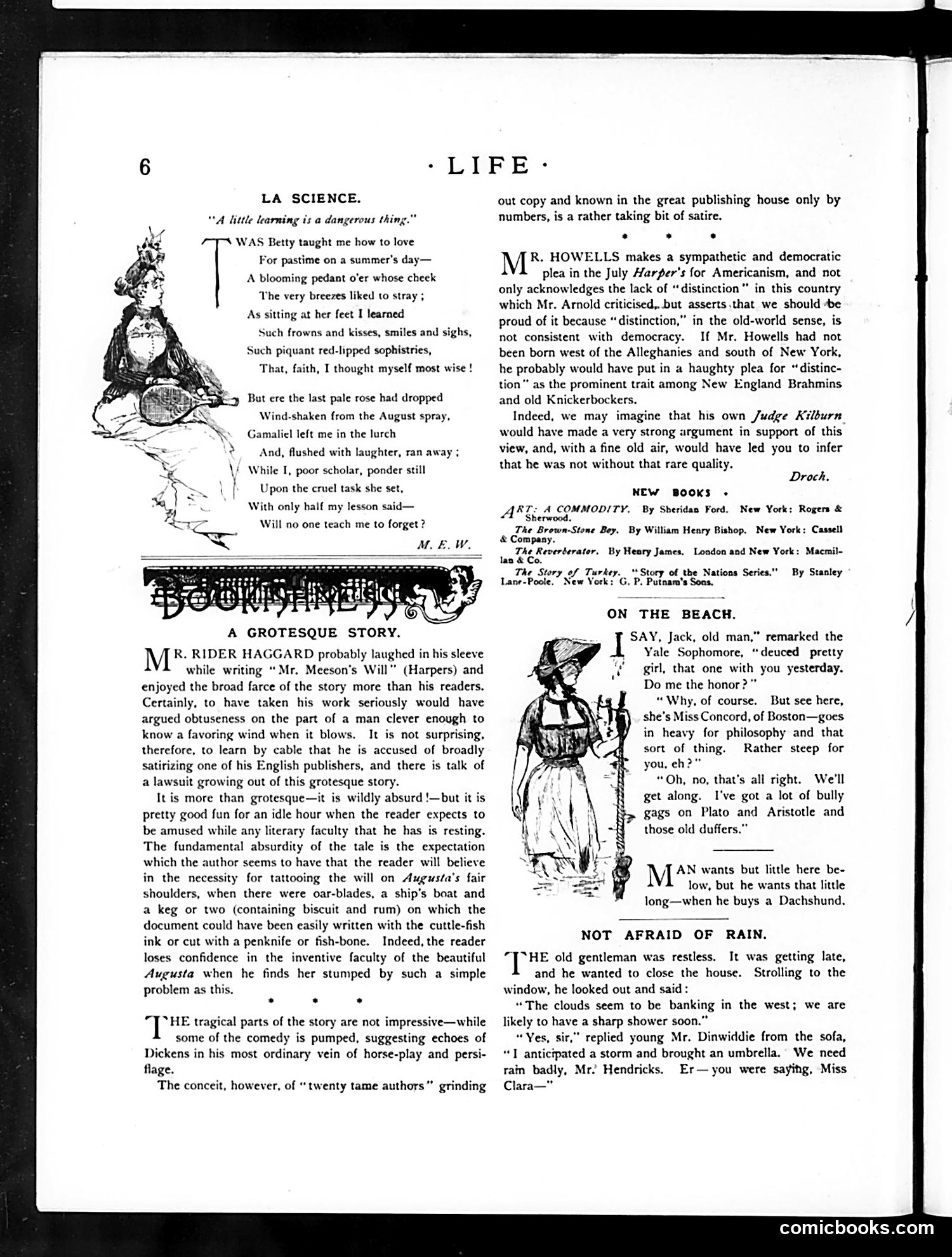
The page contains three distinct sections: **"La Science" (top left):** A humorous poem with illustration depicting a young woman learning about romance from nature—specifically from observing insects. The satire mocks sentimental Victorian-era romantic education. **"A Grotesque Story" (center):** A critical review of an H. Rider Haggard story ("Mr. Meeson's Will"). The reviewer satirizes the absurd plot requiring elaborate tattooing as legal documentation, mocking both the author's implausible invention and publishers' credulous acceptance of such nonsense. **"On the Beach" and "Not Afraid of Rain"** (right): Brief humorous dialogues about social interactions—a Yale student pursuing a Boston philosophy student, and an elderly man's casual attitude toward approaching weather. The page exemplifies Life's satirical approach to literature, romance, and social behavior of the era.
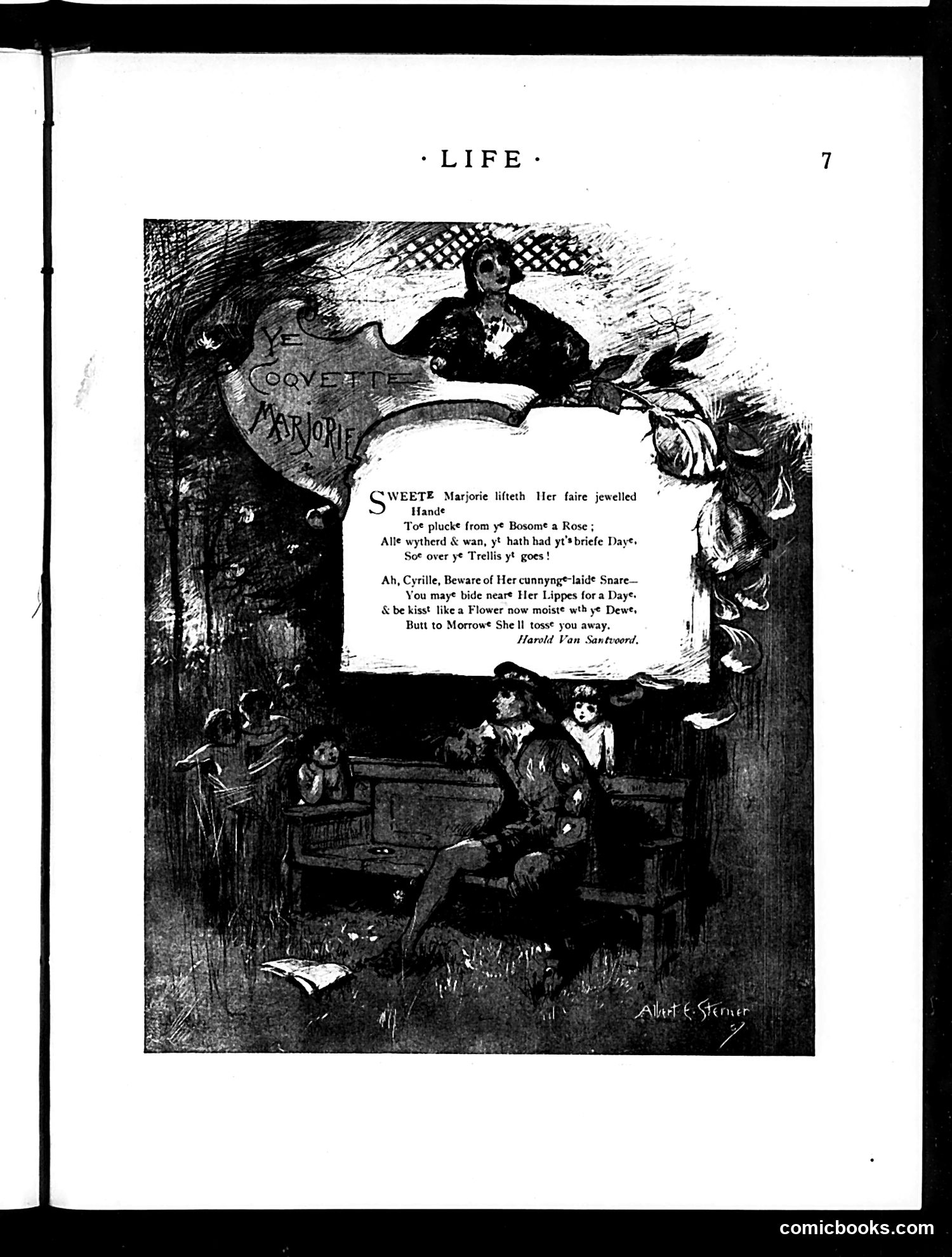
This page presents a satirical illustration by Albert Sterner featuring a romantic verse attributed to Harold Van Sarsfield. The poem addresses "Sweet Marjorie," praising her beauty and warning a character named Cyrille against romantic entanglement with her, suggesting she'll abandon him by tomorrow. The illustration depicts an theatrical scene: elegantly dressed figures observe from above (including what appears to be a woman labeled "Coquette Marjorie"), while below, a group of working-class or bohemian characters sit together. The contrast between upper and lower figures suggests social class commentary—the beautiful, capricious "Marjorie" of high society contrasted against ordinary people below. The satire targets romantic idealization and the fickle nature of society women, a common Life magazine theme mocking upper-class affectation and superficiality.
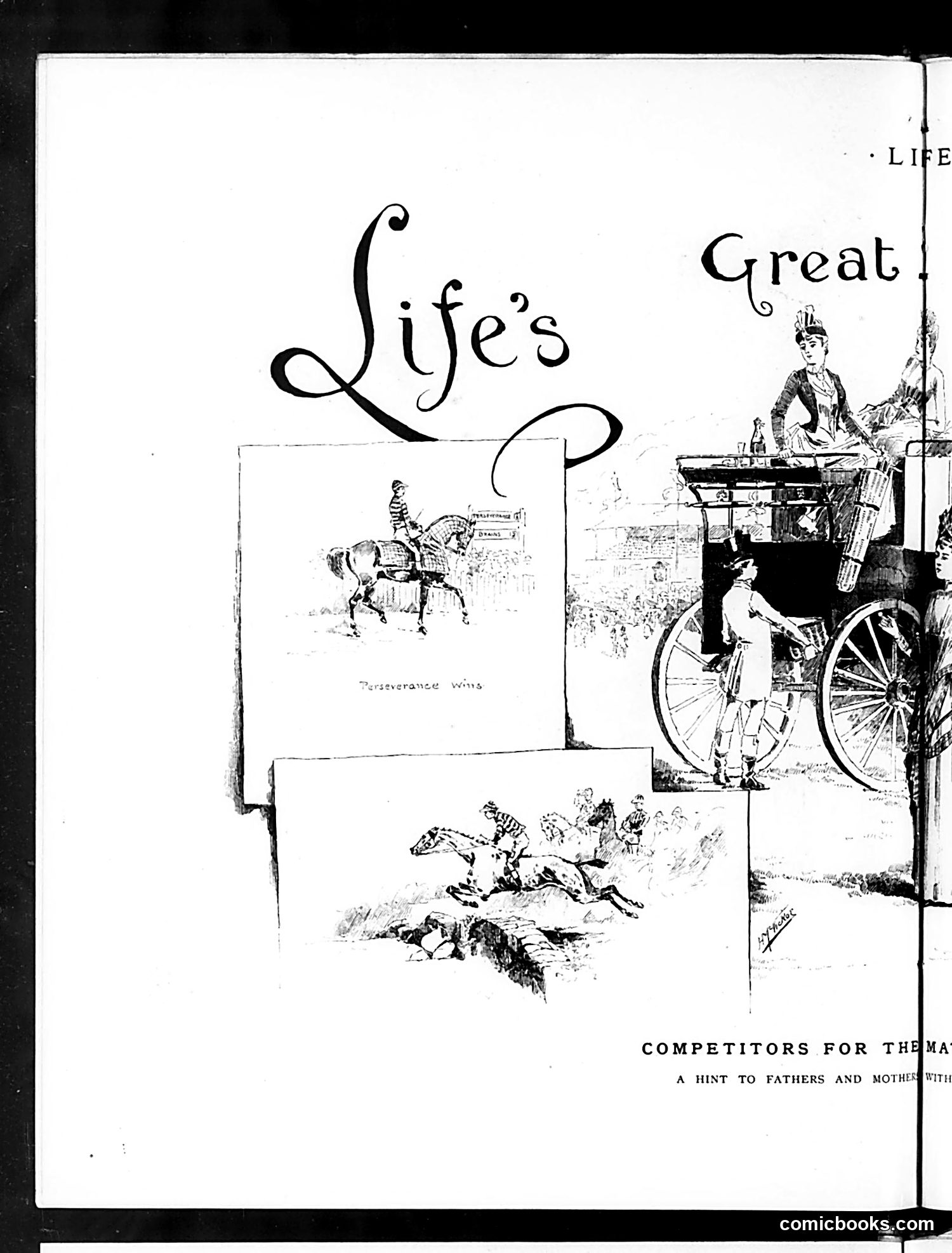
This appears to be a title/contents page from *Life* magazine featuring the heading "Life's Great" with three illustrations below depicting various activities: horseback riding, cycling, and what appears to be fox hunting or a similar field sport. The partial text at bottom reads "COMPETITORS FOR THE MA[?]" and "A HINT TO FATHERS AND MOTHE[RS] WITH[?]" The satire seems to concern itself with leisure activities and outdoor pursuits available to the wealthy or upper classes. Without seeing the complete text or the full article, the exact social critique remains unclear, but it likely comments on competitive pastimes among society's privileged members—possibly satirizing their pursuits as frivolous or commenting on class distinctions in recreational activities. The "hint to fathers and mothers" suggests parental concern about children's participation in these activities.
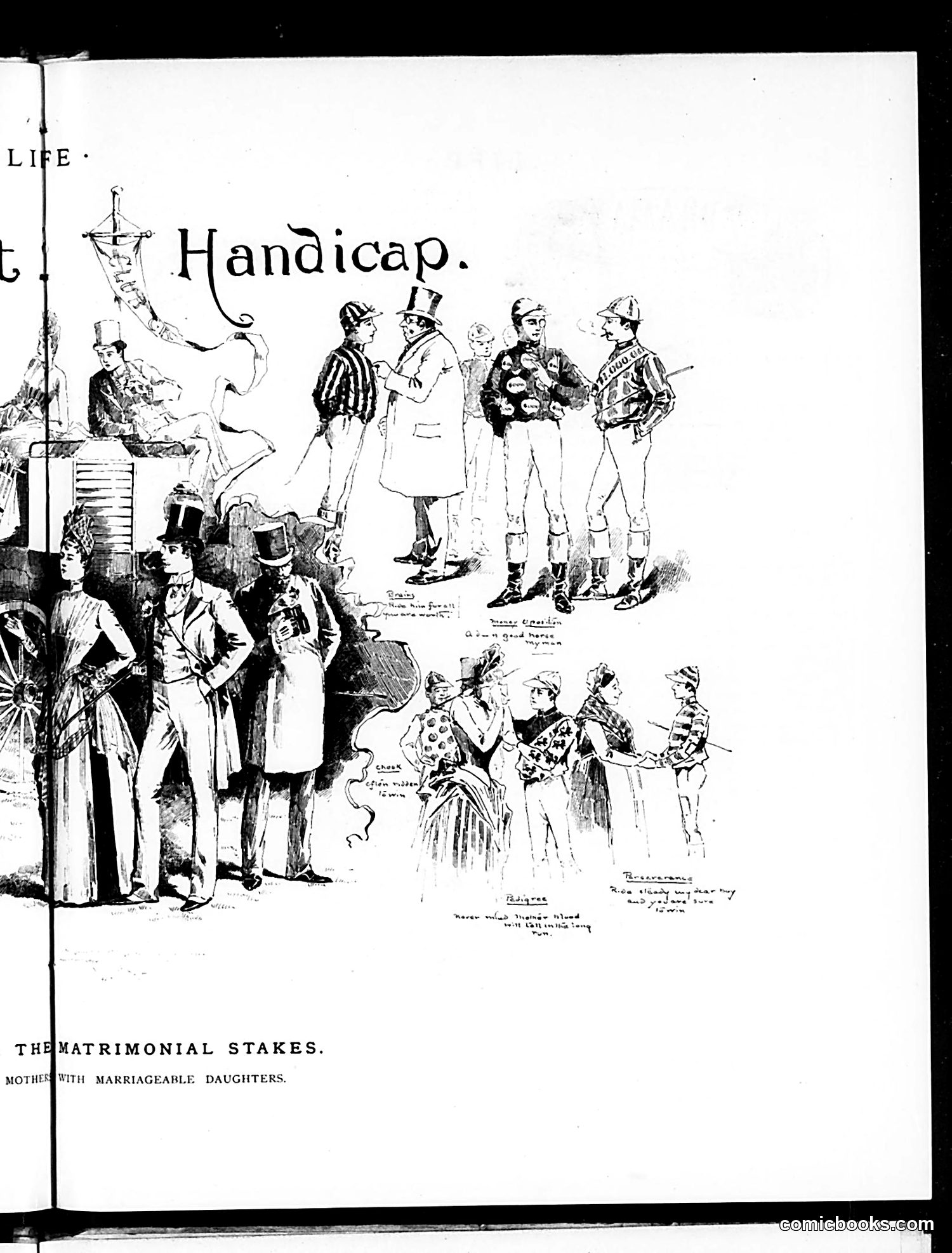
This satirical cartoon from *Life* magazine uses horse-racing terminology to mock marriage, specifically targeting the "marriage market" for wealthy daughters. The title "The Matrimonial Stakes" with subtitle "Mothers with Marriageable Daughters" compares finding husbands to betting on horses. The left panel shows elegantly-dressed mothers and daughters presented as if they're racing stock being evaluated. The right panels depict various male "competitors"—military officers, aristocrats, and gentlemen in formal dress—as if they're suitors being handicapped or assessed like racehorses. The satire critiques how mothers strategically position their daughters in high society to attract advantageous marriages, reducing both women and men to commodities in a calculated competition for wealth and status.
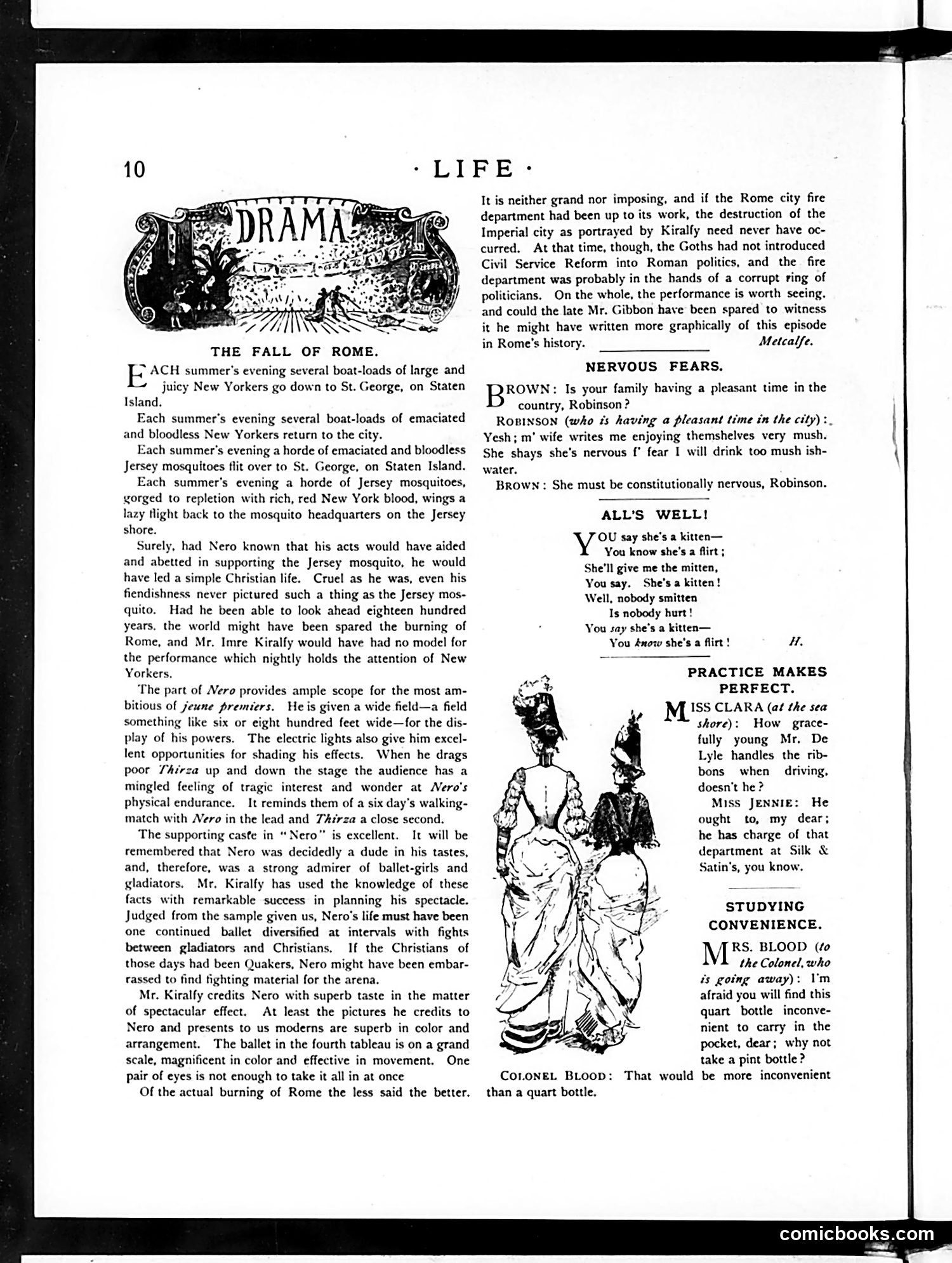
This page satirizes a contemporary theatrical production of Nero's Rome. The drama section critiques the spectacle's historical authenticity and staging choices, particularly regarding the fire department's competence. The satire suggests that if Rome's fire department had been as effective as the depicted performance, the city wouldn't have burned—thereby mocking both the drama's realism and, implicitly, contemporary municipal governance (possibly New York City's fire department, given references to "New Yorkers" and Staten Island). The remaining content—brief comedic dialogues ("Nervous Fears," "All's Well," "Practice Makes Perfect," "Studying Convenience")—are unrelated humor pieces typical of Life's satirical magazine format, poking fun at social situations and class differences.
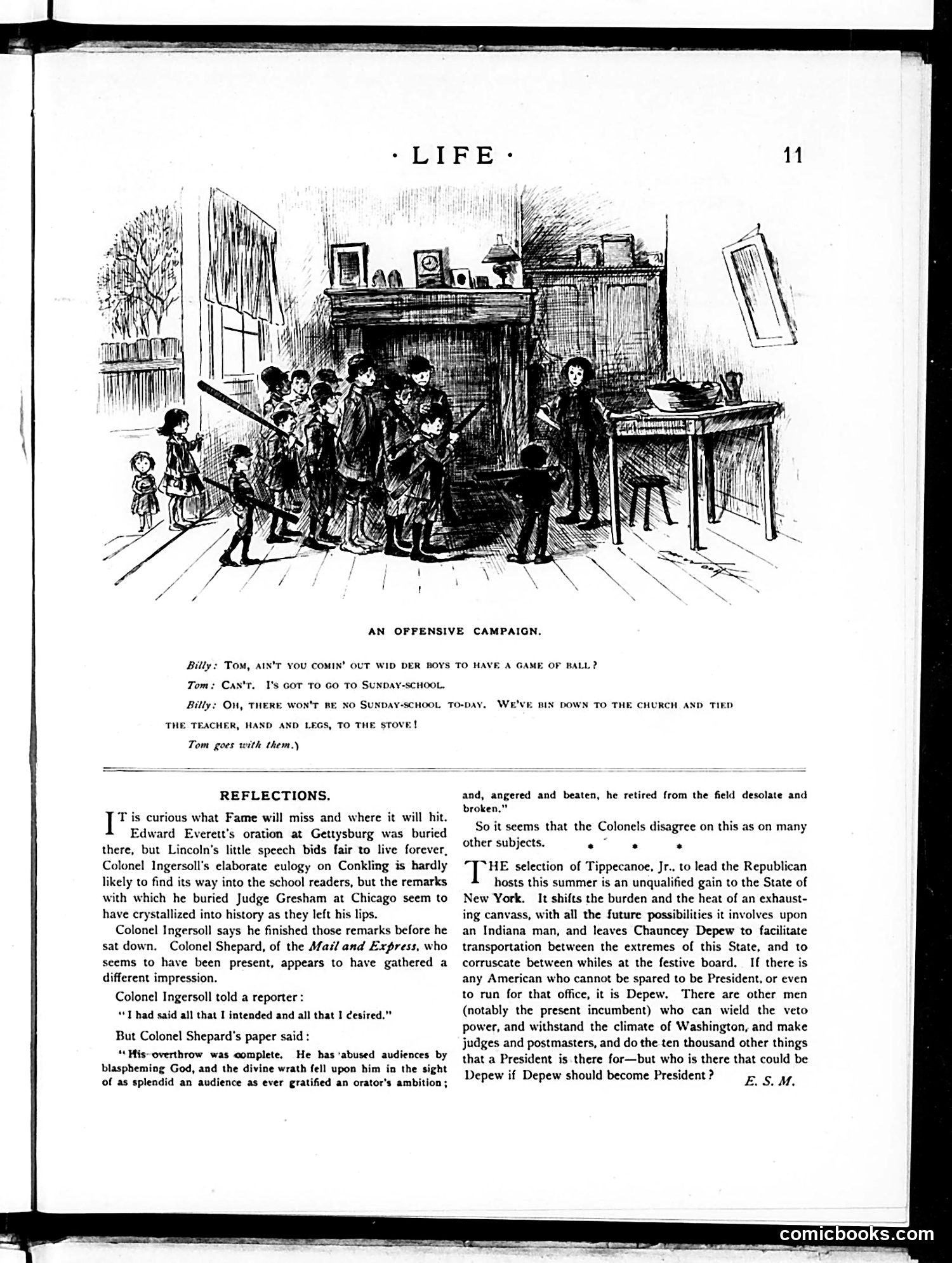
**The Cartoon:** This sketch depicts street children persuading a boy named Tom to skip Sunday school by claiming it won't meet that day. They plan to tie the teacher "hand and legs, to the stove"—depicting children plotting mischief against an authority figure. The satire mocks how children devise schemes to avoid religious instruction, presenting this as an "offensive campaign" against moral education. **The "Reflections" Section:** This commentary discusses Colonel Robert Ingersoll (a famous 19th-century orator and freethinker) and disputes over his speeches at notable funerals. It contrasts Ingersoll's claim he finished eloquently versus newspaper accounts showing he was "angered and beaten" into retreat. The piece satirizes disagreement over historical accounts and oratorical skill. The final section discusses Tippecanoe Jr. (likely William Henry Harrison Jr.) as a Republican presidential candidate, suggesting he's expendable compared to Vice President Chauncey Depew, whom the writer argues is irreplaceable for his political and social skills.
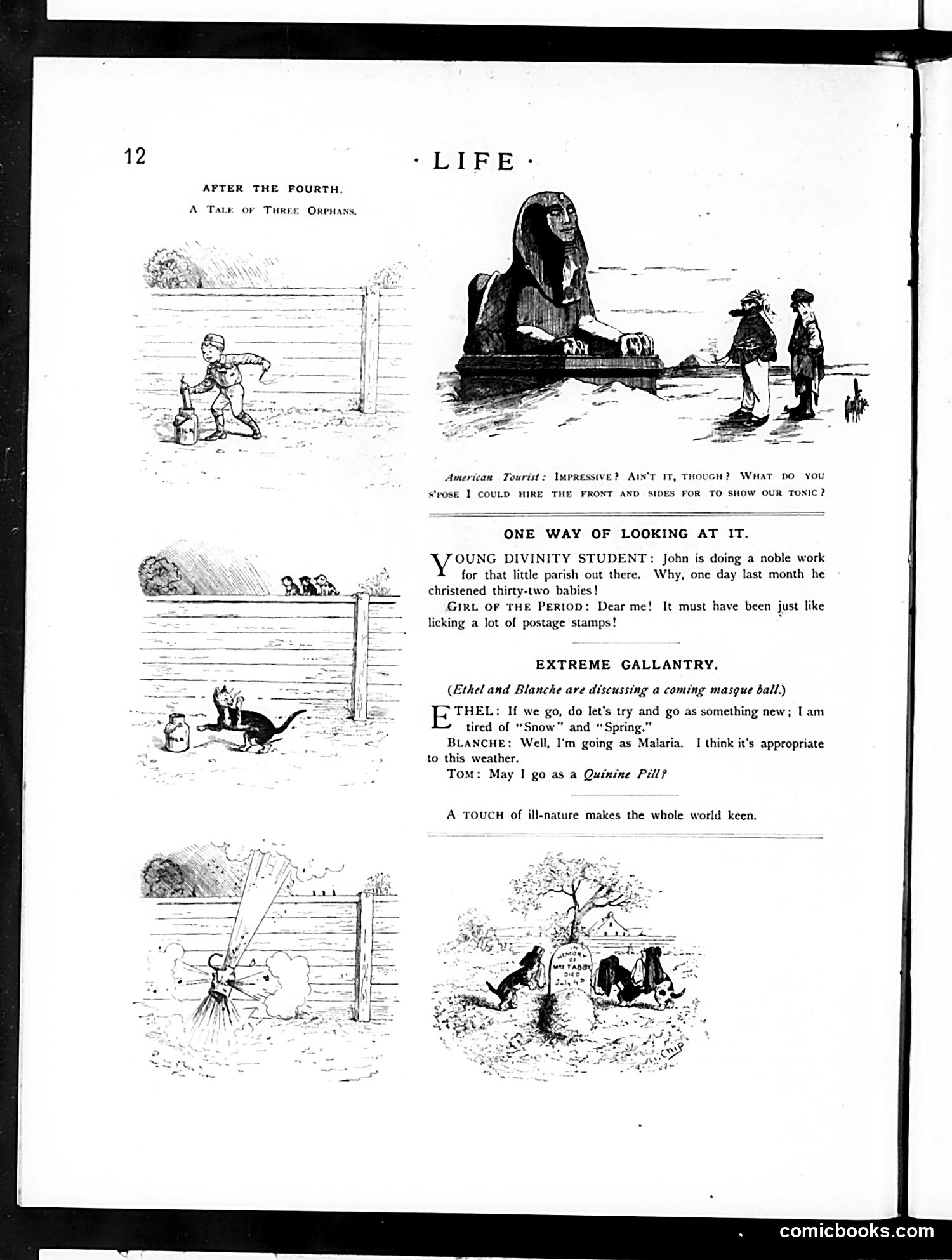
This page contains three separate satirical jokes typical of early 20th-century Life magazine: 1. **"After the Fourth"**: An American tourist admires a large Egyptian sphinx, asking to rent its front and sides to display as a "tonic" (patent medicine advertisement). The joke mocks American commercialism and the tourist impulse to commodify historical monuments. 2. **"One Way of Looking at It"**: A divinity student praises a minister who christened 32 babies in one month; a "Girl of the Period" compares it to "licking postage stamps"—a tedious, repetitive task. This satirizes modern women's perceived superficiality and detachment from religious solemnity. 3. **"Extreme Gallantry"**: Young people discussing masquerade costumes—one woman chooses "Malaria" as timely to the weather; a man offers to go as "Quinine Pill" (a fever remedy). The satire targets both illness-themed humor and young people's irreverent wit. The page's epigraph—"A touch of ill-nature makes the whole world keen"—frames these as examples of contemporary social mockery.
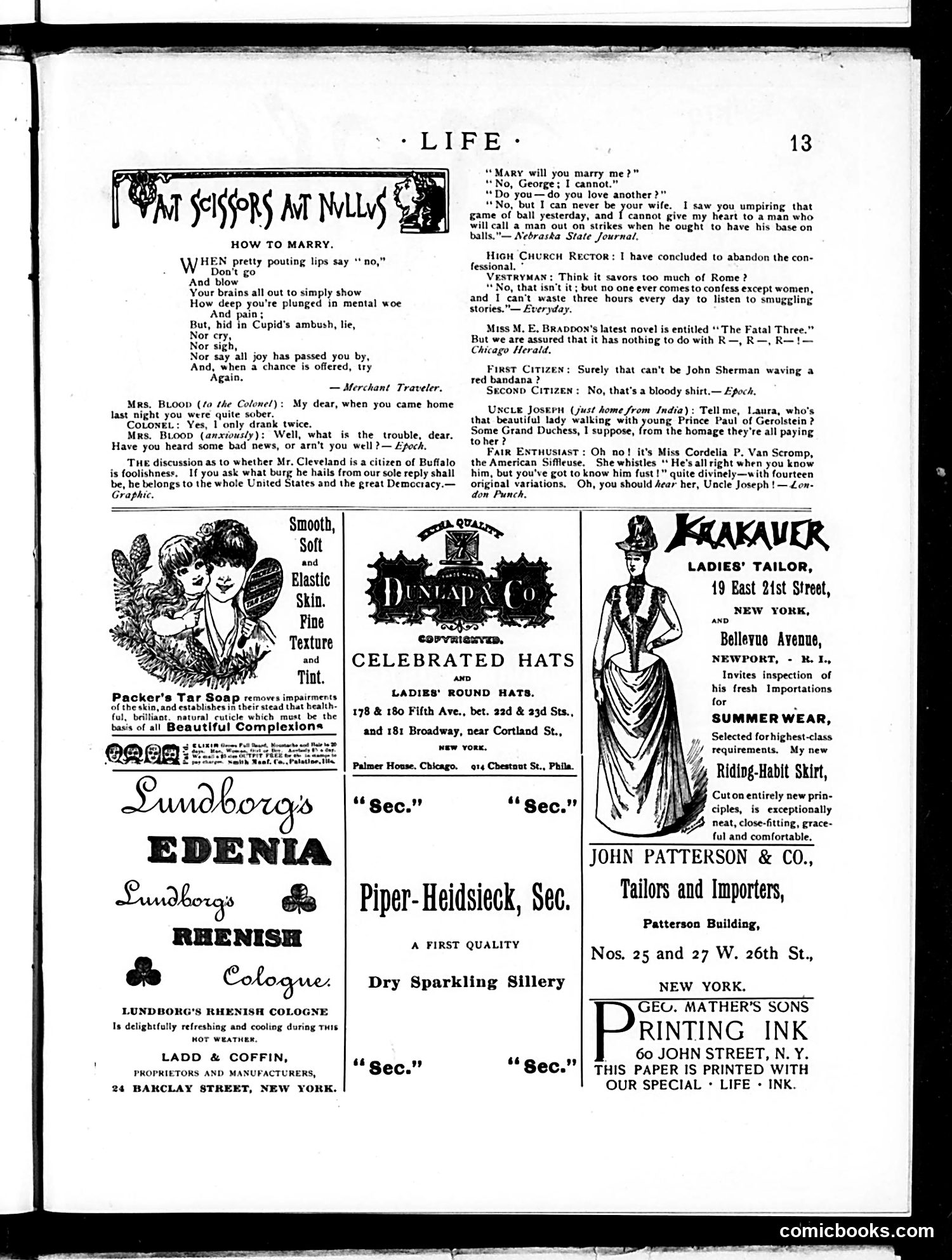
This page mixes brief satirical anecdotes with period advertisements. The humor targets contemporary social issues: **"At Singers and Nullys: How to Marry"** mocks romantic melodrama—advising against theatrical despair when rejected, instead recommending patient persistence. **The baseball joke** satirizes an umpire's incompetence: a woman refuses marriage because the man called a batter out on "strikes" when he should have been awarded "base on balls"—a technical rule violation suggesting poor judgment. **The confession anecdote** jokes that a High Church rector abandons the confessional because only women use it, wasting his time with "smuggling stories" (gossip). **Sherman reference** appears cryptic without dates, but "bloody shirt" alludes to post-Civil War Republican political rhetoric. The remaining items mock a congressman's origins, a "siffleuse" (female whistler) performer, and romantic pretense. The page is primarily **advertisements for luxury goods**: soap, cologne, hats, wines, tailoring—targeting affluent readers. This reflects *Life*'s audience and business model.
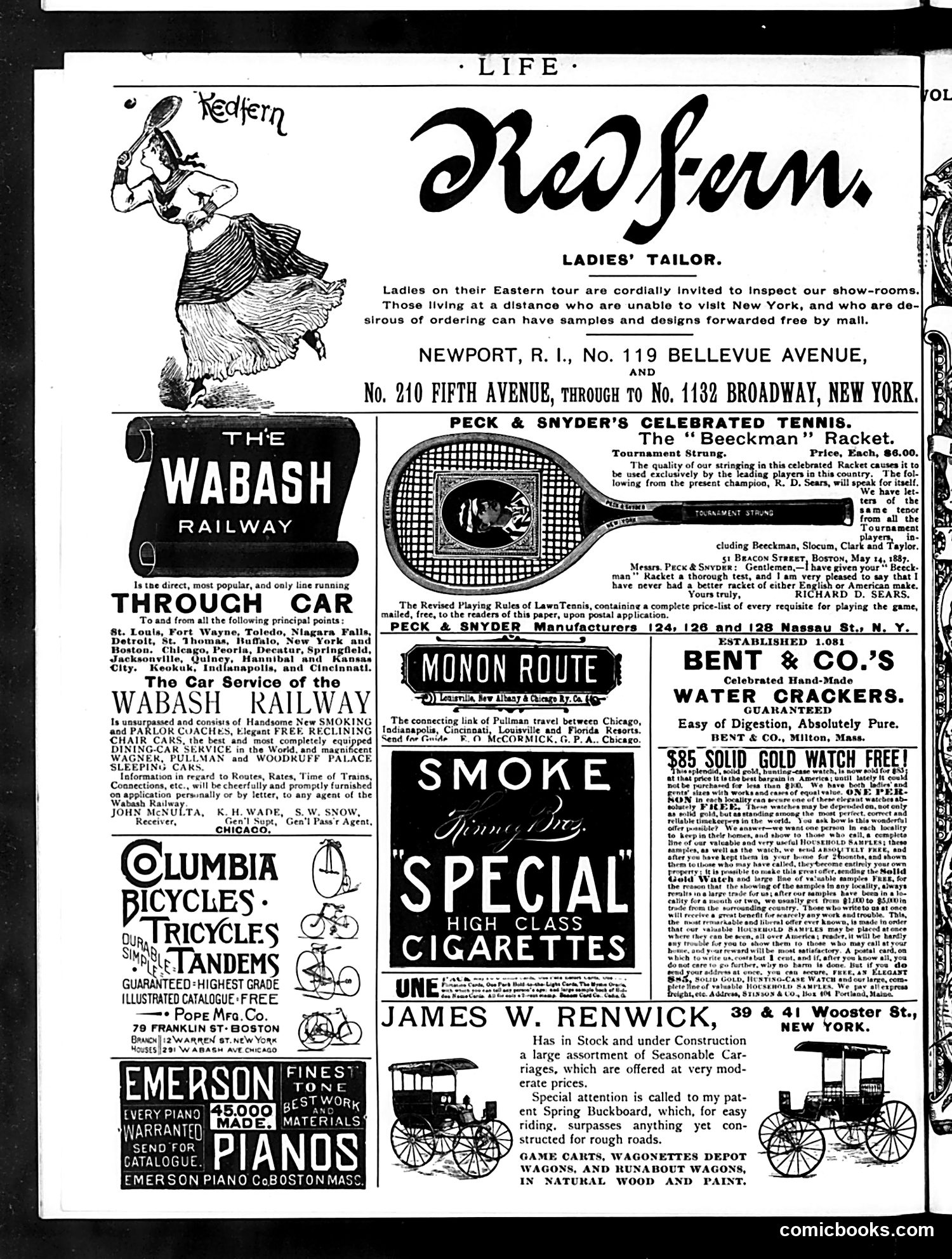
This page is primarily **advertising**, not satire or political commentary. It's a collection of late 19th-century product advertisements from Life magazine. Key advertisers include: - **Red Fern**: A ladies' tailor with locations in Newport and New York - **Wabash Railway**: Promoting through-car rail service to major cities - **Peck & Snyder**: Tennis equipment, endorsing their "Beeckman" racket with a testimonial from R.D. Sears (the champion player) - **Columbia Bicycles/Tricycles**: Pope Manufacturing Company bicycles - **Monon Route**: Pullman travel connections - **Special High Class Cigarettes** by James W. Renwick - **Bent & Co.**: Water crackers - **Emerson Piano Company** - **Bent & Co.**: Carriages and wagons The only visual element is a decorative illustration of a female figure labeled "Redfern" at the top—a fashion-advertisement mascot, not satire. The page reflects Gilded Age consumer culture targeting wealthy customers (note Newport addresses, Pullman cars, luxury goods).