
Life, 1888-07-05 · page 6 of 14
Life — July 5, 1888 — page 6: what you’re looking at
What you’re looking at
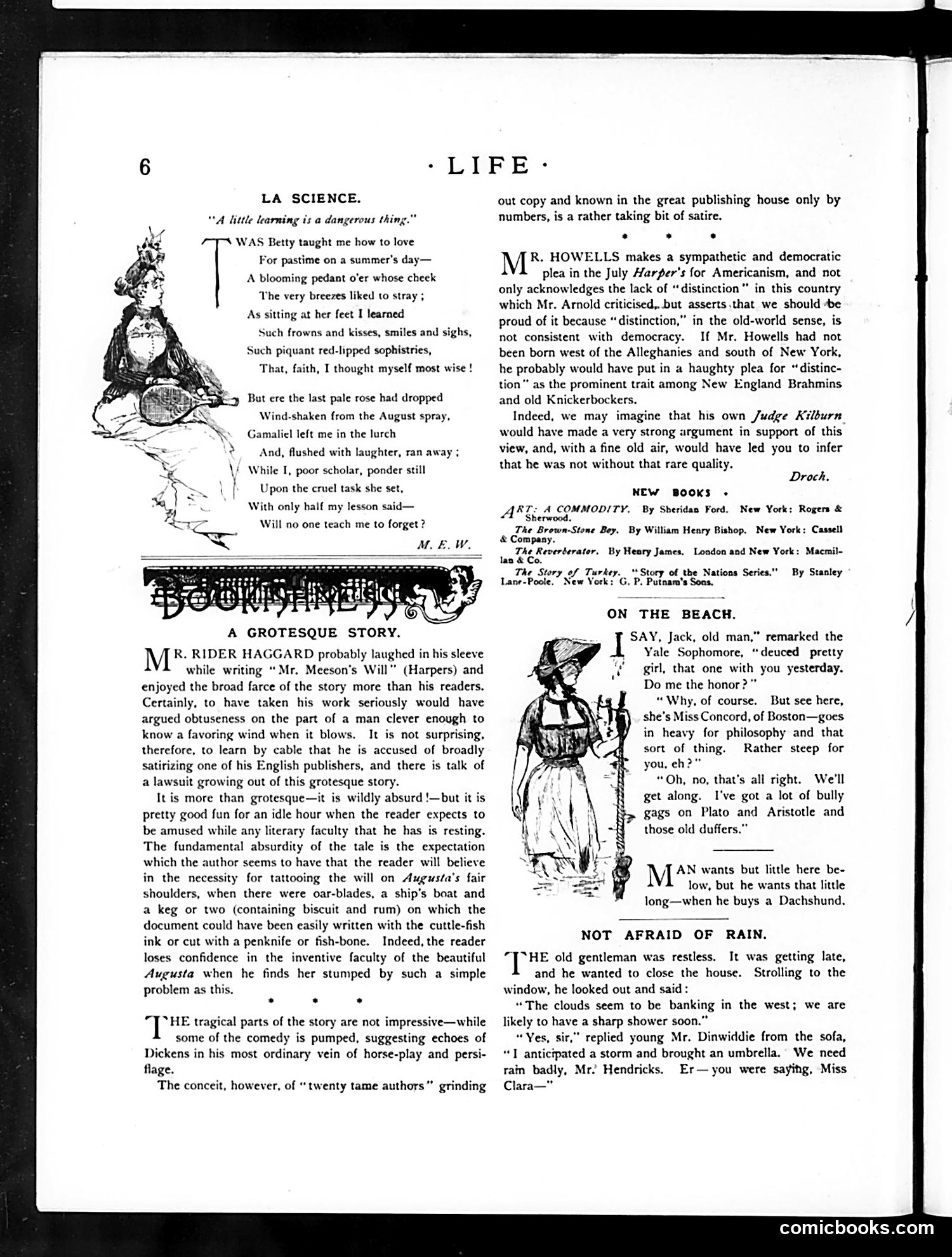
The page contains three distinct sections: **"La Science" (top left):** A humorous poem with illustration depicting a young woman learning about romance from nature—specifically from observing insects. The satire mocks sentimental Victorian-era romantic education. **"A Grotesque Story" (center):** A critical review of an H. Rider Haggard story ("Mr. Meeson's Will"). The reviewer satirizes the absurd plot requiring elaborate tattooing as legal documentation, mocking both the author's implausible invention and publishers' credulous acceptance of such nonsense. **"On the Beach" and "Not Afraid of Rain"** (right): Brief humorous dialogues about social interactions—a Yale student pursuing a Boston philosophy student, and an elderly man's casual attitude toward approaching weather. The page exemplifies Life's satirical approach to literature, romance, and social behavior of the era.
📄 Transcribed text from this page (OCR, searchable)
Machine-transcribed from the original scan — historical spelling and the odd misread are preserved.
- LIFE: LA SCIENCE. “A little learning is a dangerous thing.” WAS Betty taught me how to love For pastime on a summer's day— ‘A blooming pedant o'er whose cheek The very breezes liked to stray ; As sitting at her feet I learned Such frowns and kisses, smiles and sighs, Such piquant red-lipped sophistries, That, faith, I thought myself most wise ! But ere the last pale rose had dropped Wind-shaken from the August spray, Gamaliel left me in the lurch And, flushed with laughter, ran away ; 4 While I, poor scholar, ponder still Upon the cruel task she set, h only half my lesson said— Will no one teach me to forget ? MEW. A GROTESQUE STORY. R. RIDER HAGGARD probably laughed in his sleeve while writing “Mr. Meeson’s Will" (Harpers) and enjoyed the broad farce of the story more than his readers. Certainly, to have taken his work seriously would have argued obtuseness on the part of a man clever enough to know a favoring wind when it blows. It is not surprising, therefore, to learn by cable that he is accused of broadly satirizing one of his English publishers, and there is talk of a lawsuit growing out of this grotesque story. It is more than grotesque—it is wildly absurd !—but it is pretty good fun for an idle hour when the reader expects to be amused while any literary faculty that he has is resting. The fundamental absurdity of the tale is the expectation which the author seems to have that the reader will believe in the necessity for tattooing the will on Augusta's fair shoulders, when there were oar-blades, a ship’s boat and a keg or two (containing biscuit and rum) on which the document could have been easily written with the cuttle-fish ink or cut with a penknife or fish-bone. Indeed, the reader loses confidence in the inventive faculty of the beautiful Augusta when he finds her stumped by such a simple problem as this. . . . Te tragical parts of the story are not impressive—while some of the comedy is pumped, suggesting echoes of Dickens in his most ordinary vein of horse-play and persi- flage. The conceit, however, of “twenty tame authors” grinding out copy and known in the great publishing house only by numbers, is a rather taking bit of satire. . * . R. HOWELLS makes a sympathetic and democratic plea in the July Harper's for Americanism, and not only acknowledges the lack of “distinction” in this country which Mr. Arnold criticised,..but asserts that we should “be proud of it because “distinction,” in the old-world sense, is not consistent with democracy. If Mr. Howells had not been born west of the Alleghanies and south of New York, he probably would have put in a haughty plea for “distinc- tion” as the prominent trait among New England Brahmins and old Knickerbockers. Indeed, we may imagine that his own Judge Kilburn would have made a very strong argument in support of this view, and, with a fine old air, would have led you to infer that he was not without that rare quality. Droch, NEW BooKs - ART; A COMMODITY. By Sheridan Ford, New York: Rogers & The Brown-Stone Bey. By William Henry Bishop. New York: Cassell & Company. The Reverberater. By Heary James, London and New York: Macmil~ lan & Co. The Story of Turkey. By Stanley Lane-Poole. haar “Story of the Nations Series.” New York: G. P. Putnaro's Soas. ON THE BEACH. SAY, Jack, old man,” remarked the Yale Sophomore, “deuced pretty girl, that one with you yesterday. Do me the honor?” “Why, of course. But see here, she’s Miss Concord, of Boston—goes. in heavy for philosophy and that sort of thing. Rather steep for you, eh?” “Oh, no, that’s all right. We'll get along. I've got a lot of bully gags on Plato and Aristotle and those old duffers.”” M AN wants but little here be- low, but he wants that little long—when he buys a Dachshund. NOT AFRAID OF RAIN. Gite old gentleman was restless. It was getting late, and he wanted to close the house. Strolling to the window, he looked out and said : “The clouds seem to be banking in the west; we are likely to have a sharp shower soon.” “Yes, sir,” replied young Mr. Dinwiddie from the sofa, “I anticipated a storm and brought an umbrella. We need rain badly, Mr. Hendricks. Er— you were saying, Miss Clara—" comicbooks.com