
Life, 1888-07-05 · page 10 of 14
Life — July 5, 1888 — page 10: what you’re looking at
What you’re looking at
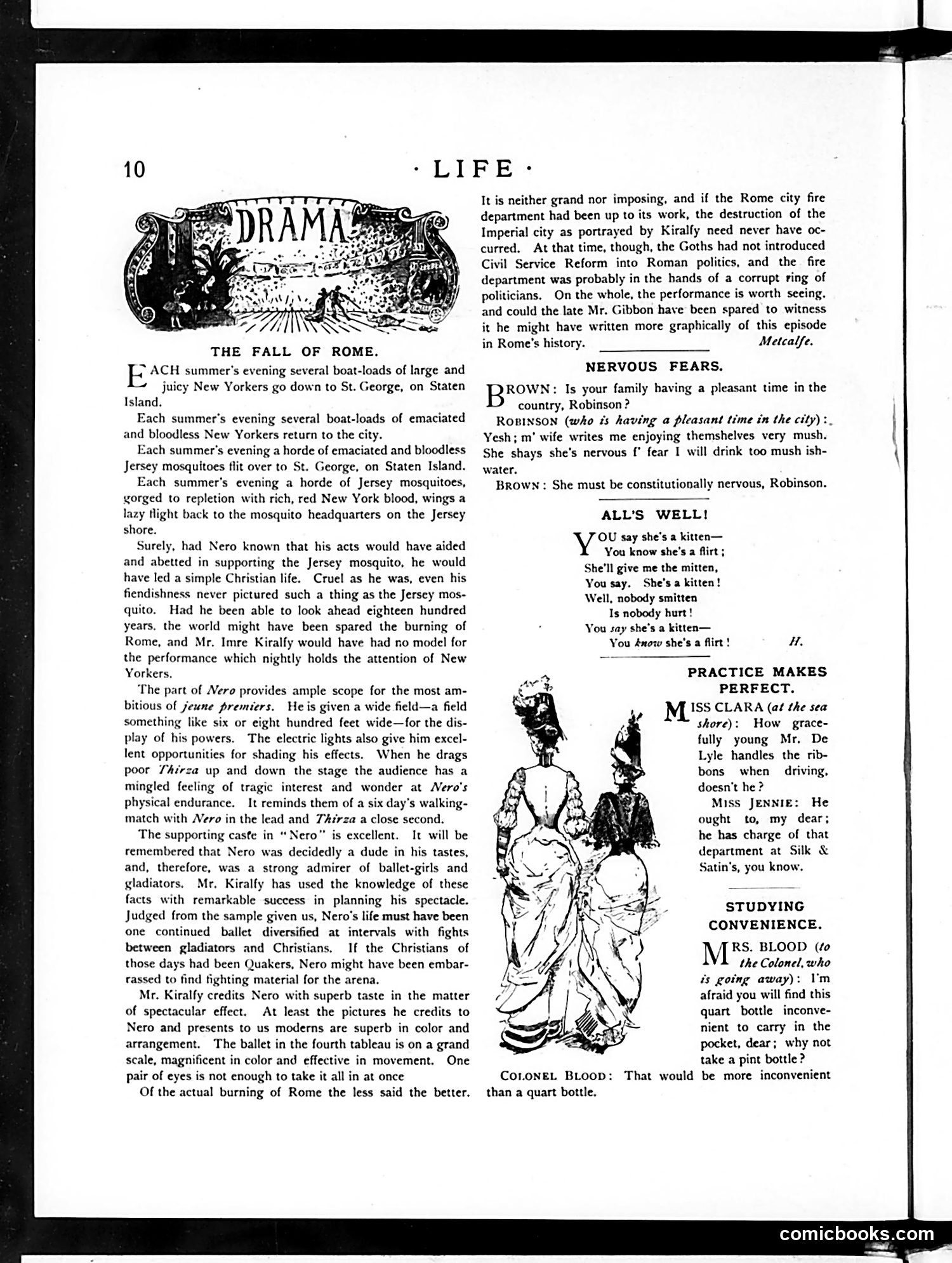
This page satirizes a contemporary theatrical production of Nero's Rome. The drama section critiques the spectacle's historical authenticity and staging choices, particularly regarding the fire department's competence. The satire suggests that if Rome's fire department had been as effective as the depicted performance, the city wouldn't have burned—thereby mocking both the drama's realism and, implicitly, contemporary municipal governance (possibly New York City's fire department, given references to "New Yorkers" and Staten Island). The remaining content—brief comedic dialogues ("Nervous Fears," "All's Well," "Practice Makes Perfect," "Studying Convenience")—are unrelated humor pieces typical of Life's satirical magazine format, poking fun at social situations and class differences.
📄 Transcribed text from this page (OCR, searchable)
Machine-transcribed from the original scan — historical spelling and the odd misread are preserved.
- LIFE: THE FALL OF ROME. 4 ACH summer's evening several boat-loads of large and —~ juicy New Yorkers go down to St. George, on Staten Island. Each summer's evening several boat-loads of emaciated and bloodless New Yorkers return to the city. Each summer's evening a horde of emaciated and bloodless Jersey mosquitoes flit over to St. George, on Staten Island. Each summer's evening a horde of Jersey mosquitoes, gorged to repletion with rich, red New York blood, wings a lazy flight back to the mosquito headquarters on the Jersey shore. Surely, had Nero known that his acts would have aided and abetted in supporting the Jersey mosquito, he would have led a simple Christian life. Cruel as he was, even his fiendishness never pictured such a thing as the Jersey mos- quito. Had he been able to look ahead eighteen hundred years, the world might have been spared the burning of Rome, and Mr. Imre Kiralfy would have had no model for the performance which nightly holds the attention of New Yorkers. The part of Nero provides ample scope for the most am- bitious of jeune premiers. He is given a wide field—a field something like six or eight hundred feet wide—for the dis- play of his powers. The electric lights also give him excel- lent opportunities for shading his effects. When he drags poor 7Airza up and down the stage the audience has a mingled feeling of tragic interest and wonder at Nero's physical endurance. It reminds them of a six day’s walking- match with Nero in the lead and 7srza a close second. The supporting caste in “Nero” is excellent. It will be remembered that Nero was decidedly a dude in his tastes, and, therefore, was a strong admirer of ballet-girls and gladiators. Mr. Kiralfy has used the knowledge of these facts with remarkable success in planning his spectacle. Judged from the sample given us, Nero's life must have been one continued ballet diversified at intervals with fights between gladiators and Christians. If the Christians of those days had been Quakers, Nero might have been embar- rassed to find fighting material for the arena. Mr. Kiralfy credits Nero with superb taste in the matter of spectacular effect. At least the pictures he credits to Nero and presents to us moderns are superb in color and arrangement. The ballet in the fourth tableau is on a grand scale, magnificent in color and effective in movement. One pair of eyes is not enough to take it all in at once Of the actual burning of Rome the less said the better. It is neither grand nor imposing, and if the Rome city fire department had been up to its work, the destruction of the Imperial city as portrayed by Kiralfy need never have oc- curred. At that time, though, the Goths had not introduced Civil Service Reform into Roman politics, and the fire department was probably in the hands of a corrupt ring of politicians. On the whole, the performance is worth seeing, and could the late Mr. Gibbon have been spared to witness it he might have written more graphically of this episode in Rome's history. Metcalfe. NERVOUS FEARS. ROWN: Is your family having a pleasant time in the country, Robinson ? ROBINSON (who #s having a pleasant time in the city) :. Yesh; m' wife writes me enjoying themshelves very mush. She shays she’s nervous f" fear I will drink too mush ish- water. Brown: She must be constitutionally nervous, Robinson. ALL'S WELL! OU say she’s a kitten— You know she's a flirt ; She'll give me the mitten, You say. She's a kitten! Well, nobody smitten Is nobody hurt! You say she’s a kitten— You Anozw she's a flirt! HH. PRACTICE MAKES PERFECT. M's CLARA (at the sea shore): How grace- fully young Mr, De Lyle handles the rib- bons when driving, doesn’t he ? Miss JENNIE: He ought to, my dear; he has charge of that department at Silk & Satin’s, you know. STUDYING CONVENIENCE. M RS. BLOOD (fo the Colonel, who ts going away): \'m afraid you will find this quart bottle inconve- nient to carry in the pocket, dear; why not take a pint bottle? CoLoneL BLoop: That would be more inconvenient than a quart bottle, comicbooks.com