
Life, 1888-07-05 · page 2 of 14
Life — July 5, 1888 — page 2: what you’re looking at
What you’re looking at
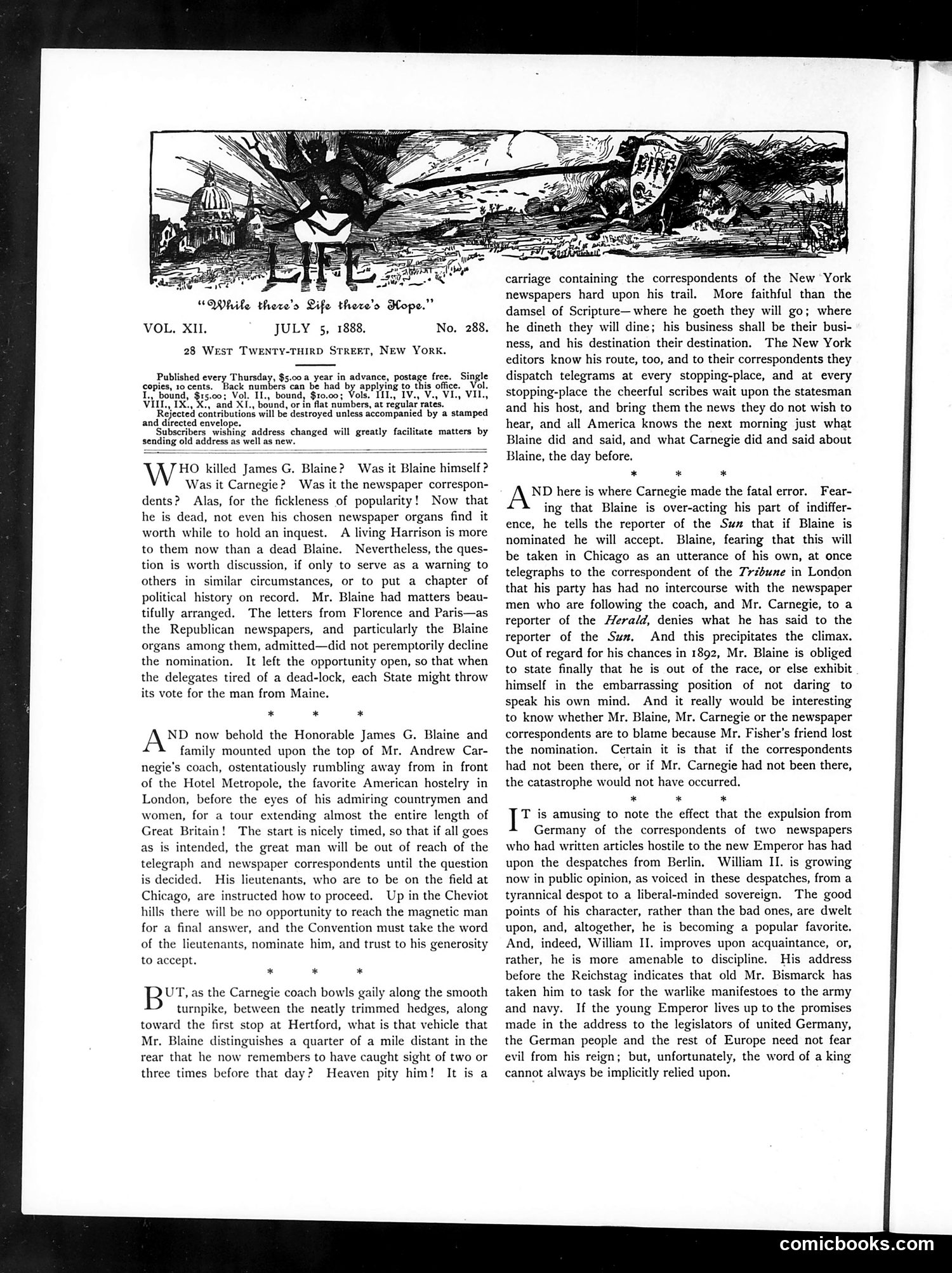
This *Life* magazine article satirizes James G. Blaine's 1892 presidential campaign. The text mocks the excessive media coverage surrounding Blaine's cross-country tour by coach, where newspaper correspondents followed him obsessively. The satire targets how Blaine attempted to manage his public image through the press—telegraphing messages to newspapers and trying to control what reporters wrote about him. The article suggests Blaine's strategist made a "fatal error" by over-managing the candidate's media presence, particularly regarding his relationship with James Carnegie (likely Andrew Carnegie's associate). The piece critiques both Blaine's campaign manipulation and the newspapers' complicity in following him so closely, illustrating the emerging tension between political candidates and press coverage in the Gilded Age.
📄 Transcribed text from this page (OCR, searchable)
Machine-transcribed from the original scan — historical spelling and the odd misread are preserved.
VOL. XII. JULY 5, 1888. No. 288. 28 West TWENTY-THIRD STREET, NEW York. Published every Thursday, $5.00 a year in advance, postage free. Single copies, 10 cents. Back numbers can be had by applying to this office. I,, bound, $15.00; Vol. II., bound, $10.00; Vols. IIL, IV., V.. VI. VIL, Vill., IX, X, and XI., bound, or in flat numbers, at regular rates. Rejected contributions will be destroyed unless accompanied by a stamped and directed envelope. Subscribers wishing address changed will greatly facilitate matters by sending old address as well as new. HO killed James G. Blaine? Was it Blaine himself? Was it Carnegie? Was it the newspaper correspon- dents? Alas, for the fickleness of popularity! Now that he is dead, not even his chosen newspaper organs find it worth while to hold an inquest. A living Harrison is more to them now than a dead Blaine. Nevertheless, the ques- tion is worth discussion, if only to serve as a warning to others in similar circumstances, or to put a chapter of political history on record. Mr. Blaine had matters beau- tifully arranged. The letters from Florence and Paris—as the Republican newspapers, and particularly the Blaine organs among them, admitted—did not peremptorily decline the nomination. It left the opportunity open, so that when the delegates tired of a dead-lock, each State might throw its vote for the man from Maine. * * * ND now behold the Honorable James G. Blaine and family mounted upon the top of Mr. Andrew Car- negie’s coach, ostentatiously rumbling away from in front of the Hotel Metropole, the favorite American hostelry in London, before the eyes of his admiring countrymen and women, for a tour extending almost the entire length of Great Britain! The start is nicely timed, so that if all goes as is intended, the great man will be out of reach of the telegraph and newspaper correspondents until the question is decided. His lieutenants, who are to be on the field at Chicago, are instructed how to proceed. Up in the Cheviot hills there will be no opportunity to reach the magnetic man for a final answer, and the Convention must take the word of the lieutenants, nominate him, and trust to his generosity to accept. * * * UT, as the Carnegie coach bowls gaily along the smooth turnpike, between the neatly trimmed hedges, along toward the first stop at Hertford, what is that vehicle that Mr. Blaine distinguishes a quarter of a mile distant in the rear that he now remembers to have caught sight of two or three times before that day? Heaven pity him! It is a carriage containing the correspondents of the New York newspapers hard upon his trail. More faithful than the damsel of Scripture—where he goeth they will go; where he dineth they will dine; his business shall be their busi- ness, and his destination their destination. The New York editors know his route, too, and to their correspondents they dispatch telegrams at every stopping-place, and at every stopping-place the cheerful scribes wait upon the statesman and his host, and bring them the news they do not wish to hear, and all America knows the next morning just what Blaine did and said, and what Carnegie did and said about Blaine, the day before. * * * A™® here is where Carnegie made the fatal error. Fear- ing that Blaine is over-acting his part of indiffer- ence, he tells the reporter of the Sus that if Blaine is nominated he will accept. Blaine, fearing that this will be taken in Chicago as an utterance of his own, at once telegraphs to the correspondent of the 7zbune in London that his party has had no intercourse with the newspaper men who are following the coach, and Mr. Carnegie, to a reporter of the Hera/d, denies what he has said to the reporter of the Su#, And this precipitates the climax. Out of regard for his chances in 1892, Mr. Blaine is obliged to state finally that he is out of the race, or else exhibit himself in the embarrassing position of not daring to speak his own mind. And it really would be interesting to know whether Mr. Blaine, Mr. Carnegie or the newspaper correspondents are to blame because Mr. Fisher's friend lost the nomination. Certain it is that if the correspondents had not been there, or if Mr. Carnegie had not been there, the catastrophe would not have occurred. * * * T is amusing to note the effect that the expulsion from Germany of the correspondents of two newspapers who had written articles hostile to the new Emperor has had upon the despatches from Berlin, William II. is growing now in public opinion, as voiced in these despatches, from a tyrannical despot to a liberal-minded sovereign. The good points of his character, rather than the bad ones, are dwelt upon, and, altogether, he is becoming a popular favorite. And, indeed, William II. improves upon acquaintance, or, rather, he is more amenable to discipline. His address before the Reichstag indicates that old Mr. Bismarck has taken him to task for the warlike manifestoes to the army and navy. If the young Emperor lives up to the promises made in the address to the legislators of united Germany, the German people and the rest of Europe need not fear evil from his reign; but, unfortunately, the word of a king cannot always be implicitly relied upon. comicbooks.com