
A complete issue · 18 pages · 1888
Life — June 21, 1888
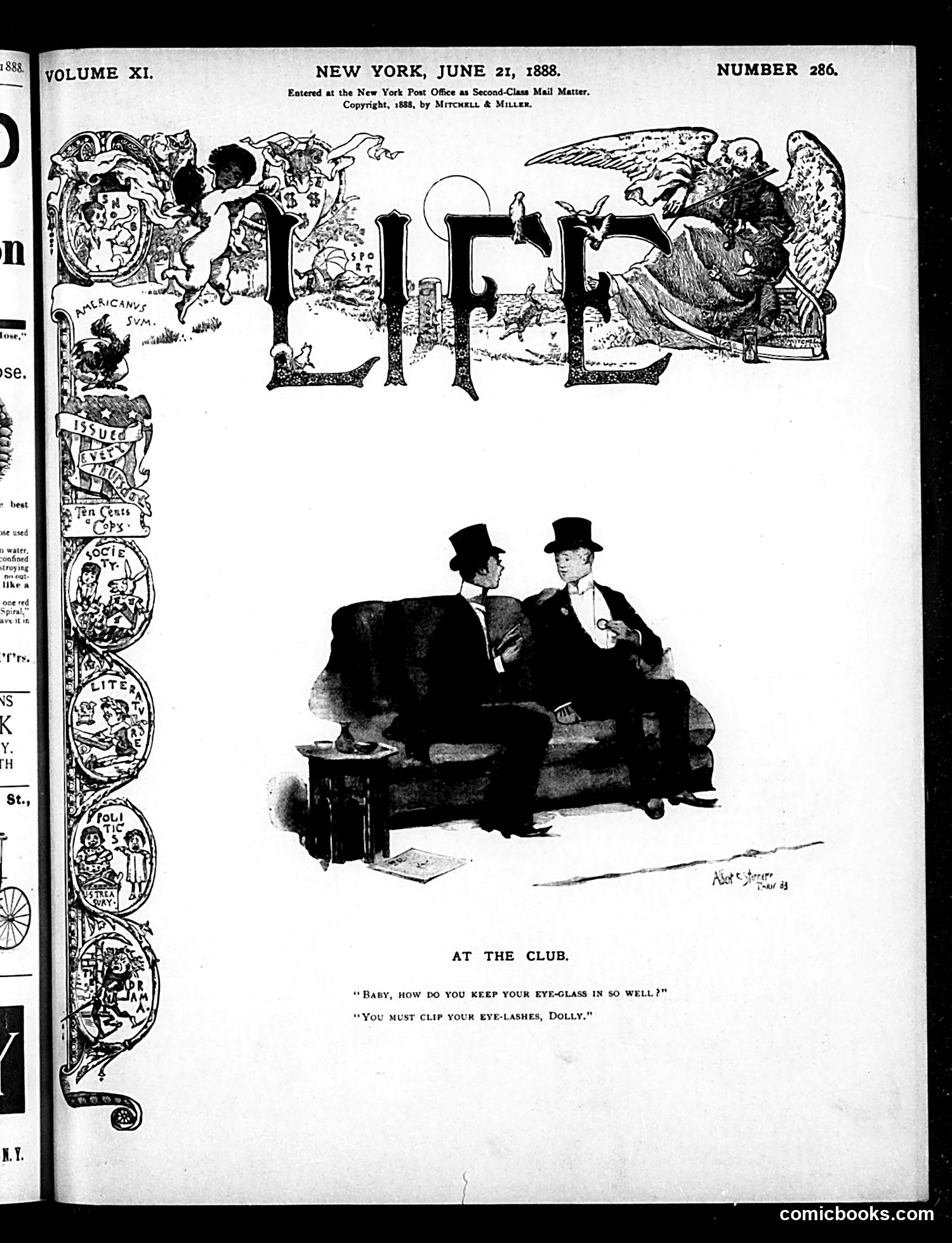
This is a satirical cartoon about men's club culture in the Gilded Age. Two well-dressed gentlemen sit on a couch in conversation. The dialogue suggests a humorous exchange about maintaining eyeglasses: one man asks how the other keeps his eye-glass "in so well," and receives the cheeky reply, "You must clip your eye-lashes, Dolly." The joke plays on vanity and affectation among wealthy club members. "Dolly" appears to be a dismissive or mocking nickname, suggesting the man is overly concerned with fashionable accessories and appearance. The cartoon satirizes the pretension and superficiality of exclusive men's clubs, where maintaining proper appearance and engaging in trivial conversation were social priorities. The monocle was a status symbol of the era.
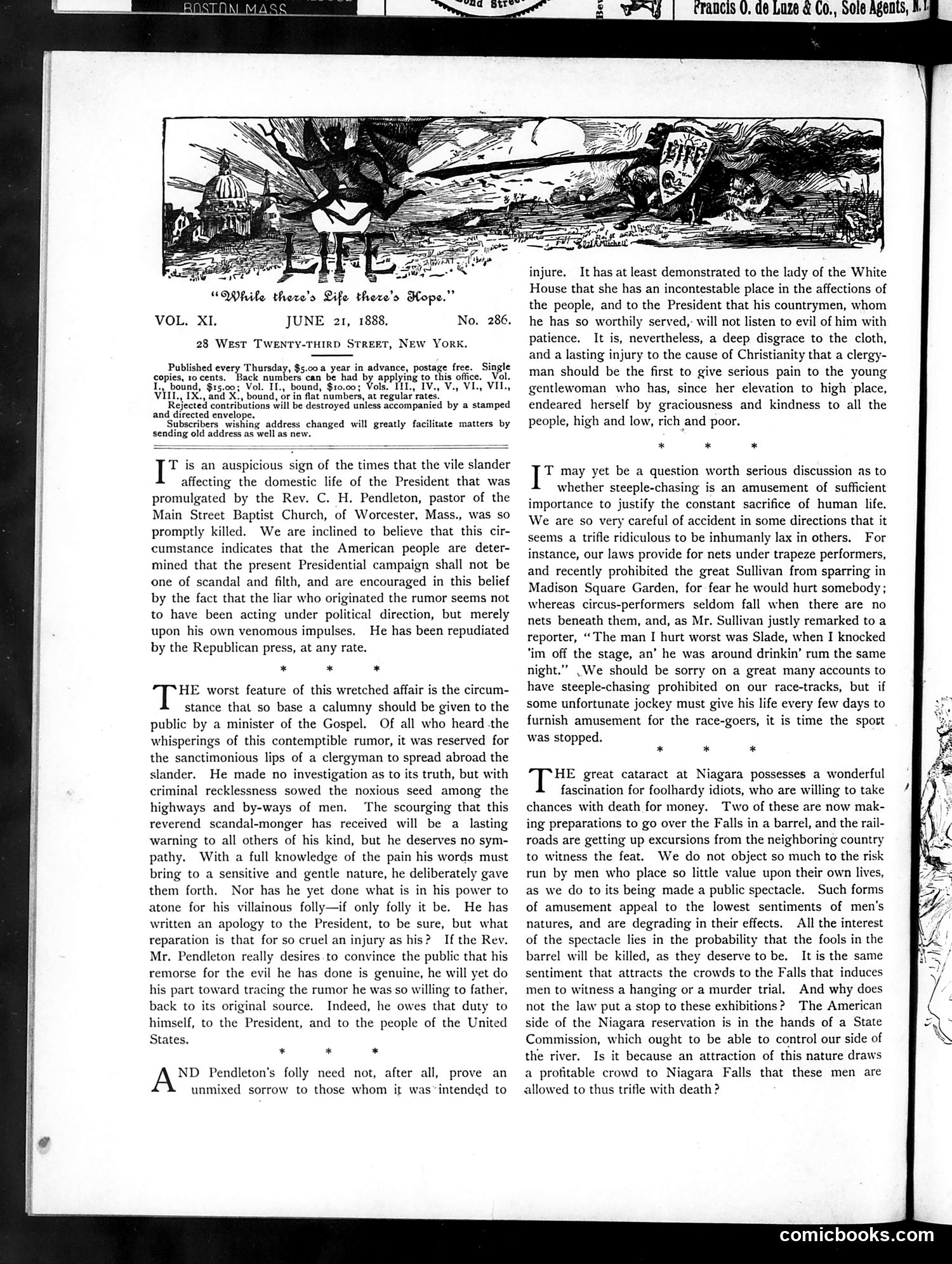
The masthead illustration titled "While there's Life there's Hope" appears to be a generic symbolic image rather than a specific political cartoon. The page's content concerns a scandal involving Rev. C. H. Pendleton of Worcester, Massachusetts, who spread false rumors damaging the President's domestic life. The articles condemn Pendleton's actions as both morally reprehensible and politically motivated, noting the rumor was circulated through Republican press channels—suggesting partisan orchestration. The text also criticizes other contemporary social issues: steeple-chasing (horse racing) as dangerous, and the commercialization of Niagara Falls daredevil stunts, where spectators pay to watch people risk death in barrels going over the falls. The overall tone is satirical moral outrage at both political dishonesty and public indifference to human suffering for entertainment.
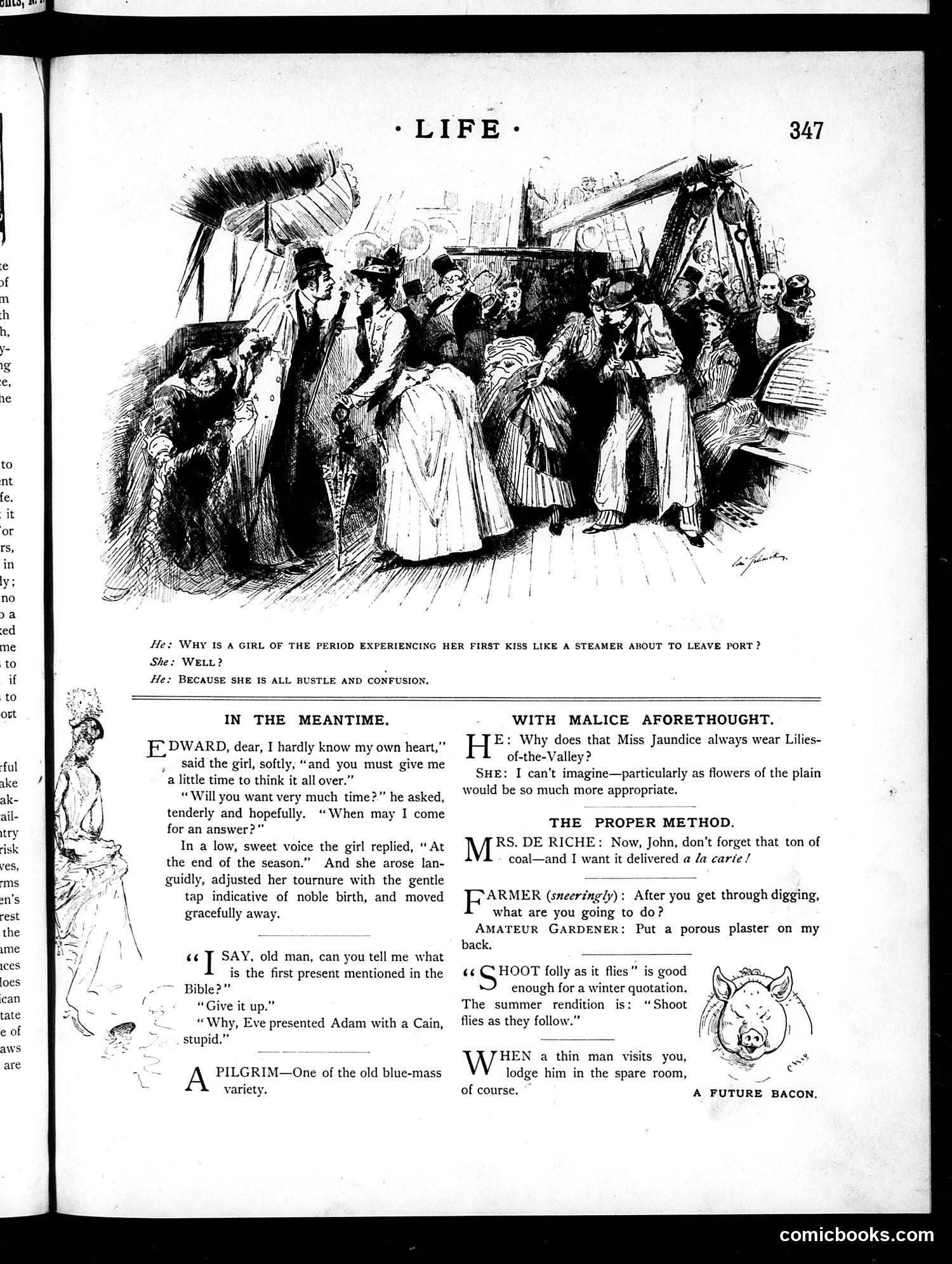
This page contains several brief satirical jokes typical of early 20th-century *Life* magazine humor. The main cartoon depicts a crowded ship deck with well-dressed passengers. The joke contrasts a woman's emotional farewell ("Why is a girl...like a steamer about to leave port?") with the punchline: "Because she is all bustle and confusion"—a visual pun referencing both the bustling activity and women's fashion (the "bustle," a framework structure worn under skirts that was prominent in Victorian/Edwardian era). Below are additional short satirical pieces: "In the Meantime" (romantic dialogue), "With Malice Aforethought" (wordplay about flowers), "The Proper Method" (domestic humor), and brief quips about winter and thin visitors. The humor relies on period-specific fashion references and domestic social conventions that modern readers might not immediately recognize.
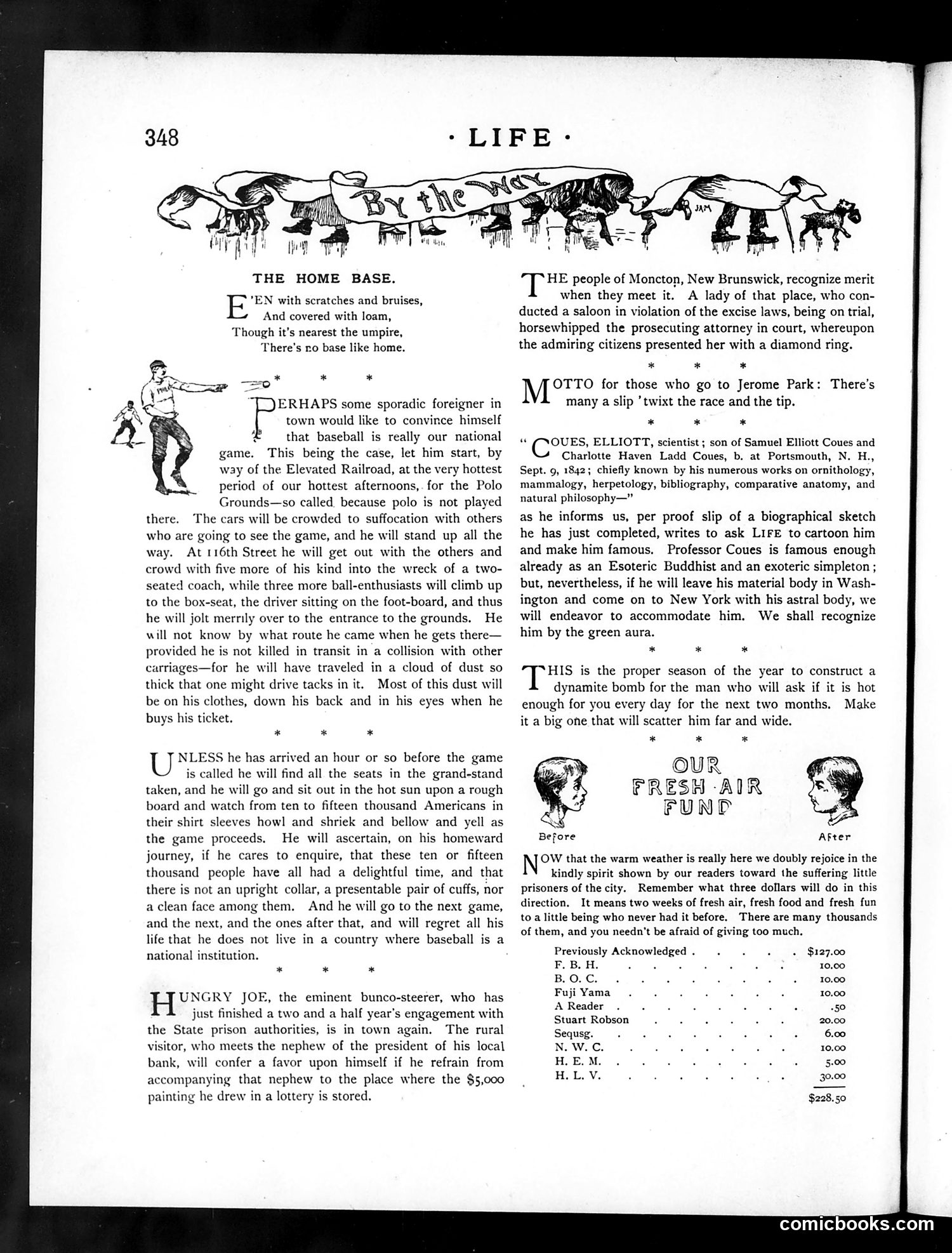
This page contains three satirical pieces rather than a unified cartoon: **"The Home Base"** uses baseball metaphor to mock foreigners attending games at Polo Grounds. The joke suggests an out-of-town visitor attending a baseball game will be jostled, dusty, and uncomfortable—a critique of the chaotic experience American sporting events offer. **"Our Fresh Air Fund"** section acknowledges charitable donations (listed at bottom) supporting poor urban children with summer breaks. The before/after illustrations show health improvement from fresh air exposure—earnest social commentary rather than satire. The page is primarily text-based humor and charitable acknowledgment rather than political cartooning. The satirical edge targets spectator culture and foreign visitors' unfamiliarity with American pastimes, reflecting early 20th-century attitudes toward both newcomers and baseball enthusiasm.
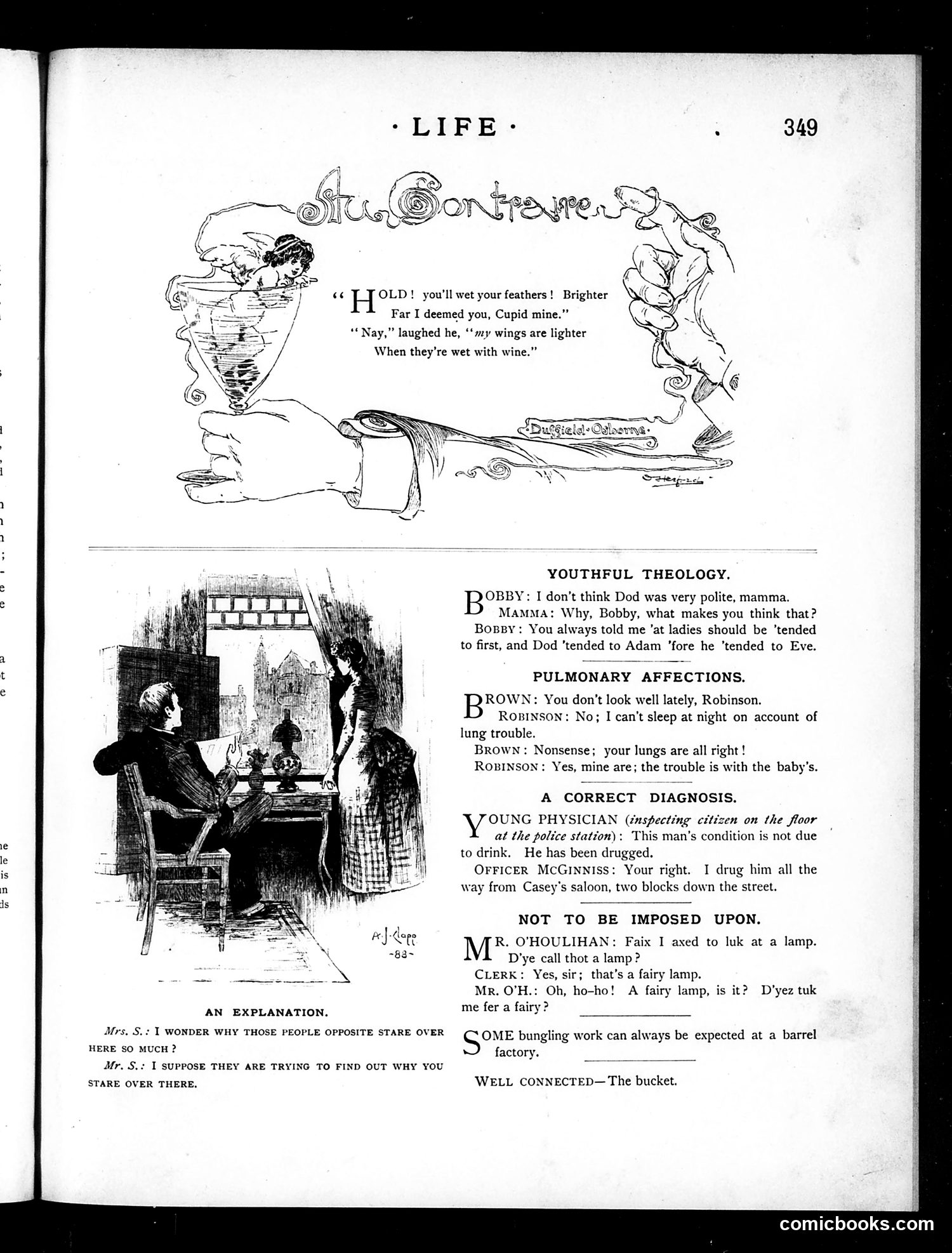
This page contains four separate humorous sketches and dialogues typical of early 20th-century satirical humor. **Top cartoon** ("Siu Conversed"): Depicts Cupid in a wine glass with cherubs, playing on the phrase "love and wine" through wordplay about wet feathers and wings. **"Youthful Theology"**: A child's innocent misunderstanding of religious doctrine—confusing God's treatment of Adam and Eve with notions of politeness. **"Pulmonary Affections"**: Doctor-patient banter where Robinson blames his baby's lungs for his own sleeplessness—a domestic comedy. **"A Correct Diagnosis"** and **"Not to Be Imposed Upon"**: Street-level humor involving working-class characters, mistaken identity, and vernacular speech typical of vaudeville humor of the era. The page emphasizes everyday domestic situations and wordplay rather than political commentary.
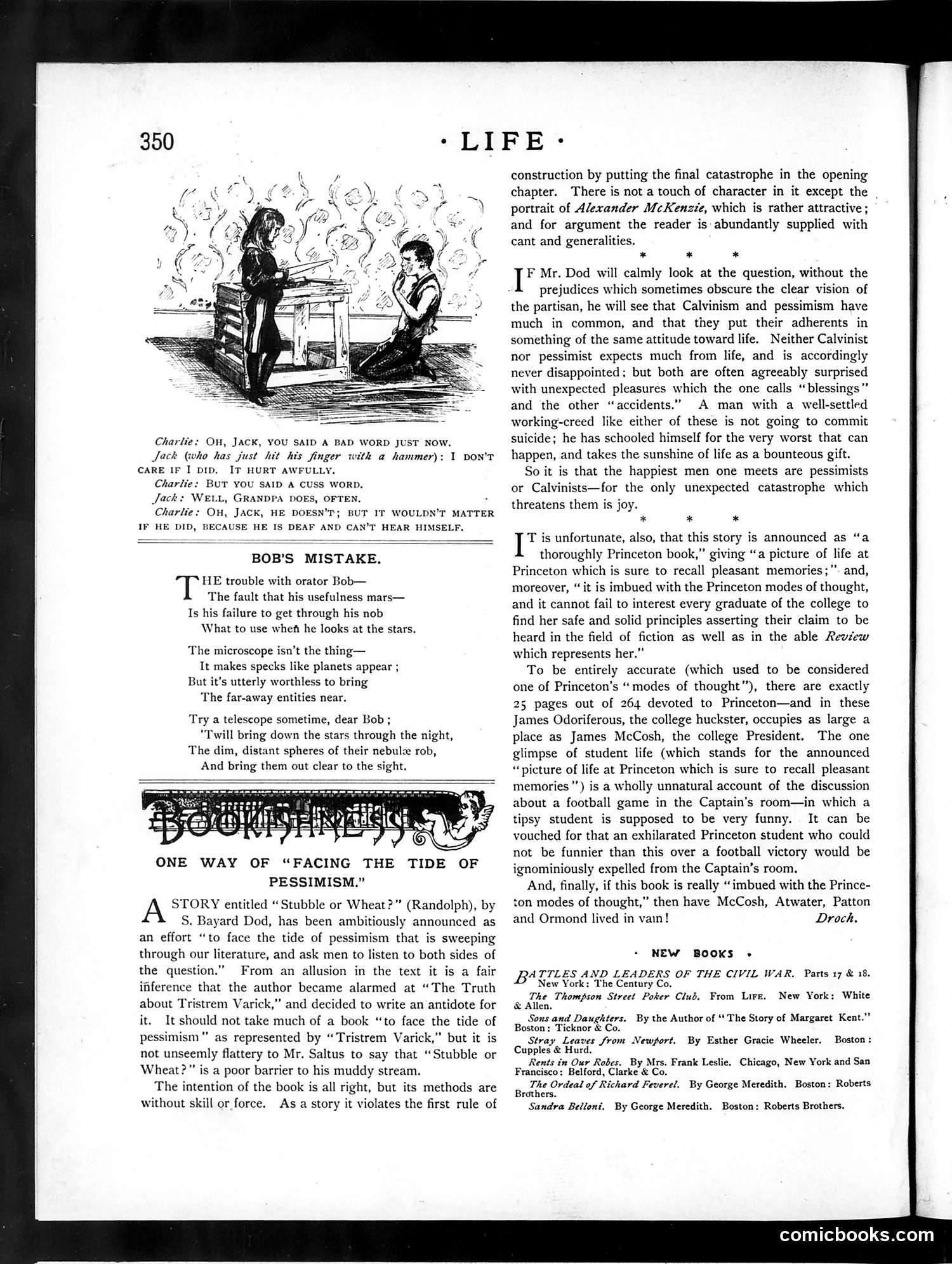
**The Cartoon "Bob's Mistake":** This appears to be a humorous poem about an unnamed character named Bob who repeatedly fails at astronomical observation. The verse mocks his incompetence—he cannot properly use a microscope or telescope to observe celestial objects. The joke seems to be that Bob's fundamental problem is his inability to "get through his nob" (slang for head/brain), suggesting stupidity rather than equipment failure. The satire targets general human foolishness and incompetence rather than specific political figures. **The Literary Review Section:** The page contains a critical essay reviewing "Stubble or Wheat?" by S. Bayard Dod, a novel attempting to address pessimism in American literature. The reviewer questions whether the book effectively counters pessimistic philosophy, suggesting the author's methods are "without skill or force."
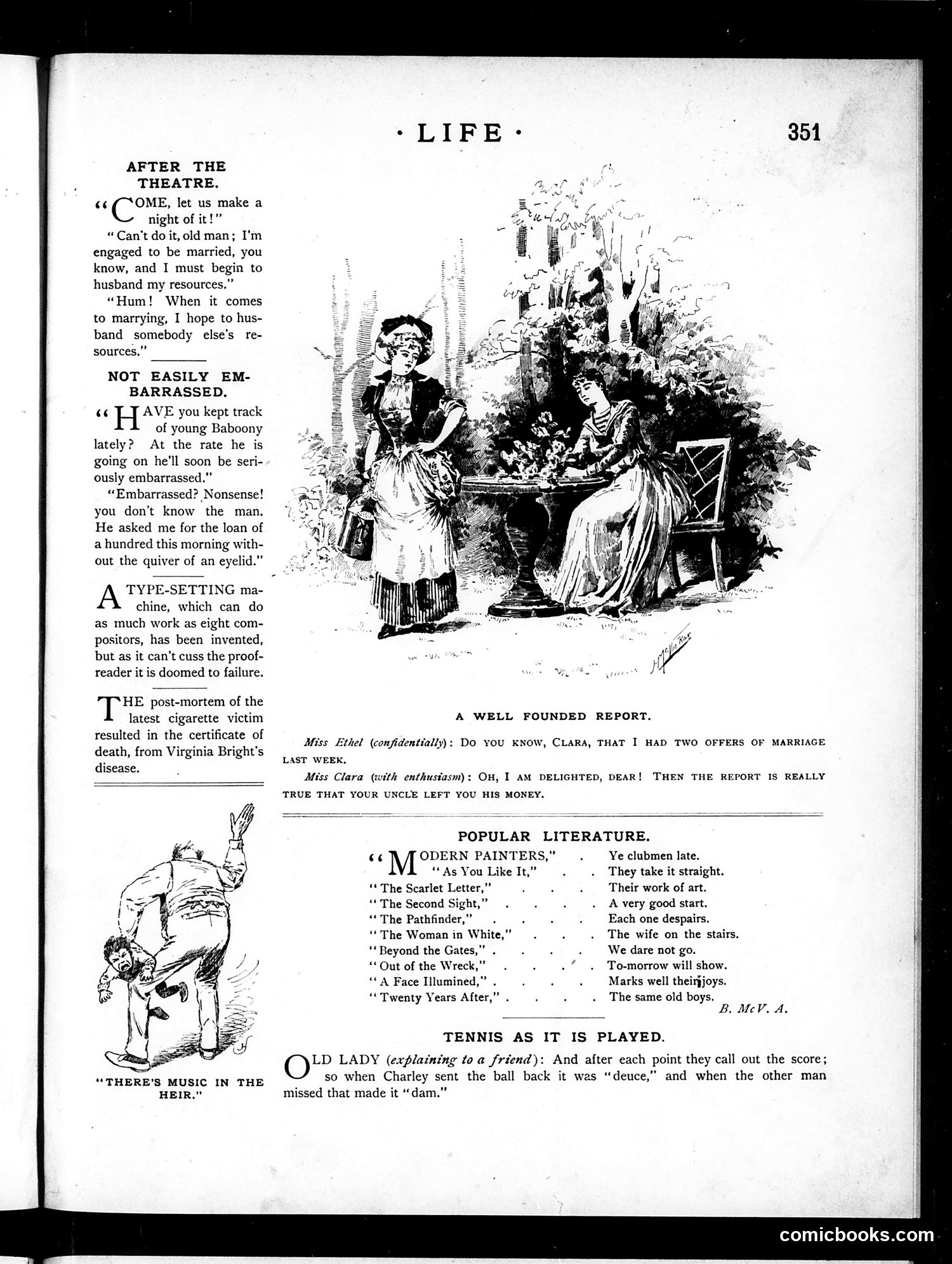
This page contains several short humorous pieces rather than political cartoons: **"After the Theatre"** depicts a conversation where a man declines a night out, claiming he must husband his resources for an upcoming marriage—prompting the witty reply that when marrying, one typically husbands someone *else's* resources. **"Not Easily Embarrassed"** jokes about a man's shameless spending habits. **"A Type-Setting Machine"** offers commentary on new printing technology. **"The post-mortem"** references a cigarette-related death from Virginia Bright's disease. **"A Well Founded Report"** shows two women discussing marriage proposals and an inheritance. The page also includes a "Popular Literature" section listing contemporary books with brief humorous descriptions, and a joke about tennis terminology. These are light, domestic humor pieces typical of Life's satirical style.
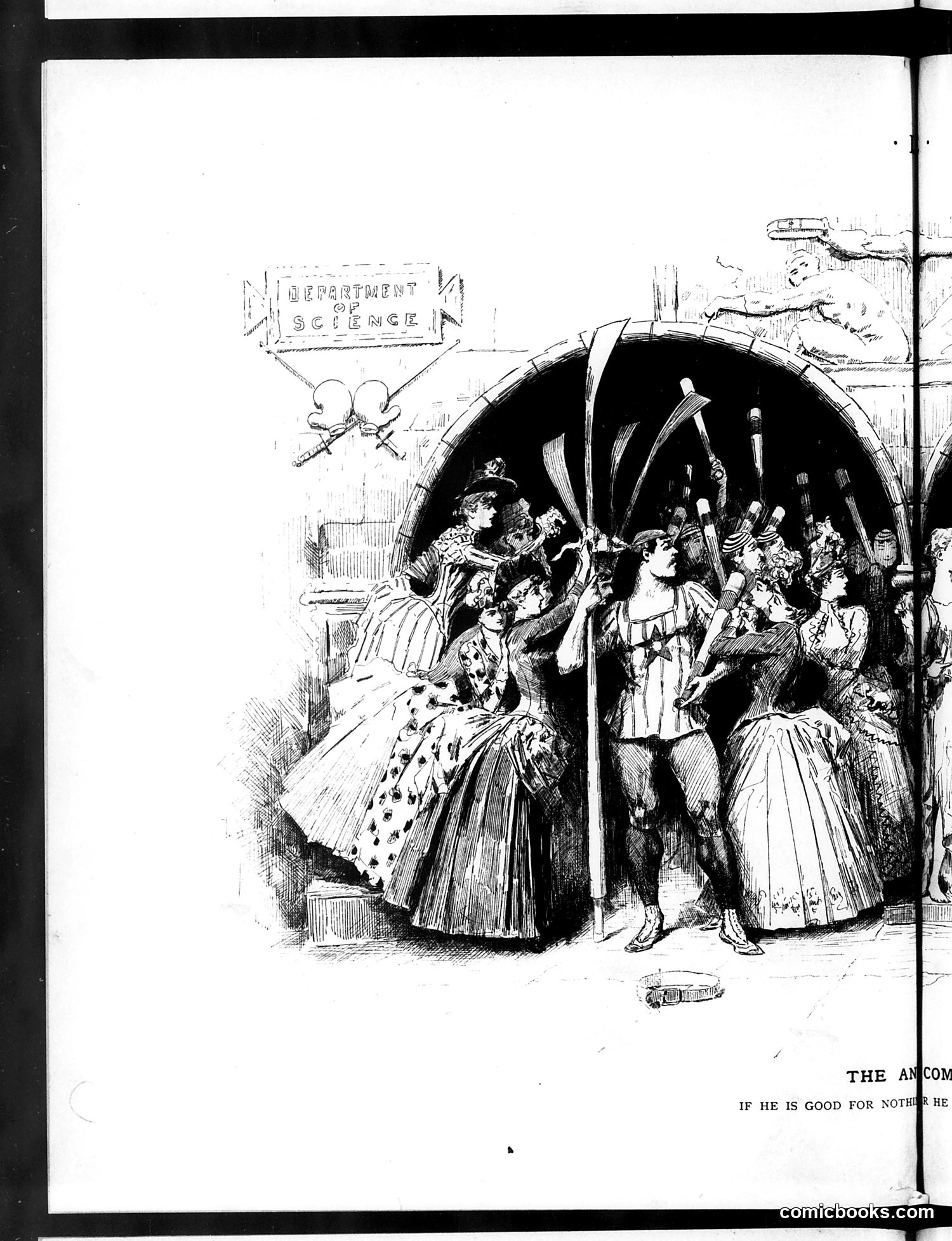
This is a satirical cartoon from Life magazine depicting a scene at the "Department of Science." A well-dressed woman (likely representing society or the establishment) sits enthroned while a group of figures—appearing to be scientists or scholars with various implements and tools—stand before her in supplication or presentation. The sign overhead reads "DEPARTMENT OF SCIENCE," and the crossed bones or implements suggest mockery of scientific authority. The partial text at bottom ("THE AN COM... IF HE IS GOOD FOR NOTHIN' R HE") is too fragmentary to fully interpret, but the overall satire appears to criticize how science or scientists were regarded by high society, or how institutional science deferred to social hierarchy rather than pursuing independent inquiry. The exact historical moment remains unclear without fuller context.
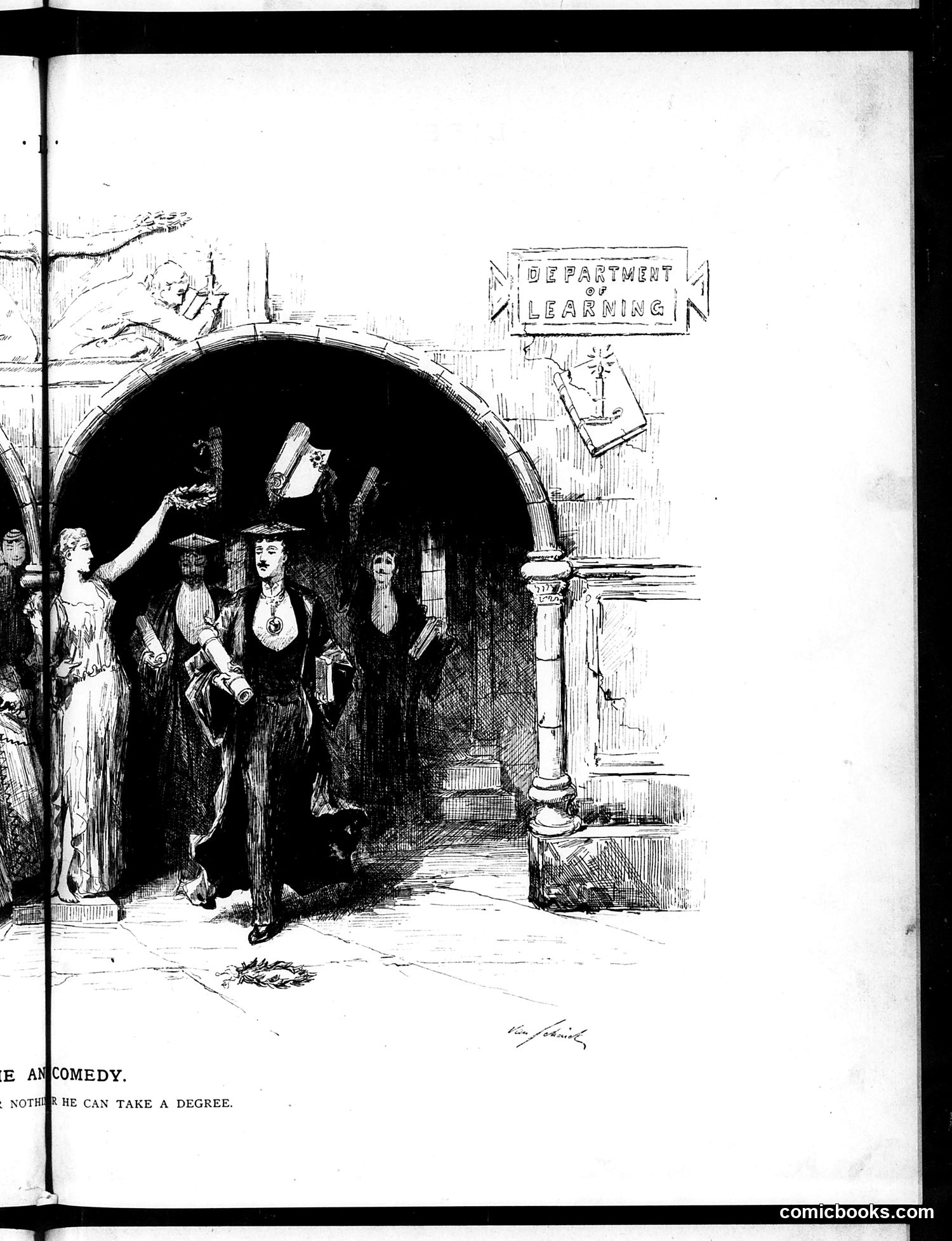
This satirical illustration depicts women entering a university building labeled "Department of Learning," addressing early 20th-century debates over women's higher education access. The cartoon's caption states "Nothing he can take a degree" (likely "Nothing [like?] he can take a degree"), suggesting ironic commentary on women pursuing university degrees—a contentious social issue when women's educational rights were limited or newly won. The well-dressed women are shown confidently entering an arched doorway, while the drawing style emphasizes their fashionable appearance. The satire appears to mock either women's ambitions for higher education or society's resistance to it, though the exact target of ridicule—whether pro- or anti-women's education—remains somewhat ambiguous from the image alone.
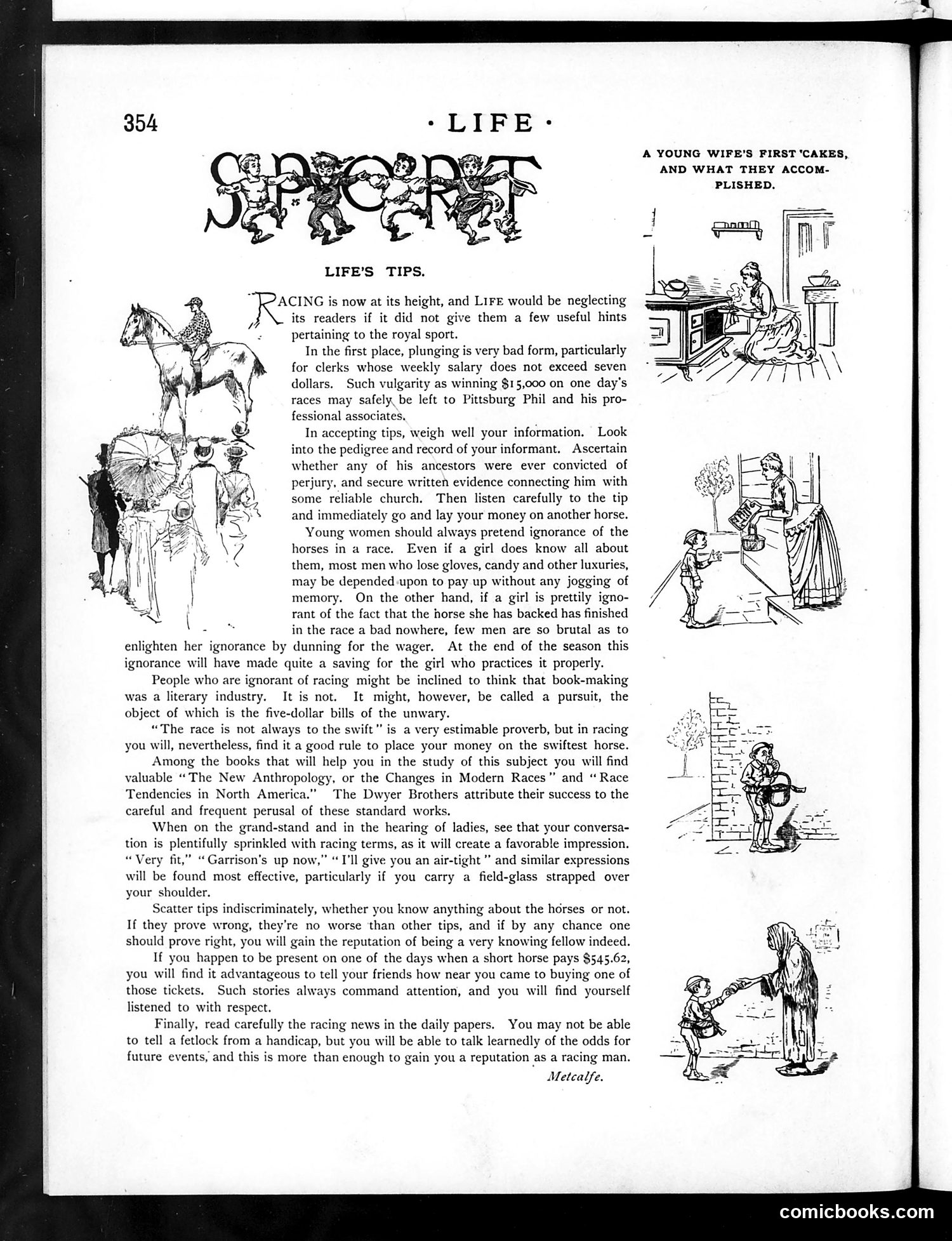
This is a satirical advice column titled "Life's Tips" about horse racing, paired with an illustration series titled "A Young Wife's First Cakes, and What They Accomplished." The main text offers tongue-in-cheek guidance for placing bets on races, suggesting readers study pedigrees and feign knowledge of horses to impress others. It humorously recommends that ignorant young women pretend not to know about horses, as men apparently enjoy enlightening them—a backhanded commentary on gender dynamics and condescension. The right-side illustrations humorously depict a young housewife's baking disasters and their social consequences—burnt cakes, mishaps with servants, and general domestic chaos. The juxtaposition suggests both racing advice and domestic incompetence are subjects of satirical humor in this era. The byline "Metcalfe" indicates the author's identity.
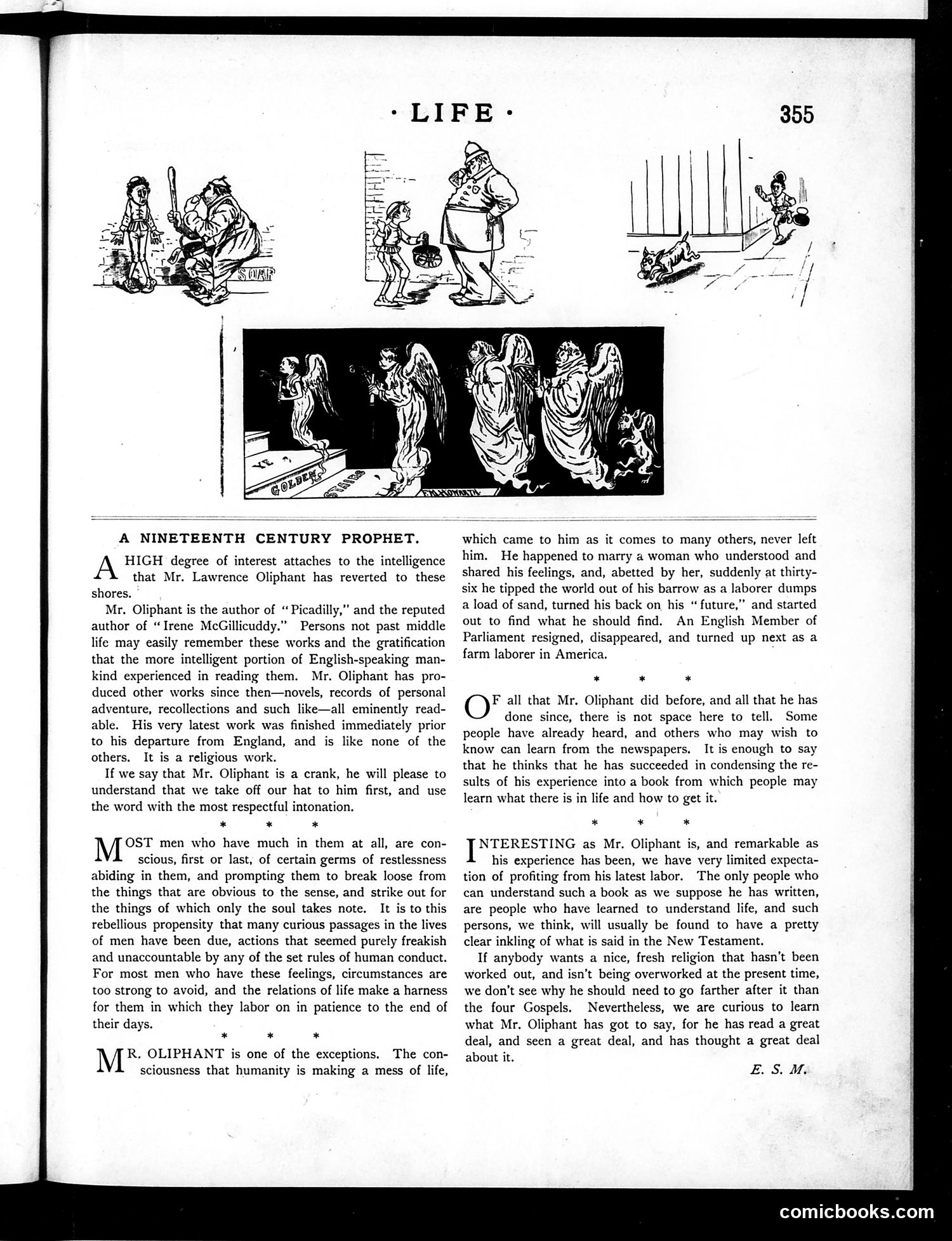
This satirical article discusses Lawrence Oliphant, a prominent Victorian author known for novels like *Picadilly*, who has returned to America with a new religious work. The piece employs gentle mockery while grudgingly respecting his unconventional life choices. The satire centers on Oliphant's dramatic rejection of respectable society: at 36, he abandoned a promising career (including a position as an English MP) to work as a farm laborer in America, driven by spiritual questioning. Life magazine presents this as admirable eccentricity while remaining skeptical of his new book's value. The editorial's humor lies in its backhanded praise—acknowledging Oliphant's intellectual seriousness while suggesting his spiritual insights likely won't surpass what people can already find in the New Testament. The cartoons above (though unclear in detail) likely illustrate his various life phases or eccentric behavior, reinforcing the "prophet" characterization ironically.
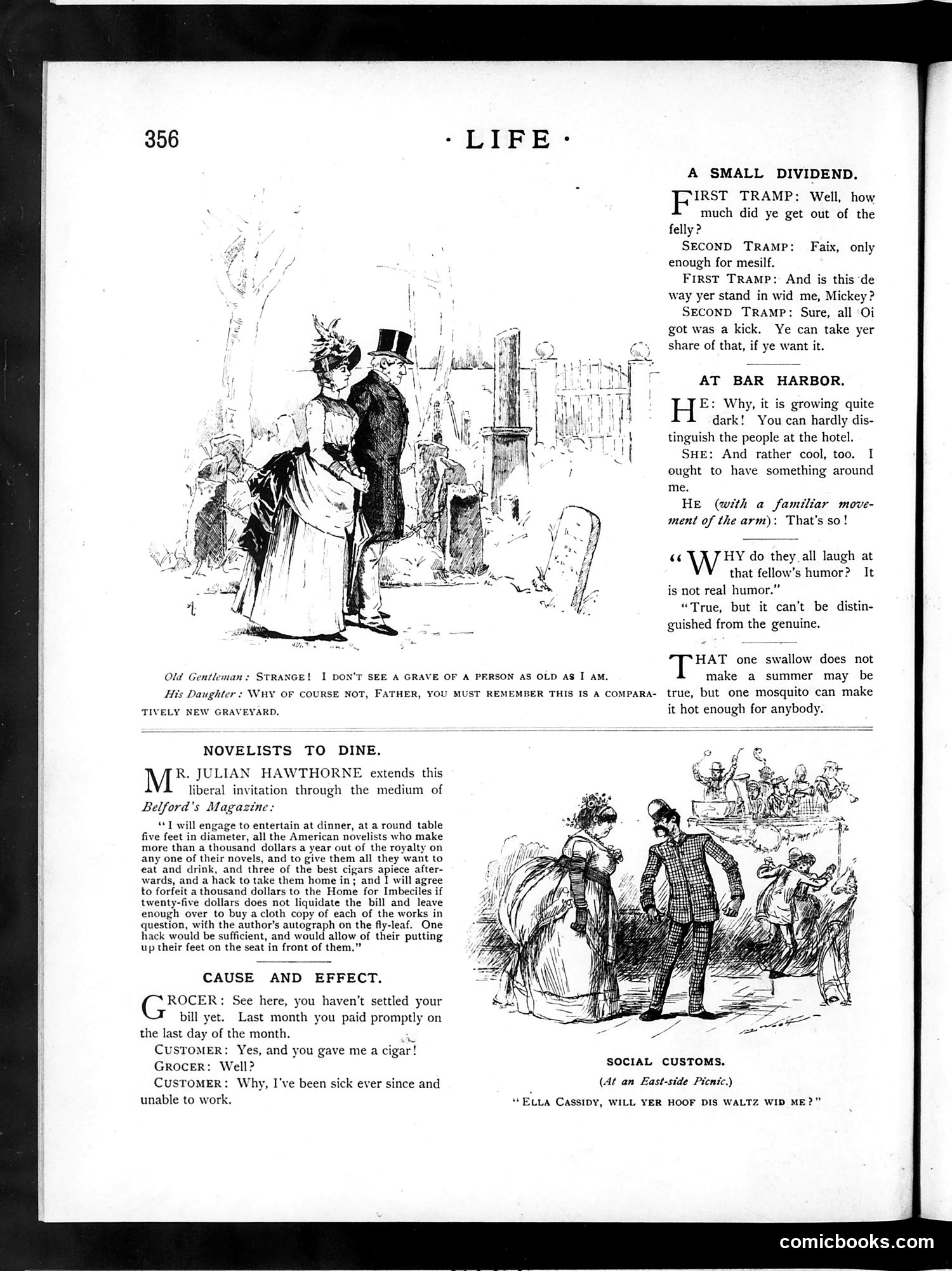
This page collects brief humorous vignettes mocking middle and upper-class social conventions: **"A Small Dividend"** satirizes Irish immigrants (indicated by dialect: "Faix," "mesilf") as petty criminals who rob each other. **"At Bar Harbor"** (an exclusive resort) depicts a flirtation where the man makes an unsolicited physical advance, which she welcomes—satirizing courtship norms where such presumption was socially acceptable. **The graveyard cartoon** jokes that an old man sees no elderly graves because the cemetery is newly established, implying he's remarkably old. **"Novelists to Dine"** quotes author Julian Hawthorne's tongue-in-cheek challenge: he'll host America's profitable novelists lavishly, betting the bill costs only $25—mocking both wealthy authors' pretensions and the publishing industry's economics. **"Cause and Effect"** blames illness on a grocer's poor-quality cigar, satirizing both working-class superstition and product quality. The page exemplifies Life's formula: quick satirical jabs at contemporary manners, immigration, class, and commerce.
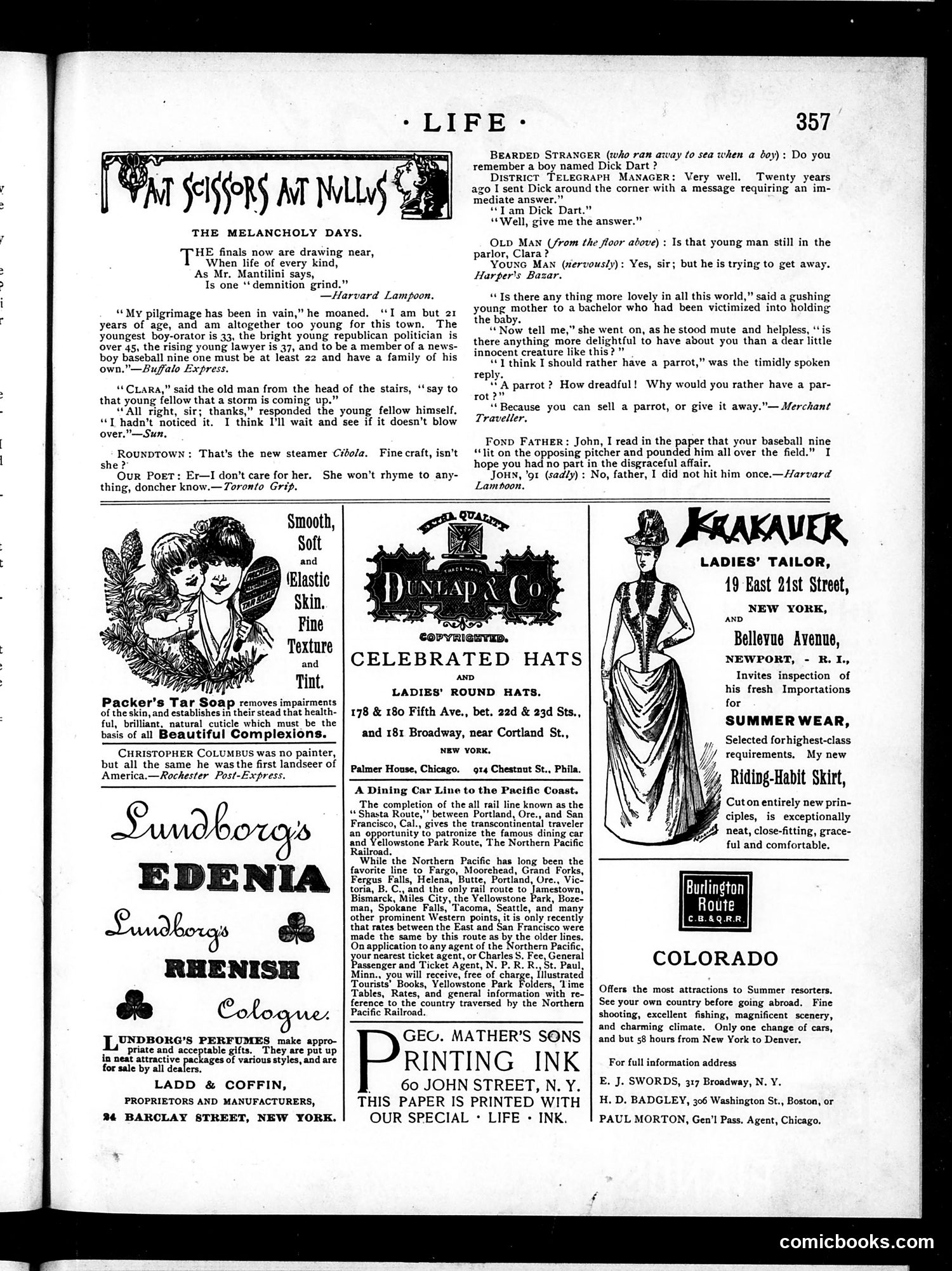
This page is primarily **advertising and humor filler** rather than political cartoons. It contains several brief, disconnected jokes typical of Life magazine's satirical style: **The humor pieces** mock social conventions: a young man too inexperienced for city life; an awkward suitor trying to escape a parlor; a bachelor pressured to admire a baby who'd prefer to own a parrot (implying babies are burdensome); a father disapproving of his son's baseball team's violence. **The "Bearded Stranger" joke** plays on delayed consequences—a man returns 20 years later expecting an answer to a message the telegraph manager sent him as a boy. **Christopher Columbus reference** makes a pun: Columbus was no "painter" but was the first "land-seer" (discoverer) of America. The remainder is **commercial advertising** for soaps, perfumes, hats, railroads, and printing ink—standard for Life's revenue model. There is no significant political commentary on this particular page.
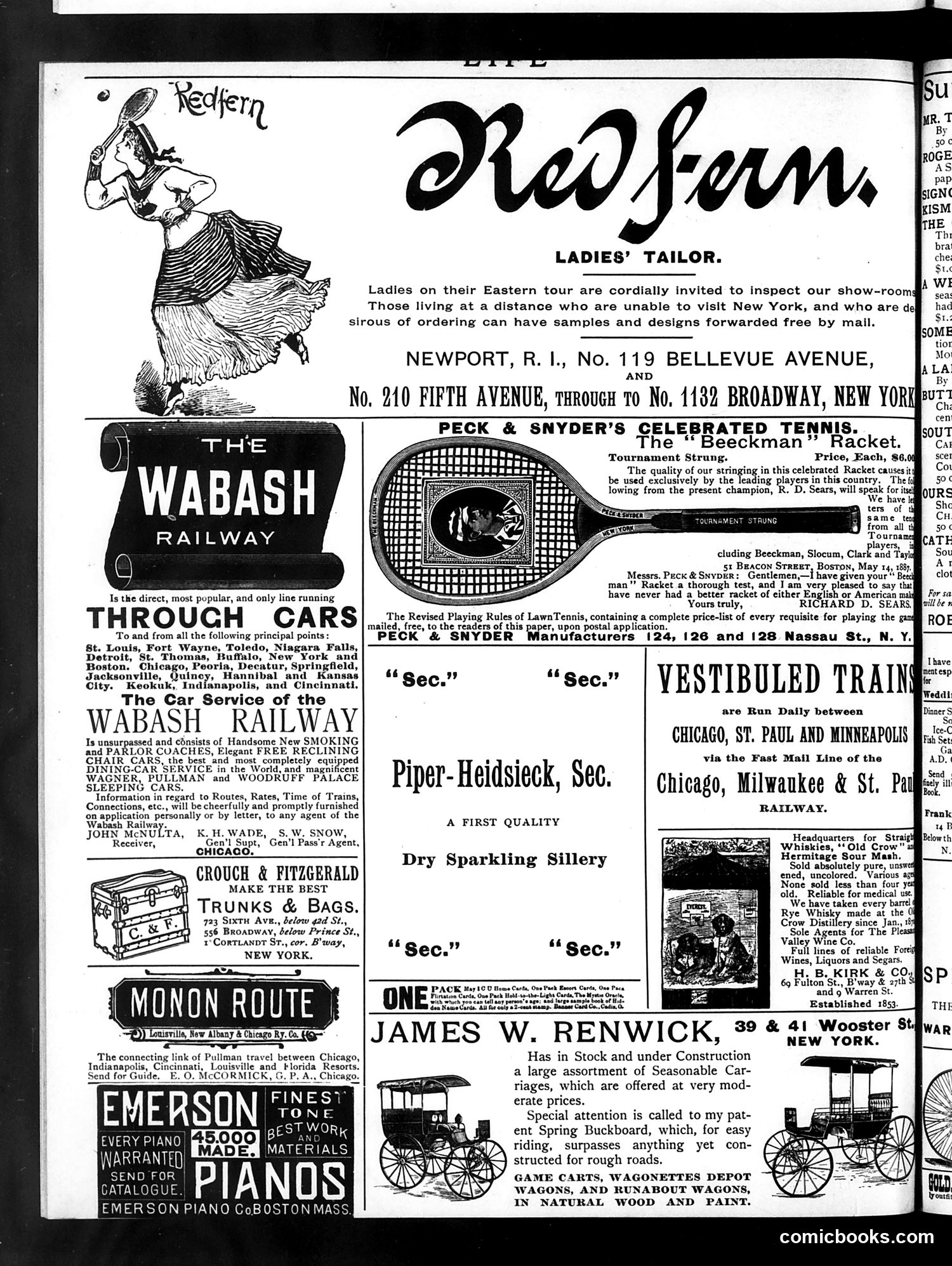
This page is **primarily advertising**, not satire or political commentary. It's a collection of late 19th-century commercial advertisements typical of Life magazine's revenue model. The only illustration with potential satirical intent is the **Red Fern logo** at the top—a stylized female figure in fashionable dress. This appears to be a straightforward ladies' tailor advertisement targeting wealthy Eastern women, emphasizing convenience (mail service) for those unable to visit their New York showrooms in person. The remaining content consists of practical advertisements: railroad services (Wabash Railway), sporting equipment (Peck & Snyder tennis rackets), luggage (Crouch & Fitzgerald), trains (Monon Route, Chicago/Milwaukee rail), pianos (Emerson), wine (Piper-Heidsieck, B. Kirk), and carriages (James W. Renwick). There is **no discernible political or social satire** on this page—it reflects the magazine's business model of selling advertising space to manufacturers and service providers of the era.
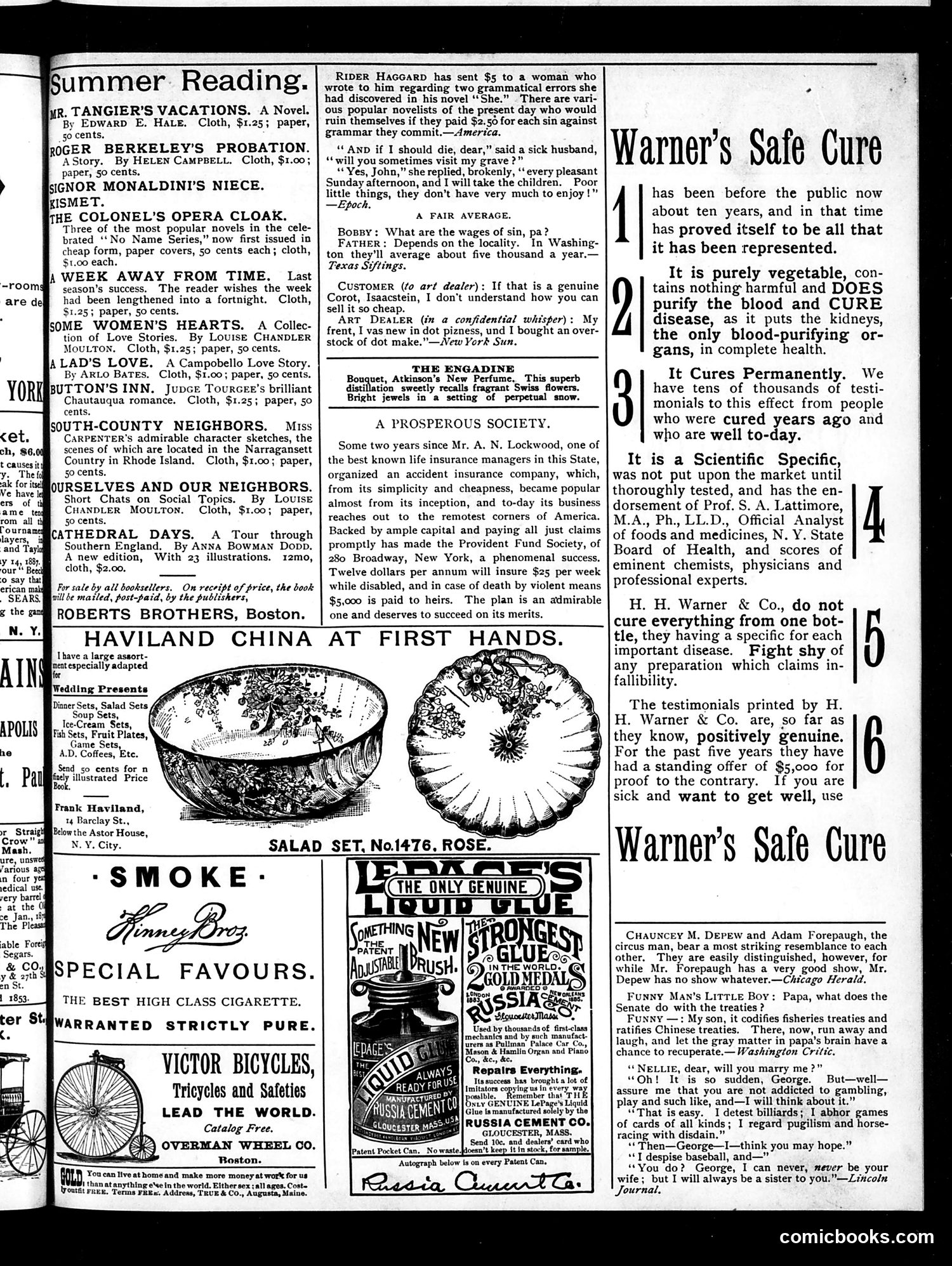
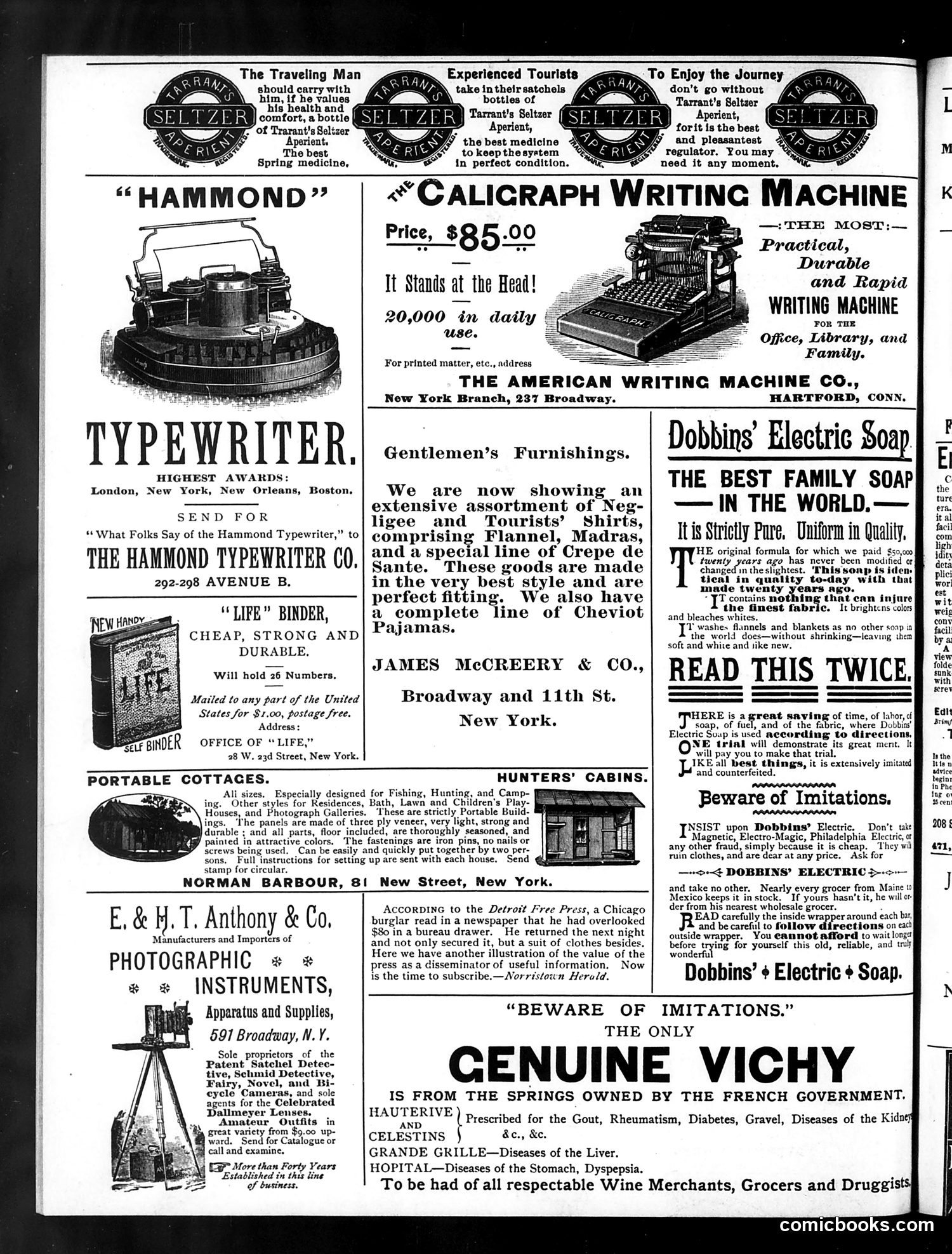
This is primarily an **advertising page** from Life magazine, not a political cartoon. It contains commercial advertisements for products and services typical of the late 19th/early 20th century. The ads include: - **Seltzer Aperient** (digestive medicine) for travelers - **Hammond Typewriter** and **Caligraph Writing Machine** (competing office technologies) - **Dobbins' Electric Soap** (prominently featured with repeated warnings against imitations) - Photographic instruments, portable cottages, and gentlemen's furnishings - **Vichy water** (mineral water from French springs, marketed for medical purposes) The **satirical element** appears only in a small embedded anecdote: a Chicago burglar reads in a newspaper that he'd missed $80 in a drawer, returns to steal it—plus clothes—illustrating the unintended consequences of published information. This reflects the magazine's mixed model: serious advertising revenue alongside satirical content. The soap ads' emphasis on "beware of imitations" suggests competitive market concerns of the era.
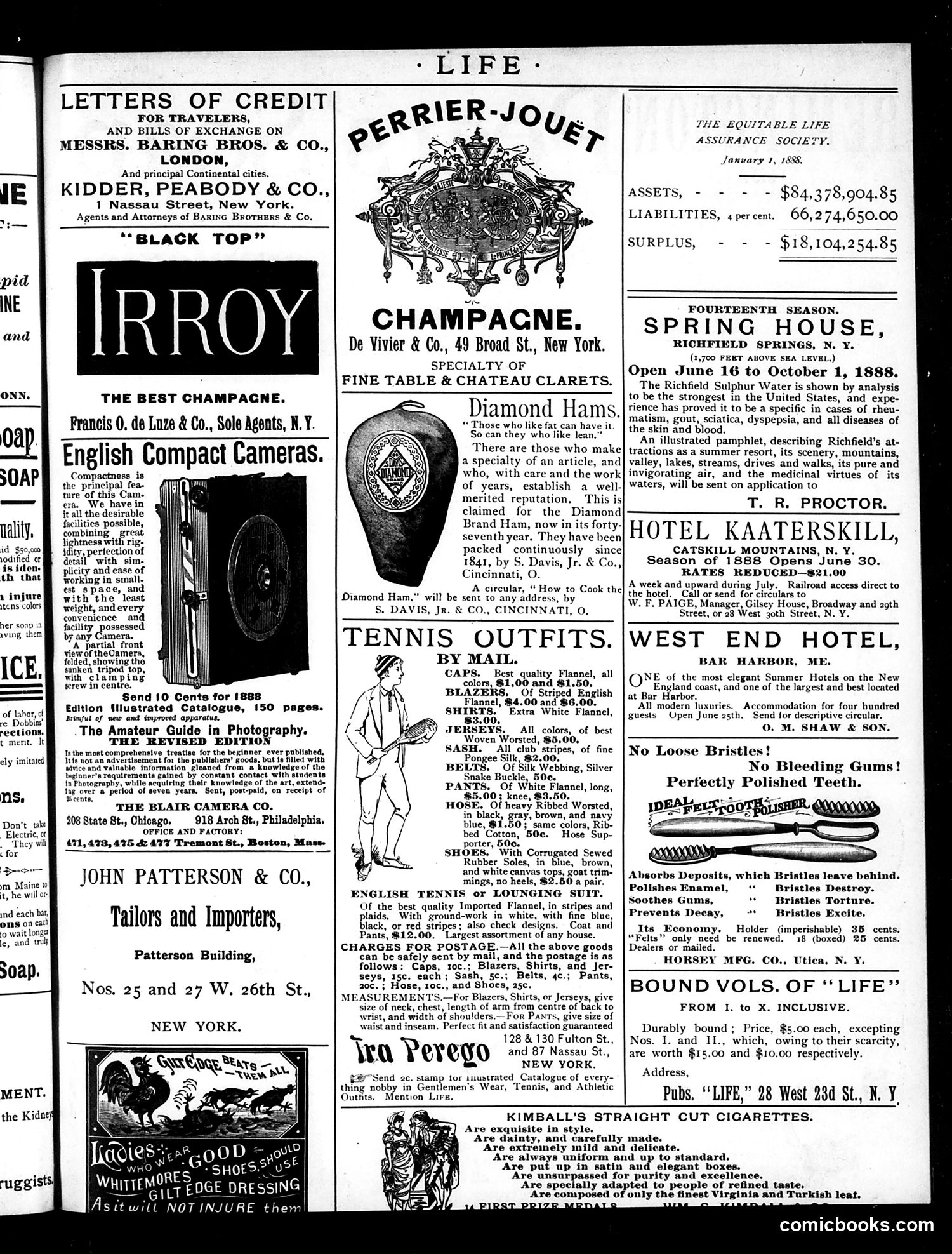
This is primarily an **advertising page** from Life magazine (1888), not a satirical cartoon page. The page contains various commercial advertisements arranged around decorative headers, particularly for champagne, cameras, clothing, and food products. **Notable content includes:** - **Perrier-Jouët Champagne** advertisement (top center) with ornate coat of arms - **Diamond Hams** promotion claiming 47 years of continuous production since 1841 - **Tennis Outfits by Mail** offering flannel caps, blazers, jerseys, and white pants—reflecting the era's sporting fashion - **English Compact Cameras** and photography guides - Various luxury goods (tailoring, letters of credit) **For modern readers:** This reflects late-19th-century consumer culture—the emergence of mail-order shopping, sporting leisure activities becoming fashionable among the wealthy, and photography as an accessible hobby. The abundance of imported European goods (French champagne, English flannel) signals American affluence and international trade. There are no political cartoons or satirical commentary visible on this page.
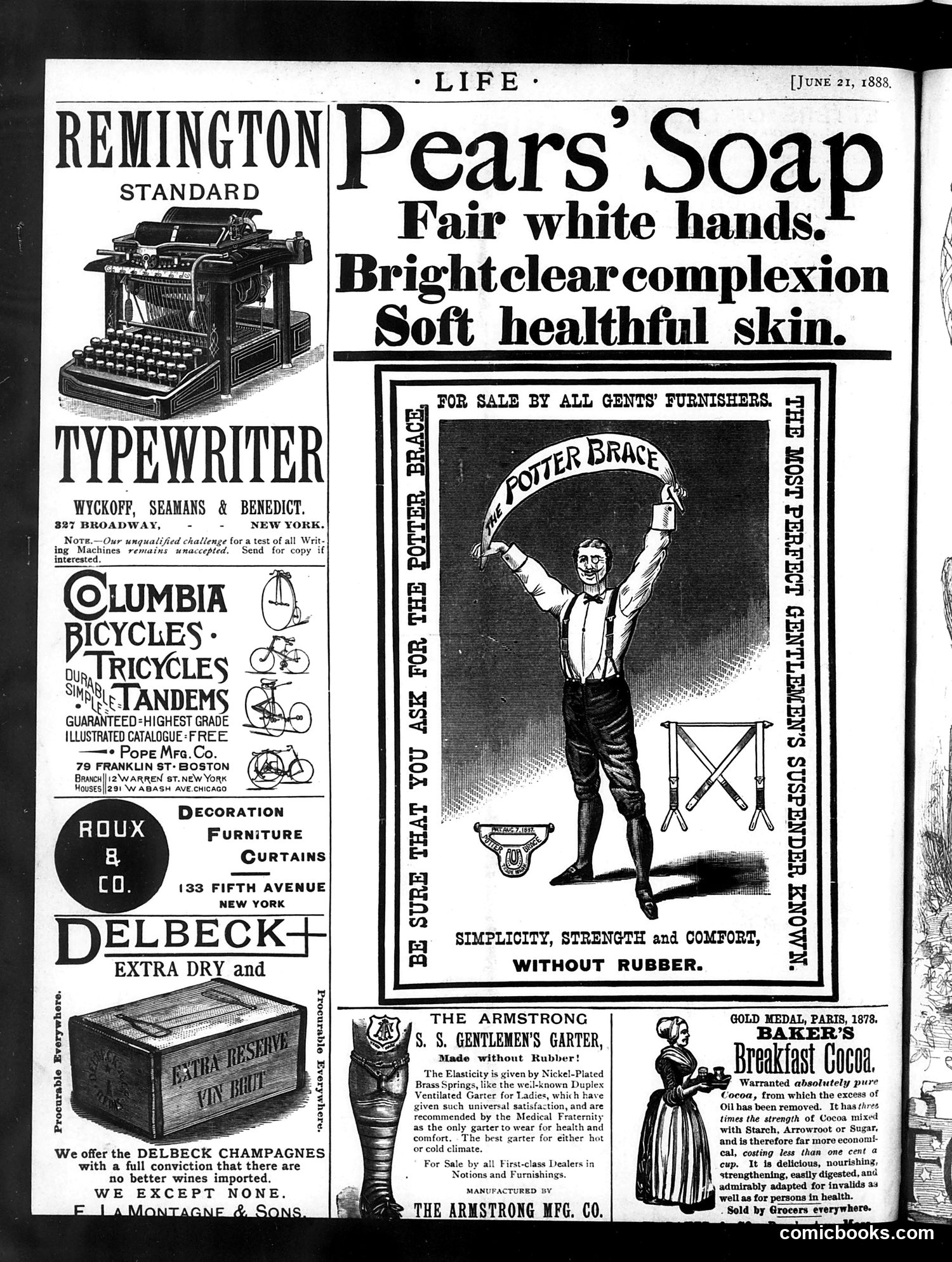
This page is primarily **advertisements**, not satire or editorial cartoon. It represents typical late-19th-century commercial messaging with several notable historical details: The **Pears' Soap ad** prominently promises "Fair white hands" and "Bright clear complexion"—language reflecting period beauty standards and racial attitudes now recognized as problematic. Other ads showcase era-typical products: the Remington typewriter (relatively new technology), Columbia bicycles and tricycles (the bicycle boom of the 1880s-90s), and gentlemen's accessories like the Armstrong garter and Potter Brace (orthopedic support). The **Baker's Breakfast Cocoa** advertises purity and economy, emphasizing removal of oil and superiority over mixed varieties. Overall, this reflects Gilded Age consumer culture and advertising conventions, including problematic beauty standards and product claims that would be considered false or offensive by modern standards. The page documents what companies sold and how they marketed to middle-class men in 1888.