
Life, 1888-06-21 · page 2 of 18
Life — June 21, 1888 — page 2: what you’re looking at
What you’re looking at
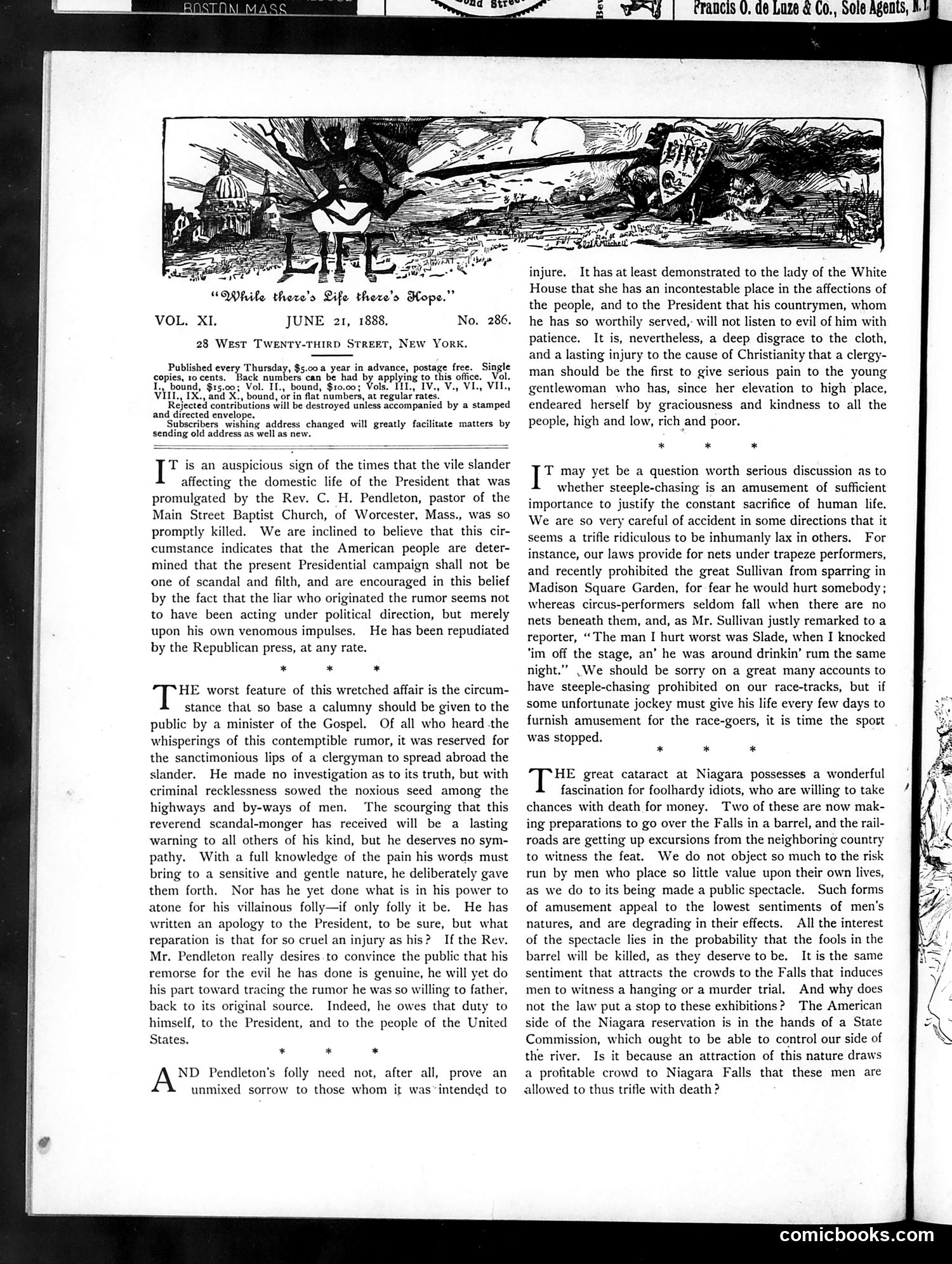
The masthead illustration titled "While there's Life there's Hope" appears to be a generic symbolic image rather than a specific political cartoon. The page's content concerns a scandal involving Rev. C. H. Pendleton of Worcester, Massachusetts, who spread false rumors damaging the President's domestic life. The articles condemn Pendleton's actions as both morally reprehensible and politically motivated, noting the rumor was circulated through Republican press channels—suggesting partisan orchestration. The text also criticizes other contemporary social issues: steeple-chasing (horse racing) as dangerous, and the commercialization of Niagara Falls daredevil stunts, where spectators pay to watch people risk death in barrels going over the falls. The overall tone is satirical moral outrage at both political dishonesty and public indifference to human suffering for entertainment.
📄 Transcribed text from this page (OCR, searchable)
Machine-transcribed from the original scan — historical spelling and the odd misread are preserved.
“While there's Life there’s Hope.” VOL. XI. JUNE 21, 1888, No. 286. 28 West TWENTY-THIRD STREET, NEW YORK. Published every Thursday, $5.00 a year in advance, postage free. Single copies, 10 cents. Back numbers can be had by applying to this office. Vol. I, bound, $15.00; Vol. II., bound, $10.00; Vols. III., IV., V., VI. VIL; VIII, IX., and X?, bound, or in flat’ numbers, at regular rates, Rejected contributions will be destroyed unless accompanied by a stamped and directed envelo} Subscribers wishing address changed will greatly facilitate matters by sending old address as well as new. T is an auspicious sign of the times that the vile slander affecting the domestic life of the President that was promulgated by the Rev. C. H. Pendleton, pastor of the Main Street Baptist Church, of Worcester, Mass., was so promptly killed. We are inclined to believe that this cir- cumstance indicates that the American people are deter- mined that the present Presidential campaign shall not be one of scandal and filth, and are encouraged in this belief by the fact that the liar who originated the rumor seems not to have been acting under political direction, but merely upon his own venomous impulses. He has been repudiated by the Republican press, at any rate. * * * HE worst feature of this wretched affair is the circum- stance that so base a calumny should be given to the public by a minister of the Gospel. Of all who heard the whisperings of this contemptible rumor, it was reserved for the sanctimonious lips of a clergyman to spread abroad the slander. He made no investigation as to its truth, but with criminal recklessness sowed the noxious seed among the highways and by-ways of men. The scourging that this reverend scandal-monger has received will be a_ lasting warning to all others of his kind, but he deserves no sym- pathy. With a full knowledge of the pain his words must bring to a sensitive and gentle nature, he deliberately gave them forth. Nor has he yet done what is in his power to atone for his villainous folly—if only folly it be. He has written an apology to the President, to be sure, but what reparation is that for so cruel an injury as his? If the Rev. Mr. Pendleton really desires to convince the public that his remorse for the evil he has done is genuine, he will yet do his part toward tracing the rumor he was so willing to father, back to its original source. Indeed, he owes that duty to himself, to the President, and to the people of the United States. * * * AX Pendleton's folly need not, after all, prove an unmixed sorrow to those whom it was”intended to injure. It has at least demonstrated to the lady of the White House that she has an incontestable place in the affections of the people, and to the President that his countrymen, whom. he has so worthily served,- will not listen to evil of him with patience. It is, nevertheless, a deep disgrace to the cloth, and a lasting injury to the cause of Christianity that a clergy- man should be the first to give serious pain to the young gentlewoman who has, since her elevation to high place, endeared herself by graciousness and kindness to all the people, high and low, rich and poor. * * * T may yet be a question worth serious discussion as to whether steeple-chasing is an amusement of sufficient importance to justify the constant sacrifice of human life. We are so very careful of accident in some directions that it seems a trifle ridiculous to be inhumanly lax in others. For instance, our laws provide for nets under trapeze performers, and recently prohibited the great Sullivan from sparring in Madison Square Garden, for fear he would hurt somebody ; whereas circus-performers seldom fall when there are no nets beneath them, and, as Mr. Sullivan justly remarked to a reporter, “The man I hurt worst was Slade, when I knocked ‘im off the stage, an’ he was around drinkin’ rum the same night.”” .We should be sorry on a great many accounts to have steeple-chasing prohibited on our race-tracks, but if some unfortunate jockey must give his life every few days to furnish amusement for the race-goers, it is time the sport was stopped. * * HE great cataract at Niagara possesses a wonderful fascination for foolhardy idiots, who are willing to take chances with death for money. Two of these are now mak- ing preparations to go over the Falls in a barrel, and the rail- roads are getting up excursions from the neighboring count to witness the feat. We do not object so much to the ris run by men who place so little value upon their own lives, as we do to its being made a public spectacle. Such forms of amusement appeal to the lowest sentiments of men’s natures, and are degrading in their effects. All the interest of the spectacle lies in the probability that the fools in the barrel will be killed, as they deserve to be. It is the same sentiment that attracts the crowds to the Falls that induces men to witness a hanging or a murder trial. And why does not the law put a stop to these exhibitions? The American side of the Niagara reservation is in the hands of a State Commission, which ought to be able to control our side of the river. Is it because an attraction of this nature draws a profitable crowd to Niagara Falls that these men are allowed to thus trifle with death ? comicbooks.com