
Life, 1888-06-21 · page 6 of 18
Life — June 21, 1888 — page 6: what you’re looking at
What you’re looking at
**The Cartoon "Bob's Mistake":** This appears to be a humorous poem about an unnamed character named Bob who repeatedly fails at astronomical observation. The verse mocks his incompetence—he cannot properly use a microscope or telescope to observe celestial objects. The joke seems to be that Bob's fundamental problem is his inability to "get through his nob" (slang for head/brain), suggesting stupidity rather than equipment failure. The satire targets general human foolishness and incompetence rather than specific political figures. **The Literary Review Section:** The page contains a critical essay reviewing "Stubble or Wheat?" by S. Bayard Dod, a novel attempting to address pessimism in American literature. The reviewer questions whether the book effectively counters pessimistic philosophy, suggesting the author's methods are "without skill or force."
📄 Transcribed text from this page (OCR, searchable)
Machine-transcribed from the original scan — historical spelling and the odd misread are preserved.
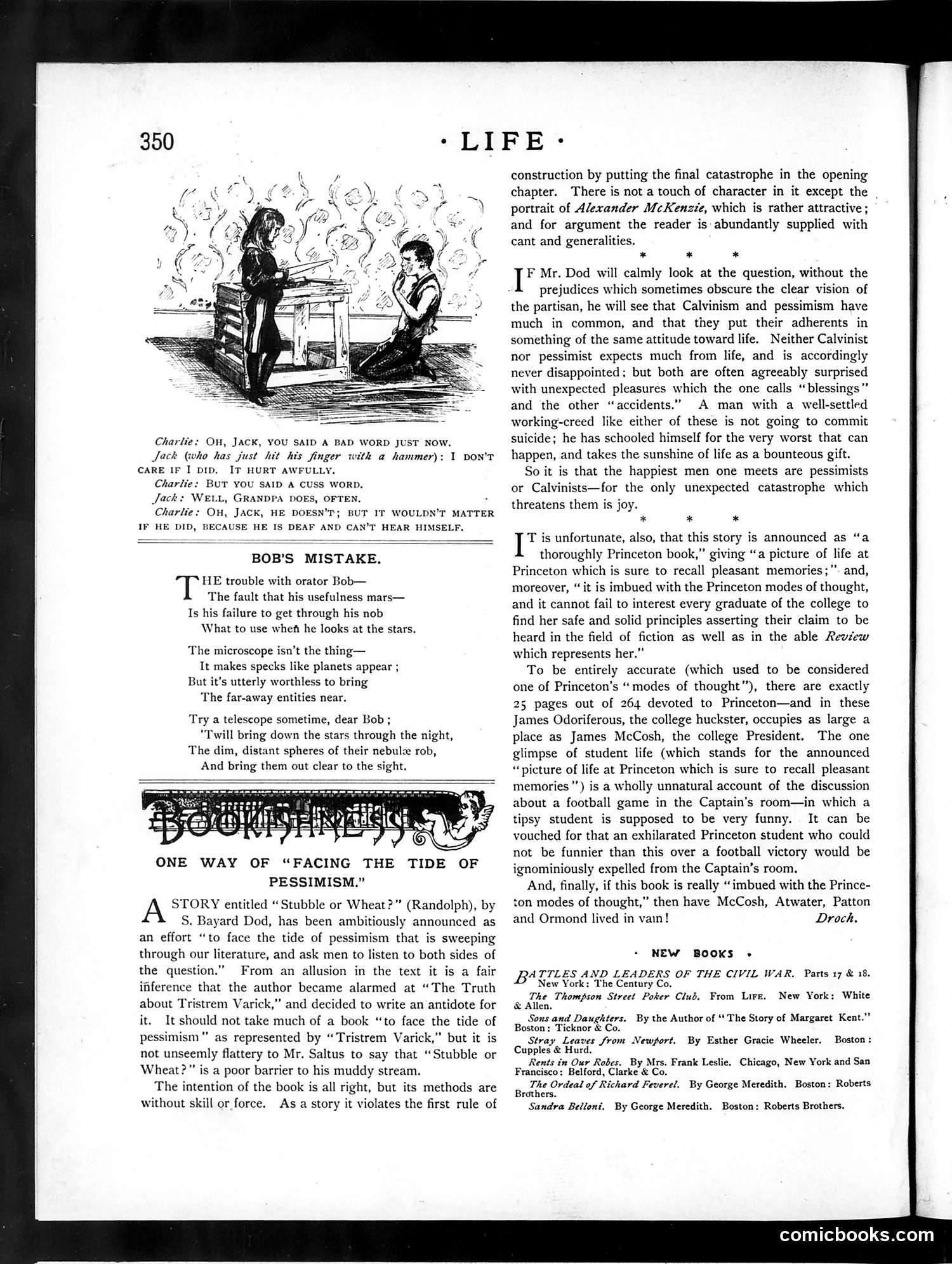
‘LIFE: Charlie: Ov, JACK, YOU SAID A BAD WORD JUST Now. Jack (who has just hit his finger with a hammer): 1 vow't CARE IF I pip. IT HURT AWFULLY. Charlie: BUT YOU SAID A CUSS WORD. Jack: WELL, GRANDPA DOES, OFTEN. Charlie: Ou, JACK, HE DOESN'T; BUT IT WOULDN’T MATTER E HE IS DEAF AND CAN’T HEAR HIMSELF. IF HE DID, BOB’S MISTAKE. HE trouble with orator Bob— The fault that his usefulness mars— Is his failure to get through his nob What to use whet he looks at the stars. The microscope isn’t the thing— It makes specks like planets appear ; But it’s utterly worthless to bring The far-away entities near. Try a telescope sometime, dear Bob ; ‘Twill bring down the stars through the night, The dim, distant spheres of their nebulz rob, And bring them out clear to the sight. ONE WAY OF “FACING THE TIDE OF PESSIMISM.” STORY entitled “Stubble or Wheat?” (Randolph), by S. Bayard Dod, has been ambitiously announced as an effort “to face the tide of pessimism that is sweeping through our literature, and ask men to listen to both sides of the question.” From an allusion in the text it is a fair ifference that the author became alarmed at “The Truth about Tristrem Varick,” and decided to write an antidote for it. It should not take much of a book “to face the tide of pessimism” as represented by “Tristrem Varick,” but it is not unseemly flattery to Mr. Saltus to say that “Stubble or Wheat?” is a poor barrier to his muddy stream. The intention of the book is all right, but its methods are without skill or force. As a story it violates the first rule of construction by putting the final catastrophe in the opening chapter. There is not a touch of character in it except the portrait of Alexander McKenzie, which is rather attractive ; and for argument the reader is-abundantly supplied with cant and generalities. * * * F Mr. Dod will calmly look at the question, without the prejudices which sometimes obscure the clear vision of the partisan, he will see that Calvinism and pessimism have much in common, and that they put their adherents in something of the same attitude toward life. Neither Calvinist nor pessimist expects much from life, and is accordingly never disappointed; but both are often agreeably surprised with unexpected pleasures which the one calls “blessings” and the other “accidents.” A man with a well-settled working-creed like either of these is not going to commit suicide; he has schooled himself for the very worst that can happen, and takes the sunshine of life as a bounteous gift. So it is that the happiest men one meets are pessimists or Calvinists—for the only unexpected catastrophe which threatens them is joy. * * * T is unfortunate, also, that this story is announced as “a thoroughly Princeton book,” giving “a picture of life at Princeton which is sure to recall pleasant memories ;". and, moreover, “it is imbued with the Princeton modes of thought, and it cannot fail to interest every graduate of the college to find her safe and solid principles asserting their claim to be heard in the field of fiction as well as in the able Revéew which represents her.” To be entirely accurate (which used to be considered one of Princeton’s “modes of thought”), there are exactly 25 pages out of 264 devoted to Princeton—and in these James Odoriferous, the college huckster, occupies as large a place as James McCosh, the college President. The one glimpse of student life (which stands for the announced “picture of life at Princeton which is sure to recall pleasant memories”) is a wholly unnatural account of the discussion about a football game in the Captain’s room—in which a tipsy student is supposed to be very funny. It can be vouched for that an exhilarated Princeton student who could not be funnier than this over a football victory would be ignominiously expelled from the Captain’s room. And, finally, if this book is really “imbued with the Prince- ton modes of thought,” then have McCosh, Atwater, Patton and Ormond lived in vain! Droch. + NEW BOOKS + B4 TTLES AND LEADERS OF THE CIVIL WAR. Parts 17 & 18. New York: The Century Co. The Thompson Street Poker Club, From Lire. & Allen. Sons and Daughters. By the Author of “The Story of Margaret Kent.” Boston: Ticknor & Co. Stray Leaves from Newport. Cupples & Hurd. Rents in Our Robes. By Mrs. Frank Leslie, Chicago, New York and San Francisco: Belford, Clarke & Co. The Ordeal of Richard Feverel. By George Meredith. Boston: Roberts Brothers. Sandra Belloni. New York: White By Esther Gracie Wheeler. Boston: By George Meredith. Boston: Roberts Brothers. comicbooks.com