
Life, 1888-06-21 · page 11 of 18
Life — June 21, 1888 — page 11: what you’re looking at
What you’re looking at
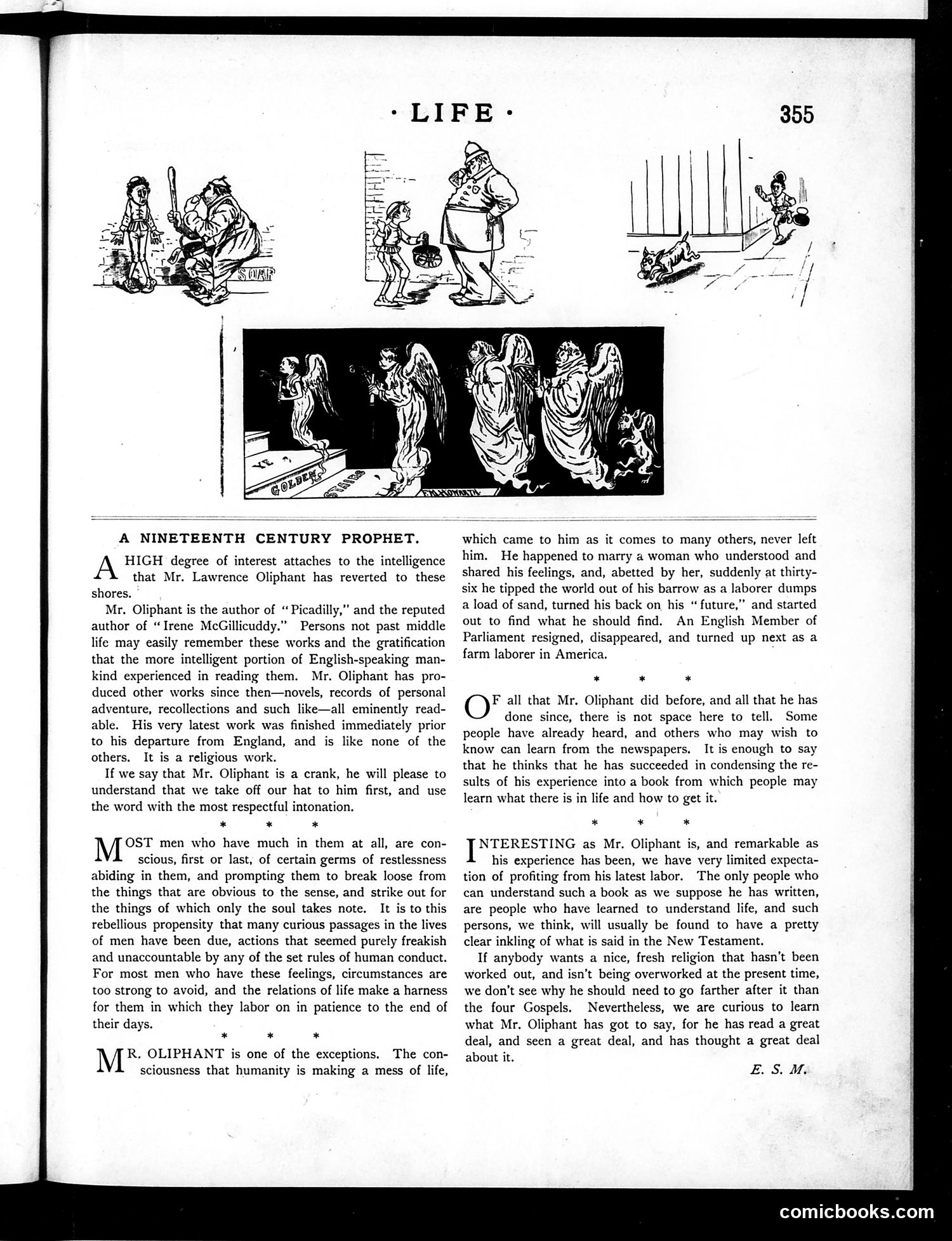
This satirical article discusses Lawrence Oliphant, a prominent Victorian author known for novels like *Picadilly*, who has returned to America with a new religious work. The piece employs gentle mockery while grudgingly respecting his unconventional life choices. The satire centers on Oliphant's dramatic rejection of respectable society: at 36, he abandoned a promising career (including a position as an English MP) to work as a farm laborer in America, driven by spiritual questioning. Life magazine presents this as admirable eccentricity while remaining skeptical of his new book's value. The editorial's humor lies in its backhanded praise—acknowledging Oliphant's intellectual seriousness while suggesting his spiritual insights likely won't surpass what people can already find in the New Testament. The cartoons above (though unclear in detail) likely illustrate his various life phases or eccentric behavior, reinforcing the "prophet" characterization ironically.
📄 Transcribed text from this page (OCR, searchable)
Machine-transcribed from the original scan — historical spelling and the odd misread are preserved.
A NINETEENTH CENTURY PROPHET. HIGH degree of interest attaches to the intelligence that Mr. Lawrence Oliphant has reverted to these shores. Mr. Oliphant is the author of “ Picadilly,” and the reputed author of “Irene McGillicuddy.” Persons not past middle life may easily remember these works and the gratification that the more intelligent portion of English-speaking man- kind experienced in reading them. Mr. Oliphant has pro- duced other works since then—novels, records of personal adventure, recollections and such like—all eminently read- able. His very latest work was finished immediately prior to his departure from England, and is like none of the others. It is a religious work. If we say that Mr. Oliphant is a crank, he will please to understand that we take off our hat to him first, and use the word with the most respectful intonation. * * * OST men who have much in them at all, are con- scious, first or last, of certain germs of restlessness abiding in them, and prompting them to break loose from the things that are obvious to the sense, and strike out for the things of which only the soul takes note. It is to this rebellious propensity that many curious passages in the lives of men have been due, actions that seemed purely freakish and unaccountable by any of the set rules of human conduct. For most men who have these feelings, circumstances are too strong to avoid, and the relations of life make a harness for them in which they labor on in patience to the end of their days. * * * R. OLIPHANT is one of the exceptions. The con- sciousness that humanity is making a mess of life, which came to him as it comes to many others, never left him. He happened to marry a woman who understood and shared his feelings, and, abetted by her, suddenly at thirty- six he tipped the world out of his barrow as a laborer dumps a load of sand, turned his back on his “ future,” and started out to find what he should find. An English Member of Parliament resigned, disappeared, and turned up next as a farm laborer in America. * * * F all that Mr. Oliphant did before, and all that he has done since, there is not space here to tell. Some people have already heard, and others who may wish to know can learn from the newspapers. It is enough to say that he thinks that he has succeeded in condensing the re- sults of his experience into a book from which people may learn what there is in life and how to get it. * * * PERESENG as Mr. Oliphant is, and remarkable as his experience has been, we have very limited expecta- tion of profiting from his latest labor. The only people who can understand such a book as we suppose he has written, are people who have learned to understand life, and such persons, we think, will usually be found to have a pretty clear inkling of what is said in the New Testament. If anybody wants a nice, fresh religion that hasn’t been worked out, and isn’t being overworked at the present time, we don’t see why he should need to go farther after it than the four Gospels. Nevertheless, we are curious to learn what Mr. Oliphant has got to say, for he has read a great deal, and seen a great deal, and has thought a great deal about it. ELS. M. comicbooks.com