
A complete issue · 16 pages · 1888
Life — June 14, 1888
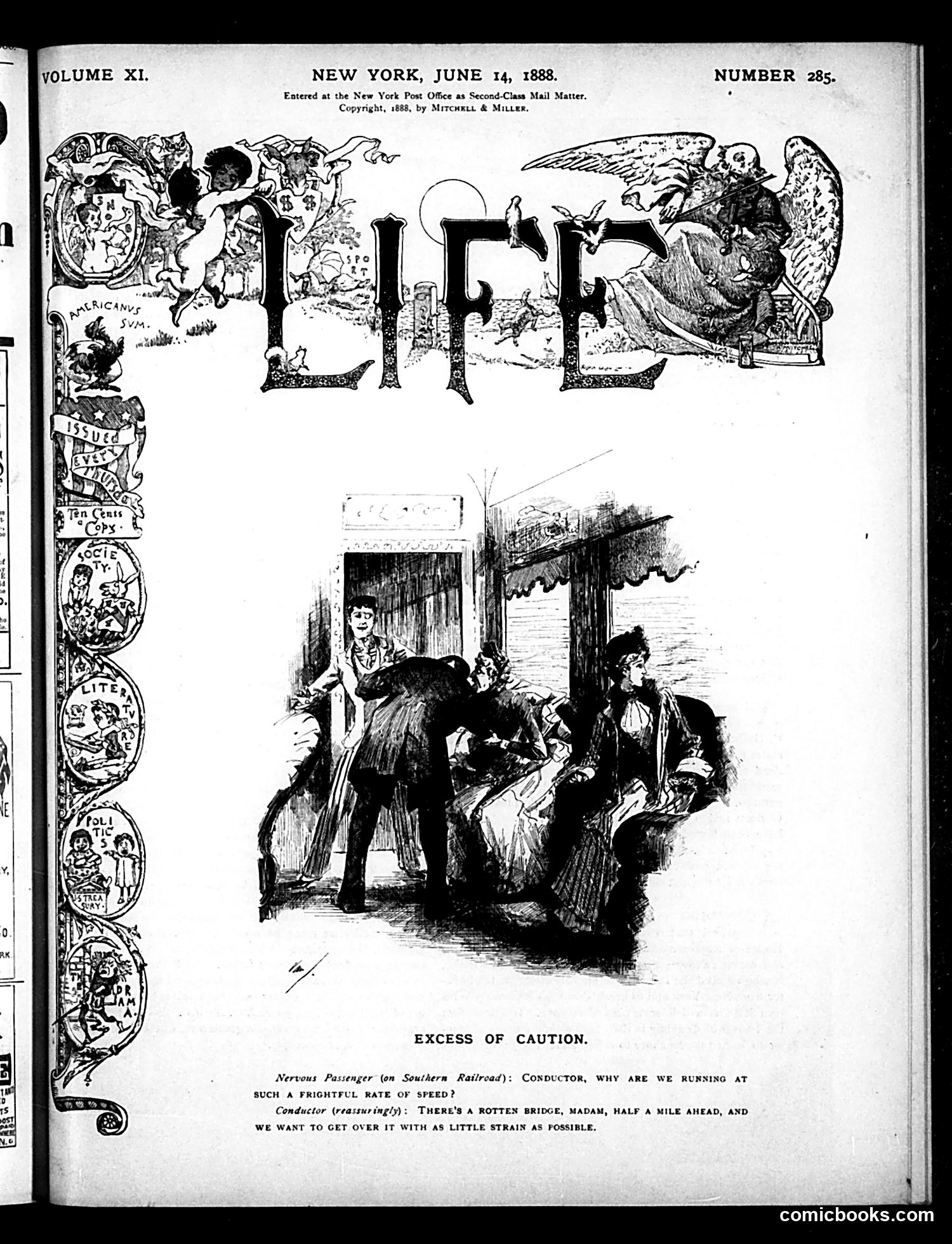
This cartoon satirizes railroad safety concerns of the 1880s. A nervous conductor reassures anxious passengers they're running at high speed to cross a rotting bridge ahead "with as little strain as possible"—a logical paradox that exposes the absurdity of railroad management's approach to dangerous infrastructure. The joke targets the era's widespread problems with aging rail lines and inadequate maintenance. Rather than repairing the bridge, the conductor proposes speed as a solution, reflecting real public anxiety about train safety during this period of rapid railroad expansion. The ornate decorative border and "LIFE" masthead indicate this was the magazine's cover or major feature, suggesting railroad safety was a significant contemporary concern for American readers.
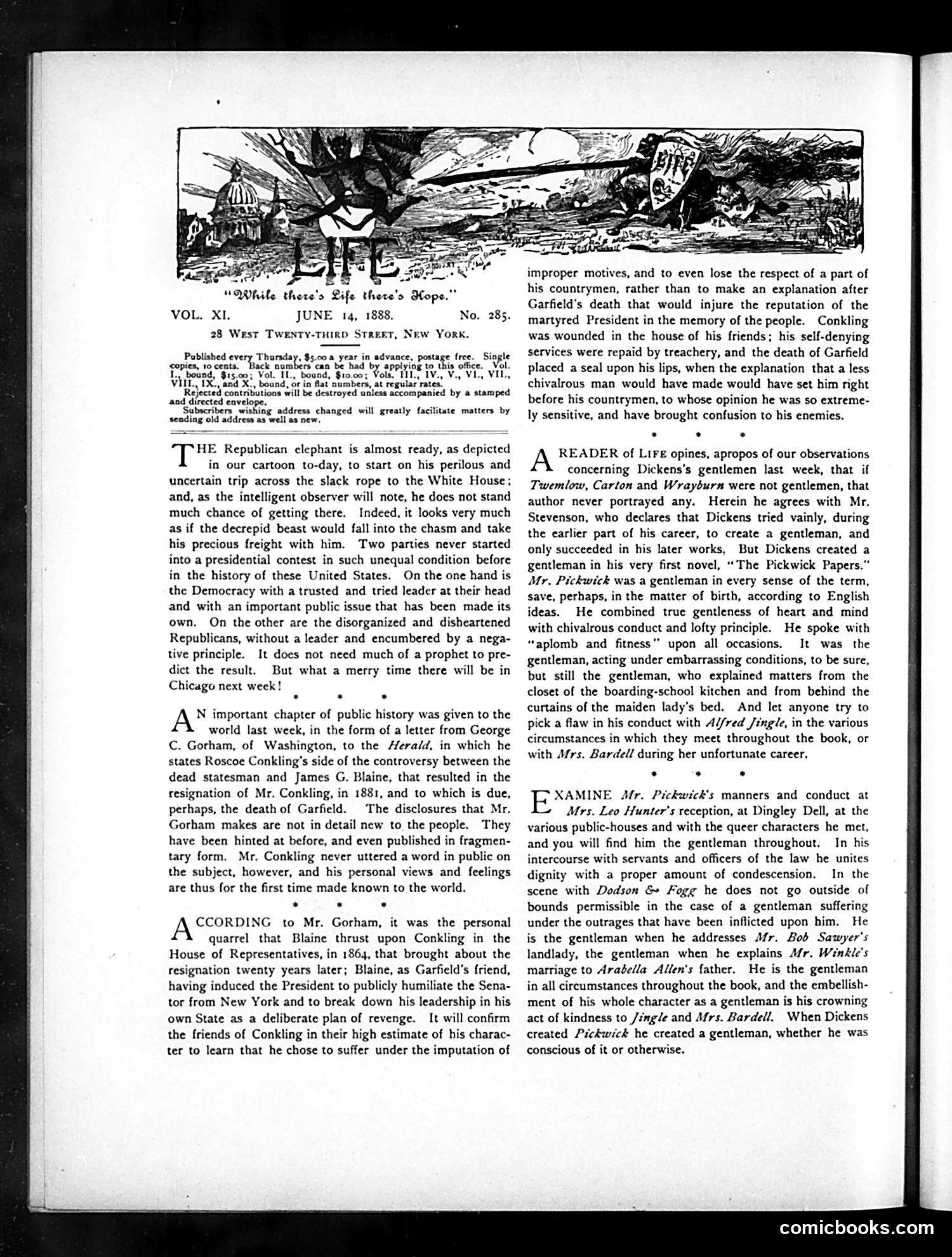
**The Cartoon:** The upper illustration depicts a Republican elephant preparing to cross a "slack rope" to the White House, carrying heavy baggage. The satire suggests Republicans face an uncertain, precarious path to the presidency—they lack the stability and favorable conditions Democrats have enjoyed. The cartoon ridicules Republican prospects by implying their candidate and platform are inadequately prepared for the election ahead. **The Articles:** The page discusses Charles J. Garfield's death and controversies surrounding Roscoe Conkling's political conflict with James G. Blaine. It also analyzes Charles Dickens's portrayal of gentlemen in his novels, particularly *Pickwick*, arguing Dickens successfully created gentlemanly characters despite social criticism.
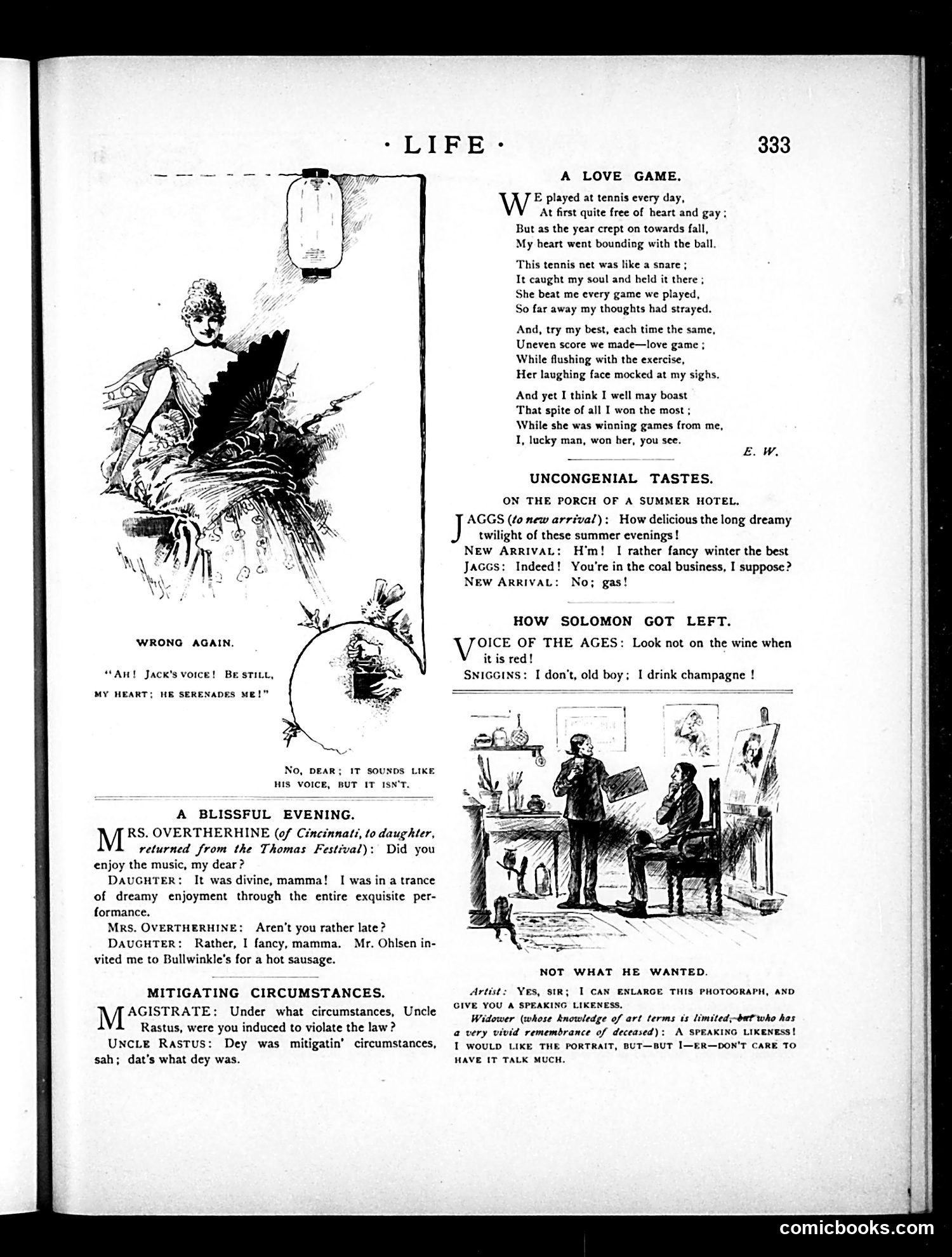
This page contains several humorous short pieces and sketches typical of early Life magazine's satirical format: **"A Love Game"** depicts tennis as romantic competition—a woman consistently beats a man at tennis while he remains emotionally entangled, suggesting he "won" by capturing her attention despite losing matches. **"Wrong Again"** shows a brief domestic scene where a woman mistakes a man's voice for someone named Jack, creating comedic confusion. **"Uncongenial Tastes"** and other brief dialogues present class-based humor contrasting nouveau riche characters ("Jags," "Sniggins") with established society types, poking fun at pretension and social climbing among the wealthy. **"Not What He Wanted"** depicts an artist and patron in a humorous negotiation over portrait enlargement and artistic integrity. These represent Life's typical format: gentle social satire targeting upper-class foibles, romantic misunderstandings, and status anxiety.
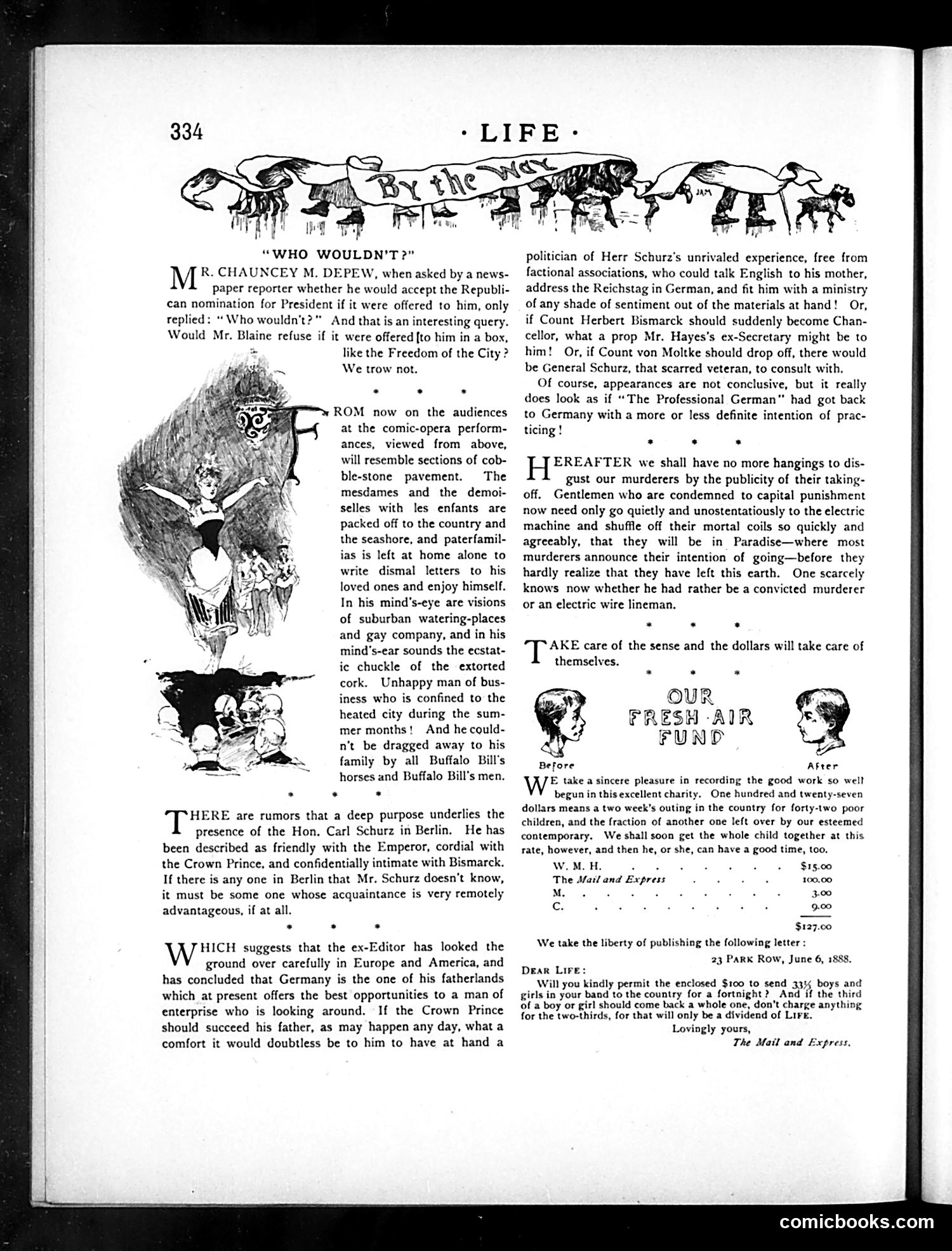
The main cartoon depicts a rotund man in formal dress being carried away by multiple figures. The text "Who Wouldn't?" references a query about accepting a Republican nomination for President. The cartoon satirizes the appeal of high office, with the portly figure appearing almost weightless as he's transported—suggesting the irresistible allure of political power and prestige. The page also references German politics, mentioning "Carl Schurz in Berlin" and discussing various European political figures. The satire appears to mock both American political ambition and German political intrigue of the era. A secondary section titled "Our Fresh Air Fund" discusses charity work sending urban children to the countryside for rest, establishing this as a genuine philanthropic initiative of the period rather than satire.
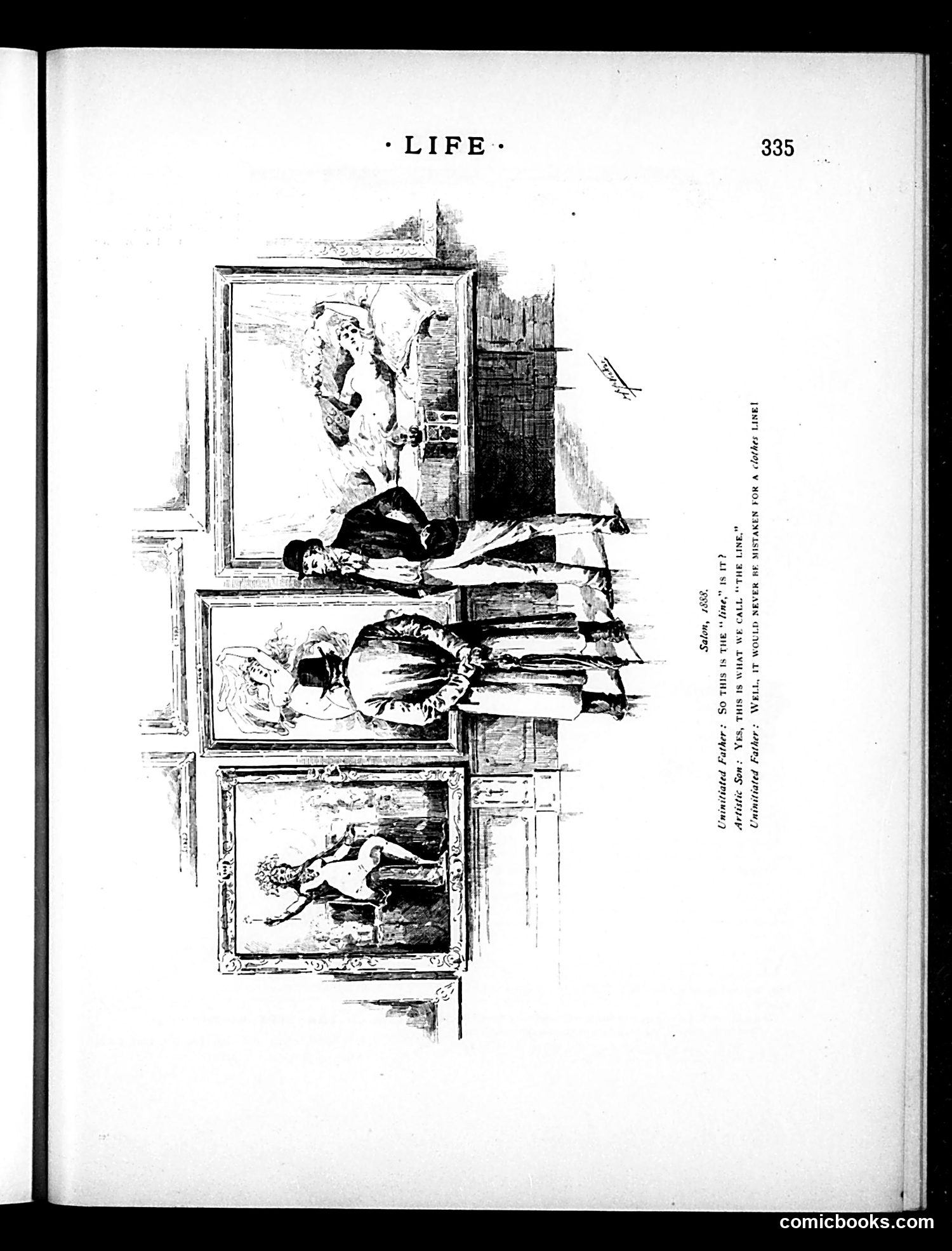
This page contains a three-panel satirical comic strip, though the OCR text is largely illegible. The illustration shows what appears to be a domestic or social scene with multiple figures in period dress (likely late 19th or early 20th century). The panels seem to depict a sequential narrative involving people in formal attire interacting in what looks like an interior setting. Without legible caption text, the specific satire or joke is difficult to identify with certainty. The comic likely comments on contemporary social customs, manners, or domestic situations typical of Life magazine's satirical approach. The artistic style and composition suggest this is satirizing some recognizable social behavior or relationship dynamic of the era, but the precise target and point of the humor cannot be reliably determined from the image alone.
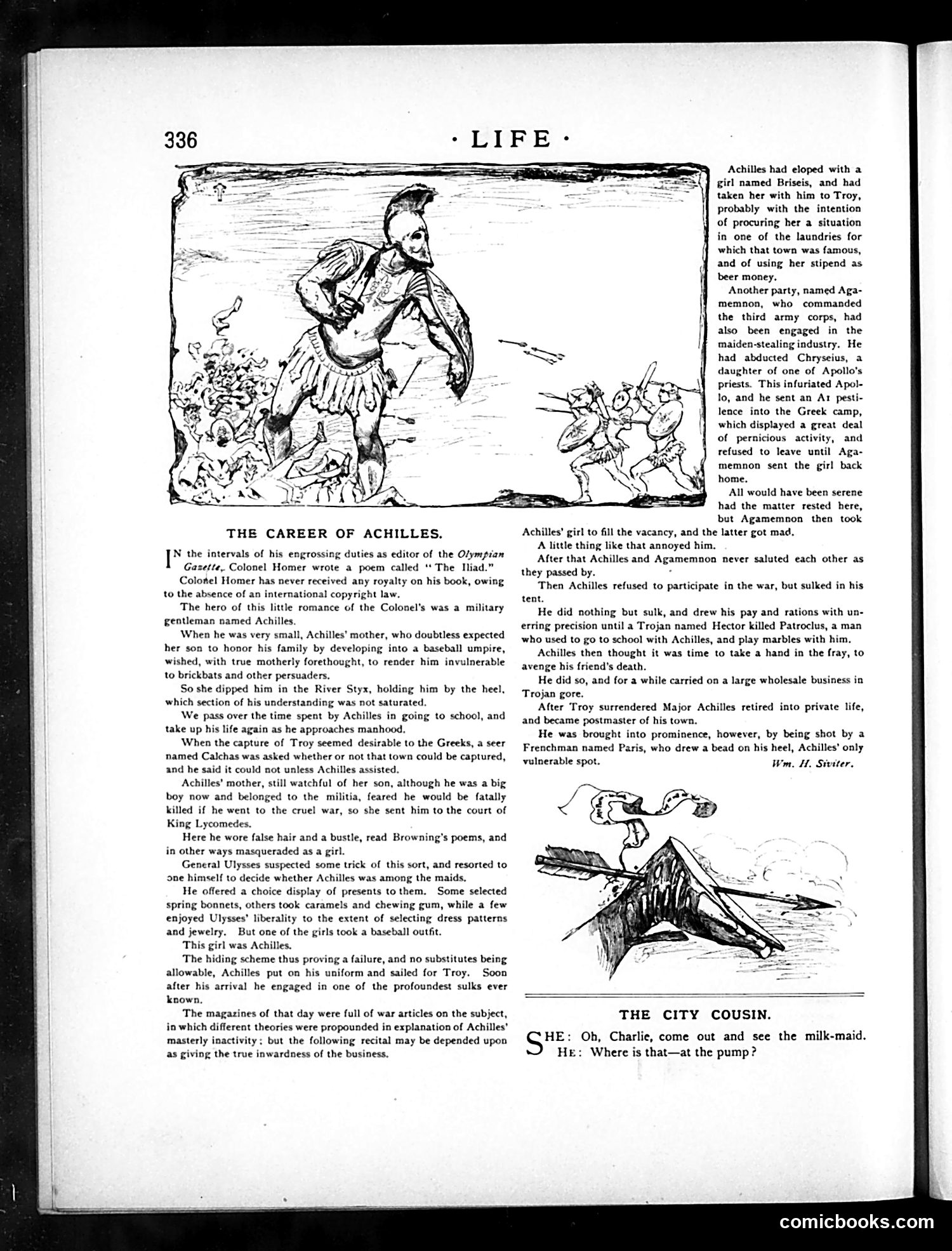
This page satirizes American military leadership and masculinity through a classical Trojan War framework. The text recounts how Colonel Homer, commanding officer, expected Achilles to become a "baseball umpire" rather than a warrior—a humorous degradation of martial duty. The central joke appears to target military incompetence: Achilles is forced into cross-dressing as a maid to avoid war service, parodying both avoidance of combat and questions about military leadership's judgment. References to Agamemnon and disputes over "maiden-stealing" likely mock internal military conflicts over resources and authority. The satire suggests contemporary American military figures were equally absurd as Greek mythology's conflicts, undermining the seriousness of military institutions through classical allegory.
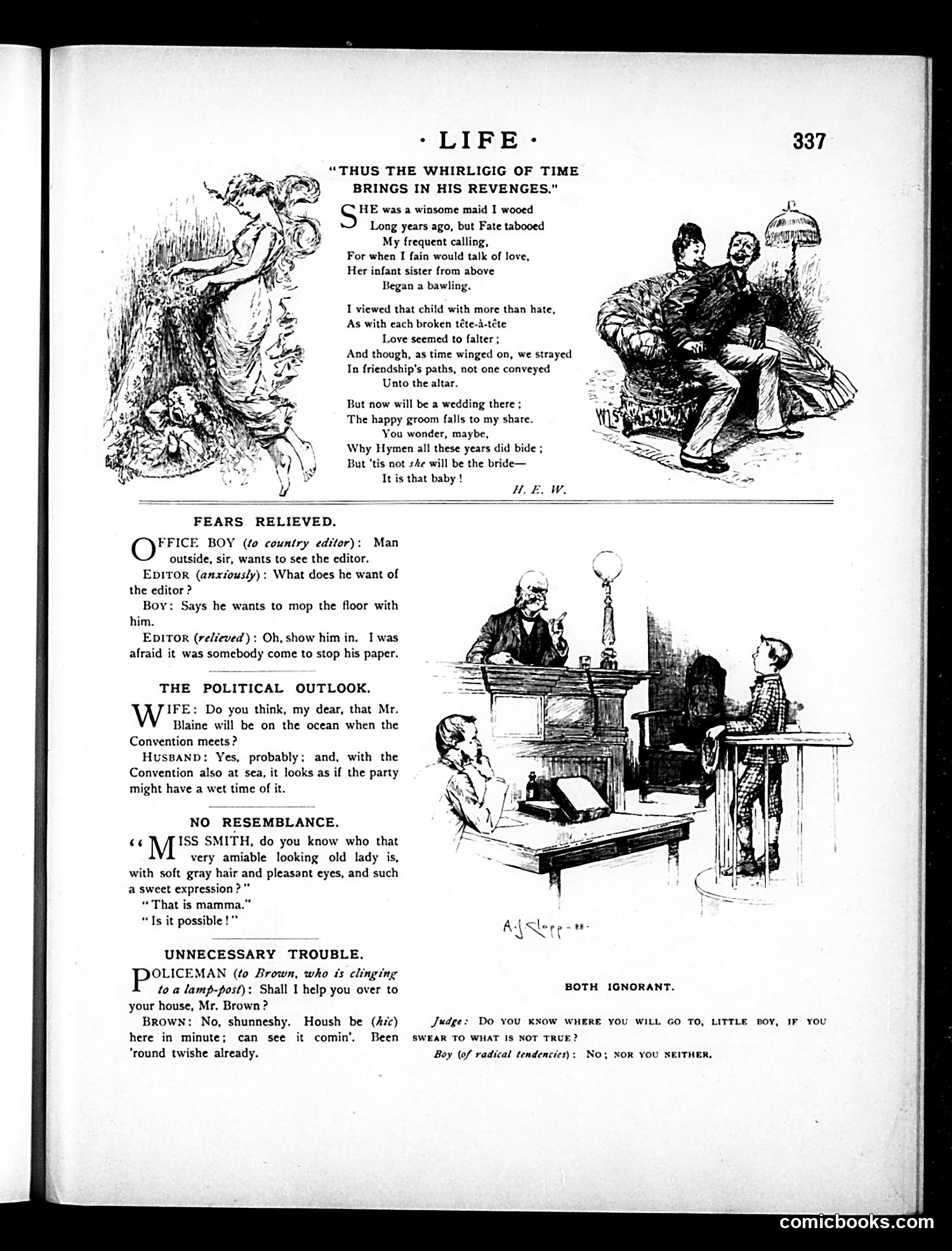
This page contains several brief humorous sketches typical of *Life* magazine's satirical format: 1. **"Thus the Whirligig of Time Brings in His Revenges"** - A poem about a man who wooed a woman years ago but was rejected; now he's attending her wedding to someone else, and her illegitimate child will become the groom. 2. **"Fears Relieved"** - An editor worries a visitor wants to stop his paper's publication; the visitor only wants to mop the floor. 3. **"The Political Outlook"** - A couple discusses whether politician Mr. Blaine will be "on the ocean" during a convention, with a joke about a "wet time." 4. **"No Resemblance"** - A woman is asked if she knows a lady resembling her; the answer: "That is mamma." 5. **"Both Ignorant"** - A judge questions a boy about swearing, establishing mutual ignorance. These are light social commentary and domestic humor typical of the era.
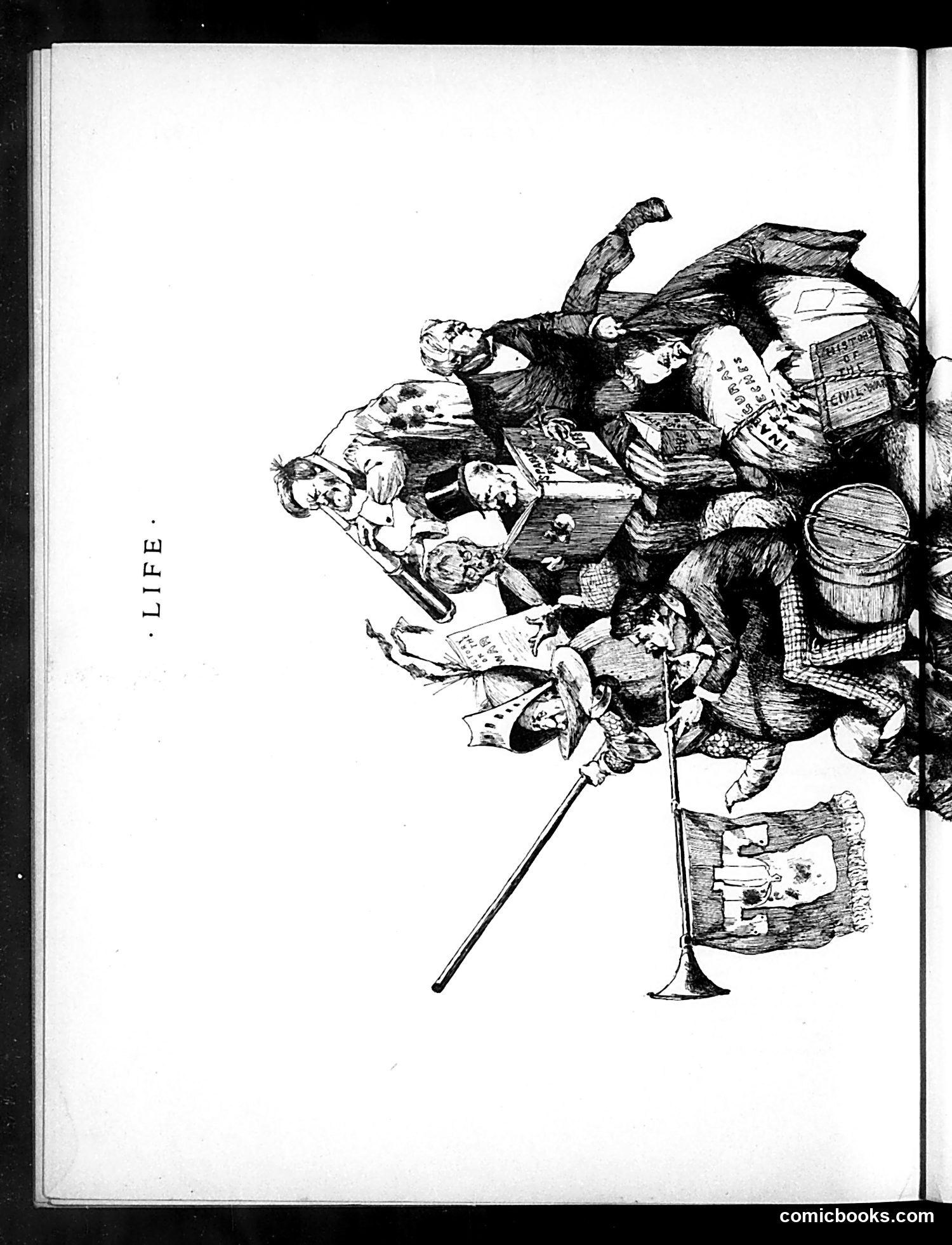
This is a satirical illustration titled "LIFE" showing a chaotic balloon or airship scene. Multiple figures in period dress are crowded together, appearing to be in disarray or celebration. The composition includes a trumpet and flag, suggesting themes of spectacle, excess, or public commotion. The style and presentation suggest this is social commentary on contemporary American life—likely mocking consumerism, public behavior, or cultural excess given the jumbled collection of figures and objects. The balloon imagery may reference aspirational or inflated expectations. However, without clearer text identifying specific political figures or dated publication information visible in this image, I cannot definitively identify which historical moment or personalities are being satirized. The artistic style appears consistent with early-20th-century American satirical magazines.
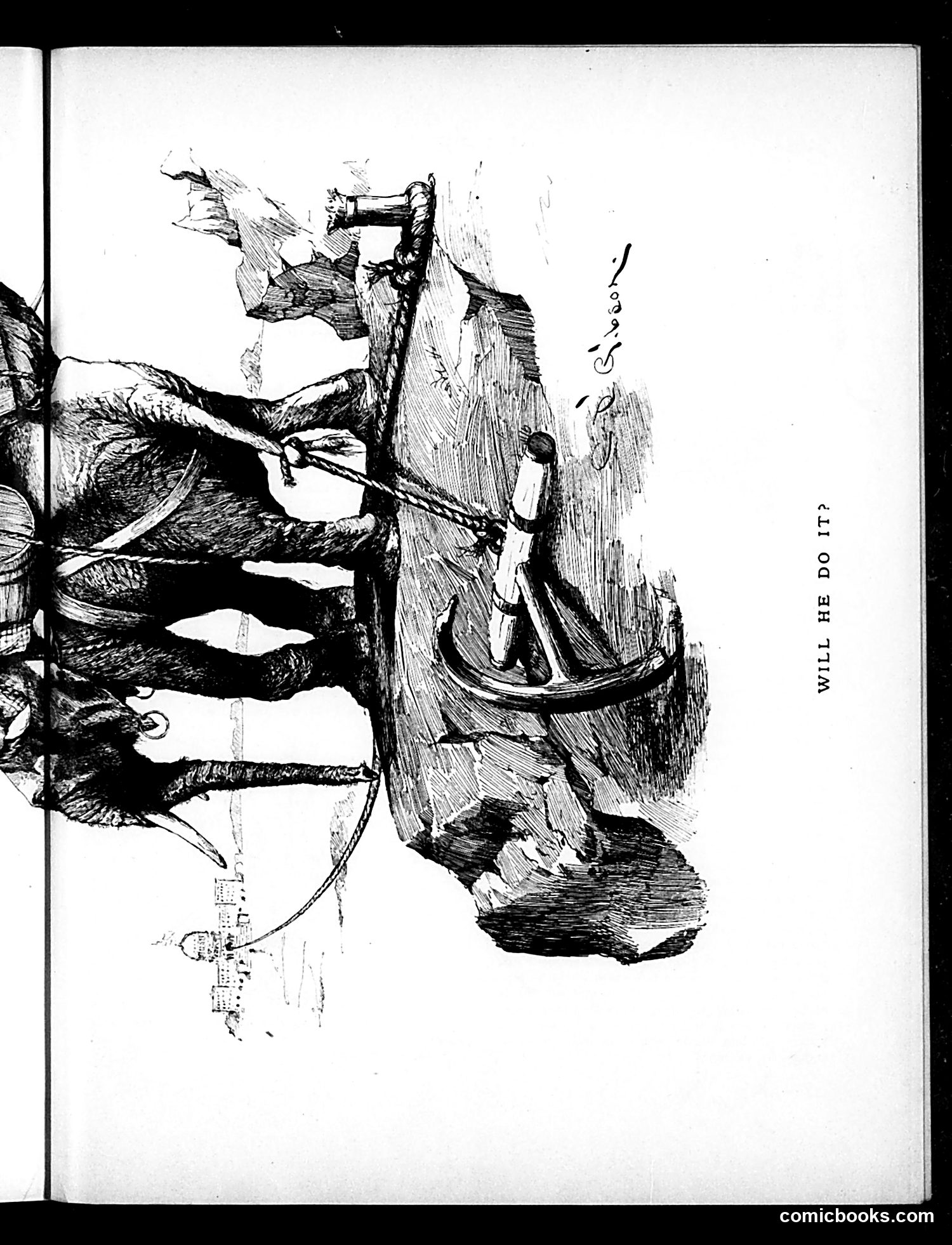
This page shows a political cartoon titled "WILL HE DO IT?" The image depicts a man in formal attire holding what appears to be a telescope or similar instrument, looking upward with apparent uncertainty or hesitation. The cartoon's title poses a question about whether "he" will take some action. Without being able to identify the specific figure or the historical moment this references, I cannot definitively explain who is portrayed or what action is being questioned. The formal dress and the questioning tone suggest this concerns a political or social figure facing a significant decision, but the specific context—the identity of the person, the date of publication, and the particular event being satirized—would require additional information beyond what's clearly visible in the image to explain accurately.
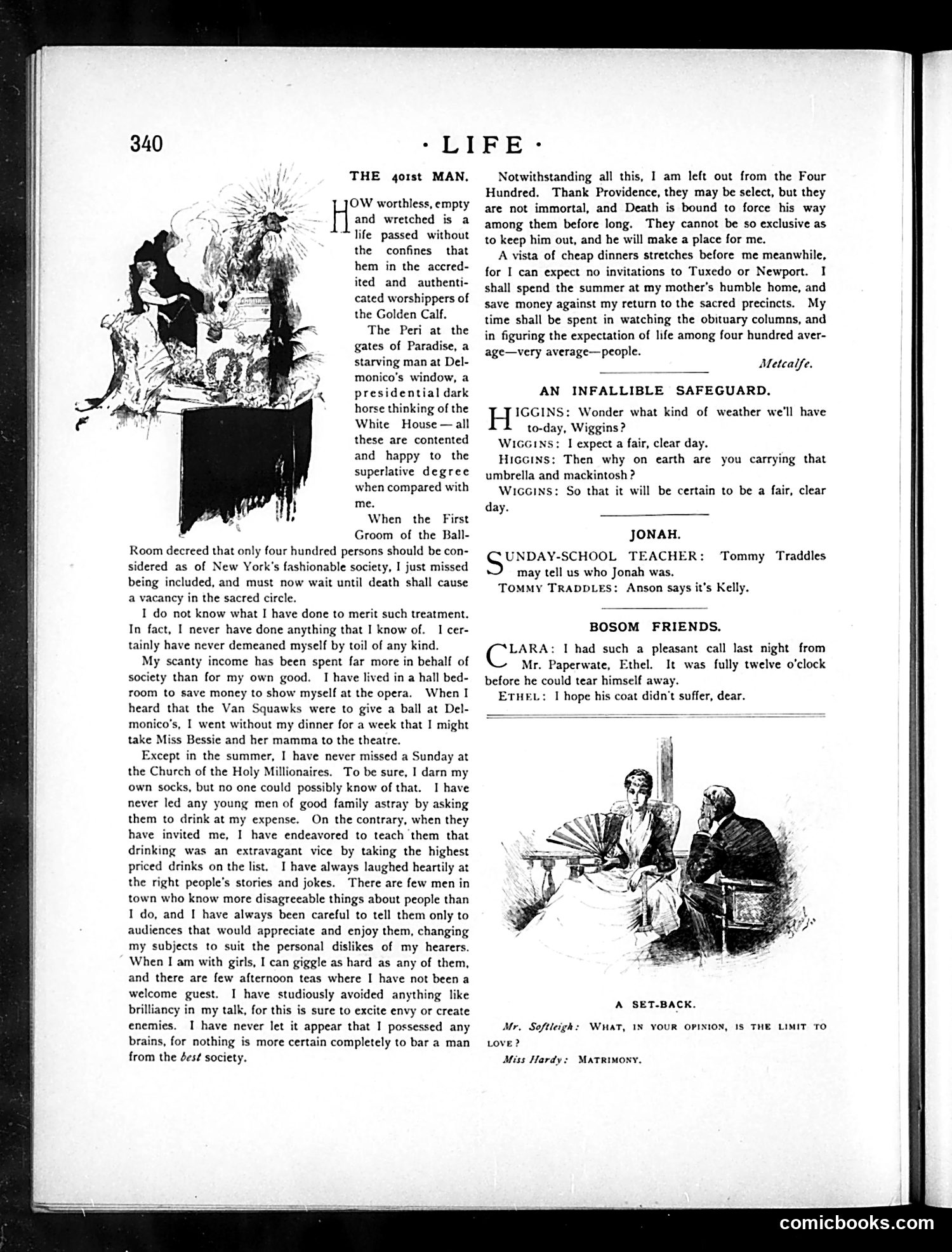
This page from *Life* magazine contains several short satirical pieces rather than a unified political cartoon. **"The 401st Man"** mocks high-society exclusivity. The narrator, apparently excluded from New York's elite "Four Hundred" social circle, boasts of his charitable work and social accomplishments while complaining bitterly about being left out. The satire targets the pretentious self-importance of both the exclusive society and the excluded person desperately seeking validation from it. **Other brief items** include wordplay humor ("An Infallible Safeguard," "Jonah," "Bosom Friends") and a small illustration showing two figures discussing the "limit to love," with the response "Matrimony"—mocking marriage as love's boundary. The overall tone satirizes vanity, social climbing, and marital cynicism characteristic of *Life*'s humor during this era.
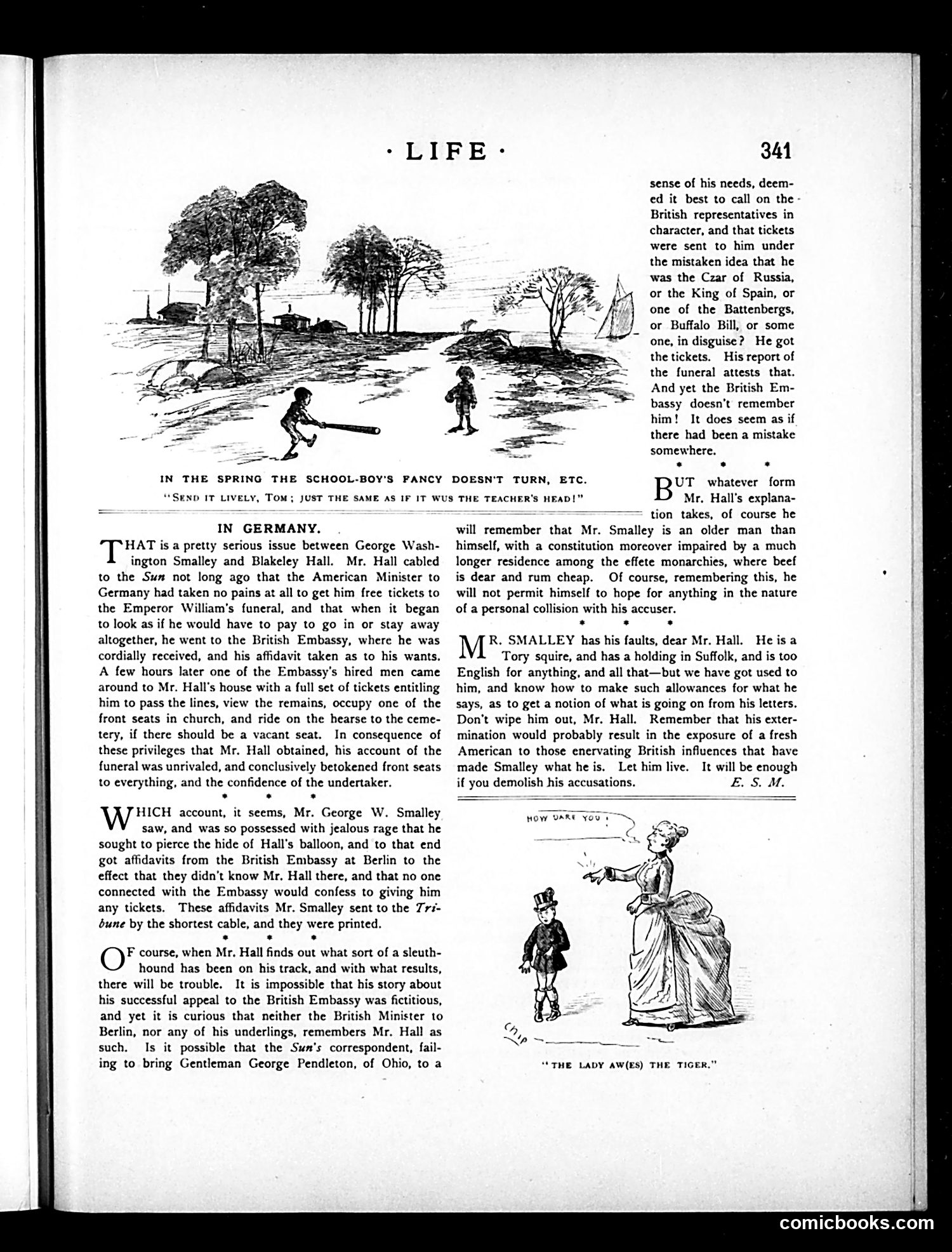
This page satirizes a real journalistic feud between two American newspaper correspondents covering Emperor William's funeral in Germany. **Blakeley Hall** (Sun correspondent) claimed the British Embassy gave him prime funeral access; **George W. Smalley** (Tribune correspondent), jealous of Hall's exclusive coverage, obtained affidavits from the Embassy denying they knew Hall or provided tickets. Life mocks both men mercilessly. The satire suggests Hall may have impersonated someone important (Czar, King of Spain, Buffalo Bill) to fraudulently obtain tickets, yet somehow the British "don't remember" him. The editor defends Smalley as an older man (a "Tory squire") weakened by European living, urging Hall not to physically retaliate but merely "demolish his accusations." The cartoon "The Lady Aw(es) the Tiger" (a pun on Stockton's famous story) depicts a woman intimidating a small boy—likely representing Hall's embarrassment. The humor relies on readers knowing these rival journalists' reputations and the Emperor William funeral as a major 1888 news event.
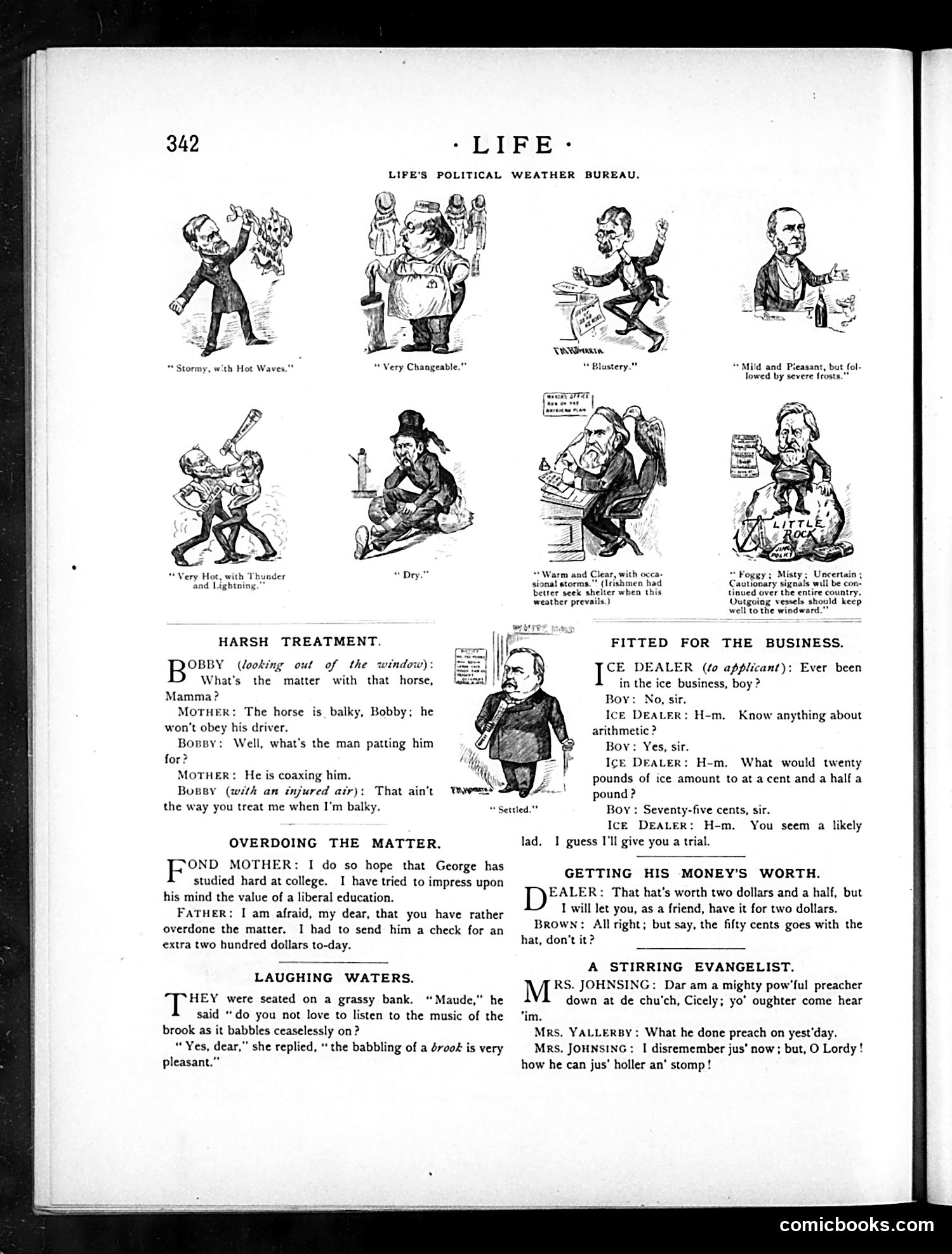
**Top Section—"Political Weather Bureau":** Eight caricatured figures represent political conditions as weather patterns. Without dates or clear labels, the specific politicians are unclear, but the metaphor compares political instability to meteorological unpredictability ("Very Changeable," "Stormy with Hot Waves," "Blusterly"). **Domestic Humor Sections:** The page contains four separate joke-dialogues mocking everyday situations: - **"Harsh Treatment"**: A child observes inconsistent parenting—a horse is coaxed while he receives harsh discipline. - **"Overdoing the Matter"**: A father's complaint that financing his son's college education contradicts the mother's emphasis on its value. - **"Laughing Waters"**: A woman misunderstands "brook" as "brood" (children). - **"Fitted for the Business"**: An ice dealer hires a boy based solely on arithmetic ability, ignoring actual experience. The remaining sections employ heavy dialect caricature ("Dar am," "jus' holler") stereotyping working-class and African American speech patterns—reflecting period publication conventions.
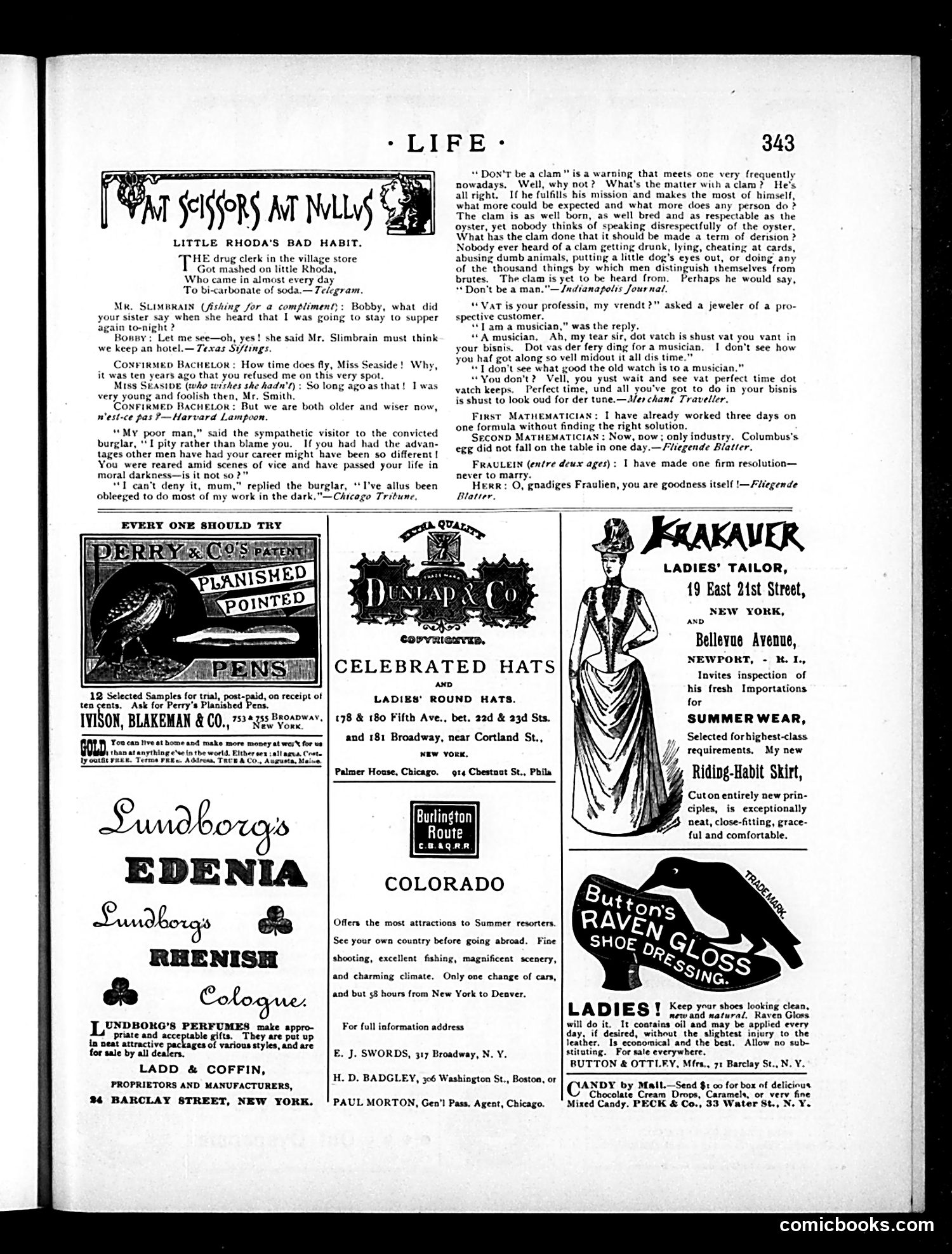
This page contains multiple brief humorous anecdotes typical of late 19th-century American satirical magazines, plus period advertisements. The cartoons/jokes mock various social types: a lovesick pharmacist, an opportunistic bachelor revisiting an old rejection, and a burglar's candid admission that he works "in the dark" out of necessity—a play on criminal necessity rather than moral darkness. The "Don't be a clam" editorial defends clams against being used as insults, noting they commit no human vices. Other brief pieces include a German-accented jeweler convinced a musician needs a precise watch, and mathematicians discussing problem-solving. The bulk of the page comprises advertisements for period goods: fountain pens, ladies' hats, perfume, patent medicines, summer clothing, shoe polish, and candy—typical commercial content filling space in magazines of this era. The humor relies on wordplay, ethnic dialect comedy (the German jeweler), and social observation now dated but recognizable to contemporary readers.
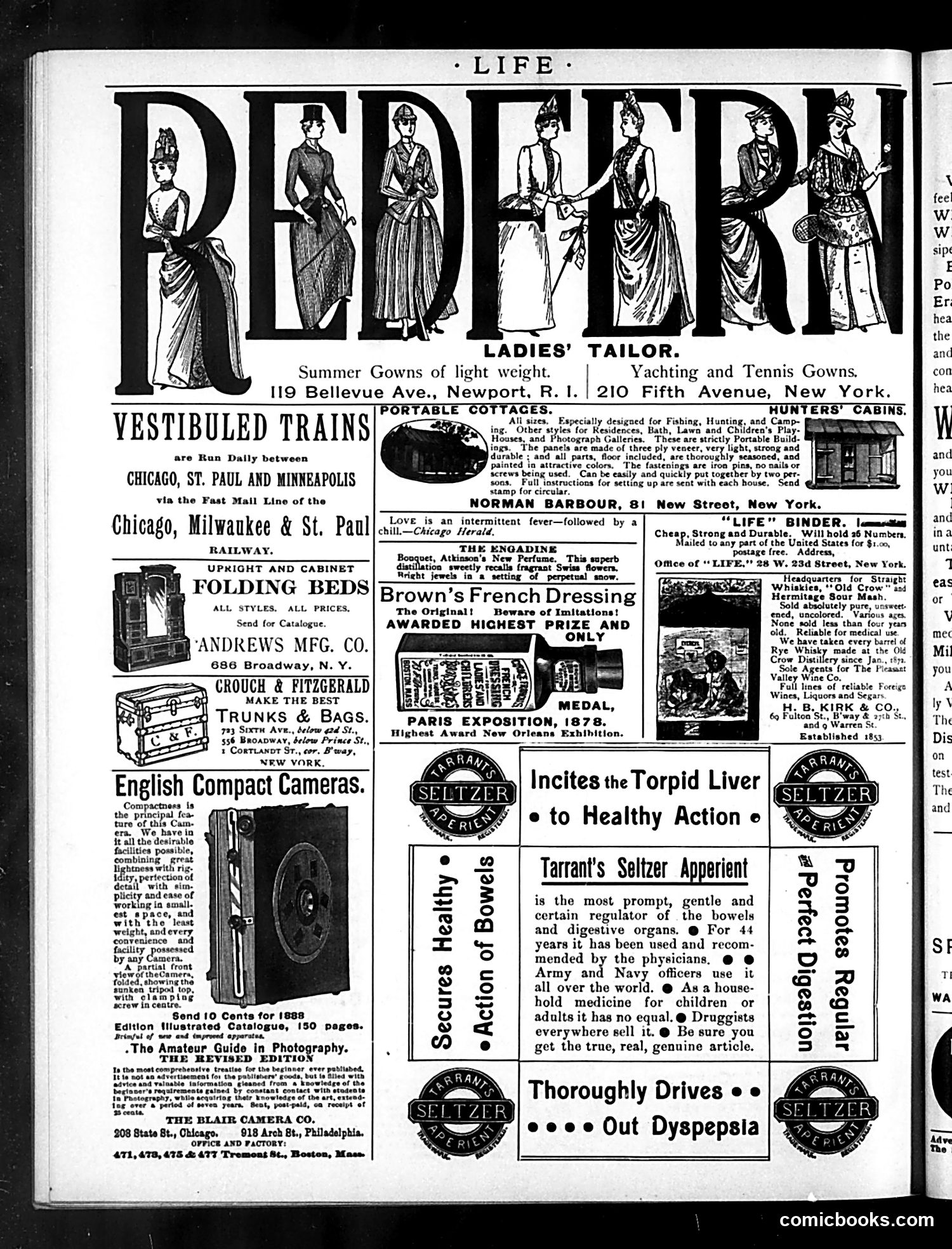
This is primarily a **commercial advertising page** rather than a satirical cartoon page. The dominant content consists of period advertisements for late 19th-century products and services. The top features a large decorative header "PEDLER" with illustrations of women in Victorian summer fashions—advertising ladies' tailors in Newport and New York offering yachting and tennis gowns. Below are typical era advertisements: folding beds, camera equipment, trunks and bags, portable hunting cabins, and whiskey. Most notably, a substantial ad promotes **Tarrant's Seltzer Apperient**, a digestive remedy claiming to cure liver problems and dyspepsia—representative of the patent medicine marketing common in this period. The only text-based humor is a brief quote: "Love is an intermittent fever—followed by a chill," attributed to the Chicago Herald, likely commenting on romantic disappointment. The page reflects Gilded Age consumer culture and the widespread marketing of dubious medicinal "remedies" before modern FDA regulations.
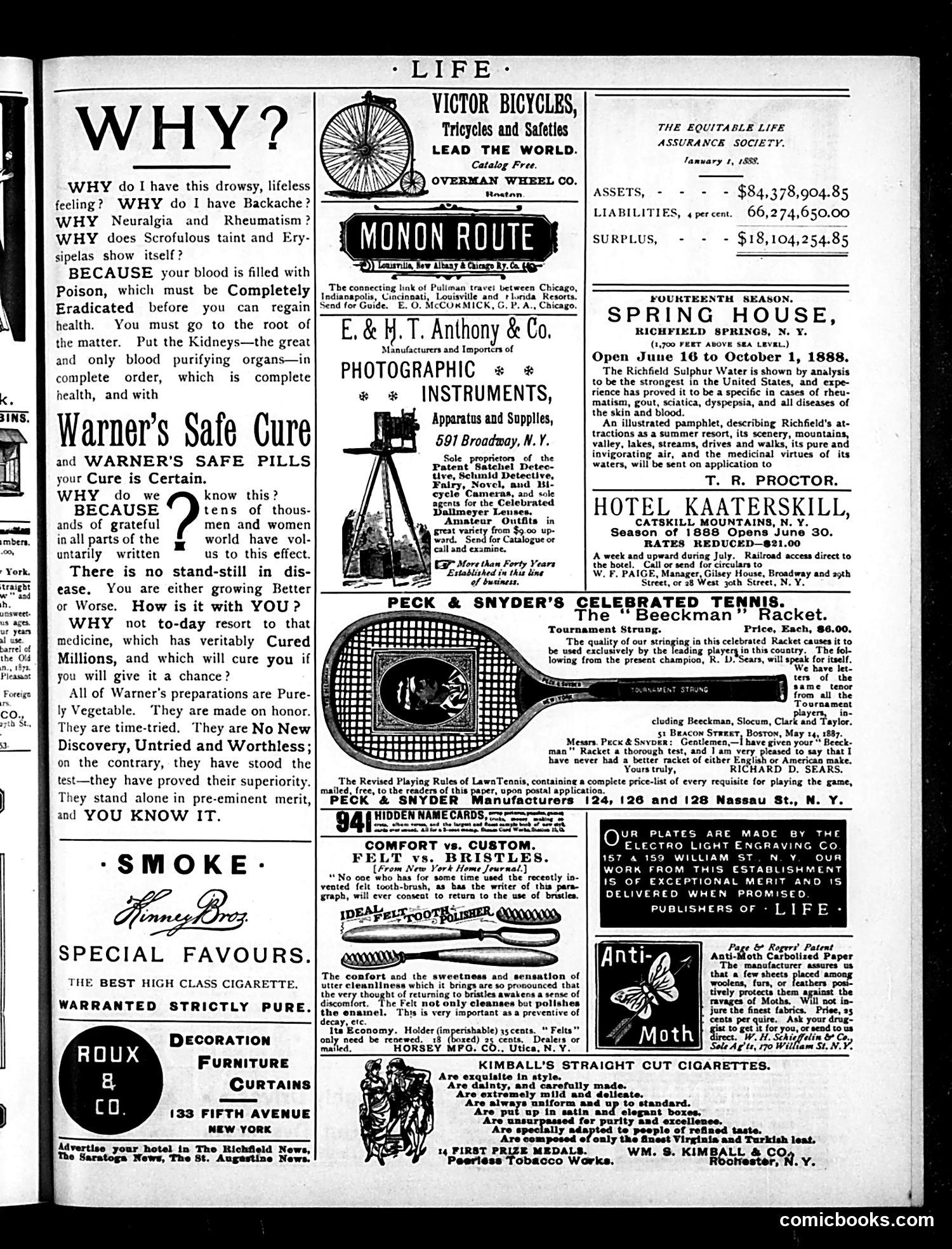
This page is primarily **advertising**, not political satire. It showcases late-1880s consumer products and services targeting affluent readers. The largest advertisement—**Warner's Safe Cure**—exemplifies the era's widespread patent medicine industry. It promises to cure vague ailments (drowsiness, backache, neuralgia) by "purifying" the blood through kidney treatment. These unregulated remedies were common before modern FDA oversight and often contained harmful substances. Other prominent ads reflect Gilded Age prosperity: bicycles (Victor Bicycles), photographic equipment (Anthony & Co.), luxury hotels (Richfield Springs, Hotel Kaaterskill), and fine goods (James Bock cigarettes, Roux furniture). The Equitable Life Assurance Society ad displays corporate wealth through asset figures. The page reveals period anxieties about health alongside consumerism—people sought remedies for conditions we'd now recognize as requiring legitimate medical attention, yet had few reliable options. The ads collectively document what affluent Americans valued and feared in 1888.
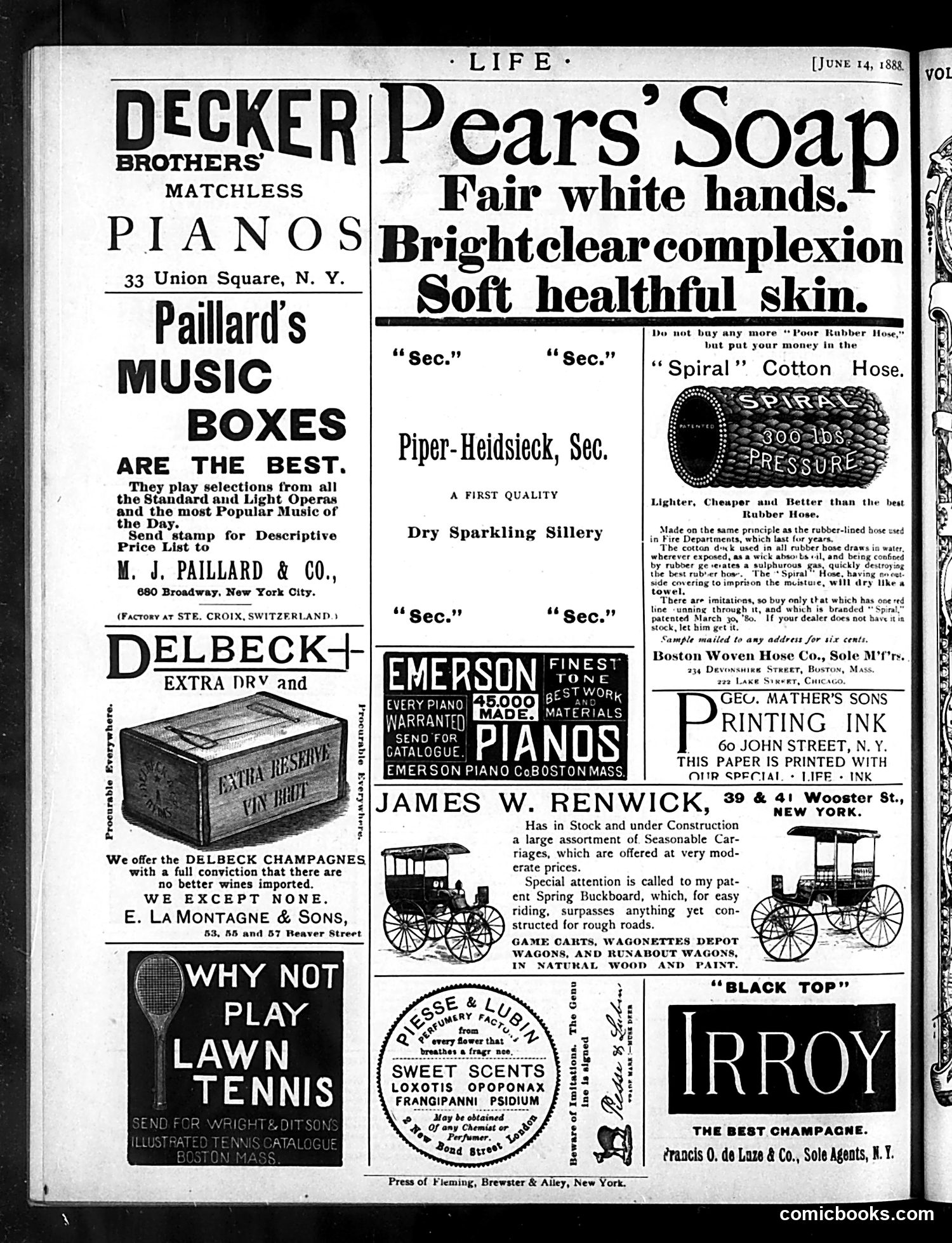
This is primarily an **advertising page**, not a satirical cartoon page. It contains commercial advertisements typical of 1880s American magazines, with no political or social satire evident. The ads reflect period consumer culture: Pears' Soap promoting "fair white hands" and "bright clear complexion" (reflecting Victorian beauty standards emphasizing pale skin); pianos and music boxes as luxury goods; champagne brands (Delbeck, Piper-Heidsieck, Irroy); and practical items like "Spiral" cotton hose and carriages with patent spring mechanisms. One ad references lawn tennis equipment, suggesting this leisure activity was becoming fashionable among the affluent audience Life targeted. The page demonstrates how 1880s magazines financed themselves through advertising while establishing consumer aspirations among middle and upper-class readers. There is no identifiable political commentary or satirical content visible here.