
Life, 1888-06-14 · page 2 of 16
Life — June 14, 1888 — page 2: what you’re looking at
What you’re looking at
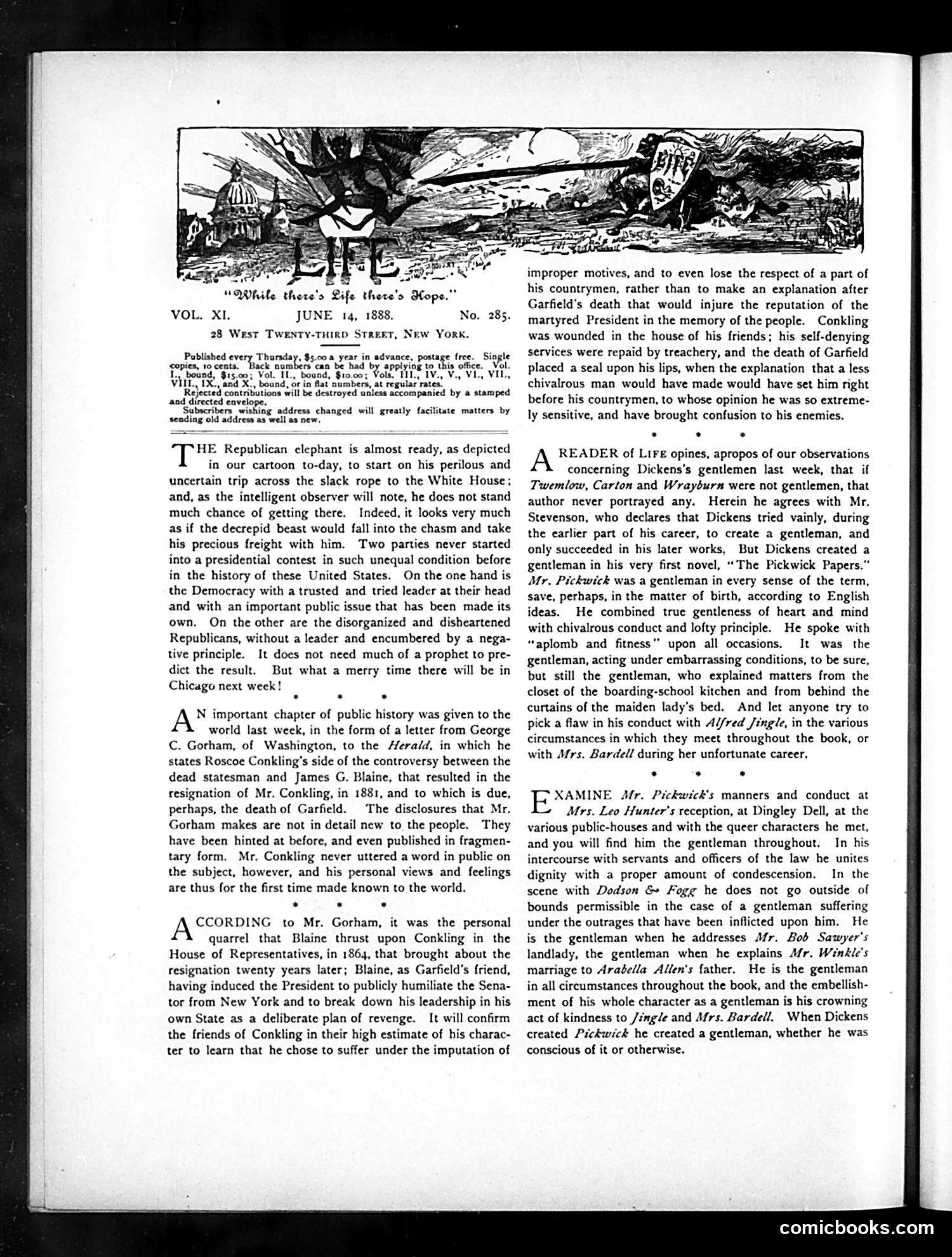
**The Cartoon:** The upper illustration depicts a Republican elephant preparing to cross a "slack rope" to the White House, carrying heavy baggage. The satire suggests Republicans face an uncertain, precarious path to the presidency—they lack the stability and favorable conditions Democrats have enjoyed. The cartoon ridicules Republican prospects by implying their candidate and platform are inadequately prepared for the election ahead. **The Articles:** The page discusses Charles J. Garfield's death and controversies surrounding Roscoe Conkling's political conflict with James G. Blaine. It also analyzes Charles Dickens's portrayal of gentlemen in his novels, particularly *Pickwick*, arguing Dickens successfully created gentlemanly characters despite social criticism.
📄 Transcribed text from this page (OCR, searchable)
Machine-transcribed from the original scan — historical spelling and the odd misread are preserved.
“While there's Life there's Hope.” VOL. XI. JUNE 14, 1888, No. 285. 28 West TWENTY-THIRD STREET, NEw York. Published every Thursday, $5.00 year in advance, postage free. Siggle copies, 10 cents. hack numbers can be had by ‘applying to this office. Vol. bound, $13.00; VoL. Il, bound, $1o.co; Vols. Til 1V., Vx. Vi Vil VIII, IX., and X:, bound, or in flat numbers, at regular rates, Rejected contributions will be destroyed unless accompanied by a stamped and directed envelope. Subscribers wishing address changed will greatly facilitate matters by sending old address as well as new. HE Republican elephant is almost ready, as depicted in our cartoon to-day, to start on his perilous and uncertain trip across the slack rope to the White House; and, as the intelligent observer will note, he does not stand much chance of getting there. Indeed, it looks very much as if the decrepid beast would fall into the chasm and take his precious freight with him. Two parties never started into a presidential contest in such unequal condition before in the history of these United States. On the one hand is the Democracy with a trusted and tried leader at their head and with an important public issue that has been made its own. On the other are the disorganized and disheartened Republicans, without a leader and encumbered by a nega- tive principle. It does not need much of a prophet to pre- dict the result. But what a merry time there will be in Chicago next week! . . . N important chapter of public history was given to the world last week, in the form of a letter from George C. Gorham, of Washington, to the Herald, in which he states Roscoe Conkling’s side of the controversy between the dead statesman and James G. Blaine, that resulted in the resignation of Mr. Conkling, in 1881, and to which is due, perhaps, the death of Garfield. The disclosures that Mr. Gorham makes are not in detail new to the people. They have been hinted at before, and even published in fragmen- tary form. Mr, Conkling never uttered a word in public on the subject, however, and his personal views and feelings are thus for the first time made known to the world. . . . CCORDING to Mr. Gorham, it was the personal quarrel that Blaine thrust upon Conkling in the House of Representatives, in 1864, that brought about the resignation twenty years later; Blaine, as Garfield's friend, having induced the President to publicly humiliate the Sena- tor from New York and to break down his leadership in his own State as a deliberate plan of revenge. It will confirm the friends of Conkling in their high estimate of his charac- ter to learn that he chose to suffer under the imputation of improper motives, and to even lose the respect of a part of his countrymen, rather than to make an explanation after Garfield's death that would injure the reputation of the martyred President in the memory of the people. Conkling was wounded in the house of his friends; his self-denying services were repaid by treachery, and the death of Garfield placed a seal upon his lips, when the explanation that a less chivalrous man would have made would have set him right before his countrymen, to whose opinion he was so extreme- ly sensitive, and have brought confusion to his enemies. READER of LiF¢ opines, apropos of our observations concerning Dickens's gentlemen last week, that if Twemlow, Carton and Wrayburn were not gentlemen, that author never portrayed any. Herein he agrees with Mr. Stevenson, who declares that Dickens tried vainly, during the earlier part of his career, to create a gentleman, and only succeeded in his later works, But Dickens created a gentleman in his very first novel, “The Pickwick Papers.” Mr. Pickwick was a gentleman in every sense of the term, save, perhaps, in the matter of birth, according to English ideas. He combined true gentleness of heart and mind with chivalrous conduct and lofty principle. He spoke with “aplomb and fitness” upon all occasions. It was the gentleman, acting under embarrassing conditions, to be sure, but still the gentleman, who explained matters from the closet of the boarding-school kitchen and from behind the curtains of the maiden lady’s bed. And let anyone try to pick a flaw in his conduct with A//red Jingle, in the various circumstances in which they meet throughout the book, or with Mrs. Bardell during her unfortunate career. FRAME Mr. Pickwick's manners and conduct at Mrs. Leo Hunter's reception, at Dingley Dell, at the various public-houses and with the queer characters he met, and you will find him the gentleman throughout. In his intercourse with servants and officers of the law he unites dignity with a proper amount of condescension. In the scene with Dodson & Fogg he does not go outside of bounds permissible in the case of a gentleman suffering under the outrages that have been inflicted upon him. He is the gentleman when he addresses Mr. Bob Sawyer's landlady, the gentleman when he explains Afr. Winkle's marriage to Arabella Allen's father. He is the gentleman in all circumstances throughout the book, and the embellish- ment of his whole character as a gentleman is his crowning act of kindness to Jingle and Mrs. Bardell, When Dickens created Pickwick he created a gentleman, whether he was conscious of it or otherwise. comicbooks.com