
Life, 1888-06-14 · page 6 of 16
Life — June 14, 1888 — page 6: what you’re looking at
What you’re looking at
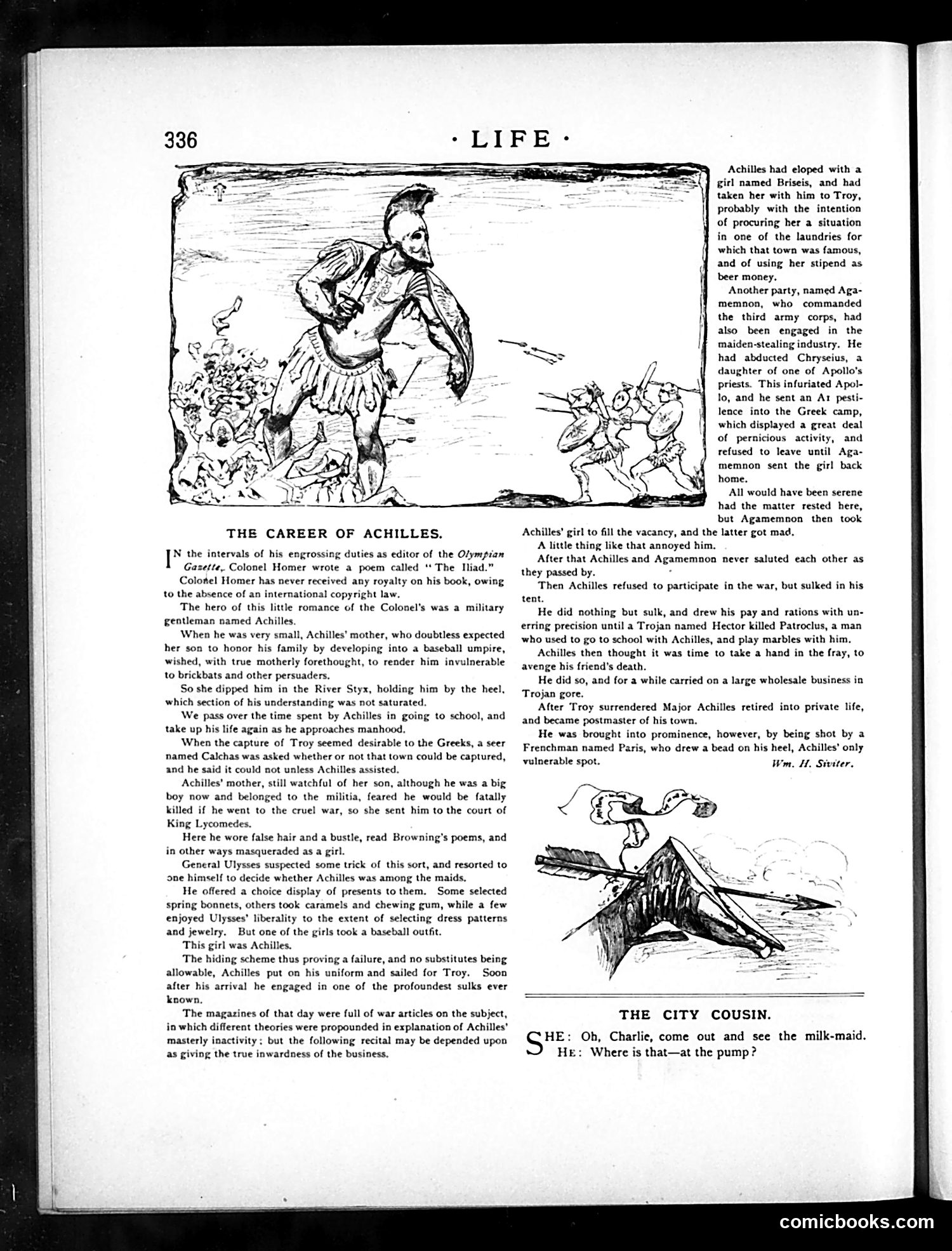
This page satirizes American military leadership and masculinity through a classical Trojan War framework. The text recounts how Colonel Homer, commanding officer, expected Achilles to become a "baseball umpire" rather than a warrior—a humorous degradation of martial duty. The central joke appears to target military incompetence: Achilles is forced into cross-dressing as a maid to avoid war service, parodying both avoidance of combat and questions about military leadership's judgment. References to Agamemnon and disputes over "maiden-stealing" likely mock internal military conflicts over resources and authority. The satire suggests contemporary American military figures were equally absurd as Greek mythology's conflicts, undermining the seriousness of military institutions through classical allegory.
📄 Transcribed text from this page (OCR, searchable)
Machine-transcribed from the original scan — historical spelling and the odd misread are preserved.
THE CAREER OF ACHILLES. [N the intervals of his engrossing duties as editor of the Olympian Gazette, Colonel Homer wrote a poem called ‘The Iliad.” Coloftel Homer has never received any royalty on his book, owing to the absence of an international copyright law. The hero of this little romance of the Colonel's was a military gentleman named Achilles. When he was very small, Achilles’ mother, who doubtless expected her son to honor his family by developing into a baseball umpire, wished, with true motherly forethought, to render him invulnerable to brickbats and other persuaders, So she dipped him in the River Styx, holding him by the heel, which section of his understanding was not saturated. We pass over the time spent by Achilles in going to school, and take up his life again as he approaches manhood, When the capture of Troy seemed desirable to the Greeks, a seer named Calchas was asked whether or not that town could be captured, and he said it could not unless Achilles assisted, Achilles’ mother, still watchful of her son, although he was a big boy now and belonged to the militia, feared he would be fatally killed if he went to the cruel war, so she sent him to the court of King Lycomedes. Here he wore false hair and a bustle, read Browning's poems, and in other ways masqueraded as a girl. General Ulysses suspected some trick of this sort, and resorted to one himself to decide whether Achilles was among the maids. He offered a choice display of presents to them. Some selected spring bonnets, others took caramels and chewing gum, while a few enjoyed Ulysses’ liberality to the extent of selecting dress patterns and jewelry. But one of the girls took a baseball outfit. This girl was Achilles. The hiding scheme thus proving a failure, and no substitutes being allowable, Achilles put on his uniform and sailed for Troy. Soon after his arrival he engaged in one of the profoundest sulks ever known. ‘The magazines of that day were full of war articles on the subject, in which different theories were propounded in explanation of Achilles’ masterly inactivity; but the following recital may be depended upon as giving the true inwardness of the business. Achilles had eloped with a girl named Briseis, and had taken her with him to Troy, probably with the intention of procuring her a situation in one of the laundries for which that town was famous, and of using her stipend as beer money, Another party, named Aga- memnon, who commanded the third army corps, had also been engaged in the maiden-stealing industry. He had abducted Chryseius, a daughter of one of Apollo's priests. This infuriated Apol- lo, and he sent an Ar pesti- lence into the Greek camp, which displayed a great deal of pernicious activity, and refused to leave until Aga- memnon sent the girl back home. All would have been serene had the matter rested here, but Agamemnon then took Achilles’ girl to fill the vacancy, and the latter got mad, A little thing like that annoyed him, After that Achilles and Agamemnon never saluted each other as they passed by. : Then Achilles refused to participate in the war, but sulked in his tent. He did nothing but sulk, and drew his pay and rations with un- erring precision until a Trojan named Hector killed Patroclus, a man who used to go to school with Achilles, and play marbles with him. Achilles then thought it was time to take a hand in the fray, to avenge his friend's death. He did so, and for a while carried on a large wholesale business in Trojan gore. After Troy surrendered Major Achilles retired into private life, and became postmaster of his town. He was brought into prominence, however, by being shot by a Frenchman named Paris, who drew a bead on his heel, Achilles’ only vulnerable spot. Wm. H. Siviter. THE CITY COUSIN. HE: Oh, Charlie, come out and see the milk-maid. HE: Where is that—at the pump? comicbooks.com