
Life, 1888-06-14 · page 11 of 16
Life — June 14, 1888 — page 11: what you’re looking at
What you’re looking at
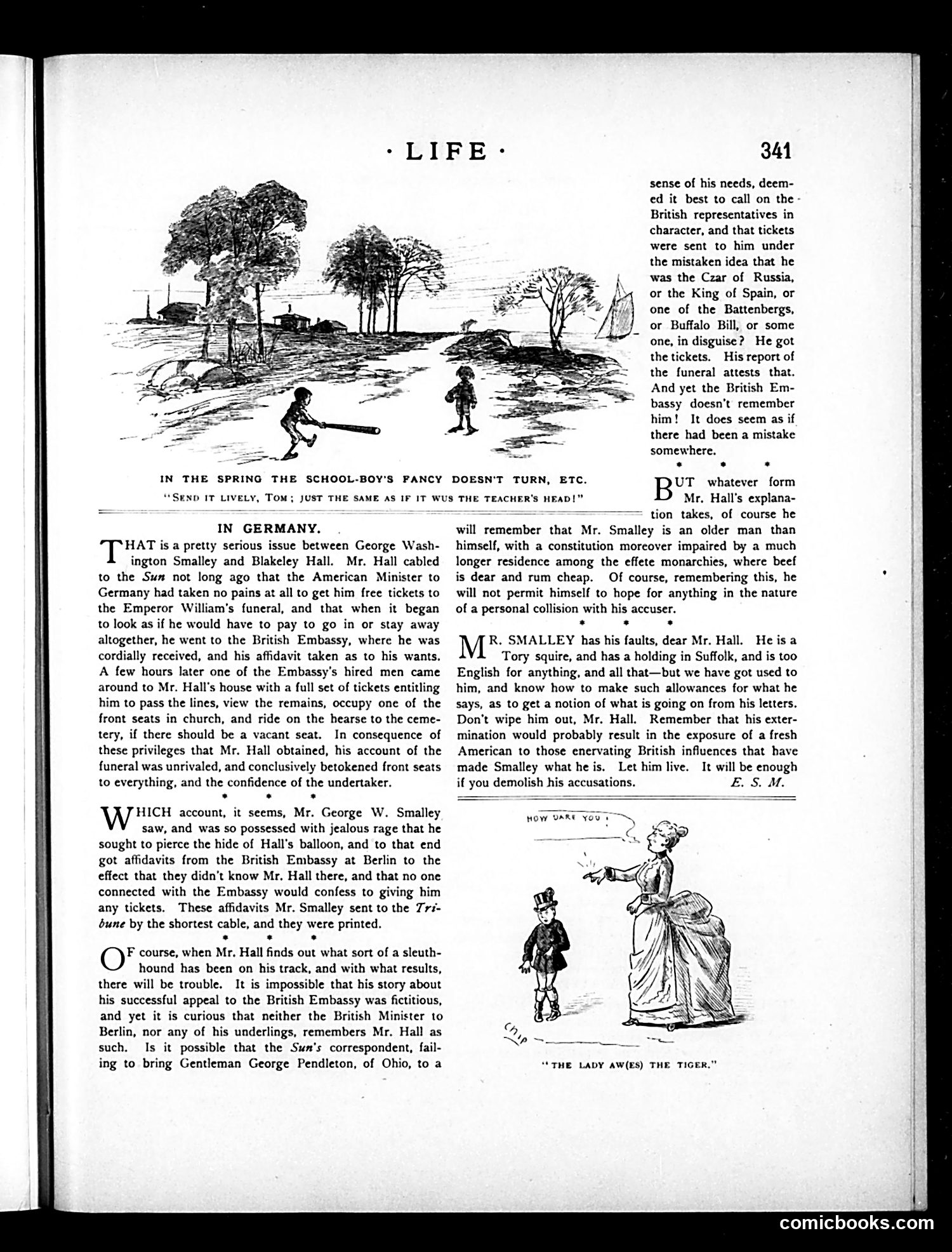
This page satirizes a real journalistic feud between two American newspaper correspondents covering Emperor William's funeral in Germany. **Blakeley Hall** (Sun correspondent) claimed the British Embassy gave him prime funeral access; **George W. Smalley** (Tribune correspondent), jealous of Hall's exclusive coverage, obtained affidavits from the Embassy denying they knew Hall or provided tickets. Life mocks both men mercilessly. The satire suggests Hall may have impersonated someone important (Czar, King of Spain, Buffalo Bill) to fraudulently obtain tickets, yet somehow the British "don't remember" him. The editor defends Smalley as an older man (a "Tory squire") weakened by European living, urging Hall not to physically retaliate but merely "demolish his accusations." The cartoon "The Lady Aw(es) the Tiger" (a pun on Stockton's famous story) depicts a woman intimidating a small boy—likely representing Hall's embarrassment. The humor relies on readers knowing these rival journalists' reputations and the Emperor William funeral as a major 1888 news event.
📄 Transcribed text from this page (OCR, searchable)
Machine-transcribed from the original scan — historical spelling and the odd misread are preserved.
IN THE SPRING THE SCHOOL-BOY'S FANCY DOESN'T TURN, ETC. “SEND IT LIVELY, Tom; JUST THE SAME AS IF IT WUS THE TEACHER'S HEAD!” IN GERMANY. HAT isa pretty serious issue between George Wash- ington Smalley and Blakeley Hall. Mr. Hall cabled to the Sun not long ago that the American Minister to Germany had taken no pains at all to get him free tickets to the Emperor William's funeral, and that when it began to look as if he would have to pay to go in or stay away altogether, he went to the British Embassy, where he was cordially received, and his affidavit taken as to his wants. A few hours later one of the Embassy's hired men came around to Mr. Hall's house with a full set of tickets entitling him to pass the lines, view the remains, occupy one of the front seats in church, and ride on the hearse to the ceme- tery, if there should be a vacant seat. In consequence of these privileges that Mr. Hall obtained, his account of the funeral was unrivaled, and conclusively betokened front seats to everything, and the confidence of the undertaker. . . . HICH account, it seems, Mr. George W. Smalley saw, and was so possessed with jealous rage that he sought to pierce the hide of Hall's balloon, and to that end got affidavits from the British Embassy at Berlin to the effect that they didn’t know Mr. Hall there, and that no one connected with the Embassy would confess to giving him any tickets. These affidavits Mr. Smalley sent to the 7rs- dune by the shortest cable, and they were printed. . . * F course, when Mr. Hall finds out what sort of a sleuth- hound has been on his track, and with what results, there will be trouble. It is impossible that his story about his successful appeal to the British Embassy was fictitious, and yet it is curious that neither the British Minister to Berlin, nor any of his underlings, remembers Mr. Hall as such. Is it possible that the Sun's correspondent, fail- ing to bring Gentleman George Pendleton, of Ohio, to a 341 sense of his needs, deem- ed it best to call on the - British representatives in character, and that tickets were sent to him under the mistaken idea that he was the Czar of Russia, or the King of Spain, or one of the Battenbergs, or Buffalo Bill, or some one, in disguise? He got the tickets. His report of the funeral attests that. And yet the British Em- bassy doesn’t remember him! It does seem as if there had been a mistake somewhere. . . . Bu whatever form Mr. Hall's explana- rae ————= tion takes, of course he will remember that Mr. Smalley is an older man than himself, with a constitution moreover impaired by a much longer residence among the effete monarchies, where beef is dear and rum cheap. Of course, remembering this, he will not permit himself to hope for anything in the nature of a personal collision with his accuser. . . . R. SMALLEY has his faults, dear Mr. Hall. He is a Tory squire, and has a holding in Suffolk, and is too English for anything, and all that—but we have got used to him, and know how to make such allowances for what he says, as to get a notion of what is going on from his letters. Don't wipe him out, Mr. Hall. Remember that his exter- mination would probably result in the exposure of a fresh American to those enervating British influences that have made Smalley what he is. Let him live. It will be enough if you demolish his accusations. ““THE LADY AW(ES) THE TIGER.” comicbooks.com