
A complete issue · 16 pages · 1888
Life — March 22, 1888
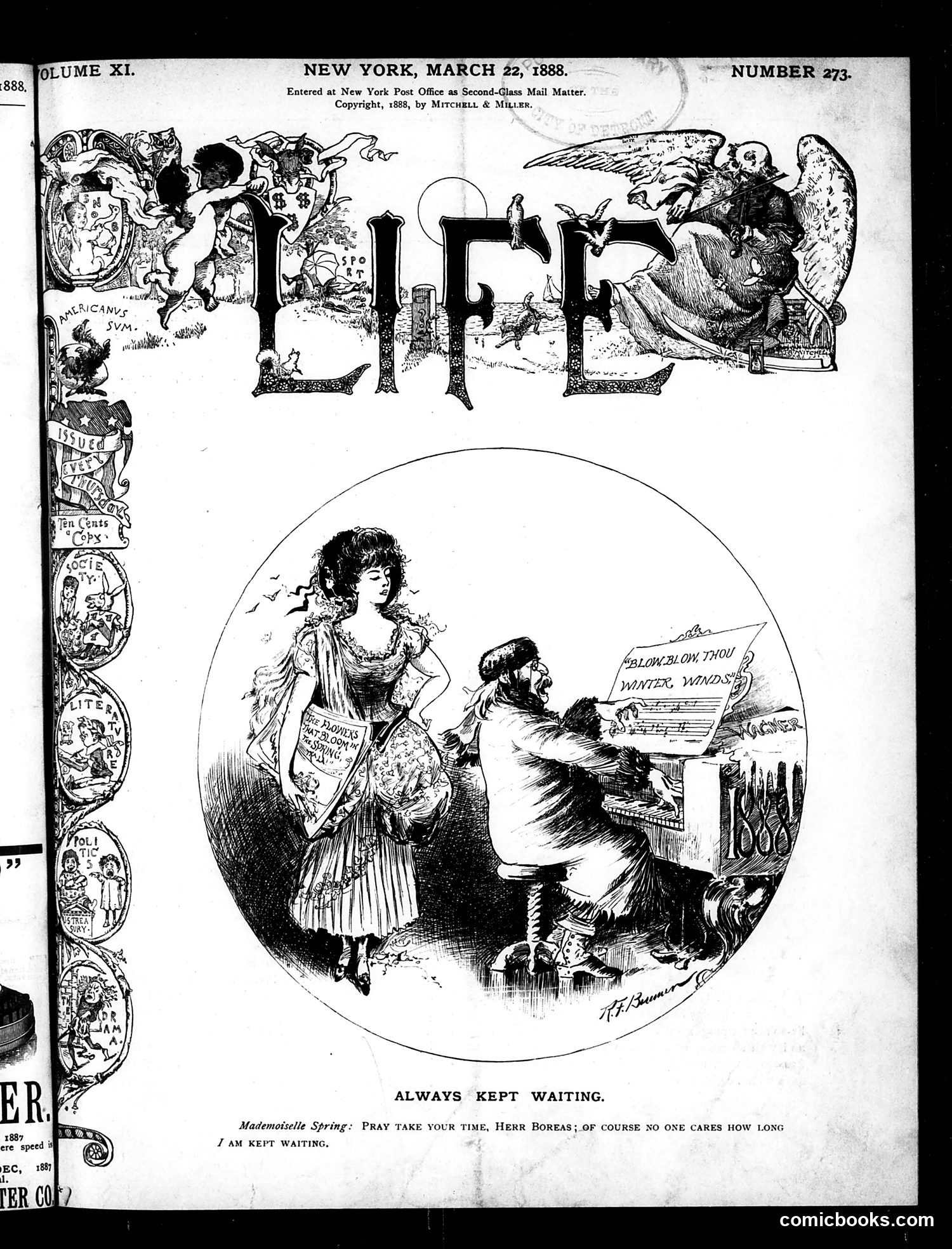
The main cartoon depicts a woman (appearing to represent a romantic interest or suitor) standing impatiently while a man sits at a piano, absorbed in composing music. Sheet music labeled "Hallow'en Thou Winter Winds" is visible. The caption reads: "Mademoiselle Spring: Pray take your time, Herr Boreas; of course no one cares how long I am kept waiting." This appears to be seasonal satire—Spring personified as a woman is sarcastically telling Boreas (the Greek god of the north wind, representing winter) that she's content waiting for him to finish his musical composition before yielding to her arrival. The joke mocks the unpredictability of spring weather in March, when winter refuses to release its grip, leaving people frustrated by delayed seasonal change.
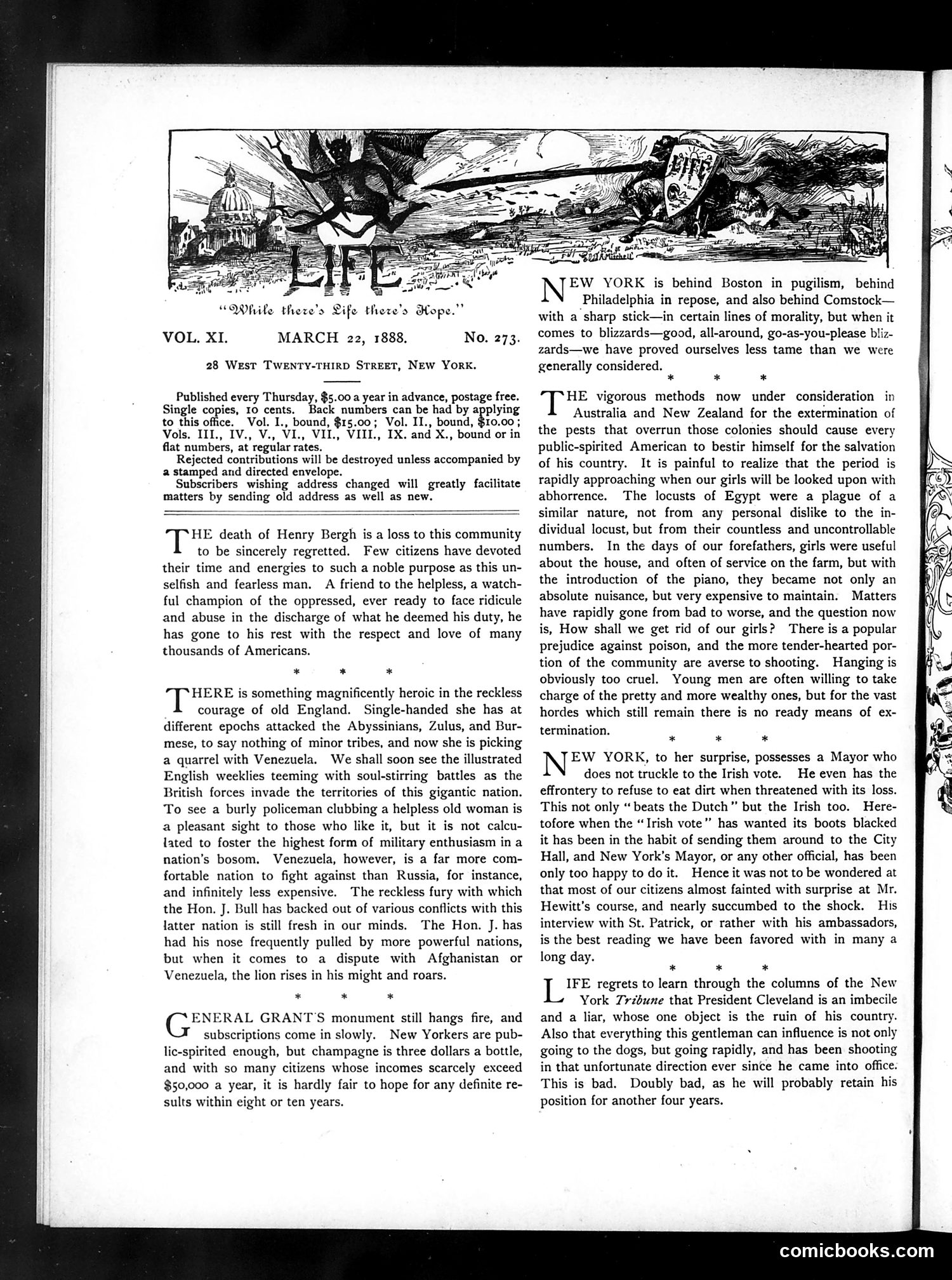
The header cartoon depicts a figure labeled "Life" with the motto "While there's Life there's Hope," showing a winged character overlooking a landscape with a domed building (likely the Capitol). The text addresses several contemporary issues: 1. **Henry Bergh's death** - mourned as a loss to the community for his animal welfare advocacy 2. **England's military conflicts** - praising British courage against Abyssinians, Zulus, and Burmese, while criticizing their expensive conflicts with Afghanistan and Venezuela 3. **General Grant's Monument** - donations coming in slowly; the magazine criticizes that wealthy New Yorkers won't adequately fund it 4. **President Cleveland** - strongly criticized as a "knave and liar" whose influence ruins the country, with skepticism about his reelection prospects The satire targets both civic neglect and Cleveland's administration.
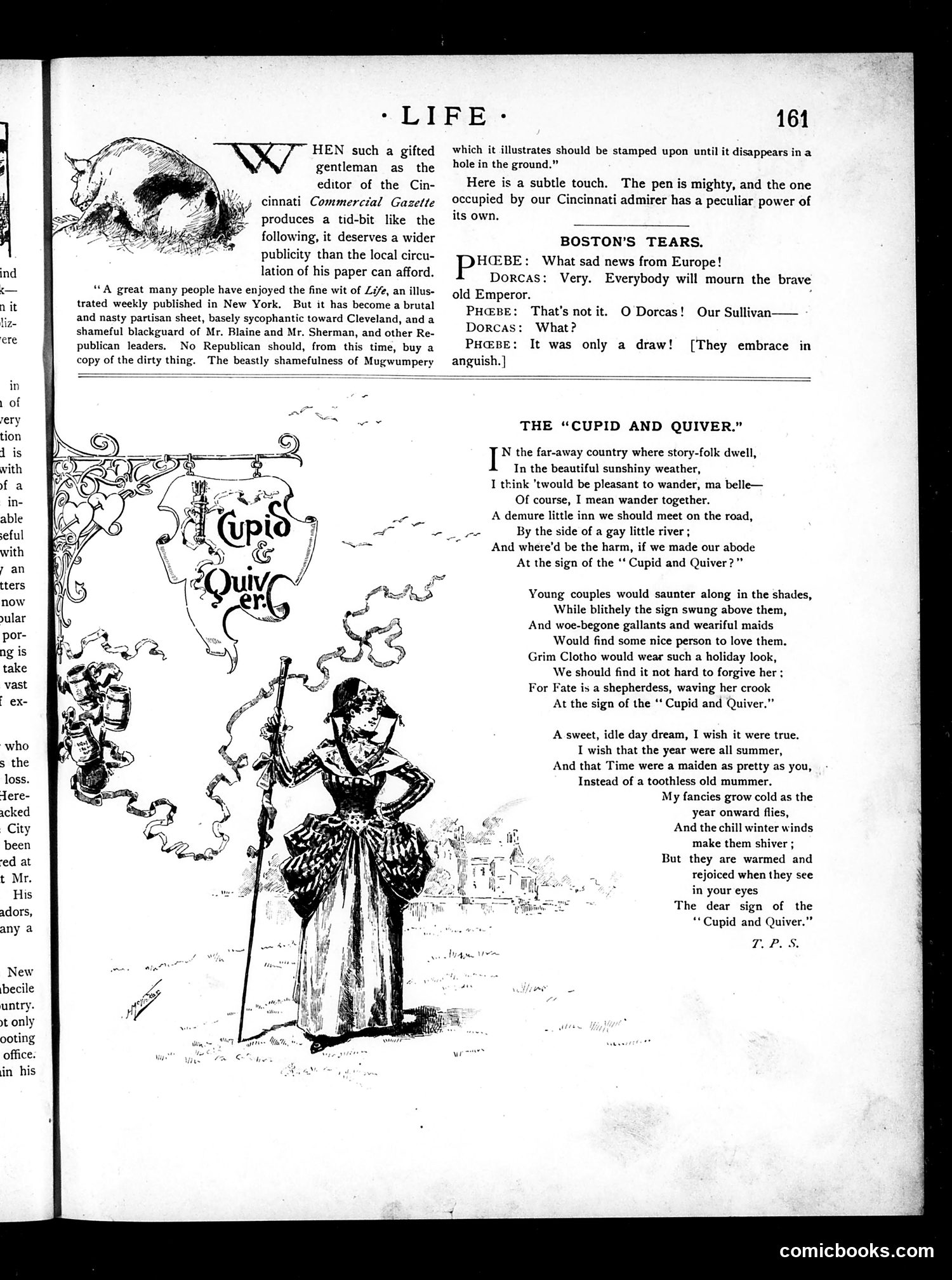
The top section critiques the *Cincinnati Commercial Gazette*'s editor for producing partisan journalism. The text sarcastically praises "Life" magazine's superior wit while attacking the Cincinnati paper for "basely sycophantic" Republican bias toward political figures like Blaine and Sherman. This appears to be 19th-century intra-press rivalry, with *Life* (a satirical publication) mocking a competitor's obvious partisan allegiances. The lower half contains "The Cupid and Quiver," a romantic poem illustrated with a whimsical sign. This is purely literary content—sentimental verse about young love and countryside romance, unrelated to the political critique above. The illustration shows a woman pointing to the inn's sign in a pastoral setting.
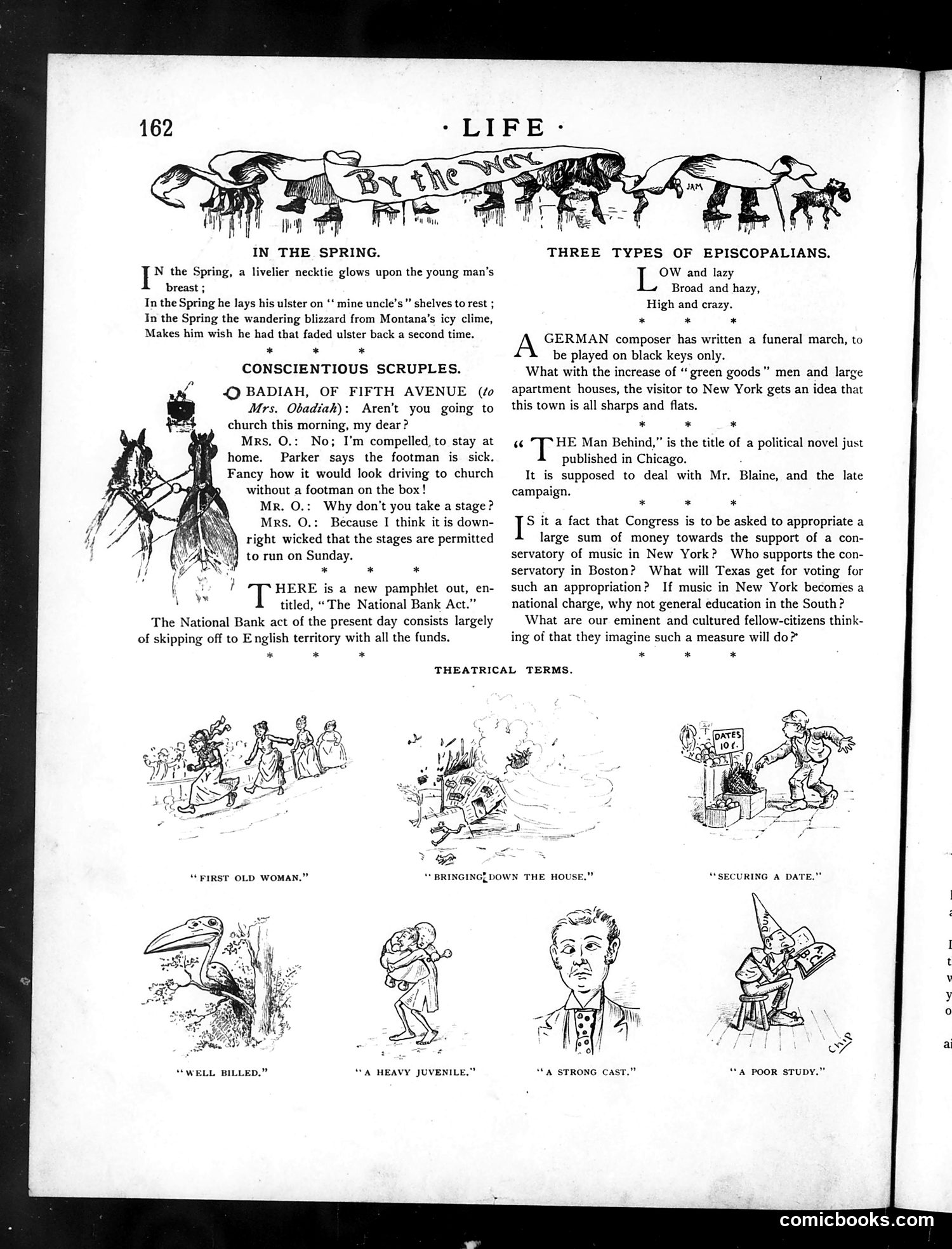
This page contains several satirical sections targeting early 1890s American society: **"In the Spring"** mocks wealthy young men whose fashionable lifestyle (fur-trimmed neckties, winter trips to Montana) creates artificial desires disconnected from reality. **"Conscientious Scruples"** satirizes Sunday observance hypocrisy—Mrs. O. won't attend church without a footman, yet criticizes stages running on the Sabbath. The cartoon highlights class-based moral inconsistency. **"Three Types of Episcopalians"** categorizes Anglican church members by social attitude: lazy, broad-minded, and fanatically pious. The lower **"Theatrical Terms"** section uses theatrical vocabulary as visual puns for social situations—"First Old Woman," "Heavy Juvenile," etc.—common satirical humor for this era's middle-class readers familiar with theater conventions.
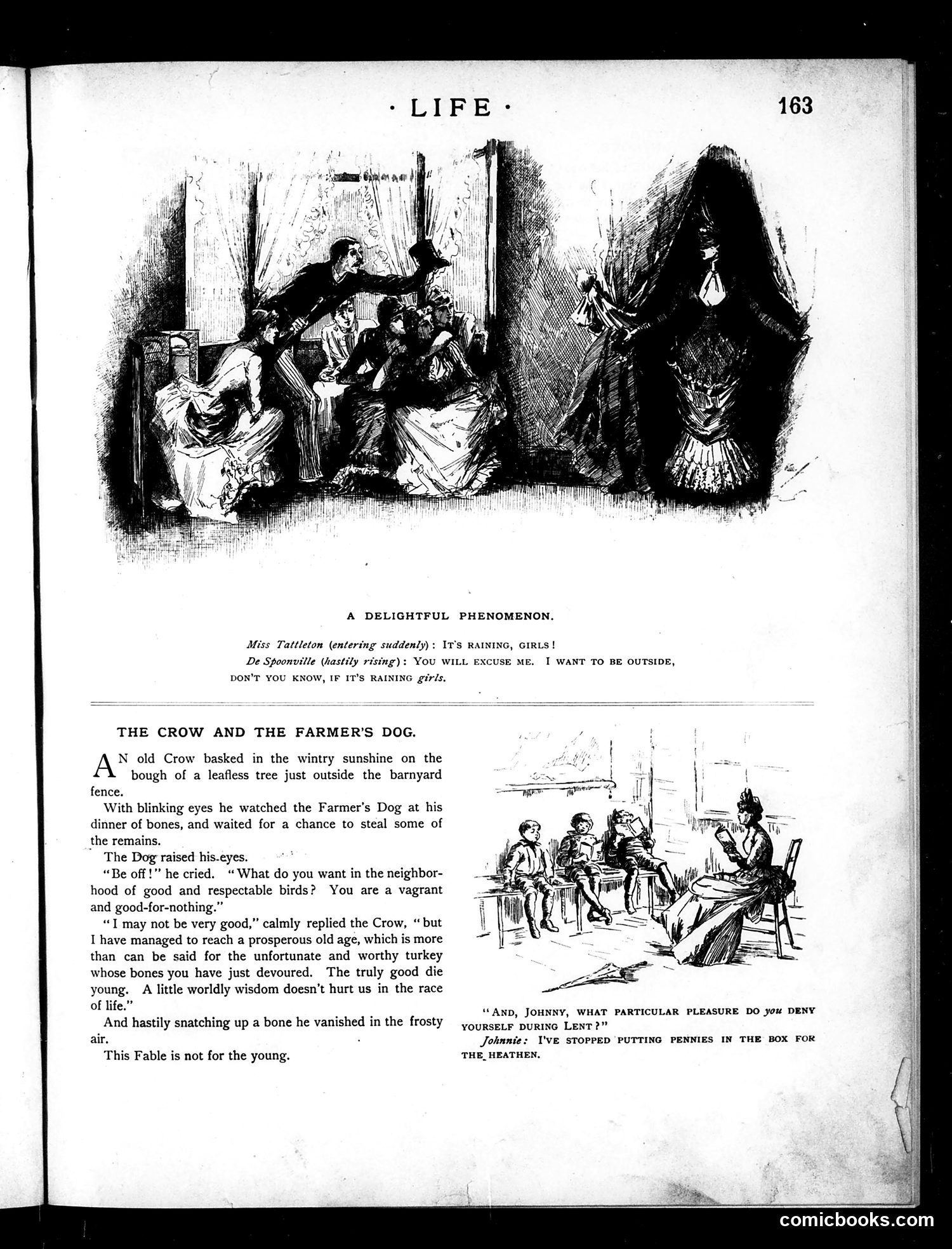
**Top Cartoon ("A Delightful Phenomenon"):** Shows a social scene where Miss Tattleton suddenly announces it's raining, prompting De Spoonville to hastily rise, wanting to go outside—contradicting the typical Victorian-era expectation that ladies would avoid rain. The humor lies in the reversal: De Spoonville uses the rain as an excuse to escape indoors, suggesting he wants to avoid the women's company. **Bottom Story ("The Crow and the Farmer's Dog"):** A fable where an old crow justifies eating bones by claiming worldly wisdom and age grant him dignity despite being a vagrant. The moral explicitly states "This Fable is not for the young," suggesting satirical commentary on how the elderly or destitute rationalize questionable behavior through appeals to experience and wisdom. The accompanying illustration shows domestic figures in a relaxed interior scene.
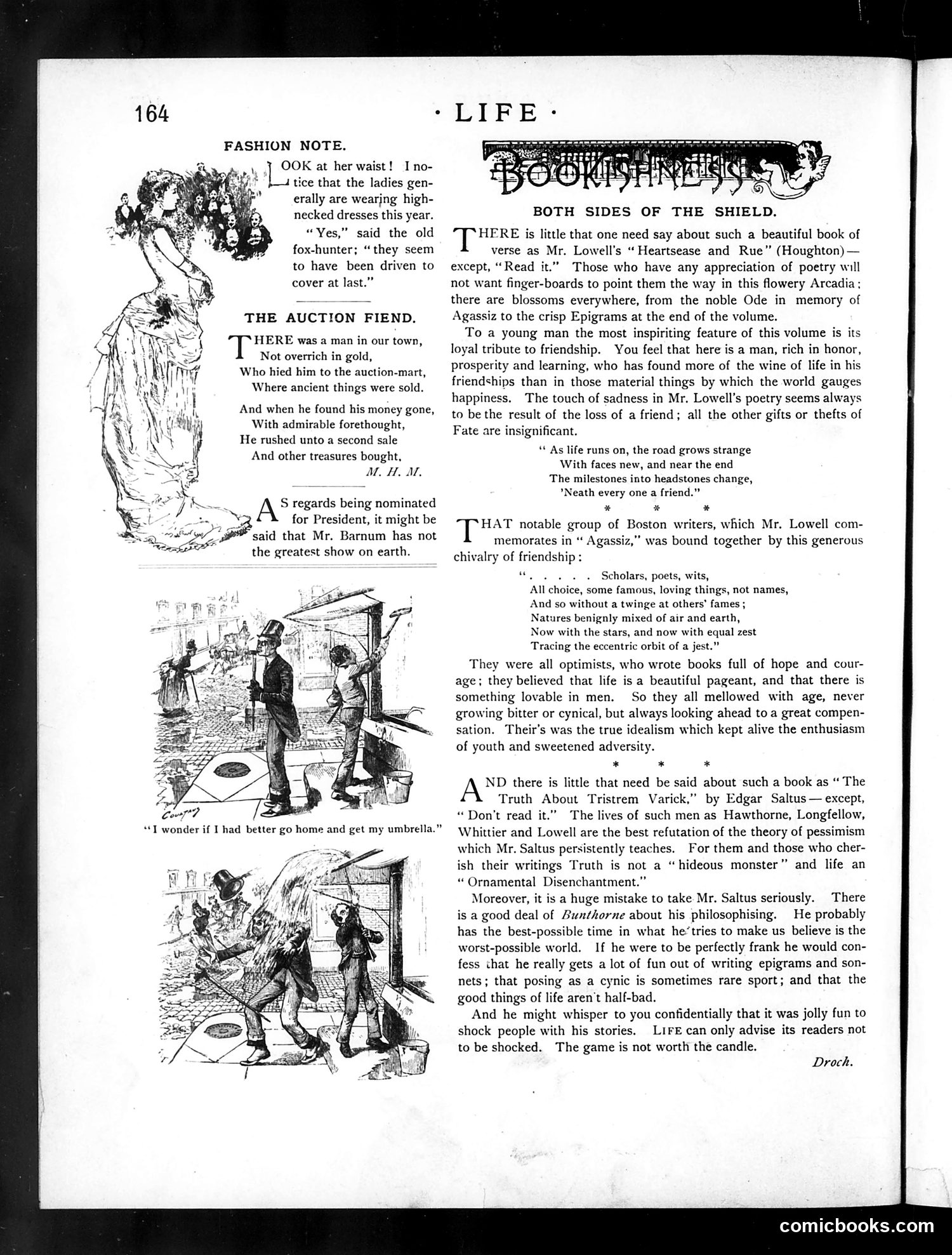
This page contains three distinct sections: **Top right:** A book review titled "Both Sides of the Shield," praising Lowell's poetry collection "Heartsease and Rue." The review discusses the book's treatment of friendship and loss. **Left side:** Three humor pieces—a fashion note about high-necked dresses, "The Auction Fiend" (a poem about a man who compulsively buys at auctions), and two cartoon vignettes showing men in rainy weather, with captions like "I wonder if I had better go home and get my umbrella." **Bottom right:** A literary critique of books by Hawthorne, Longfellow, and particularly Edgar Saltus, discussing his cynical philosophy and satirical writing style. The author argues Saltus shouldn't be taken too seriously, as his provocative stories are meant to entertain rather than shock. The page is primarily literary content and mild social satire rather than political commentary.
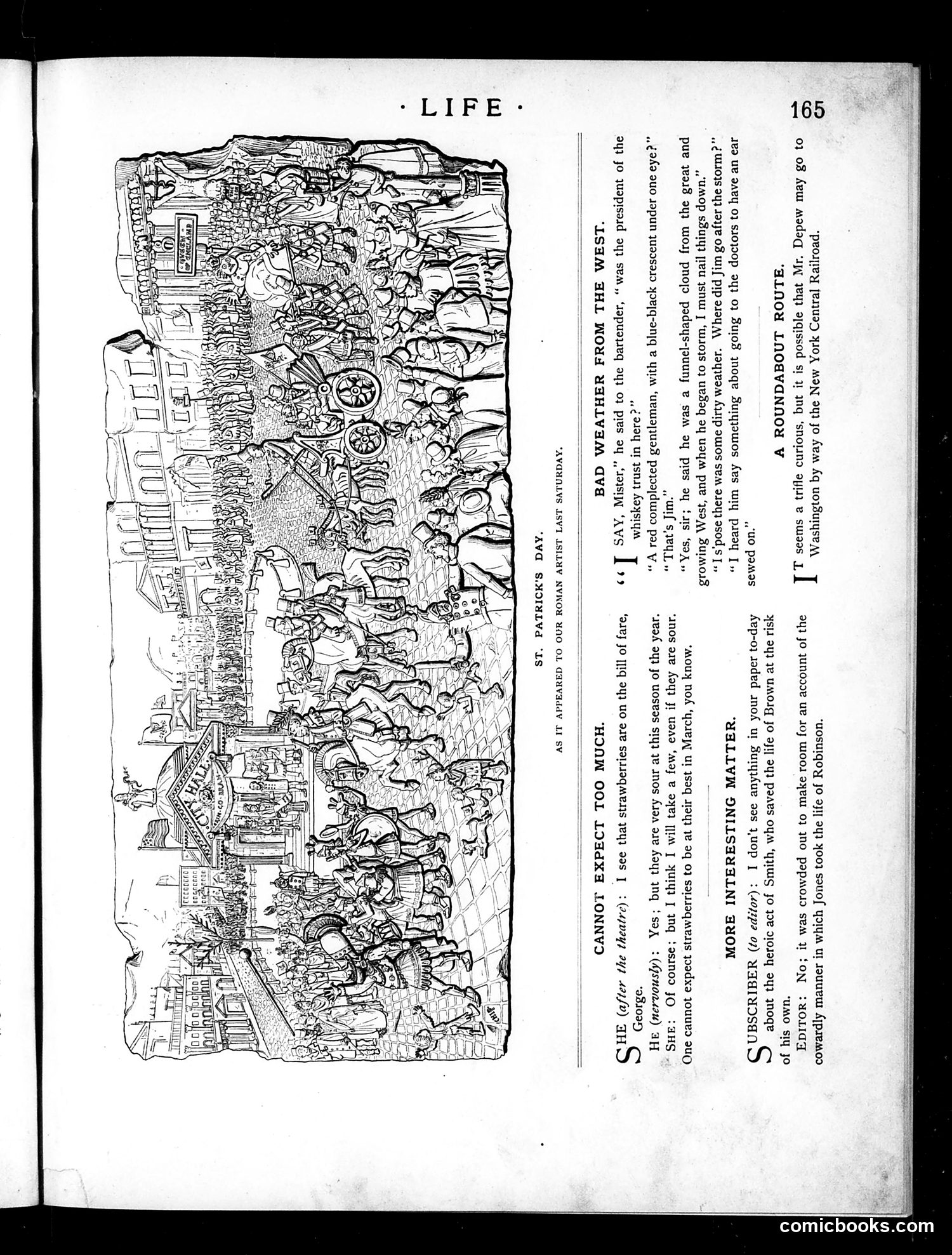
This page contains a detailed political cartoon titled "St. Patrick's Day Parade on Fifth Avenue" depicting a crowded street scene. The cartoon satirizes the Irish-American community's annual St. Patrick's Day celebration in New York City. The image shows numerous figures in period dress (appearing to be early 20th century) lining and participating in the parade. The satire likely targets the spectacle and chaos of the event, or possibly comments on Irish-American political or social prominence in New York at that time. The accompanying text references "Bad Weather from the West," suggesting commentary on both the parade itself and broader social/political conditions. Without clearer OCR of the complete captions, the specific satirical targets remain somewhat unclear, though the cartoon clearly mocks aspects of urban Irish-American culture and celebration.
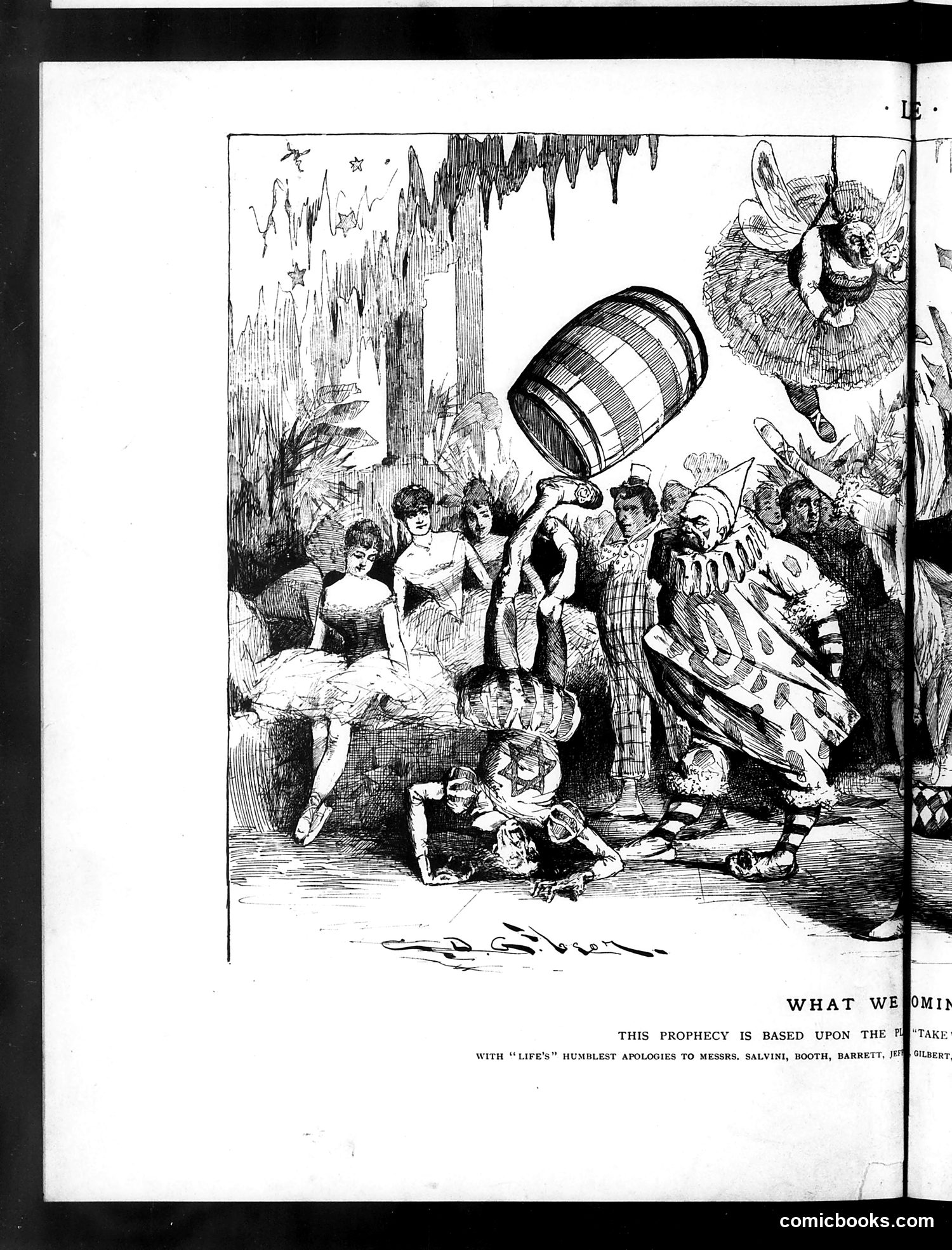
This satirical illustration depicts a fantastical scene with elaborately costumed figures surrounding ordinary people in what appears to be a theatrical or dreamlike setting. The caption references "Life's humblest apologies to Messrs. Salvini, Booth, Barrett, [and] Gilbert"—likely alluding to famous 19th-century actors and theatrical figures. The cartoon appears to satirize theatrical excess or operatic spectacle, with the barrel suspended overhead and the ornate, costumed characters suggesting grandiose stage productions. The "prophecy" mentioned in the text implies satire about future entertainment trends or theatrical pretension. The juxtaposition of ordinary people with elaborate theatrical performers suggests mockery of high-minded artistic ambitions or the theatrical world's affectations. The exact political or social critique remains somewhat unclear without fuller publication context.
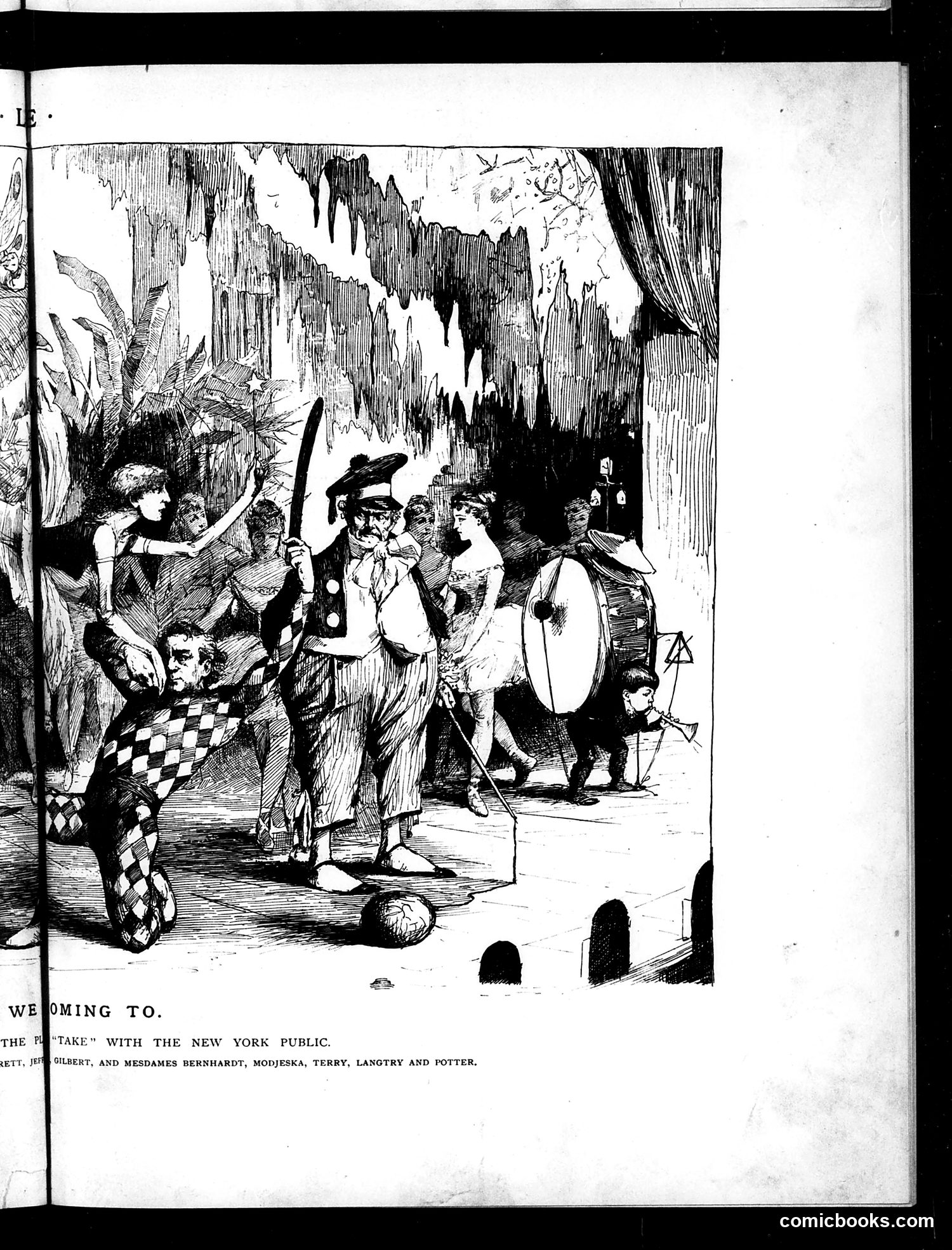
This satirical illustration depicts a theatrical performance or "take" being presented to the New York public. The caption lists performers including Gilbert, Bernhardt, Mojeska, Terry, Langtry, and Potter—likely famous actors and actresses of the era. The scene shows what appears to be a stage cave or theatrical setting with performers in period costume. One figure holds a large drum, others carry weapons or props. The checkerboard-patterned costume on the left suggests theatrical exaggeration or comedic performance. The satire appears to mock the pretension of high theatrical productions being marketed to the general public, or possibly critiques how famous actors presented elaborate productions. The cave setting and dramatic costuming suggest parody of grand historical or dramatic theatrical works.
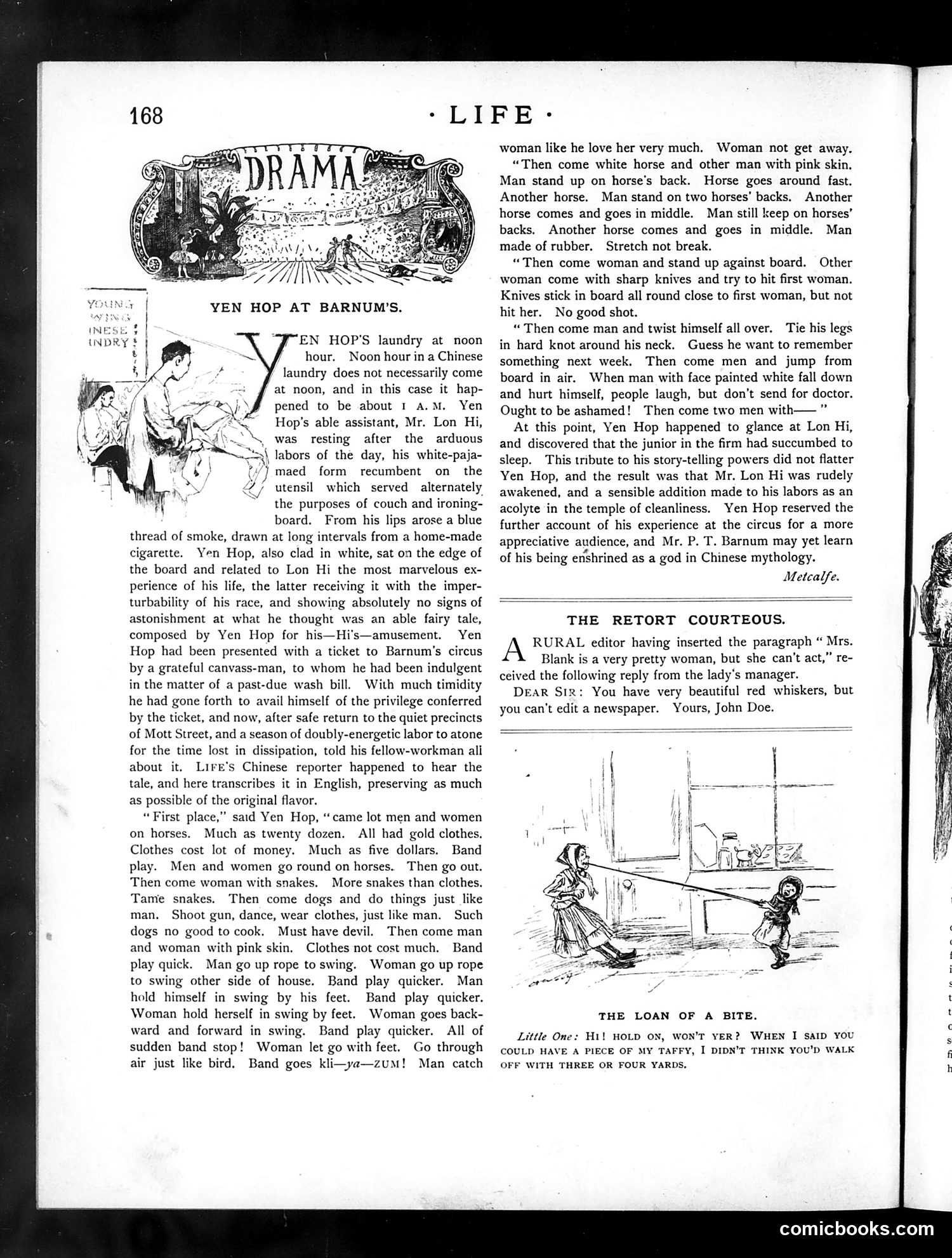
This piece satirizes P.T. Barnum's circus by recounting a Chinese launderer's (Yen Hop's) visit. The narrative mocks both the circus spectacle and racial stereotypes of Chinese immigrants. Yen Hop attends after being given a ticket, then describes the acrobatic performances in broken English—a comedic device of the era portraying non-native speakers as subjects of humor. The satire targets Barnum's exploitation of spectacle and "exotic" entertainment. The accompanying illustration shows the launderer at work, emphasizing the low-status position of Chinese immigrants in America. The text concludes by joking that Barnum might become "enshrined as a god in Chinese mythology"—mockingly suggesting the circus's grandiosity to a Chinese observer. This reflects late-19th-century American attitudes: simultaneous fascination with and disdain for non-white cultures.
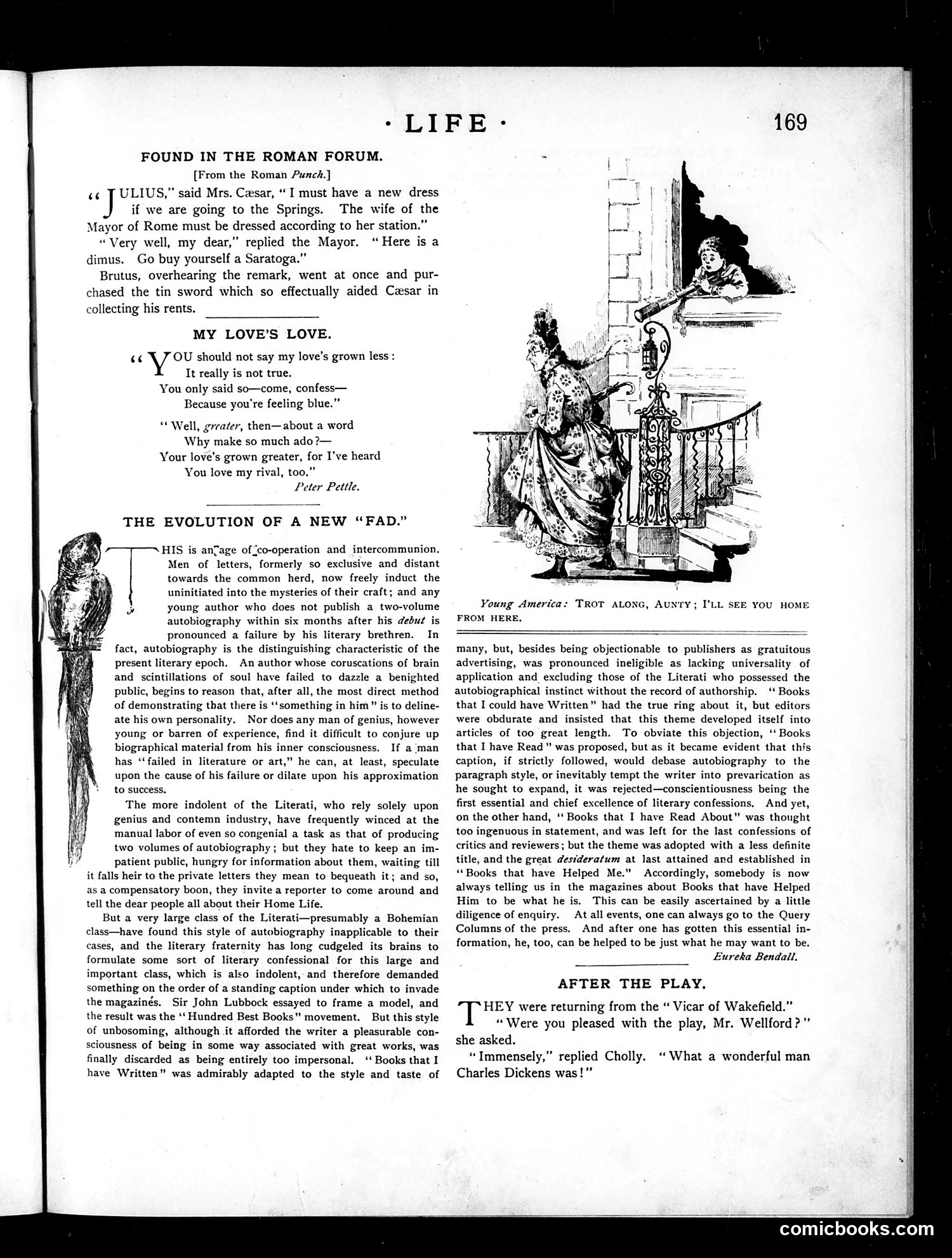
This page contains three separate satirical pieces: **"Found in the Roman Forum"** mocks spousal financial dynamics. Mrs. Caesar demands a new dress befitting her station; her husband dismissively gives her pocket change ("dimus") to buy a cheap dress ("Saratoga"). The joke references Brutus purchasing the "tin sword" that killed Caesar—implying marital complaints lead to assassination. **"My Love's Love"** is a witty poem about romantic jealousy. A lover claims their affection hasn't diminished, but the speaker counters that it has actually *grown*—because they now love the speaker's rival too. **"The Evolution of a New 'Fad'"** satirizes contemporary literary trends. It mocks authors who publish autobiographies despite having accomplished nothing, and editors' desperate attempts to create new confessional formats ("Books I Could Have Written," "Books That Have Helped Me") to capitalize on readers' appetite for self-centered writing. The piece suggests literary autobiography has become an industry exploiting mediocre writers' vanity. The illustration shows a young person escorting an elderly woman, likely referencing modern manners.
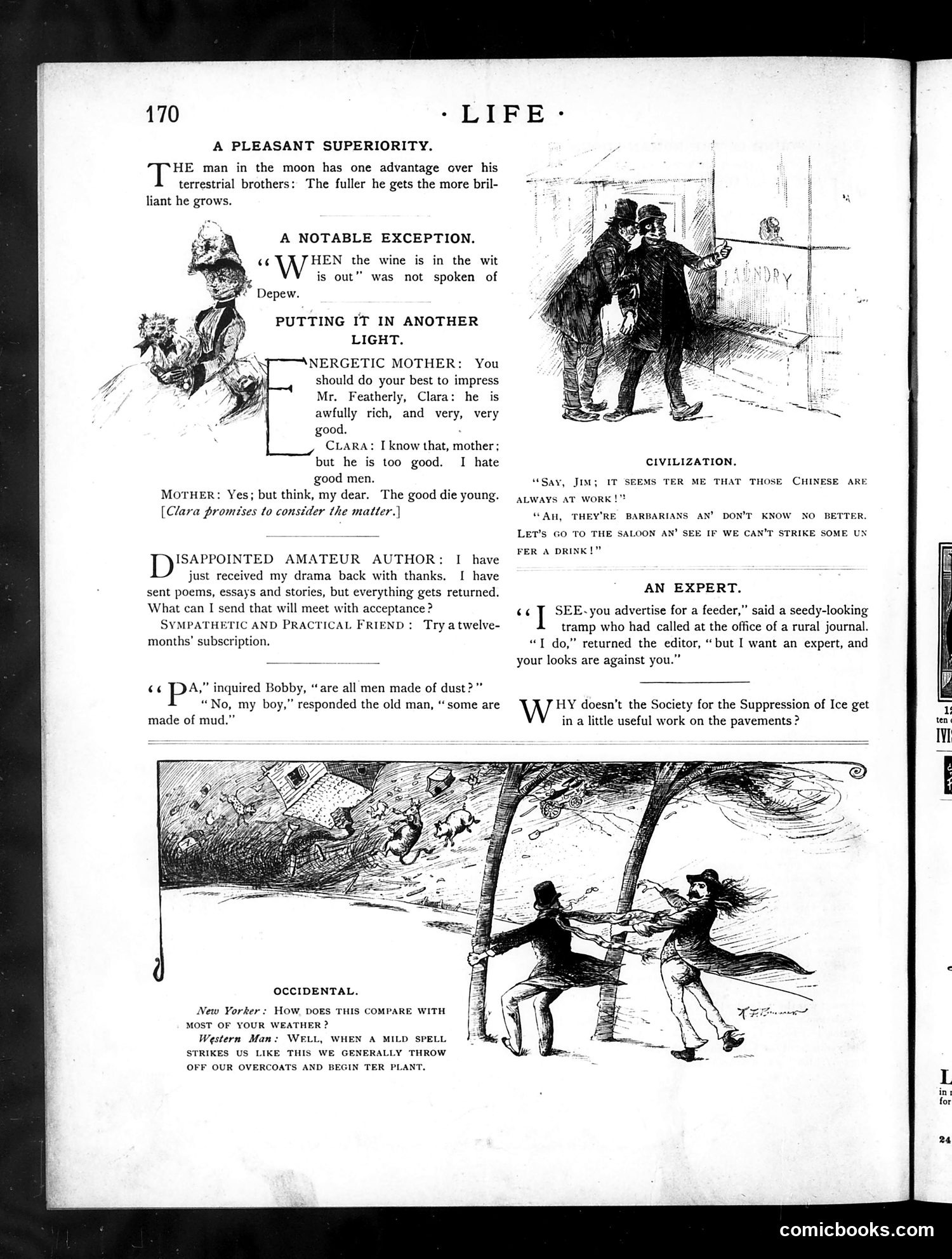
This page contains six short satirical pieces typical of early 20th-century Life magazine humor: 1. **"A Pleasant Superiority"**: A joke about the moon being "fuller" (more complete/drunk) and thus more brilliant—a play on the phrase "the fuller he gets." 2. **"A Notable Exception"**: References the proverb "when wine is in, wit is out," noting it wasn't said about Depew (likely Chauncey Depew, a prominent figure of the era). 3. **"Putting It in Another Light"**: A mother encourages her daughter Clara to marry the wealthy Mr. Featherly despite his goodness, reasoning "the good die young"—dark humor about marrying for money. 4. **"Disappointed Amateur Author"**: Satirizes rejection-prone writers; the practical friend suggests a subscription to the magazine itself as the only publishable content. 5. **"Occidental"**: Contrasts Eastern and Western work ethics—a Westerner boasts that mild weather prompts seasonal work. 6. **"Civilization"**: Two working-class men mock Chinese diligence as barbarism while heading to a saloon. These pieces mock social pretensions, publishing gatekeeping, gender dynamics, and ethnic stereotypes common to the era.
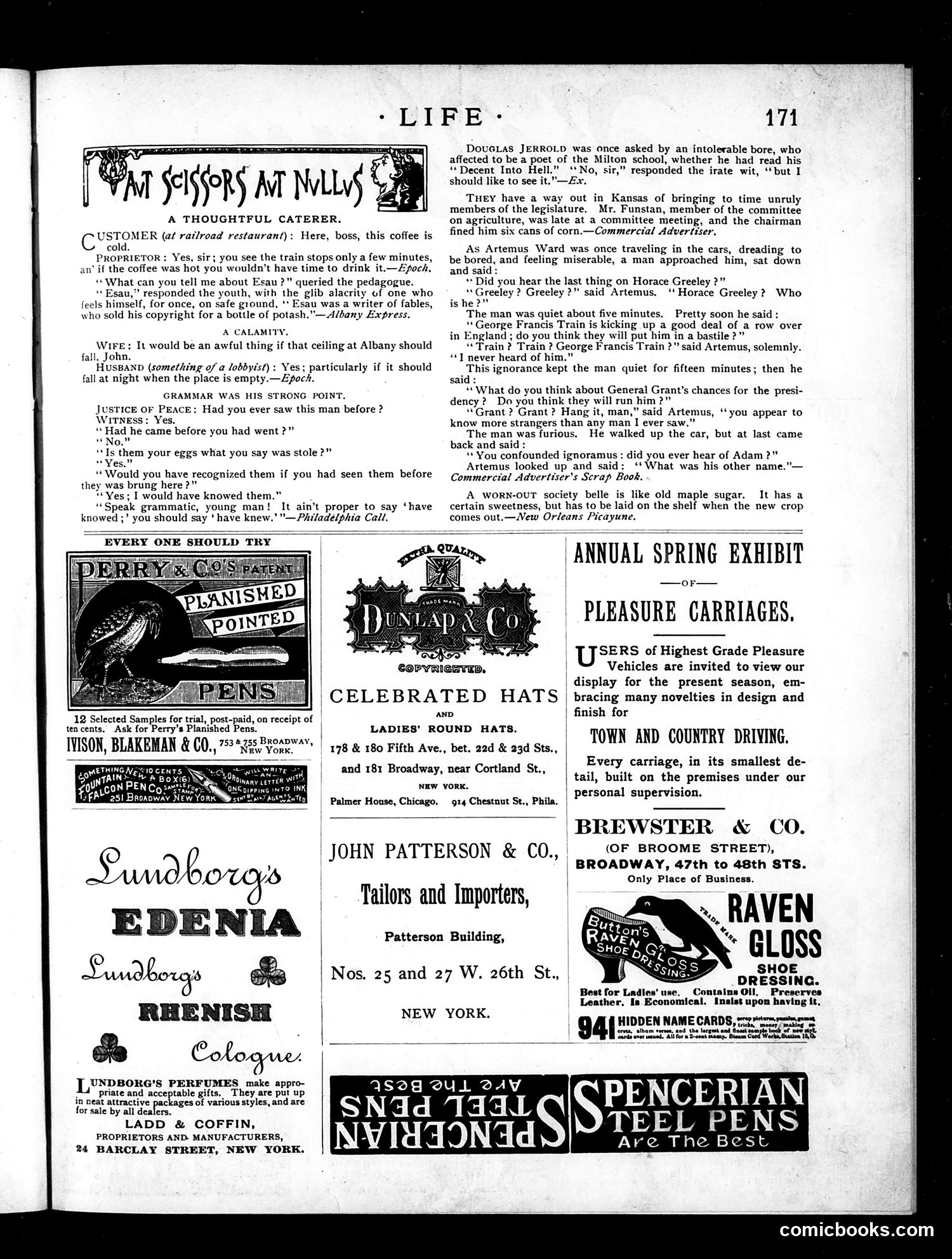
This page collects brief satirical anecdotes and jokes typical of 19th-century American humor magazines. The cartoons lack political content; instead they mock social types and verbal absurdities. **Main sketches:** - A railroad restaurant proprietor defends cold coffee with illogical practicality - A lobbyist hopes a ceiling collapse occurs when the building is empty (cynical commentary on legislators) - A justice of the peace corrects a witness's grammar while questioning them about stolen eggs—satirizing pedantic officiousness **Notable literary references:** Douglas Jerrold's witty retort to a bad poet; Artemus Ward (19th-century humorist) feigning ignorance to bore an annoying stranger—the joke being his strategic rudeness wins out. The page is primarily **advertising**, featuring pens, hats, perfumes, carriages, and tailoring services. The humor reflects Victorian-era sensibilities: concern with grammar, railroad inconveniences, and social pretension.
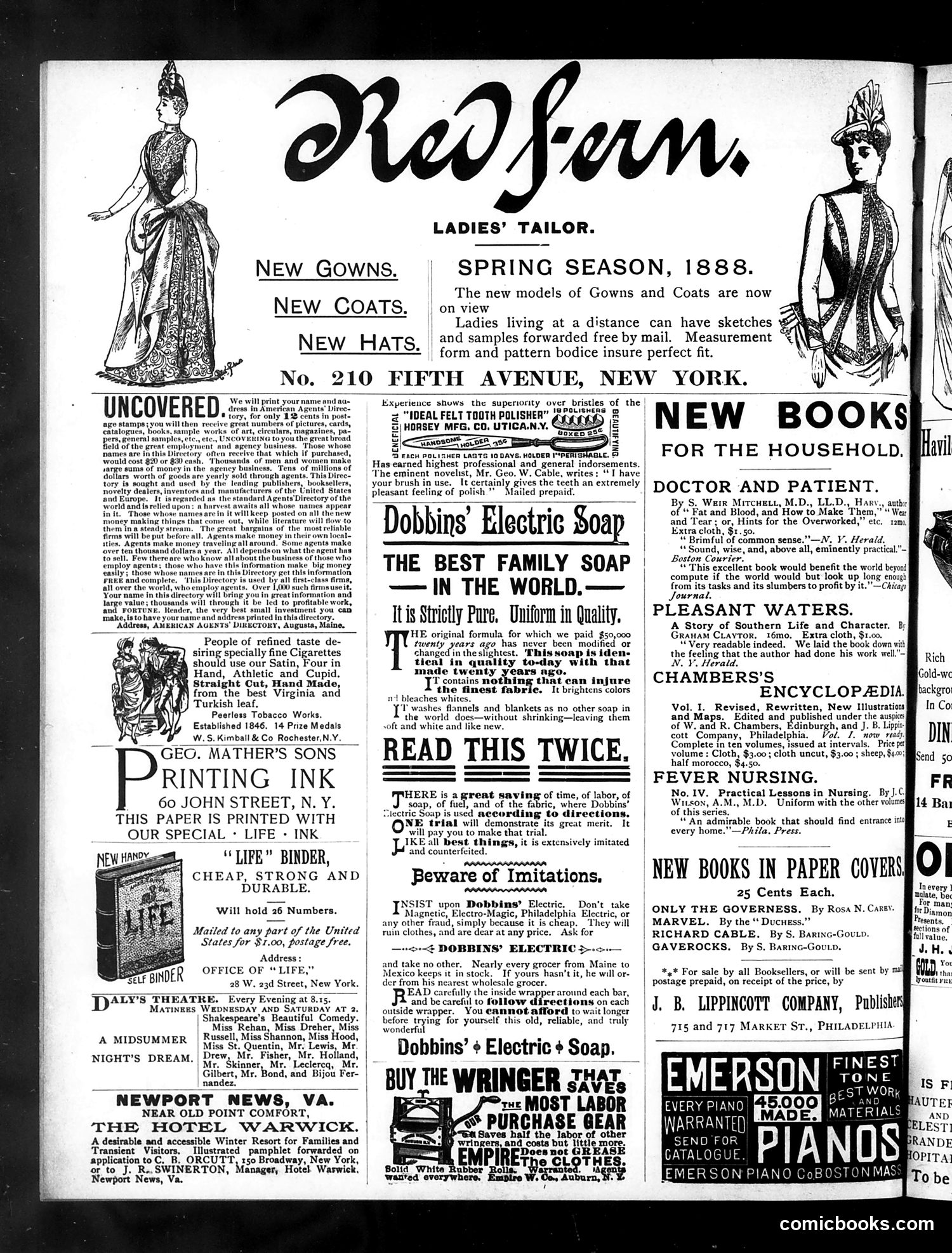
This is primarily an **advertising page**, not a satirical cartoon. It features a ladies' tailor shop ("Red Fern") at Fifth Avenue, New York, showcasing fashionable women's clothing designs typical of 1888—elaborate gowns with bustles and decorative hats. The page is dominated by product advertisements for consumer goods: Dobbins' Electric Soap (heavily promoted with warnings against cheap imitations), tooth polish, printing ink, a Life magazine binder, and theater listings. There's also promotion for the Hotel Warwick resort in Newport News, Virginia. **Notable context**: The repeated warnings about counterfeit "Electric" soaps suggest this was a common consumer problem in the 1880s, when trademark protection was weak. The ads reflect Gilded Age consumer culture and emerging national marketing strategies using magazine advertisements to reach middle and upper-class readers.
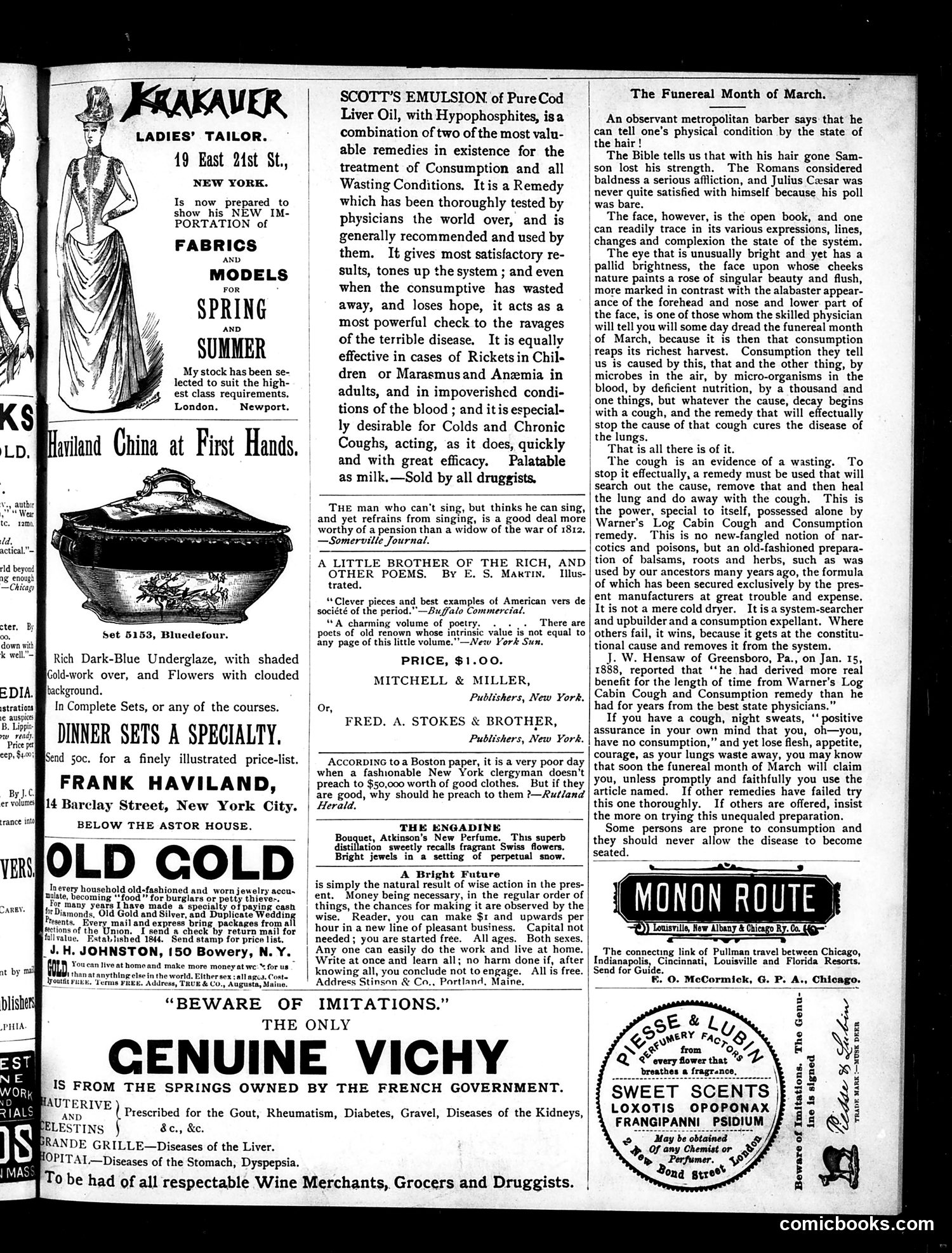
This page is primarily **advertisements and filler content** rather than political cartoons. However, it contains brief satirical **commentary pieces**: 1. **"The man who can't sing..."** — A joke mocking war widows of 1812, suggesting someone who resists singing uncontrollably deserves more pension consideration than actual war widows. The satire attacks misplaced priorities. 2. **"Fashionable New York clergyman"** — Satirizes wealthy Manhattan clergy who preach to congregations dressed in expensive clothing ($50,000 worth), questioning why a clergyman would praise material wealth from the pulpit. 3. **"The Funereal Month of March"** — A barber's observations about physical appearance declining in March, discussing consumption (tuberculosis) as a seasonal killer. The tone is darkly humorous about illness and death. The rest of the page consists of period advertisements for clothing, jewelry services, perfume, patent medicines (Scott's Emulsion for consumption), and business opportunities—typical of 19th-century magazine fill.
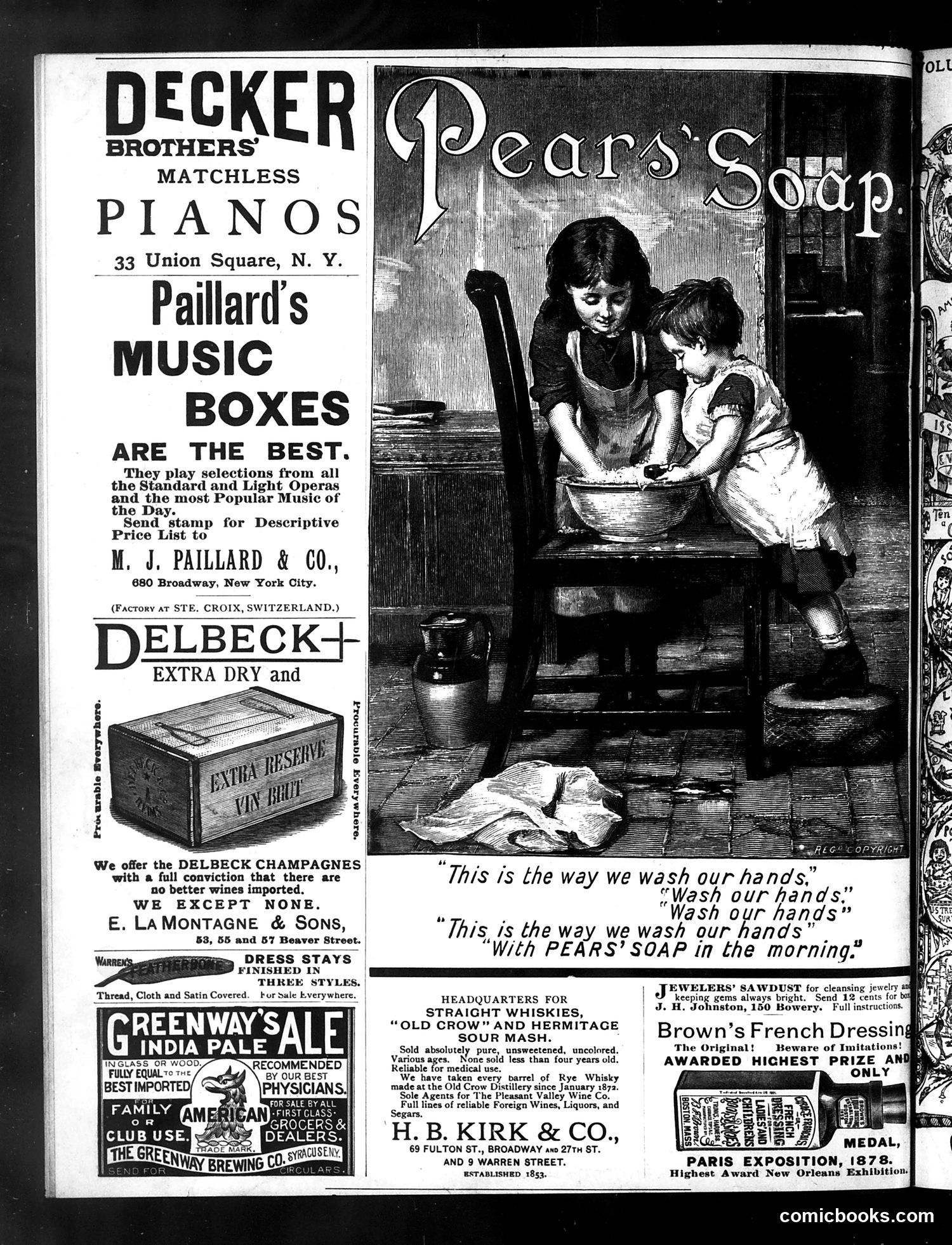
This is **primarily an advertisement page** from Life magazine, not a political cartoon. The page features various late 19th-century consumer product ads including pianos, music boxes, champagne, whiskey, soap, and other goods. The most visually prominent content is a **Pears' Soap advertisement** showing a woman and child washing hands. The accompanying text presents a nursery rhyme: "This is the way we wash our hands / With PEARS' SOAP in the morning." This reflects **Victorian-era marketing strategy**: using domestic scenes and children to promote hygiene products, capitalizing on growing awareness of cleanliness and germ theory in the late 1800s. The advertisement normalizes soap use as routine daily practice for respectable families. The other ads emphasize quality and imported prestige (French dress, Swiss-made music boxes, French champagne), typical of how American merchants marketed luxury goods to middle-class consumers during this period.