
Life, 1888-03-22 · page 6 of 16
Life — March 22, 1888 — page 6: what you’re looking at
What you’re looking at
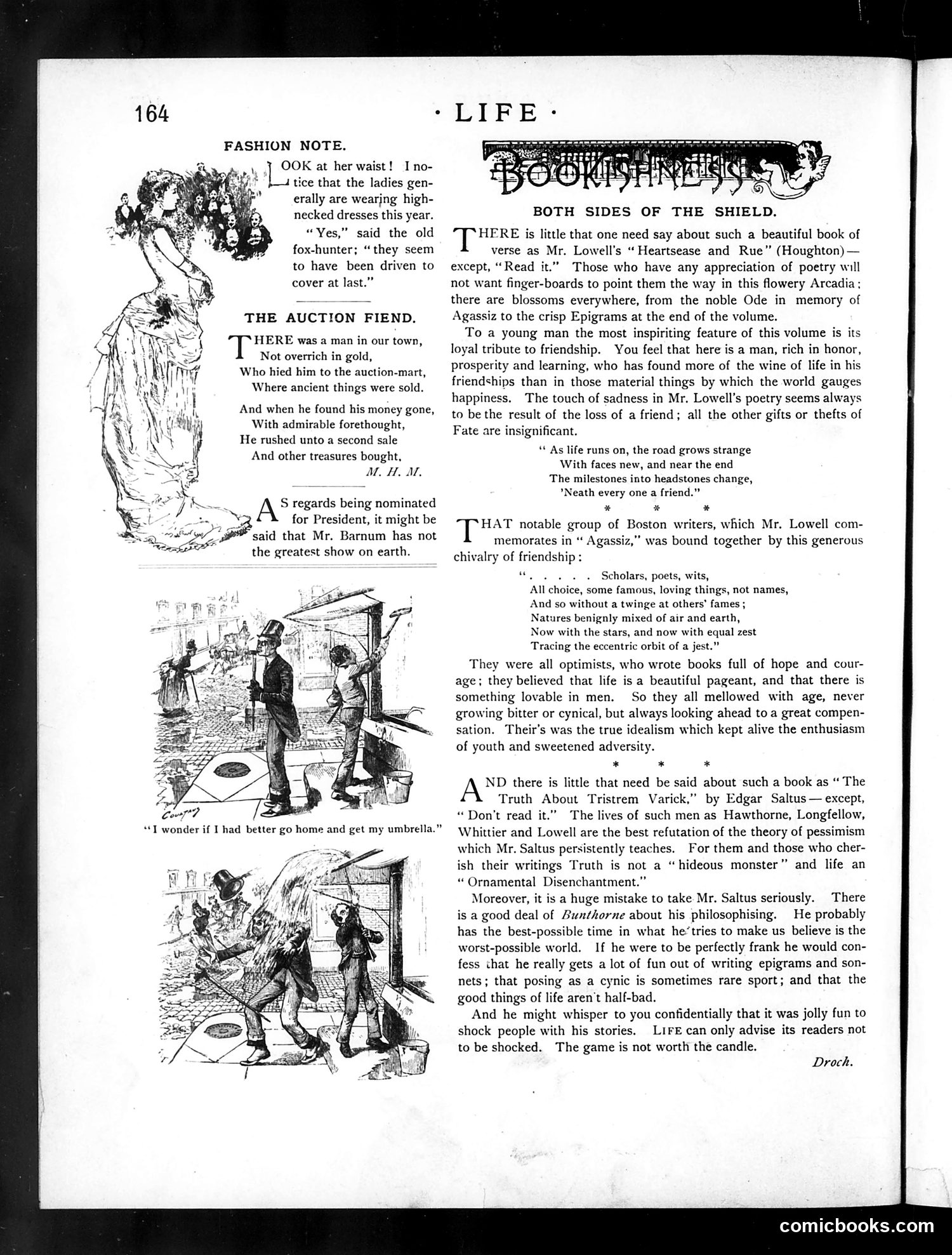
This page contains three distinct sections: **Top right:** A book review titled "Both Sides of the Shield," praising Lowell's poetry collection "Heartsease and Rue." The review discusses the book's treatment of friendship and loss. **Left side:** Three humor pieces—a fashion note about high-necked dresses, "The Auction Fiend" (a poem about a man who compulsively buys at auctions), and two cartoon vignettes showing men in rainy weather, with captions like "I wonder if I had better go home and get my umbrella." **Bottom right:** A literary critique of books by Hawthorne, Longfellow, and particularly Edgar Saltus, discussing his cynical philosophy and satirical writing style. The author argues Saltus shouldn't be taken too seriously, as his provocative stories are meant to entertain rather than shock. The page is primarily literary content and mild social satire rather than political commentary.
📄 Transcribed text from this page (OCR, searchable)
Machine-transcribed from the original scan — historical spelling and the odd misread are preserved.
FASHION NOTE. OOK at her waist! I no- tice that the ladies gen- erally are wearjng high- necked dresses this year. BOTH SIDES OF THE SHIELD. “Yes,” said the old TRE is little that one need say about such a beautiful book of fox-hunter; “they seem verse as Mr. Lowell's “ Heartsease and Rue” (Houghton) — to have been driven to except, ‘Read it.” Those who have any appreciation of poetry will cover at last.” not want finger-boards to point them the way in this flowery Arcadia ; - — there are blossoms everywhere, from the noble Ode in memory of THE AUCTION FIEND. Agassiz to the crisp Epigrams at the end of the volume. HERE was a inan ta our tows; To a young man the most inspiriting feature of this volume is its Not overrich in gold, loyal tribute to friendship. You feel that here is a man, tich in honor, Who Bled ‘bin 4 the ancient, prosperity and learning, who has found more of the wine of life in his Where ancient things were sold. friendships than in those material things by which the world gauges happiness. The touch of sadness in Mr. Lowell’s poetry seems always to be the result of the loss of a friend; all the other gifts or thefts of Fate are insignificant. And when he found his money gone, With admirable forethought, He rushed unto a second sale 7 And other treasures bought, ‘As life runs on, the road grows strange MHOM. With faces new, and near the end The milestones into headstones change, - *Neath every one a friend.” * * * HAT notable group of Boston writers, which Mr. Lowell com- memorates in “ Agassiz,” was bound together by this generous chivalry of friendship : S regards being nominated for President, it might be said that Mr. Barnum has not the greatest show on earth. Scholars, poets, wits, All choice, some famous, loving things, not names, And so without a twinge at others’ fames ; Natures benignly mixed of air and earth, Now with the stars, and now with equal zest Tracing the eccentric orbit of a jest.” They were all optimists, who wrote books full of hope and cour- age; they believed that life is a beautiful pageant, and that there is something lovable in men. So they all mellowed with age, never growing bitter or cynical, but always looking ahead to a great compen- sation. Their’s was the true idealism which kept alive the enthusiasm of youth and sweetened adversity. * * * ND there is little that need be said about such a book as “ The Truth About Tristrem Varick,” by Edgar Saltus— except, “Don’t read it.” The lives of such men as Hawthorne, Longfellow, Whittier and Lowell are the best refutation of the theory of pessimism which Mr. Saltus persistently teaches. For them and those who cher- ish their writings Truth is not a “hideous monster” and life an “ Ornamental Disenchantment.” Moreover, it is a huge mistake to take Mr. Saltus seriously. There is a good deal of Bunthorne about his philosophising. He probably has the best-possible time in what he’ tries to make us believe is the worst-possible world. If he were to be perfectly frank he would con- fess chat he really gets a lot of fun out of writing epigrams and son- nets; that posing as a cynic is sometimes rare sport; and that the good things of life aren't half-bad. And he might whisper to you confidentially that it was jolly fun to shock people with his stories. LiFE can only advise its readers not to be shocked. The game is not worth the candle. Droch. comicbooks.com