
Life, 1888-03-22 · page 11 of 16
Life — March 22, 1888 — page 11: what you’re looking at
What you’re looking at
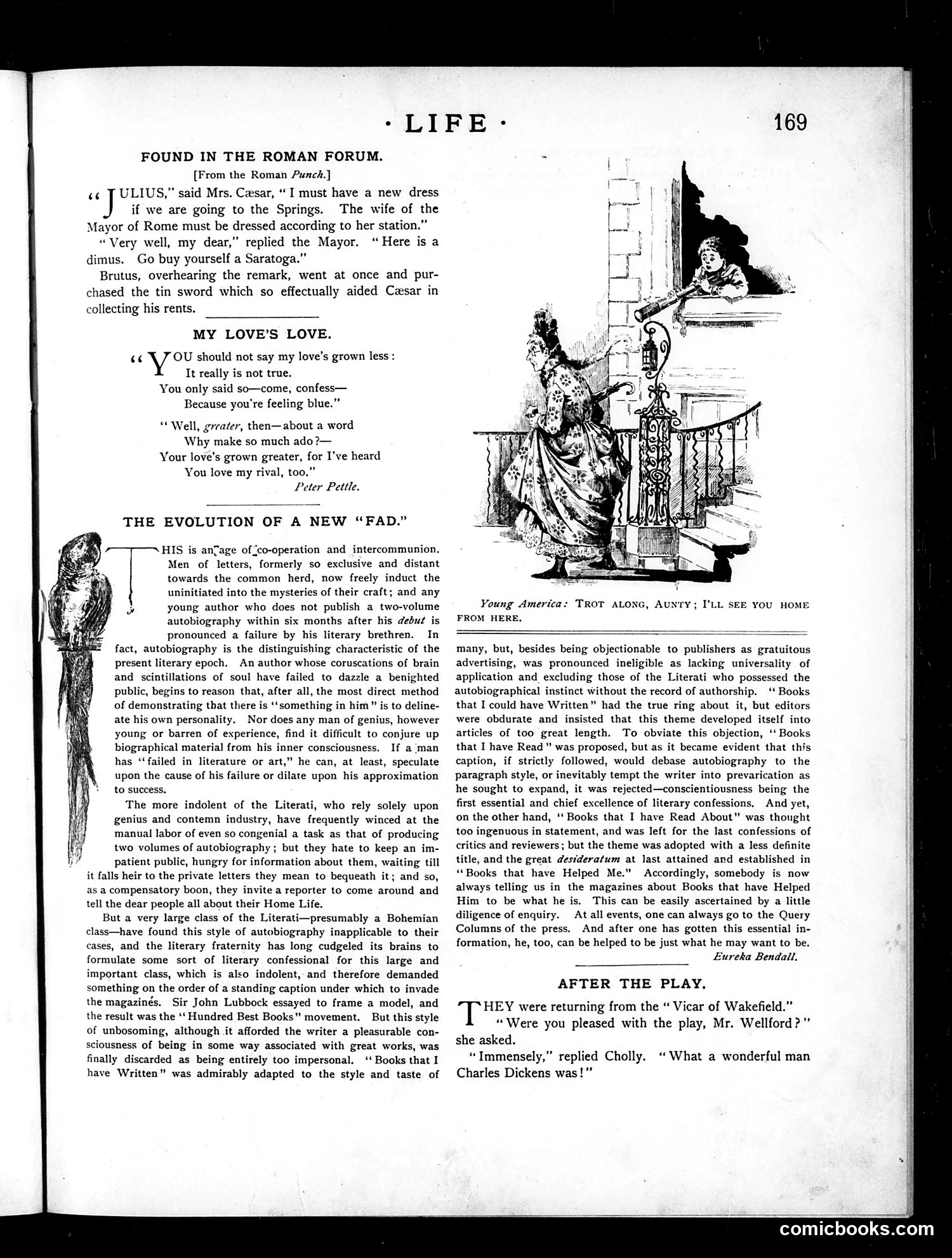
This page contains three separate satirical pieces: **"Found in the Roman Forum"** mocks spousal financial dynamics. Mrs. Caesar demands a new dress befitting her station; her husband dismissively gives her pocket change ("dimus") to buy a cheap dress ("Saratoga"). The joke references Brutus purchasing the "tin sword" that killed Caesar—implying marital complaints lead to assassination. **"My Love's Love"** is a witty poem about romantic jealousy. A lover claims their affection hasn't diminished, but the speaker counters that it has actually *grown*—because they now love the speaker's rival too. **"The Evolution of a New 'Fad'"** satirizes contemporary literary trends. It mocks authors who publish autobiographies despite having accomplished nothing, and editors' desperate attempts to create new confessional formats ("Books I Could Have Written," "Books That Have Helped Me") to capitalize on readers' appetite for self-centered writing. The piece suggests literary autobiography has become an industry exploiting mediocre writers' vanity. The illustration shows a young person escorting an elderly woman, likely referencing modern manners.
📄 Transcribed text from this page (OCR, searchable)
Machine-transcribed from the original scan — historical spelling and the odd misread are preserved.
- LIFE: FOUND IN THE ROMAN FORUM. [From the Roman Punch.] «¢ T ULIUS,” said Mrs. Cesar, “I must have a new dress J if we are going to the Springs. The wife of the Mayor of Rome must be dressed according to her station. “Very well, my dear,” replied the Mayor. “Here is a dimus. Go buy yourself a Saratoga.” Brutus, overhearing the remark, went at once and pur- chased the tin sword which so effectually aided Casar in collecting his rents. MY LOVE’S LOVE. OU should not say my love's grown less : It really is not true. You only said so—come, confess— Because you're feeling blue.” “Well, greater, then—about a word Why make so much ado ?— Your love’s grown greater, for I've heard You love my rival, too eter Pettle. THE EVOLUTION OF A NEW “FAD.” HIS is an7age of co-operation and intercommunion. Men of letters, formerly so exclusive and distant towards the common herd, now freely induct the uninitiated into the mysteries of their craft; and any young author who does not publish a two-volume autobiography within six months after his debut is pronounced a failure by his literary brethren. In fact, autobiography is the distinguishing characteristic of the present literary epoch. An author whose coruscations of brain and scintillations of soul have failed to dazzle a benighted public, begins to reason that, after all, the most direct method of demonstrating that there is ‘something in him” is to deline- ate his own personality. Nor does any man of genius, however young or barren of experience, find it difficult to conjure up biographical material from his inner consciousness. If a ‘man has ‘‘failed in literature or art,” he can, at least, speculate upon the cause of his failure or dilate upon his approximation to success. The more indolent of the Literati, who rely solely upon genius and contemn industry, have frequently winced at the manual labor of even so congenial a task as that of producing two volumes of autobiography; but they hate to keep an im- patient public, hungry for information about them, waiting till it falls heir to the private letters they mean to bequeath it; and so, as a compensatory boon, they invite a reporter to come around and tell the dear people all about their Home Life. But a very large class of the Literatipresumably a Bohemian class—have found this style of autobiography inapplicable to their cases, and the literary fraternity has long cudgeled its brains to formulate some sort of literary confessional for this large and important class, which is also indolent, and therefore demanded something on the order of a standing caption under which to invade the magazinés. Sir John Lubbock essayed to frame a model, and the result was the ‘‘ Hundred Best Books” movement. But this style of unbosoming, although jit afforded the writer a pleasurable con- sciousness of being in some way associated with great works, was finally discarded as being entirely too impersonal. ‘‘ Books that I have Written” was admirably adapted to the style and taste of Cara. Sees Young America: TROT ALONG, AUNTY; I'LL SEE YOU HOME FROM HERE, many, but, besides being objectionable to publishers as gratuitous advertising, was pronounced ineligible as lacking universality of application and excluding those of the Literati who possessed the autobiographical instinct without the record of authorship. ‘“ Books that I could have Written” had the true ring about it, but editors were obdurate and insisted that this theme developed itself into articles of too great length. To obviate this objection, ‘Books that I have Read ” was proposed, but as it became evident that this caption, if strictly followed, would debase autobiography to the paragraph style, or inevitably tempt the writer into prevarication as he sought to expand, it was rejected—conscientiousness being the first essential and chief excellence of literary confessions. And yet, on the other hand, ‘ Books that I have Read About” was thought too ingenuous in statement, and was left for the last confessions of critics and reviewers ; but the theme was adopted with a less definite title, and the great desideratum at last attained and established in “Books that have Helped Me.” Accordingly, somebody is now always telling us in the magazines about Books that have Helped Him to be what he is. This can be easily ascertained by a little diligence of enquiry. At all events, one can always go to the Query Columns of the press. And after one has gotten this essential in- formation, he, too, can be helped to be just what he may want to be. Eureka Bendall. AFTER THE PLAY. HEY were returning from the “ Vicar of Wakefield.” “Were you pleased with the play, Mr. Wellford?” she asked. “Immensely,” replied Cholly. Charles Dickens was!” “What a wonderful man comicbooks.com