
A complete issue · 16 pages · 1888
Life — February 9, 1888
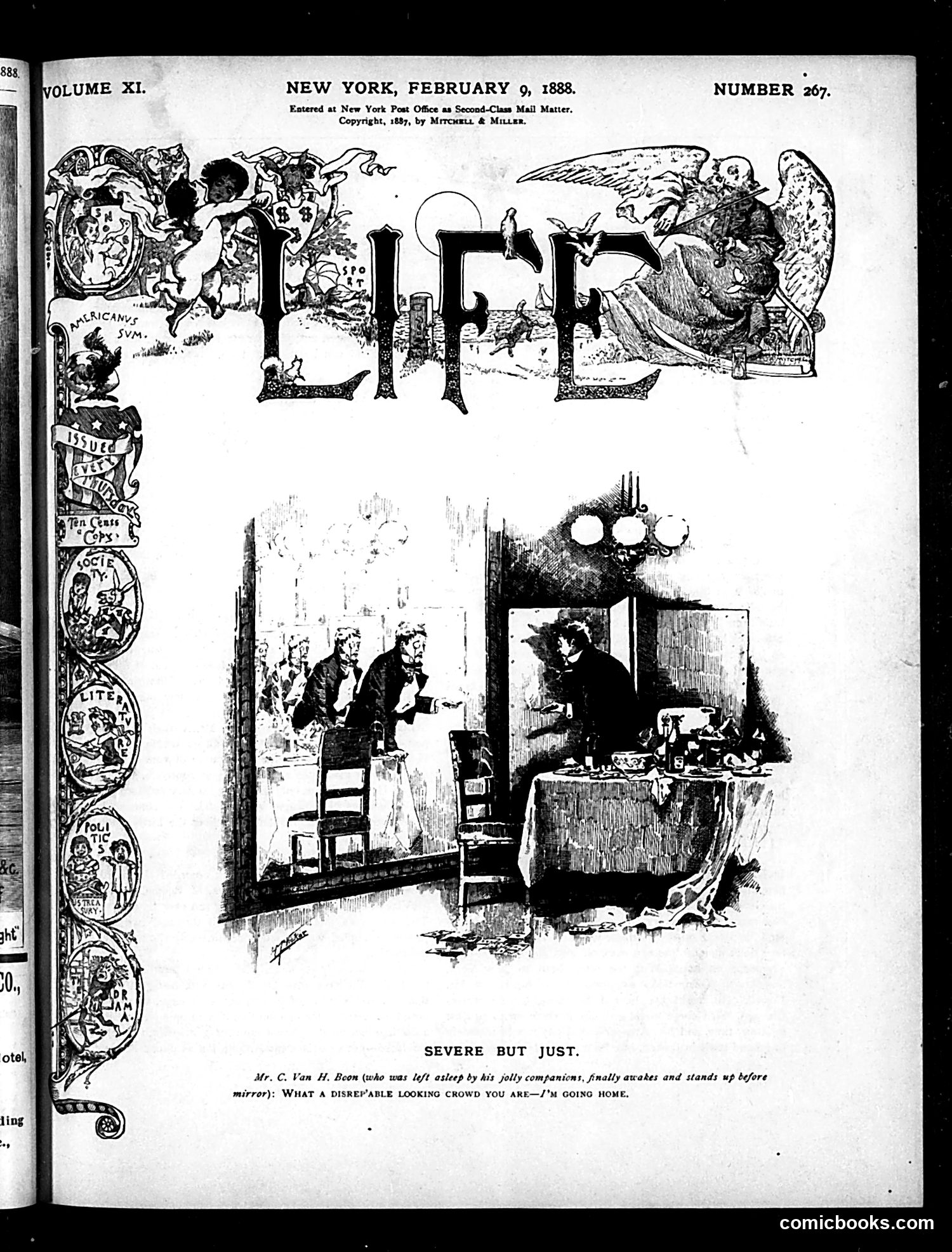
This cartoon from *Life* magazine (February 9, 1888) depicts a domestic scene satirizing marital discipline. A man (identified as "Mr. C. Van H. Been") stands before a mirror after being attacked by his companions, appearing disheveled. His wife, visible through a doorway, has apparently assaulted him—likely hitting him with objects now scattered on the floor. The caption's dialogue—"What a disreputable looking crowd you are—I'm going home"—suggests the wife is commenting on her husband's rowdy friends and has taken violent action to express her disapproval of their behavior. The title "Severe But Just" indicates the cartoon mocks the idea that such violence, while harsh, was justified punishment for disorderly conduct. This reflects 19th-century attitudes about domestic control and marital "correction."
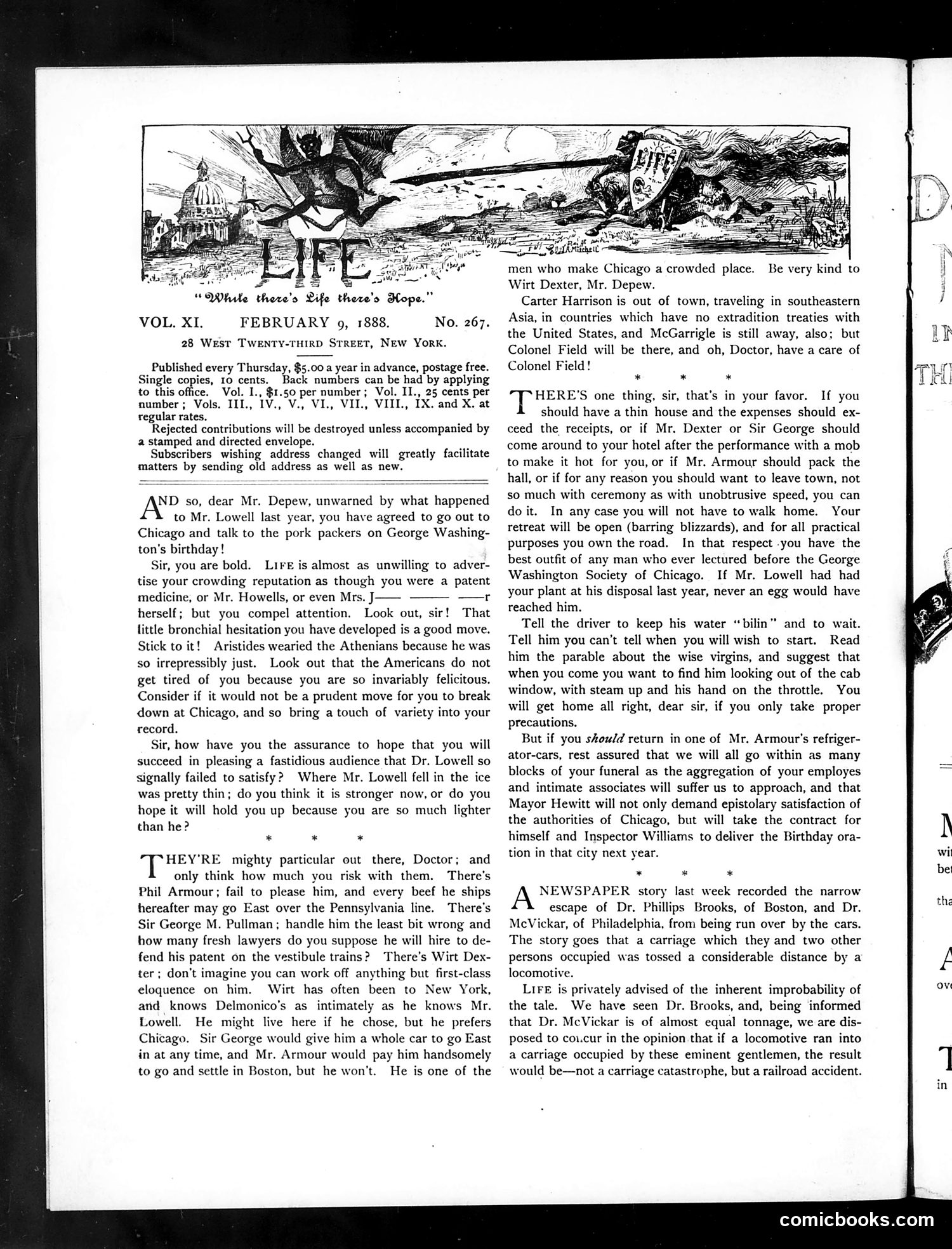
The masthead cartoon depicts a classical figure (likely representing Life or Truth) gesturing toward a cityscape with the caption "While there's Life there's Hope." The editorial content addresses Dr. Lowell, who apparently lectured before the George Washington Society of Chicago. The writer encourages him to visit Chicago, suggesting he could add "variety" to his lecture record—a backhanded compliment implying his talks are monotonous. References to Wirt Dexter, Sir George Pullman, and Mr. Armour indicate these were prominent Chicago businessmen of the era. The text mockingly suggests practical advice for his visit: keeping a carriage driver alert, avoiding walking, and noting that if he must return in an Armour refrigerator car, his funeral procession would cause civic disruption. This is dark satire about the dangers of Chicago's industrial transportation systems.
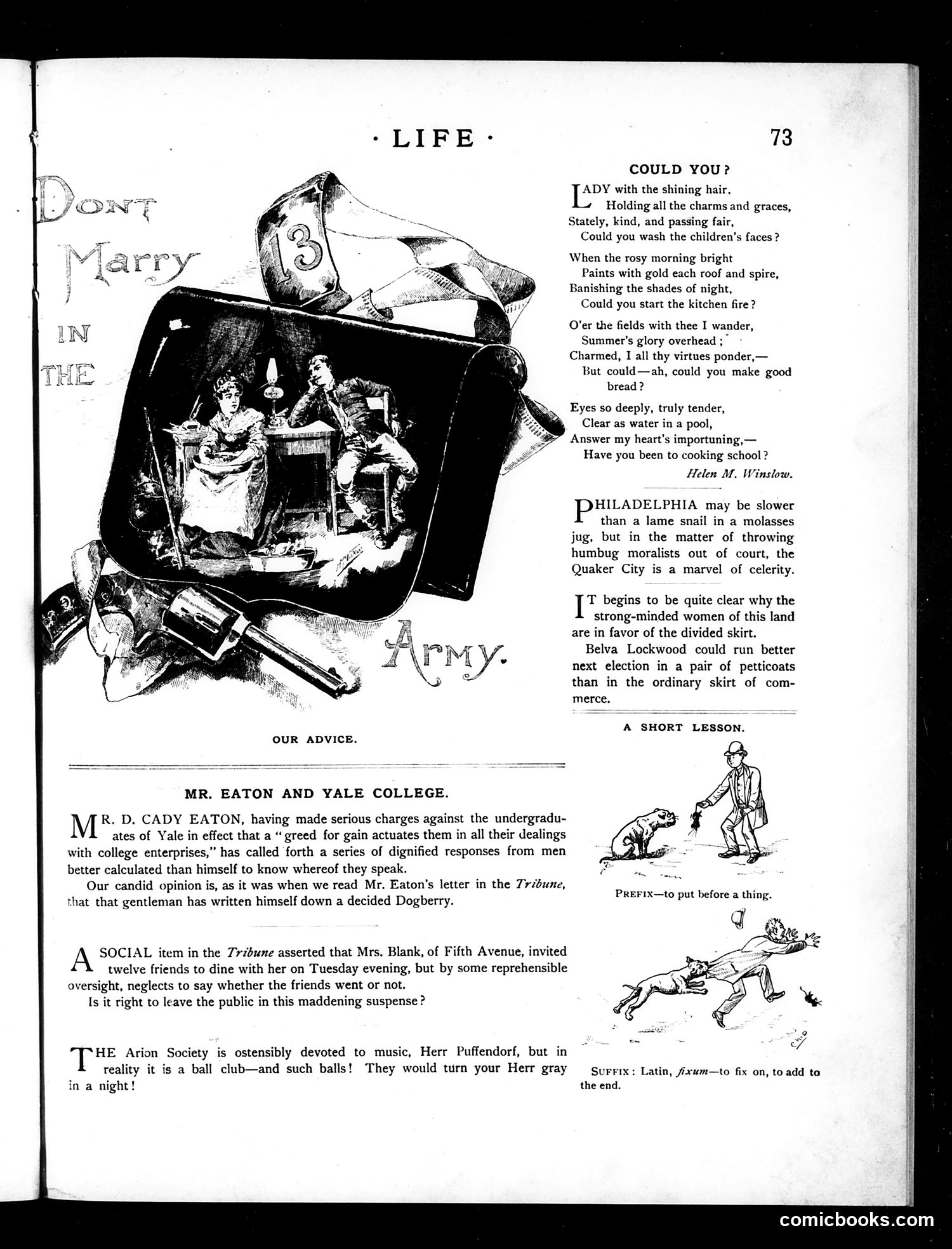
This page contains social commentary and satirical advice columns rather than political cartoons. **"Don't Marry in the Army"** is an illustrated essay warning against military marriage, depicting domestic chaos within a soldier's quarters—suggesting married soldiers faced inadequate housing and difficult conditions. **"Could You?"** by Helen M. Winslow is a pointed poem questioning whether women possess practical domestic skills (bread-baking, cooking) despite their "charms and graces," satirizing the gap between idealized femininity and actual household competence. The remaining items mock Philadelphia's slowness, Yale College's handling of undergraduate conduct, and social etiquette lapses (Mrs. Blank's unexplained party cancellation). **"A Short Lesson"** provides Latin grammar humor with illustrations of prefixes and suffixes, offering educational satire typical of Life's intellectual audience.
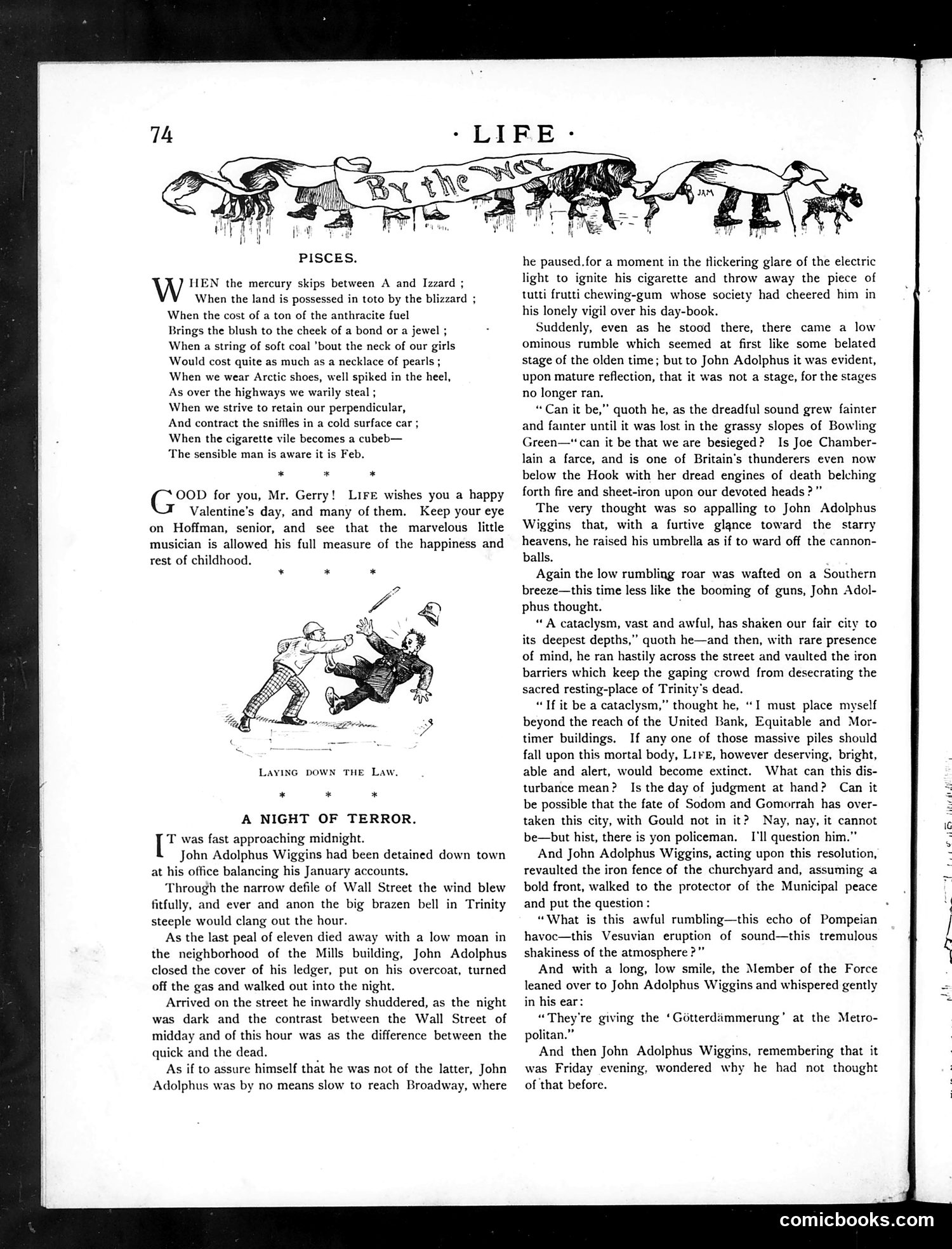
The page contains two sections: **"Pisces" Poem**: A satirical verse about financial and social absurdities—mercury prices, anthracite fuel costs, pearl necklaces, Arctic shoes, highway conditions, and cigarette regulations. The humor targets everyday consumer frustrations and the "sensible man" who avoids Feb (likely Valentine's Day excess). **"A Night of Terror" Story**: A narrative about John Adolphus Wiggins experiencing London during what appears to be an air raid or bombing. The story references "Götterdämmerung" at the Metropolitan (Wagner's opera), Trinity Church, and Wall Street, suggesting World War I-era London under German attack. Wiggins fears a catastrophe destroying the city, creating dark comedic tension between his financial concerns and mortal danger. The illustration "Laying Down the Law" shows a confrontational figure, likely satirizing authority or law enforcement.
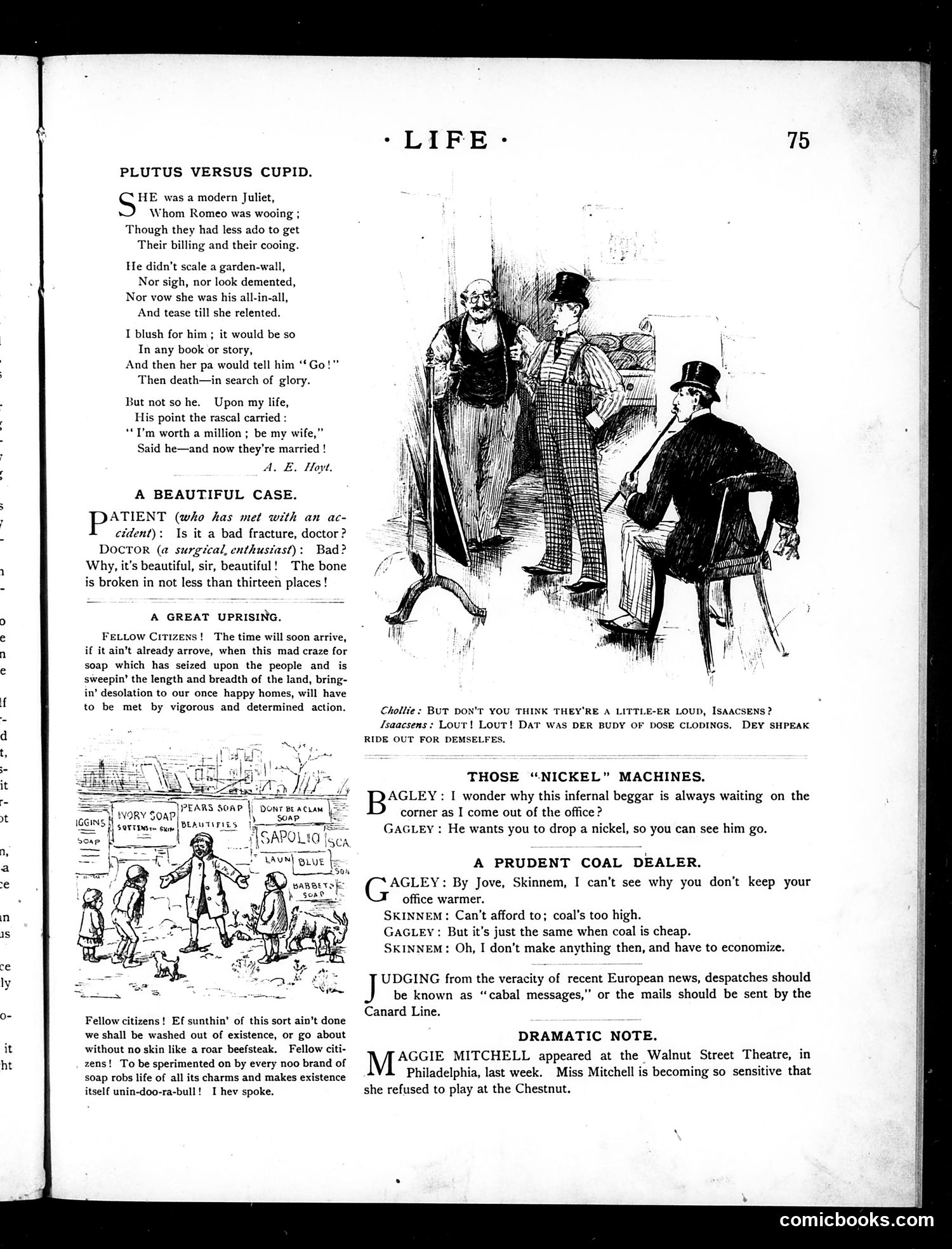
**"Plutus versus Cupid"** is a humorous poem about a modern Juliet whose Romeo lacks wealth—he can't even afford romantic gestures. The joke: despite being poor, he's confident enough to declare himself worth a million and marry her anyway. **"A Beautiful Case"** mocks medical jargon: a doctor describes a broken bone with theatrical enthusiasm, calling thirteen fractures "beautiful." **"A Great Uprising"** appears to be political satire about citizens and soap-related social upheaval, though the specific reference is unclear. The remaining items—**"Those Nickel Machines,"** **"A Prudent Coal Dealer,"** and **"Dramatic Note"**—are brief comedic anecdotes about everyday annoyances (beggars, heating costs) and theatrical gossip. This page reflects turn-of-century American concerns: poverty, class, medical pretension, and urban life.
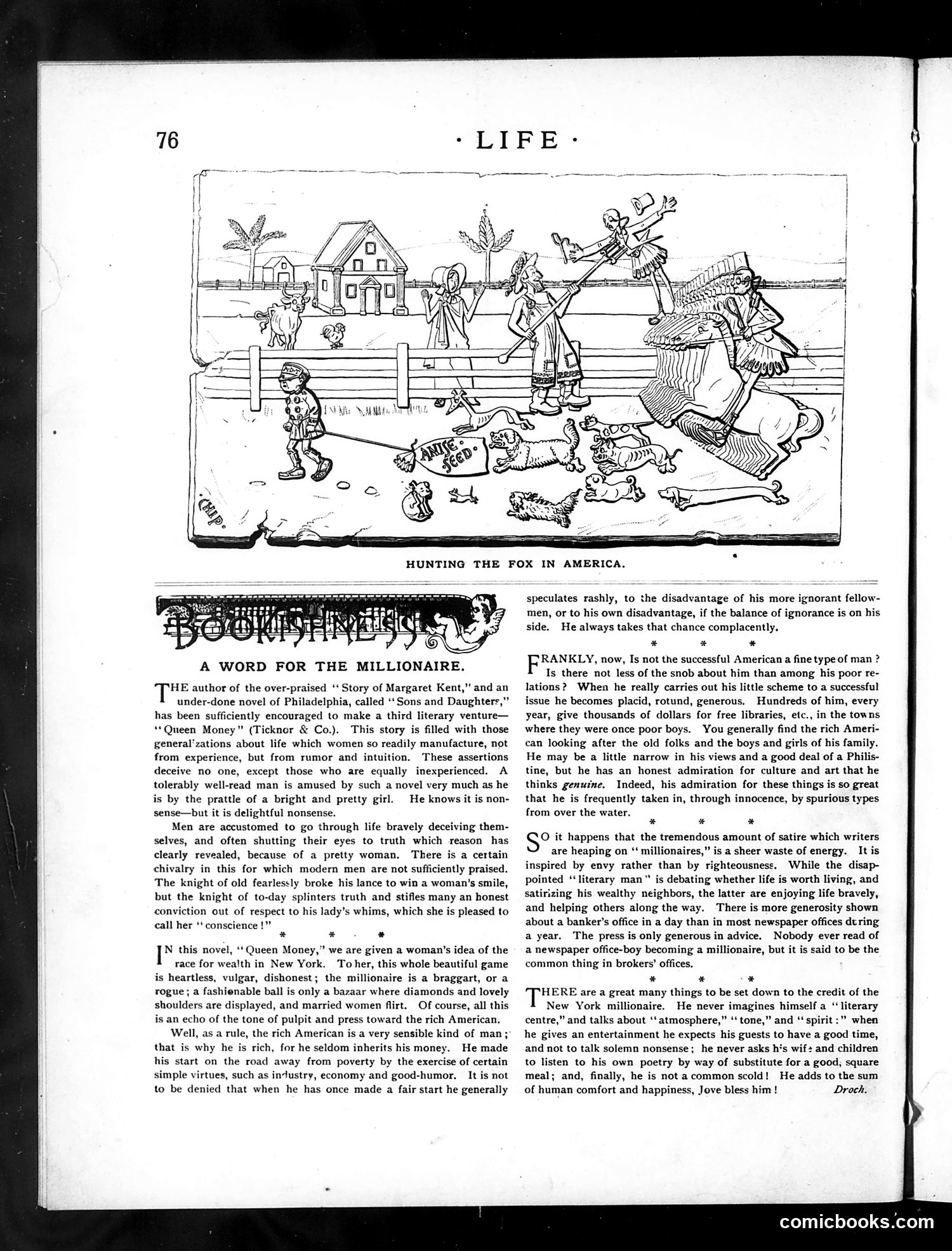
The cartoon depicts a chaotic rural scene titled "Hunting the Fox in America." It appears to be satirizing American wealth and social pretension through the lens of fox hunting—traditionally an aristocratic European sport. The image shows what appears to be wealthy Americans awkwardly attempting this refined pursuit in a farmyard setting, with their horses, dogs, and elaborate costumes contrasting absurdly with the humble domestic farm animals and buildings. The satire likely mocks the nouveau riche American upper class for aping European aristocratic customs without understanding or executing them properly. The accompanying text discusses American millionaires and their character, reinforcing this theme of satirizing wealthy Americans' social aspirations and pretensions to refinement.
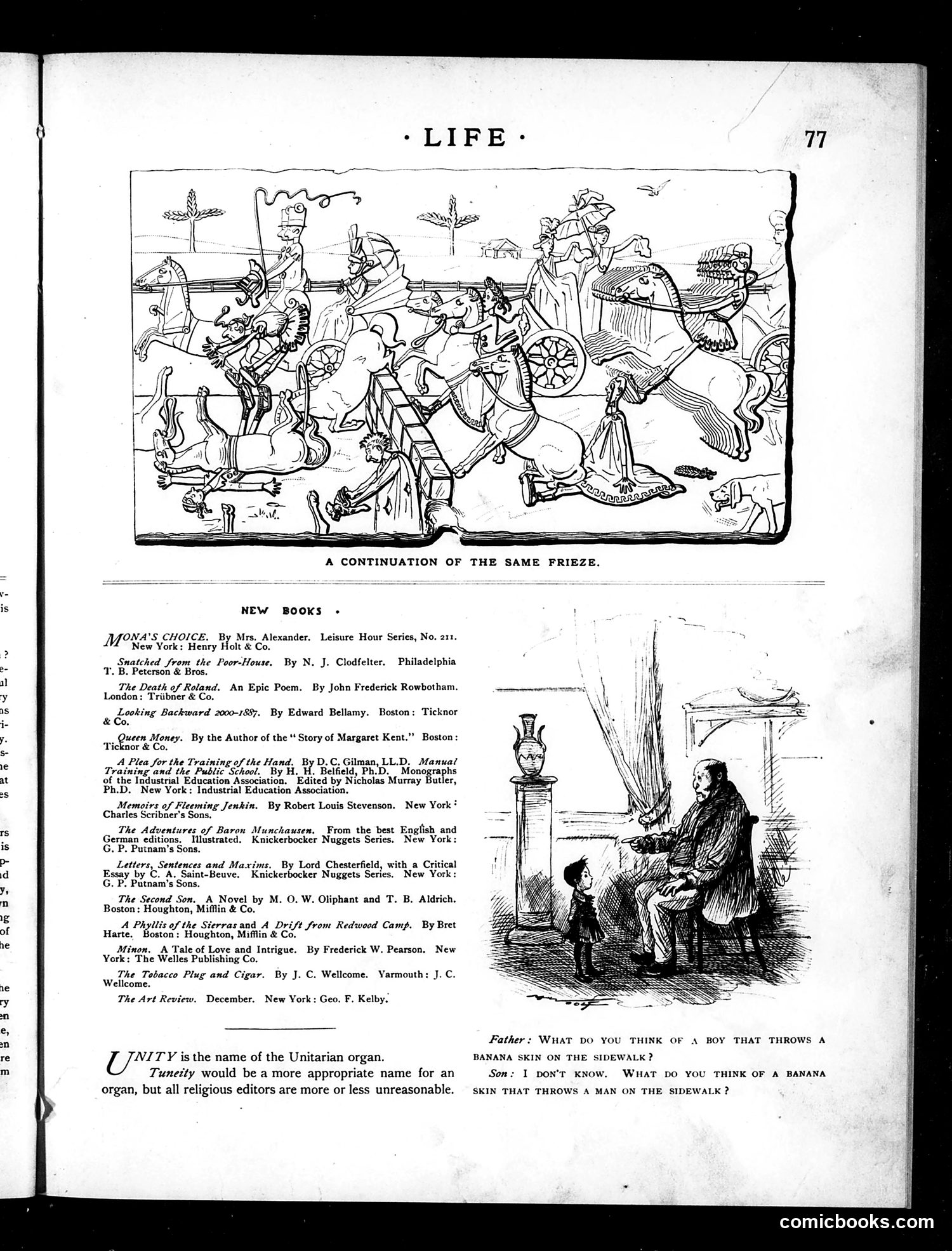
This page features a chaotic medieval or historical battle scene cartoon depicting mounted warriors, soldiers, and conflict. The title indicates it's a continuation of a previous satirical illustration, though without that context, the specific political targets remain unclear. The cartoon employs visual absurdism—crowded composition with exaggerated action—typical of Life magazine's satirical style. The exact figures and events referenced are **not identifiable from the image alone**. Below the cartoon is a "New Books" section listing contemporary publications, followed by a brief joke about religious editors and organ naming (UNITY vs. Timely). The page demonstrates Life's mix of political satire, literary advertising, and humor, though this particular cartoon's specific satirical message requires additional historical context to decode.
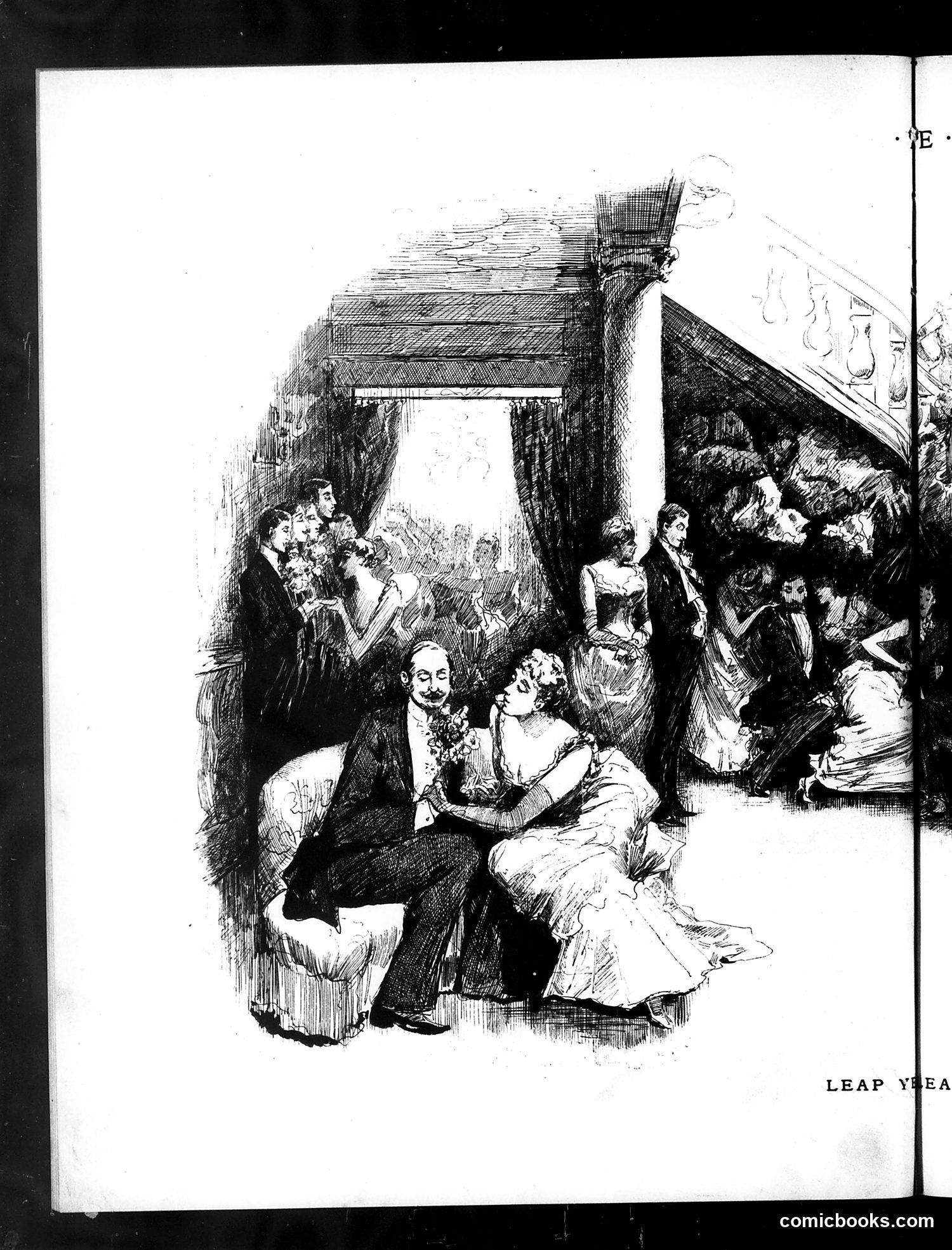
This is a satirical illustration from *Life* magazine titled "Leap Year," depicting a formal social gathering, likely from the late 19th century based on the artistic style and clothing. The cartoon appears to satirize the social convention of "Leap Year"—traditionally a year when women were permitted to propose to men, inverting normal courtship gender roles. In the foreground, a woman in a light dress actively courts a somewhat reluctant-looking man seated on a chair, while other couples socialize in the background. The architectural setting suggests an upper-class venue. The satire targets the absurdity of strict Victorian gender conventions around courtship and marriage proposals, mocking both the rigidity of social rules and the awkwardness of their reversal. The woman's aggressive pursuit contrasts with expected feminine passivity.
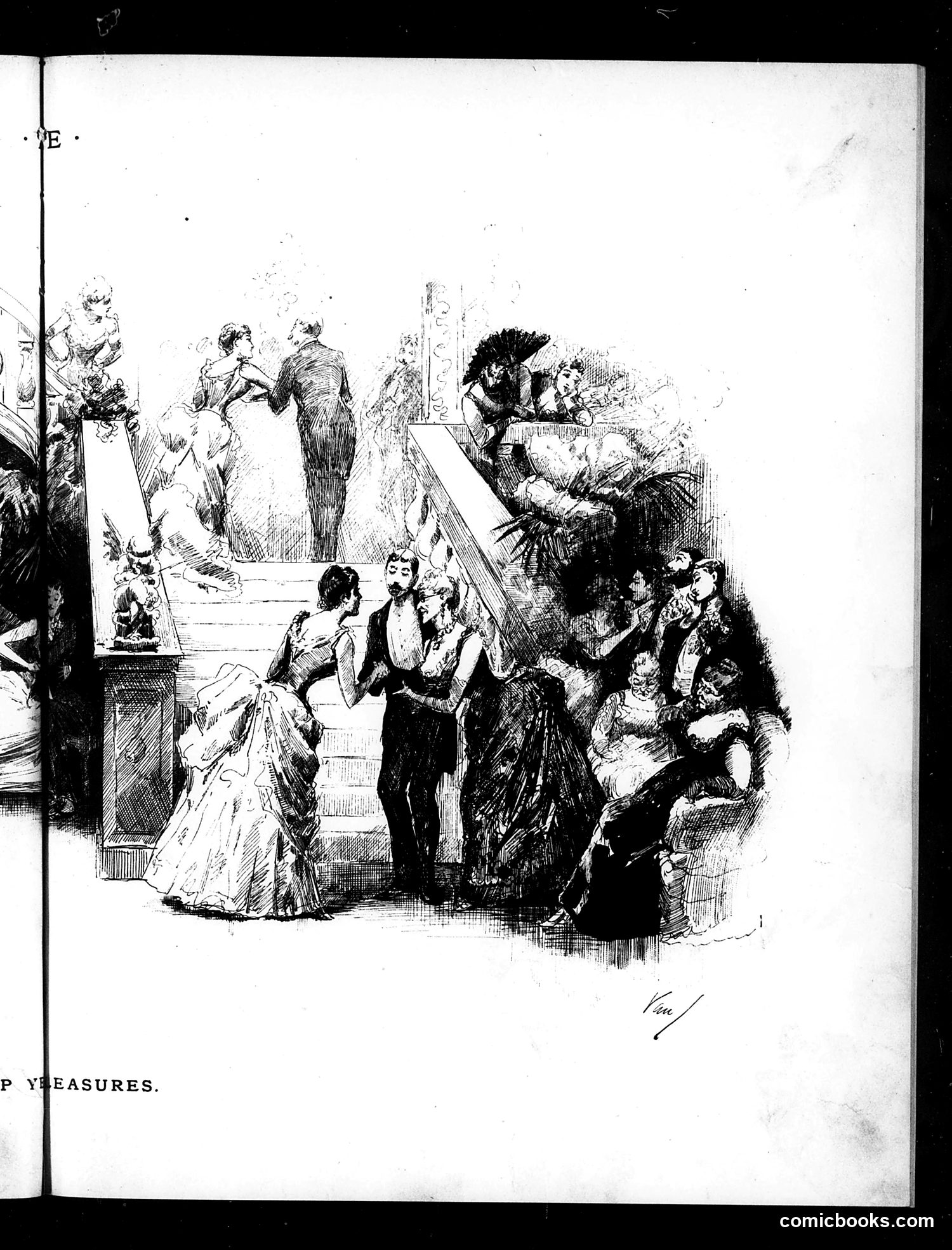
This appears to be an illustration titled "P YEASURES" (likely "PLEASURES," with the first letter cut off). The sketch depicts a theatrical or social scene from what appears to be the 19th century, showing well-dressed figures at what seems to be an opera house or similar venue. The image shows upper-class attendees in formal dress interacting on multiple levels—some elevated on a stage or box, others mingling in the foreground. The style and composition suggest satire of high society behavior, vanity, or social pretension, though without additional context or visible text identifying specific figures or events, the precise satirical target remains unclear. The sketch's technique is typical of Life's humorous social commentary.
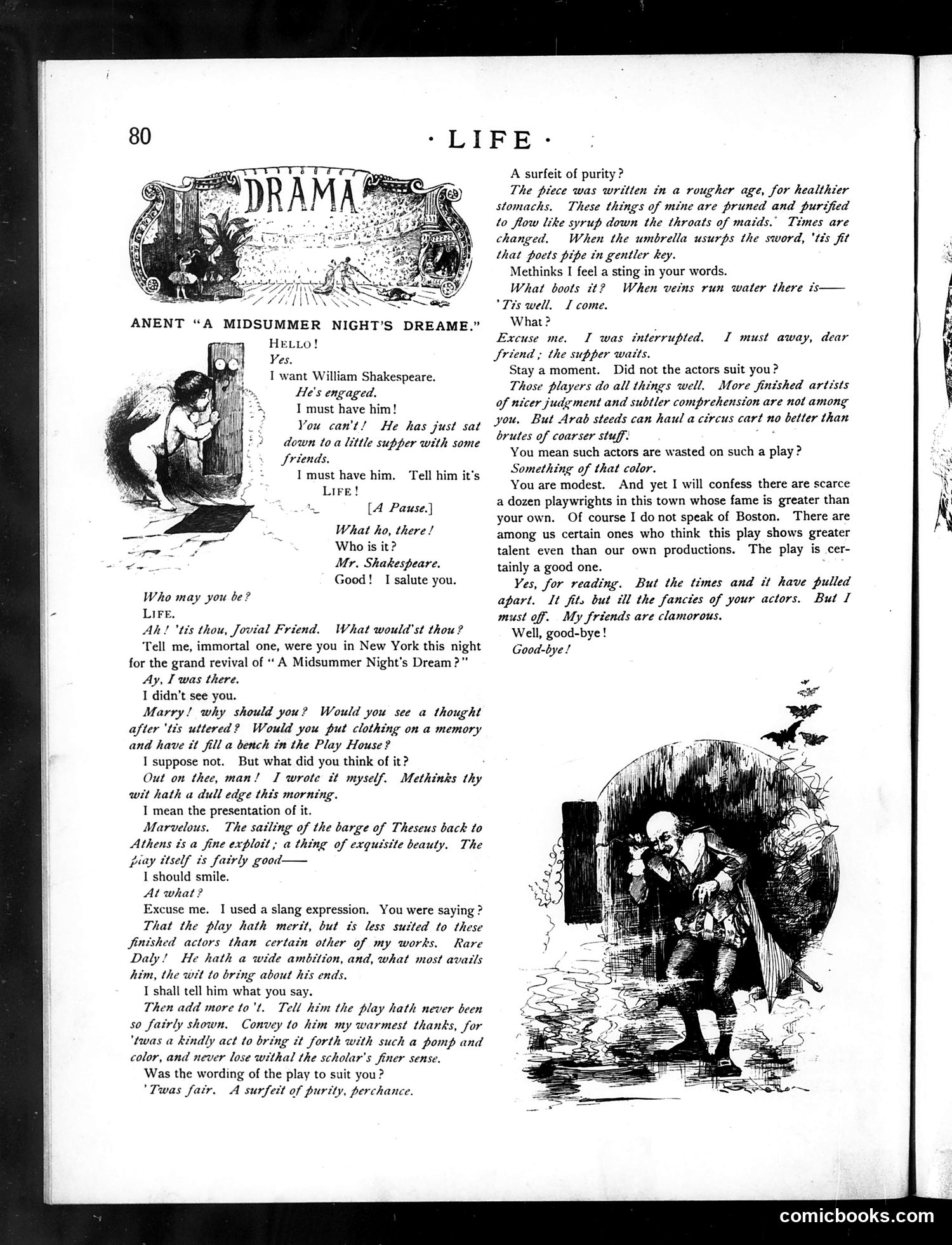
This page presents a dialogue between "Life" (personified as an immortal character) and "Mr. Shakespeare" about a local production of *A Midsummer Night's Dream*. Life critiques the performance, suggesting the actors, while competent, lack the caliber of talent in major theatrical centers like Boston. The satire mocks provincial theater: the actors are "wasted" on this play, though Life admits the production is "certainly a good one." The illustration depicts a beggar or poor character, likely referencing the play's themes of transformation and social displacement. The humor targets both mediocre regional theater and Life's condescending attitude toward amateur performers in smaller towns, reflecting late-19th-century literary snobbery about theatrical standards outside major cities.
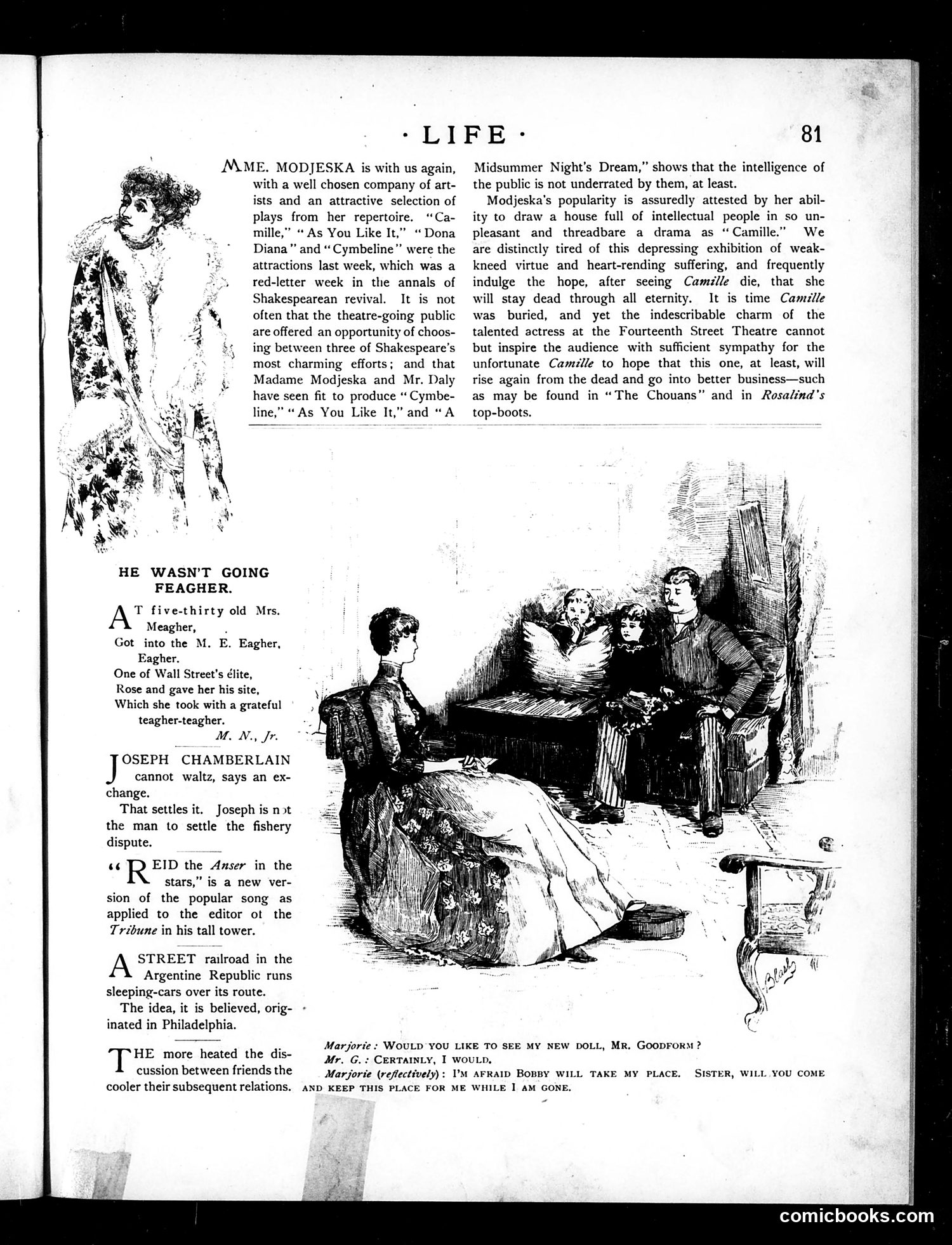
This Life magazine page (p. 81) contains theater criticism and light satirical humor pieces typical of the era. The main article praises actress **Madame Modjeska**, a celebrated Polish-American performer, for her repertory season featuring Shakespeare plays and *Camille*. The critic expresses relief that Modjeska's talent can elevate even the "depressing" melodrama *Camille*—repeatedly wishing the titular character would stay dead rather than be revived in inferior productions. The lower section contains brief satirical quips: one mocks **Joseph Chamberlain** (British statesman) for not waltzing, implying he's therefore unfit to settle fishery disputes; another jokes about a Argentine railroad with sleeping cars, claiming the idea originated in Philadelphia. The illustration depicts a domestic scene where young **Marjorie** shows her doll to **Mr. Goodform** while worrying her brother Bobby will replace her in his affections—gentle humor about childhood jealousy and social anxiety.
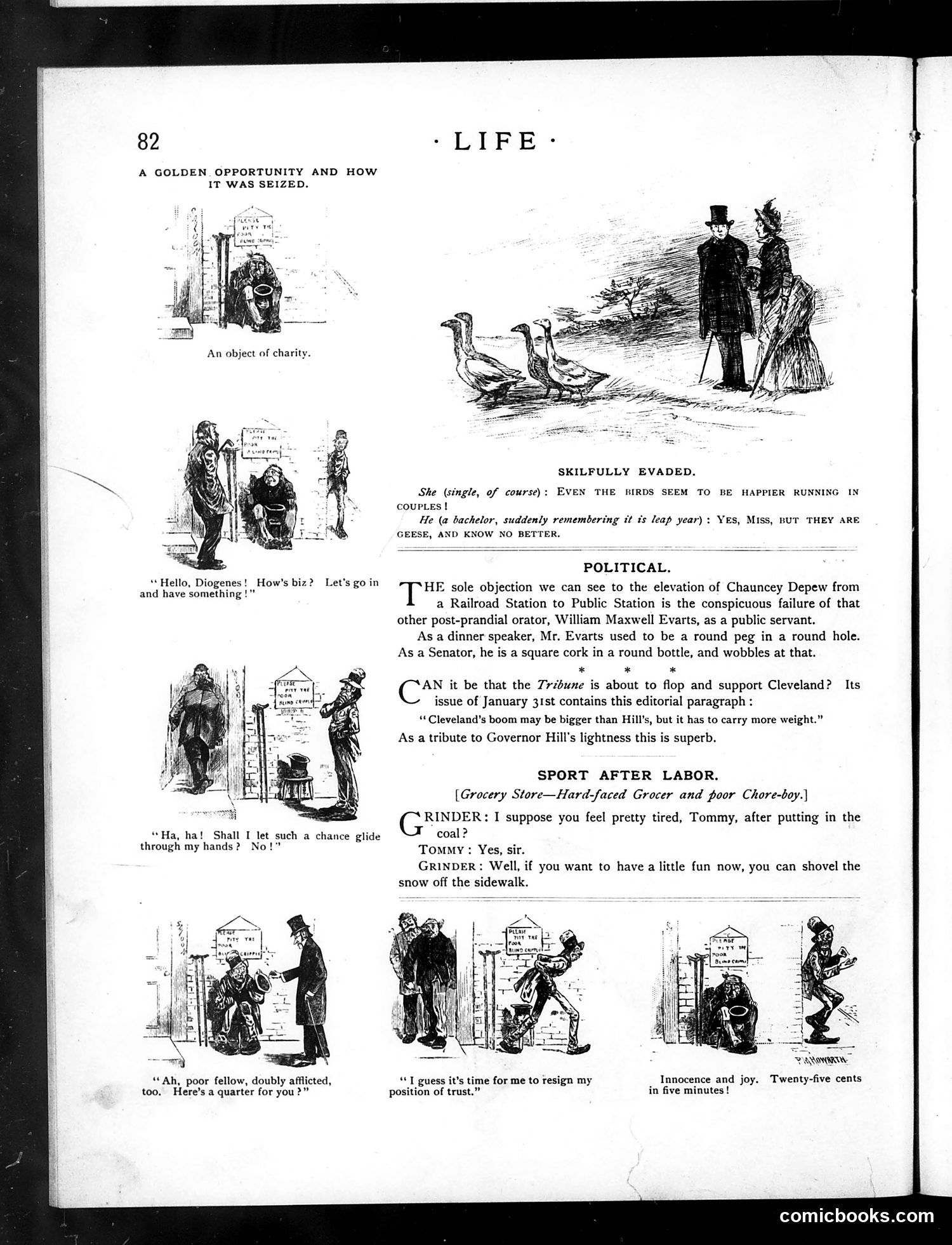
This page contains three separate satirical pieces: **"Skilfully Evaded"** mocks a bachelor's dodge of a woman's leap-year marriage hint by comparing courting humans to geese—implying bachelors lack the sense to recognize social obligation. **"Political"** attacks two figures: Chauncey Depew's railroad-to-public-office elevation, and especially William Maxwell Evarts, a former senator criticized as a "square cork in a round bottle"—good at dinner speeches but incompetent in governance. A secondary jab suggests the *Tribune* newspaper may flip its support to Cleveland over Hill, mocking Governor Hill's perceived lightness or insignificance. **"Sport After Labor"** depicts class exploitation: a grocer works an exhausted coal-shoveling boy, then offers him a quarter to shovel snow as "fun." The final panels show the boy's innocent joy at the coins, contrasting sharply with the grocer's cruelty—satire on child labor and wealthy indifference to working-class hardship. The overall tone is biting social commentary on political incompetence, romantic evasion, and labor exploitation.
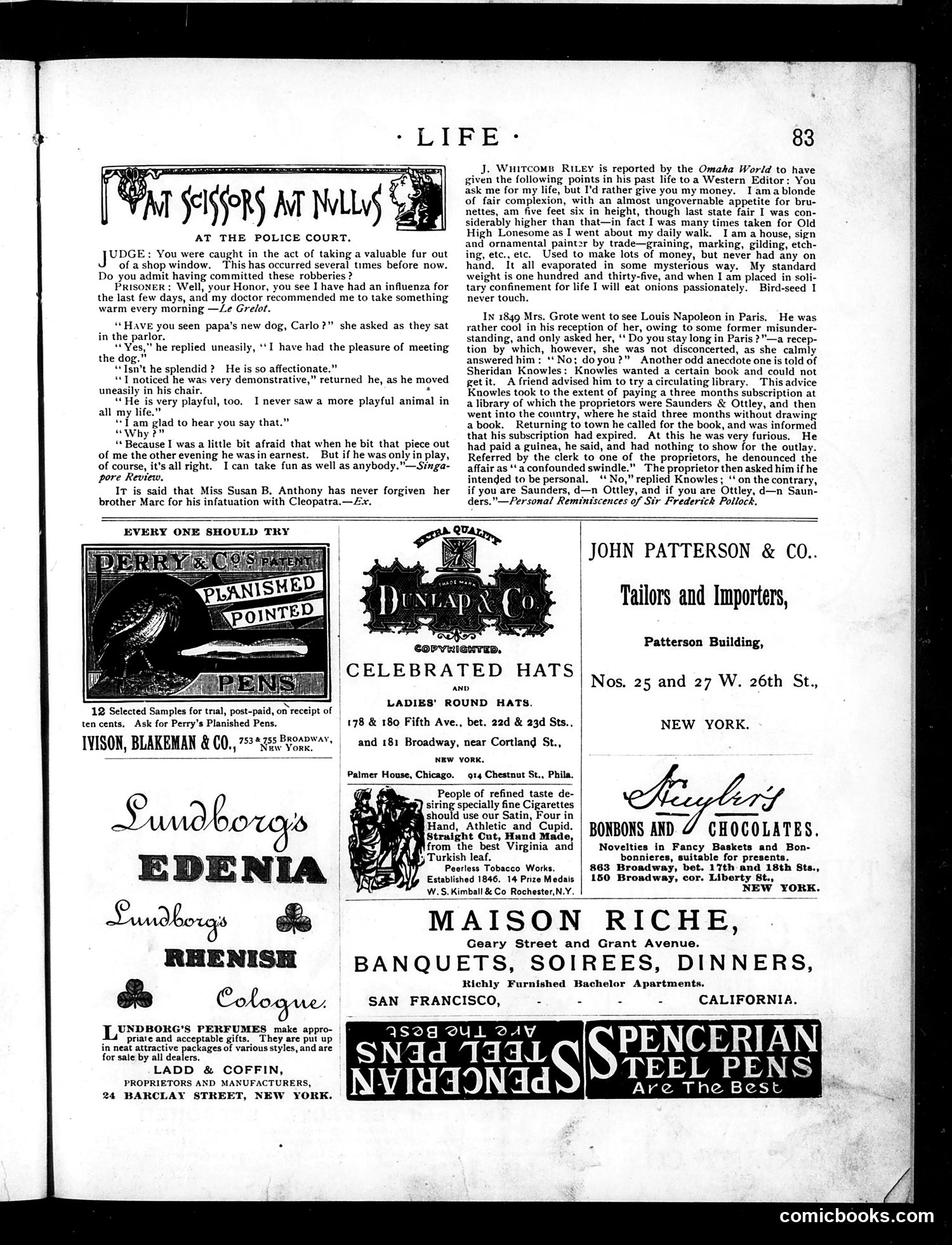
This page mixes satirical commentary with period advertisements. The main humor pieces mock social awkwardness and famous figures: **The police-court cartoon** plays on miscommunication: a man claims his doctor recommended "something warm" for influenza—he's been stealing furs. The judge interprets the excuse as pathetically transparent. **The dog anecdote** presents similar misunderstanding humor: a guest, bitten by the host's "playful" dog, diplomatically reframes the painful incident as mere roughhousing. **References to historical figures** (J. Whitcomb Riley, Susan B. Anthony, Sheridan Knowles, Napoleon) appear as brief jokes—mostly wordplay or personality quirks rather than political satire. The Cleopatra reference is unclear without more context. **The advertisements** (pens, hats, cologne, chocolates, tailors) dominate the page's lower half, typical of Life's revenue model. Overall: lighthearted domestic humor mixed with celebrity gossip, not pointed political commentary.
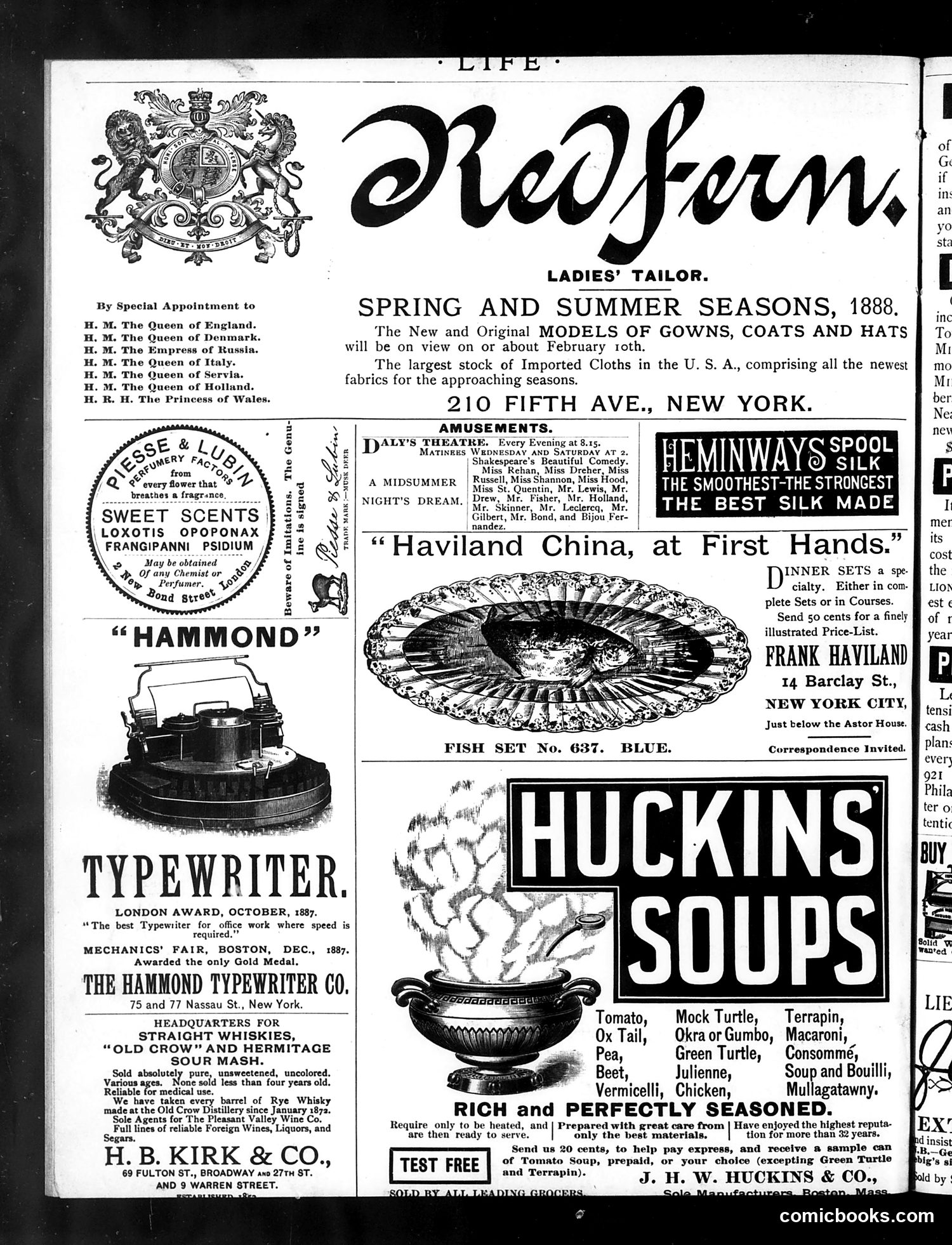
This is primarily an **advertising page** from Life magazine's 1888 spring issue, not a political cartoon. The page showcases luxury goods and services targeting wealthy readers. **Key advertisements include:** - **Red Fern** (top): A ladies' tailor at Fifth Avenue advertising imported fabrics and custom gowns, coats, and hats for spring/summer 1888 - **Hammond Typewriter**: Recently awarded gold medals, marketed as "the best typewriter for office work" - **Huckins Soups**: A specialty soup company advertising ready-to-heat canned soups in multiple varieties - **Frank Haviland**: Selling fine china dinner sets - **Haviland China**: Featured with an ornate fish serving set illustration - **H.B. Kirk & Co.**: Selling whiskey and liquors **Theater listings** for Daly's Theatre appear, featuring Shakespeare's "A Midsummer Night's Dream." The page reflects Gilded Age consumer culture—targeting the wealthy with imported goods, new technology (typewriters), and convenient prepared foods. There is no satire or political commentary visible.
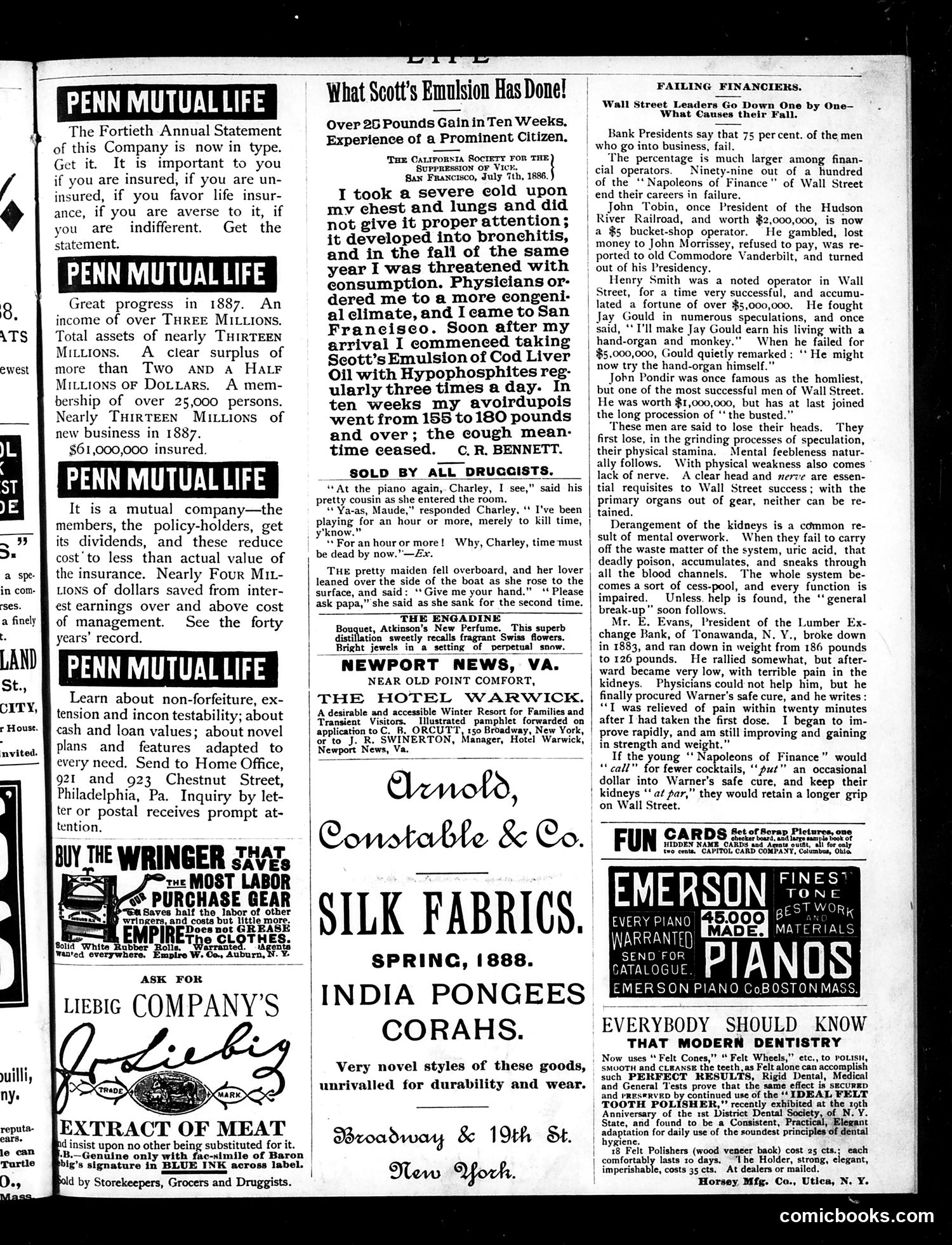
This page is primarily **advertisements and business announcements** rather than political satire or comics. The dominant content includes: **Penn Mutual Life Insurance** corporate advertisements emphasizing financial stability and membership benefits. **Scott's Emulsion testimonial** from a San Francisco citizen claiming weight gain (155 to 180 pounds) and cough relief from the cod liver oil product—typical patent medicine marketing of the 1880s. **Small humorous anecdotes** (marked "SOLD BY DRUGGISTS" section) featuring light social comedy about a young man playing piano and a drowning woman asking her lover to ask her father's permission. **Miscellaneous advertisements** for silk fabrics, pianos, extract of meat, dental services, and resort hotels. The page's satirical content is minimal and scattered. The "Failing Financiers" headline addresses business failure rates but lacks visible accompanying cartoon or detailed commentary. Overall, this represents typical 1880s magazine layout: commercial advertisements interspersed with brief social humor and business notices.
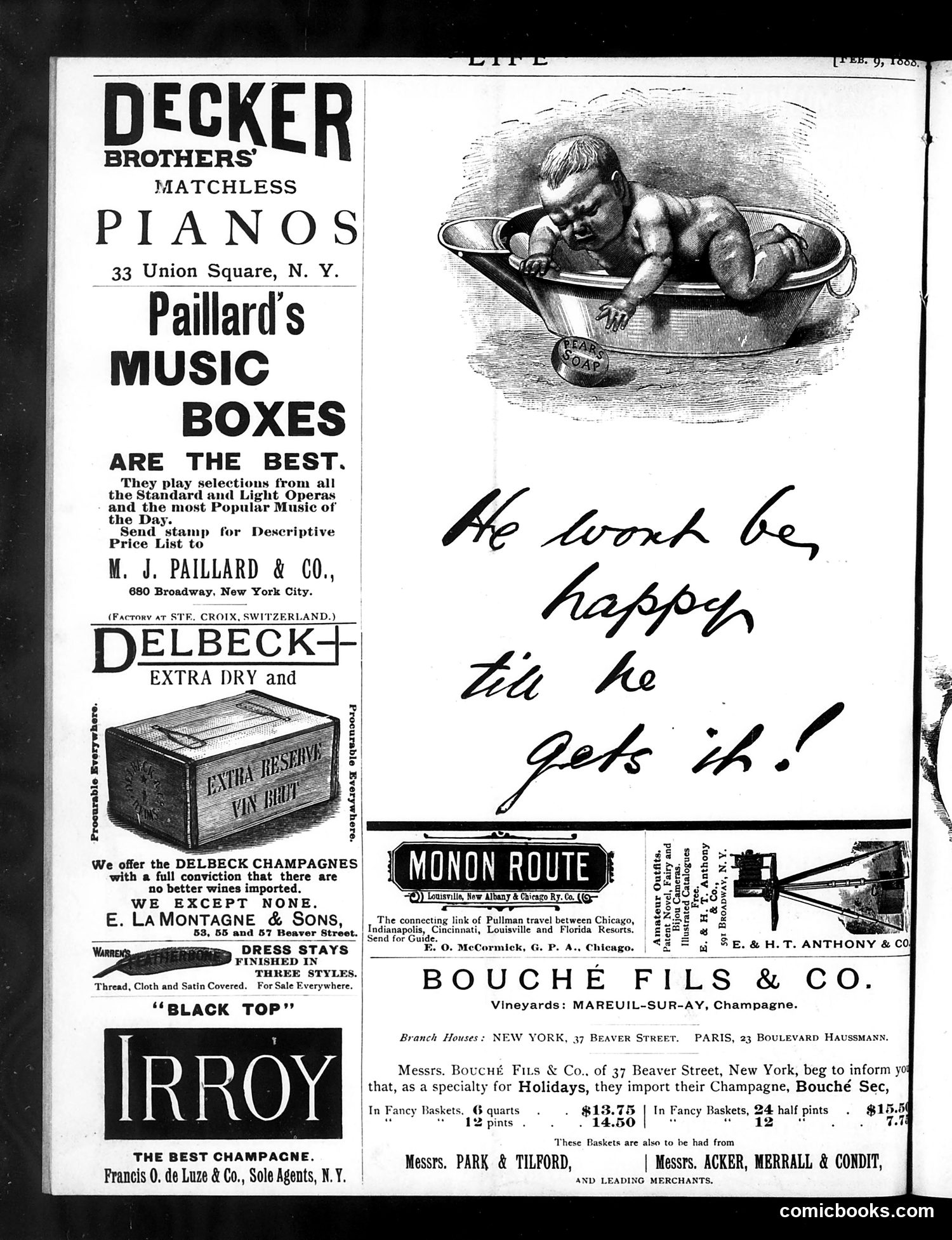
This page is **primarily advertising**, not editorial content or political satire. It features commercial advertisements for luxury goods typical of late 19th-century Life magazine. The single visual element—a cherub or baby in a bathtub with soap—appears to be an ad illustration, likely for Pears Soap (a famous brand using similar imagery in that era). The handwritten text overlay "He won't be happy till he gets it!" is a sales slogan playing on consumer desire. The rest of the page advertises pianos, music boxes, champagne (multiple brands), dress stays, cameras, and rail travel—all high-end products marketed to affluent readers. The "Monon Route" advertisement promotes luxury Pullman train travel between major cities. This represents Life's business model: satirical editorial content subsidized by advertising to wealthy audiences who could afford such goods. There is no political cartoon or social satire present on this particular page.