
Life, 1888-02-09 · page 10 of 16
Life — February 9, 1888 — page 10: what you’re looking at
What you’re looking at
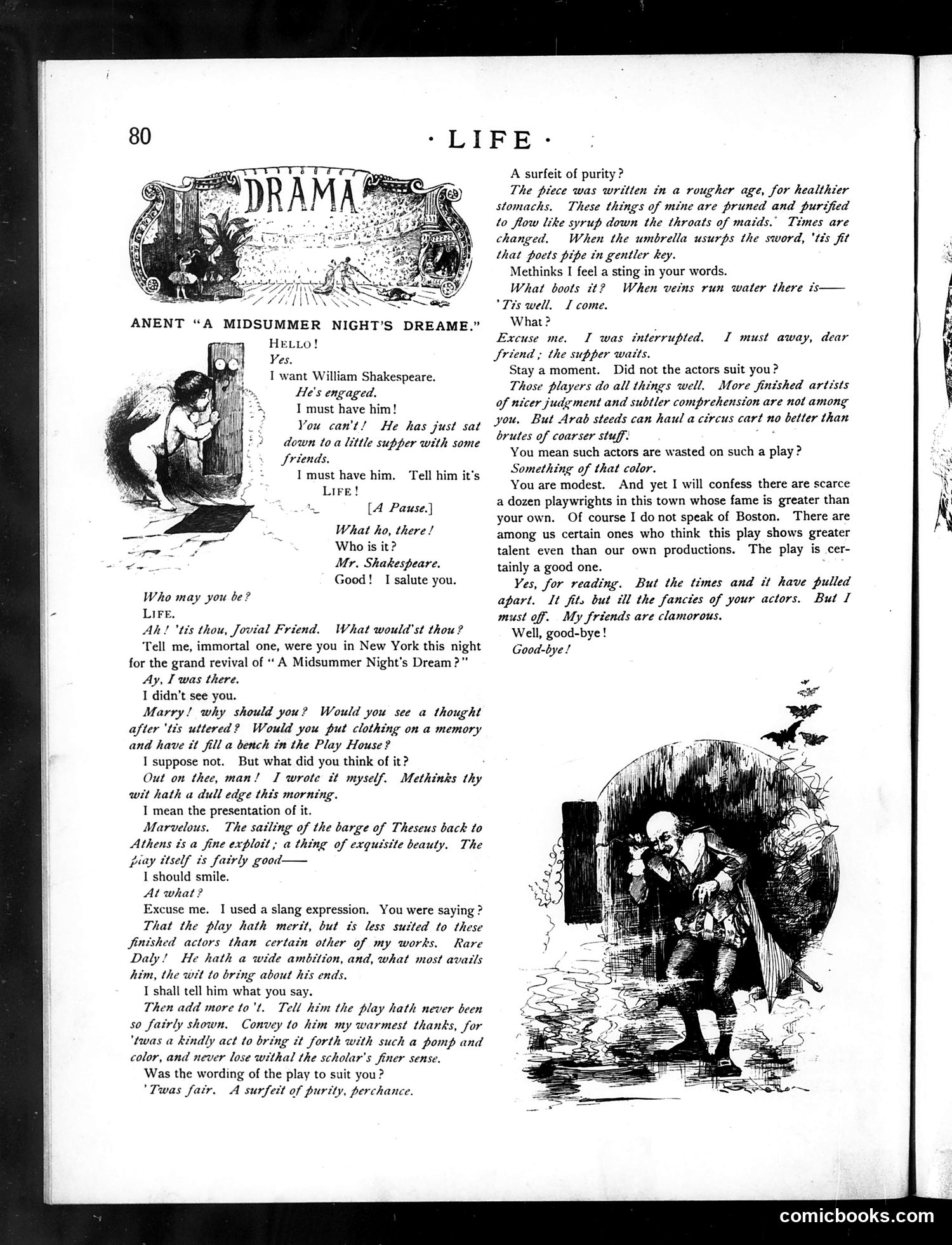
This page presents a dialogue between "Life" (personified as an immortal character) and "Mr. Shakespeare" about a local production of *A Midsummer Night's Dream*. Life critiques the performance, suggesting the actors, while competent, lack the caliber of talent in major theatrical centers like Boston. The satire mocks provincial theater: the actors are "wasted" on this play, though Life admits the production is "certainly a good one." The illustration depicts a beggar or poor character, likely referencing the play's themes of transformation and social displacement. The humor targets both mediocre regional theater and Life's condescending attitude toward amateur performers in smaller towns, reflecting late-19th-century literary snobbery about theatrical standards outside major cities.
📄 Transcribed text from this page (OCR, searchable)
Machine-transcribed from the original scan — historical spelling and the odd misread are preserved.
*LIFE- I want William Shakespeare. He's engaged. I must have him! You can't! He has just sat down toa little supper with some friends, I must have him. Tell him it’s Lire! [A Pause.] What ho, there! Who is it ? Mr. Shakespeare. Good! I salute you. Who may you be? LIFE. Ah! "tis thou, Jovial Friend. What would'st thou? Tell me, immortal one, were you in New York this night for the grand revival of “A Midsummer Night's Dream?” Ay, I was there. I didn’t see you. Marry! why should you? Would you see a thought after''tis uttered? Would you put clothing on a memory and have it fill a bench in the Play House? I suppose not. But what did you think of it? Out on thee, man! I wrote it myself. Methinks thy wit hath a dull edge this morning. I mean the presentation of it. Marvelous. The sailing of the barge of Theseus back to Athens is a fine exploit; a thing of exquisite beauty. The play itself is fairly good—— I should smile. At what? Excuse me. I used a slang expression. You were saying ? That the play hath merit, but ts less sutted to these finished actors than certain other of my works. Rare Daly! He hath a wide ambition, and, what most avails him, the wit to bring about his ends. I shall tell him what you say. Then add more to’t. Tell him the play hath never been so fairly shown, Convey to him my warmest thanks, for ‘twas a kindly act to bring it forth with such a pomp and color, and never lose withal the scholar's finer sense. Was the wording of the play to suit you? "Twas fair. A surfeit of purity, perchance. A surfeit of purity ? The piece was written in a rougher age, for healthier stomachs. These things of mine are pruned and purified to flow like syrup down the throats of maids. Times are changed. When the umbrella usurps the sword, 'tis fit that poets pipe in gentler key. Methinks I feel a sting in your words. What boots it? When veins run water there is—— ’Tis well. I come. What ? Excuse me. I was interrupted. friend ; the supper waits. Stay a moment. Did not the actors suit you? Those players do all things well. More finished artists of nicer judgment and subtler comprehension are not among you, But Arab steeds can haul a circus cart no better than brutes of coarser stuff: . You mean such actors are wasted on such a play? Something of that color. You are modest. And yet I will confess there are scarce a dozen playwrights in this town whose fame is greater than your own. Of course I do not speak of Boston. There are among us certain ones who think this play shows greater talent even than our own productions. The play is cer- tainly a good one. Yes, for reading. But the times and it have pulled apart. It fits but ill the fancies of your actors. But I must off. My friends are clamorous. Well, good-bye ! Good-bye! I must away, dear comicbooks.com