
Life, 1888-02-09 · page 6 of 16
Life — February 9, 1888 — page 6: what you’re looking at
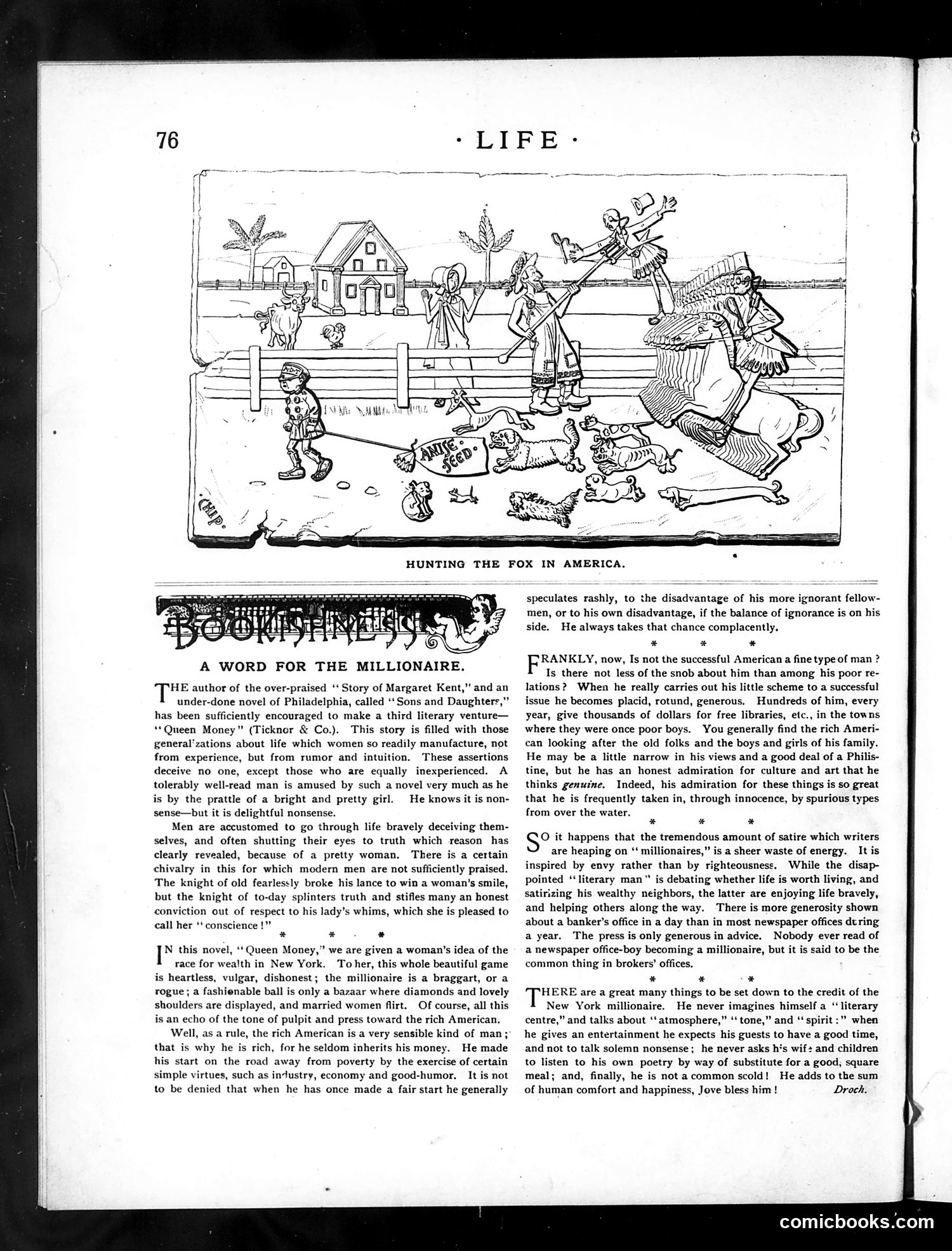
What you’re looking at
The cartoon depicts a chaotic rural scene titled "Hunting the Fox in America." It appears to be satirizing American wealth and social pretension through the lens of fox hunting—traditionally an aristocratic European sport. The image shows what appears to be wealthy Americans awkwardly attempting this refined pursuit in a farmyard setting, with their horses, dogs, and elaborate costumes contrasting absurdly with the humble domestic farm animals and buildings. The satire likely mocks the nouveau riche American upper class for aping European aristocratic customs without understanding or executing them properly. The accompanying text discusses American millionaires and their character, reinforcing this theme of satirizing wealthy Americans' social aspirations and pretensions to refinement.
📄 Transcribed text from this page (OCR, searchable)
Machine-transcribed from the original scan — historical spelling and the odd misread are preserved.
A WORD FOR THE MILLIONAIRE. HE author of the over-praised ‘ Story of Margaret Kent,” and an under-done novel of Philadelphia, called ‘‘ Sons and Daughters,” has been sufficiently encouraged to make a third literary venture— “Queen Money” (Ticknor & Co.). This story is filled with those general'zations about life which women so readily manufacture, not from experience, but from rumor and intuition. These assertions deceive no one, except those who are equally inexperienced. A tolerably well-read man is amused by such a novel very much as he is by the prattle of a bright and pretty girl. He knows it is non- sense—but it is delightful nonsense. Men are accustomed to go through life bravely deceiving them- selves, and often shutting their eyes to truth which reason has clearly revealed, because of a pretty woman. There is a certain chivalry in this for which modern men are not sufficiently praised. The knight of old fearlestly broke his lance to win a woman’s smile, but the knight of to-day splinters truth and stifles many an honest conviction out of respect to his lady’s whims, which she is pleased to call her *‘ conscience !” * * N this novel, ‘Queen Money,” we are given a woman's idea of the race for wealth in New York. To her, this whole beautiful game is heartless, vulgar, dishonest; the millionaire is a braggart, or a rogue ; a fashienable ball is only a bazaar where diamonds and lovely shoulders are displayed, and married women flirt. Of course, all this is an echo of the tone of pulpit and press toward the rich American. Well, as a rule, the rich American is a very sensible kind of man; that is why he is rich, for he seldom inherits his money. He made his start on the road away from poverty by the exercise of certain simple virtues, such as industry, economy and good-humor, It is not to be denied that when he has once made a fair start he generally speculates rashly, to the disadvantage of his more ignorant fellow- men, or to his own disadvantage, if the balance of ignorance is on his side. He always takes that chance complacently. * * * RANKLY, now, Is not the successful American a fine type of man ? Is there not less of the snob about him than among his poor re- lations? When he really carries out his little scheme to a successful issue he becomes placid, rotund, generous. Hundreds of him, every year, give thousands of dollars for free libraries, etc., in the towns where they were once poor boys. You generally find the rich Ameri- can looking after the old folks and the boys and girls of his family. He may be a little narrow in his views and a good deal of a Philis- tine, but he has an honest admiration for culture and art that he thinks genuine. Indeed, his admiration for these things is so great that he is frequently taken in, through innocence, by spurious types from over the water. * * O it happens that the tremendous amount of satire which writers are heaping on ‘ millionaires,” is a sheer waste of energy. It is inspired by envy rather than by righteousness. While the disap- pointed ‘literary man” is debating whether life is worth living, and satirizing his wealthy neighbors, the latter are enjoying life bravely, and helping others along the way. There is more generosity shown about a banker’s office in a day than in most newspaper offices during a year. The press is only generous in advice. Nobody ever read of ‘a newspaper office-boy becoming a millionaire, but it is said to be the common thing in brokers’ offices. * * * HERE are a great many things to be set down to the credit of the New York millionaire. He never imagines himself a ‘literary centre,” and talks about ‘‘ atmosphere,” ‘‘ tone,” and “spirit :” when he gives an entertainment he expects his guests to have a good time, and not to talk solemn nonsense; he never asks h’s wif+ and children to listen to his own poetry by way of substitute for a good, square meal; and, finally, he is not acommon scold! He adds to the sum of human comfort and happiness, Jove bless him ! Droch. comicbooks.com