
Life, 1888-02-09 · page 4 of 16
Life — February 9, 1888 — page 4: what you’re looking at
What you’re looking at
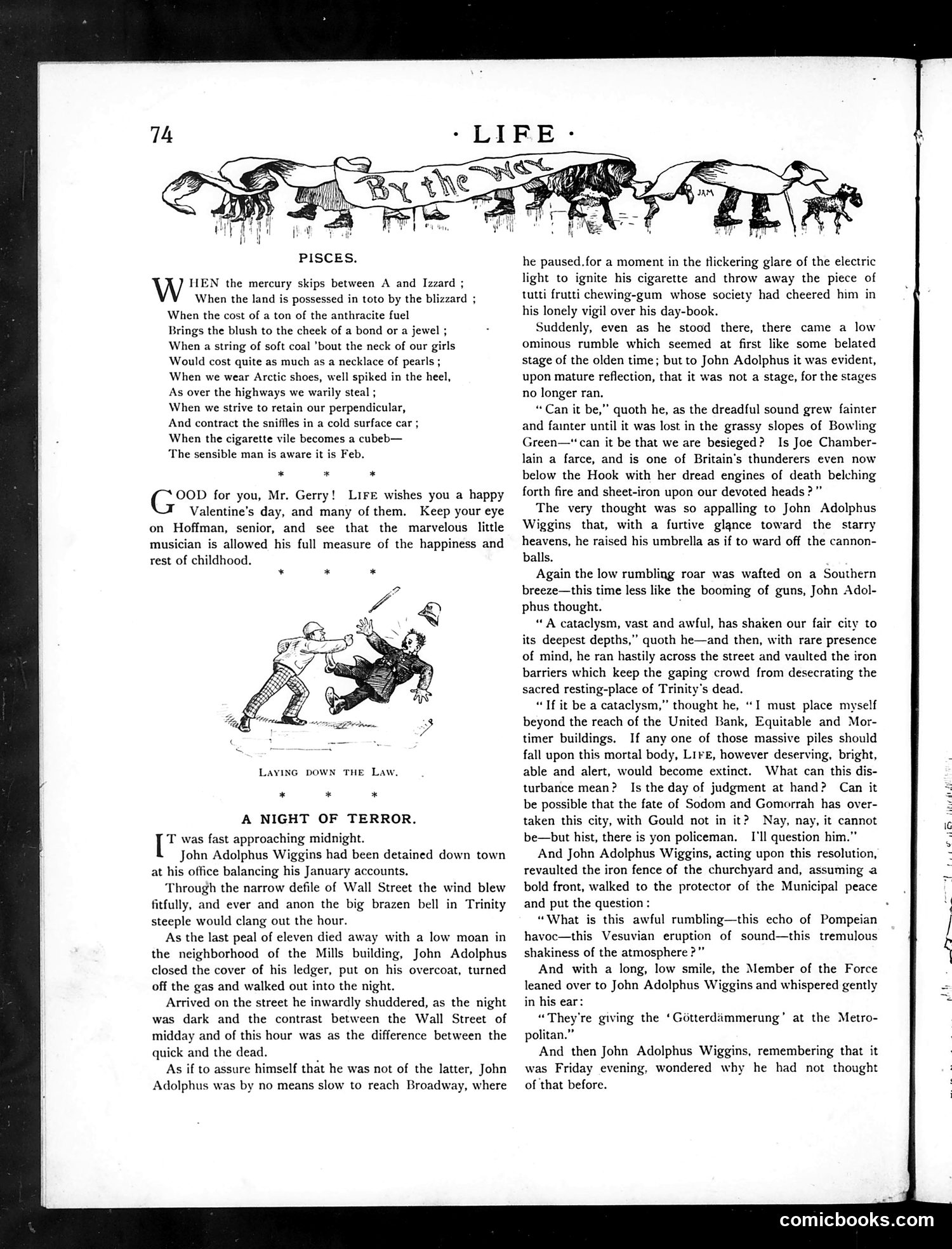
The page contains two sections: **"Pisces" Poem**: A satirical verse about financial and social absurdities—mercury prices, anthracite fuel costs, pearl necklaces, Arctic shoes, highway conditions, and cigarette regulations. The humor targets everyday consumer frustrations and the "sensible man" who avoids Feb (likely Valentine's Day excess). **"A Night of Terror" Story**: A narrative about John Adolphus Wiggins experiencing London during what appears to be an air raid or bombing. The story references "Götterdämmerung" at the Metropolitan (Wagner's opera), Trinity Church, and Wall Street, suggesting World War I-era London under German attack. Wiggins fears a catastrophe destroying the city, creating dark comedic tension between his financial concerns and mortal danger. The illustration "Laying Down the Law" shows a confrontational figure, likely satirizing authority or law enforcement.
📄 Transcribed text from this page (OCR, searchable)
Machine-transcribed from the original scan — historical spelling and the odd misread are preserved.
PISCES. HEN the mercury skips between A and Izzard ; When the land is possessed in toto by the blizzard ; When the cost of a ton of the anthracite fuel Brings the blush to the cheek of a bond or a jewel ; When a string of soft coal "bout the neck of our girls Would cost quite as much as a necklace of pearls ; When we wear Arctic shoes, well spiked in the heel, As over the highways we warily steal ; When we strive to retain our perpendicular, And contract the sniffles in a cold surface car ; When the cigarette vile becomes a cubeb— The sensible man is aware it is Feb. * * * OOD for you, Mr. Gerry! Lire wishes you a happy Valentine's day, and many of them. Keep your eye on Hoffman, senior, and see that the marvelous little musician is allowed his full measure of the happiness and rest of childhood. LayInG DOWN THE Law. * * * A NIGHT OF TERROR. T was fast approaching midnight. John Adolphus Wiggins had been detained down town at his office balancing his January accounts. Through the narrow defile of Wall Street the wind blew fitfully, and ever and anon the big brazen bell in Trinity steeple would clang out the hour. As the last peal of eleven died away with a low moan in the neighborhood of the Mills building, John Adolphus closed the cover of his ledger, put on his overcoat, turned off the gas and walked out into the night. Arrived on the street he inwardly shuddered, as the night was dark and the contrast between the Wall Street of midday and of this hour was as the difference between the quick and the dead. As if to assure himself that he was not of the latter, John Adolphus was by no means slow to reach Broadway, where he paused.for a moment in the flickering glare of the electric light to ignite his cigarette and throw away the piece of tutti frutti chewing-gum whose society had cheered him in his lonely vigil over his day-book. Suddenly, even as he stood there, there came a low ominous rumble which seemed at first like some belated stage of the olden time; but to John Adolphus it was evident, upon mature reflection, that it was not a stage, for the stages no longer ran. “Can it be,” quoth he, as the dreadful sound grew fainter and fainter until it was lost in the grassy slopes of Bowling Green—* can it be that we are besieged? Is Joe Chamber- lain a farce, and is one of Britain's thunderers even now below the Hook with her dread engines of death belching forth fire and sheet-iron upon our devoted heads?” The very thought was so appalling to John Adolphus Wiggins that, with a furtive glance toward the starry heavens, he raised his umbrella as if to ward off the cannon- balls. Again the low rumbling roar was wafted on a Southern breeze—this time less like the booming of guns, John Adol- phus thought. “A cataclysm, vast and awful, has shaken our fair city to its deepest depths,” quoth he—and then, with rare presence of mind, he ran hastily across the street and vaulted the iron barriers which keep the gaping crowd from desecrating the sacred resting-place of Trinity's dead. “If it be a cataclysm,” thought he, “I must place myself beyond the reach of the United Bank, Equitable and Mor- timer buildings. If any one of those massive piles should fall upon this mortal body, Lire, however deserving, bright, able and alert, would become extinct. What can this dis- turbance mean? Is the day of judgment at hand? Can it be possible that the fate of Sodom and Gomorrah has over- taken this city, with Gould not in it? Nay, nay, it cannot be—but hist, there is yon policeman. I'll question him.” And John Adolphus Wiggins, acting upon this resolution, revaulted the iron fence of the churchyard and, assuming a bold front, walked to the protector of the Municipal peace and put the question : “What is this awful rumbling—this echo of Pompeian havoc—this Vesuvian eruption of sound—this tremulous shakiness of the atmosphere ?”” And with a long, low smile, the Member of the Force leaned over to John Adolphus Wiggins and whispered gently in his ear: “They're giving the ‘Gétterdimmerung’ at the Metro- politan.” And then John Adolphus Wiggins, remembering that it was Friday evening, wondered why he had not thought of that before. comicbooks.com