
Life, 1888-02-09 · page 2 of 16
Life — February 9, 1888 — page 2: what you’re looking at
What you’re looking at
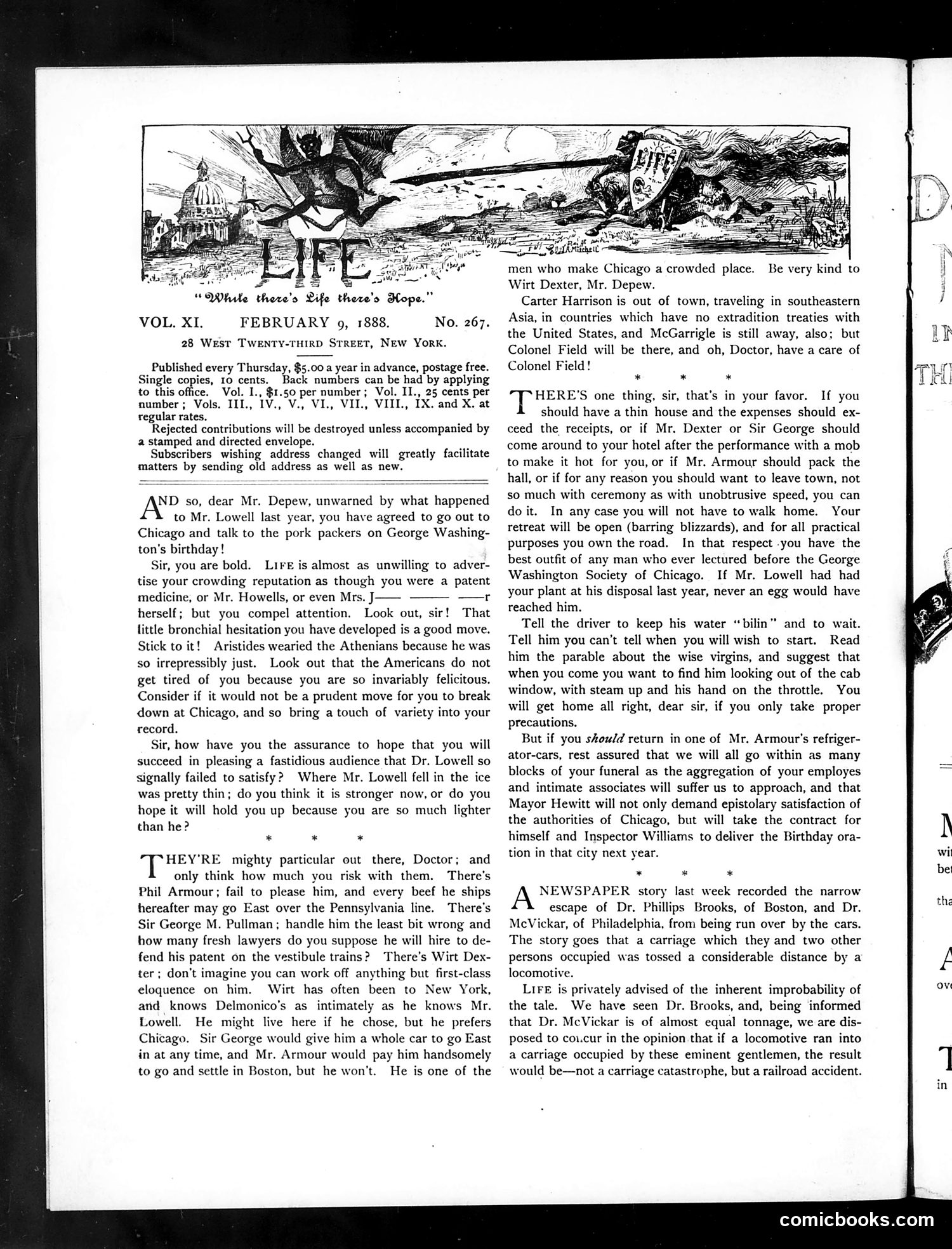
The masthead cartoon depicts a classical figure (likely representing Life or Truth) gesturing toward a cityscape with the caption "While there's Life there's Hope." The editorial content addresses Dr. Lowell, who apparently lectured before the George Washington Society of Chicago. The writer encourages him to visit Chicago, suggesting he could add "variety" to his lecture record—a backhanded compliment implying his talks are monotonous. References to Wirt Dexter, Sir George Pullman, and Mr. Armour indicate these were prominent Chicago businessmen of the era. The text mockingly suggests practical advice for his visit: keeping a carriage driver alert, avoiding walking, and noting that if he must return in an Armour refrigerator car, his funeral procession would cause civic disruption. This is dark satire about the dangers of Chicago's industrial transportation systems.
📄 Transcribed text from this page (OCR, searchable)
Machine-transcribed from the original scan — historical spelling and the odd misread are preserved.
VOL. XI. FEBRUARY 9, 1888. No. 267. 28 West Twenty-rHirD STREET, New York. Published every Thursday, $5.00 a year in advance, postage free. Single copies, 10 cents. Back numbers can be had by applying to this office. Vol. I., $1.50 per number; Vol. II., 25 cents per number ; Vols. III., IV., V., VI., VII., VIII, IX. and X. at regular rates, Rejected contributions will be destroyed unless accompanied by a stamped and directed envelope. Subscribers wishing address changed will greatly facilitate matters by sending old address as well as new. ND so, dear Mr. Depew, unwarned by what happened to Mr. Lowell last year, you have agreed to go out to Chicago and talk to the pork packers on George Washing- ton's birthday! Sir, you are bold. Lire is almost as unwilling to adver- tise your crowding reputation as though you were a patent medicine, or Mr. Howells, or even Mrs. J —r herself; but you compel attention. Look out, sir! That little bronchial hesitation you have developed is a good move. Stick to it! Aristides wearied the Athenians because he was so irrepressibly just. Look out that the Americans do not get tired of you because you are so invariably felicitous. Consider if it would not be a prudent move for you to break down at Chicago, and so bring a touch of variety into your record. Sir, how have you the assurance to hope that you will succeed in pleasing a fastidious audience that Dr. Lowell so signally failed to satisfy? Where Mr. Lowell fell in the ice was pretty thin; do you think it is stronger now, or do you hope it will hold you up because you are so much lighter than he? * * * HEY'RE mighty particular out there, Doctor; and only think how much you risk with them. There's Phil Armour; fail to please him, and every beef he ships hereafter may go East over the Pennsylvania line. There's Sir George M. Pullman; handle him the least bit wrong and how many fresh lawyers do you suppose he will hire to de- fend his patent on the vestibule trains? There’s Wirt Dex- ter; don't imagine you can work off anything but first-class eloquence on him. Wirt has often been to New York, and knows Delmonico’s as intimately as he knows Mr. Lowell. He might live here if he chose, but he prefers Chicago. Sir George would give him a whole car to go East in at any time, and Mr. Armour would pay him handsomely to go and settle in Boston, but he won't. He is one of the men who make Chicago a crowded place. Wirt Dexter, Mr. Depew. Carter Harrison is out of town, traveling in southeastern Asia, in countries which have no extradition treaties with the United States, and McGarrigle is still away, also; but Colonel Field will be there, and oh, Doctor, have a care of Colonel Field! Be very kind to * * * HERE'S one thing, sir, that’s in your favor. If you should have a thin house and the expenses should ex- ceed the receipts, or if Mr. Dexter or Sir George should come around to your hotel after the performance with a mob to make it hot for you, or if Mr. Armour should pack the hall, or if for any reason you should want to leave town, not so much with ceremony as with unobtrusive speed, you can do it. In any case you will not have to walk home. Your retreat will be open (barring blizzards), and for all practical purposes you own the road. In that respect -you have the best outfit of any man who ever lectured before the George Washington Society of Chicago. If Mr. Lowell had had your plant at his disposal last year, never an egg would have reached him. Tell the driver to keep his water “bilin” and to wait. Tell him you can’t tell when you will wish to start. Read him the parable about the wise virgins, and suggest that when you come you want to find him looking out of the cab window, with steam up and his hand on the throttle. You will get home all right, dear sir, if you only take proper precautions. But if you sZou/d return in one of Mr. Armour’s refriger- ator-cars, rest assured that we will all go within as many blocks of your funeral as the aggregation of your employes and intimate associates will suffer us to approach, and that Mayor Hewitt will not only demand epistolary satisfaction of the authorities of Chicago, but will take the contract for himself and Inspector Williams to deliver the Birthday ora- tion in that city next year. * * * NEWSPAPER story last week recorded the narrow escape of Dr. Phillips Brooks, of Boston, and Dr. McVickar, of Philadelphia, from being run over by the cars. The story goes that a carriage which they and two other persons occupied was tossed a considerable distance by a locomotive. LIFE is privately advised of the inherent improbability of the tale. We have seen Dr. Brooks, and, being informed that Dr. McVickar is of almost equal tonnage, we are dis- posed to cou.cur in the opinion that if a locomotive ran into a carriage occupied by these eminent gentlemen, the result would be—not a carriage catastrophe, but a railroad accident. comicbooks.com