
A complete issue · 18 pages · 1887
Life — December 22, 1887
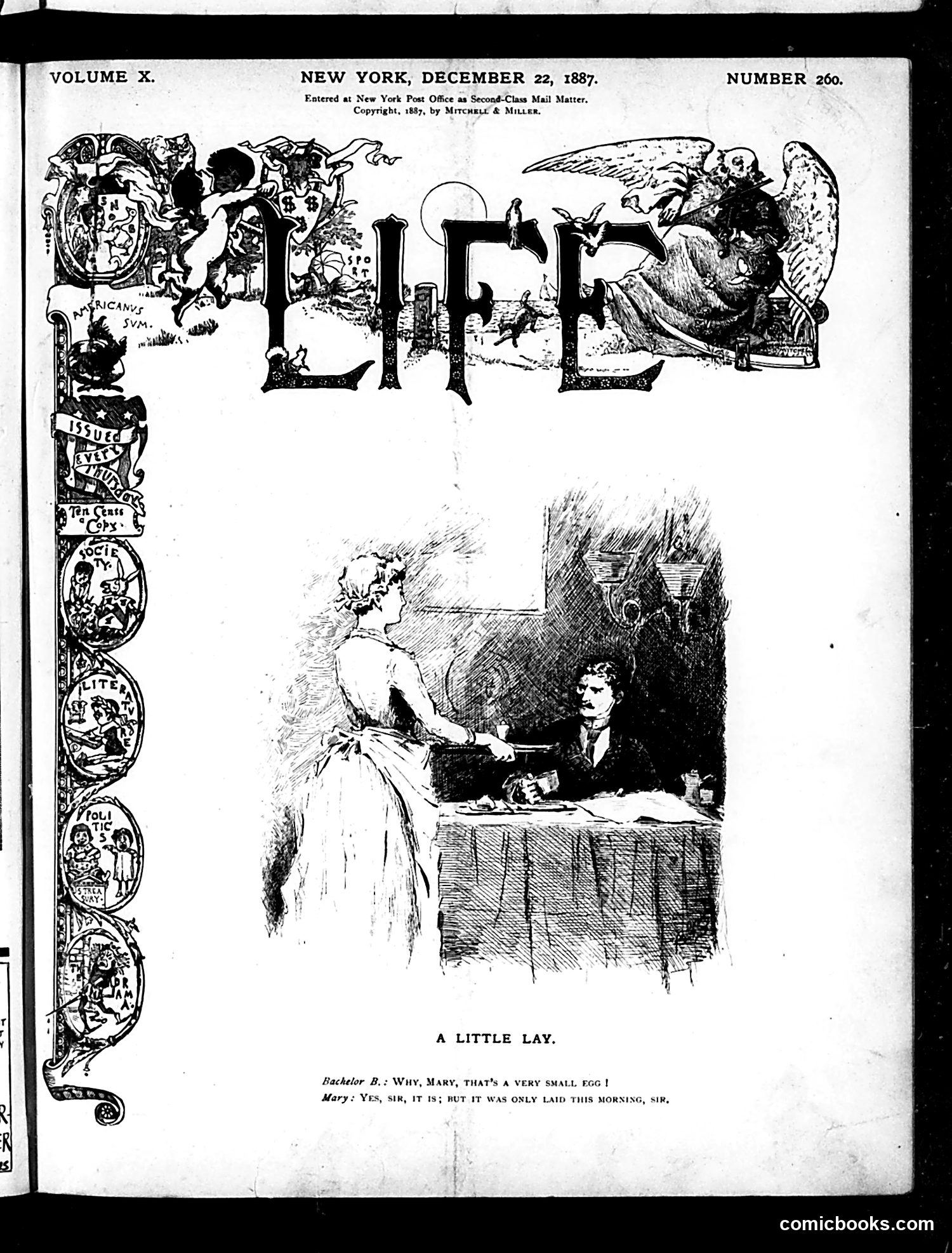
This is a simple visual joke with no apparent political content. The cartoon shows a well-dressed man (identified as "Bachelor B.") dining with a woman. The humor relies on a double meaning of the word "lay"—referring both to eggs and to an illicit romantic encounter. The joke: Bachelor B. comments that the egg before him is very small. Mary (likely a servant) responds that the egg was laid that very morning. The implication is that Bachelor B. is making an inappropriate innuendo, mistakenly treating "lay" as a euphemism when Mary is simply answering literally about the egg's recent origin. This represents Victorian-era humor based on misunderstanding and double meanings rather than overt satire.
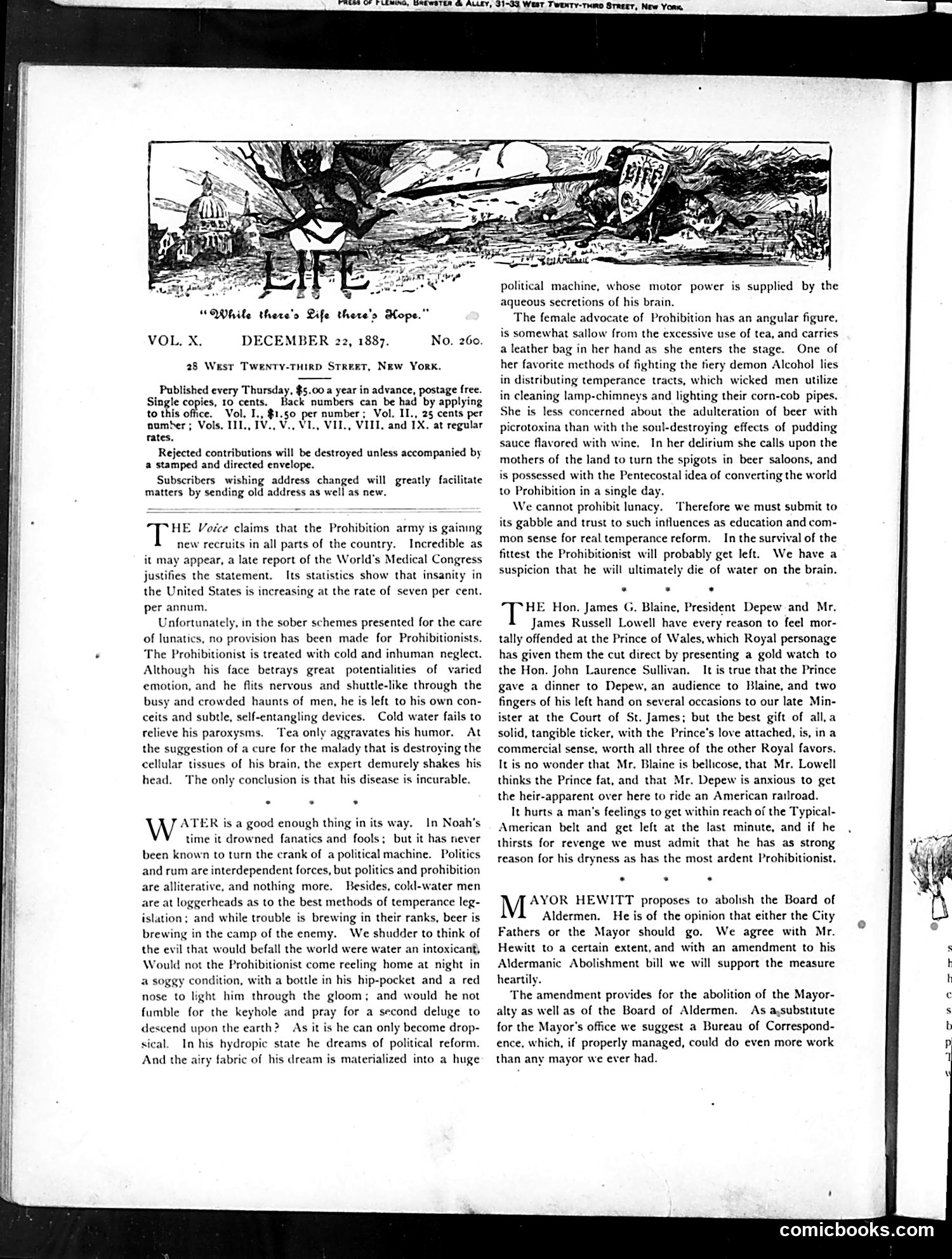
The cartoon depicts a nightmarish landscape labeled "While there's Life there's Hope," satirizing the Prohibition movement. The accompanying text mocks Prohibitionists as mentally unbalanced—describing their "angular figure," obsessive use of temperance tracts, and fixation on "converting the world to Prohibition in a single day." The satire argues that Prohibition advocates lack practical sense and will ultimately fail ("die of water on the brain"). The piece also criticizes their neglect of actual social problems facing the poor. A secondary item discusses the Prince of Wales's offense at receiving a gold watch from James Russell Lowell, framing the gift as commercially tasteless despite its royal attachment—a jab at American commercialism and social pretension.
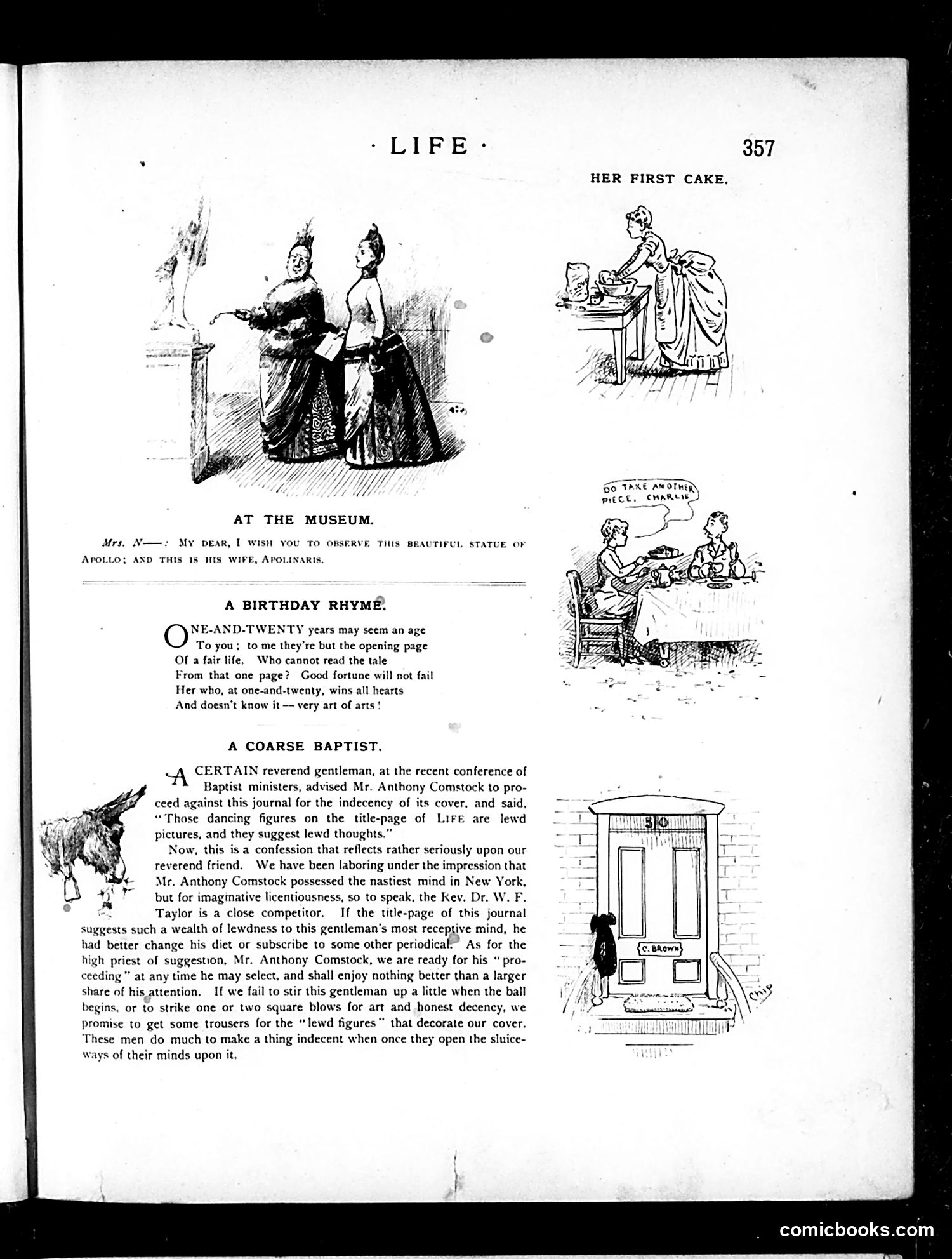
This page contains three distinct satirical pieces: **"At the Museum"** mocks affected upper-class women displaying pretentious cultural knowledge at art exhibitions, a common target of 1880s-90s satire about conspicuous consumption and false sophistication. **"A Birthday Rhyme"** celebrates turning 21 as life's opening chapter, presenting a sentimental verse about youth and opportunity. **"A Coarse Baptist"** satirizes a reverend who complained about Life's "lewd" title-page illustrations as indecent. The editors defend their artistic choices while mockingly suggesting the reverend's objections reveal his own unseemly imagination. This appears to reference Rev. Dr. W.F. Taylor, mentioned as a "close competitor" in moral sensitivity—part of broader 1880s-90s debates over acceptable content in popular magazines. The humor derives from attacking religious censorship as prudish hypocrisy.
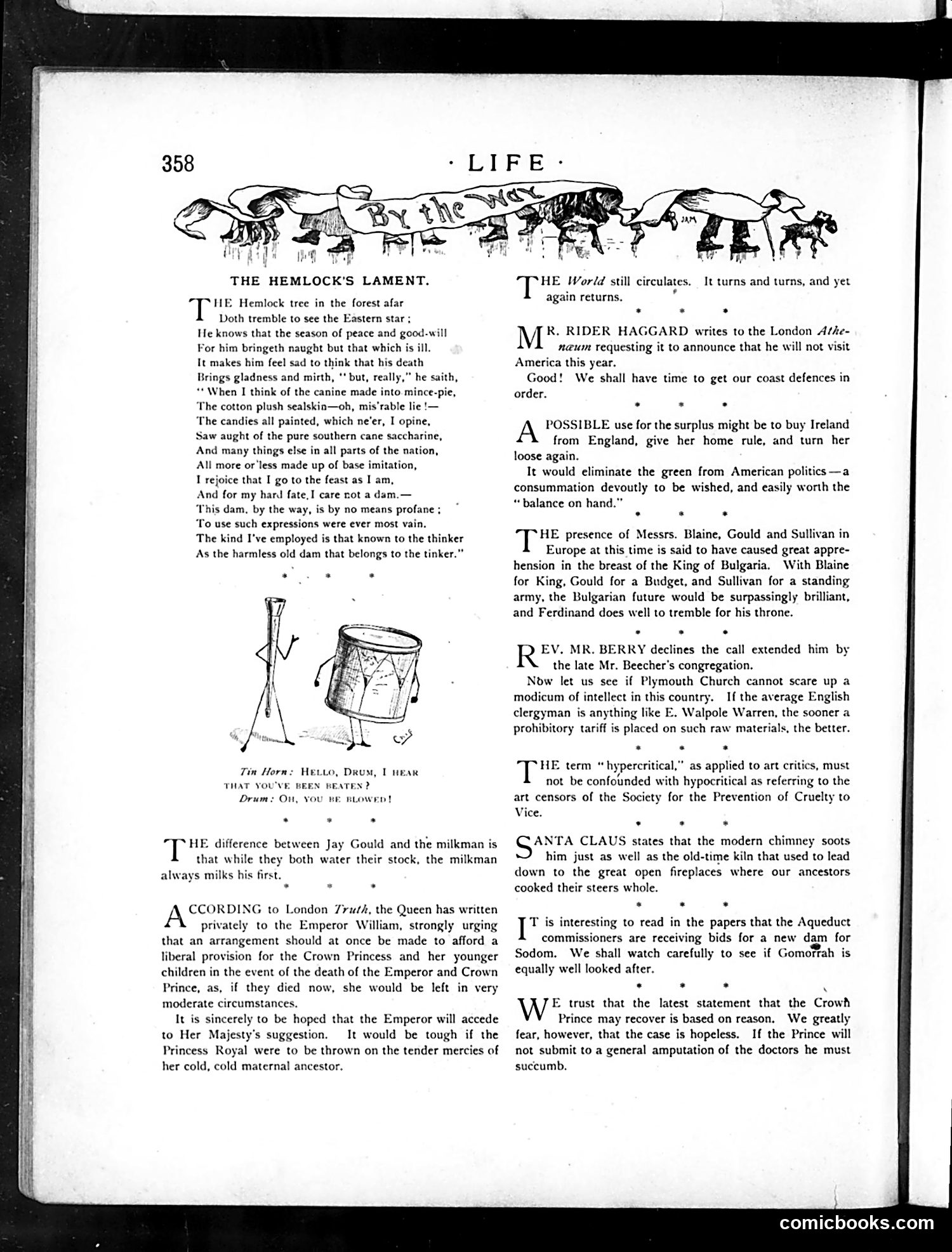
This page contains brief satirical commentary and a small cartoon rather than a major political cartoon. The cartoon shows a tin horn and drum with the caption "Tin Horn: Hello, Drum, I hear you've been beaten? Drum: Oh, you've bloomed!"—a visual pun on percussion instruments being struck. The text sections are short editorial quips addressing various topics: Mr. Rider Haggard's travel plans, Irish land reform, European political figures (Blaine, Gould, Sullivan, and Bulgarian succession), church matters, art criticism terminology, chimney maintenance, and Crown Prince health concerns. The page functions as a miscellaneous humor and commentary section typical of Life's format, mixing wordplay, light social observation, and brief political references without sustained satirical focus on any single issue or figure.
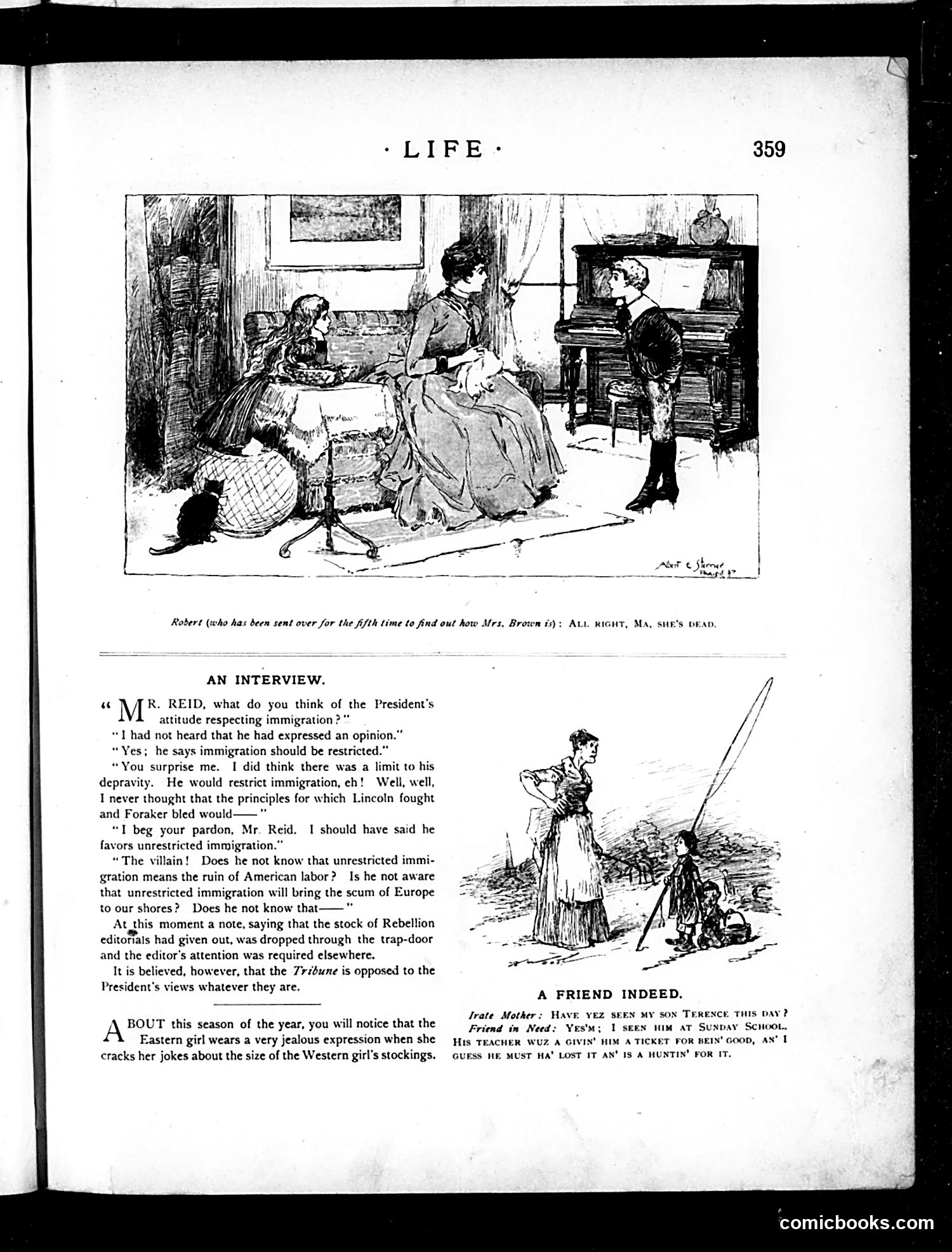
**Top Illustration:** Shows a domestic scene where Robert (seeking Mrs. Brown for the fifth time) is told "All right, Ma, she's dead." This appears to be a serial comic strip joke about a persistent suitor's repeated, unsuccessful visits. **"An Interview" Section:** Features Mr. Reid discussing the President's immigration policy. Reid argues against unrestricted immigration, claiming it ruins American labor and brings "the scum of Europe." The *Tribune* (mentioned in the text) opposes the President's views on immigration. This reflects early 20th-century political debate over immigration restriction versus open borders. **"A Friend Indeed":** A brief joke about a boy named Terence losing a hunting ticket at school. The page primarily satirizes immigration policy debates of its era.
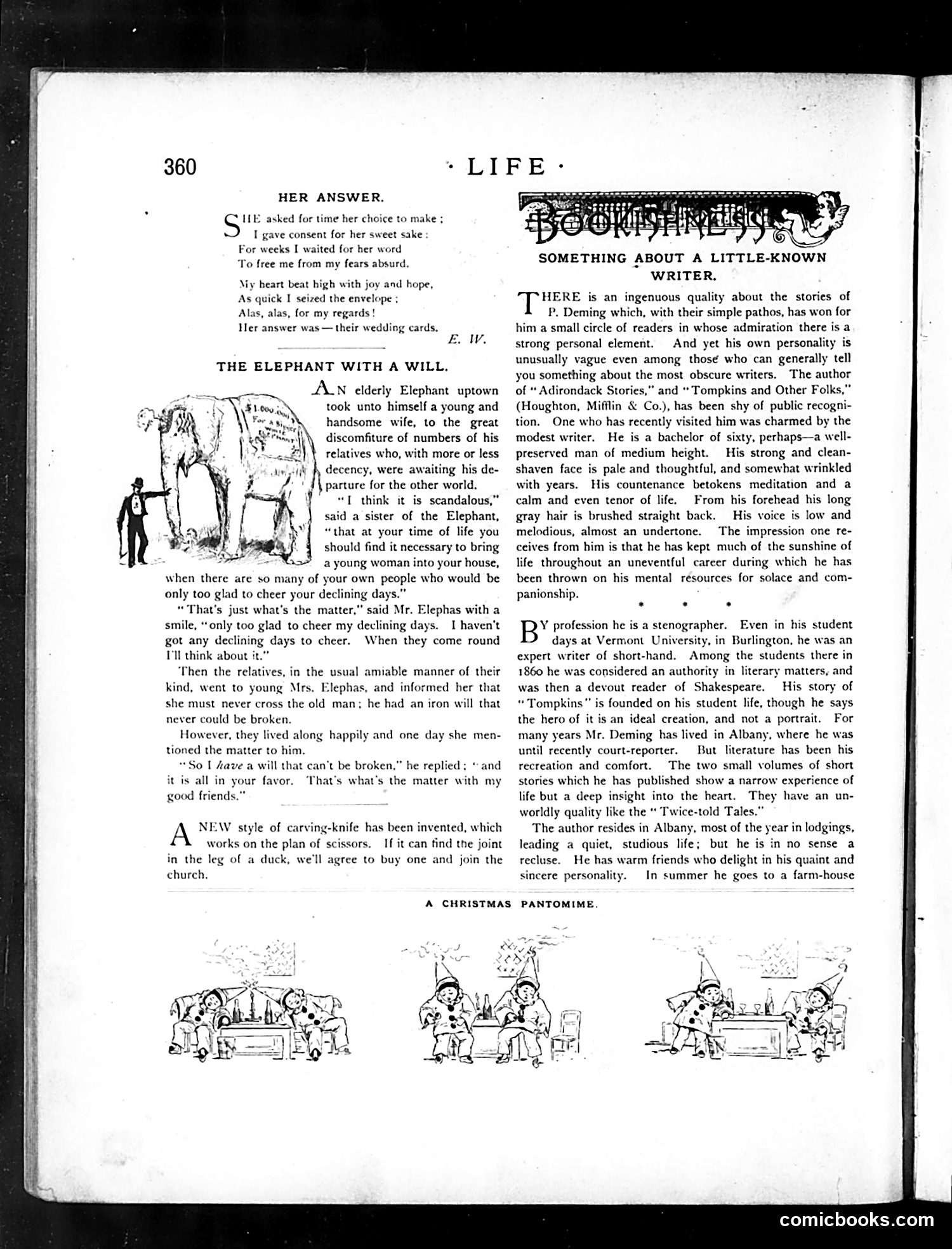
This page contains three distinct pieces: 1. **"Her Answer"** - A romantic poem about a woman consenting to marriage, written in the sentimental style common to the era. 2. **"The Elephant with a Will"** - A fable about an elderly elephant who refuses to bring a young woman into his household despite family pressure. The joke turns on wordplay: he declares he has "a will that can't be broken" and prefers keeping "good friends" over obliging relatives. This satirizes family meddling in marriage and romantic decisions. 3. **"Something About a Little-Known Writer"** - A biographical sketch of author P. Deming, praising his literary merit and describing his modest lifestyle in Albany. 4. **"A Christmas Pantomime"** - Three small illustrations depicting domestic Christmas scenes (unclear specific reference). The page mixes sentimental romance, domestic satire, and literary appreciation—typical *Life* magazine content emphasizing urbane humor about social conventions.
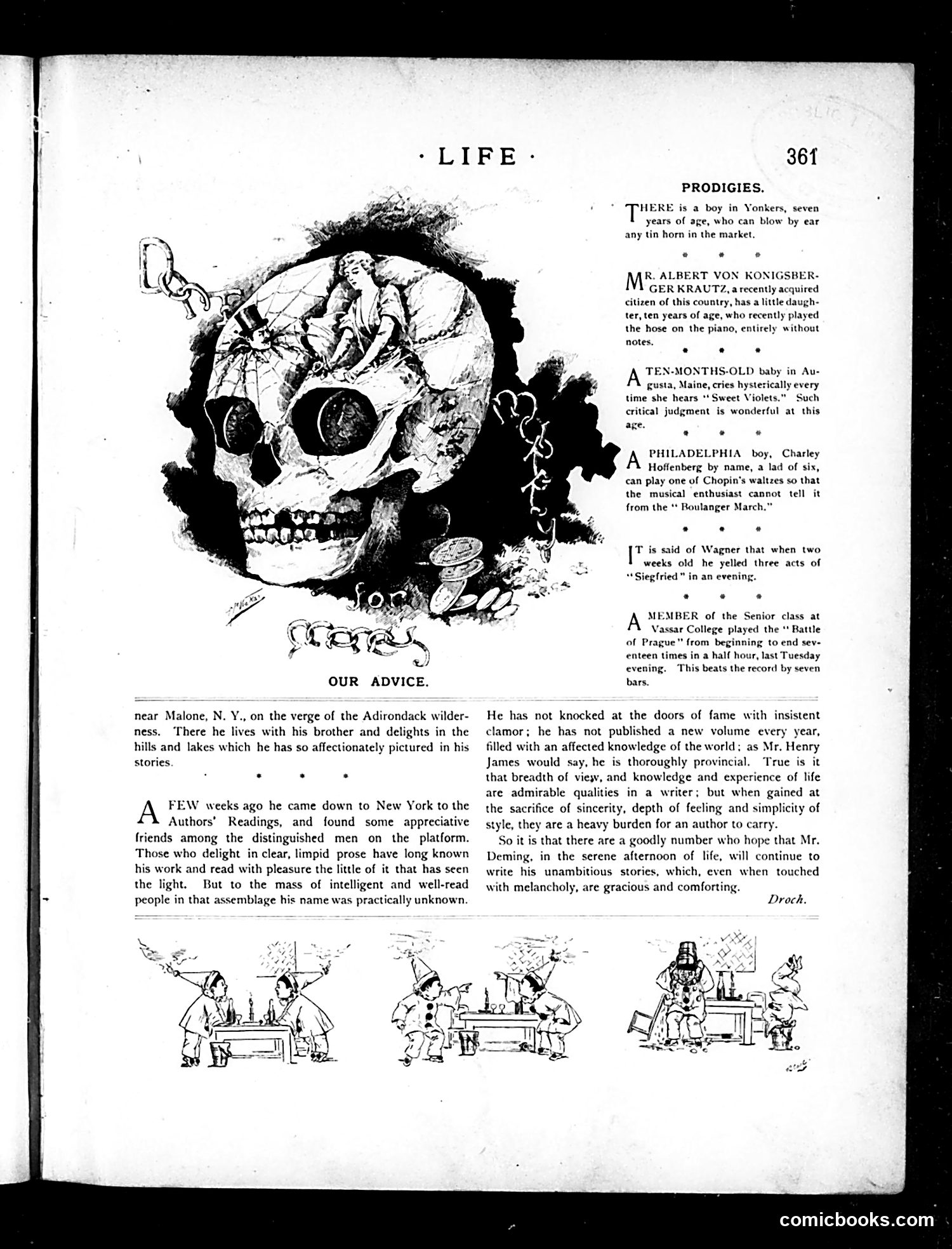
**Main Content: "Our Advice"** This section discusses Mr. Deming, an author who lives near Malone, New York. The text praises his modest approach to writing—he hasn't aggressively pursued fame or published frequently. Instead, he writes "unambitious stories, which, even when touched with melancholy, are gracious and comforting." The piece encourages Deming to continue writing despite his lack of prominence. **"Prodigies" Section** Brief anecdotes celebrate child prodigies, including a seven-year-old who can blow by ear, a pianist who plays without sheet music, and others demonstrating precocious musical talent. **Visual Elements** The skull illustration and small cartoons at bottom appear decorative rather than satirical. The skull's artistic style suggests early 20th-century aesthetic design.
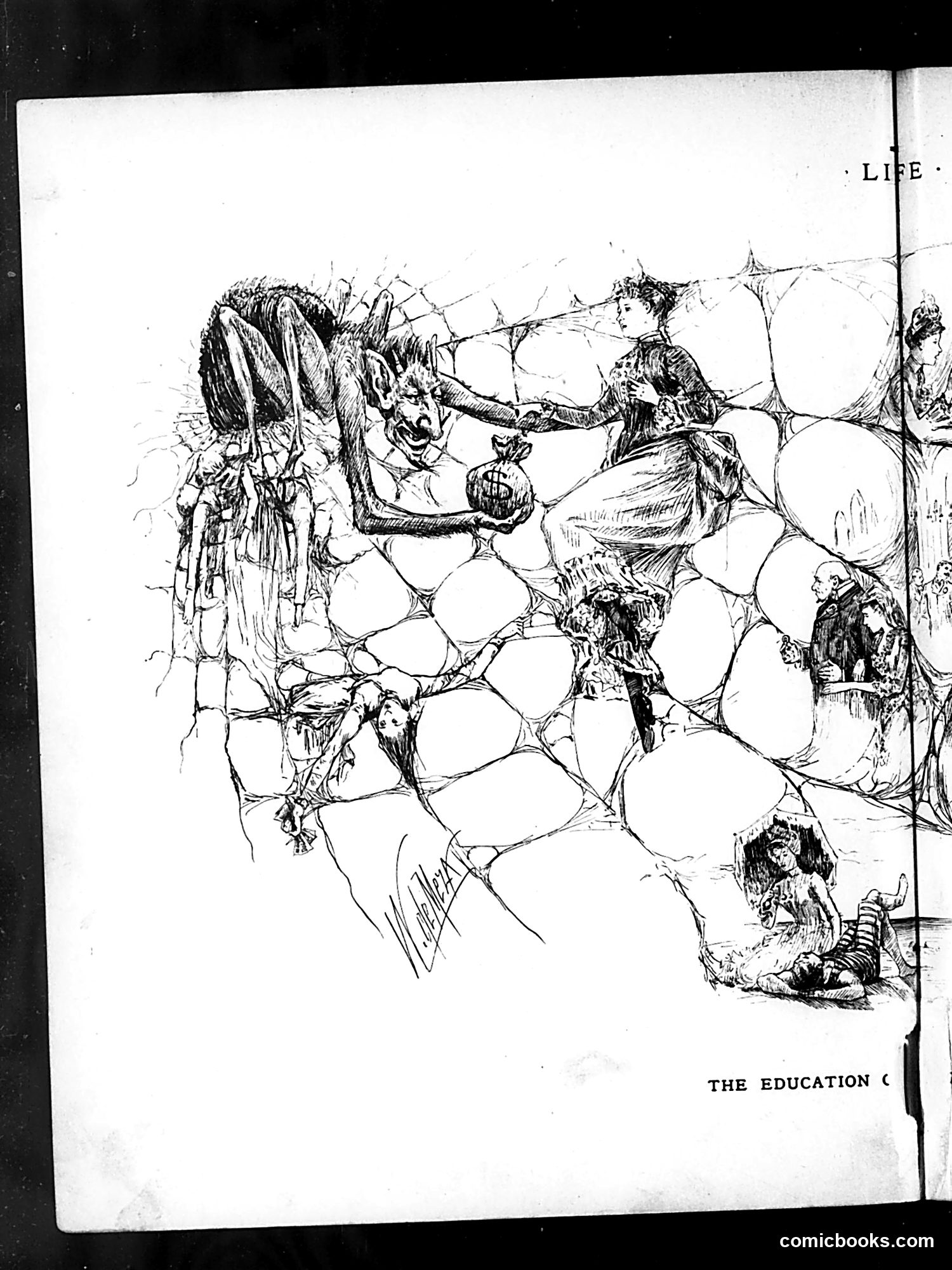
This appears to be a satirical illustration from Life magazine showing what looks like a giant spider or insect-like creature interacting with several human figures of varying sizes. The figures seem to be in different social positions—some appear to be well-dressed adults, while others appear smaller or in subordinate positions. The title fragment "THE EDUCATION O[F]" (text cut off) suggests this cartoon satirizes some form of instruction or socialization process. The spider/creature likely represents either a corrupting influence, a powerful institution, or a manipulative force "educating" these figures hierarchically. Without the complete title and caption, the specific political or social target remains unclear, though the composition suggests commentary on class dynamics, institutional power, or social conditioning.
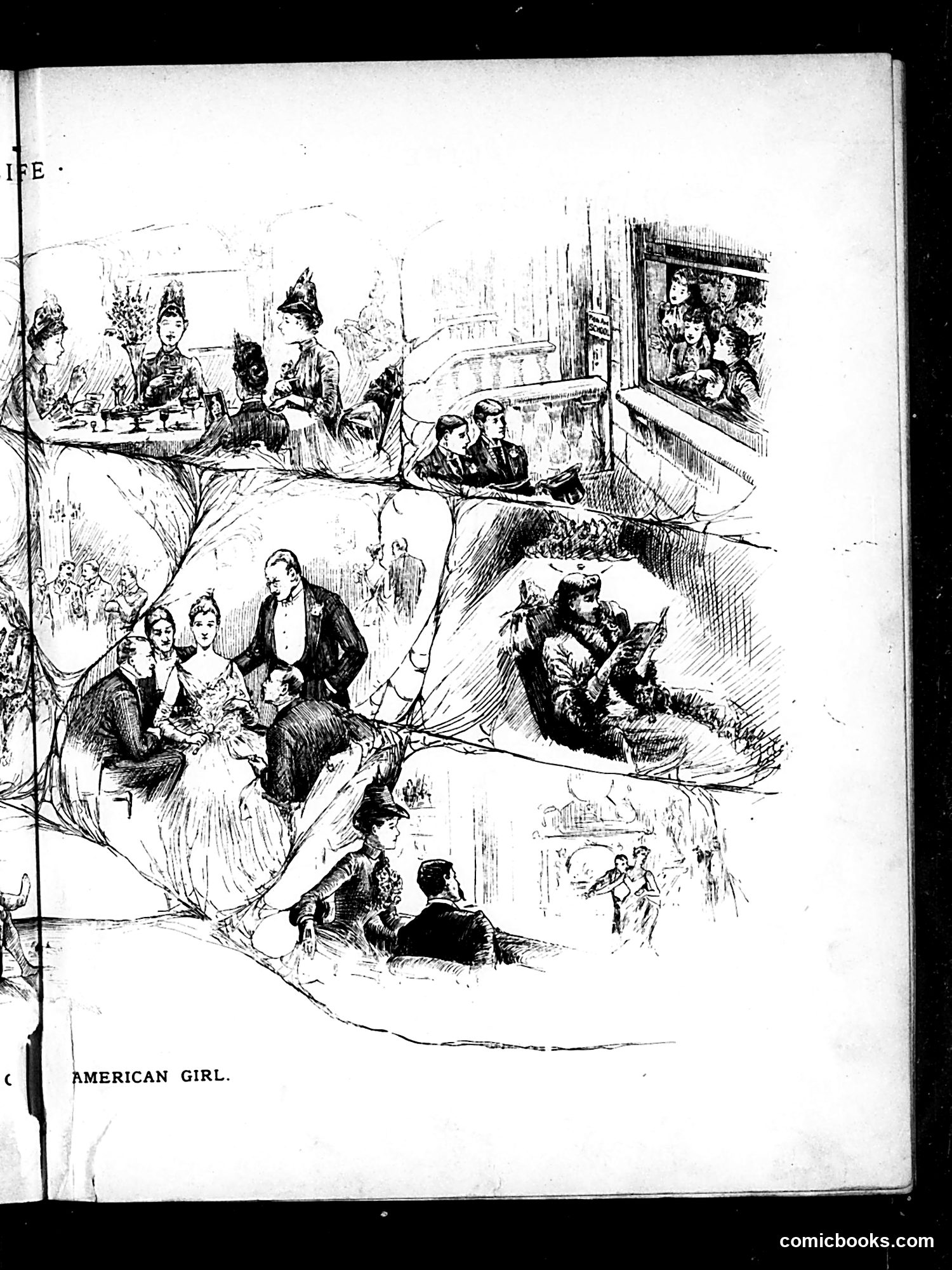
This illustration depicts various scenes of American social life, likely from the late 19th or early 20th century. The cartoon showcases different vignettes of young women in fashionable dress engaging in leisure activities—dining, socializing, and enjoying outdoor recreation in what appears to be parks or gardens. The title "American Girl" suggests this is satirizing contemporary American femininity and social customs. The multiple scenes likely contrast or comment on different social classes or types of American women. The detailed fashion and social settings indicate satire about American social pretensions, leisure culture, or changing women's roles in society during this era. Without additional context or caption text, the specific satirical targets remain unclear, though the composition suggests commentary on American social life and gender.
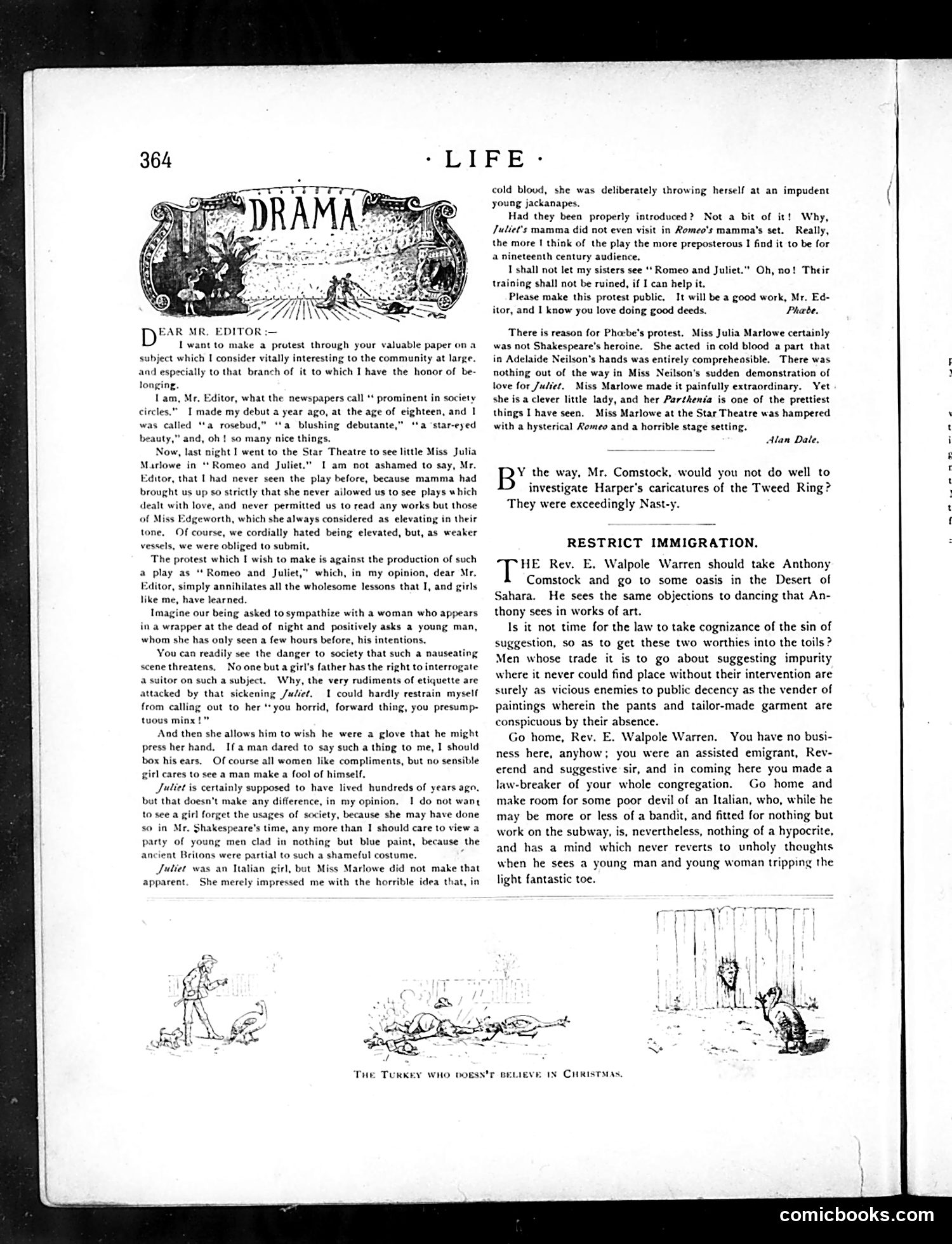
This page contains a **"Drama" section** with reader letters critiquing theatrical productions. The main letter protests a production of "Romeo and Juliet" featuring child actress Miss Julia Marlowe, arguing the play is inappropriately adult and that her mother failed in supervision by allowing such roles. A response defends Marlowe's performance as impressive and age-appropriate. The page also includes an unrelated editorial titled **"Restrict Immigration,"** attacking Rev. E. Walpole Warren for opposing dancing and theatrical art as sinful, sarcastically suggesting he belongs in the Sahara Desert instead. At the bottom is a **cartoon** showing "The Turkey Who Doesn't Believe in Christmas"—a visual pun about skepticism. The page reflects late-19th-century American debates over theatrical propriety and immigrant values.
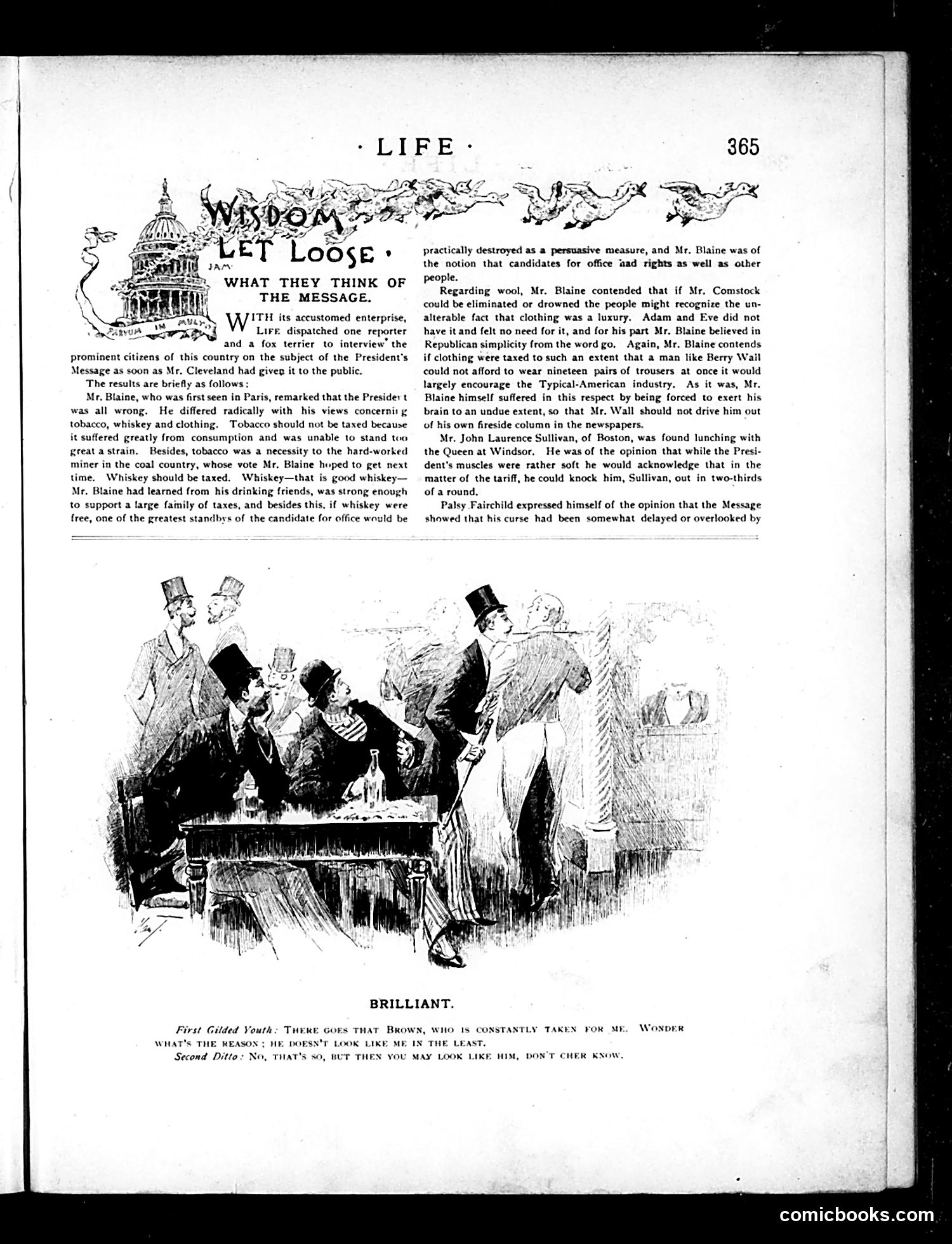
This page satirizes prominent figures' reactions to President Cleveland's tariff message. The main text mocks James G. Blaine (Republican politician), who opposes Cleveland's proposed taxes on tobacco, whiskey, and wool. The satire highlights Blaine's self-interested hypocrisy: he argues tobacco shouldn't be taxed because miners need it (and their votes), yet contradictorily supports taxing whiskey for revenue—despite personally benefiting from untaxed alcohol. References to "Berry Wall" (a wealthy man famous for excessive clothing) and boxer John L. Sullivan (humorously reported dining with the Queen) ridicule wealthy elites who'd suffer minimal tax impact. The bottom cartoon joke is simpler: two gilded youths discuss being confused for one another despite looking nothing alike—poking fun at vapid wealthy young men. The overall message: politicians and the rich prioritize personal gain over consistent principle when debating tariffs.
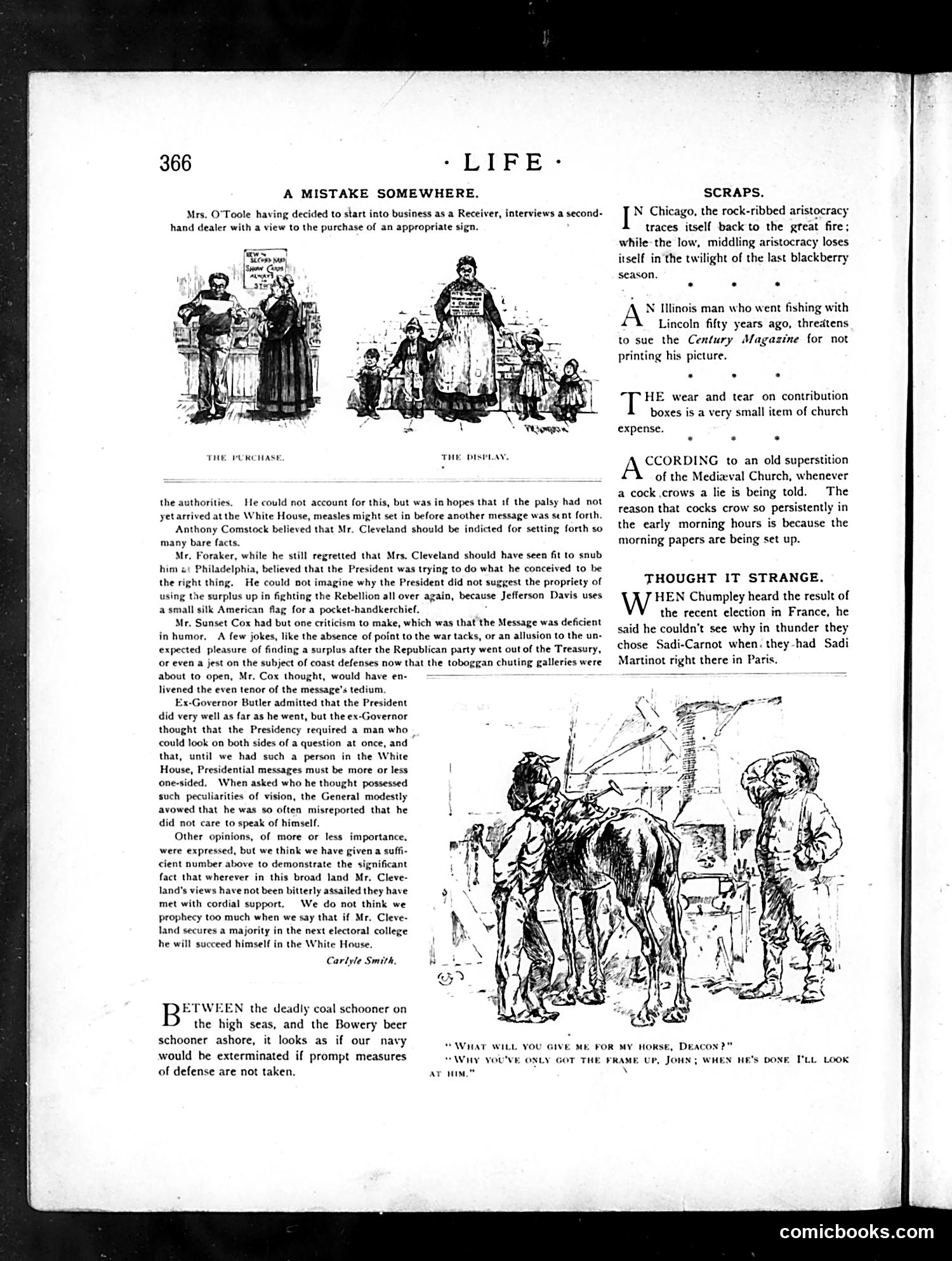
The main cartoon depicts Mrs. O'Toole, an Irish immigrant woman, purchasing a sign for her new business as a "Receiver" (likely a debt collector or bankruptcy administrator). The satire lies in the visual joke: she's buying a sign meant for a pawn shop or secondhand dealer, which is inappropriate for her actual profession—suggesting her unfamiliarity with American business conventions or the dealer's incompetence. The accompanying text consists of political commentary mocking President Cleveland's recent message to Congress. Various political figures (Comstock, Foraker, "Sunset" Cox, ex-Governor Butler) offer contradictory criticisms—some want more facts, others want jokes; some praise him, others say he's one-sided. The satire targets how politicians universally applaud or attack the same action depending on their perspective, while the final quip suggests Cleveland will win reelection regardless of this posturing. The "Scraps" section offers unrelated social humor about Chicago aristocracy and lying roosters.
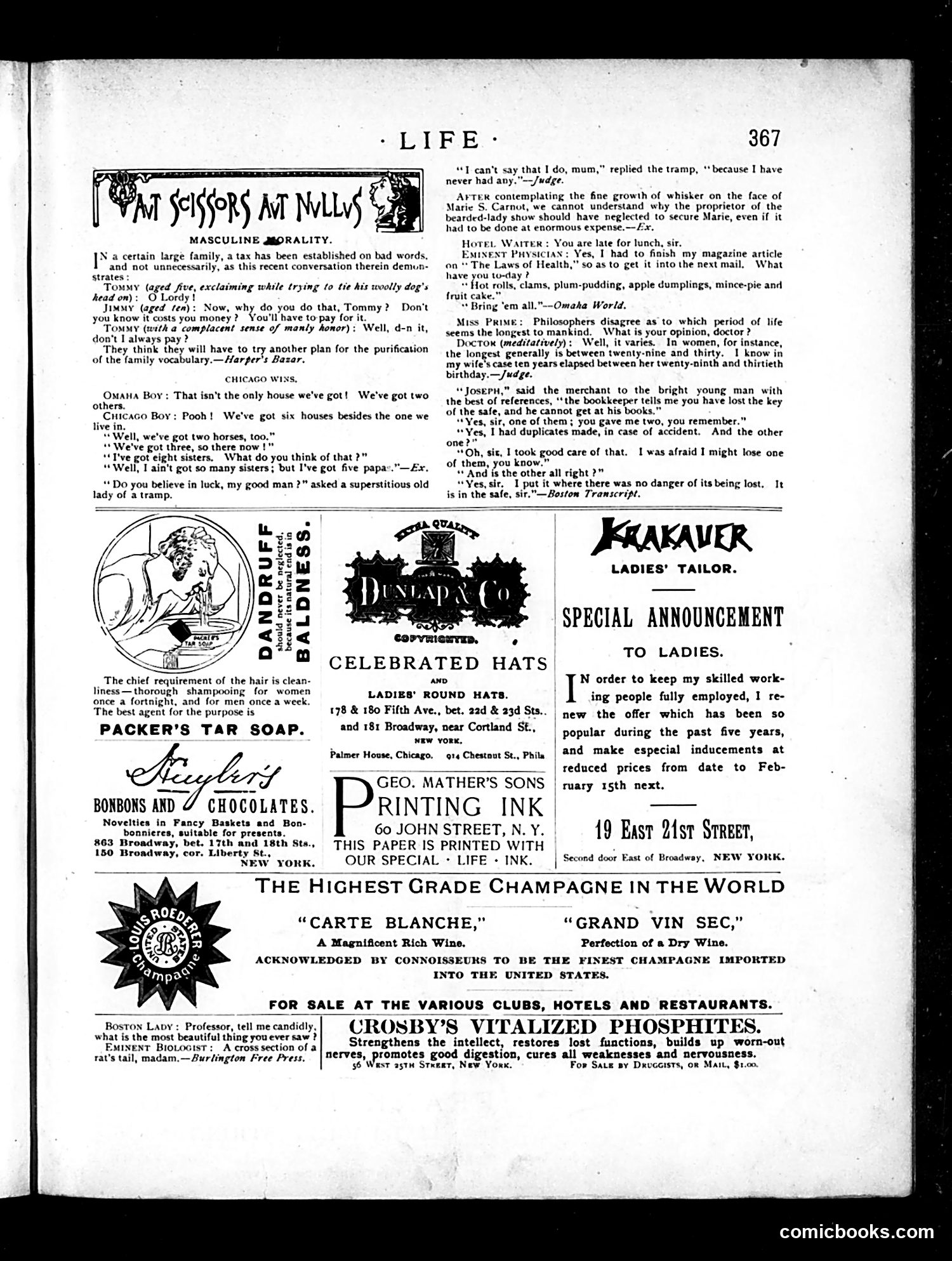
This page contains several brief comic anecdotes satirizing Victorian-era social pretensions and male behavior: **"Masculine Morality"** depicts a family's attempt to tax children for swearing. Five-year-old Tommy exclaims "O Lordy!" while playing, and his ten-year-old brother Jimmy reminds him it costs money. Tommy pragmatically responds he "always pays"—suggesting even young boys accept swearing as a normal masculine expense, undercutting the parents' moral reform effort. **"Chicago Wins"** shows boys boasting about possessions, with a Chicago boy ultimately triumphing by claiming "five papas"—a joke about illegitimacy or infidelity that would have scandalized contemporary readers. Other brief jokes mock physicians (one ironically writes about health while eating poorly), merchants (losing safe keys), and superstition. The satire targets middle-class Victorian moralism and masculine bravado as inherently hypocritical and futile. The page is otherwise dominated by period advertisements for soap, chocolates, and tailoring services.
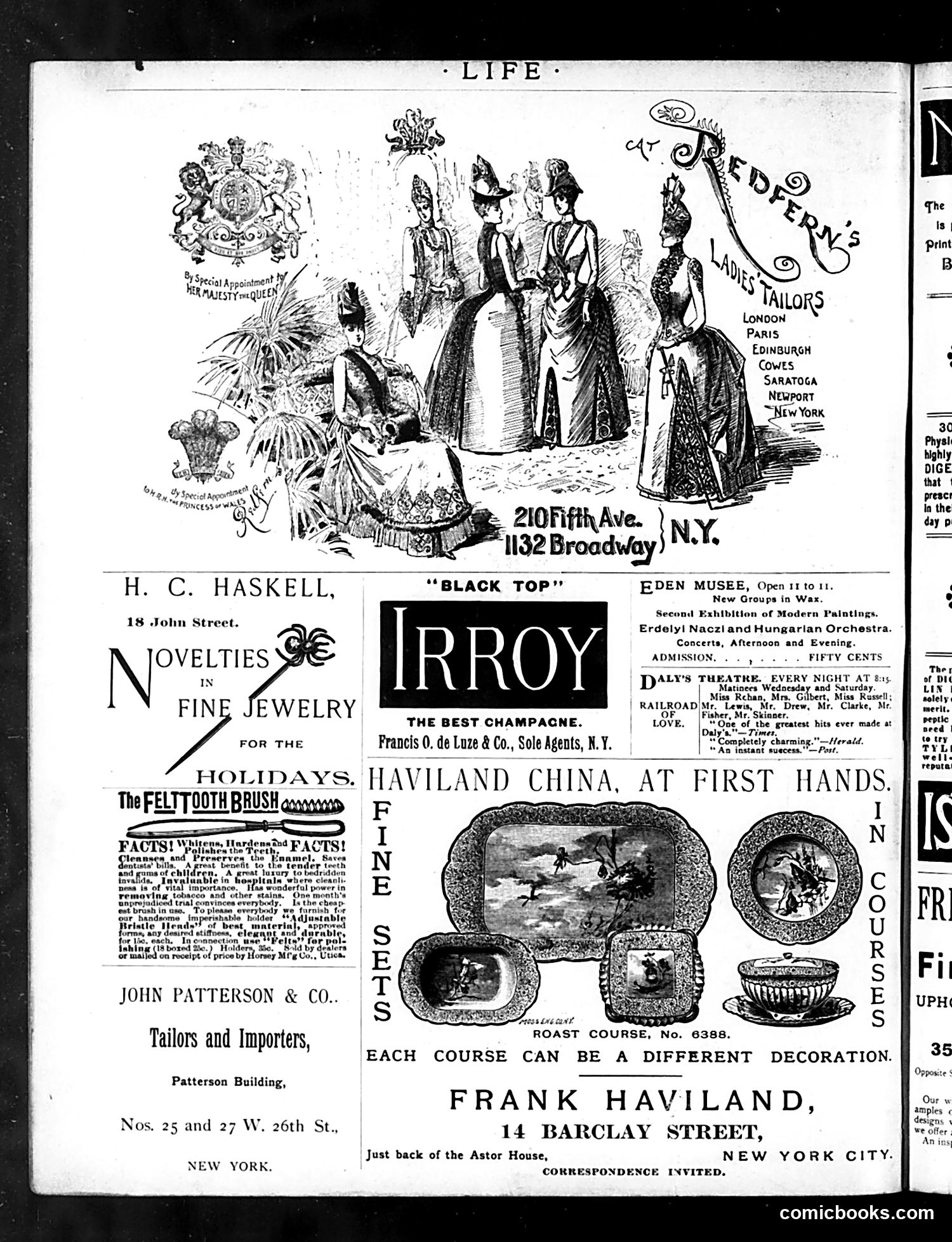
This page is primarily **advertising**, not satirical content. It's a collection of late 19th-century commercial advertisements with one decorative illustration at top. The upper illustration shows elegantly dressed women in Victorian-era clothing, promoting **Sefdern's Ladies Tailors** with locations in London, Paris, Edinburgh, and New York—advertising high-end tailoring services to wealthy women. Below are typical period advertisements: H.C. Haskell's jewelry, the Felttooth Brush (emphasizing dental health and stain removal), John Patterson & Co. tailors, champagne, theater performances at Daly's Theatre, and notably **Haviland China**—fine porcelain dinnerware displayed with images of decorative plates and serving dishes, highlighting that customers could purchase directly from the importer at "first hands" rather than through middlemen. The page reflects Gilded Age consumer culture targeting affluent New Yorkers seeking luxury goods, fashionable clothing, and refined home furnishings.
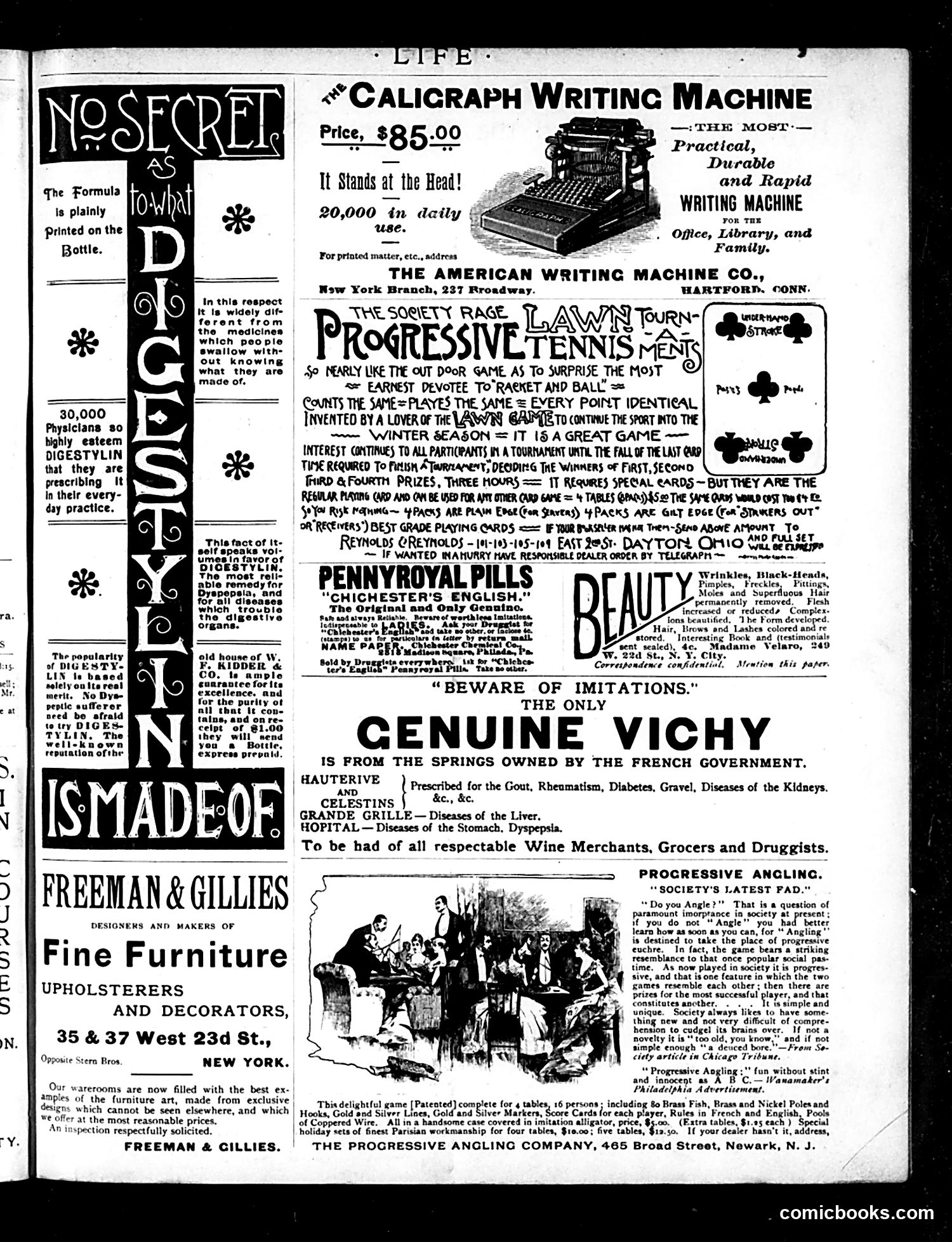
This page is primarily **advertising**, with one notable satirical cartoon about a parlor game. ## Main Content: "Progressive Angling" The large illustrated cartoon depicts an indoor lawn tennis variant called "Progressive Angling"—a society game designed to extend outdoor recreation indoors during winter. The satire mocks upper-class leisure pursuits: the game mimics lawn tennis precisely ("counts the same, plays the same, every point identical"), yet absurdly requires special cards and indoor setup. The accompanying text humorously suggests that "angling" (this parlor game) will replace the card game euchre as society's preferred entertainment, satirizing how wealthy Americans adopt new fashions and games without meaningful substance. ## Advertisements The page also features ads for the **Caligraph Writing Machine** ($85), **No Secret Digestylin** (a digestive aid), **Pennyroyal Pills** (contraceptive/abortifacient), **Genuine Vichy** water (health remedy), **Freeman & Gillies** furniture, and other period products—typical of Life's revenue model mixing satire with commercial endorsements.
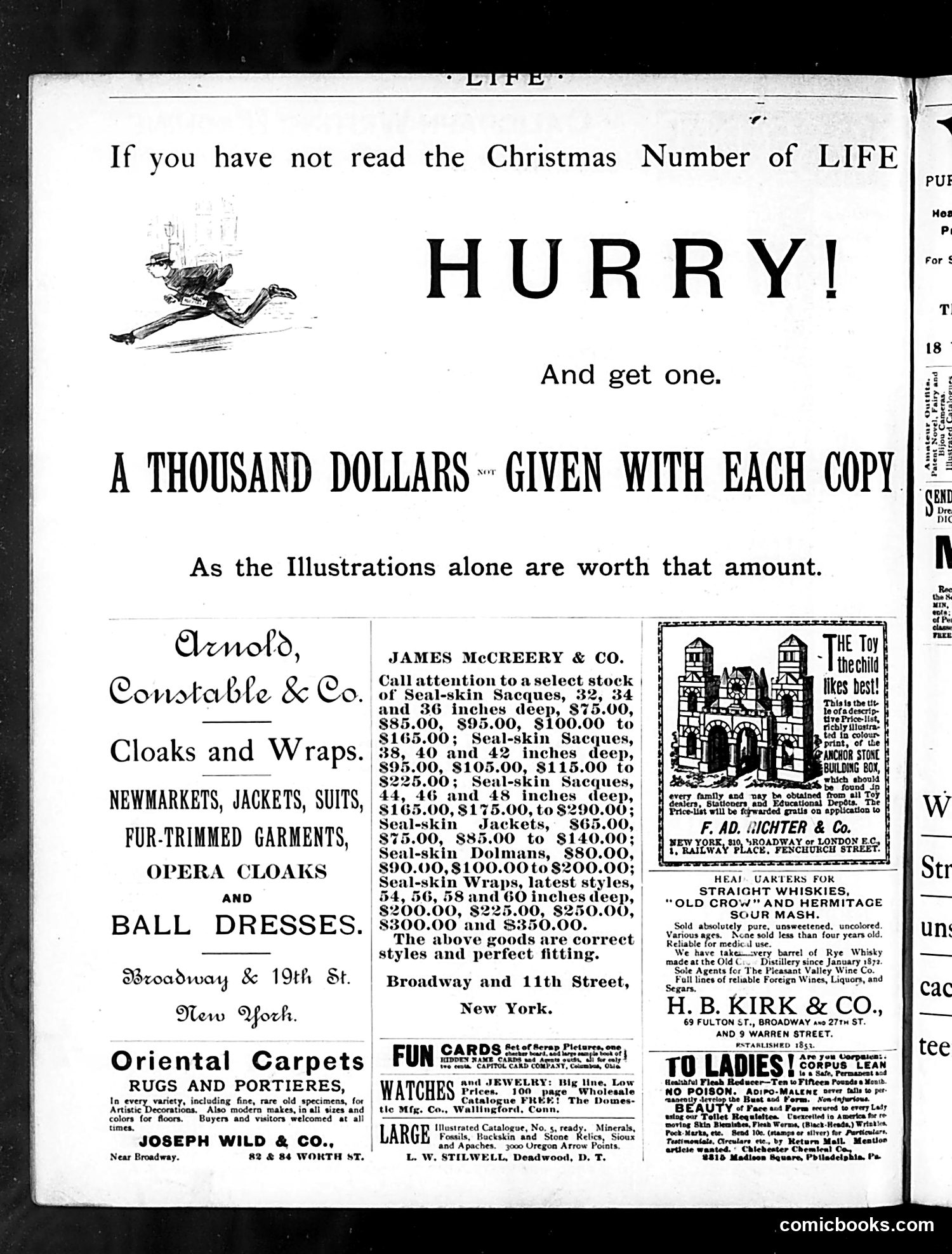
This is primarily an **advertising page**, not a political cartoon or satire. It's a promotional spread for Life's Christmas Number issue, featuring a small sketch of a running figure at the top left (likely representing the magazine's mascot or a generic holiday image). The page's central claim—"A THOUSAND DOLLARS GIVEN WITH EACH COPY"—is a promotional gimmick asserting that the illustrations alone justify this value. This appeals to readers by suggesting exceptional artistic quality. The bulk of the page consists of department store and product advertisements typical of late 19th-century American publications: luxury goods (seal-skin cloaks, fur-trimmed garments), carpets, jewelry, watches, and various patent medicines and beauty products. The advertisements reflect the affluent readership Life targeted and the consumer culture of the Gilded Age. There is **no discernible political or social satire** on this particular page—it's straightforward commercial advertising designed to fund the magazine.
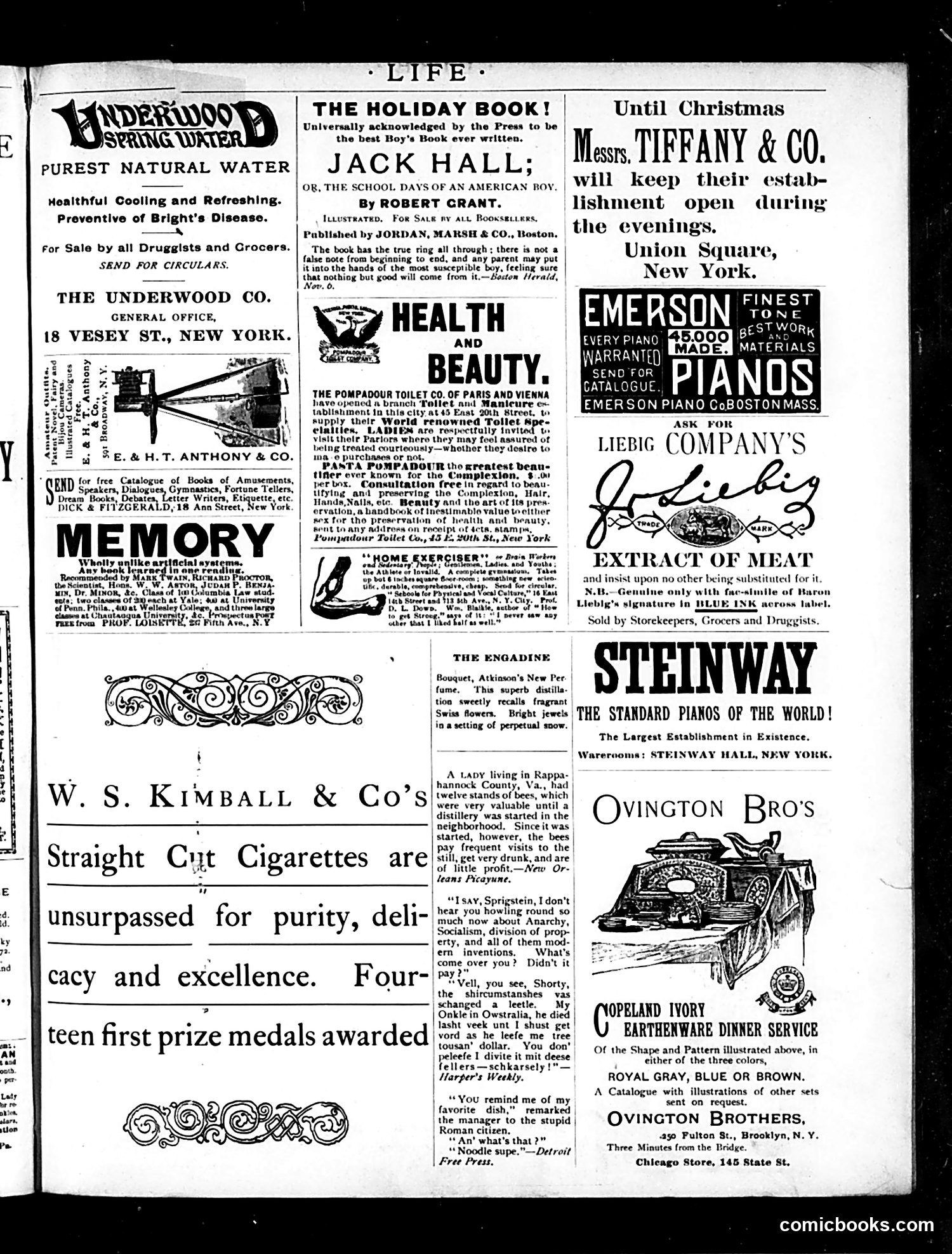
This is a Life magazine page dominated by commercial advertisements rather than editorial content or political cartoons. The ads promote products like Underwood Spring Water, Emerson Pianos, Steinway Pianos, Liebig's Extract of Meat, and W.S. Kimball & Co. cigarettes. The only satirical content appears to be brief humorous anecdotes scattered among ads—including a joke about an Australian uncle's bees getting drunk at a distillery, and ethnic dialect humor featuring "Shorty" and "Sprigstein" discussing socialism and inheritance. These reflect period stereotyping common to late-19th/early-20th-century Life magazine humor. The page also advertises holiday gift books, including "Jack Hall," promoted as an exemplary boy's book by Robert Grant. Overall, this represents a typical Life magazine page: commercial announcements interspersed with light comic bits rather than sustained political satire.
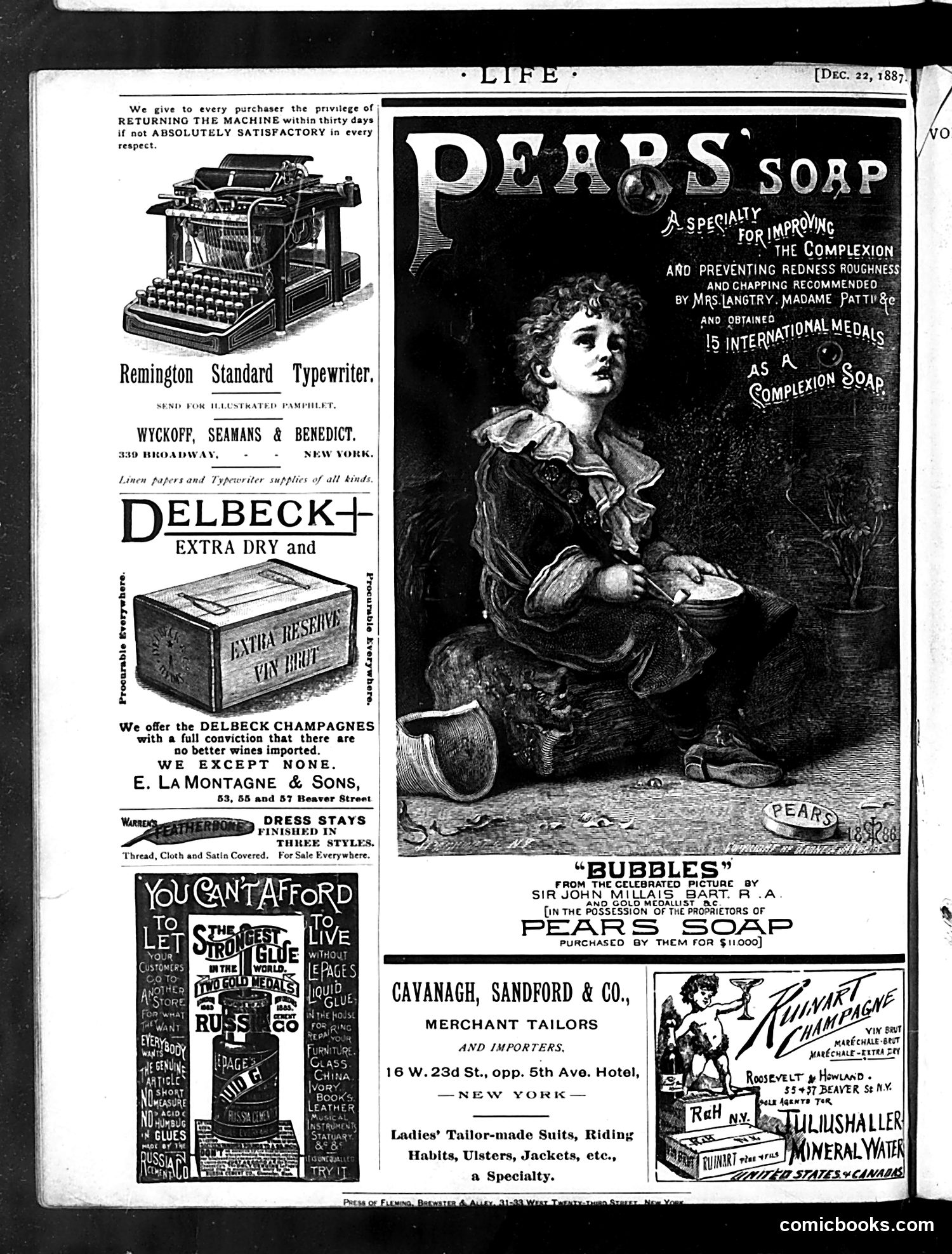
This is primarily a **advertising page** from Life magazine (December 22, 1883), not a political cartoon. It contains multiple product advertisements typical of the era: **Notable ads include:** - **Remington Standard Typewriter** - a new technology being marketed with a satisfaction guarantee - **Pears' Soap** - featuring a famous painting "Bubbles" by Sir John Millais (purchased for $11,000), endorsed by actress Mrs. Langtry, a celebrity of the period - **Delbeck Champagne** - positioning itself as superior imported wine - **Cavanagh, Sandford & Co.** - merchant tailors offering ladies' custom clothing - **Runkel's Cocoa** - a beverage product The page reflects **late 19th-century consumer culture**: manufacturers were beginning to use celebrity endorsements, famous artwork, and aggressive marketing claims. The typewriter's 30-day return policy represents early consumer protection marketing, while the high price paid for the Millais painting ($11,000) demonstrates how brands leveraged fine art for prestige.