
Life, 1887-12-22 · page 10 of 18
Life — December 22, 1887 — page 10: what you’re looking at
What you’re looking at
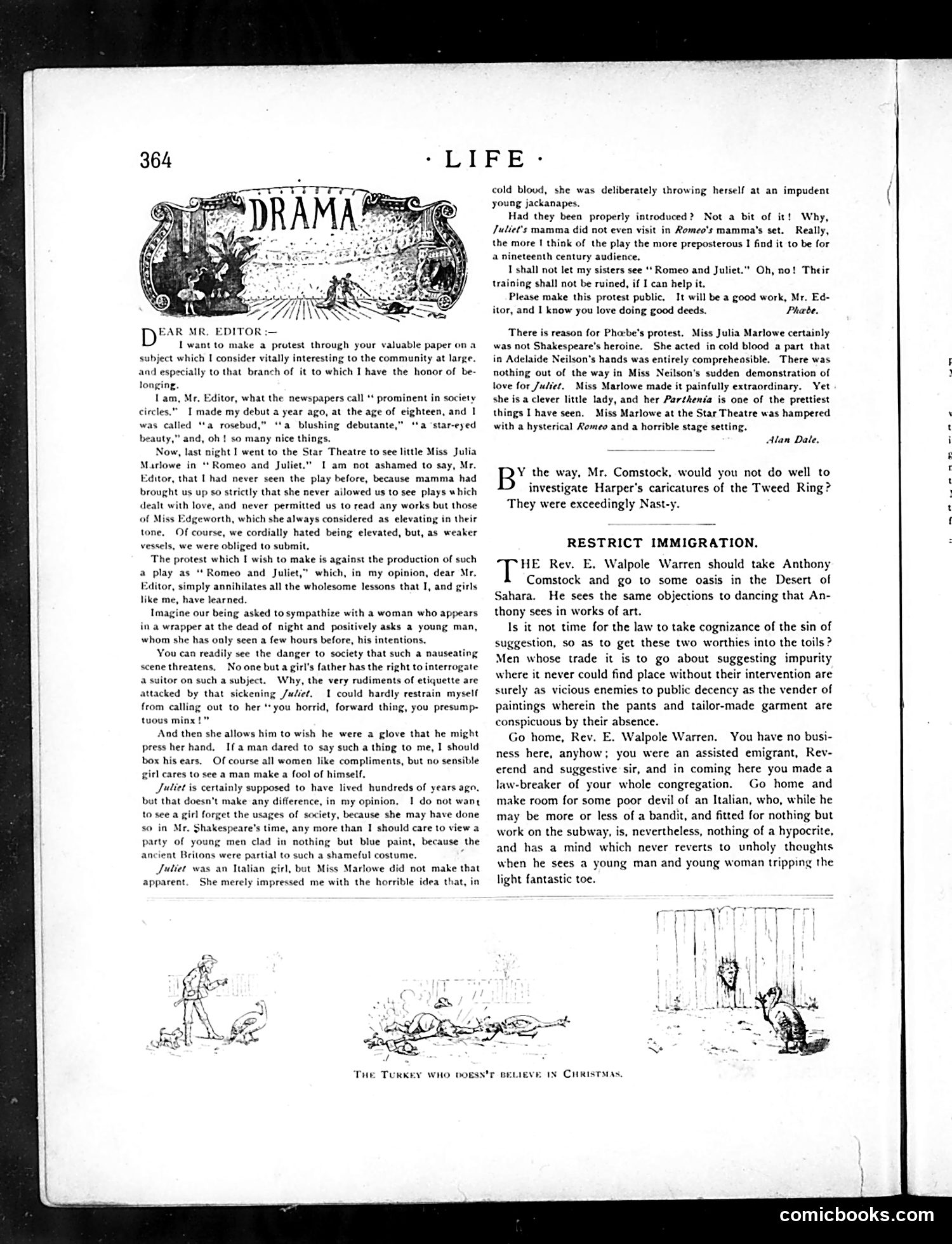
This page contains a **"Drama" section** with reader letters critiquing theatrical productions. The main letter protests a production of "Romeo and Juliet" featuring child actress Miss Julia Marlowe, arguing the play is inappropriately adult and that her mother failed in supervision by allowing such roles. A response defends Marlowe's performance as impressive and age-appropriate. The page also includes an unrelated editorial titled **"Restrict Immigration,"** attacking Rev. E. Walpole Warren for opposing dancing and theatrical art as sinful, sarcastically suggesting he belongs in the Sahara Desert instead. At the bottom is a **cartoon** showing "The Turkey Who Doesn't Believe in Christmas"—a visual pun about skepticism. The page reflects late-19th-century American debates over theatrical propriety and immigrant values.
📄 Transcribed text from this page (OCR, searchable)
Machine-transcribed from the original scan — historical spelling and the odd misread are preserved.
*~LIFE- EAR MR, EDITOR :— I want to make a protest through your valuable paper on a subject which I consider vitally interesting to the community at large. and especially to that branch of it to which I have the honor of be- longing. Lam, Mr. Editor, what the newspapers call ** prominent in society circtes." I made my debut a year ago, at the age of eighteen, and I was called “a rosebud,” ‘a blushing debutante,” ‘a ‘star-eyed beauty,” and, oh ! so many nice things. Now, last night I went to the Star Theatre to see little Miss Julia Marlowe in “Romeo and Juliet." I am not ashamed to say, Mr. Editor, that I had never seen the play before, because mamma had brought us up so strictly that she never ailowed us to see plays which dealt with love, and never permitted us to read any works but those of Miss Edgeworth, which she always considered as elevating in their tone. Of course, we cordially hated being elevated, but, as weaker vessels, we were obliged to submit, The protest which I wish to make is against the production of such a play as ‘Romeo and Juliet,” which, in my opinion, dear Mr, Editor, simply annihilates all the wholesome lessons that I, and girls like me, have learned. Imagine our being asked to sympathize with a woman who appears in a wrapper at the dead of night and positively asks a young man, whom she has only seen a few hours before, his intentions, You can readily see the danger to society that such a nauseat scene threatens. Noone buta girl's father has the right to interrogate a suitor on such a subject. Why, the very rudiments of etiquette are attacked by that sickening /u/iet. 1 could hardly restrain myself from calling out to her you horrid, forward thing, you presump- tuous minx!" And then she allows him to wish he were a glove that he might press her hand. If a man dared to say such a thing to me, I should box his ears. Of course all women like compliments, but no sensible girl cares to see a man make a fool of himself. Juliet is certainly supposed to have lived hundreds of years ago, but that doesn’t make any difference, in my opinion, 1 do not want to see a girl forget the usages of society, because she may have done so in Mr. Shakespeare's time, any more than I should care to view a party of young men clad in nothing but blue paint, because the ancient Britons were partial to such a shameful costume. ‘ Jutiet was an Nalian girl, but Miss Marlowe did not make that apparent. She merely impressed me with the horrible idea that, in cold blood, she was deliberately throwing herself at an impudent young jackanapes. Had they been properly introduced? Not a bit of it! Why, Juliet’s mamma did not even visit in Romeo's mamma's set. Really, the more I think of the play the more preposterous I find it to be for a nineteenth century audience. I shall not let my sisters see * Romeo and Juliet.” Oh, no! Their training shall not be ruined, if I can help it. Please make this protest public, It will be a good work, Mr. Ed- itor, and I know you love doing good deeds. Phabe. There is reason for Phocbe's protest. Miss Julia Marlowe certainly was not Shakespeare's heroine. She acted in cold blood a part that in Adelaide Neilson’s hands was entirely compreheasible. There was nothing out of the way in Miss Neilson’s sudden demonstration of love for Juliet, Miss Marlowe made it painfully extraordinary. Yet she is a clever little lady, and her Parthenia is one of the prettiest things I have seen. Miss Marlowe at the Star Theatre was hampered with a hysterical Romeo and a horrible stage setting. Alan Dale, Y the way, Mr. Comstock, would you not do well to investigate Harper's caricatures of the Tweed Ring? They were exceedingly Nast-y. RESTRICT IMMIGRATION. HE Rev. E. Walpole Warren should take Anthony Comstock and go to some oasis in the Desert of Sahara. He sees the same objections to dancing that An- thony sees in works of art. Is it not time for the law to take cognizance of the sin of suggestion, so as to get these two worthies into the toils ? Men whose trade it is to go about suggesting impurity where it never could find place without their intervention are surely as vicious enemies to public decency as the vender of paintings wherein the pants and tailor-made garment are conspicuous by their absence. 30 home, Rev. E. Walpole Warren. You have no busi- ness here, anyhow; you were an assisted emigrant, Rev- erend and suggestive sir, and in coming here you made a law-breaker of your whole congregation. Go home and make room for some poor devil of an Italian, who, while he may be more or less of a bandit, and fitted for nothing but work on the subw: , nevertheless, nothing of a hypocrite, and has a mind which never reverts to unholy thoughts when he sees a young man and young woman tripping the light fantastic toe. THe TURKEY WHO DOESN'T BELIEVE IN CHtRIstotas. comicbooks.com