
Life, 1887-12-22 · page 6 of 18
Life — December 22, 1887 — page 6: what you’re looking at
What you’re looking at
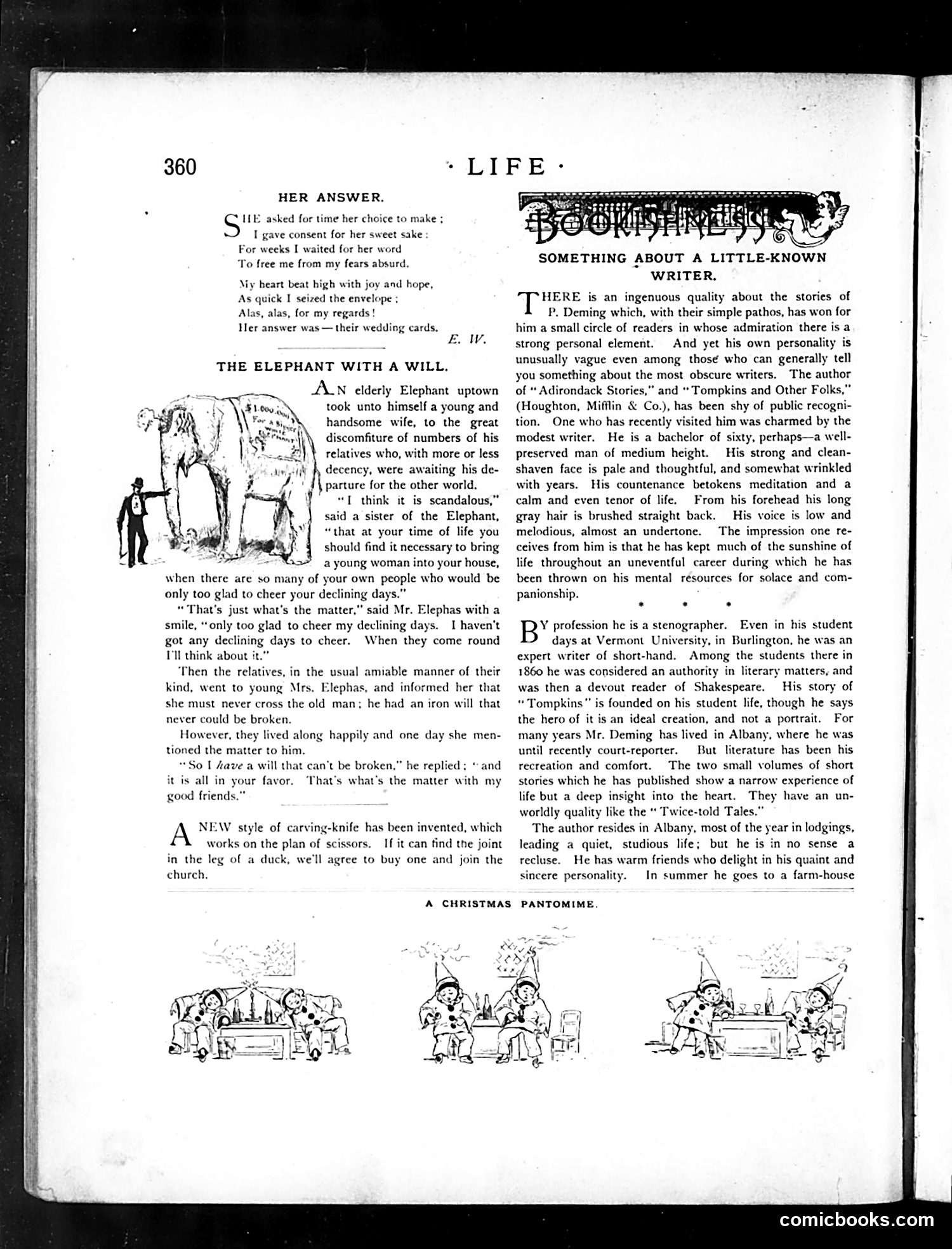
This page contains three distinct pieces: 1. **"Her Answer"** - A romantic poem about a woman consenting to marriage, written in the sentimental style common to the era. 2. **"The Elephant with a Will"** - A fable about an elderly elephant who refuses to bring a young woman into his household despite family pressure. The joke turns on wordplay: he declares he has "a will that can't be broken" and prefers keeping "good friends" over obliging relatives. This satirizes family meddling in marriage and romantic decisions. 3. **"Something About a Little-Known Writer"** - A biographical sketch of author P. Deming, praising his literary merit and describing his modest lifestyle in Albany. 4. **"A Christmas Pantomime"** - Three small illustrations depicting domestic Christmas scenes (unclear specific reference). The page mixes sentimental romance, domestic satire, and literary appreciation—typical *Life* magazine content emphasizing urbane humor about social conventions.
📄 Transcribed text from this page (OCR, searchable)
Machine-transcribed from the original scan — historical spelling and the odd misread are preserved.
es HER ANSWER. ILE asked for time her choice to make ; I gave consent for her sweet sake For weeks I waited for her word To free me from my fears absurd. Niy heart beat high with joy and hope, As quick I seized the envelope ; Alas, alas, for my regards! Her answer was— their wedding cards, . EW, THE ELEPHANT WITH A WILL. AN elderly Elephant uptown “ty \ve “ took unto himself a young and r\ : handsome wife, to the great ae, 1 discomfiture of numbers of his | relatives who, with more or less decency, were awaiting his de- j \ parture for the other world. =xf/ f° “1 think it is scandalous,” i said a sister of the Elephant, i Y “that at your time of life you yey should find it necessary to bring TAS a young woman into your house, when there are so many of your own people who would be only too glad to cheer your declining days.” 's just what's the matter,” said Mr. Elephas with a smile, “only too glad to cheer my declining days. I haven't got any declining days to cheer. When they come round I'll think about it.” Then the relatives, in the usual amiable manner of their kind, went to young Mrs, Elephas, and informed her that she must never cross the old man; he had an iron will that never could be broken. However, they lived along happily and one day she men- tioned the matter to him. “So [ Aave a will that can’t be broken,” he replied ; “and it is all in your favor. That's what's the matter with my good friends.” NEW style of carving-knife has been invented, which sors. If it can find the joint works on the plan of sc in the leg of a duck, we'll z church. gree to buy one and join the A CHRISTMAS PANTOMIME. SOMETHING ABOUT A LITTLE-KNOW WRITER, HERE is an ingenuous quality about the stories of P. Deming which, with their simple pathos, has won for him a small circle of readers in whose admiration there is a strong personal element. And yet his own personality is unusually vague even among thosé who can generally tell you something about the most obscure writers. The author of “ Adirondack Stories,” and “ Tompkins and Other Folks,” (Houghton, Mifflin & Co.), has been shy of public recogni- tion. One who has recently visited him was charmed by the modest writer. He is a bachelor of sixty, perhaps—a well- preserved man of medium height. His strong and clean- shaven face is pale and thoughtful, and somewhat wrinkled with years. His countenance betokens meditation and a calm and even tenor of life. From his forehead his long gray hair is brushed straight back. His voice is low and melodious, almost an undertone. The impression one re- ceives from him is that he has kept much of the sunshine of life throughout an uneventful career during which he has been thrown on his mental resources for solace and com- panionship. . . . Y profession he is a stenographer. Even in his student days at Vermont University, in Burlington, he was an expert writer of short-hand. Among the students there in 1860 he was considered an authority in literary matters, and was then a devout reader of Shakespeare. His story of “Tompkins” is founded on his student life, though he says the hero of it is an ideal creation, and not a portrait. For many years Mr. Deming has lived in Albany, where he was until recently court-reporter. But _ literature has been his recreation and comfort. The two small volumes of short stories which he has published show a narrow experience of life but a deep insight into the heart. They have an un- worldly quality like the * Twice-told Tales.” The author resides in Albany, most of the year in lodgings, leading a quiet, studious life; but he is in no sense a recluse. He has warm friends who delight in his quaint and sincere personality. In summer he goes to a farm-house comicbooks.com