
A complete issue · 16 pages · 1887
Life — September 22, 1887
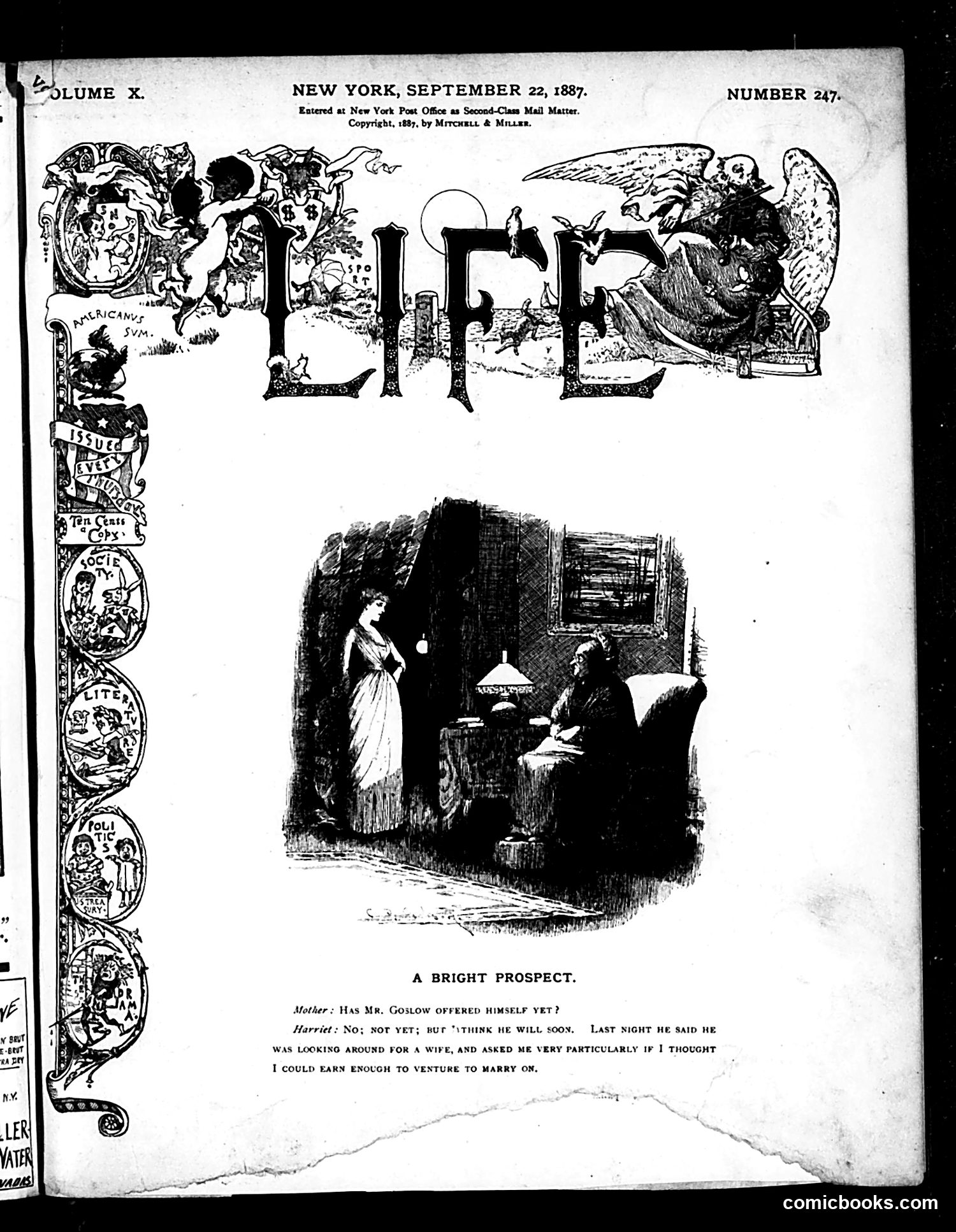
This cartoon satirizes marriage prospects for women in the 1880s. The illustration shows a woman standing while a man sits, depicting a conversation between mother and daughter about a suitor named Mr. Goslow. The humor lies in the bleak reality beneath polite society: The mother asks if Goslow has proposed; the daughter says not yet, but he's "looking around for a wife" and asked her pointedly whether she could "earn enough to venture to marry on." The satire targets the financial vulnerability of unmarried women of this era. Rather than courting based on affection, the "bright prospect" is actually a man seeking a woman who can financially support him—reversing typical marriage expectations and highlighting women's limited economic independence and marital options.
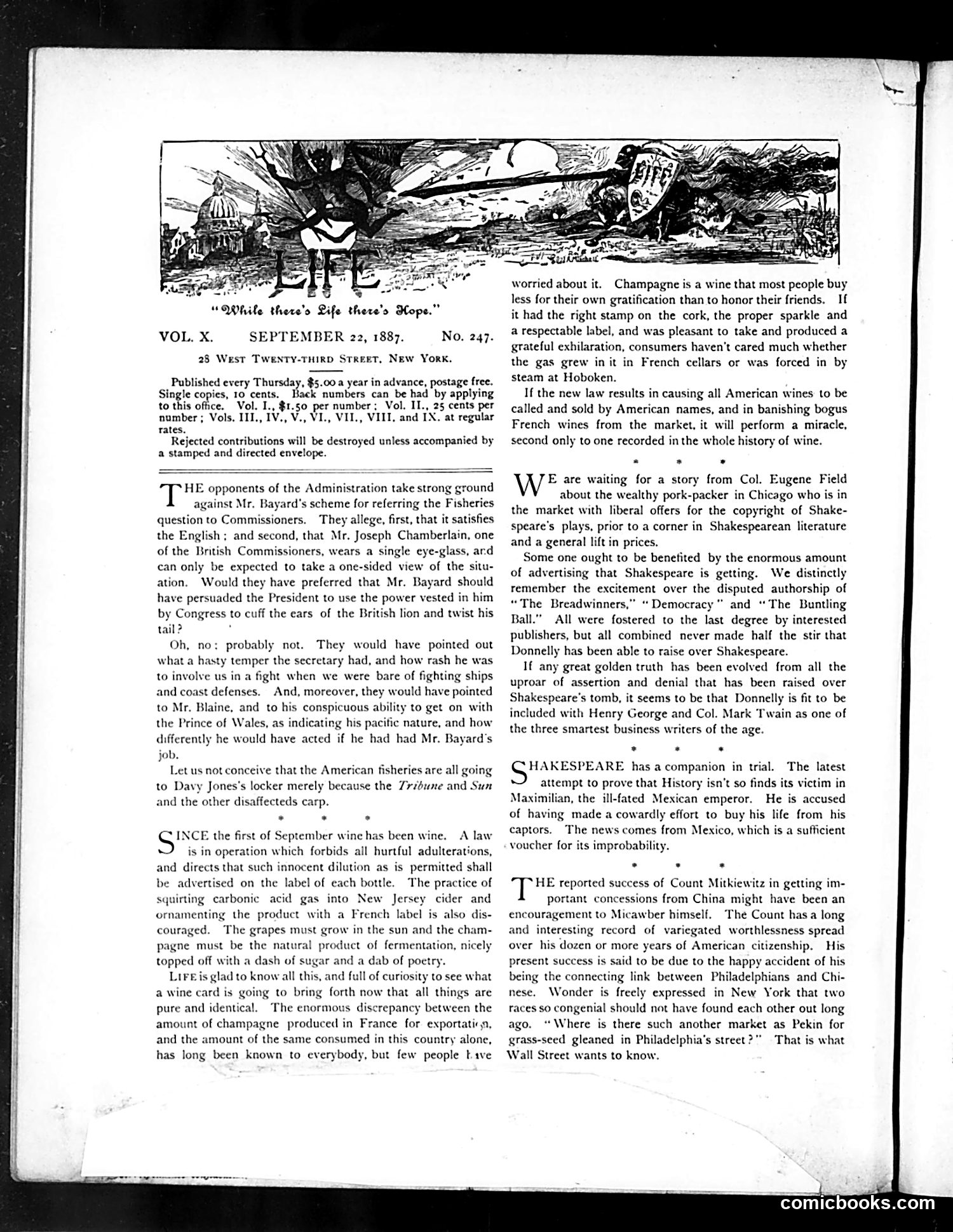
The masthead cartoon depicts a barren landscape with a gnarled tree and the caption "While there's Life there's Hope." This appears to be Life magazine's characteristic visual branding rather than political commentary. The text discusses several contemporary issues: Mr. Bayard's fisheries scheme with Britain, Shakespeare authorship disputes (particularly regarding "The Broadwinners"), and Count Mikliewicz's negotiations with China. The magazine employs satirical commentary on these topics, particularly mocking the Shakespeare authorship controversy as a distraction for publishers and questioning the viability of American diplomatic efforts. The overall tone suggests satirical skepticism toward contemporary political and literary controversies of the 1880s.
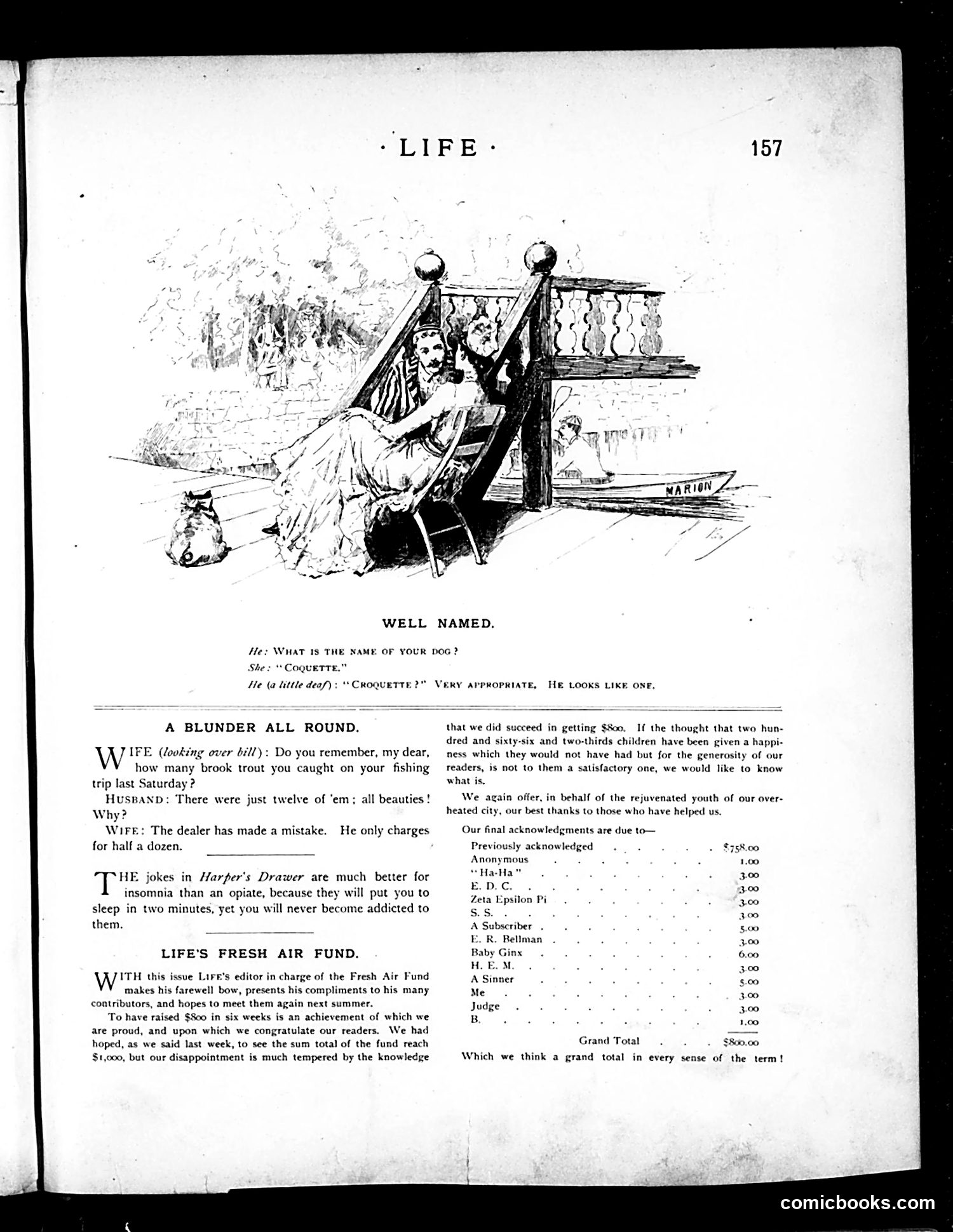
This page contains three humor pieces unrelated to politics or current events: 1. **"Well Named"** (top): A cartoon joke about a woman naming her dog "Coquette"—a pun suggesting the dog matches the woman's flirtatious behavior. 2. **"A Blunder All Round"** (middle): A brief joke about a husband misreporting his fishing catch. The dealer charged for "half a dozen" when the husband said he caught "twelve"—a play on the dealer's dishonest pricing. 3. **"Life's Fresh Air Fund"** (bottom): An announcement celebrating fundraising success. Life magazine raised $800 in two weeks for what appears to be a charitable cause providing summer relief, with acknowledgments listing donor names and amounts contributed. No political satire or caricature is present on this page.
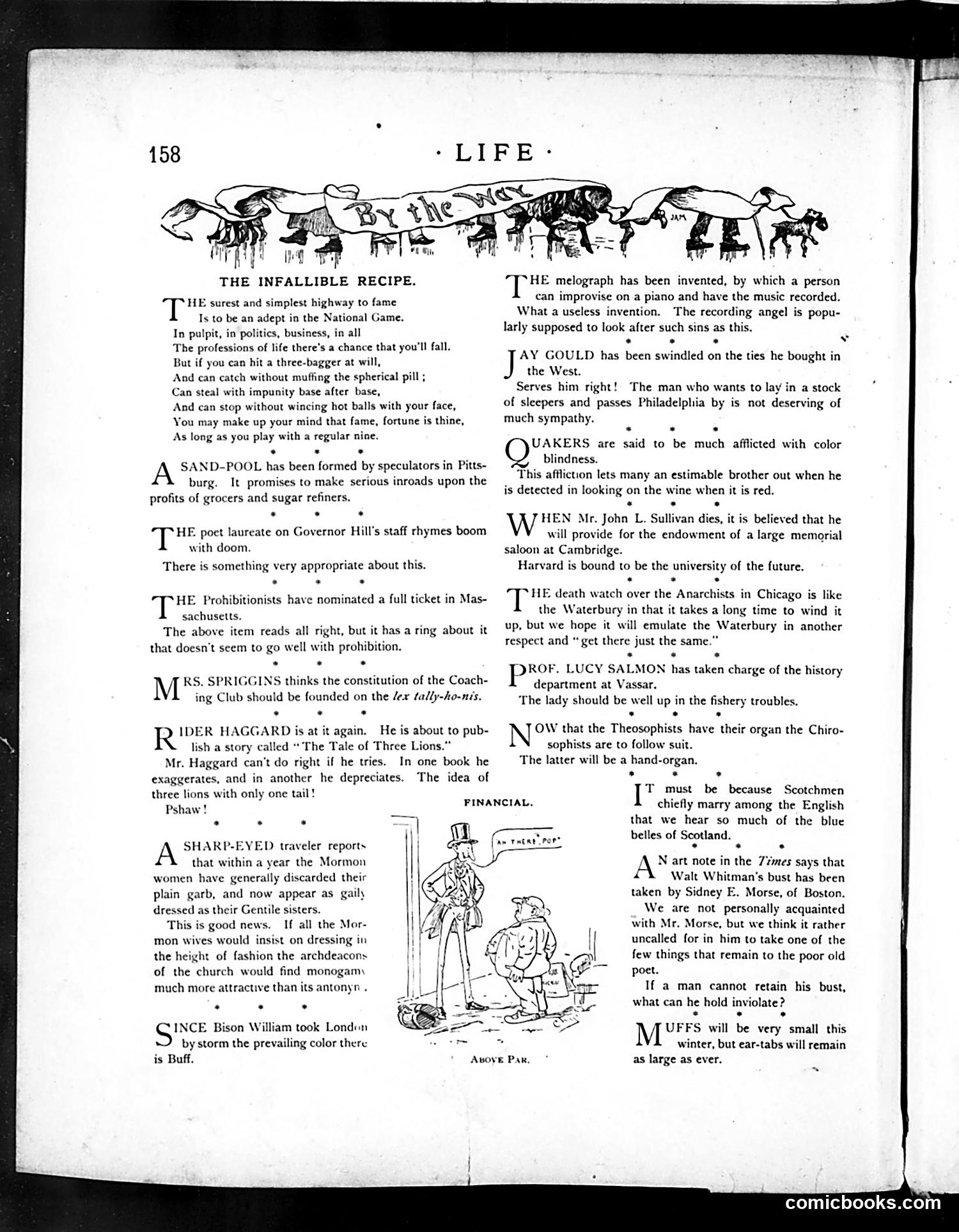
This page contains brief satirical commentary on contemporary 1890s issues rather than a single cartoon. Notable items include: **"The Infallible Recipe"** mocks success in American life—suggesting one needs to be skilled at the "National Game" (baseball), politics, and business while maintaining a facade of respectability. **Jay Gould reference** satirizes the railroad magnate's unsavory business practices in western expansion. **The Prohibitionists item** jokes that their political ticket sounds odd paired with prohibition itself. **Rider Haggard reference** critiques the prolific adventure novelist's repetitive storytelling about "three lions." The small cartoon labeled "Above Par" depicts financial/class commentary, though specifics are unclear. Overall, this represents Life's typical format: punchy social commentary targeting politicians, businessmen, cultural figures, and reform movements of the era.
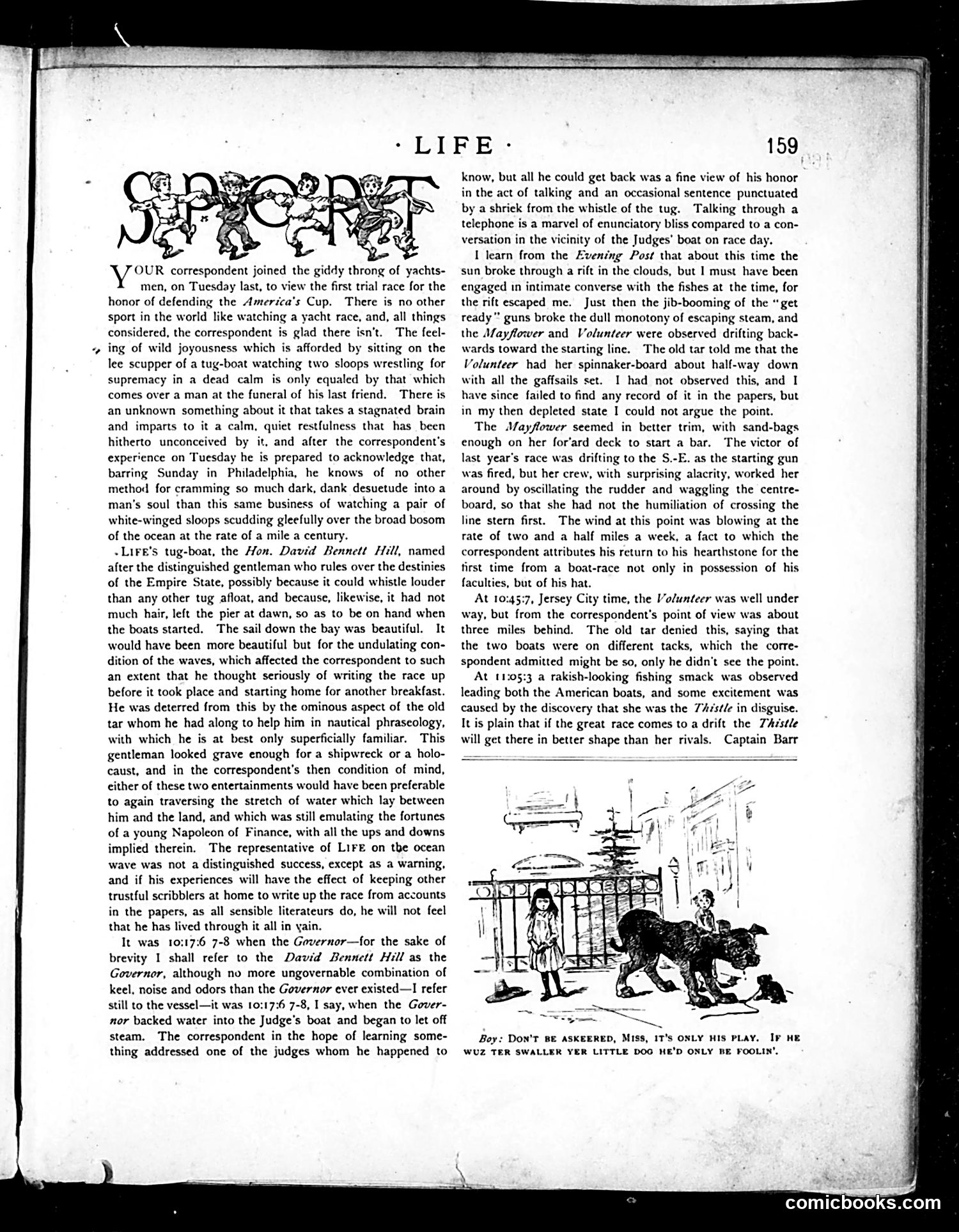
This page contains a sports article about yacht racing, specifically the America's Cup competition. The text describes the correspondent's experience watching the first trial race, featuring yachts named the *Mayflower* and *Volunteer*. The correspondent references a yacht called the *Thistle*, apparently a competitor that was discovered later in the race. The small cartoon at the bottom depicts a humorous domestic scene: a woman tells a boy not to be upset about his small dog's play, noting the dog would only be foolish if it were ten times larger. This appears to be unrelated humor rather than political satire—simply an everyday joke about children's play and pet behavior. The page is primarily focused on sports journalism rather than political commentary.
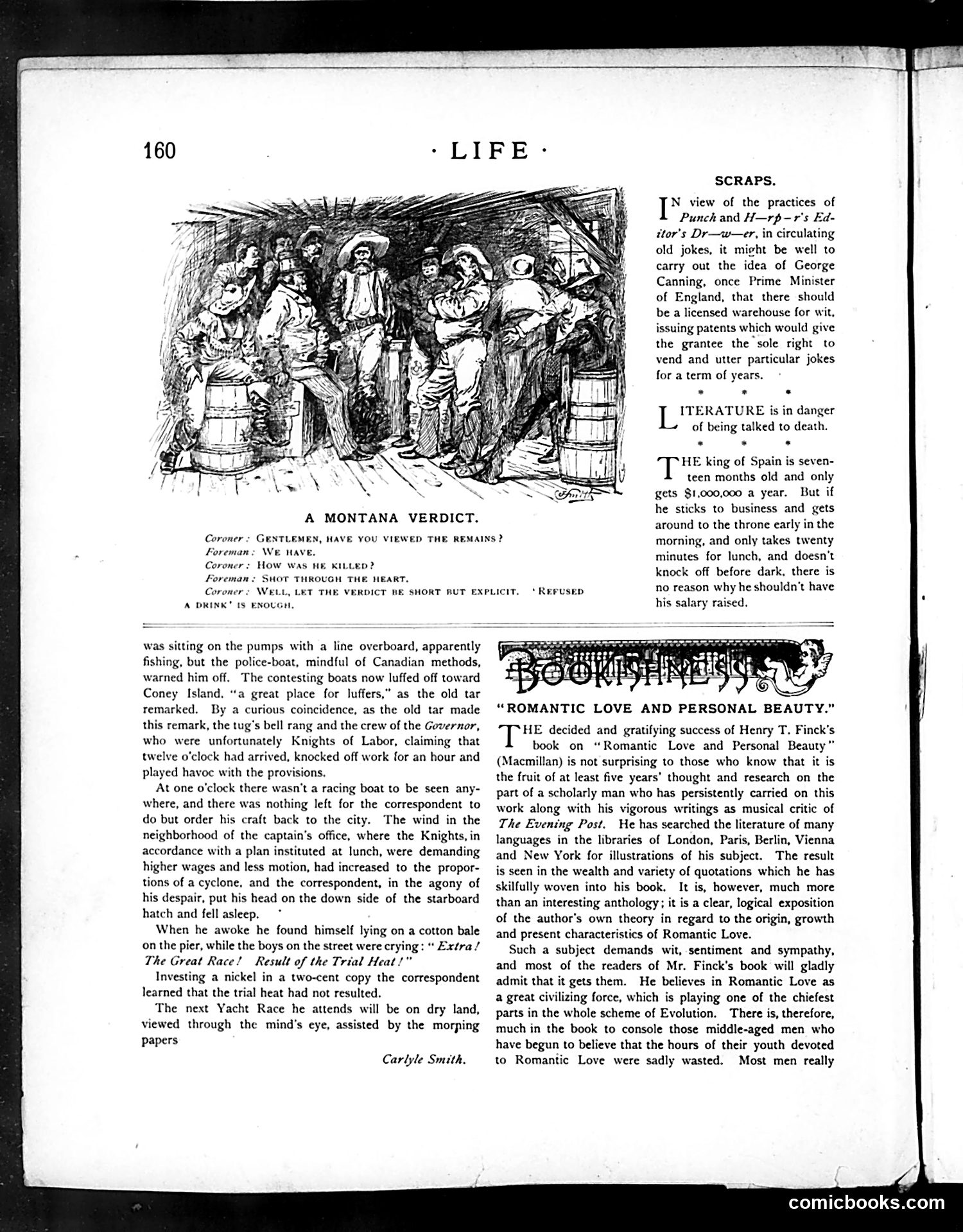
This cartoon depicts a coroner's inquest in Montana following a shooting death. The humor relies on frontier justice stereotypes: when asked how the victim was killed, the foreman replies "shot through the heart," and when instructed to render a proper verdict, responds simply "A drink's enough"—suggesting the assembled men prioritize getting drunk over serious legal proceedings. The satire mocks Montana's reputation for rough frontier culture and inadequate judicial processes. The joke assumes readers recognize Montana as a lawless, unsophisticated region where official inquests are treated casually and alcohol matters more than justice. This reflects period Eastern attitudes toward Western states as uncivilized and comically inept at governance.
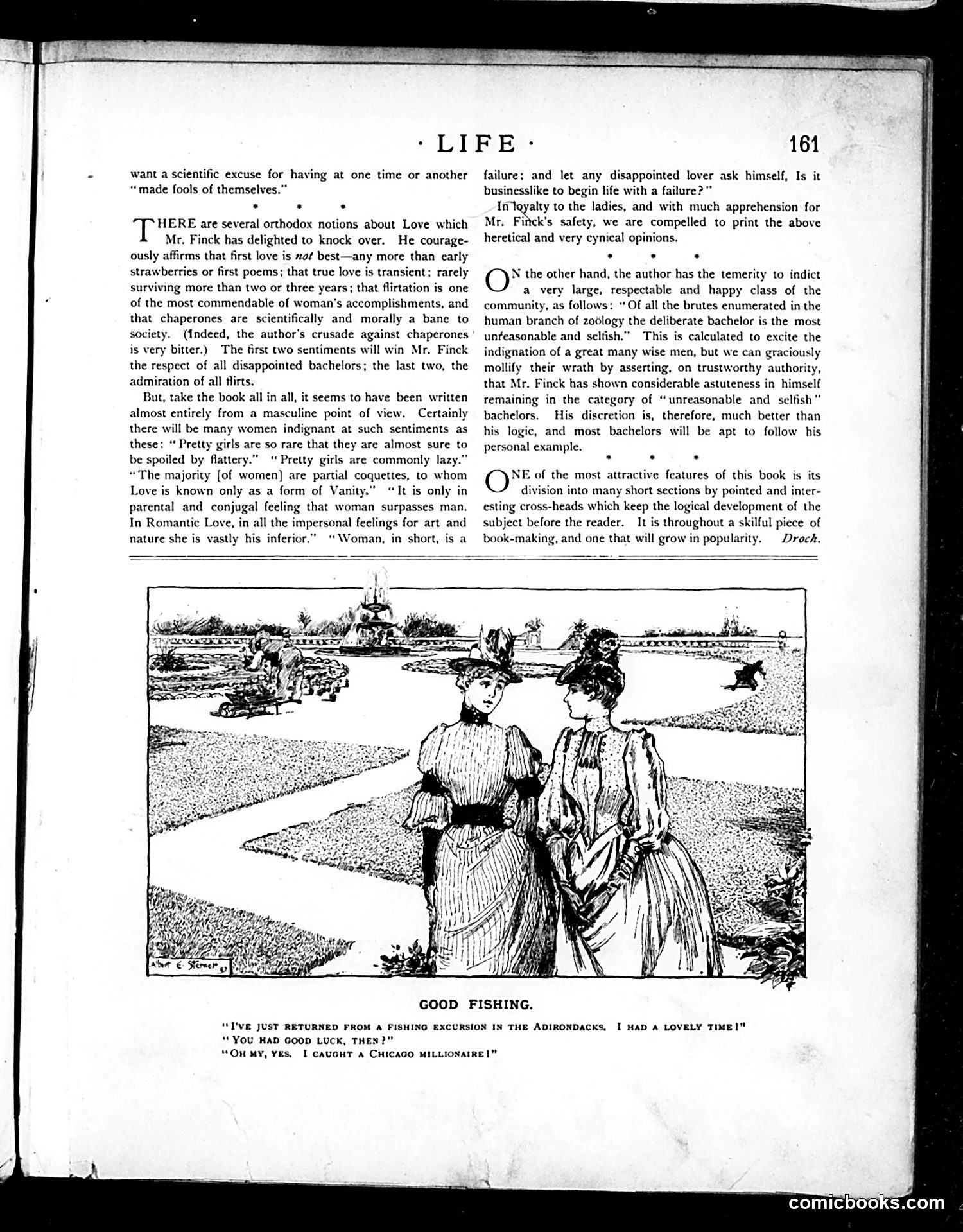
This cartoon illustrates a social joke about wealthy women and marriage prospects. Two fashionably dressed women in 1890s attire converse by a scenic riverside. One remarks she's just returned from a fishing excursion in the Adirondacks and had "a lovely time." When asked about her luck, she responds: "Oh my, yes. I caught a Chicago millionaire!" The humor relies on the contemporary understanding that wealthy heiresses and society women engaged in calculated courtship, "fishing" for rich husbands much like anglers pursue fish. The Adirondacks reference indicates an exclusive resort area where such social encounters occurred. The joke satirizes how marriage among the wealthy was frankly transactional, with women viewed as strategically pursuing affluent bachelors.
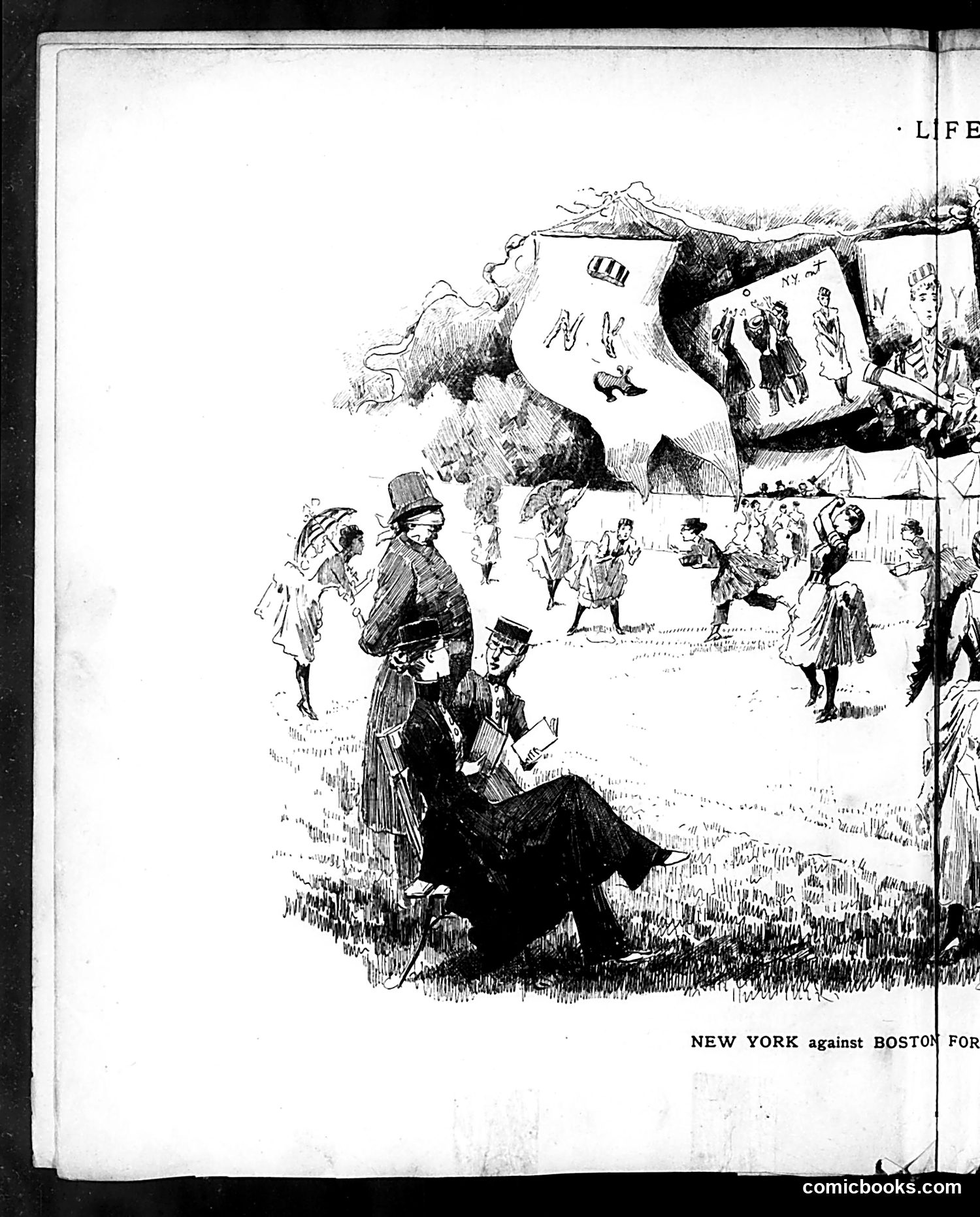
This appears to be a satirical cartoon from *Life* magazine about a baseball rivalry between New York and Boston. The caption reads "NEW YORK against BOSTON FOR[...]" (text cut off). The cartoon depicts a giant figure (likely representing New York or a New York baseball team) looming over a baseball field scene below. The giant holds what appears to be a banner or flag, suggesting dominance or superiority. Various spectators and players populate the field below in typical early 20th-century dress. The satire likely mocks either the rivalry's intensity or one city's perceived arrogance about baseball superiority. The exaggerated scale emphasizes the dramatic stakes Americans invested in baseball competition between major cities during this era.
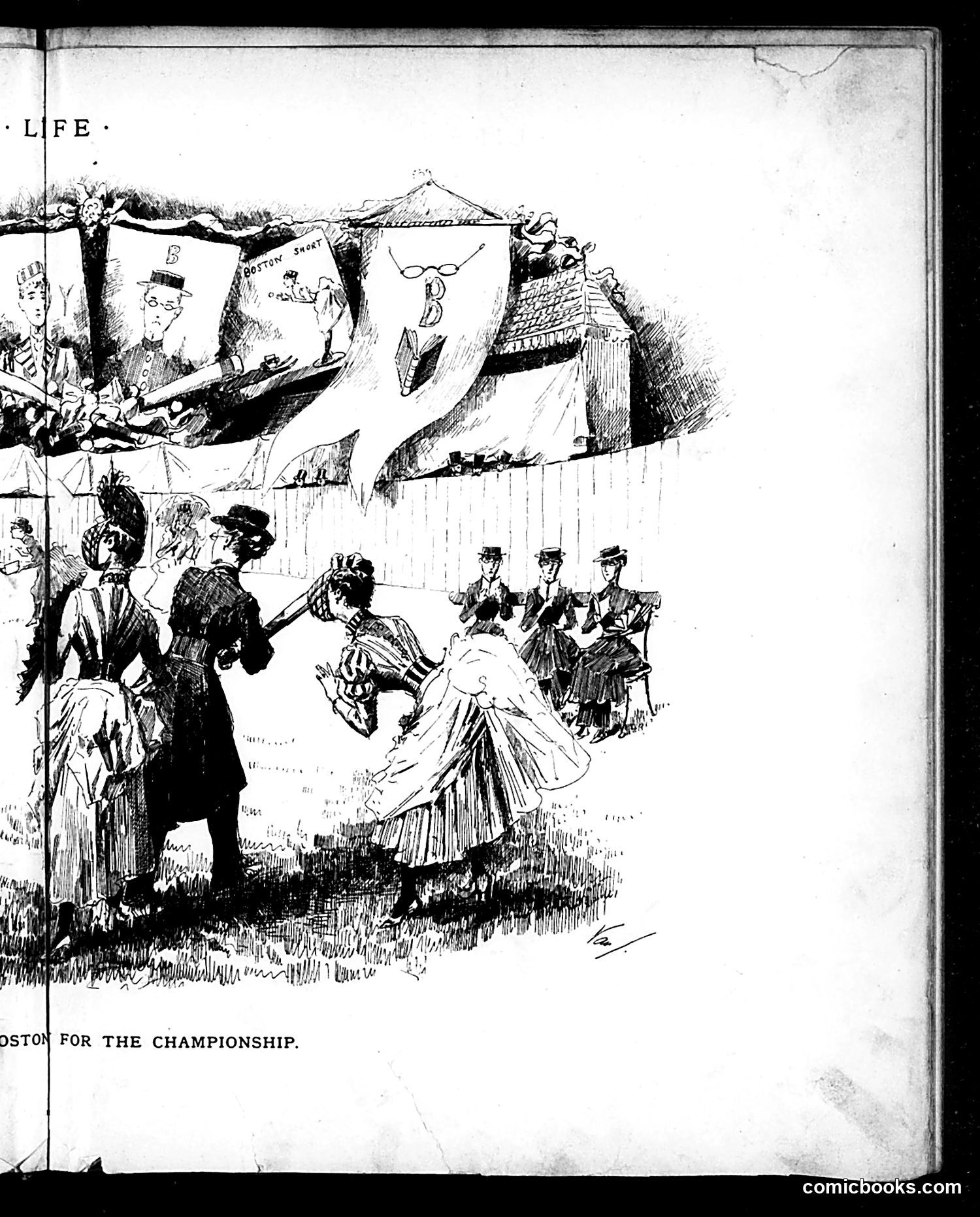
This Life magazine cartoon satirizes competitive sports rivalry, likely from the early 1900s. The image shows what appears to be a sporting event or competition venue with spectators gathered behind a fence. Large banners or signs hang above featuring caricatured faces and symbols (including what looks like "B" initials, possibly representing Boston teams). The title "Boston for the Championship" suggests this mocks Boston's sports ambitions or boasting. The crowd includes well-dressed spectators in period attire, and the overall scene captures the satirical tone Life magazine employed toward civic pride and competitive sporting culture of the era. The exaggerated facial caricatures on the banners are typical of the magazine's humorous approach to social commentary.
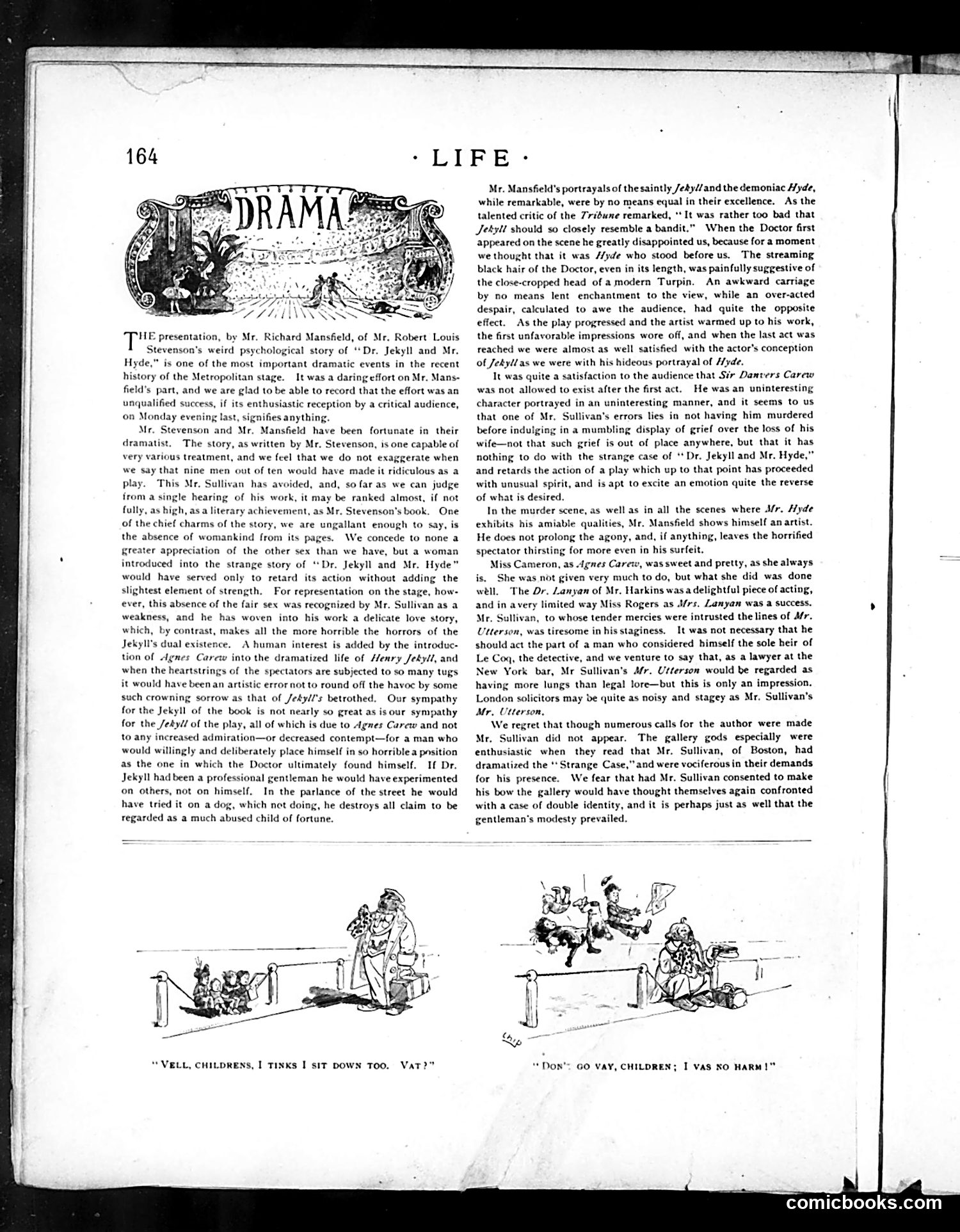
This page reviews a theatrical production of "Dr. Jekyll and Mr. Hyde" presented by Richard Mansfield. The text praises Mansfield's portrayal of both the saintly Jekyll and the demonic Hyde, noting the production's success despite initial audience confusion about the Doctor's appearance. The two cartoons below depict scenes from the play, showing audience reactions. The left cartoon shows children being ushered out ("Well, childrens, I tinks I sit down too. Vat?"), while the right shows another character exclaiming ("Doc"—Go vay, childrens; I vas no harm!"). These captions suggest the play's frightening nature, with theatrical dialogue capturing humorous reactions to Hyde's disturbing stage presence and the difficulty of managing audience comfort during intense dramatic moments.
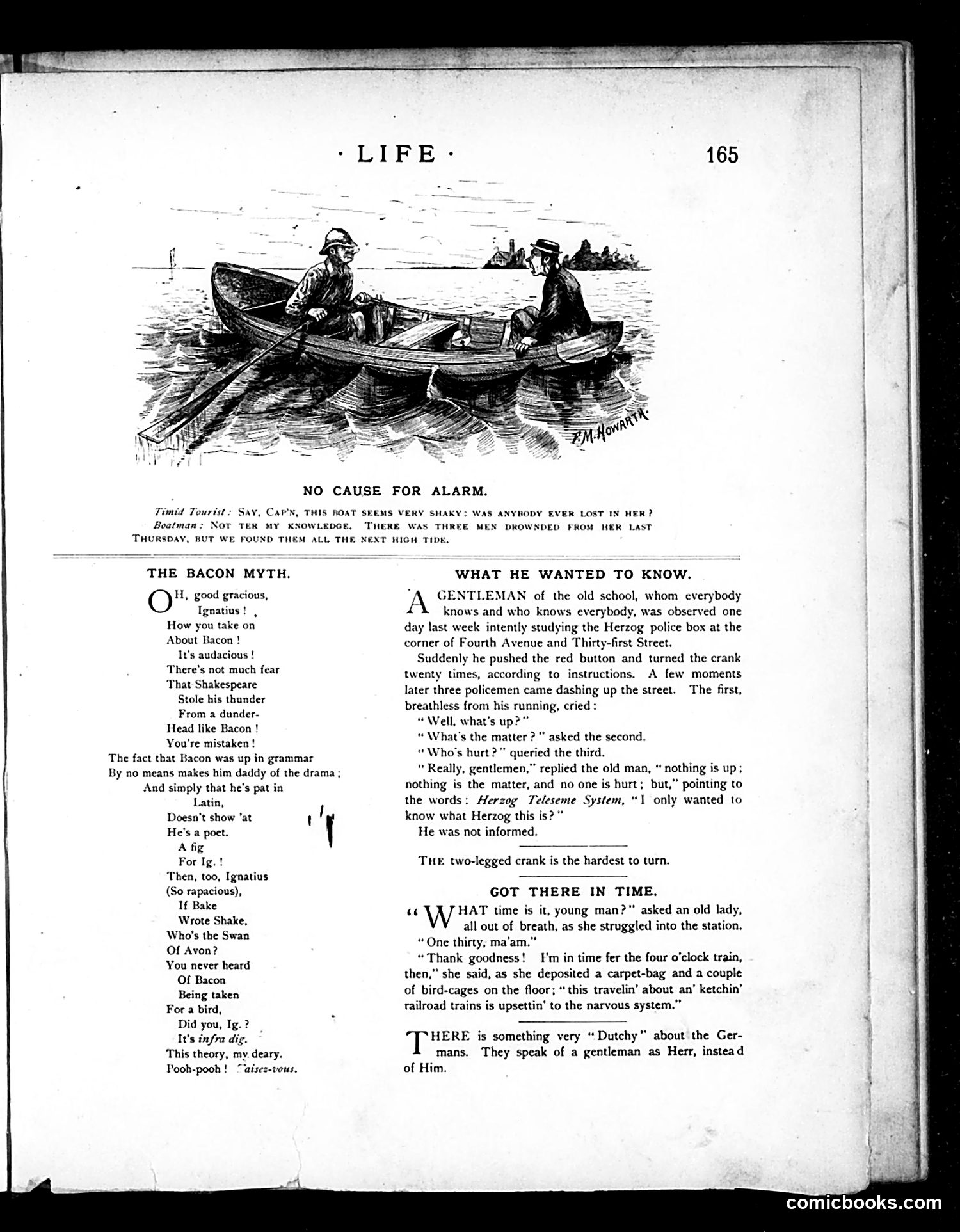
This page contains three separate satirical pieces: 1. **"No Cause for Alarm"**: A visual joke about a nervous tourist in a rickety boat. The boatman casually mentions three men drowned from this very boat last Thursday—but reassures the tourist they were recovered at high tide, implying no real danger. The satire mocks both the tourist's anxiety and the boatman's casual attitude toward maritime deaths. 2. **"The Bacon Myth"**: A verse debate about whether Francis Bacon wrote Shakespeare's plays. The speaker (Ignatius) ridicules this theory through wordplay and logic, pointing out that calling Bacon "the Swan of Avon" makes no sense. This satirizes the ongoing scholarly dispute about Shakespeare's authorship. 3. **"What He Wanted to Know"** and **"Got There in Time"**: Brief humorous anecdotes—one mocking an old gentleman's confusion about a police call-box system, another about an elderly woman's befuddled time-sense. The final item jokes about German language conventions ("Herr" vs. "Him"). These represent typical Life magazine humor: wordplay, social observation, and gentle mockery of human folly.
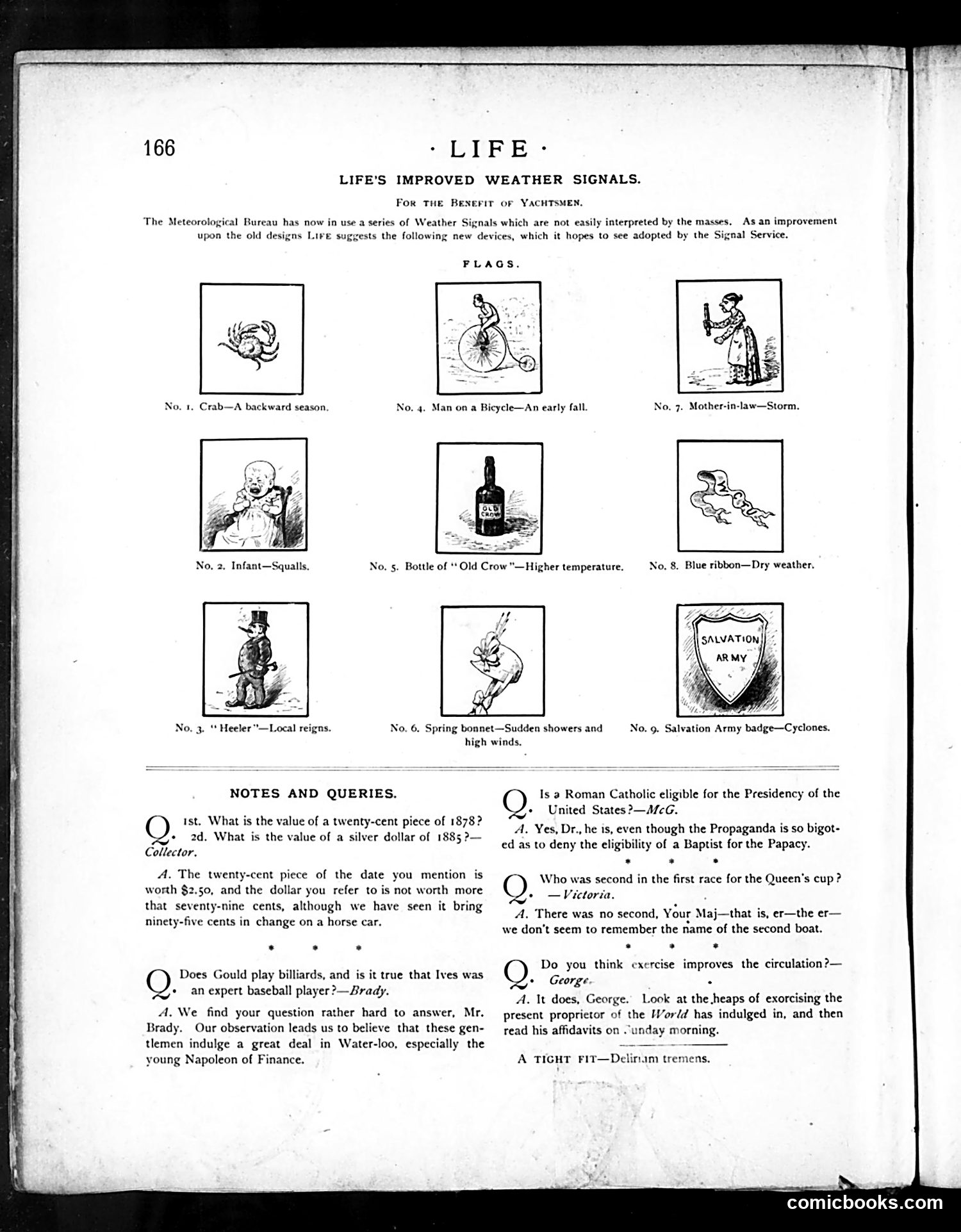
This page satirizes the U.S. Meteorological Bureau's weather signal system as unnecessarily obscure. Life proposes absurdist "improved" weather flags using everyday objects and figures instead—a crab for backward seasons, a man on a bicycle for early fall, a mother-in-law for storms, etc. The humor lies in the exaggerated visual metaphors: suggesting that a "Salvation Army badge" signals cyclones, or a "blue ribbon" means dry weather. It's satirizing bureaucratic complexity by showing how ridiculous symbolic weather forecasting could become. The "Notes and Queries" section contains unrelated topical humor about coin values, billionaire Jay Gould, and the newspaper publisher Joseph Pulitzer (the "young Napoleon of Finance"), mocking his exercise regime and legal troubles—typical late-1880s satirical jabs at prominent figures.
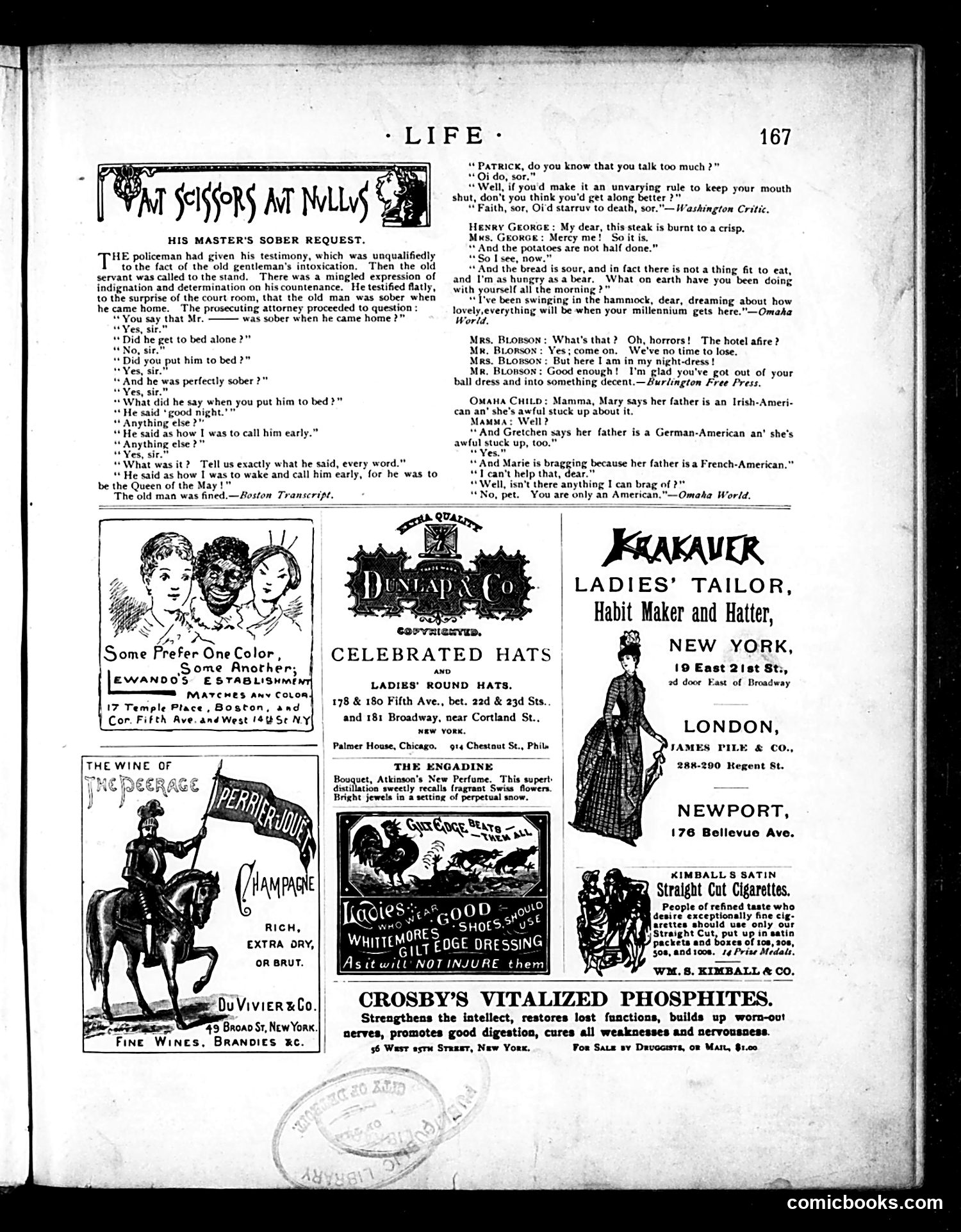
This page contains **three separate humorous stories** satirizing Irish-American servants and domestic life: 1. **"His Master's Sober Request"**: A courtroom comedy where a servant testifies his drunk employer was sober. The punchline: the servant has an Irish accent and says he'd "starve to death" if he followed advice to stay quiet—mocking Irish stereotypes as talkative and poor. 2. **Henry George domestic scene**: A husband complains about burned food while his wife admits she spent the morning daydreaming about his promised "millennium" (likely referencing George's Single Tax economic theory). Satire of idealistic reformers neglecting practical duties. 3. **"Omaha Child"**: A child reports classmates bragging about immigrant heritage (Irish-American, German-American, French-American fathers), then asks what she can brag about. The mother's deflating answer—"You are only an American"—satirizes the period's ethnic hierarchies and suggests native-born Americans lack distinctive identity. The page is **primarily advertisements** for hats, wine, cigarettes, and patent medicines, typical of the era.
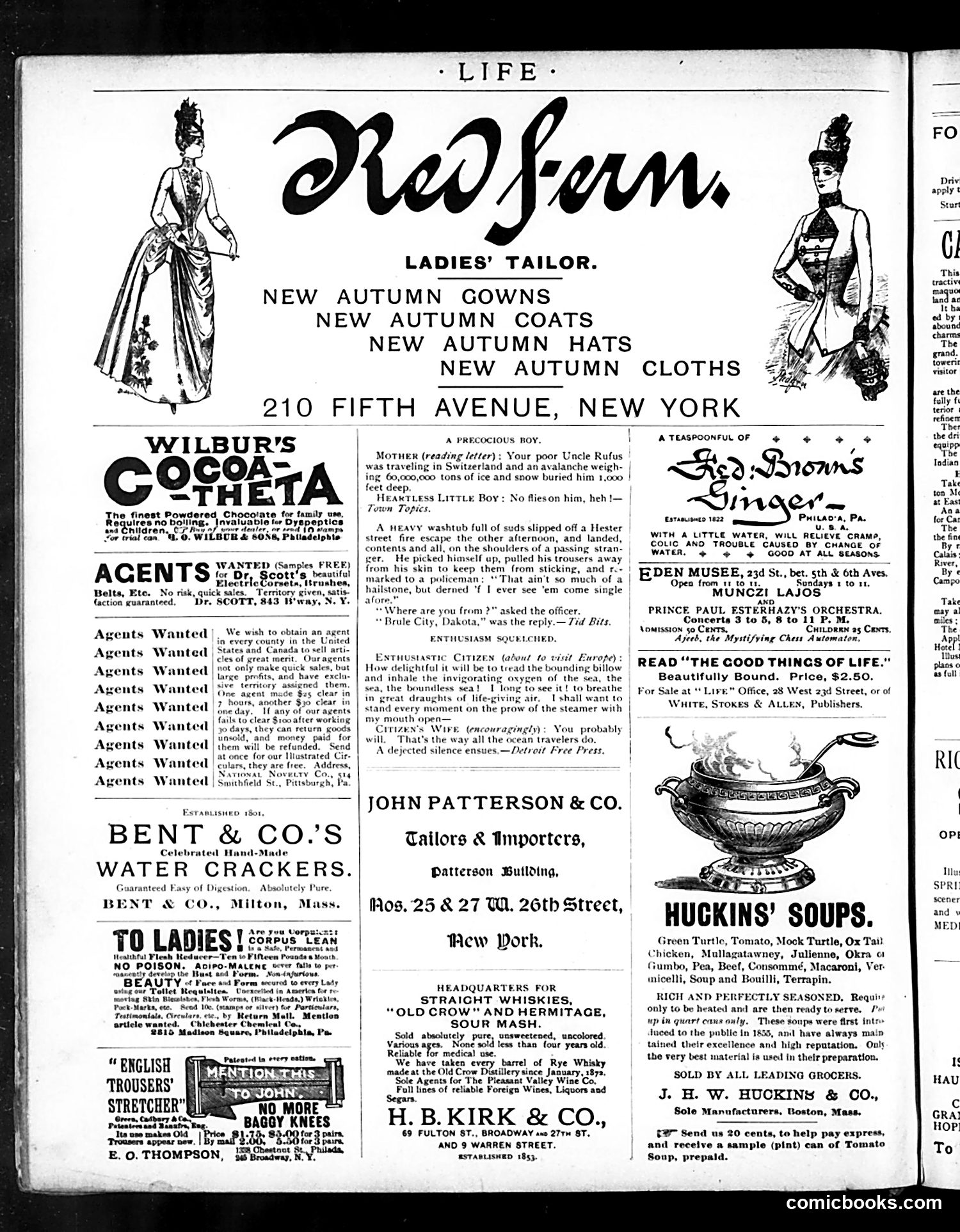
This page from *Life* magazine is primarily **advertising with brief comic sketches**. The advertisements dominate—featuring ladies' fashion (Red Fern tailor), chocolate, water crackers, various patent medicines and health devices, and spirits. The humor appears in three short comic scenarios: 1. **"A Precocious Boy"**: A child's callous reaction to his uncle being buried in an avalanche—the joke being his lack of sympathy. 2. **"A Heavy Washtub"**: A man hit by falling wash water expresses relief he's not seasick, anticipating ocean travel will make him vomit like other travelers. 3. **"Enthusiasm Squelched"**: A man's romantic fantasies about ocean travel are deflated when his wife bluntly notes seasickness affects everyone the same way. All three jokes reflect period attitudes: child callousness, slapstick mishaps, and domestic deflation of male enthusiasm—typical *Life* magazine humor circa early 1900s. The page itself represents how 19th-century satirical publications were primarily supported by advertising.
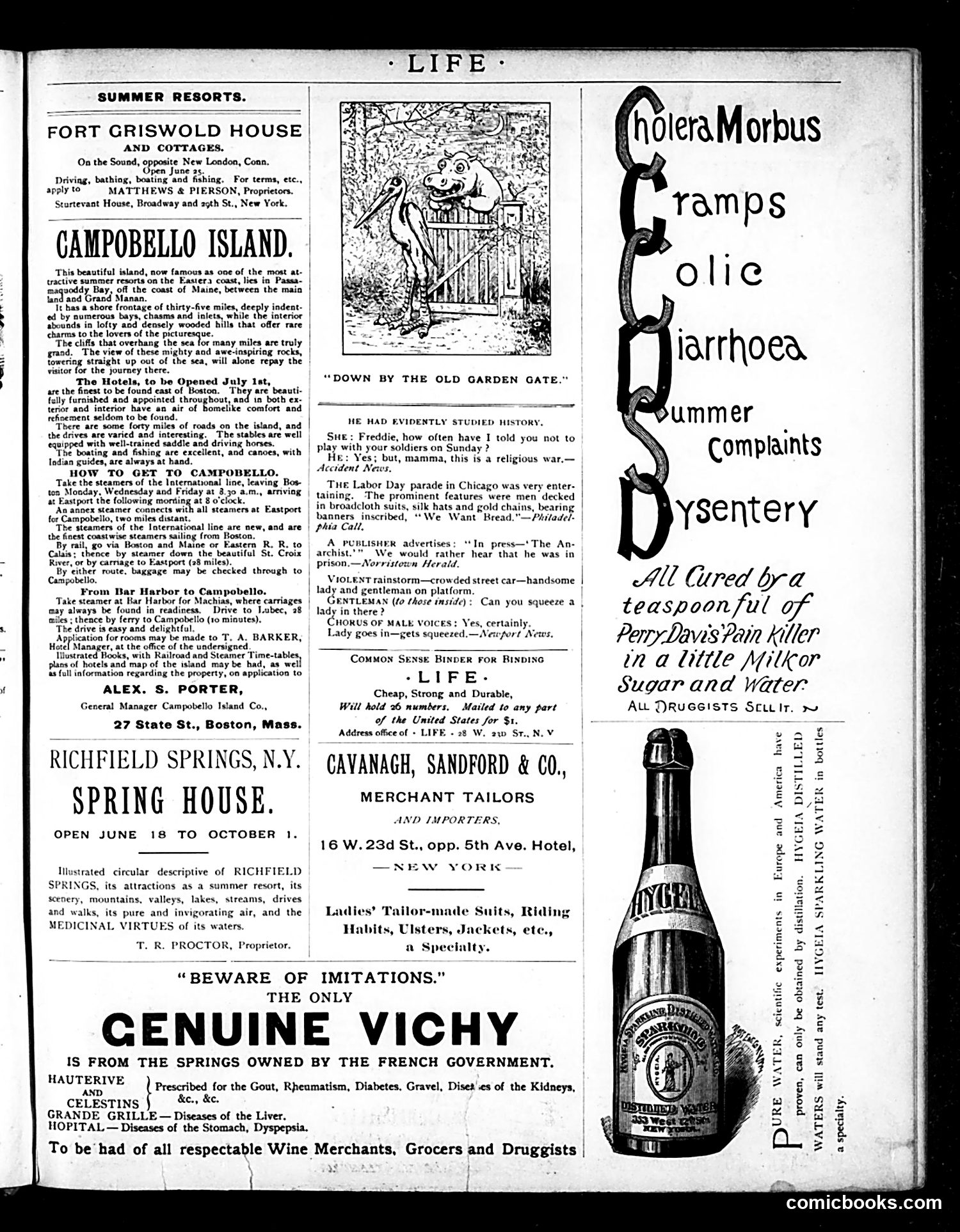
This page is primarily **advertisements for summer resorts** (Fort Griswold House, Campobello Island, Richfield Springs) interspersed with brief humorous anecdotes and product ads. The main cartoon shows a figure peering through a garden gate, captioned "DOWN BY THE OLD GARDEN GATE." The accompanying joke reveals the figure had "evidently studied history"—a child explains to his mother that playing with toy soldiers on Sunday is acceptable because "this is a religious war." The satire is gentle: it mocks a child's creative logic in circumventing religious prohibitions. The "history" reference likely alludes to religiously-motivated historical conflicts (like the Crusades or sectarian wars), making the joke a play on how children rationalize rule-breaking through pseudo-learned justifications. The surrounding content includes brief satirical jabs at Chicago's Labor Day parade (workers in fine clothes demanding bread) and various social observations typical of *Life* magazine's light humor. The page reflects turn-of-the-century American leisure culture and middle-class sensibilities.
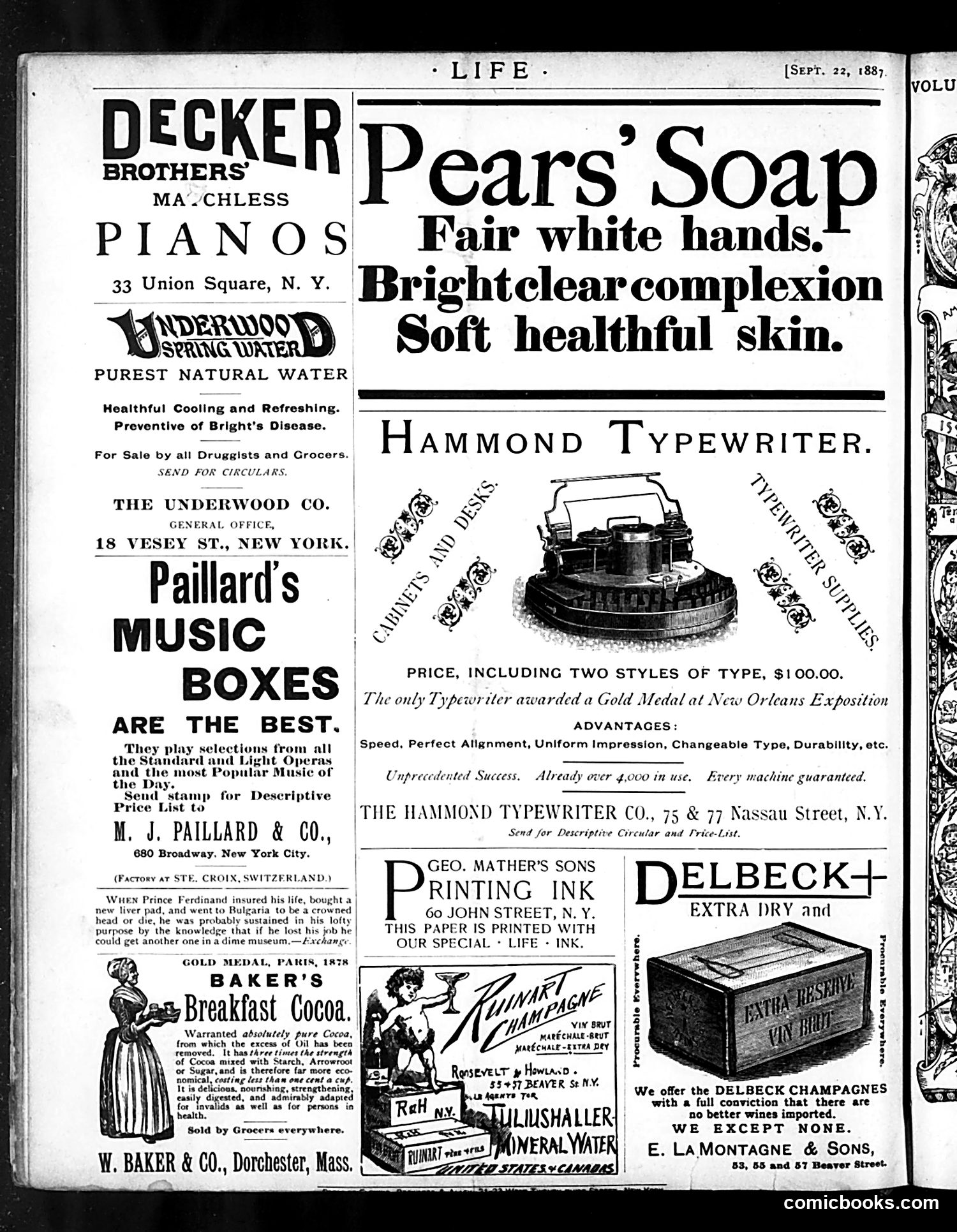
This is primarily an **advertising page**, not a satirical cartoon. Dated September 22, 1885, it contains various product advertisements typical of the era. The only non-advertisement content is a brief **joke** about Prince Ferdinand: when he insured his life and bought a new suit, people joked that if he lost his job, he could get work in a dime museum—a crude reference to sideshows that exhibited oddities. The humor relies on mockery of his appearance or social status. The rest of the page features period advertisements for: - **Pears' Soap** (emphasizing "fair white hands" and "bright clear complexion"—reflecting Victorian beauty standards and, problematically, racial preferences) - **Hammond Typewriter** (newly invented technology) - **Paillard Music Boxes**, pianos, cocoa, champagne, and printing supplies This reflects late-19th-century consumer culture and advertising conventions rather than satirical commentary.