
Life, 1887-09-22 · page 10 of 16
Life — September 22, 1887 — page 10: what you’re looking at
What you’re looking at
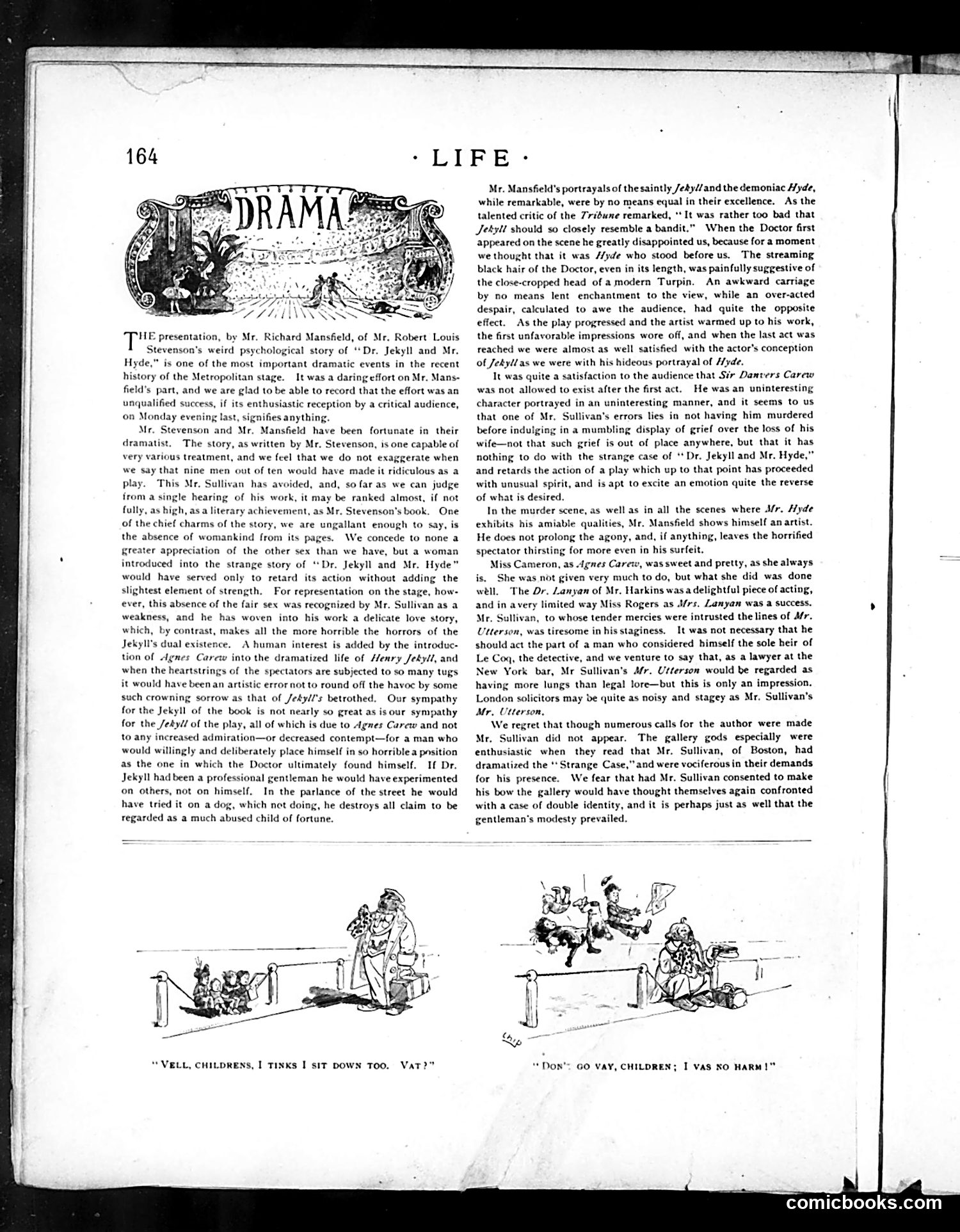
This page reviews a theatrical production of "Dr. Jekyll and Mr. Hyde" presented by Richard Mansfield. The text praises Mansfield's portrayal of both the saintly Jekyll and the demonic Hyde, noting the production's success despite initial audience confusion about the Doctor's appearance. The two cartoons below depict scenes from the play, showing audience reactions. The left cartoon shows children being ushered out ("Well, childrens, I tinks I sit down too. Vat?"), while the right shows another character exclaiming ("Doc"—Go vay, childrens; I vas no harm!"). These captions suggest the play's frightening nature, with theatrical dialogue capturing humorous reactions to Hyde's disturbing stage presence and the difficulty of managing audience comfort during intense dramatic moments.
📄 Transcribed text from this page (OCR, searchable)
Machine-transcribed from the original scan — historical spelling and the odd misread are preserved.
*> LIFE: oe; ZL TEAAN\N SSD — HIE presentation, by Mr. Richard Mansfeld, of Mr. Robert Louis Stevenson's weird psychological story of ‘Dr. Jekyll and Mr. Hyde," is one of the most important dramatic events in the recent history of the Metropolitan stage. It was a daring effort on Mr. Mans- field’s part, and we are glad to be able to record that the effort was an unqualified success, if its enthusiastic reception by a critical audience, on Monday evening last, signifies anything. Mr. Stevenson and Mr. Mansfield have been fortunate in their dramatist. The story, as written by Mr, Stevenson, is one capable of very various treatment, and we feel that we do not exaggerate when we say that nine men out of ten would have made it ridiculous as a play. This Mr. Sullivan has avoided, and, so far as we can judge irom a single hearing of his work, it may be ranked almost, if not fully, as high, asa literary achievement, as Mr. Stevenson's book. One of the chief charms of the story, we are ungallant enough to say, is the absence of womankind from its pages. We concede to none a greater appreciation of the other sex than we have, but a woman introduced into the strange story of “Dr. Jekyll and Mr. Hyde” would have served only to retard its action without adding the slightest element of strength. For representation on the stage, how- ever, this absence of the fair sex was recognized by Mr. Sullivan as a weakness, and he has woven into his work a delicate love story, which, by contrast, makes all the more horrible the horrors of the Jekylt’s dual existence. A human interest is added by the introduc- tion of lgnes Carew into the dramatized life of Henry Jekyll, and when the heartstrings of the spectators are subjected to so many tugs it would have been an artistic error not to round off the havoc by some such crowning sorrow as that of /edy/l's betrothed. Our sympathy for the Jekyll of the book is not nearly so great as is our sympathy for the /etyi/ of the play, all of which is due to Agnes Carew and not to any increased admiration—or decreased contempt—for a man who would willingly and deliberately place himself in so horriblea position as the one in which the Doctor ultimately found himself. If Dr. Jekyll had been a professional gentleman he would have experimented on others, not on himself. In the parlance of the street he would have tried it on a dog, which not doing, he destroys all claim to be regarded as a much abused child of fortune. “VELL, CHILDRENS, I TINKs I sIT DOWN TOO. Mr. Mansfield’s portrayals of the saintly /edy//and the demoniac Hyde, while remarkable, were by no means equal in their excellence. As the talented critic of the 7ridune remarked, ‘It was rather too bad that Jekyll should so closely resemble a bandit.” When the Doctor first ‘appeared on the scene he greatly disappointed us, because for a moment we thought that it was /yde who stood before us. The streaming black hair of the Doctor, even in its length, was painfully suggestive of the close-cropped head of a modern Turpin. An awkward carriage by no means lent enchantment to the view, while an over-acted despair, calculated to awe the audience, had quite the opposite effect. As the play progressed and the artist warmed up to his work, the first unfavorable impressions wore off, and when the last act was reached we were almost as well satisfied with the actor's conception of Jekyll as we were with his hideous portrayal of Hyde. It was quite a satisfaction to the audience that Sir Danvers Carew was not allowed to exist after the first act. He was an uninteresting character portrayed in an uninteresting manner, and it seems to us that one of Mr, Sullivan's errors lies in not having him murdered before indulging in a mumbling display of grief over the loss of his wife—not that such grief is out of place anywhere, but that it has nothing to do with the strange case of ‘Dr. Jekyll and Mr. Hyde,” and retards the action of a play which up to that point has proceeded with unusual spirit, and is apt to excite an emotion quite the reverse of what is desired. In the murder scene, as well as in all the scenes where Mr. Hyde exhibits his amiable qualities, Mr. Mansfield shows himself an artist. He does not prolong the agony, and, if anything, leaves the horrified spectator thirsting for more even in his surfeit. Miss Cameron, as Agnes Carew, was sweet and pretty, as she always is, She was not given very much to do, but what she did was done well, The Dr. Lanyan of Mr. Harkins was a delightful piece of acting, and in avery limited way Miss Rogers as Afrs. Lanyan was a success. Mr, Sullivan, to whose tender mercies were intrusted the lines of Afr. Utterson, was tiresome in his staginess. It was not necessary that he should act the part of a man who considered himself the sole heir of Le Coa, the detective, and we venture to say that, as a lawyer at the New York bar, Mr Sullivan's Afr. Usterson would be regarded as having more lungs than legal lore—but this is only an impression. London solicitors may be quite as noisy and stagey as Mr. Sullivan's Mr, Utterson, We regret that though numerous calls for the author were made Mr, Sullivan did not appear. The gallery gods especially were enthusiastic when they read that Mr. Sullivan, of Boston, had dramatized the ‘Strange Case," and were vociferous in their demands for his presence. We fear that had Mr. Sullivan consented to make his bow the gallery would have thought themselves again confronted with a case of double identity, and it is perhaps just as well that the gentleman's modesty prevailed. Don’ GO VAY, CHILDREN; I VAS NO HARM!” comicbooks.com