
Life, 1887-09-22 · page 5 of 16
Life — September 22, 1887 — page 5: what you’re looking at
What you’re looking at
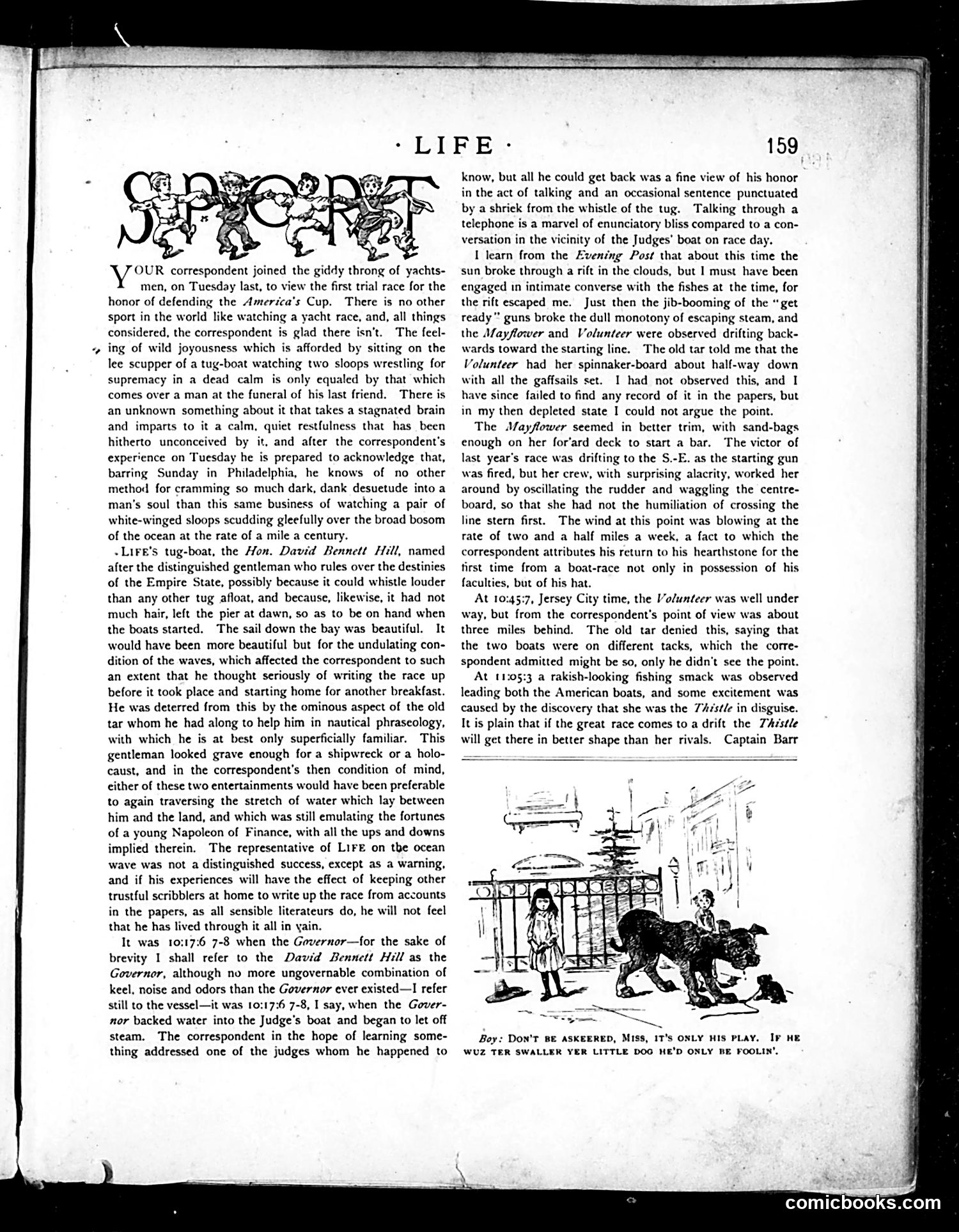
This page contains a sports article about yacht racing, specifically the America's Cup competition. The text describes the correspondent's experience watching the first trial race, featuring yachts named the *Mayflower* and *Volunteer*. The correspondent references a yacht called the *Thistle*, apparently a competitor that was discovered later in the race. The small cartoon at the bottom depicts a humorous domestic scene: a woman tells a boy not to be upset about his small dog's play, noting the dog would only be foolish if it were ten times larger. This appears to be unrelated humor rather than political satire—simply an everyday joke about children's play and pet behavior. The page is primarily focused on sports journalism rather than political commentary.
📄 Transcribed text from this page (OCR, searchable)
Machine-transcribed from the original scan — historical spelling and the odd misread are preserved.
> LIFE - OUR correspondent joined the giddy throng of yachts- men, on Tuesday last, to view the first trial race for the honor of defending the America’s Cup. There is no other sport in the world like watching a yacht race, and, all things considered, the correspondent is glad there isn’t. The feel- ing of wild joyousness which is afforded by sitting on the lee scupper of a tug-boat watching two sloops wrestling for supremacy in a dead calm is only equaled by that which comes over a man at the funeral of his last friend. There is an unknown something about it that takes a stagnated brain and imparts to it a calm, quiet restfulness that has been hitherto unconceived by it, and after the correspondent's experience on Tuesday he is prepared to acknowledge that, barring Sunday in Philadelphia, he knows of no other method for cramming so much dark, dank desuetude into a man’s soul than this same business of watching a pair of white-winged sloops scudding gleefully over the broad bosom of the ocean at the rate of a mile a century. -Lire’'s tug-boat, the Hon. David Bennett Hill, named after the distinguished gentleman who rules over the destinies of the Empire State, possibly because it could whistle louder than any other tug afloat, and because, likewise, it had not much hair, left the pier at dawn, so as to be on hand when the boats started. The sail down the bay was beautiful. It would have been more beautiful but for the undulating con- dition of the waves, which affected the correspondent to such an extent that he thought seriously of writing the race up before it took place and starting home for another breakfast. He was deterred from this by the ominous aspect of the old tar whom he had along to help him in nautical phraseology, with which he is at best only superficially familiar. This gentleman looked grave enough for a shipwreck or a holo- caust, and in the correspondent’s then condition of mind, cither of these two entertainments would have been preferable to again traversing the stretch of water which lay between him and the land, and which was still emulating the fortunes of a young Napoleon of Finance, with all the ups and downs implied therein. The representative of LIFE on tbe ocean wave was not a distinguished success, except as a warning, and if his experiences will have the effect of keeping other trustful scribblers at home to write up the race from accounts in the papers, as all sensible literateurs do, he will not feel that he has lived through it all in yain. It was 10:17:6 7-8 when the Governor—for the sake of brevity I shall refer to the David Bennett Hill as the Governor, although no more ungovernable combination of keel, noise and odors than the Governor ever existed—I refer still to the vessel—it was 10:17:6 7-8, I say, when the Gover- nor backed water into the Judge's boat and began to let off steam. The correspondent in the hope of learning some- thing addressed one of the judges whom he happened to know, but all he could get back was a fine view of his honor in the act of talking and an occasional sentence punctuated by a shriek from the whistle of the tug. Talking through a telephone is a marvel of enunciatory bliss compared to a con- versation in the vicinity of the Judges’ boat on race day. I learn from the Evening Post that about this time the sun broke through a rift in the clouds, but I must have been engaged in intimate converse with the fishes at the time, for the rift escaped me. Just then the jib-booming of the “get ready” guns broke the dull monotony of escaping steam, and the Mayflower and Volunteer were observed drifting back- wards toward the starting line. The old tar told me that the Volunteer had her spinnaker-board about half-way down with all the gaffsails set. I had not observed this, and I have since failed to find any record of it in the papers, but in my then depleted state I could not argue the point. The Mayflower seemed in better trim, with sand-bags enough on her for’ard deck to start a bar. The victor of last year’s race was drifting to the S.-E. as the starting gun was fired, but her crew, with surprising alacrity, worked her around by oscillating the rudder and waggling the centre- board, so that she had not the humiliation of crossing the line stern first. The wind at this point was blowing at the rate of two and a half miles a week, a fact to which the correspondent attributes his return to his hearthstone for the first time from a boat-race not only in possession of his faculties, but of his hat. At 10:45:7, Jersey City time, the Volunteer was well under way, but from the correspondent’s point of view was about three miles behind. The old tar denied this, saying that the two boats were on different tacks, which the corre- spondent admitted might be so, only he didn’t see the point. At 1:05:3 a rakish-looking fishing smack was observed leading both the American boats, and some excitement was caused by the discovery that she was the 7/zstle in disguise. It is plain that if the great race comes to a drift the 7Azstle will get there in better shape than her rivals. Captain Barr Boy: DON'T BE ASKEERED, MISS, 17's ONLY HIS PLAY. IF HE WUZ TER SWALLER YER LITTLE DOG HE'D ONLY BE FOOLIN'. comicbooks.com 159