
Life, 1887-09-22 · page 6 of 16
Life — September 22, 1887 — page 6: what you’re looking at
What you’re looking at
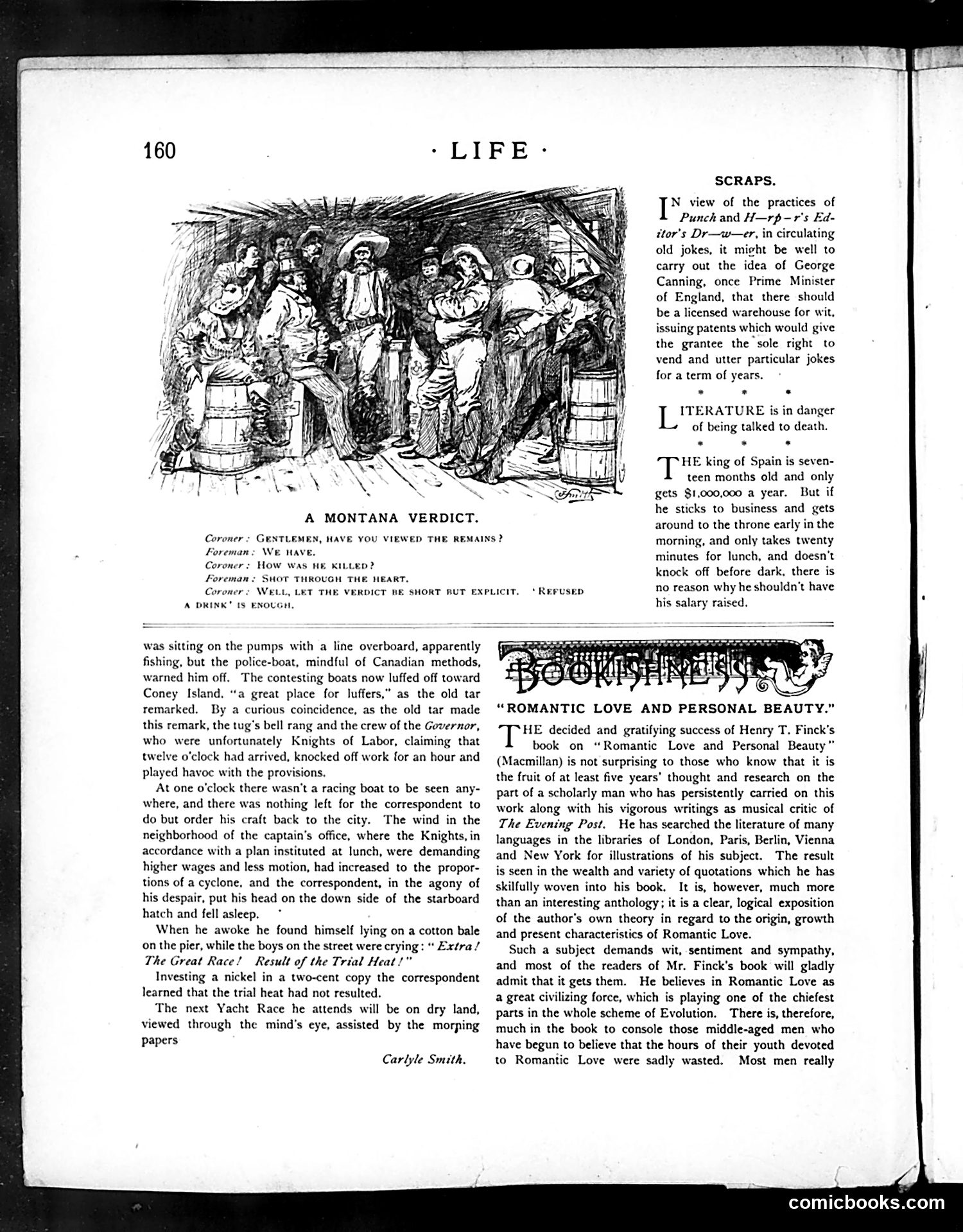
This cartoon depicts a coroner's inquest in Montana following a shooting death. The humor relies on frontier justice stereotypes: when asked how the victim was killed, the foreman replies "shot through the heart," and when instructed to render a proper verdict, responds simply "A drink's enough"—suggesting the assembled men prioritize getting drunk over serious legal proceedings. The satire mocks Montana's reputation for rough frontier culture and inadequate judicial processes. The joke assumes readers recognize Montana as a lawless, unsophisticated region where official inquests are treated casually and alcohol matters more than justice. This reflects period Eastern attitudes toward Western states as uncivilized and comically inept at governance.
📄 Transcribed text from this page (OCR, searchable)
Machine-transcribed from the original scan — historical spelling and the odd misread are preserved.
A MONTANA VERDICT. EN, HAVE YOU VIEWED THE REMAINS ? Coroner > Gente Foreman: We WN Coroner: HOW WAS HE KILLED? Foreman: SWOT THROUGH THE HEART. Coroner: WELL, LET THE VERDICT BE SHORT RUT EXPLICIT. A DRINK' IS ENOUGH, was sitting on the pumps with a line overboard, apparently fishing, but the police-boat, mindful of Canadian methods, warned him off. The contesting boats now luffed off toward Coney Island, “a great place for luffers,” as the old tar remarked. By a curious coincidence, as the old tar made this remark, the tug’s bell rang and the crew of the Governor, who were unfortunately Knights of Labor, claiming that twelve o'clock had arrived, knocked off work for an hour and played havoc with the provisions. At one o'clock there wasn’t a racing boat to be seen any- where, and there was nothing left for the correspondent to do but order his craft back to the city. The wind in the neighborhood of the captain's office, where the Knights, in accordance with a plan instituted at lunch, were demanding higher wages and less motion, had increased to the propor- tions of a cyclone, and the correspondent, in the agony of his despair, put his head on the down side of the starboard hatch and fell asleep. When he awoke he found himself lying on a cotton bale on the pier, while the boys on the street were crying: * Extra/ The Great Race! Result of the Trial Heat!" Investing a nickel in a two-cent copy the correspondent learned that the trial heat had not resulted. The next Yacht Race he attends will be on dry land, viewed through the mind's eye, assisted by the morping Papers Carlyle Smith. SCRAPS. | a view of the practices of Punch and H—rp-r's Ed- ttor's Dr—w—er, in circulating old jokes, it might be well to carry out the idea of George Canning, once Prime Minister of England, that there should be a licensed warehouse for wit, issuing patents which would give the grantee the sole right to vend and utter particular jokes for a term of years. . . . ITERATURE is in danger of being talked to death. . . . HE king of Spain is seven- teen months old and only gets $1,000,000 a year. But if he sticks to business and gets around to the throne early in the morning, and only takes twenty minutes for lunch, and doesn’t knock off before dark, there is no reason why he shouldn't have his salary raised. ‘RePUsED “ROMANTIC LOVE AND PERSONAL BEAUTY.” HE decided and gratifying success of Henry T. Finck’s book on “Romantic Love and Personal Beauty” (Macmillan) is not surprising to those who know that it is the fruit of at least five years’ thought and research on the part of a scholarly man who has persistently carried on this work along with his vigorous writings as musical critic of The Evening Post. He has searched the literature of many languages in the libraries of London, Paris, Berlin, Vienna and New York for illustrations of his subject. The result is seen in the wealth and variety of quotations which he has skilfully woven into his book. It is, however, much more than an interesting anthology; it is a clear, logical exposition of the author's own theory in regard to the origin, growth and present characteristics of Romantic Love. Such a subject demands wit, sentiment and sympathy, and most of the readers of Mr. Finck's book will gladly admit that it gets them. He believes in Romantic Love as a great civilizing force, which is playing one of the chiefest parts in the whole scheme of Evolution. There is, therefore, much in the book to console those middle-aged men who have begun to believe that the hours of their youth devoted to Romantic Love were sadly wasted. Most men really comicbooks.com