
A complete issue · 16 pages · 1887
Life — June 16, 1887
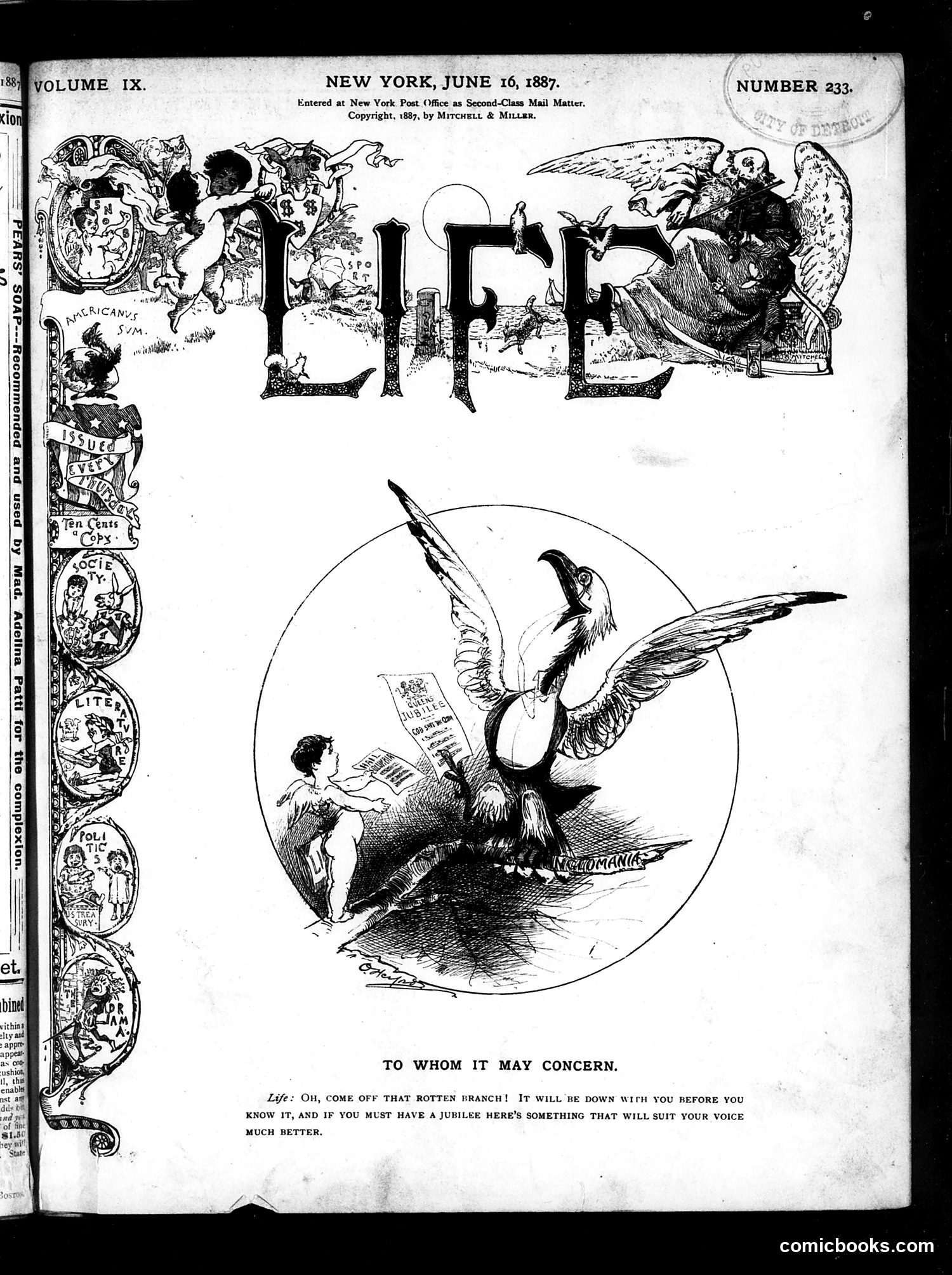
This page features a satirical cartoon titled "To Whom It May Concern." The circular illustration shows a winged, eagle-like creature labeled "Britannia" confronting a small human figure. The creature clutches documents and appears aggressive or threatening. The accompanying text reads: "Life: Oh, come off that rotten branch! It will be down with you before you know it, and if you must have a jubilee here's something that will suit your voice much better." The cartoon likely satirizes British imperial power and possibly tensions between the U.S. and Britain. The "jubilee" reference suggests Queen Victoria's Golden Jubilee (1887). The rotten branch metaphor implies British power is weakening or unstable. The overall message appears to warn Britain against overreach or threaten American resistance to British dominance.
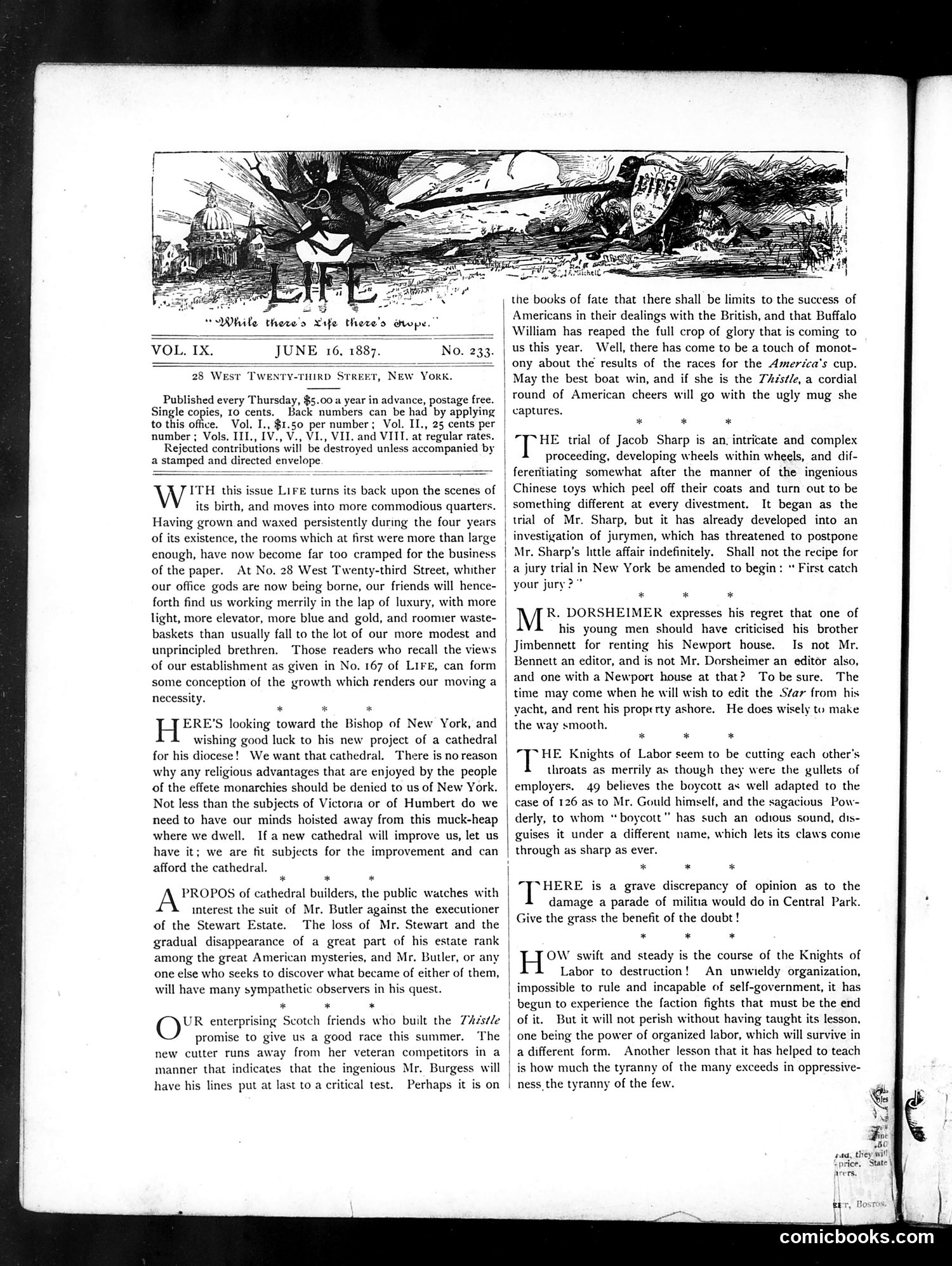
The masthead illustration shows a figure sitting beneath a gnarled tree with the caption "'While there's life there's hope.'" This appears to be Life's symbolic logo rather than political commentary. The page consists primarily of editorial commentary on contemporary issues: the America's Cup yacht race, Jacob Sharp's legal trial (described as complex and developing), disputes between editors Dorsheimer and Jimmett over a Newport house rental, labor conflicts involving the Knights of Labor and boycotts, concerns about militia use in Central Park, and organized labor's growing power. No specific political figures are caricatured on this page. The content addresses institutional and social tensions of 1887 rather than partisan politics.
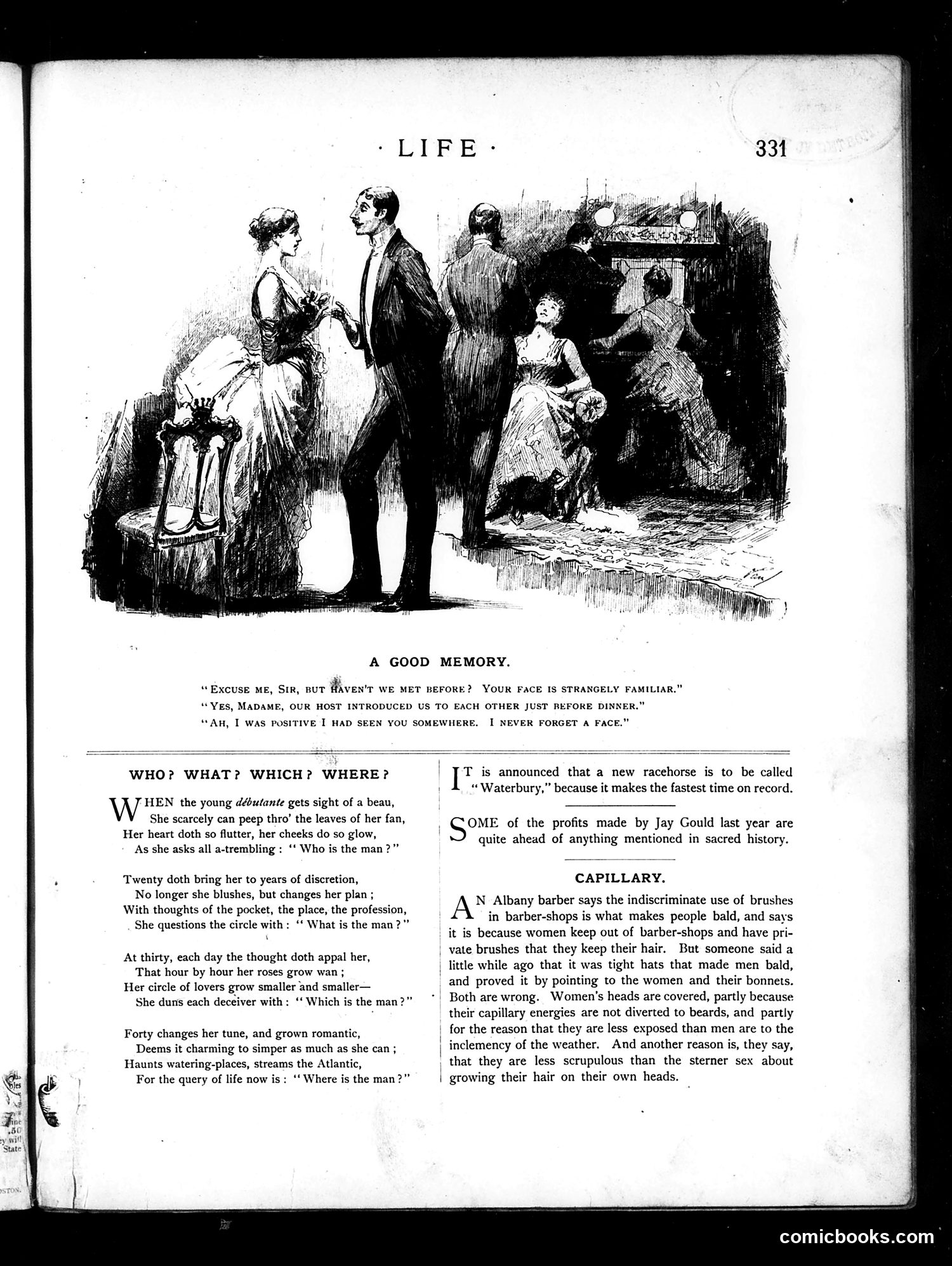
**The Cartoon:** The top illustration shows a social encounter where a well-dressed man and woman meet at what appears to be a formal gathering. The woman says she finds his face "strangely familiar," and he responds that their host introduced them just before dinner. The woman insists she never forgets a face, implying they've met elsewhere. **The Satire:** This is a gentle social comedy about the awkwardness of encountering someone in a new context. It plays on the common embarrassment of not remembering where you know someone from, or the inverse—pretending familiarity when none exists. The humor lies in the uncomfortable social dynamics of upper-class gatherings and the politeness required to navigate uncertain acquaintance. **Cultural Context:** This reflects Victorian-era anxieties about social propriety and the performative nature of formal society.
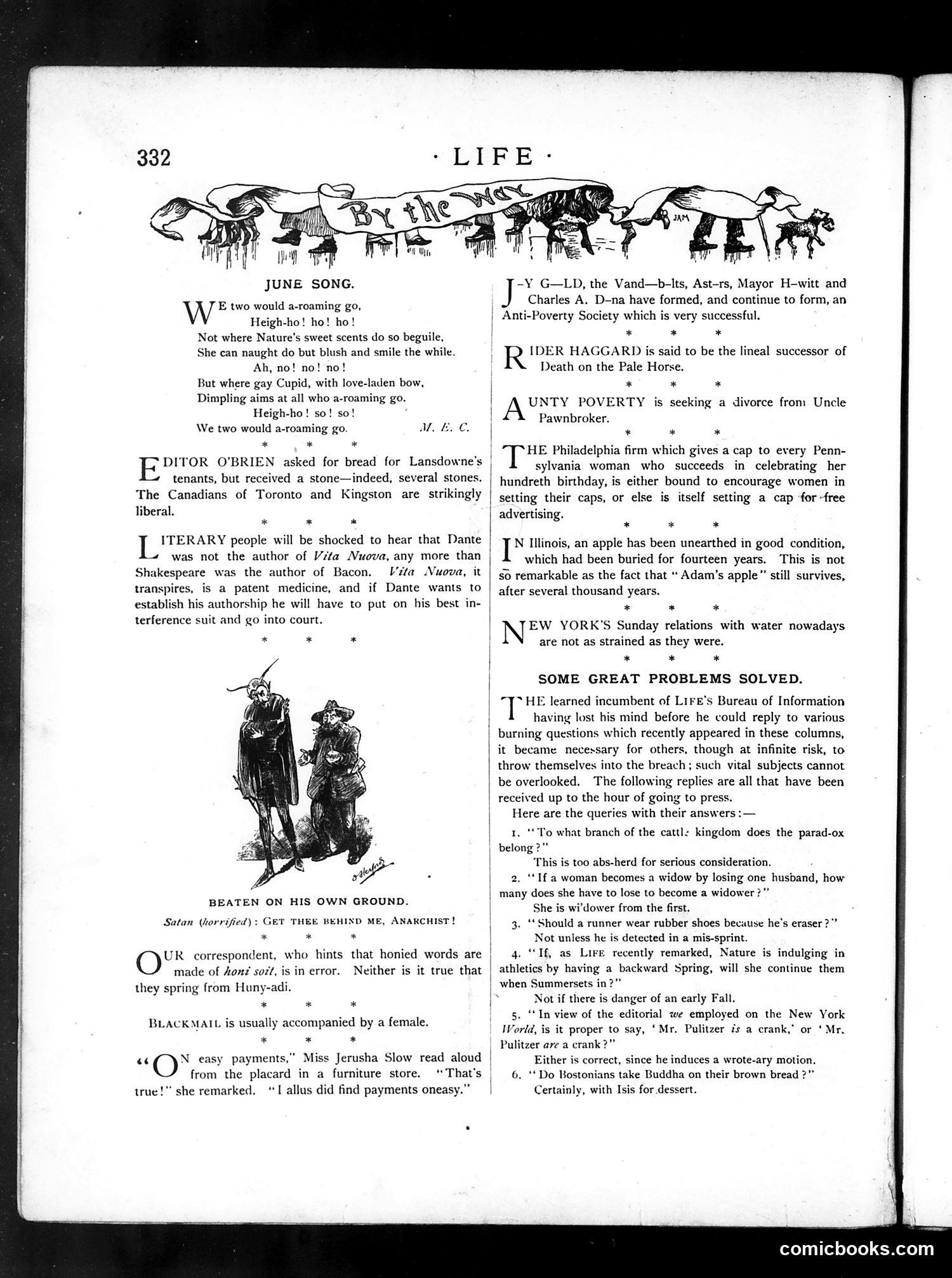
This cartoon depicts two figures—an anarchist (labeled "Satan") confronting what appears to be a well-dressed authority figure. The satire references Editor O'Brien's request for bread for Lansdowne's tenants, which received "a stone—indeed, several stones" instead. The joke turns on the phrase "beaten on his own ground": the anarchist, typically associated with violence and disruption, is himself being violently rejected—a humorous inversion suggesting even radicals face opposition when making demands. The accompanying text indicates this relates to Canadian tenant disputes and labor activism of the period. The cartoon mocks the anarchist's failed attempt at agitation by showing him physically rebuffed, suggesting his rhetoric lacks practical power.
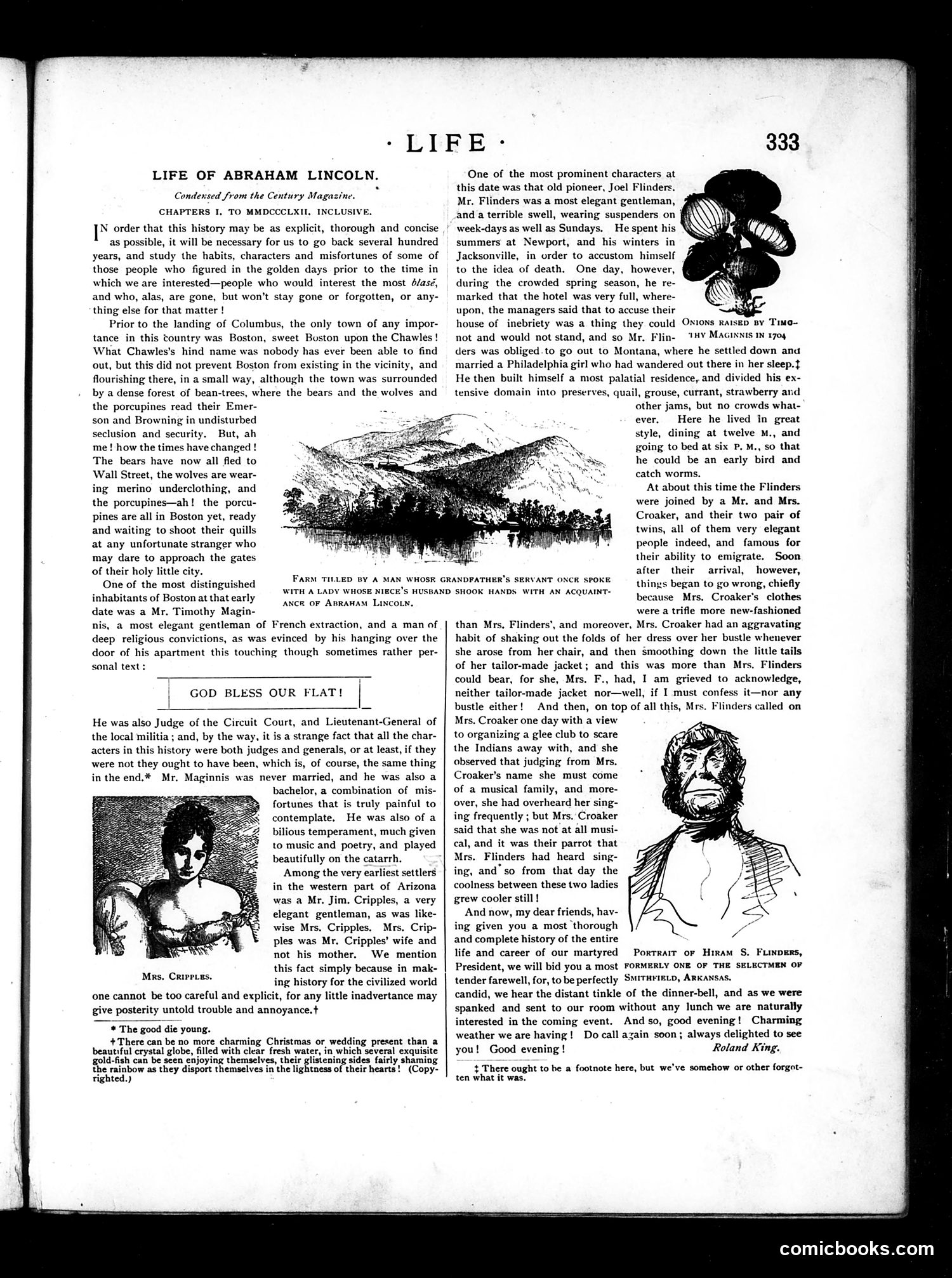
This page contains an article titled "Life of Abraham Lincoln" (continued from the Century Magazine) rather than political cartoons. The text discusses early American settlers and frontier life, including anecdotes about Mr. Flinders, a prominent early settler, and his wife Mrs. Croaker. Two portrait illustrations accompany the text: one labeled "Mrs. Cripples" and another identified as "Portrait of Hiram S. Flinders, Supposedly One of the Supposed Settlers of Arizona." The page appears to be historical/biographical rather than satirical commentary. The portraits seem intended to illustrate the colorful characters and personalities of America's pioneer era, presented in the magazine's characteristically humorous biographical style rather than as pointed political satire.
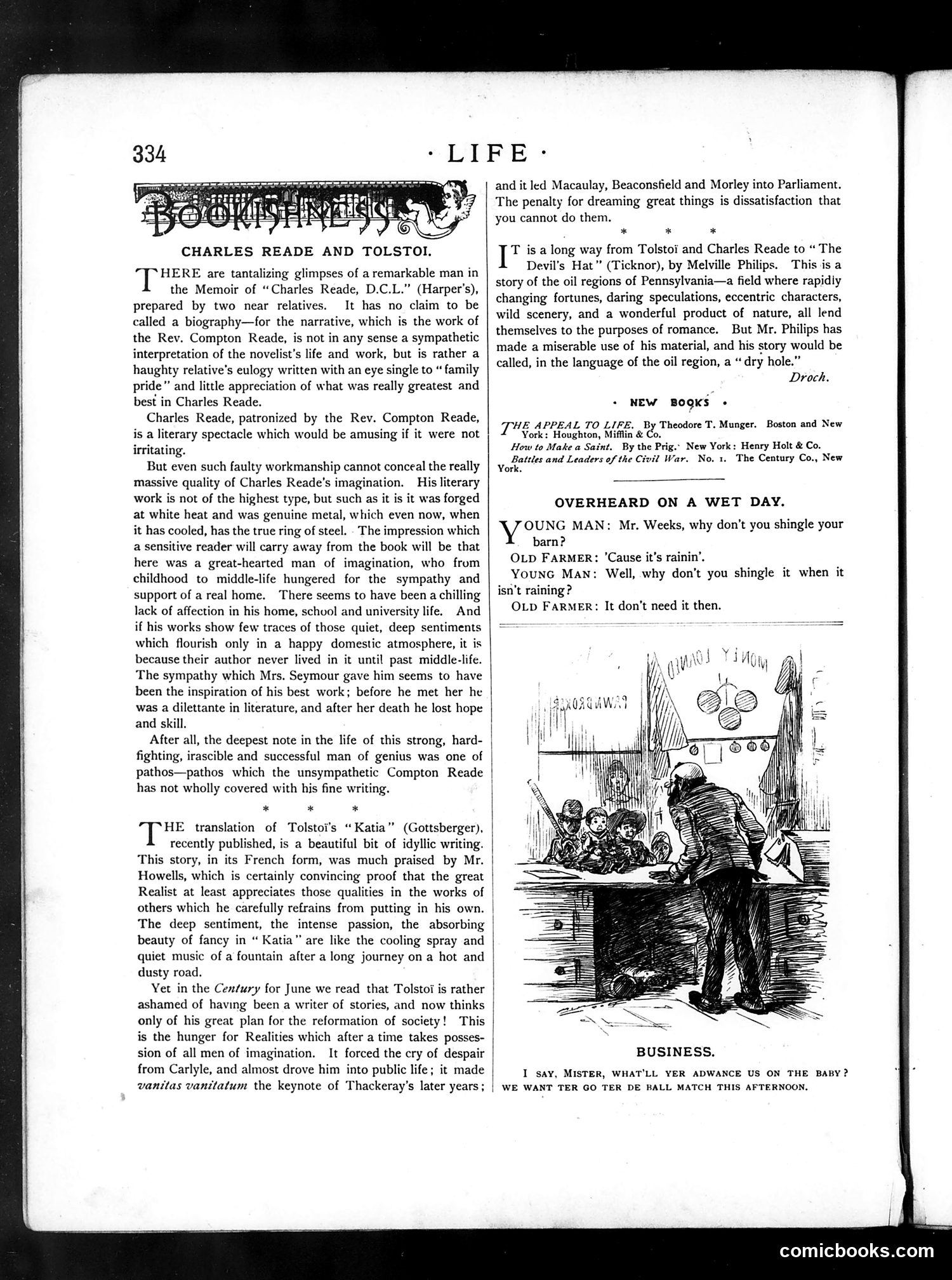
This page contains a literary review section rather than political cartoons. The main content discusses Charles Reade's memoir and Tolstoy's "Katia," with brief book announcements. The only cartoon present is titled "OVERHEARD ON A WET DAY" — a simple rural humor sketch showing an exchange between a young man and old farmer about shingling a barn in the rain. The young man questions the farmer's logic about waiting for better weather, to which the farmer replies he doesn't need it. This appears to be gentle, universal humor about rural stubbornness rather than political satire. The page's primary purpose is book reviews and literary commentary, not satirical commentary on current events.
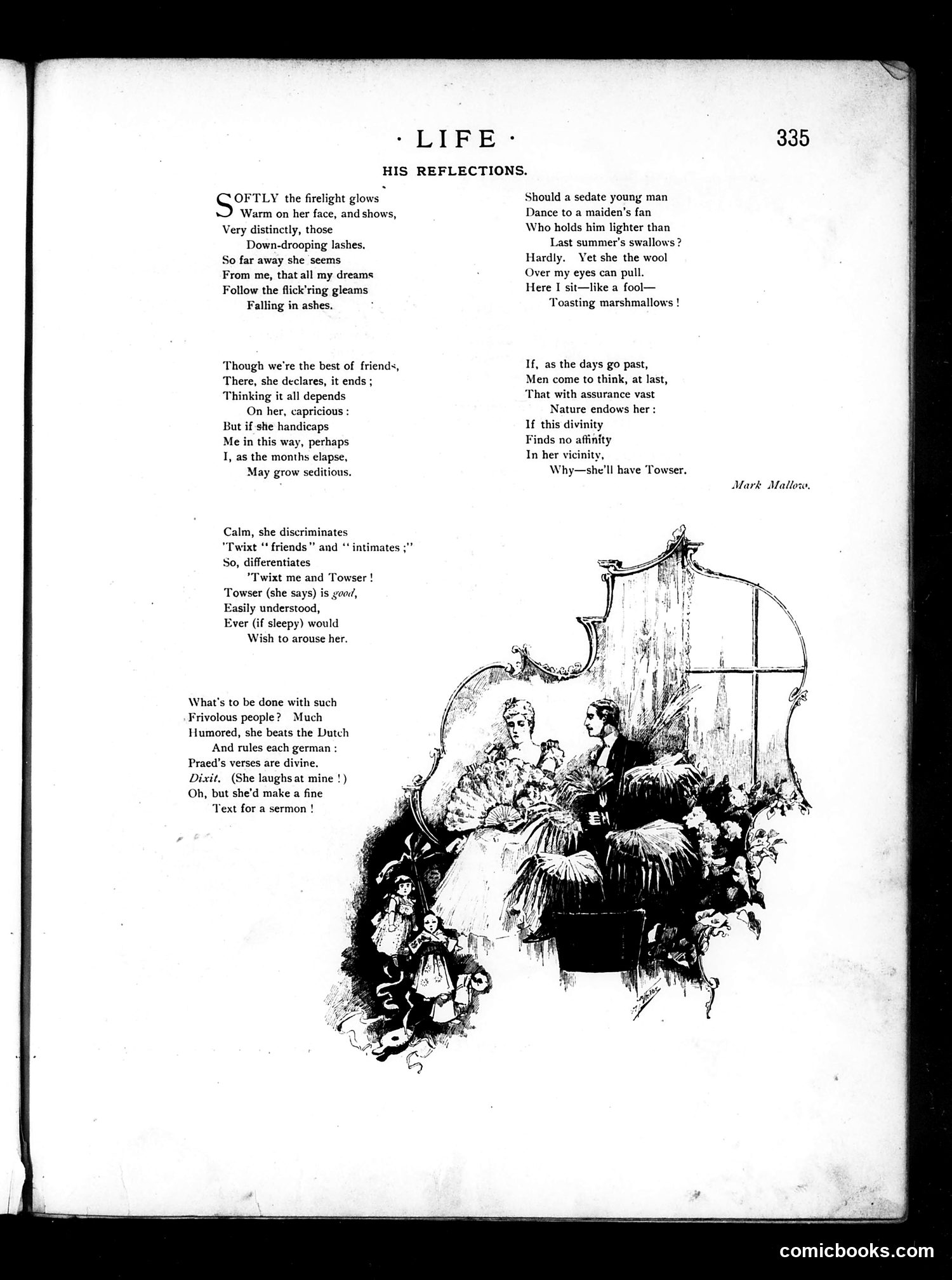
This page presents "His Reflections," a poem by Mark Mallows accompanied by an illustration. The text satirizes a young man's indecisive romantic musings about a woman—debating whether to pursue her seriously or remain emotionally detached. The illustration shows a couple in an ornate interior setting, likely from the late 19th or early 20th century, with decorative cherubs and flourishes surrounding them. The woman appears engaged while the man seems preoccupied or distracted. The satire targets masculine ambivalence in courtship: the speaker boasts of friendship while secretly fearing commitment, worrying the woman might "handicap" him as months pass. The poem mocks this vacillation as foolish, suggesting nature will ultimately decide the matter. The overall message critiques male indecision in romantic relationships—a common theme in period humor magazines.
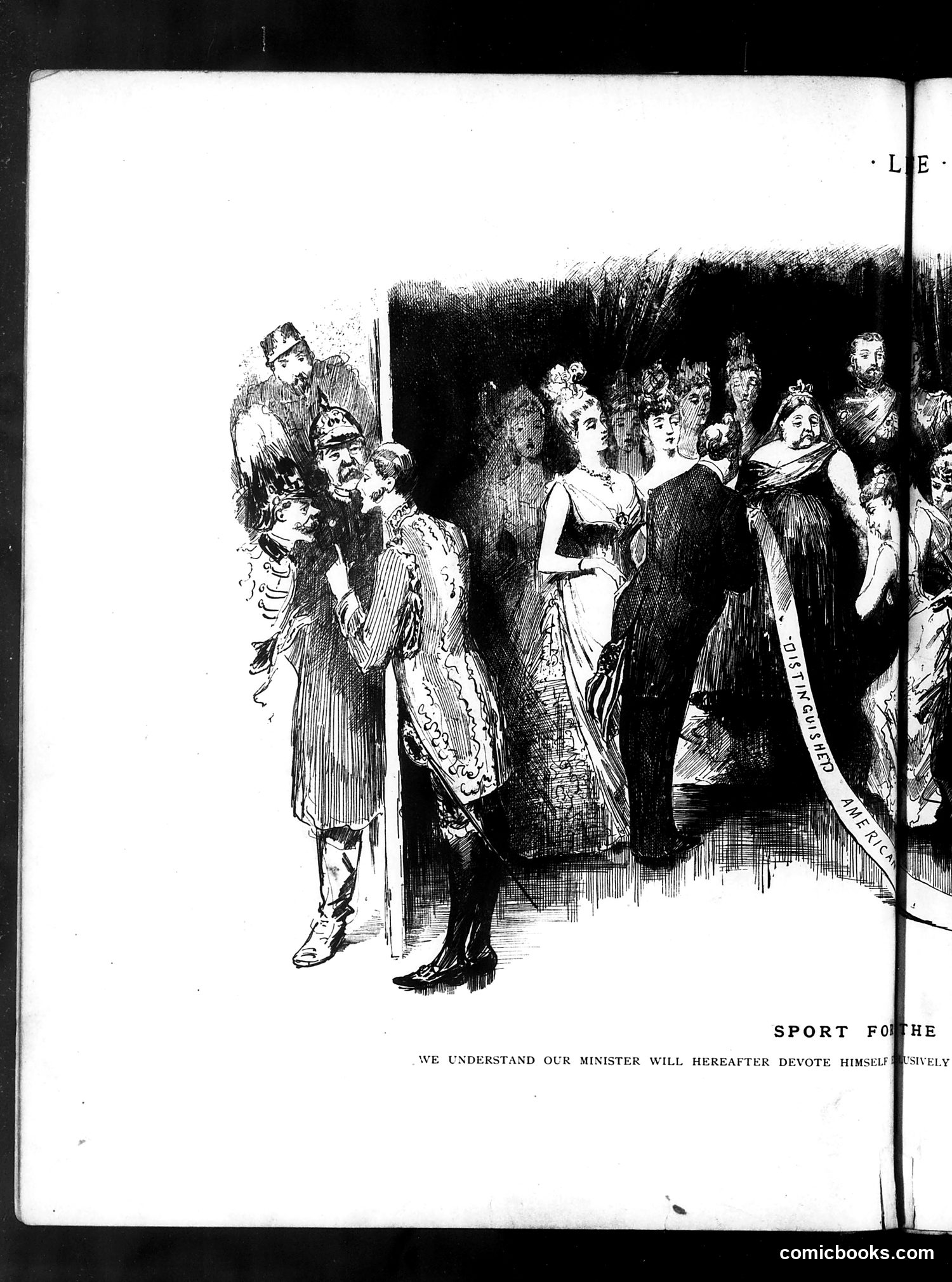
This is a satirical political cartoon from *Life* magazine with the caption "We understand our minister will hereafter devote himself exclusively" (text appears cut off). The image depicts a formal social gathering—likely a ball or reception—with well-dressed aristocratic figures. On the left stands a military or government official being presented to elegantly dressed women in the crowd. The cartoon appears to satirize a political figure's shift from public duties to society life, suggesting he will now focus exclusively on attending high-society events rather than performing his governmental responsibilities. The specific minister referenced is unclear without the complete caption, but the satire targets the perceived abandonment of public service for social prominence—a common critique of 19th-century political figures.
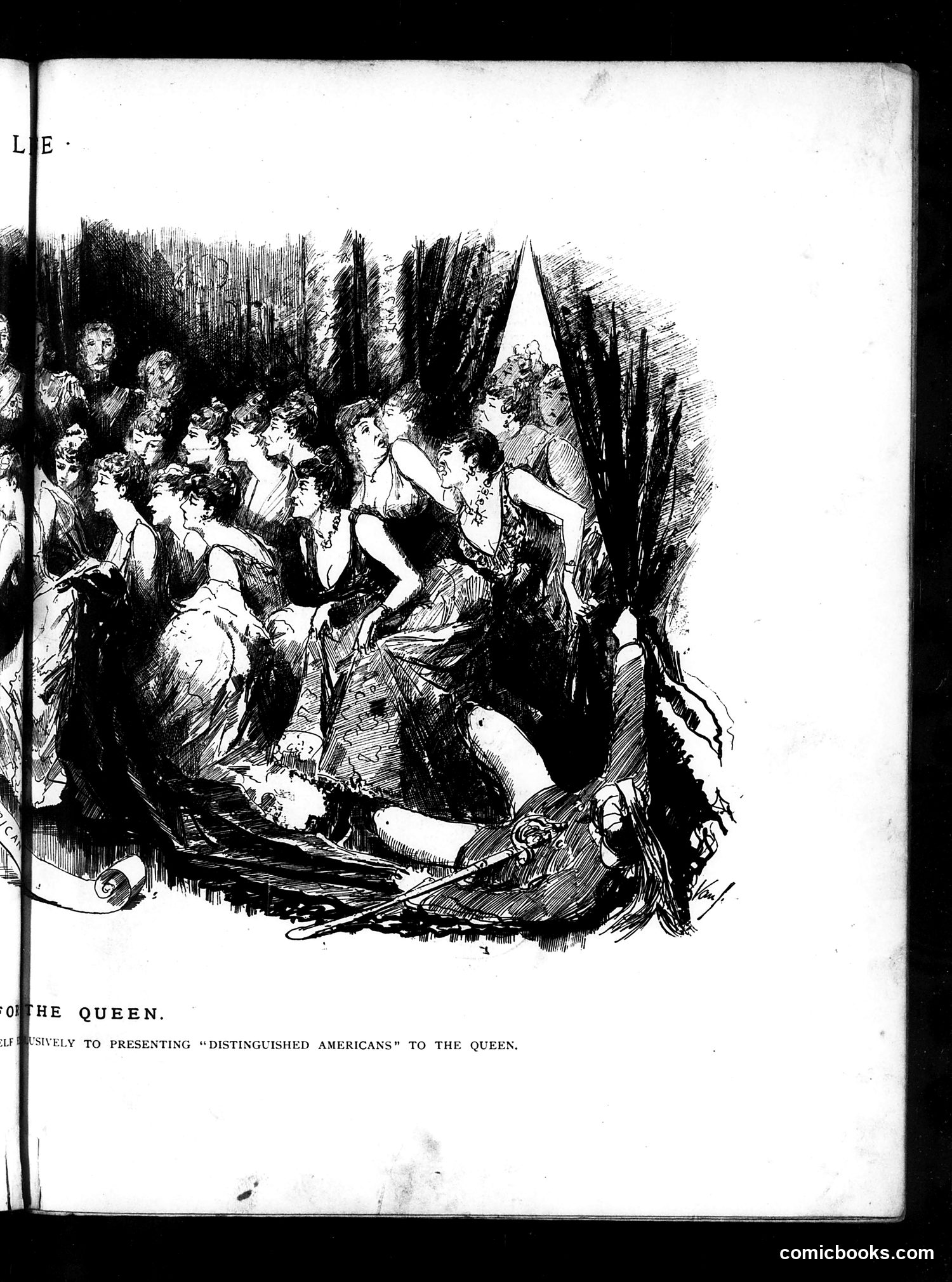
This satirical cartoon depicts a formal court presentation scene, with the caption indicating it shows "Distinguished Americans" being presented to the Queen (likely Queen Victoria, given Life magazine's 19th-century context). The satire appears to mock American pretension and social climbing—specifically, wealthy or prominent Americans seeking validation through royal recognition. The crowded, chaotic composition and the exaggerated expressions suggest the cartoon criticizes both the undignified eagerness of these Americans and the absurdity of their pursuit of aristocratic approval. The formal setting contrasts ironically with the somewhat frantic energy of the scene, amplifying the satirical point: that Americans' obsession with impressing European royalty was ridiculous and contrary to American democratic ideals.
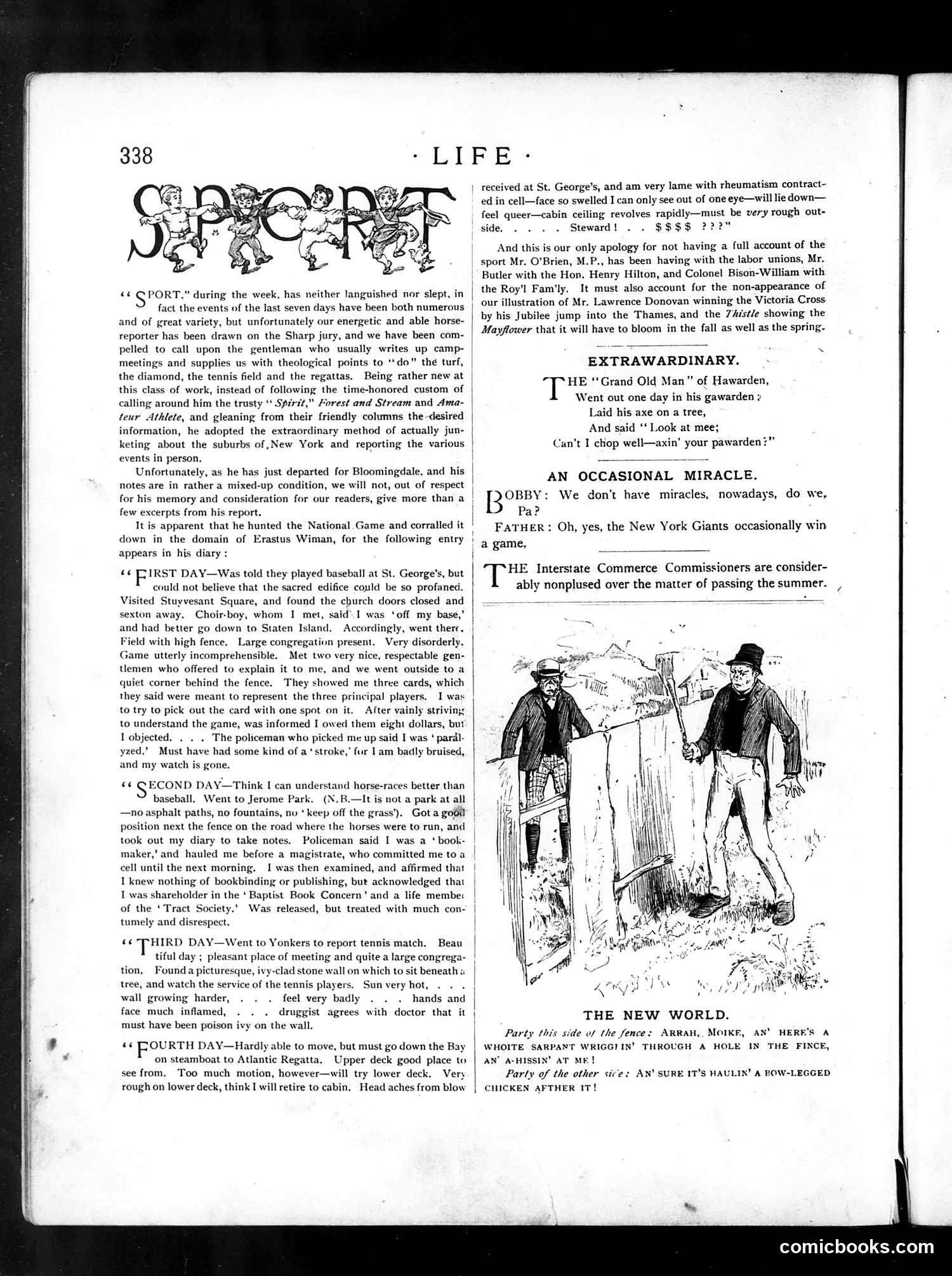
This cartoon satirizes immigration and labor concerns in early 20th-century America. Two figures at a gate represent established Americans confronting a new immigrant (depicted through the hole in the fence). The caption ridicules nativist anxieties: "Here's a white sarsaparilla wriggin' through a hole in the fence, an' a-hissin' at me! Party of the other u's: An' sure it's haulin' a bow-legged chicken after it!" The crude dialect and animal imagery mock xenophobic stereotypes while the "sarsaparilla" reference (suggesting the figure's whiteness as a defensive claim) highlights absurd racial categorizations. The cartoon appears to critique American prejudice against immigrants, treating fear of newcomers as ridiculous and contradictory to American values—hence the ironic title "The New World."
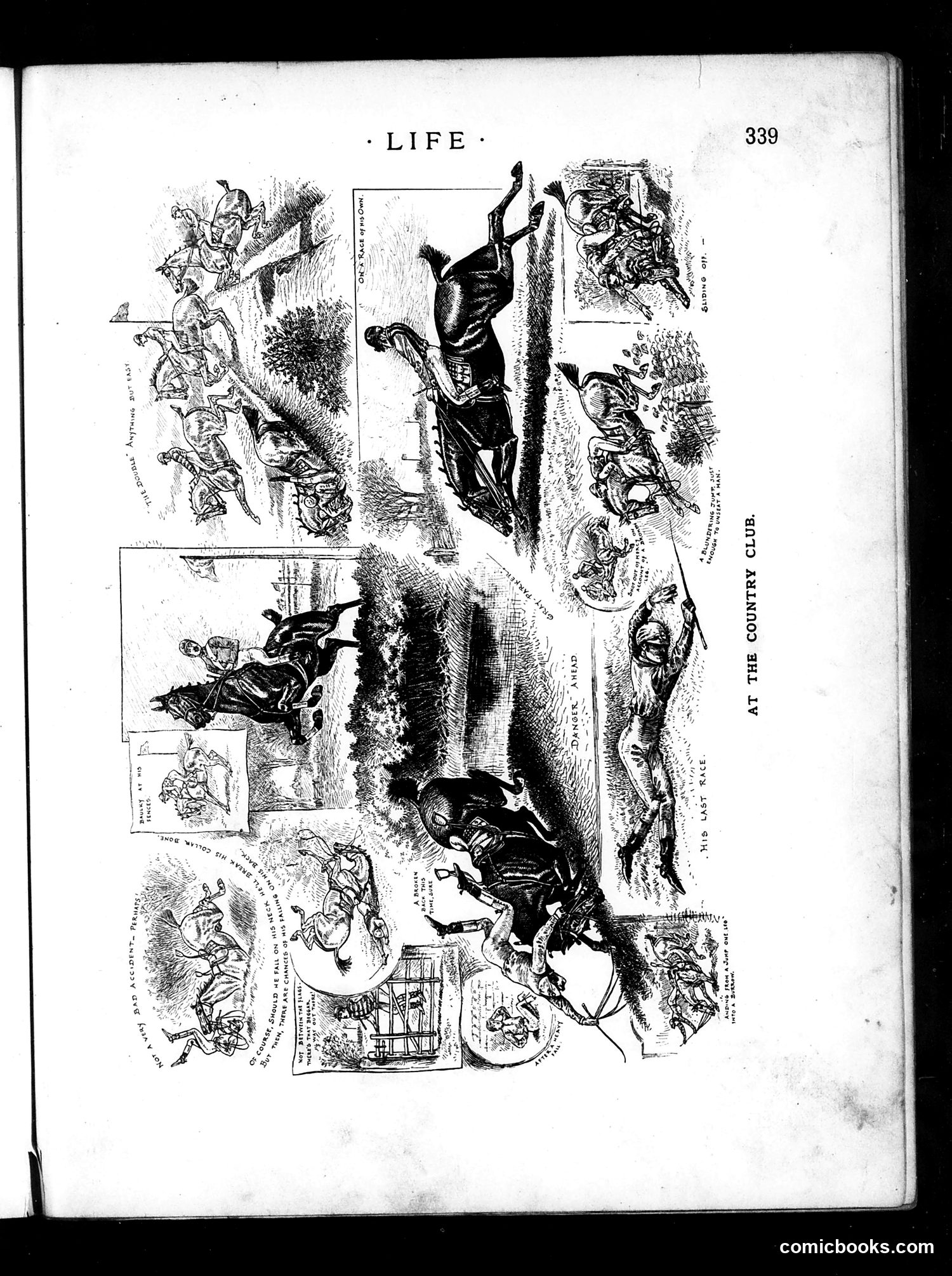
I cannot reliably read the OCR text on this page—it appears heavily corrupted or inverted. While the image shows multiple satirical sketches and caricatures typical of Life magazine, I cannot confidently identify the specific figures, historical events, or political references depicted without legible text captions. The page contains what appears to be a central large figure and numerous smaller vignettes arranged around it, suggesting a theme-based satirical commentary, likely from the late 19th or early 20th century based on the illustration style. However, without clear textual support, I cannot specify which politicians, events, or social issues are being mocked. To properly explain this page's meaning to a modern reader, I would need legible captions or clearer context.
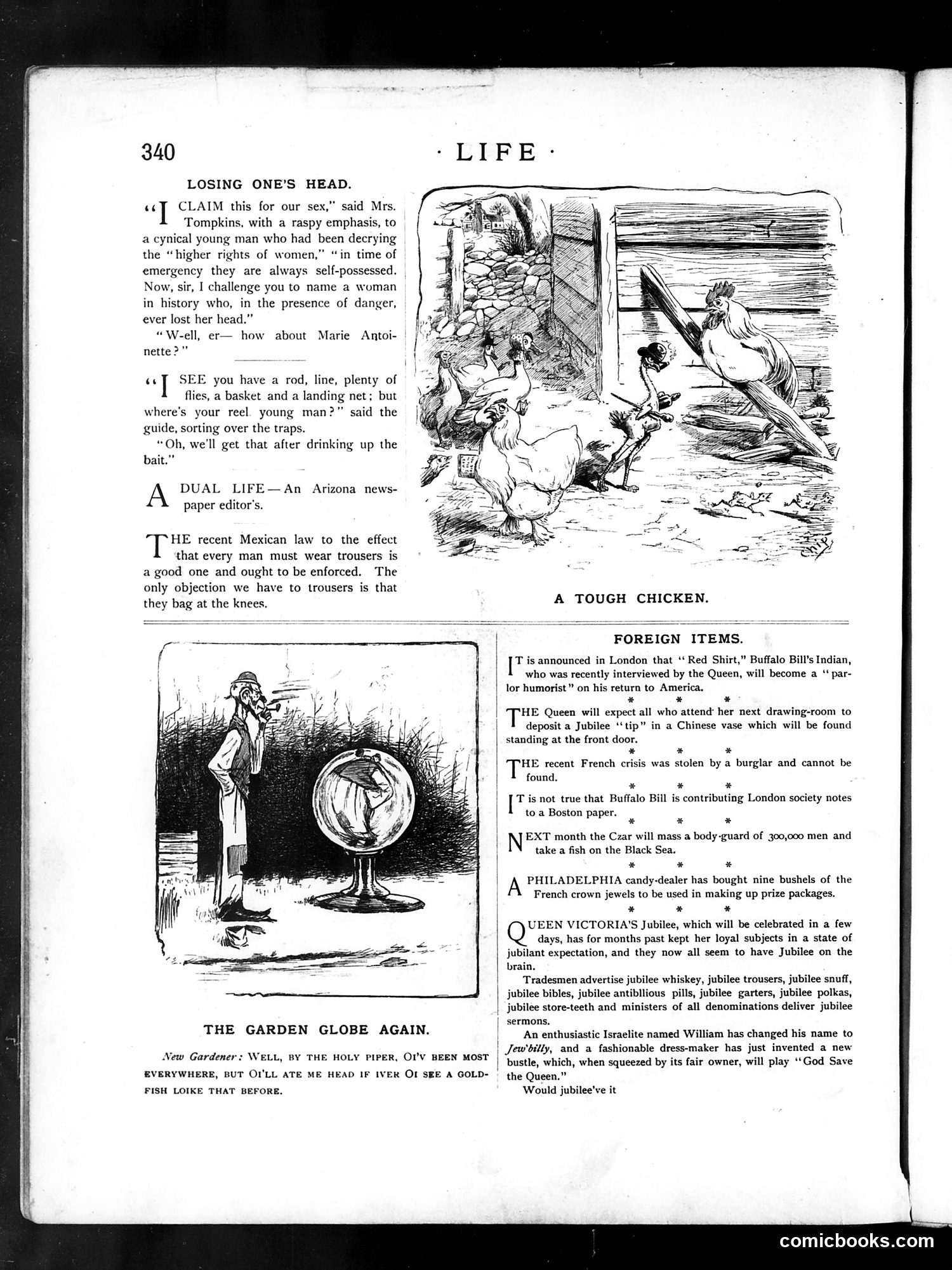
This page contains three separate humor pieces: **"Losing One's Head"**: A dialogue joke where Mrs. Tompkins claims women never lose composure in danger. When challenged to name a woman in history who did, her opponent responds "Marie Antoinette"—a reference to the French queen who was executed by guillotine during the Revolution. The joke's dark humor relies on readers understanding that she literally lost her head. **"A Tough Chicken"**: An illustration showing men struggling with an aggressive chicken, humorously depicting ordinary poultry as formidable opposition. **"Foreign Items"**: A satirical section mocking current events, particularly Queen Victoria's Diamond Jubilee celebration (which appears to have saturated British commerce). The jokes ridicule absurd applications of "jubilee" branding and exaggerate international incidents for comedic effect. The page exemplifies Life's style: political-social satire mixing wordplay, visual gags, and commentary on contemporary news and commercialism.
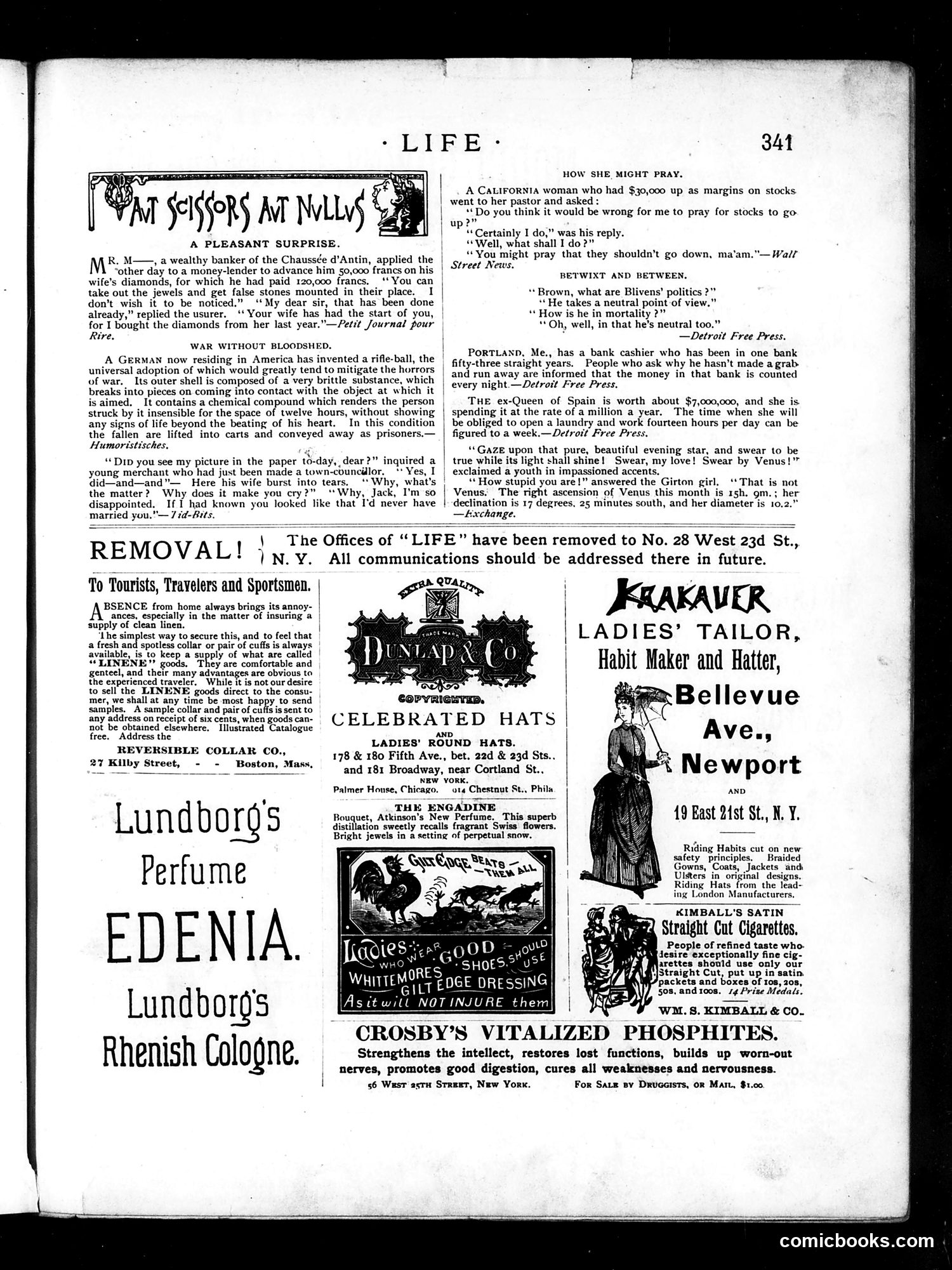
This page is primarily **advertising with satirical filler content** typical of Life magazine's format. The cartoon section contains brief humorous anecdotes rather than visual cartoons: **"A Pleasant Surprise"**: A wealthy banker attempts to deceive a moneylender by replacing his wife's expensive diamonds with fakes—only to learn the moneylender already did this to the wife years earlier. The satire targets marital infidelity and deception. **"War Without Bloodshed"**: A German inventor creates a non-lethal rifle bullet that renders victims unconscious for twelve hours. The satire mocks both German militarism and naive optimism about "humane" warfare. **"Betwixt and Between"**: A character named Blivens takes a "neutral point of view" on politics and morality—satirizing fence-sitters and the morally uncommitted. **The Stock Prayer**: A woman asks her pastor if she can pray for stock prices to rise, highlighting the era's stock speculation culture and religious hypocrisy regarding wealth-seeking. These pieces mock contemporary concerns: wealth obsession, marital infidelity, technological warfare, and moral relativism in Gilded Age America.
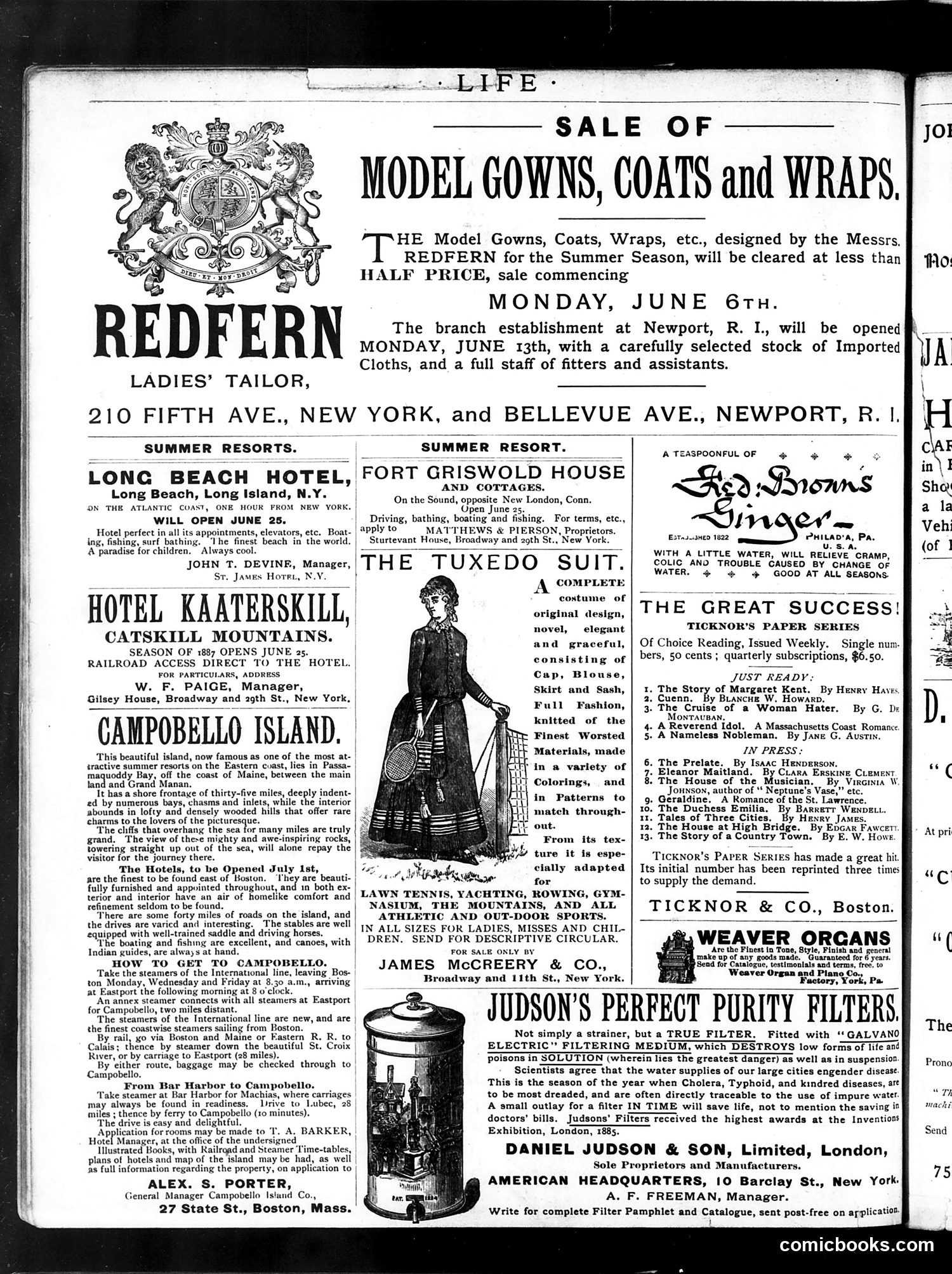
This page is primarily an **advertisement section** rather than satirical editorial content. It contains various summer resort and product advertisements from the 1880s. The visual elements include: 1. **Redfern Ladies' Tailor advertisement** (top) - promoting a sale of model gowns, coats, and wraps at half price, with locations on Fifth Avenue in New York and Newport, Rhode Island. 2. **Fashion illustration** (center) - showing "The Tuxedo Suit," a woman's formal gown design with detailed description of its construction and materials. This represents fashionable women's formal wear of the era. 3. **Ticknor's Paper Series advertisement** (right) - promoting affordable literary reading material. 4. **Product advertisements** - for Weaver Organs and Judson's Perfect Purity Filters. The page reflects **Gilded Age consumer culture**: luxury resort destinations, high-end tailoring services, and consumer goods marketed to affluent readers. The numerous resort ads (Long Beach Hotel, Hotel Kaaterskill, Campobello Island) indicate this Life magazine issue targeted wealthy leisure-class readers planning summer vacations.
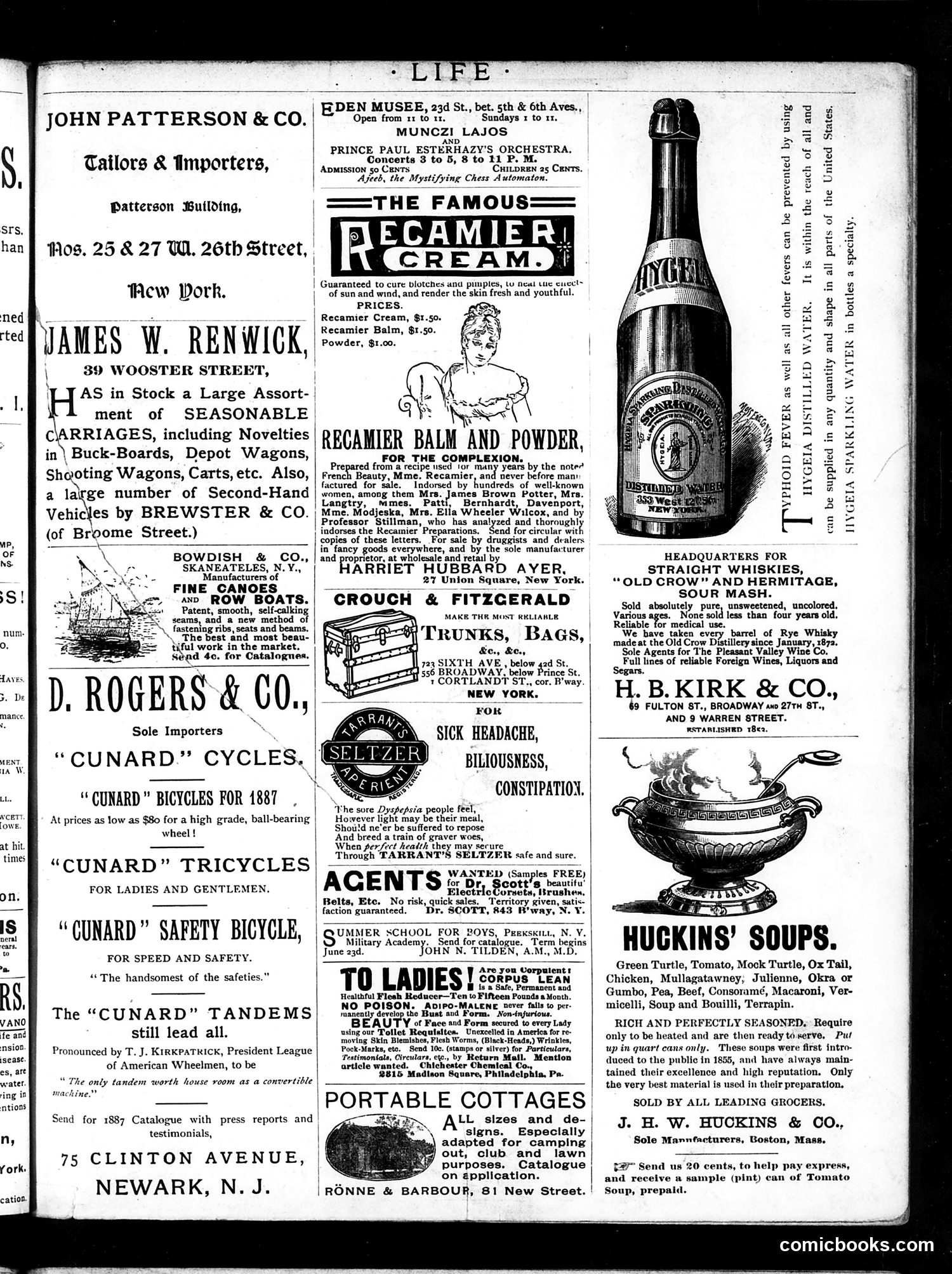
This is primarily a **commercial advertising page** from *Life* magazine (circa 1887, based on bicycle model years cited). Rather than political satire or editorial cartoons, the page showcases late 19th-century consumer products through illustrated ads. Notable featured products include: - **"Cunard" bicycles and tricycles** — emerging transportation technology marketed at various price points - **Recamier beauty cream** — endorsed by famous actresses (Bernhardt, Langtry, Patti), targeting wealthy women concerned with complexion - **Tarrant's Seltzer** — patent medicine for digestive complaints - **Carriage manufacturers and boat builders** — luxury goods for the wealthy The ads reflect Gilded Age consumer culture: beauty products endorsed by celebrities, dubious health tonics, and expensive vehicles. Most ads target affluent New Yorkers. The page shows advertising as *Life*'s primary revenue source during this era, with minimal editorial content visible.
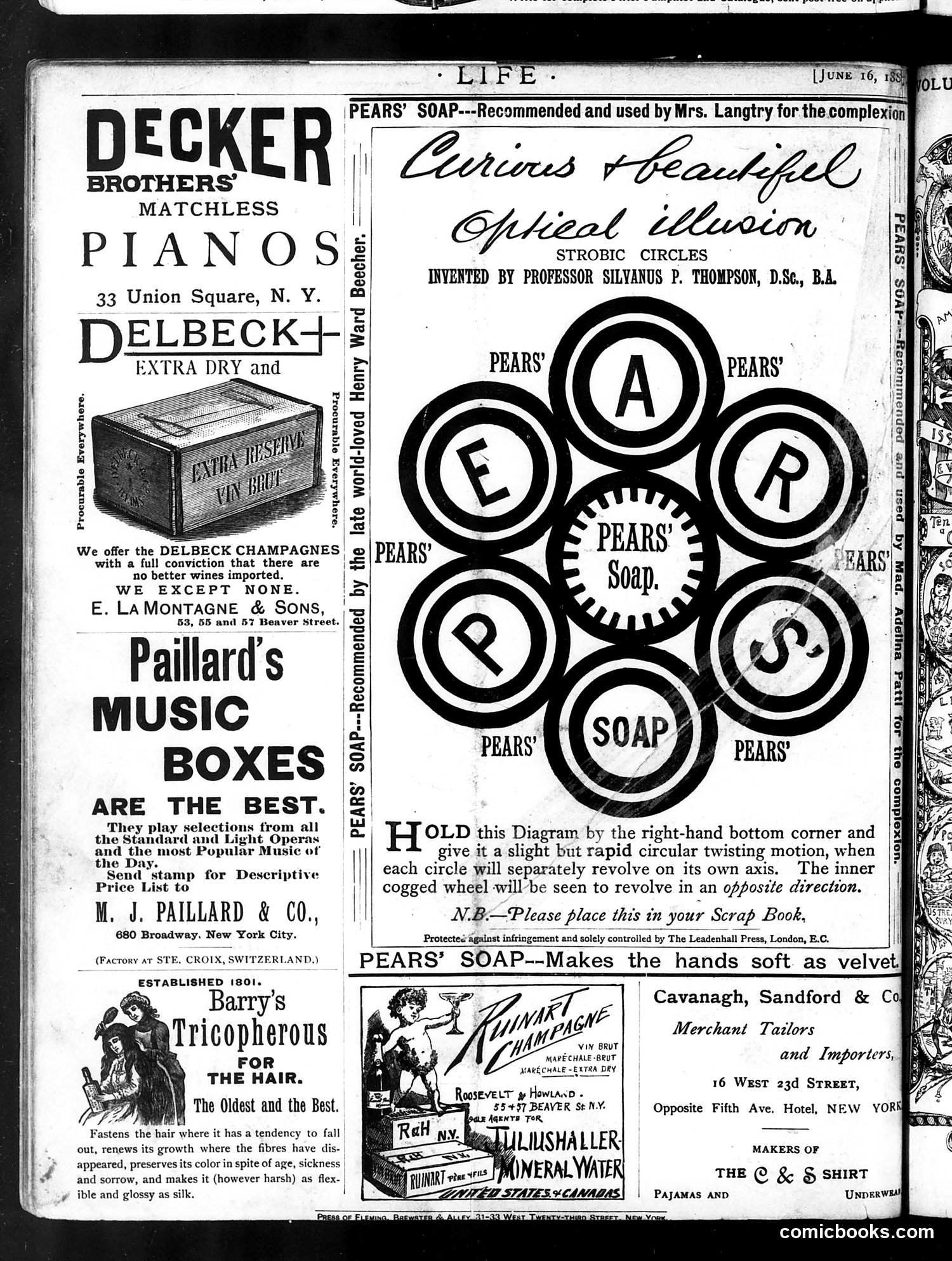
This page is primarily **advertising**, not political satire. The dominant content is a Pears' Soap promotional feature centered on "Strobic Circles"—an optical illusion device invented by Professor Silvanus P. Thompson. Users would hold the printed diagram by a corner and twist it to create the visual effect of rotating concentric circles. The advertisement references **Mrs. Langtry**, likely Lillie Langtry, a famous actress and socialite of the era, lending celebrity endorsement to the soap's complexion benefits—a common advertising strategy of the period. The remainder of the page contains standard advertisements for luxury goods: Decker Brothers pianos, Delbeck champagne, Paillard music boxes, Barry's hair tonic, and men's clothing. This reflects the magazine's affluent readership and the commercial nature of Life magazine in the 1890s.