
Life, 1887-06-16 · page 2 of 16
Life — June 16, 1887 — page 2: what you’re looking at
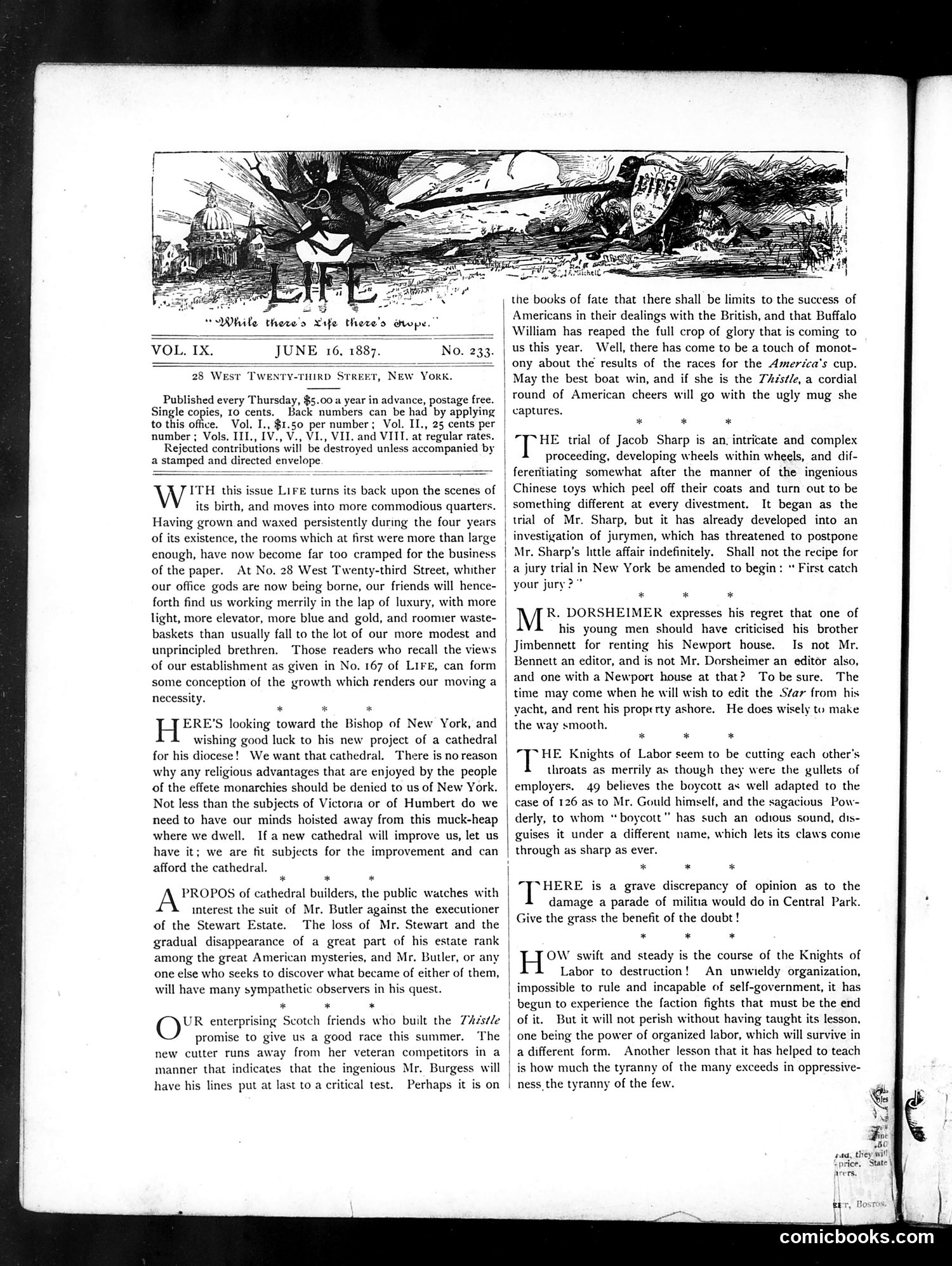
What you’re looking at
The masthead illustration shows a figure sitting beneath a gnarled tree with the caption "'While there's life there's hope.'" This appears to be Life's symbolic logo rather than political commentary. The page consists primarily of editorial commentary on contemporary issues: the America's Cup yacht race, Jacob Sharp's legal trial (described as complex and developing), disputes between editors Dorsheimer and Jimmett over a Newport house rental, labor conflicts involving the Knights of Labor and boycotts, concerns about militia use in Central Park, and organized labor's growing power. No specific political figures are caricatured on this page. The content addresses institutional and social tensions of 1887 rather than partisan politics.
📄 Transcribed text from this page (OCR, searchable)
Machine-transcribed from the original scan — historical spelling and the odd misread are preserved.
While there's Life there's dope.” VOL. IX. "JUNE 16, 1887. Published every Thursday, $5.00 a year in advance, postage free. Single copies, 10 cents. Back numbers can be had by applying to this office. number ; Vols. III., IV., V., VI., VII. and VIII. at regular rates. Rejected contributions will be destroyed unless accompanied by a stamped and directed envelope V ITH this issue Lire turns its back upon the scenes of its birth, and moves into more commodious quarters. Having grown and waxed persistently during the four years of its existence, the rooms which at first were more than large enough, have now become far too cramped for the business of the paper. At No. 28 West Twenty-third Street, whither our office gods are now being borne, our friends will hence- forth find us working merrily in the lap of luxury, with more light, more elevator, more blue and gold, and roomier waste- baskets than usually fall to the lot of our more modest and unprincipled brethren. Those readers who recall the views of our establishment as given in No. 167 of LIFE, can form some conception of the growth which renders our moving a necessity. * * * H =: looking toward the Bishop of New York, and wishing good luck to his new project of a cathedral for his diocese! We want that cathedral. There is noreason why any religious advantages that are enjoyed by the people of the effete monarchies should be denied to us of New York. Not less than the subjects of Victoria or of Humbert do we need to have our minds hoisted away from this muck-heap where we dwell. If a new cathedral will improve us, let us have it; we are fit subjects for the improvement and can afford the cathedral. * * * PROPOS of cathedral builders, the public watches with | interest the suit of Mr. Butler against the executioner of the Stewart Estate. The loss of Mr. Stewart and the gradual disappearance of a great part of his estate rank | among the great American mysteries, and Mr. Butler, or any one else who seeks to discover what became of either of them, | will have many sympathetic observers in his quest. * * * UR enterprising Scotch friends who built the 7/éstle promise to give us a good race this summer. The new cutter runs away from her veteran competitors in a manner that indicates that the ingenious Mr. Burgess will have his lines put at last to a critical test. Perhaps it is on Vol. I., $1.50 per number; Vol. II., 25 cents per | | something different at every divestment. | trial of Mr. Sharp, but it has already developed into an the books of fate that there shall be limits to the success of | Americans in their dealings with the British, and that Buffalo | William has reaped the full crop of glory that is coming to us this year. Well, there has come to be a touch of monot- | ony about the results of the races for the Amerzca's cup. May the best boat win, and if she is the 7zst/e, a cordial round of American cheers will go with the ugly mug she captures. * * * "T°HE trial of Jacob Sharp is an. intricate and complex proceeding, developing wheels within wheels, and dif- | fereritiating somewhat after the manner of the ingenious Chinese toys which peel off their coats and turn out to be It began as the investigation of jurymen, which has threatened to postpone Mr. Sharp's little affair indefinitely. Shall not the recipe for a jury trial in New York be amended to begin: “ First catch your jury?” * * * R. DORSHEIMER expresses his regret that one of his young men should have criticised his brother Jimbennett for renting his Newport house. Is not Mr. | Bennett an editor, and is not Mr. Dorsheimer an editor also, and one with a Newport house at that? Tobe sure. The time may come when he will wish to edit the Sfar from his yacht, and rent his property ashore. He does wisely to make the way smooth. * * * Te Knights of Labor seem to be cutting each other's throats as merrily as though they were the gullets of employers. 49 believes the boycott as well adapted to the case of 126 as to Mr. Gould himself, and the sagacious Pow- derly, to whom “ boycott” has such an odious sound, dis- guises it under a different name, which lets its claws come through as sharp as ever. * * * "TBERE is a grave discrepancy of opinion as to the damage a parade of militia would do in Central Park. Give the grass the benefit of the doubt! * * * OW swift and steady is the course of the Knights of Labor to destruction! An unwieldy organization, impossible to rule and incapable of self-government, it has begun to experience the faction fights that must be the end of it. But it will not perish without having taught its lesson, | one being the power of organized labor, which will survive in a different form. Another lesson that it has helped to teach is how much the tyranny of the many exceeds in oppressive- ness the tyranny of the few. they will “price, ‘State |