
Life, 1887-06-16 · page 6 of 16
Life — June 16, 1887 — page 6: what you’re looking at
What you’re looking at
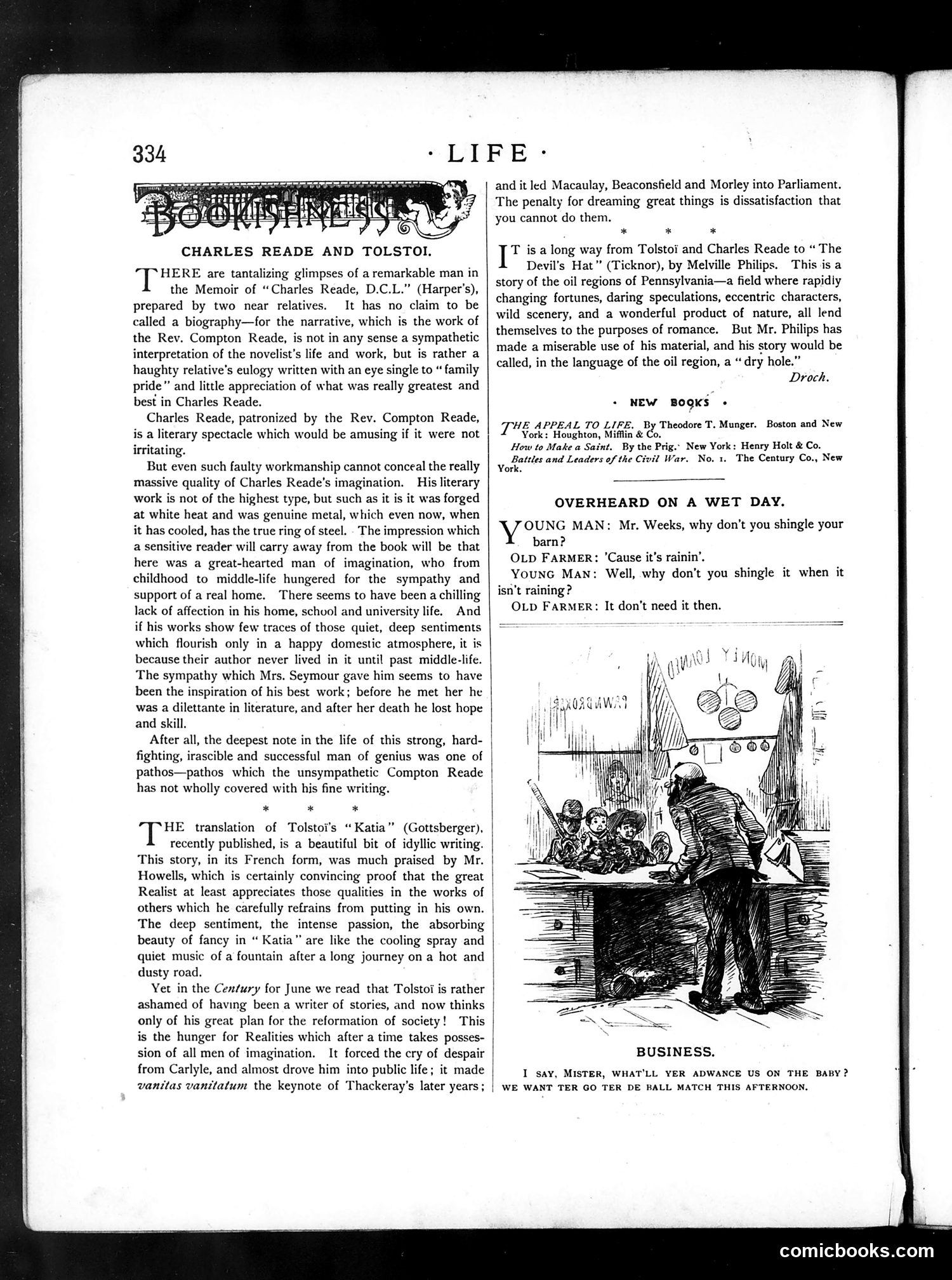
This page contains a literary review section rather than political cartoons. The main content discusses Charles Reade's memoir and Tolstoy's "Katia," with brief book announcements. The only cartoon present is titled "OVERHEARD ON A WET DAY" — a simple rural humor sketch showing an exchange between a young man and old farmer about shingling a barn in the rain. The young man questions the farmer's logic about waiting for better weather, to which the farmer replies he doesn't need it. This appears to be gentle, universal humor about rural stubbornness rather than political satire. The page's primary purpose is book reviews and literary commentary, not satirical commentary on current events.
📄 Transcribed text from this page (OCR, searchable)
Machine-transcribed from the original scan — historical spelling and the odd misread are preserved.
~ LIFE : CHARLES READE AND TOLSTOI. HERE are tantalizing glimpses of a remarkable man in the Memoir of “Charles Reade, D.C.L.” (Harper's), prepared by two near relatives. It has no claim to be called a biography—for the narrative, which is the work of the Rev. Compton Reade, is not in any sense a sympathetic interpretation of the novelist’s life and work, but is rather a haughty relative’s eulogy written with an eye single to “ family pride” and little appreciation of what was really greatest and best in Charles Reade. Charles Reade, patronized by the Rev. Compton Reade, is a literary spectacle which would be amusing if it were not irritating. But even such faulty workmanship cannot conceal the really massive quality of Charles Reade’s imagination. His literary work is not of the highest type, but such as it is it was forged at white heat and was genuine metal, which even now, when it has cooled, has the true ring of steel. . The impression which a sensitive reader will carry away from the book will be that here was a great-hearted man of imagination, who from childhood to middle-life hungered for the sympathy and support of a real home. There seems to have been a chilling lack of affection in his home, schvol and university life. And if his works show few traces of those quiet, deep sentiments which flourish only in a happy domestic atmosphere, it is because their author never lived in it until past middle-life. The sympathy which Mrs. Seymour gave him seems to have been the inspiration of his best work; before he met her he was a dilettante in literature, and after her death he lost hope and skill. After all, the deepest note in the life of this strong, hard- fighting, irascible and successful man of genius was one of | pathos—pathos which the unsympathetic Compton Reade has not wholly covered with his fine writing. * * * HE translation of Tolstoi’s “Katia” (Gottsberger), recently published, is a beautiful bit of idyllic writing. This story, in its French form, was much praised by Mr. | Howells, which is certainly convincing proof that the great Realist at least appreciates those qualities in the works of | others which he carefully refrains from putting in his own. The deep sentiment, the intense passion, the absorbing | beauty of fancy in “ Katia” are like the cooling spray and | quiet music of a fountain after a long journey on a hot and dusty road. Yet in the Century for June we read that Tolstoi is rather ashamed of having been a writer of stories, and now thinks only of his great plan for the reformation of society! This is the hunger for Realities which after a time takes posses- sion of all men of imagination. It forced the cry of despair from Carlyle, and almost drove him into public life; it made and it led Macaulay, Beaconsfield and Morley into Parliament. The penalty for dreaming great things is dissatisfaction that you cannot do them. * * * ’ is a long way from Tolstoi and Charles Reade to “ The Devil's Hat” (Ticknor), by Melville Philips. This is a story of the oil regions of Pennsylvania—a field where rapidiy changing fortunes, daring speculations, eccentric characters, wild scenery, and a wonderful product of nature, all lend themselves to the purposes of romance. But Mr. Philips has made a miserable use of his material, and his story would be called, in the language of the oil region, a “dry hole.” Droch, NEW BOOKS - THE APPEAL TO LIFE. By Theodore T. Munger. Boston and New York: Houghton, Mifflin & Co. How to Make a Saint. By the Prig.» New York: Henry Holt & Co. Battles and Leaders of the Civil War. No. 1. The Century Co., New York. OVERHEARD ON A WET DAY. OUNG MAN: Mr. Weeks, why don’t you shingle your barn? OLD FARMER: ’Cause it’s rainin’. YouNnG MAN: Well, why don’t you shingle it when it isn’t raining? OLD FARMER: It don't need it then. BUSINESS. I say, MISTER, WHAT'LL YER ADWANCE US ON THE BABY? vanitas vanitatum the keynote of Thackeray's later years; | we WANT TER GO TER DE BALL MATCH THIS AFTERNOON, comicbooks.com