
A complete issue · 18 pages · 1887
Life — March 10, 1887
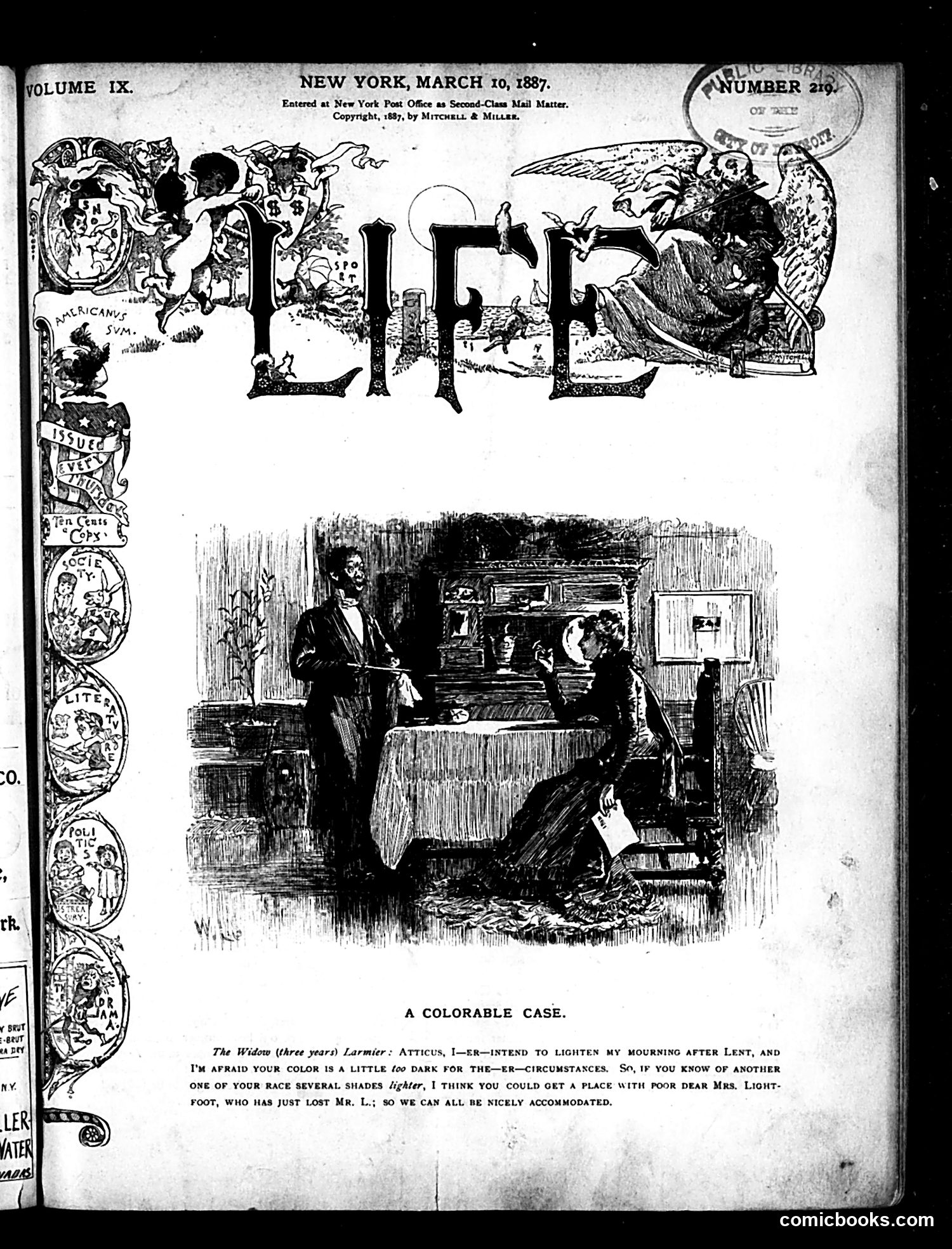
This 1887 *Life* magazine cartoon satirizes Victorian social conventions around mourning dress. The widow (identified as "three years" into mourning) consults a clergyman about her dark clothing, claiming it's "a little too dark" given her "circumstances." The joke turns on the double meaning of "colorable"—both her literal dress color and the phrase "a colorable excuse" (a plausible but false justification). She's seeking religious permission to wear lighter mourning clothes, implying her grief may be performative rather than genuine. The clergyman's offer to help her find "another one of your sex...with poor dear Mrs. Lightfoot" suggests she's really interested in remarriage. The cartoon mocks the rigid social theater of Victorian mourning practices.
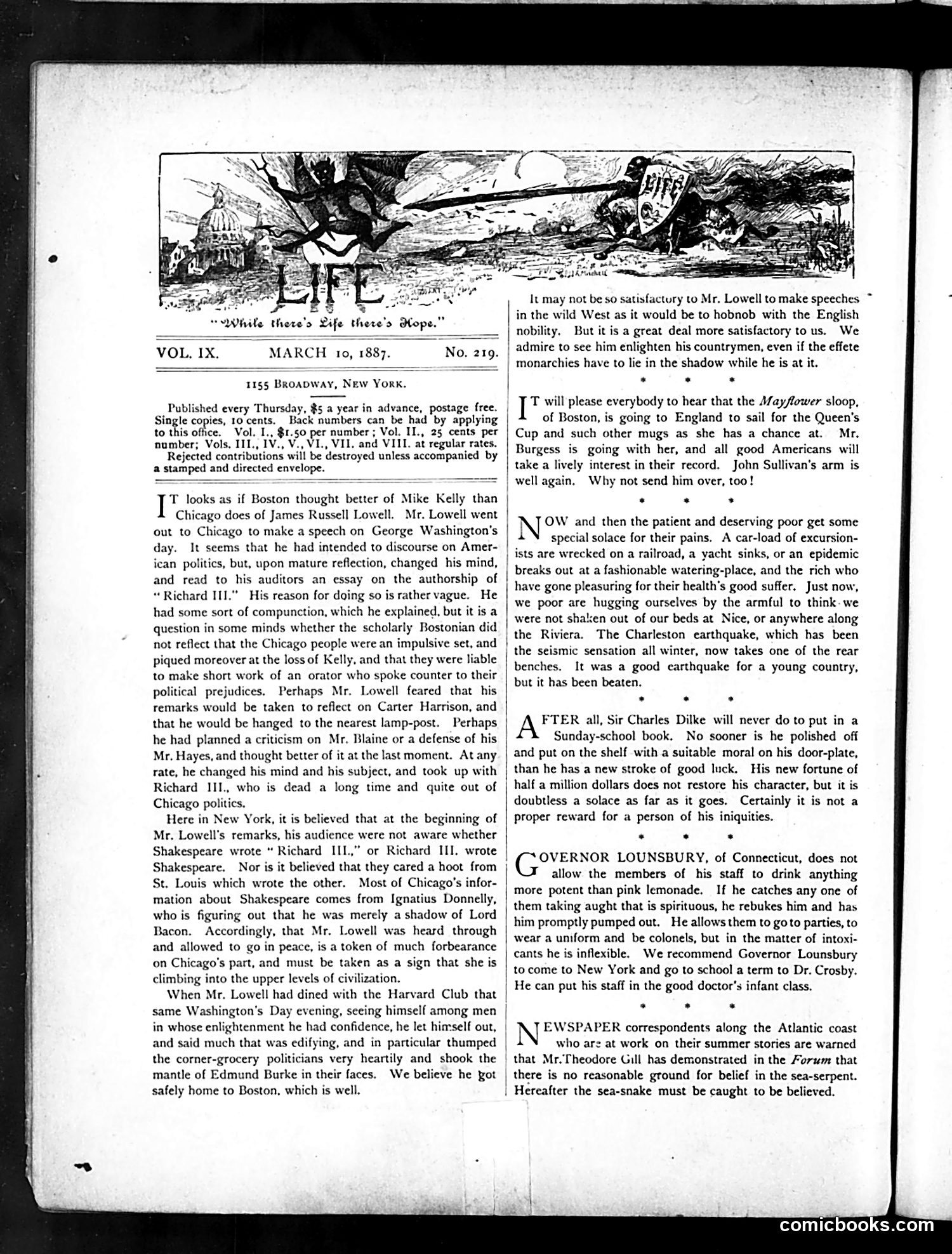
The masthead cartoon depicts a grim reaper-like figure labeled "LIFE" overlooking a desolate landscape, embodying the magazine's satirical sensibility. The main text discusses James Russell Lowell, a Boston intellectual who traveled to Chicago to lecture on George Washington but reconsidered his topic. The piece mocks both Lowell's indecision and Chicago's cultural pretensions, suggesting the city's residents were an "impulsive set" unsuited to serious scholarship. It also references speculation about Shakespeare's authorship of "Richard III"—a scholarly debate of the era. The column includes gossip about the *Mayflower* ship sailing to England and critiques of public figures including Sir Charles Dilke and Governor Lounsbury, typical of the magazine's satirical social commentary.
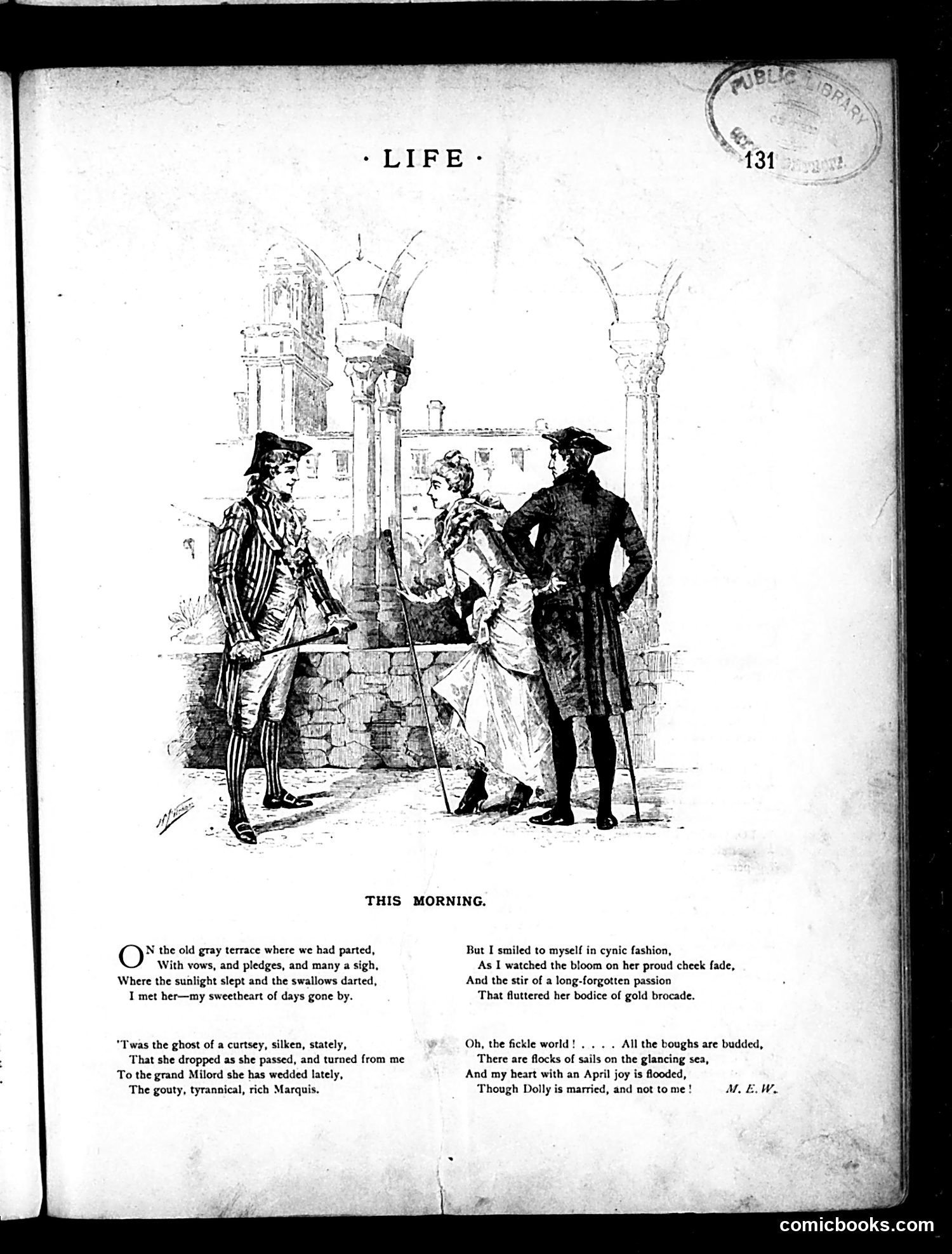
This page presents a romantic poem titled "This Morning" accompanying a Victorian-era illustration of three figures on a terrace with classical architecture. The poem's narrative concerns a male speaker who encounters his former sweetheart, now married to "the grand Milord" (a wealthy marquis). The speaker expresses bittersweet emotions—cynical amusement at her marriage to a "goaty, tyrannical, rich Marquis," yet genuine longing upon seeing her again. The illustration depicts this scene: two men in formal dress flanking a woman in an elaborate gown, set against an ornate architectural backdrop suggesting aristocratic wealth. The satire targets upper-class marriage as transactional and loveless, with the woman sacrificing genuine affection for social status and financial security—a common critique in Victorian-era satirical literature. The tone is wistful rather than harshly critical.
This page contains a series of satirical paragraphs mocking public figures and social trends, rather than political cartoons. The decorative header shows various animals in silhouette. Key items include: - **Shakespeare authorship debate**: Mocking James Russell Lowell's attempt to prove Shakespeare didn't write "Richard III" - **Jake Sharp's religiosity**: Joking about Broadway morality - **Sarah Bernhardt**: Satirizing her anxiety about natural disasters - **Trade Dollar Bill**: Commenting on currency legislation - **Frank R. Stockton**: Referencing his neuralgic illness - **Irish servants and French waiters**: Social commentary on immigrant labor The "Congratulations" section toasts *Puck* magazine (a competitor) on its August tenth anniversary, with backhanded praise about their cartoons' "harmony of tint." The humor relies on contemporary celebrity knowledge and political awareness now largely obscure.
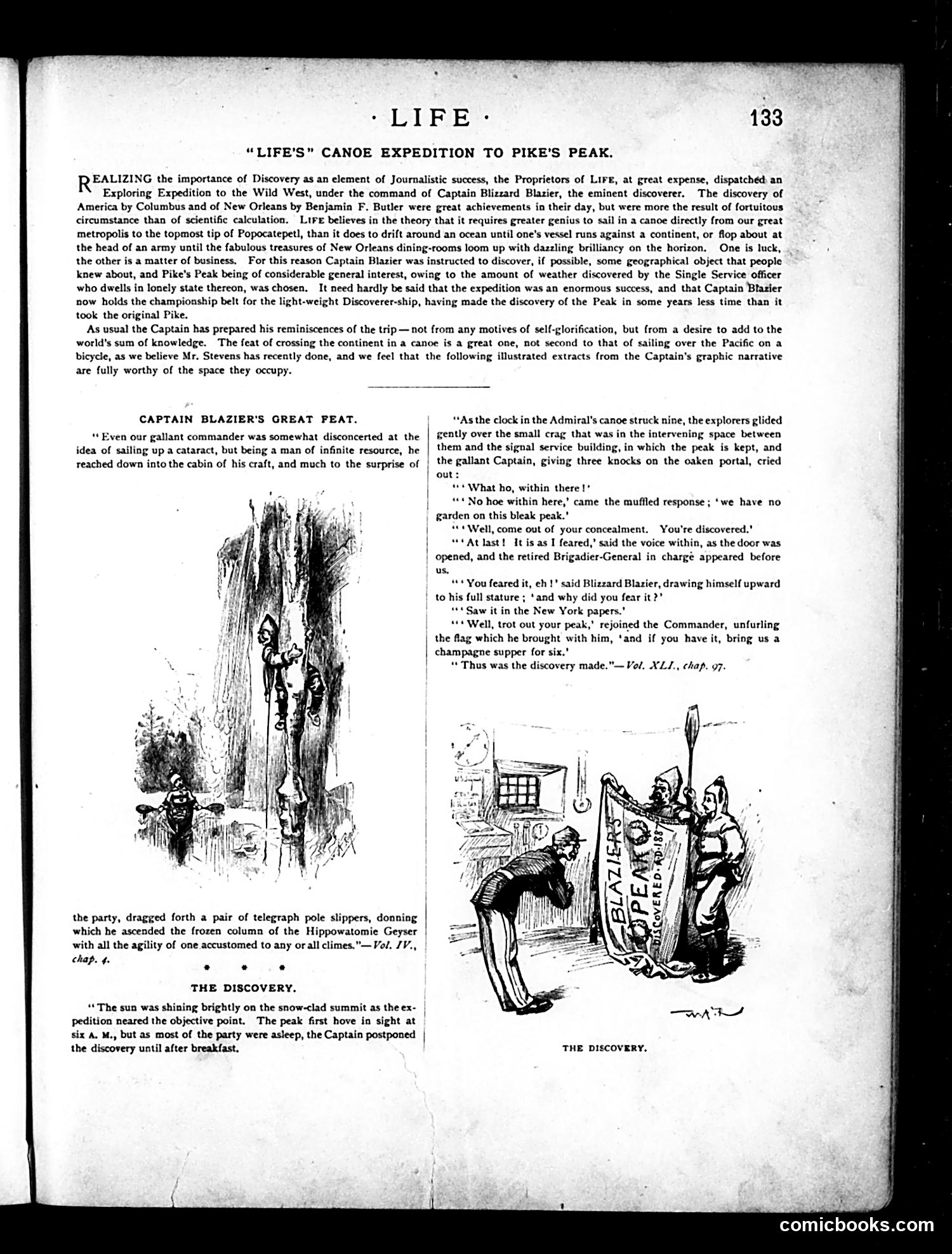
This page celebrates an expedition by *Life* magazine to Pike's Peak, led by Captain Blazier. The article frames this as a journalistic achievement—proving that important discoveries require professional genius rather than merely vast resources. The left illustration shows explorers climbing a frozen geyser (likely in Yellowstone). The right cartoon depicts the moment of "discovery" at Pike's Peak: explorers present a flag to what appears to be a military or government official (possibly meant as comedic deflation of the grand expedition's outcome). The satirical point seems to be about American exploration and journalistic competition—*Life* positioning itself as a serious news organization conducting important fieldwork, while the somewhat anticlimactic "discovery" scene gently mocks the expedition's actual significance.
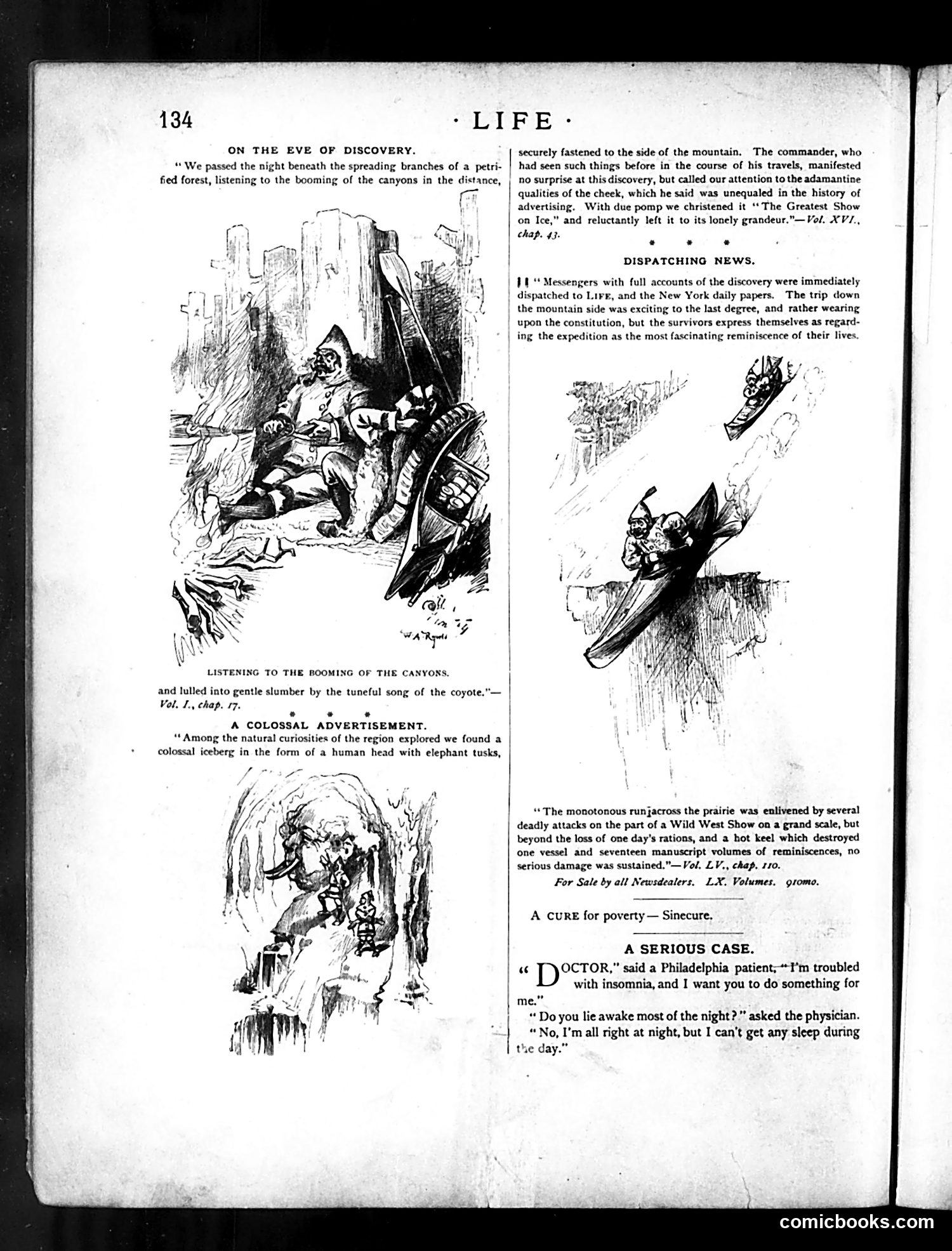
This page contains three distinct sections: 1. **"On the Eve of Discovery"** - An illustration showing figures camping near a mountain, accompanying a narrative about an expedition discovering a geological formation. The text references "The Greatest Show on Ice" and mentions a pump christening. 2. **"Dispatching News"** - A section about messengers delivering news of the discovery to Life and New York daily papers, with accompanying sketches of people traveling rapidly downhill. 3. **"A Colossal Advertisement"** - An illustration of a giant fossilized iceberg shaped like a human head with elephant tusks, presented as a natural curiosity of the explored region. 4. **"A Serious Case"** - A joke dialogue between a Philadelphia patient with insomnia and a doctor, establishing a humorous medical scenario. The overall theme appears to blend adventure narrative, news satire, and medical humor typical of Life's satirical content.
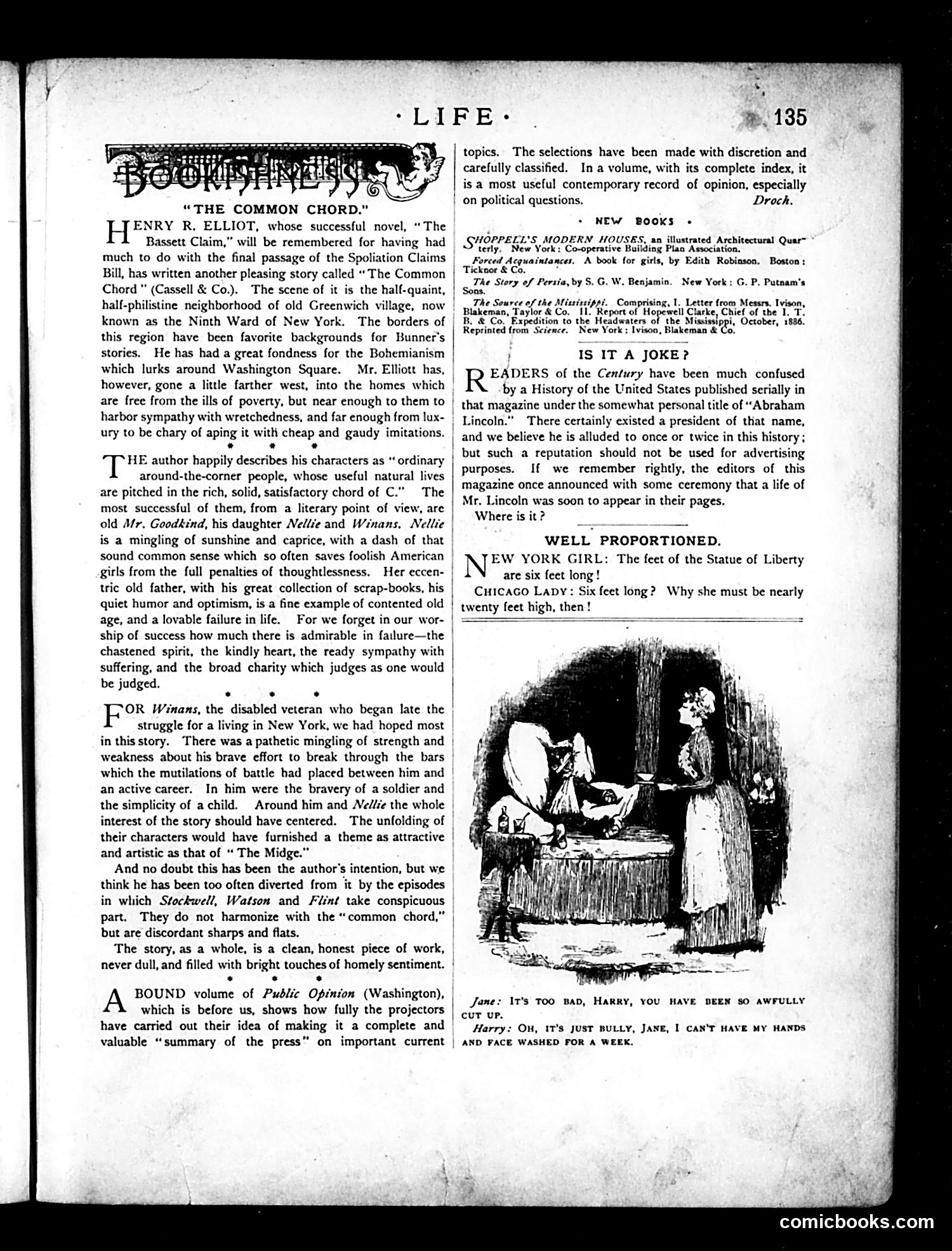
This single-panel cartoon satirizes the physical proportions of the Statue of Liberty by comparing New York and Chicago women's perspectives. A New York woman notes the statue's feet are "six feet long," while a Chicago woman humorously responds that this means the statue must be "nearly twenty feet high" to be properly proportioned—implying that Midwestern women (or Chicago women specifically) are exceptionally tall or large. The joke relies on regional stereotyping, suggesting Chicago women are notably bigger-bodied than their East Coast counterparts. The caption "Well Proportioned" ironically emphasizes the absurdity of this comparison, using the famous monument as a reference point for body-size humor that would have resonated with contemporary readers familiar with regional American stereotypes.
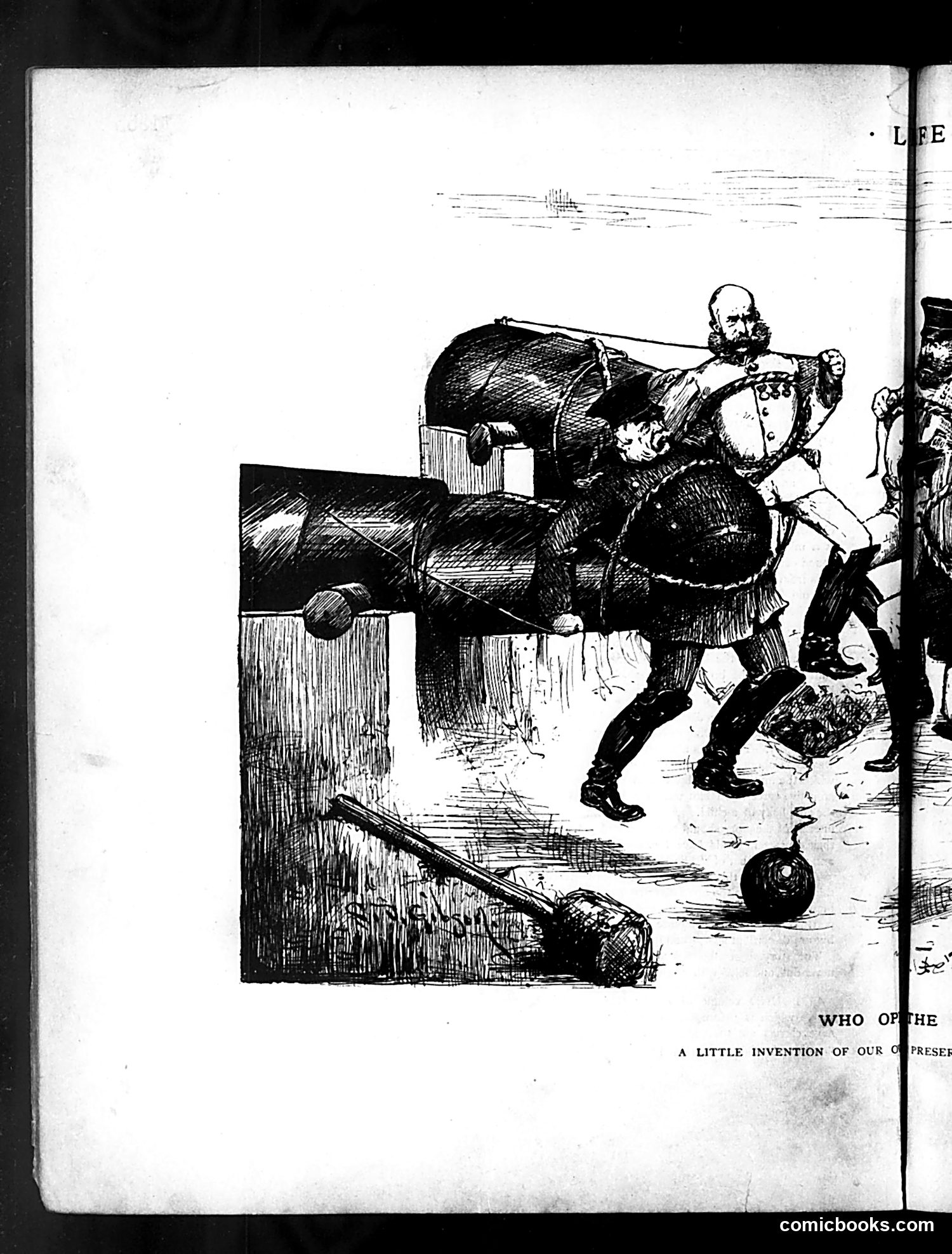
This appears to be a satirical illustration from *Life* magazine showing a military or political figure in ornate uniform operating what looks like a cannon or similar weapon. The text fragment reads "WHO OF THE" and "A LITTLE INVENTION OF OUR C[ONTRIBUTOR]," suggesting this is editorial satire about a contemporary invention or military device. The bearded man in formal military dress with decorative medals appears caricatured, though without seeing the complete caption or date, I cannot definitively identify the specific historical figure or political target. The style and setup suggest commentary on military ambition, technological warfare, or political power-plays typical of *Life* magazine's satirical approach. The cannon or weapon imagery likely critiques either militarism or a specific policy initiative. **I cannot specify the exact reference without the complete text or publication date.**
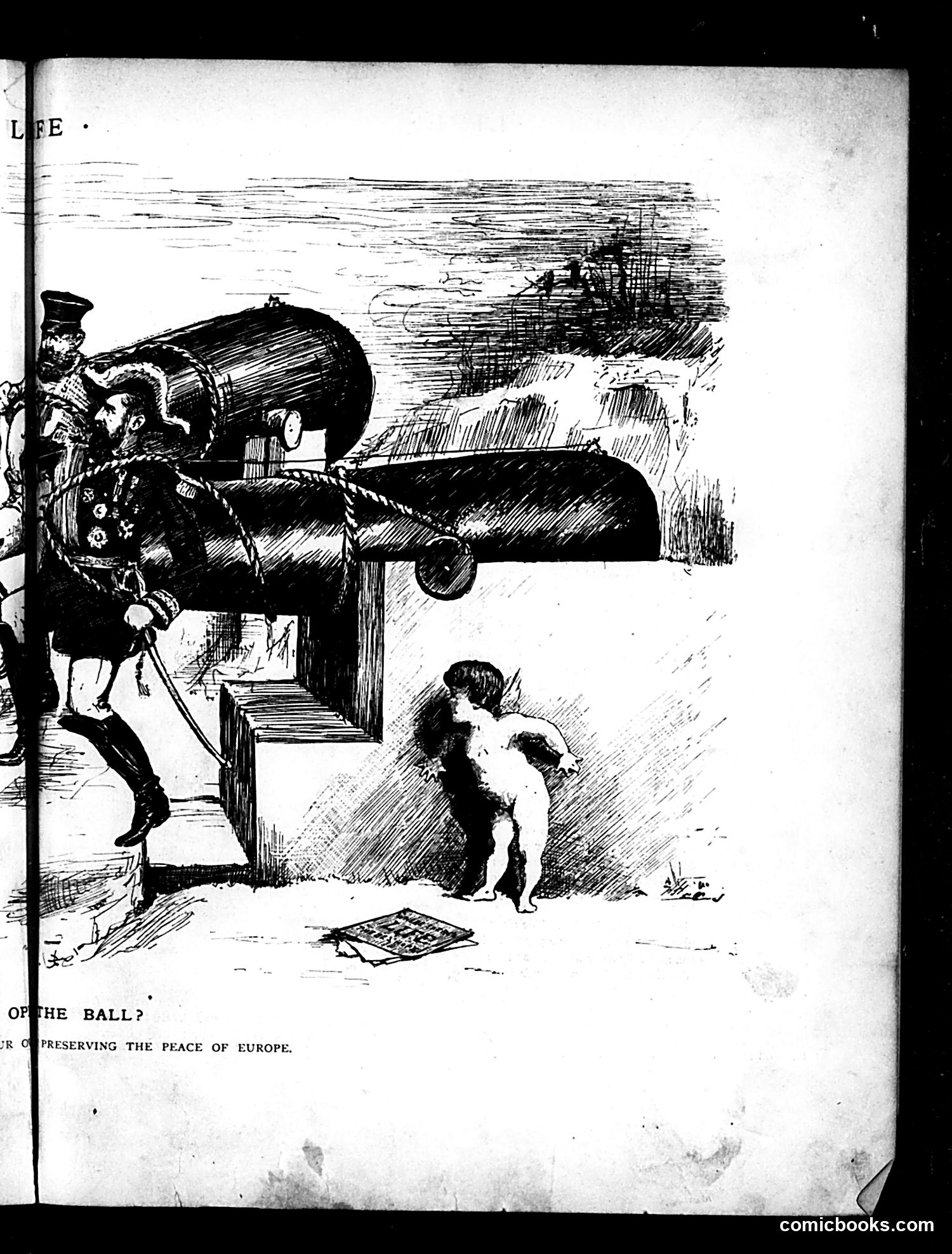
This is a political cartoon satirizing European military tensions, likely from the early 20th century. The image shows a uniformed military officer (identifiable by ornate dress and insignia, possibly representing a European power) aiming a large cannon at a small child cowering below. The cannon barrels in the background suggest a broader arms race or military buildup. The satire critiques how powerful nations' military ambitions threaten innocent civilians and destabilize peace. The title "Life of the Ball?" sarcastically questions whether Europe's military preparations actually preserve peace—suggesting instead they endanger it. The helpless child represents Europe's vulnerable population caught in great powers' dangerous games.
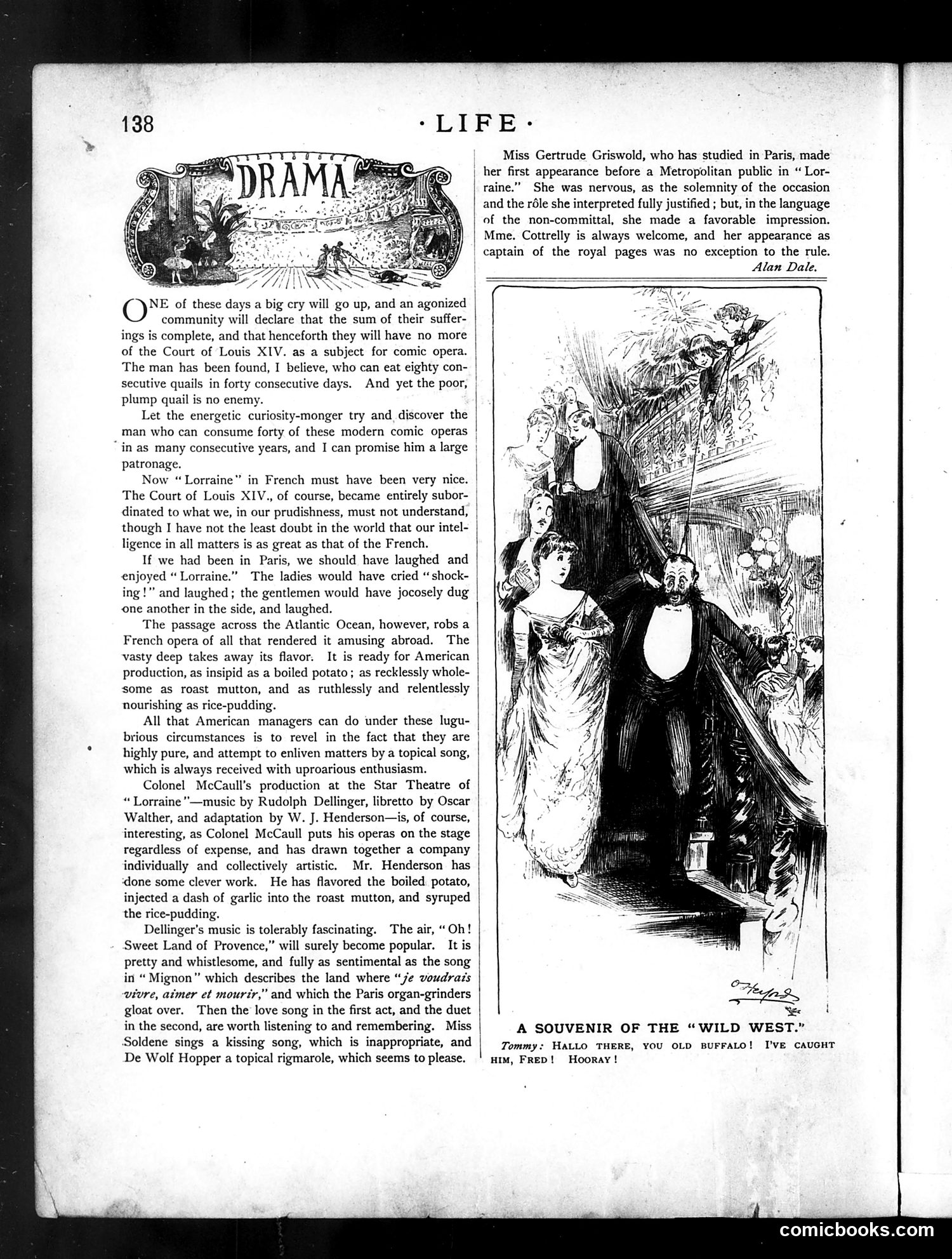
This theatrical illustration depicts a scene from Colonel McCaul's production of "Lorraine" at the Star Theatre. The sketch shows what appears to be a Wild West-themed opera or comic opera performance, with characters in period costume. The accompanying text satirizes American theatrical productions of French operas, criticizing them as inferior adaptations that strip away the original work's sophistication. The author argues that "Lorraine" loses its French elegance through American production—becoming "as insipid as a boiled potato" and "as recklessly wholesome as roast mutton." The cartoon mocks the incongruity of staging a French court drama with Western frontier elements, highlighting the perceived cultural clash of American theatrical management attempting European operatic material.
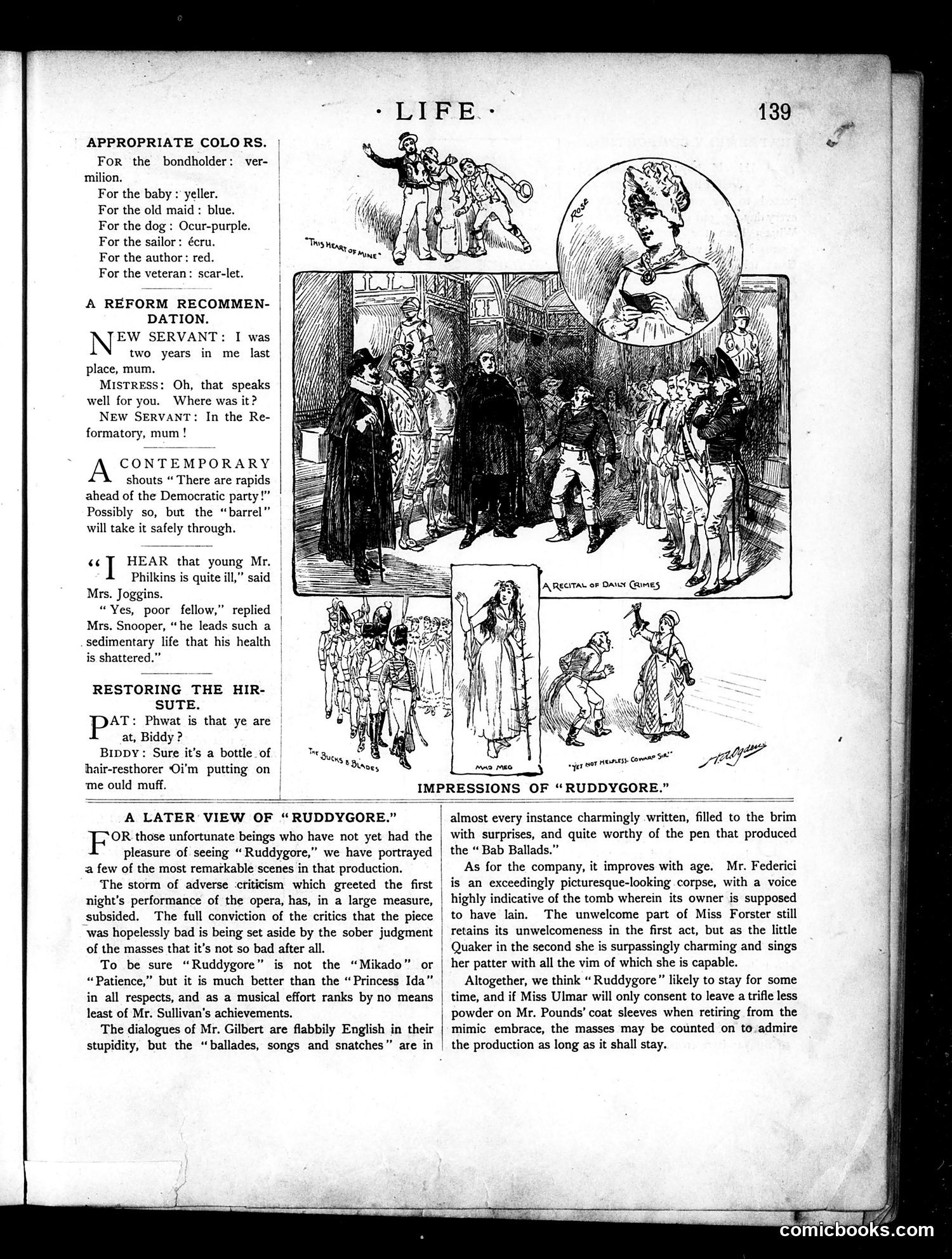
This satirical page contains several brief jokes typical of 1880s American humor, plus a review of Gilbert & Sullivan's opera "Ruddygore." **The humor pieces** mock social conventions: "Appropriate Colors" assigns satirical hues to different classes (bondholder gets "vermilion," suggesting wealth/redness); a servant reveals she worked in a reformatory; and an Irish character ("Biddy") uses a hair-restorer on her "muff" (moustache), playing on working-class Irish stereotypes and sexual innuendo. **The "Ruddygore" review** addresses the opera's poor critical reception. Life defends it against harsh reviews, arguing the public's judgment is sounder than critics'. The review compares it favorably to other Sullivan works ("Mikado," "Patience") while gently mocking specific performers—particularly Miss Forster's "unwelcomeness" in act one and Miss Ulmar's excessive powder, suggesting the production improves as it goes. The illustrated scenes show typical Victorian opera staging and character types, helping readers visualize the production discussed.
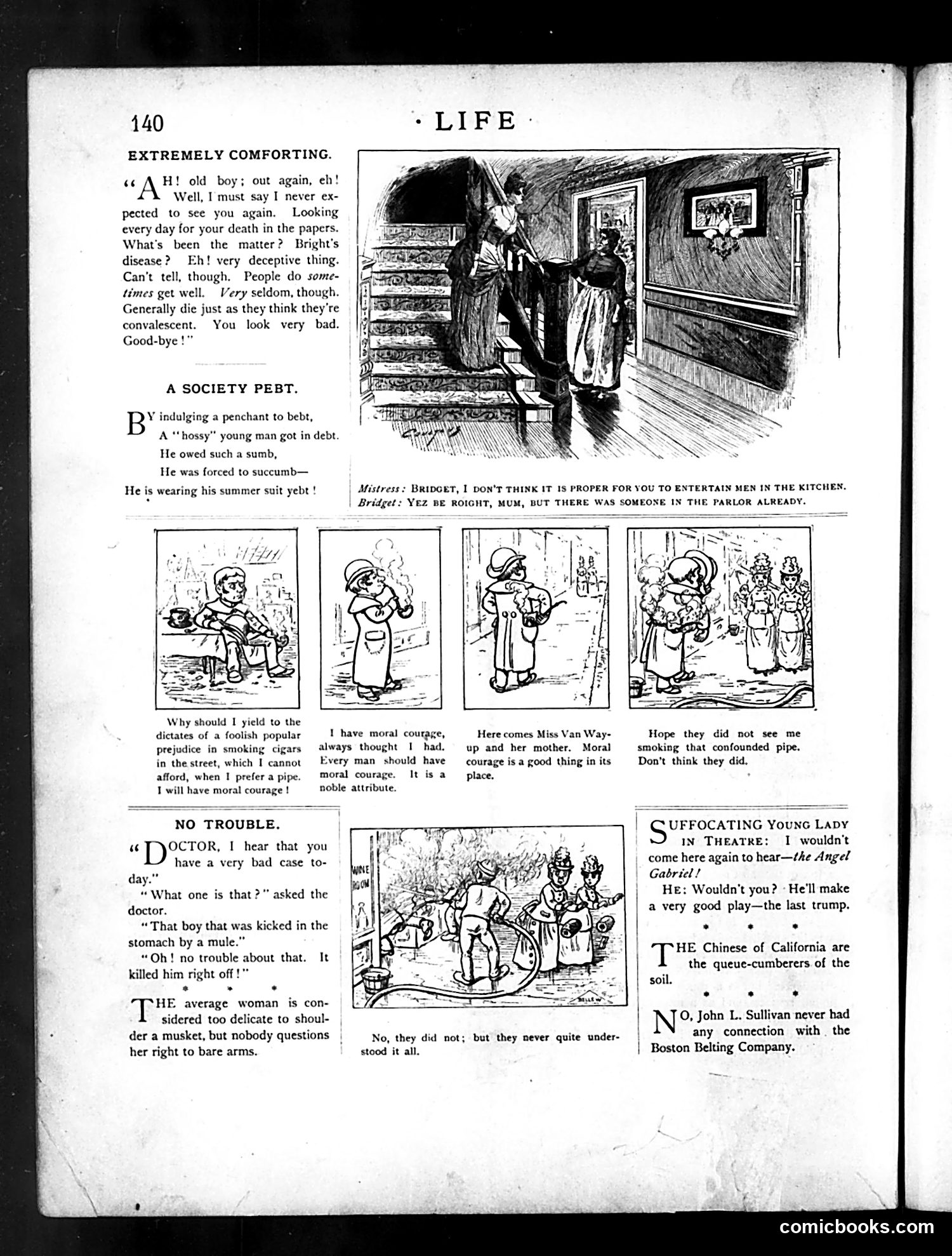
This page collects short humor pieces mocking Victorian social conventions and hypocrisy. **"Extremely Comforting"** satirizes morbid social greeting rituals—a man encounters an acquaintance and immediately expresses shock he's still alive, dwelling on disease and death. **"A Society Debt"** jokes about a young man forced to wear last season's clothing due to financial embarrassment. **The kitchen scene** features an Irish servant ("Bridget") explaining to her mistress why she entertained a man in the kitchen: someone was already in the parlor—suggesting servants mimic their employers' romantic indiscretions. **"No Trouble"** presents dark gallows humor: a doctor dismisses a boy's injuries as fatal anyway. **The moral courage sequence** shows a man smoking a cheap pipe in public despite social disapproval, then anxiously hoping upper-class women didn't notice—exposing the contradiction between claimed principles and actual behavior. Minor items mock Chinese immigration, women's rights, and celebrity nonsense. Throughout, the satire targets Victorian pretense and class anxieties.
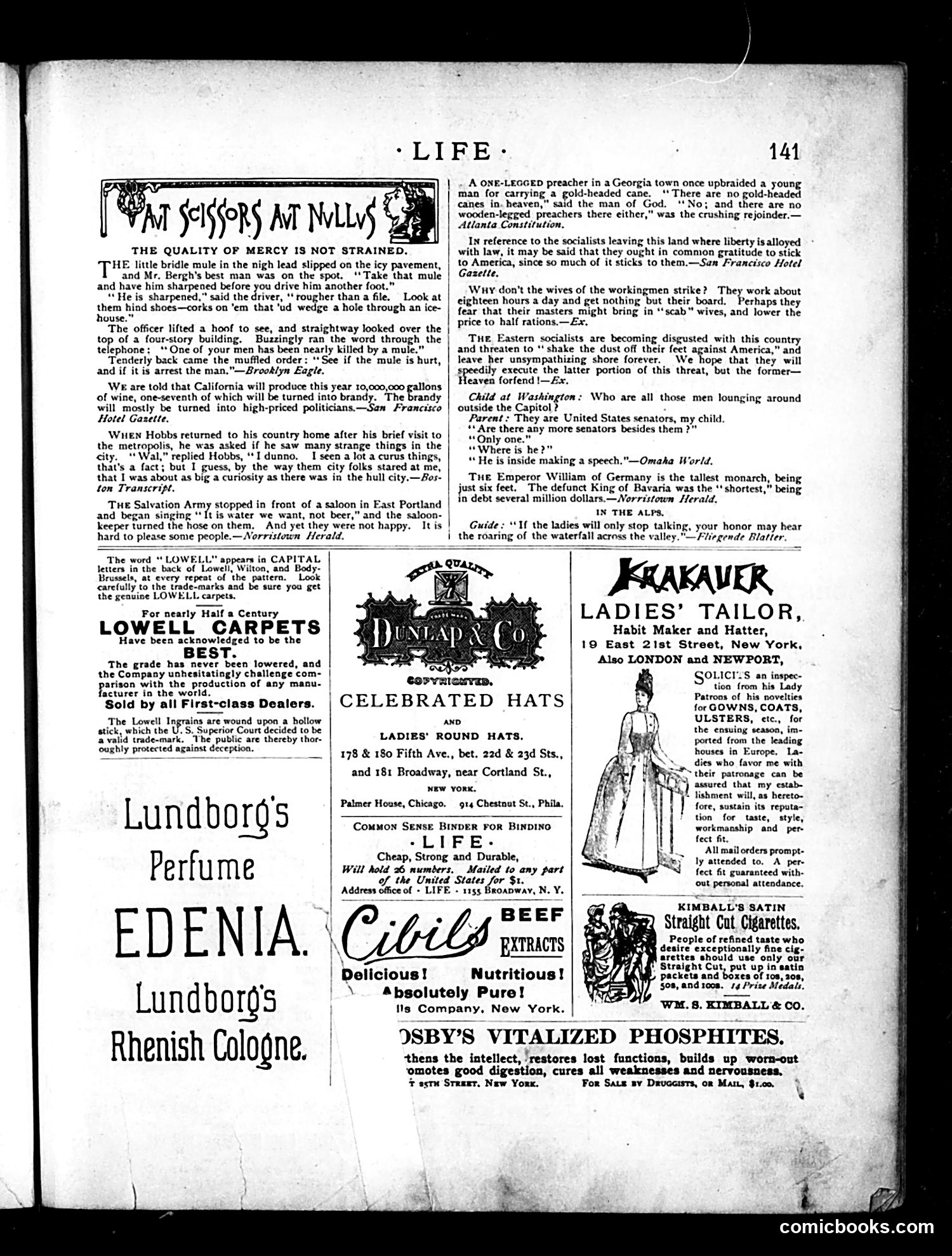
The top cartoon, "The Quality of Mercy Is Not Strained," satirizes Henry Bergh, founder of the American Society for the Prevention of Cruelty to Animals (ASPCA). A police officer investigating a slipped mule on icy pavement tells the driver to "sharpen" the animal's hooves—but the driver protests they're already sharp. The joke's punchline mocks Bergh's priorities: when told a man was nearly killed by the mule, his response is to check if *the mule* is hurt and arrest *the man*. This reflects real tension in the late 1800s between animal welfare advocates and working-class laborers. The satire suggests Bergh prioritized animal protection over human welfare—a common criticism of the animal rights movement by those who saw it as naive or misplaced compassion. The rest of the page contains brief humorous anecdotes on various topics, followed by period advertisements for carpets, perfume, hats, and patent medicines. These are typical of Life magazine's mixed format.
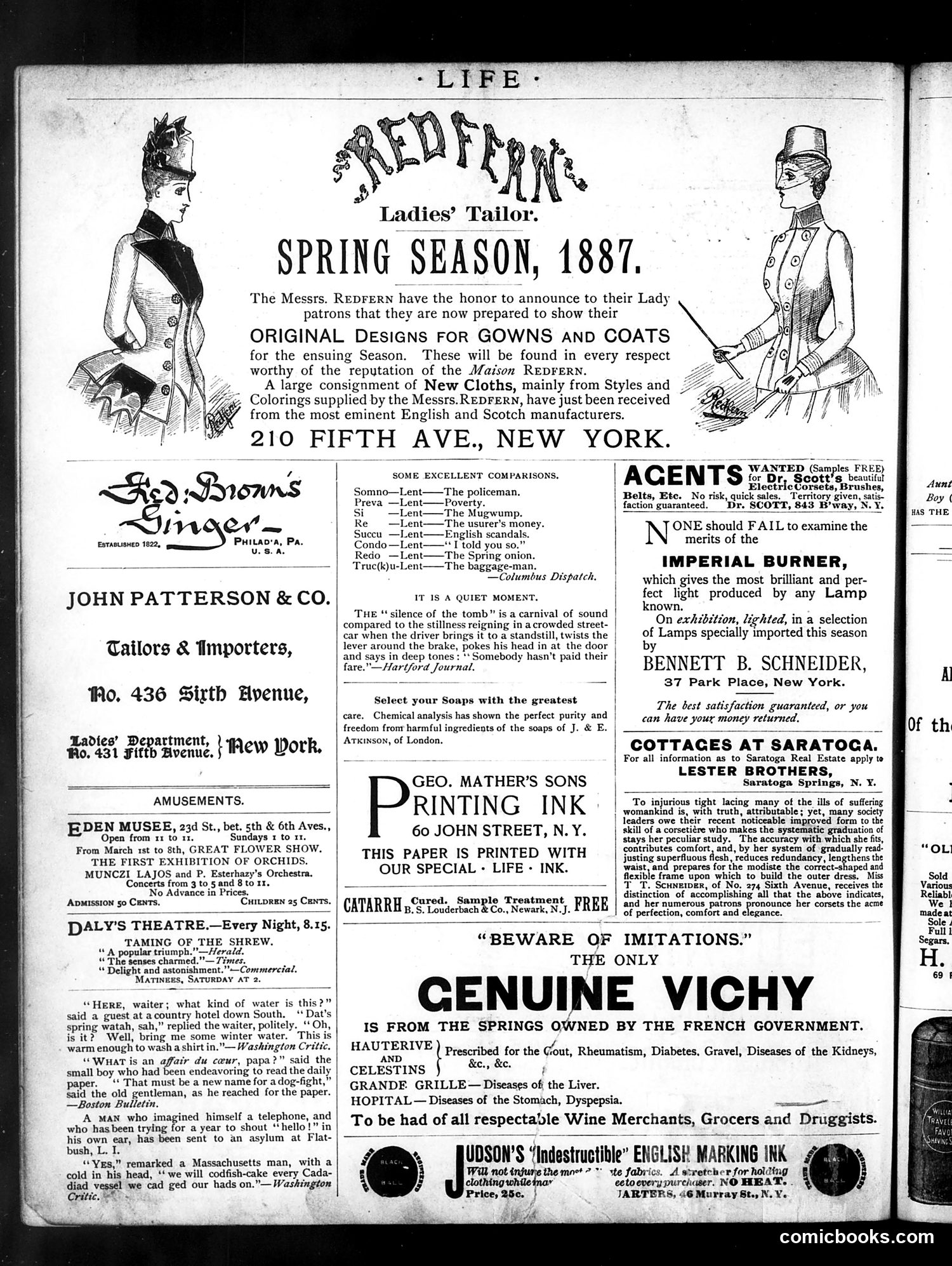
This page is primarily **advertisements and filler content** rather than political satire. The main visual elements are two fashionable women in 1887 spring attire, advertising Redfern's Ladies' Tailor on Fifth Avenue, New York. The text includes brief humorous anecdotes typical of the era's light humor—jokes about a Southern waiter misunderstanding "spring water" for "winter water," a man imagining himself a telephone, and a Massachusetts man with a cold speaking unintelligibly. These are gentle, absurdist observations rather than political commentary. The remaining content consists of theatrical announcements (Eden Musee, Daly's Theatre) and various product advertisements (soaps, corsets, printing ink, lamps), with wordplay definitions of "Lent" (Somno-Lent = policeman, etc.). **No significant political satire or caricature is present** on this page.
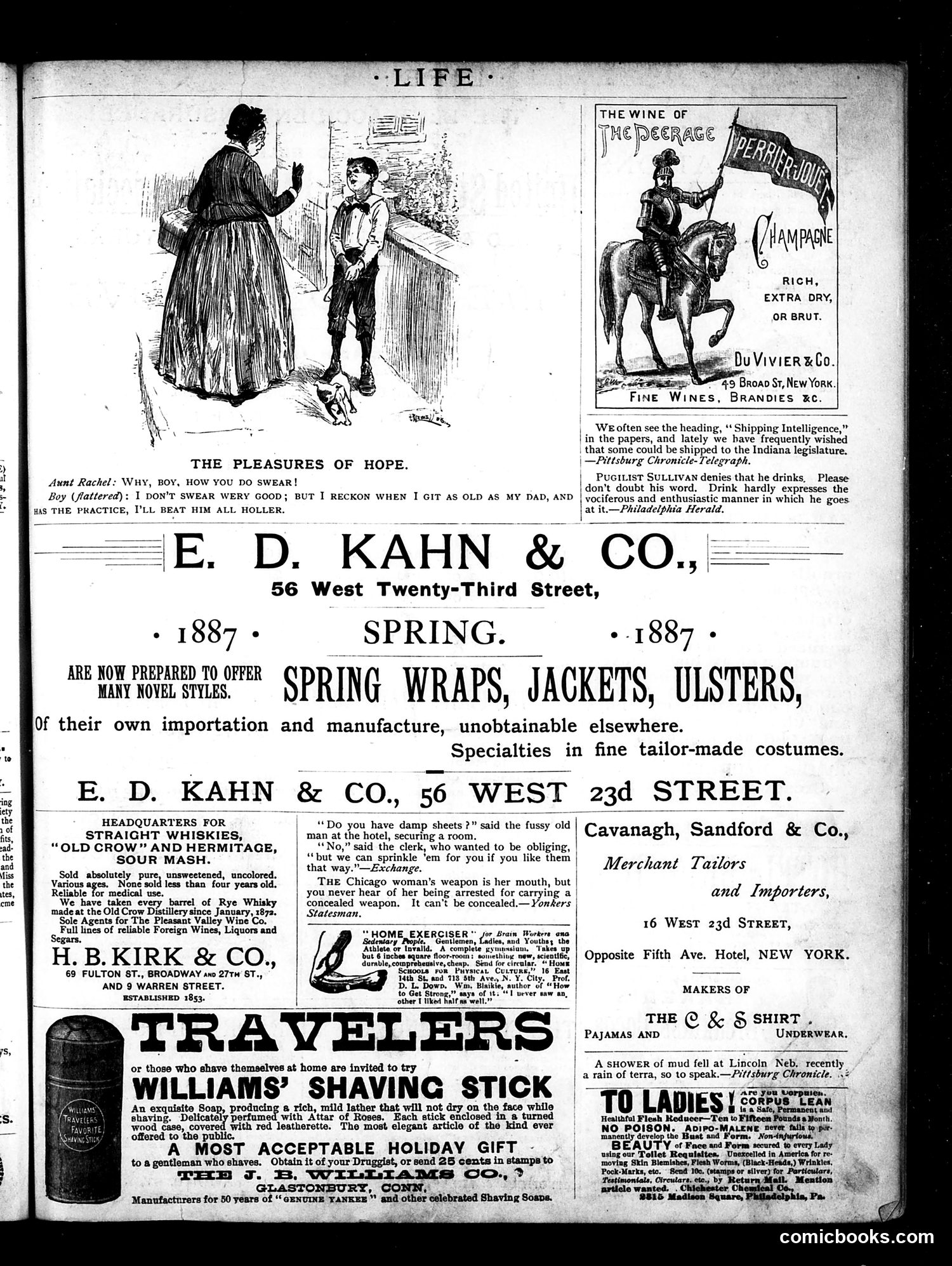
The main cartoon depicts an aunt scolding a boy for swearing. The boy, flattered by her criticism, boasts he'll "beat" his father's profanity as he gets older. The satire is gentle: it mocks both the aunt's prim disapproval and the boy's innocent pride in imitating adult vice. The page's satirical snippets below the cartoon mock public figures and regional politics. One quip references Indiana legislators needing "shipping intelligence" (a newspaper section listing departing ships)—implying they should be "shipped out." Another jabs boxer John L. Sullivan for denying he drinks, sarcastically suggesting his enthusiastic manner of drinking "hardly expresses" the truth. The page is primarily advertisements for clothing, whiskey, and patent medicines typical of 1880s American commerce, with scattered humorous editorial asides that were Life's trademark style.
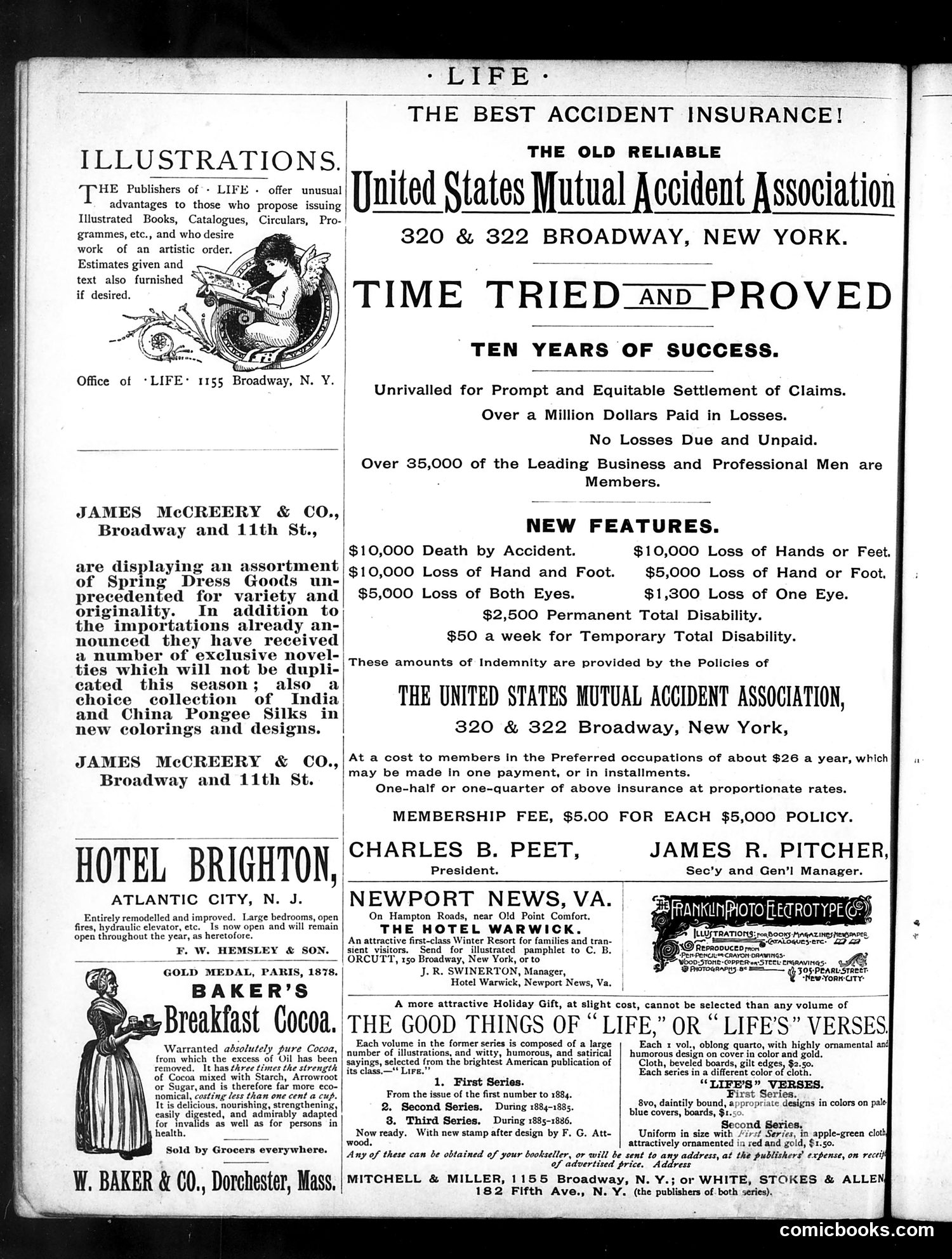
This page is primarily **advertising and promotional content** rather than satirical cartoons. It consists of: **Left column:** Notices about Life's publishing services and ads for James McCreery & Co. (department store), Hotel Brighton, and Baker's Breakfast Cocoa (with a period illustration of a woman). **Center/Right column:** A large advertisement for the **United States Mutual Accident Association**, an insurance company at Broadway in New York. The ad emphasizes the company's reliability ("Time Tried and Proved"), boasting ten years of success, over a million dollars paid in losses, and 35,000 member business and professional men. It lists coverage amounts for various accidents (death, limb loss, blindness) at approximately $26 annually. **Bottom:** Advertisements for the Hotel Warwick in Newport News, Virginia, and promotional material for "The Good Things of Life" book series—collections of humorous and satirical content from the Life publication itself. There are no political cartoons visible. The page functions as a business/commercial document typical of late 19th-century magazine advertising.
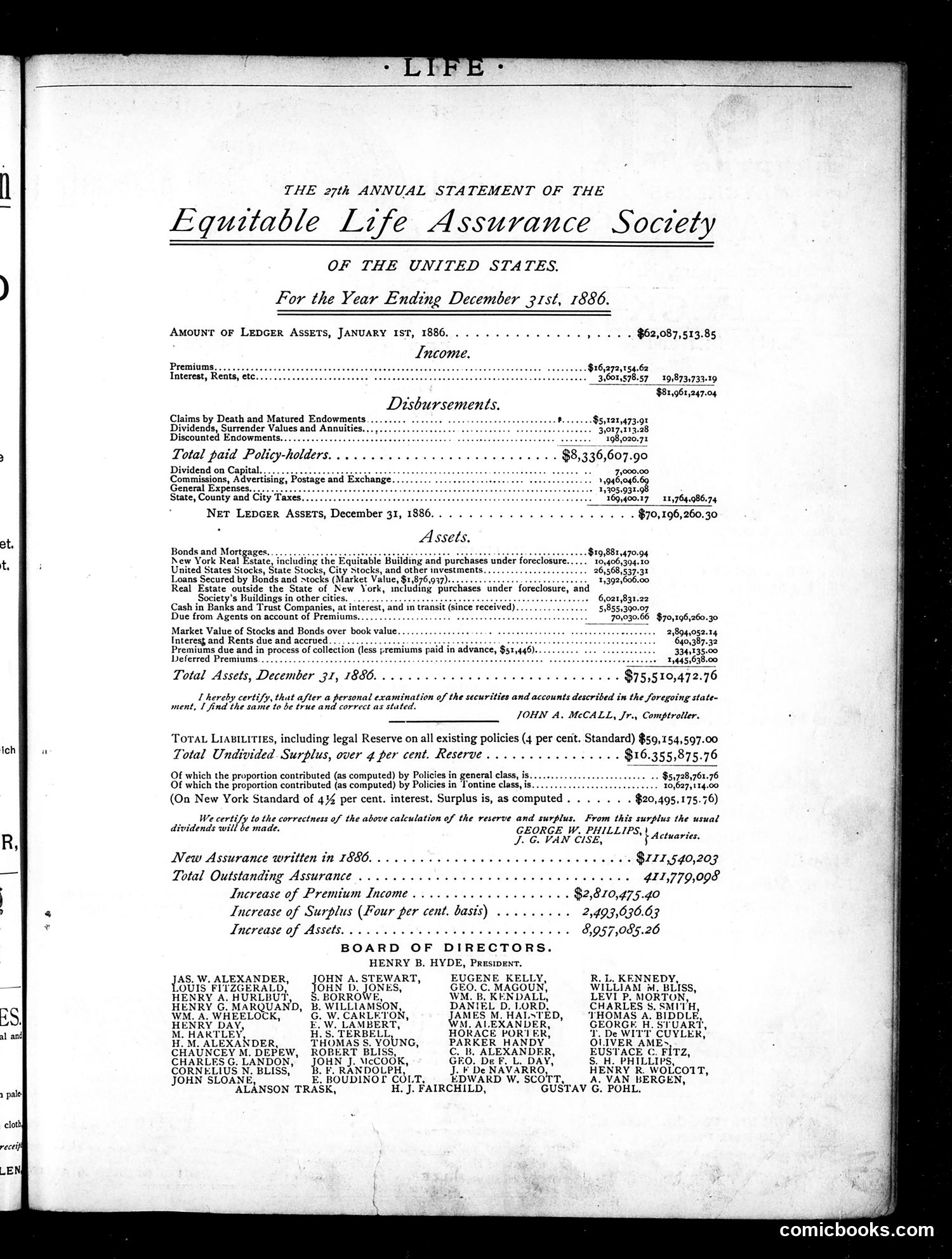
This is **not a cartoon or satirical article**—it's a financial statement. This is the 27th annual report of the Equitable Life Assurance Society for 1886, presented as a full page in *Life* magazine. The page lists assets, liabilities, income, and disbursements for the insurance company, along with a board of directors featuring prominent wealthy businessmen of the era (Henry B. Hyde as president, plus names like Levi P. Morton and other Gilded Age financiers). **Why it appeared in *Life*:** During the 1880s, *Life* published such statements as advertisements or company-sponsored content. This reflects the era's insurance industry prominence and the magazine's mixed format of satire, news, and paid notices. The document itself—with its precise financial figures and certified accounting—serves as evidence of corporate legitimacy and stability, aimed at reassuring potential policyholders.
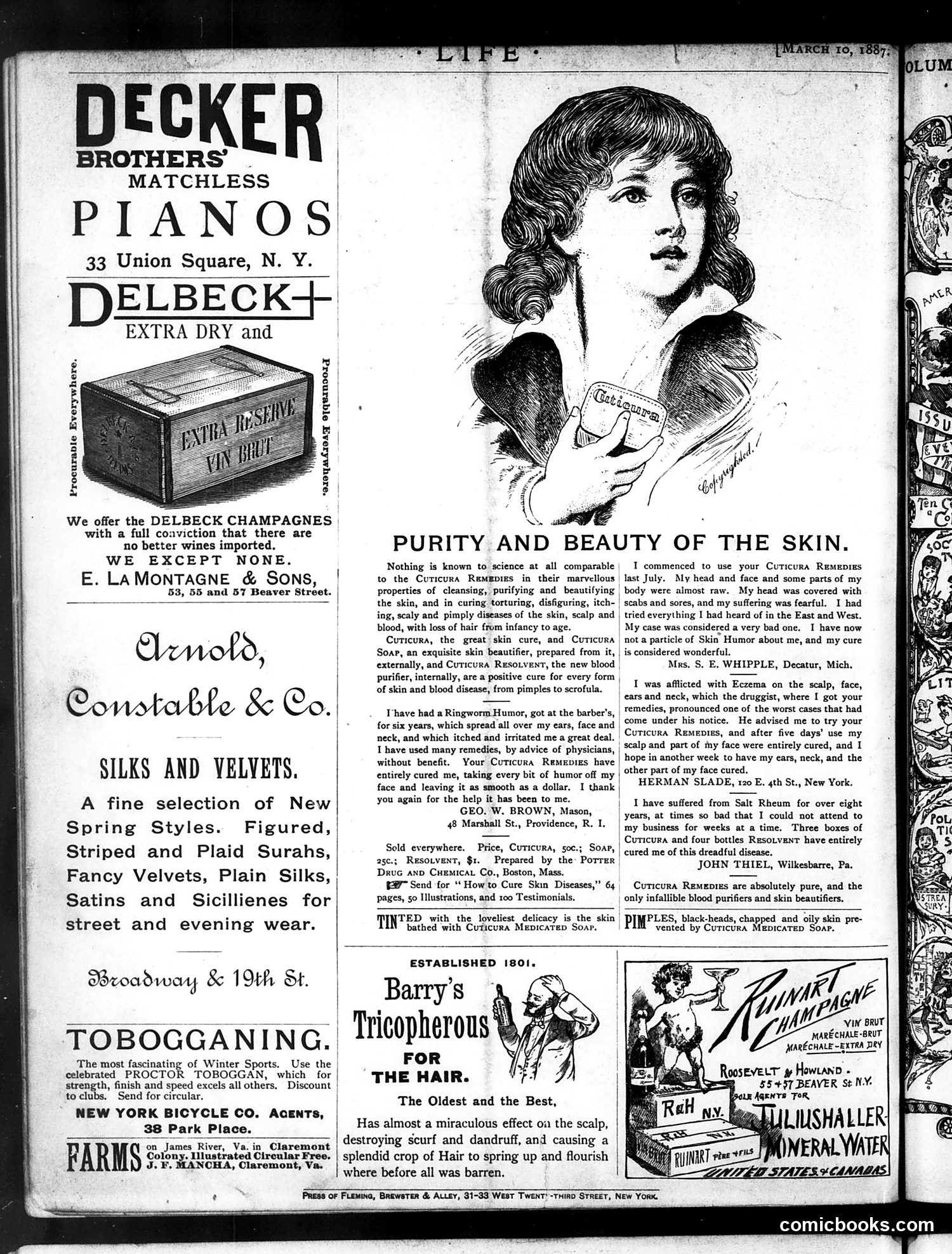
This page is predominantly **advertising**, not political satire or comics. It contains commercial promotions from the Gilded Age era, typical of Life magazine's revenue model. **Notable content includes:** - **Cuticura Remedies** (center): Extensive testimonials claiming to cure skin diseases, ringworm, eczema, and hair loss. The detailed "patient testimonials" (a common advertising tactic) suggest these products made sweeping medical claims now considered fraudulent. - **Luxury goods ads**: Piano advertisements, champagne, silks and velvets, and toboggans—reflecting wealthy readership. - **Barry's Tricopherous**: Hair treatment claiming miraculous scalp effects. The page illustrates **late 19th-century consumer culture and patent medicine marketing**—an era before FDA regulation when such remedies could make unsubstantiated health claims. The centralized female portrait represents "Purity and Beauty," the era's beauty ideal. No political cartoon or satire is evident on this page.