
Life, 1887-03-10 · page 11 of 18
Life — March 10, 1887 — page 11: what you’re looking at
What you’re looking at
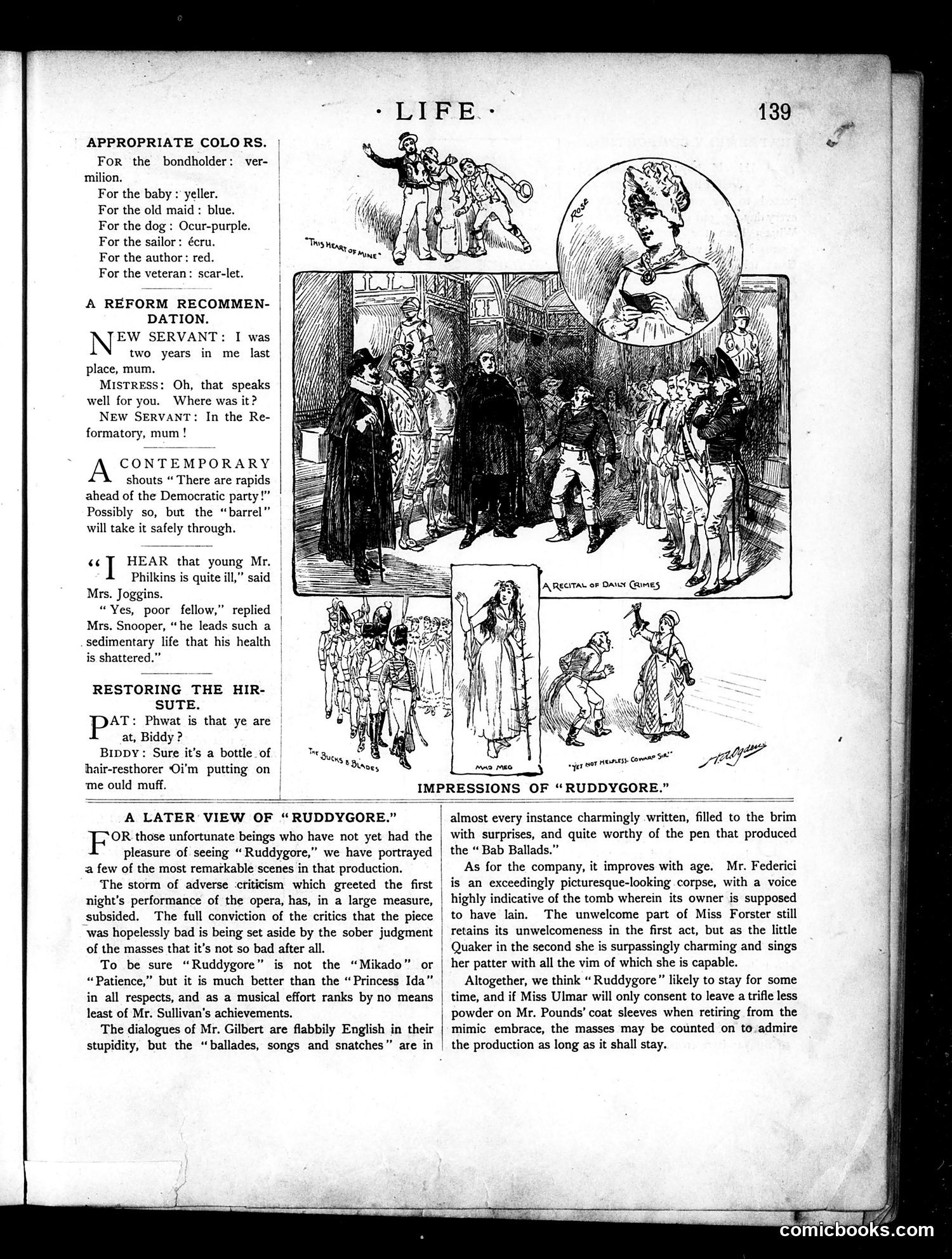
This satirical page contains several brief jokes typical of 1880s American humor, plus a review of Gilbert & Sullivan's opera "Ruddygore." **The humor pieces** mock social conventions: "Appropriate Colors" assigns satirical hues to different classes (bondholder gets "vermilion," suggesting wealth/redness); a servant reveals she worked in a reformatory; and an Irish character ("Biddy") uses a hair-restorer on her "muff" (moustache), playing on working-class Irish stereotypes and sexual innuendo. **The "Ruddygore" review** addresses the opera's poor critical reception. Life defends it against harsh reviews, arguing the public's judgment is sounder than critics'. The review compares it favorably to other Sullivan works ("Mikado," "Patience") while gently mocking specific performers—particularly Miss Forster's "unwelcomeness" in act one and Miss Ulmar's excessive powder, suggesting the production improves as it goes. The illustrated scenes show typical Victorian opera staging and character types, helping readers visualize the production discussed.
📄 Transcribed text from this page (OCR, searchable)
Machine-transcribed from the original scan — historical spelling and the odd misread are preserved.
APPROPRIATE COLORS. For the bondholder: milion. For the baby : yeller. For the old maid : blue. For the dog : Ocur-purple. For the sailor: écru. For the author: red. For the veteran: scar-let. ver- | A REFORM RECOMMEN- DATION. EW SERVANT: I was two years in me last place, mum, MISTRESS: Oh, that speaks well for you. Where was it? | NEw SERVANT: In the Re- | formatory, mum ! CONTEMPORARY shouts “ There are rapids ahead of the Democratic party!” Possibly so, but the “barrel” will take it safely through. HEAR that young Mr. Philkins is quite ill,” said Mrs. Joggins. “Yes, poor fellow,” replied Mrs. Snooper, “he leads such a sedimentary life that his health is shattered.” | “ RESTORING THE HIR- SUTE. AT: Phwat is that ye are | at, Biddy ? Bippy: Sure it’s a bottle of hair-resthorer Oi’m putting on me ould muff. A LATER VIEW OF “RUDDYGORE.” OR those unfortunate beings who have not yet had the pleasure of seeing “‘ Ruddygore,” we have portrayed ‘a few of the most remarkable scenes in that production. The storm of adverse criticism which greeted the first | | highly indicative of the tomb wherein its owner is supposed night’s performance of the opera, has, in a large measure, subsided. The full conviction of the critics that the piece was hopelessly bad is being set aside by the sober judgment of the masses that it’s not so bad after all. To be sure “Ruddygore” is not the “Mikado” or “Patience,” but it is much better than the “Princess Ida” | in all respects, and as a musical effort ranks by no means least of Mr. Sullivan's achievements. The dialogues of Mr. Gilbert are flabbily English in their stupidity, but the “ballades, songs and snatches” are in no MEO yer er eer ® IMPRESSIONS OF “RUDDYGORE.” | almost every instance charmingly written, filled to the brim with surprises, and quite worthy of the pen that produced the “ Bab Ballads.” As for the company, it improves with age. Mr. Federici is an exceedingly picturesque-looking corpse, with a voice to have lain. The unwelcome part of Miss Forster still retains its unwelcomeness in the first act, but as the little Quaker in the second she is surpassingly charming and sings her patter with all the vim of which she is capable. Altogether, we think “ Ruddygore” likely to stay for some | time, and if Miss Ulmar will only consent to leave a trifle less powder on Mr. Pounds’ coat sleeves when retiring from the mimic embrace, the masses may be counted on to. admire the production as long as it shall stay. col micbooks.com