
Life, 1887-03-10 · page 2 of 18
Life — March 10, 1887 — page 2: what you’re looking at
What you’re looking at
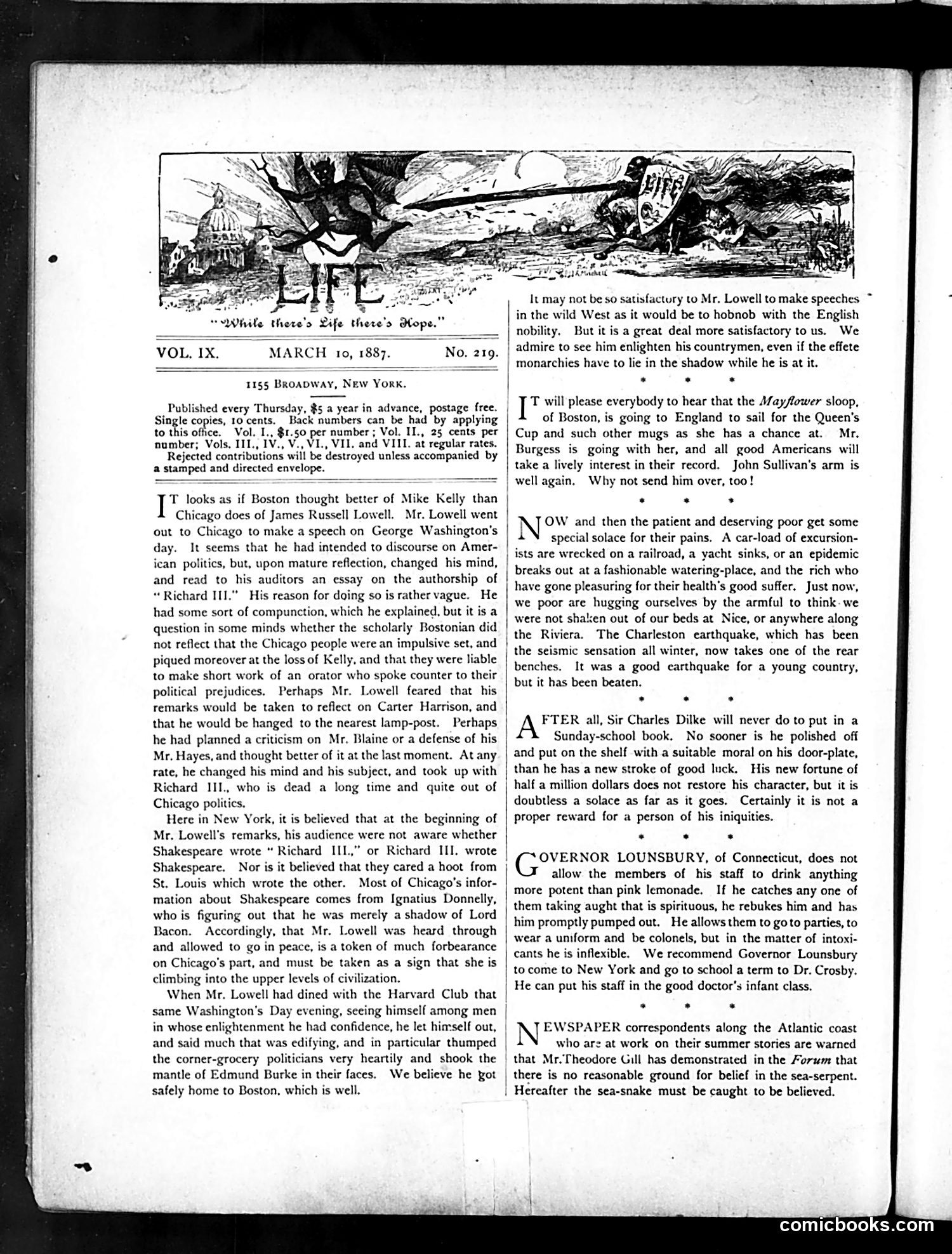
The masthead cartoon depicts a grim reaper-like figure labeled "LIFE" overlooking a desolate landscape, embodying the magazine's satirical sensibility. The main text discusses James Russell Lowell, a Boston intellectual who traveled to Chicago to lecture on George Washington but reconsidered his topic. The piece mocks both Lowell's indecision and Chicago's cultural pretensions, suggesting the city's residents were an "impulsive set" unsuited to serious scholarship. It also references speculation about Shakespeare's authorship of "Richard III"—a scholarly debate of the era. The column includes gossip about the *Mayflower* ship sailing to England and critiques of public figures including Sir Charles Dilke and Governor Lounsbury, typical of the magazine's satirical social commentary.
📄 Transcribed text from this page (OCR, searchable)
Machine-transcribed from the original scan — historical spelling and the odd misread are preserved.
5 “While there's Life there's Hope.” VOL, IX. “No. 219. : MARCH 10, 1887. 1155 Broapway, New York. Published every Thursday, $5 a year in advance, postage free. Single copies, 10 cents. Back numbers can be had by applying to this office. Vol. I., $1.50 per number ; Vol. II., 25 cents per number; Vols. III., IV., V.,VI., VIL. and VIII. at regular rates. Rejected contributions will be destroyed unless accompanied by T looks as if Boston thought better of Mike Kelly than Chicago does of James Russell Lowell. Mr. Lowell went out to Chicago to make a speech on George Washington's day. It seems that he had intended to discourse on Amer- ican politics, but, upon mature reflection, changed his mind, and read to his auditors an essay on the authorship of “Richard III." His reason for doing so is rather vague. He had some sort of compunction, which he explained, but it is a question in some minds whether the scholarly Bostonian did piqued moreover at the loss of Kelly, and that they were liable to make short work of an orator who spoke counter to their political prejudices. Perhaps Mr. Lowell feared that his remarks would be taken to reflect on Carter Harrison, and that he would be hanged to the nearest lamp-post. Perhaps he had planned a criticism on Mr. Blaine or a defense of his Mr. Hayes, and thought better of it at the last moment. At any rate, he changed his mind and his subject, and took up with Richard III, who is dead a long time and quite out of Chicago politics. Here in New York, it is believed that at the beginning of Mr. Lowell's remarks, his audience were not aware whether Shakespeare wrote “ Richard IIL,” or Richard III, wrote Shakespeare. Noor is it believed that they cared a hoot from St. Louis which wrote the other. Most of Chicago's infor- mation about Shakespeare comes from Ignatius Donnelly, who is figuring out that he was merely a shadow of Lord Bacon. Accordingly, that Mr. Lowell was heard through and allowed to go in peace, is a token of much forbearance on Chicago's part, and must be taken as a sign that she is climbing into the upper levels of civilization. When Mr. Lowell had dined with the Harvard Club that same Washington's Day evening, seeing himself among men in whose enlightenment he had confidence, he let himself out, and said much that was edifying, and in particular thumped the corner-grocery politicians very heartily and shook the mantle of Edmund Burke in their faces. We believe he pot safely home to Boston, which is well. ote ‘ | the Riviera. not reflect that the Chicago people were an impulsive set, and } It may not be so satisfactury to Mr. Lowell to make speeches ~ in the wild West as it would be to hobnob with the English nobility, But it is a great deal more satisfactory to us. We | admire to see him enlighten his countrymen, even if the effete monarchies have to lie in the shadow while he is at it. * . . T will please everybody to hear that the Mayflower sloop, of Boston, is going to England to sail for the Queen's Cup and such other mugs as she has a chance at. Mr. Burgess is going with her, and all good Americans will take a lively interest in their record. John Sullivan's arm is | well again. Why not send him over, too! . . * i OW and then the patient and deserving poor get some special solace for their pains. A car-load of excursion- | ists are wrecked on a railroad, a yacht sinks, or an epidemic breaks out at a fashionable watering-place, and the rich who have gone pleasuring for their health’s good suffer. Just now, we poor are hugging ourselves by the armful to think. we were not shaken out of our beds at Nice, or anywhere along The Charleston earthquake, which has been the seismic sensation all winter, now takes one of the rear benches. It was a good earthquake for a young country, but it has been beaten. . . . FTER all, Sir Charles Dilke will never do to put in a Sunday-school book. No sooner is he polished off and put on the shelf with a suitable moral on his door-plate, than he has a new stroke of good luck. His new fortune of half a million dollars does not restore his character, but it is doubtless a solace as far as it goes. Certainly it is not a proper reward for a person of his iniquities. . . . OVERNOR LOUNSBURY, of Connecticut, does not allow the members of his staff to drink anything more potent than pink lemonade. If he catches any one of them taking aught that is spirituous, he rebukes him and has him promptly pumped out. He allows them to goto parties, to wear a uniform and be colonels, but in the matter of intoxi- cants he is inflexible. We recommend Governor Lounsbury to come to New York and go to school a term to Dr. Crosby. | He can put his staff in the good doctor's infant class. . * * EWSPAPER correspondents along the Atlantic coast who ars at work on their summer stories are warned that Mr. Theodore Gill has demonstrated in the Forum that there is no reasonable ground for belief in the sea-serpent. | Hereafter the sea-snake must be caught to be believed. comicbooks.com