
Life, 1887-03-10 · page 7 of 18
Life — March 10, 1887 — page 7: what you’re looking at
What you’re looking at
This single-panel cartoon satirizes the physical proportions of the Statue of Liberty by comparing New York and Chicago women's perspectives. A New York woman notes the statue's feet are "six feet long," while a Chicago woman humorously responds that this means the statue must be "nearly twenty feet high" to be properly proportioned—implying that Midwestern women (or Chicago women specifically) are exceptionally tall or large. The joke relies on regional stereotyping, suggesting Chicago women are notably bigger-bodied than their East Coast counterparts. The caption "Well Proportioned" ironically emphasizes the absurdity of this comparison, using the famous monument as a reference point for body-size humor that would have resonated with contemporary readers familiar with regional American stereotypes.
📄 Transcribed text from this page (OCR, searchable)
Machine-transcribed from the original scan — historical spelling and the odd misread are preserved.
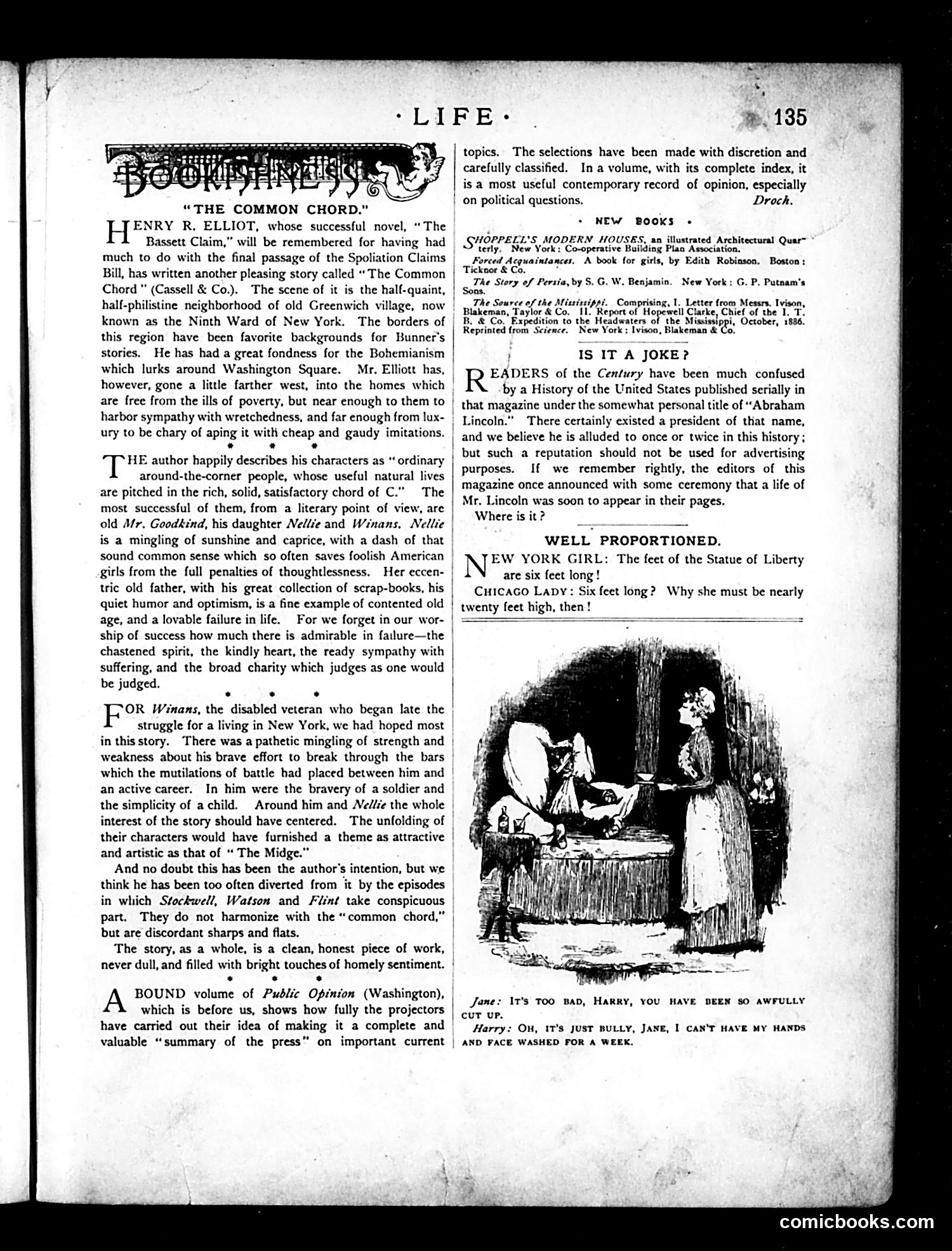
“THE COMMON CHORD.” HERE’ R. ELLIOT, whose successful novel, “ The Bassett Claim,” will be remembered for having had much to do with the final passage of the Spoliation Claims Bill, has written another pleasing story called “The Common Chord " (Cassell & Co.). half-philistine neighborhood of old Greenwich village, now known as the Ninth Ward of New York. The borders of this region have been favorite backgrounds for Bunner’s stories. He has had a great fondness for the Bohemianism which lurks around Washington Square. Mr. Elliott has, however, gone a little farther west, into the homes which | are free from the ills of poverty, but near enough to them to harbor sympathy with wretchedness, and far enough from lux- ury to be chary of aping it with cheap and gaudy imitations. * * * HE author happily describes his characters as “ordinary around-the-corner people, whose useful natural lives are pitched in the rich, solid, satisfactory chord of C." The most successful of them, from a literary point of view, are old Mr. Goodkind, his daughter Neve and Winans, Nellie is a mingling of sunshine and caprice, with a dash of that sound common sense which so often saves foolish American girls from the full penalties of thoughtlessness. quiet humor and optimism, is a fine example of contented old age, and a lovable failure in life. For we forget in our wor- ship of success how much there is admirable in failure—the chastened spirit, the kindly heart, the ready sympathy with suffering, and the broad charity which judges as one would be judged. . . . The scene of it is the half-quaint, | Her eccen- | tric old father, with his great collection of scrap-books, his | m®. 135 topics. The selections have been made with discretion and carefully classified. In a volume, with its complete index, it is a most useful contemporary record of opinion, especially | on political questions, Droch, + NEW Books - SHOPPELL'S MODERN HOUSES, an illustrated Architectural Quar~ terly, New York: Co-operative Building Plan Association, Forced Acquaintances. A book for girls, by Edith Robinson, Boston: ‘icknor & Co. i Pelcd Story of Persia, by S.G, W. Benjamin. New York: G. P. Putnam's m3. The Source of the Missi Blakeman, Taylor & Co. si. Comprising, I. Letter from Messrs. Ivison, . Report of Hopewell Clarke, Chief of the I. T! B. & Co.’ Expedition to the Headwaters of the Mississippi, October, 1886. Reprinted from Science. New York : Ivison, Blakeman & Co. } IS IT A JOKE? EADERS of the Century have been much confused by a History of the United States published serially in that magazine under the somewhat personal title of “Abraham Lincoln.” There certainly existed a president of that name, and we believe he is alluded to once or twice in this history; but such a reputation should not be used for advertising purposes. If we remember rightly, the editors of this magazine once announced with some ceremony that a life of Mr. Lincoln was soon to appear in their pages. Where is it ? WELL PROPORTIONED. EW YORK GIRL: The feet of the Statue of Liberty are six feet long! CuIcaGo Lapy: Six feet long? Why she must be nearly twenty feet high, then! OR Winans, the disabled veteran who began late the | struggle for a living in New York, we had hoped most in this story. There was a pathetic mingling of strength and | weakness about his brave effort to break through the bars which the mutilations of battle had placed between him and | an active career. In him were the bravery of a soldier and the simplicity of a child. Around him and Ned/ie the whole interest of the story should have centered. The unfolding of their characters would have furnished a theme as attractive and artistic as that of “ The Midge.” And no doubt this has been the author's intention, but we think he has been too often diverted from it by the episodes in which Stockwell, Watson and Flint take conspicuous part. They do not harmonize with the “common chord,” but are discordant sharps and flats. The story, as a whole, is a clean, honest piece of work, never dull, and filled with bright touches of homely sentiment. | . . . BOUND volume of Public Opinion (Washington), which is before us, shows how fully the projectors have carried out their idea of making it a complete and valuable “summary of the press” on important current Jane: 11'S TOO BAD, HARRY, YOU HAVE BEEN SO AWFULLY | cur up. Harry: OW, 17's JUST BULLY, Jane, I CAN'T HAVE MY HANDS | AND FACE WASHED FOR A WEEK. se comicbooks.com ri