
A complete issue · 16 pages · 1887
Life — March 3, 1887
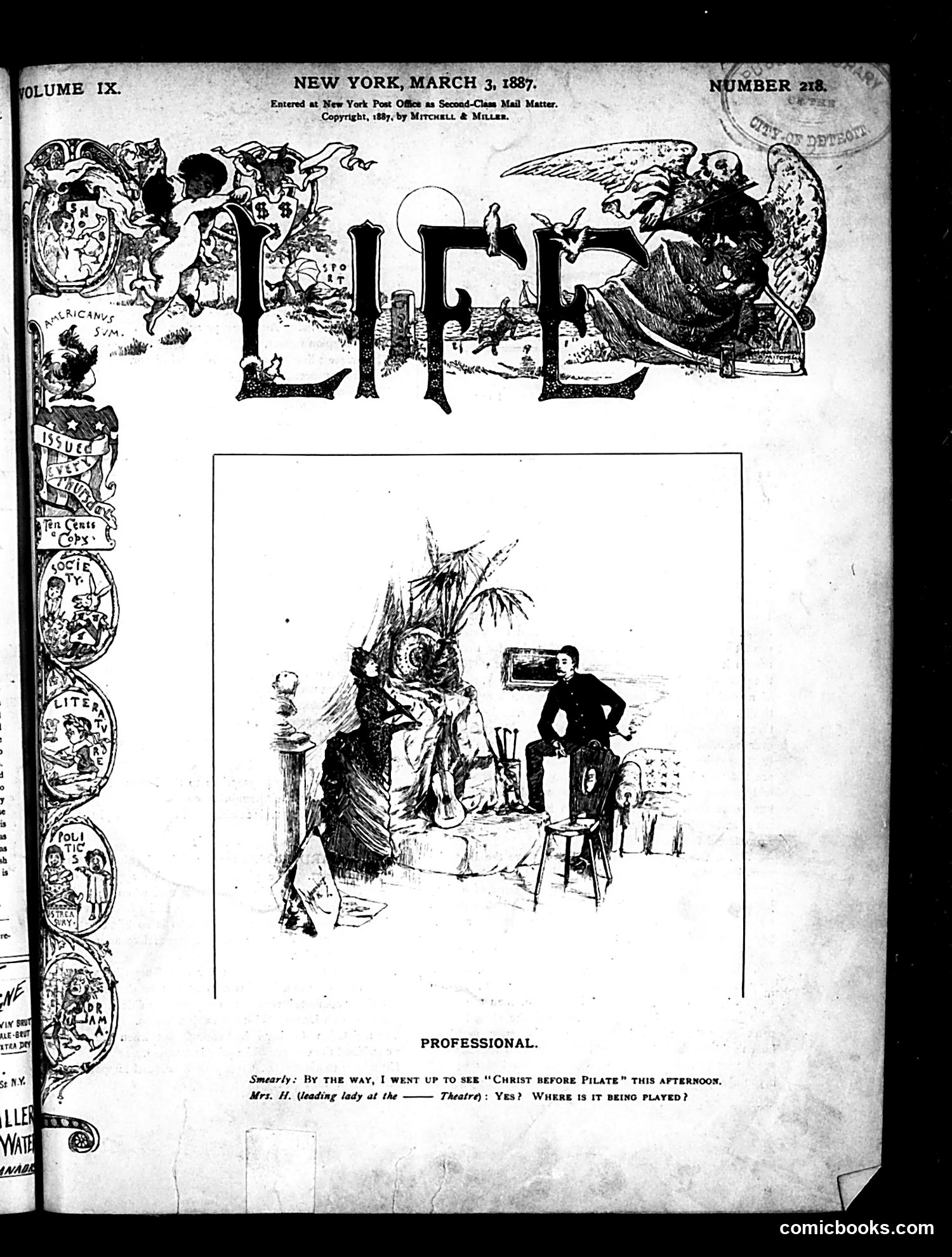
The main cartoon titled "PROFESSIONAL" depicts a theatrical scene. A smartly-dressed gentleman (likely a theater patron or critic) visits a leading lady at what appears to be a theater dressing room. He remarks: "By the way, I went up to see 'Christ before Pilate' this afternoon." The lady responds: "Yes? Where is it being played?" The joke satirizes either the obscurity of this theatrical production or, more likely, critiques the quality of the performance—suggesting the play was so poorly executed or staged that its location was unmemorable or the production itself was forgettable. The humor relies on the contrast between the gentleman's attempt at casual conversation and the lady's pointed, dismissive response highlighting the play's lack of success or prominence.
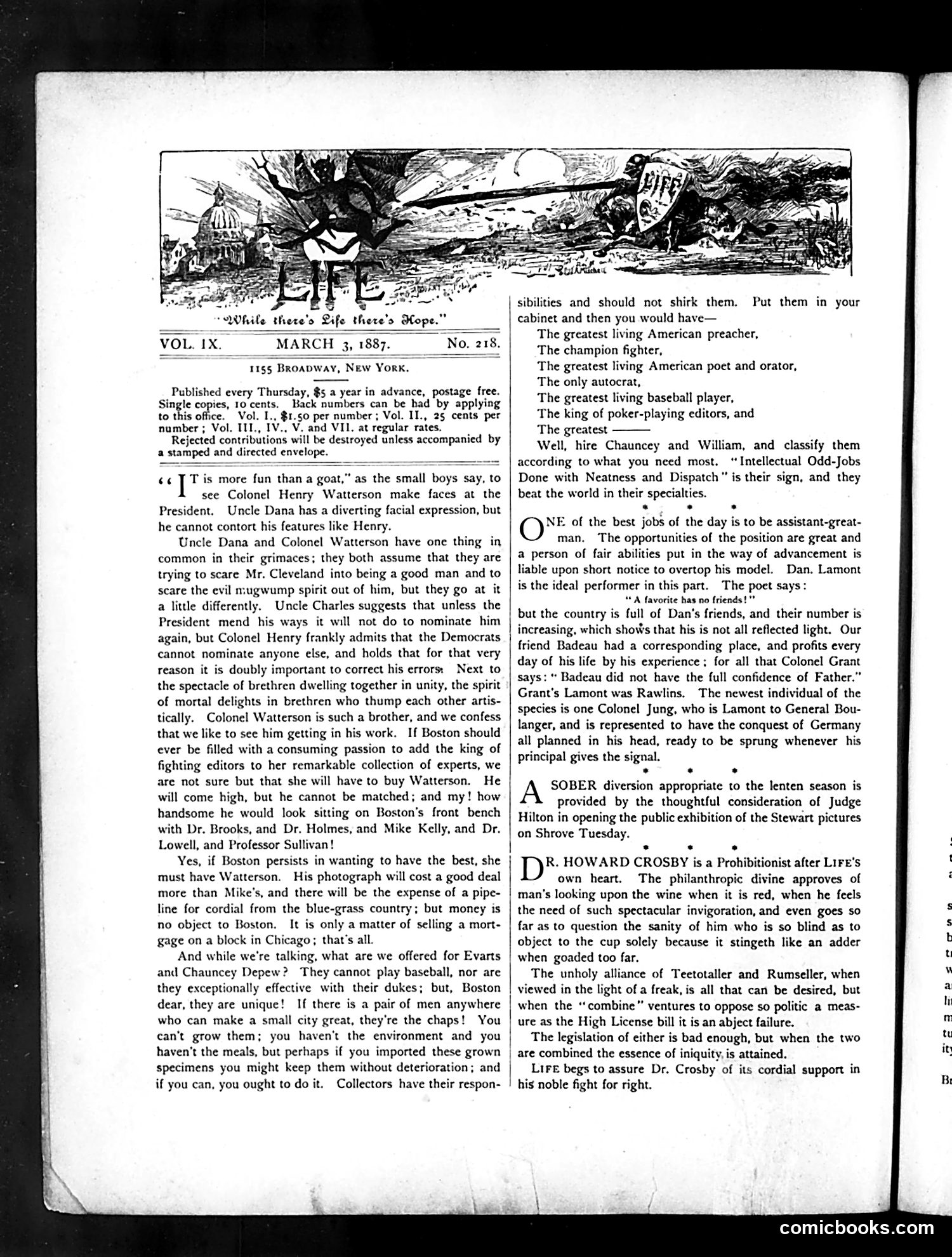
The headline "While there's Life there's Hope" frames this satirical page about American celebrity and accomplishment. The main text discusses **Colonel Henry Watterson**, a prominent newspaper editor and political figure of the era. The satire plays on his dual reputation: he has an expressive face but limited actual influence. The piece jokes that unless President Cleveland nominates him again, Democrats cannot nominate anyone else—a barbed comment on Watterson's outsized self-importance versus actual political power. The text also ridicules other contemporary figures competing for status as America's "greatest"—preachers, poets, baseball players—suggesting excessive American celebrity-worship and self-promotion. The satirical tone mocks 1880s American culture's obsession with ranking and claiming superiority in various fields.
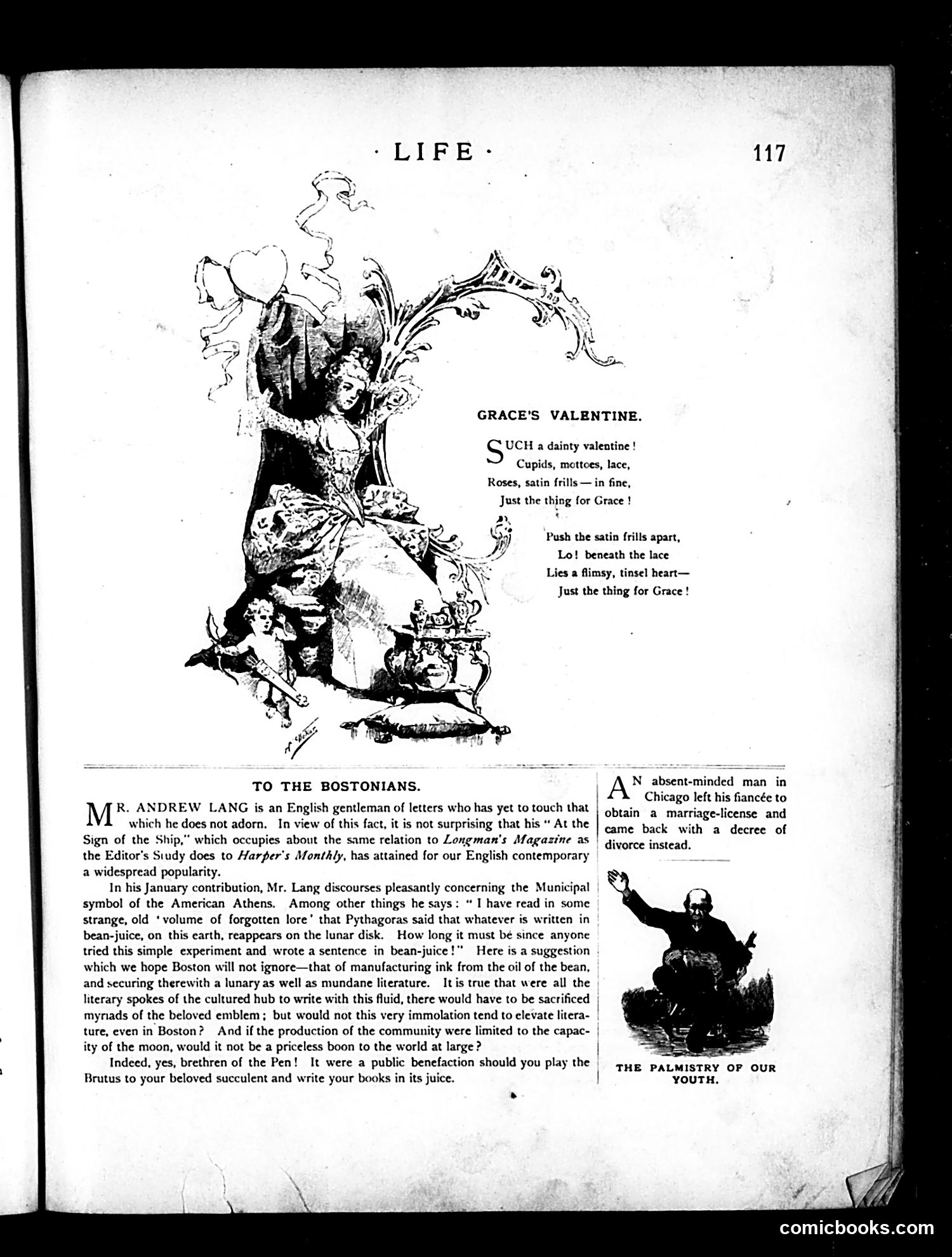
**"Grace's Valentine"** (top): A romantic illustration accompanying a poem about an elaborate Valentine's Day gift for someone named Grace—featuring satin frills, lace, and roses. This is sentimental verse with decorative artwork, typical of the era's Valentine's Day content. **"To the Bostonians"** (main text): A satirical essay praising Mr. Andrew Lang, described as an English writer of letters. The piece humorously suggests using bean-juice as ink for writing, referencing an anecdote about Pythagoras. It's gentle intellectual satire mocking Boston's literary pretensions while praising Lang's wit. **"The Palmistry of Our Youth"** (bottom right): A small illustration of what appears to be a fortune teller reading a palm, likely accompanying a humorous piece about fortune-telling trends.
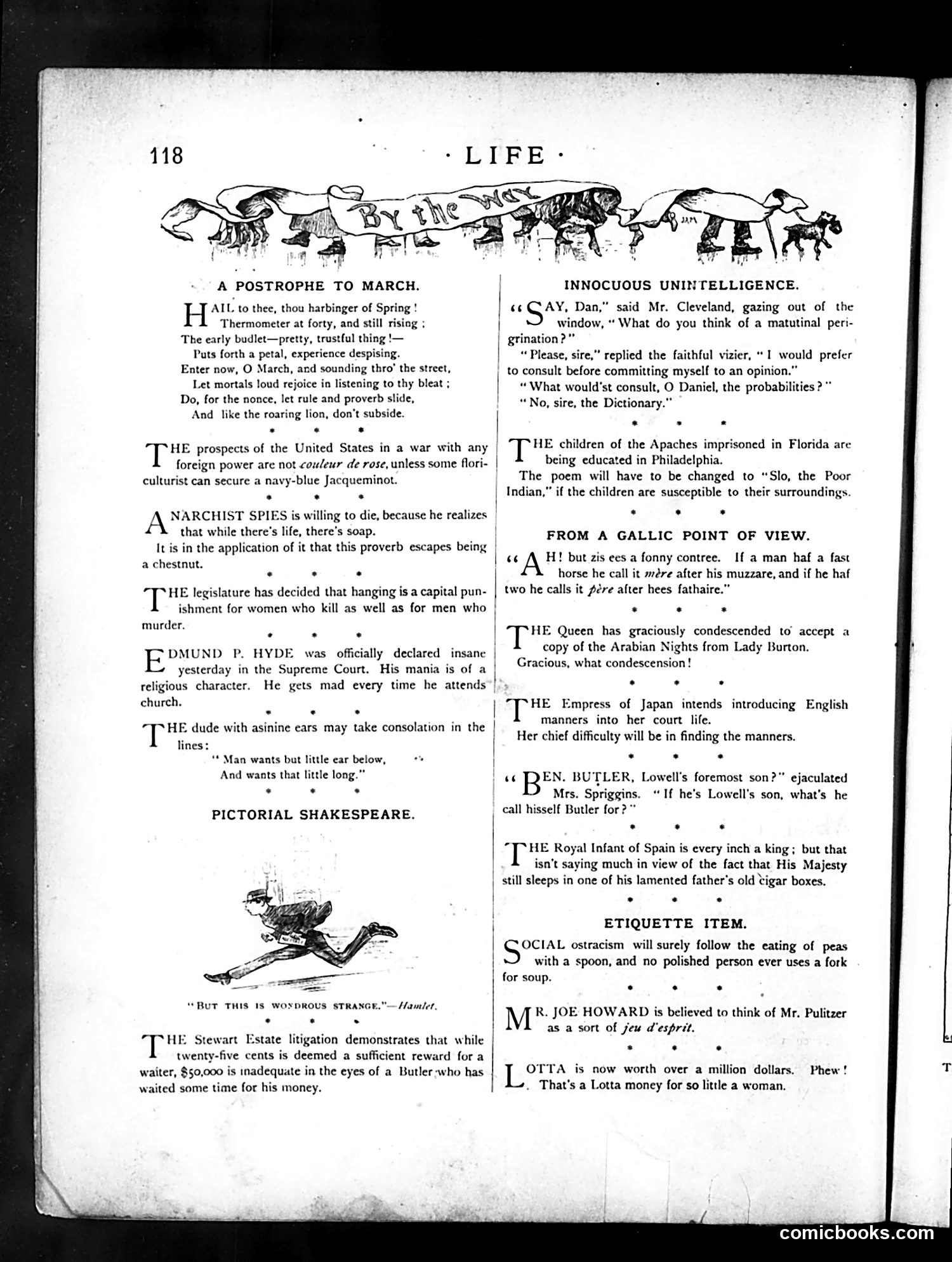
This page contains miscellaneous satirical items rather than a single unified cartoon. Notable elements include: **"A Postrophe to March"** - A poem celebrating spring's arrival with traditional romantic language. **"Pictorial Shakespeare"** - A sketch illustrating Hamlet's famous line "But this is wondrous strange," depicting a falling figure in exaggerated motion. **Various satirical quips** about contemporary society, including observations on military procurement, judicial decisions, an insanity case involving Edmund P. Hyde, and wealth disparities (the Stewart Estate litigation). The right column contains **brief social commentary** on topics like children's education, linguistic humor about horses, and etiquette observations—typical of Life's humorous miscellany format targeting educated American readers with topical, often ironic observations on politics, law, and social customs.
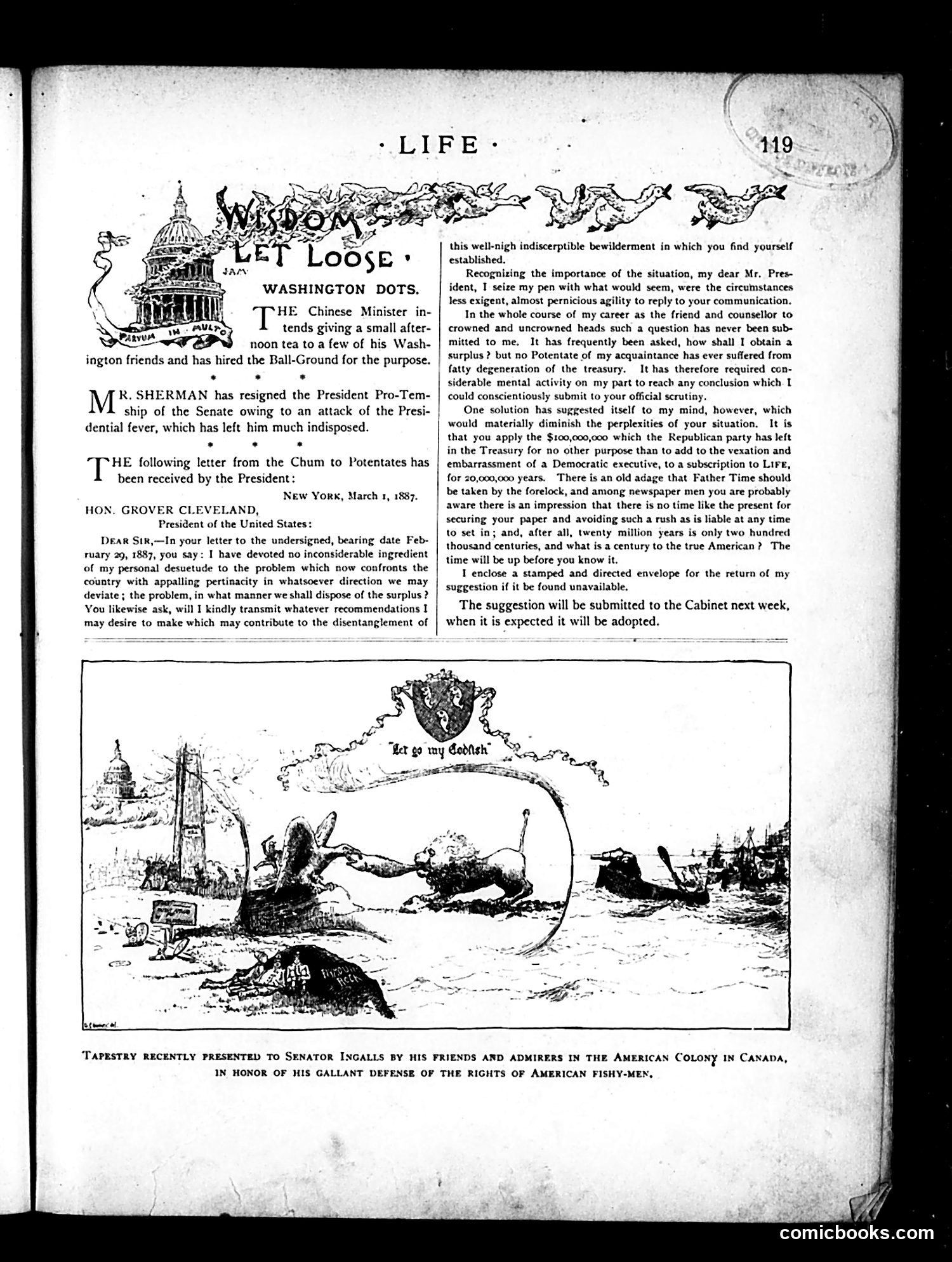
This 1887 *Life* magazine page satirizes a diplomatic dispute over fishing rights between the United States and Canada. The cartoon depicts a man (representing either the U.S. or Canada) in a net labeled "Let go my darfish," struggling with what appears to be a large fish or sea creature—likely symbolizing contested fishing territory or rights. The accompanying text references a letter from "the Chum to Potentates" regarding a surplus treasury problem and diplomatic tensions. The caption mentions a tapestry presented to Senator Ingalls "in honor of his gallant defense of the rights of American fishy-men," suggesting the cartoon comments on heated negotiations over Atlantic fishing access—a genuine source of U.S.-Canadian friction during this period.
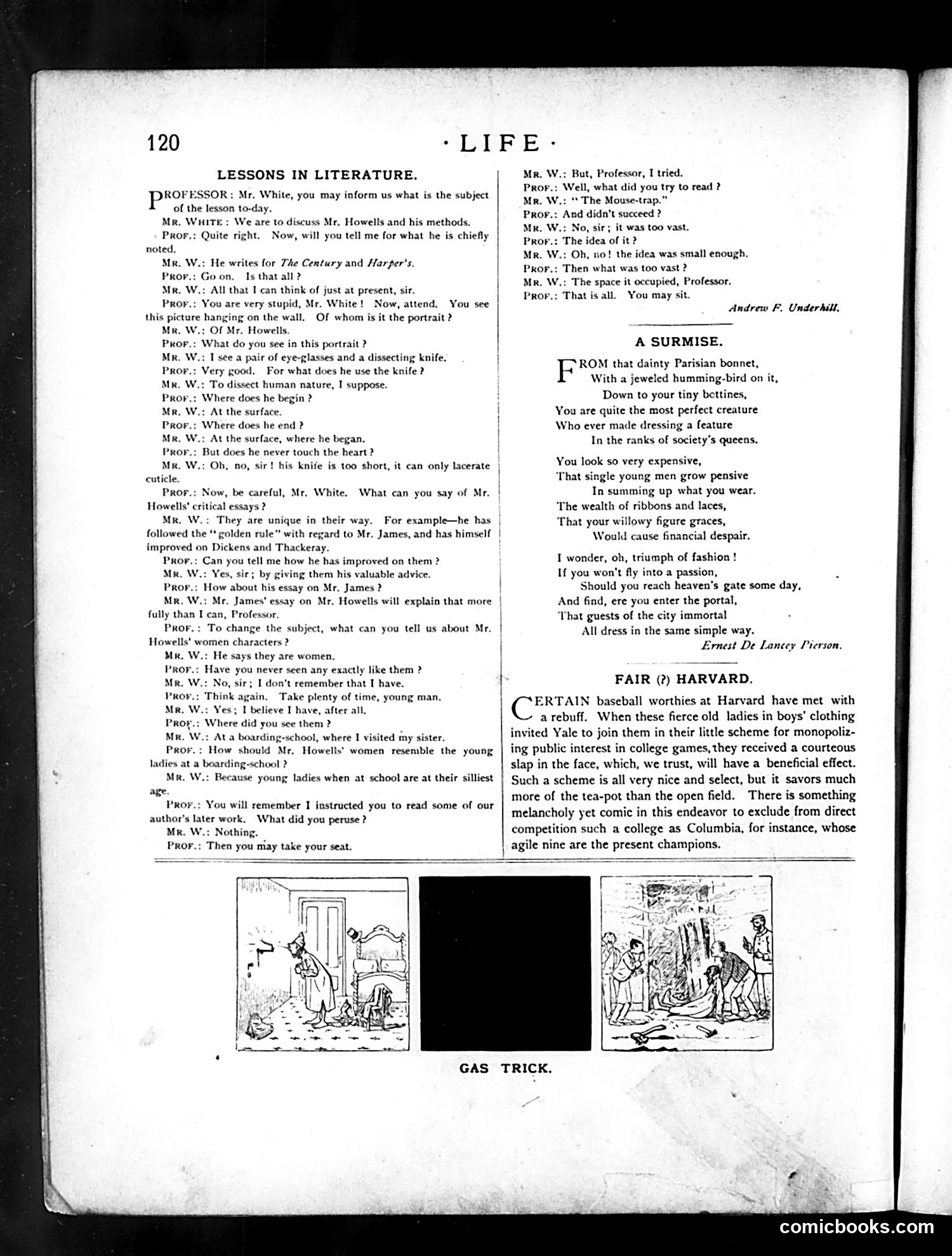
The three-panel cartoon at the bottom of the page illustrates a simple confidence scheme or practical joke. The sequence appears to show: (1) a person entering or at a doorway, (2) a middle panel (obscured/blacked out), and (3) the aftermath with multiple figures gathered around what seems to be a victim who has fallen or been knocked down. The title "Gas Trick" suggests the joke involves using gas (likely from a gas lamp or stove) to incapacitate or prank someone. This appears to be satirizing common urban con games or pranks from the early 1900s. The humor relies on slapstick physical comedy—the victim's comeuppance—rather than sophisticated wit. Without more context about specific contemporary events, the exact nature of the "trick" remains unclear from the partially illegible middle panel.
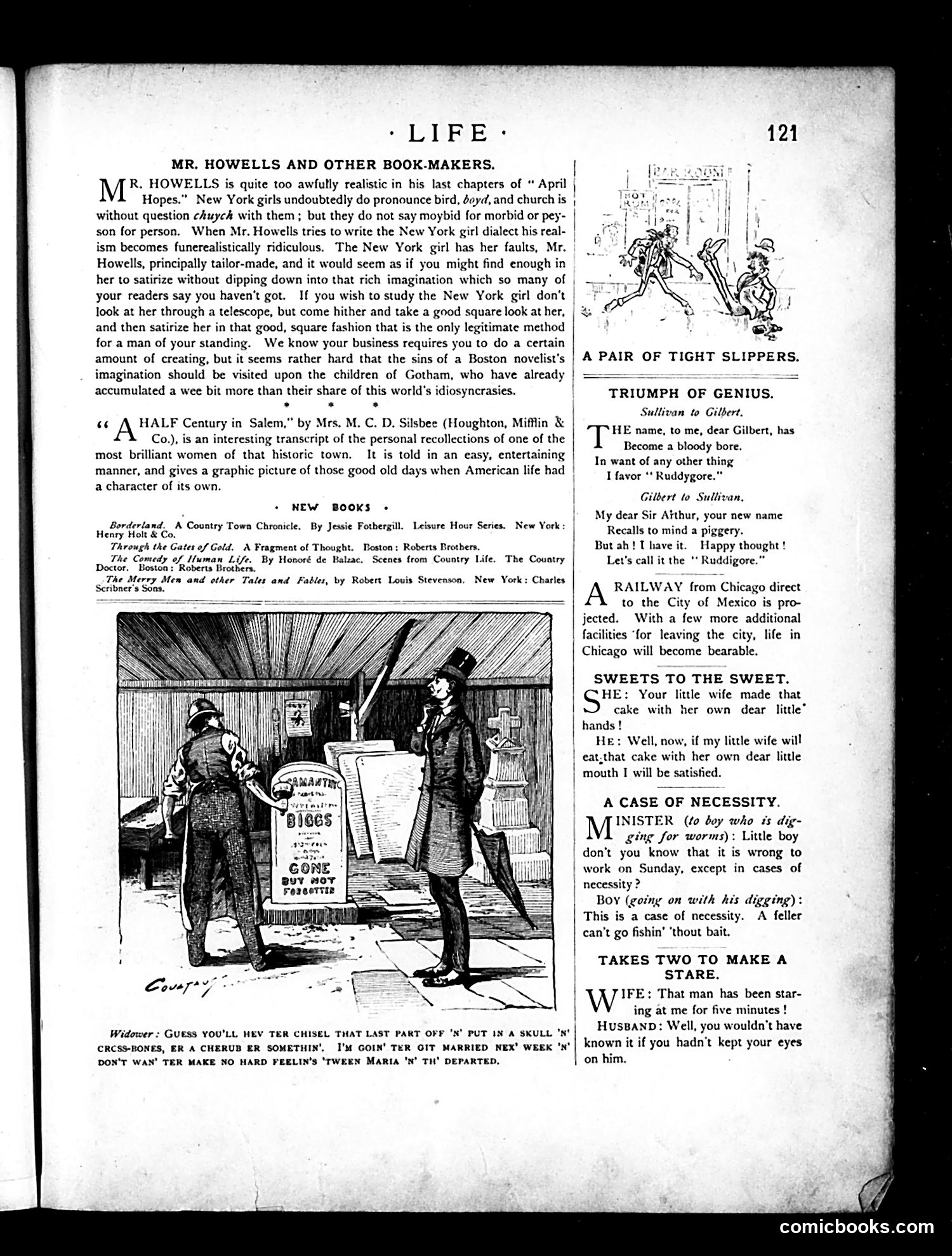
The main cartoon depicts two men in a printing shop examining a large book or document. The caption reads: "Guess you'll hex ten chisel that last part of 'it' Bill, chess-bones, er a cherub err sometimes! I'm goin' ter git married next week 'n' don't wan 'em hard feelin's tween Maria 'n' th' departed." This appears to be a humorous exchange between working-class characters—likely a printer and his associate—discussing removing or altering content before his upcoming marriage. The satire targets the working-class tendency to conceal past romantic entanglements or indiscretions from new wives, reflected in deliberately crude dialect and colloquial speech that emphasizes their rough social status. The joke plays on marital deception and the desire to erase evidence of prior romantic involvement.
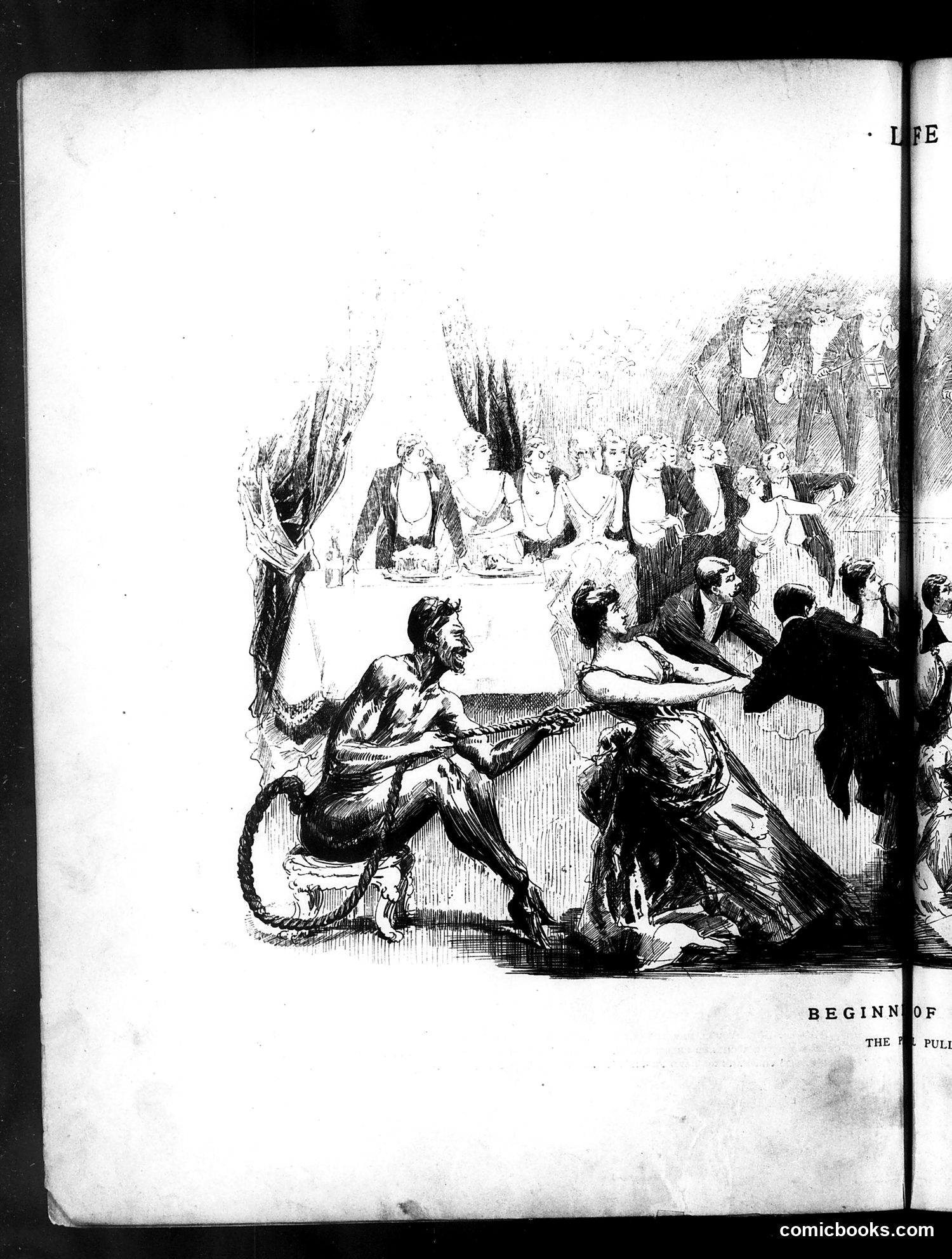
This satirical engraving depicts a formal dinner scene with sharp social commentary. In the foreground, two impoverished or marginalized figures—appearing skeletal and poorly dressed—are depicted in stark contrast to the well-dressed diners seated at the table behind them. The figures in the background are shown dining comfortably while the foreground figures seem excluded or desperate. The satire likely critiques economic inequality and class division in American society. The juxtaposition of poverty and plenty suggests commentary on how wealth disparity persists within the same social space. The style and "LIFE" masthead indicate this is from the 19th-century satirical magazine *Life*, which frequently attacked social injustices and hypocrisy through such visual contrasts. The specific political or economic context remains unclear without additional historical information.
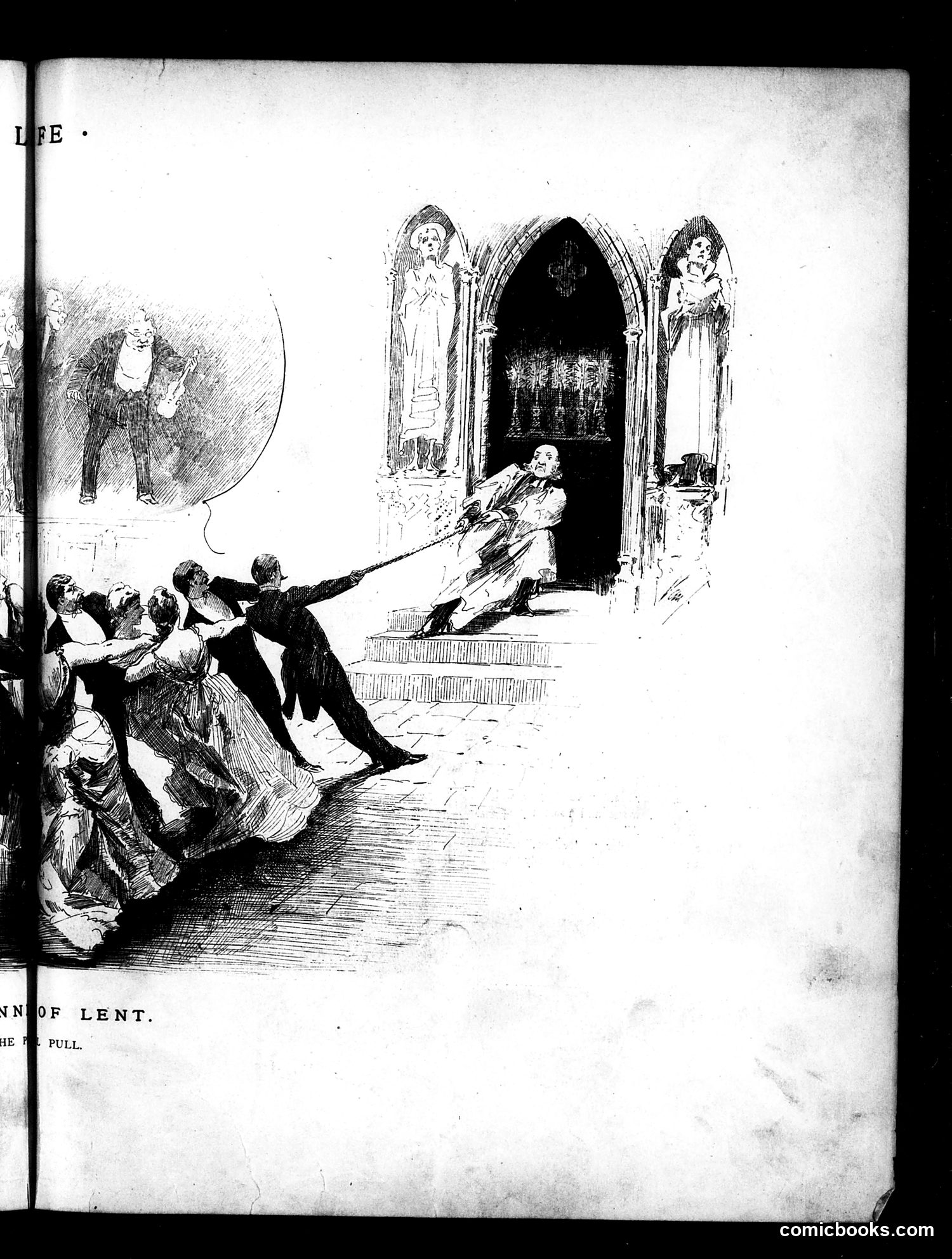
This is a satirical cartoon titled "CANNON OF LENT" (visible at bottom, though partially obscured). The image depicts a religious procession or ceremony at a church entrance, where figures are being dramatically "pulled" or propelled through the doorway by a rope or chain mechanism—depicted as a literal "cannon." The satire appears to target the Catholic practice of Lenten observance, suggesting that believers are forcibly compelled into religious participation rather than entering willingly. The exaggerated mechanical imagery mocks institutionalized religion as coercive rather than spiritually authentic. The upper left shows an ethereal figure, possibly representing a saint or spiritual ideal, contrasting with the earthbound, almost absurd scene below—emphasizing the gap between religious ideals and institutional practice. This reflects late 19th-century skepticism toward organized religion common in *Life* magazine's satirical commentary.
This page is a **drama review** of Gilbert and Sullivan's opera *"Ruddygore."* The author critiques the work as ultimately unsuccessful despite the composers' reputation, calling it "a very dreary sort of opera" with an overly complicated plot involving a witch's curse. The review criticizes the opera's irrelevant songs and excessive theatrical conventions (dance numbers, "selections"). The author praises supporting performer Geraldine Ulmar as "Rose Mayhew" but finds the main character Robin Oakapple poorly conceived—describing it as a failed parody of *The Mikado*. The illustrated header and decorative footer are typical period magazine design elements. This is straightforward theater criticism rather than political satire.
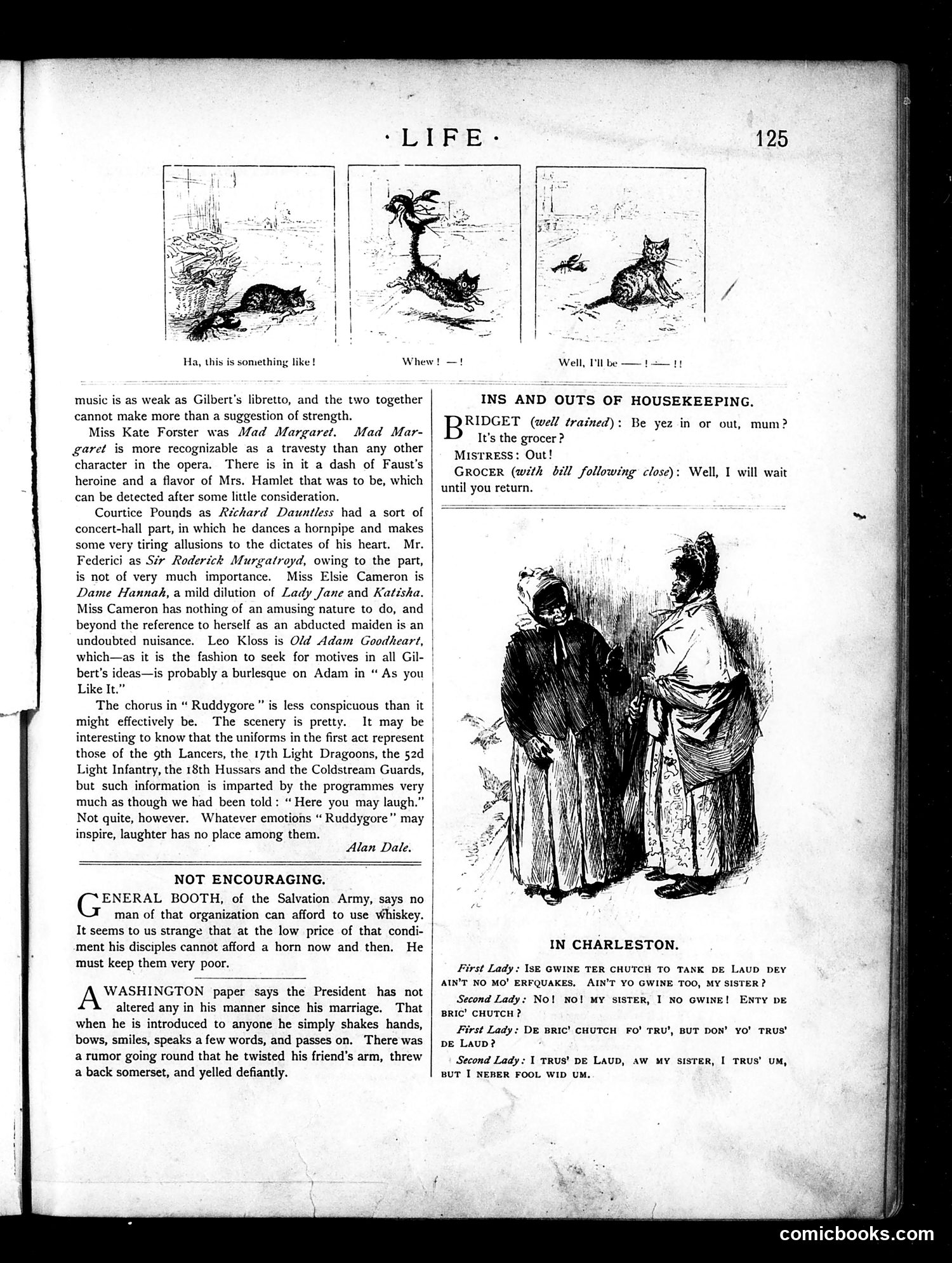
**Top Section - Opera Critique:** The text reviews Gilbert and Sullivan's "Ruddigore," critiquing performances by various cast members. The three small cartoon panels at top show cats engaged in comedic situations, illustrating the phrase "Ha, this is something like!" — a visual pun or humorous interlude unrelated to the opera review. **"Not Encouraging" Section:** Two brief satirical paragraphs mock: 1. General Booth of the Salvation Army for forbidding alcohol to members while paying them poorly 2. A rumor about the President (identity unclear from context) behaving unusually after marriage — the satire suggests gossip exaggerated his normal, reserved demeanor **"Ins and Outs of Housekeeping":** A comic dialogue between a mistress and grocer, poking fun at domestic confusion and servant miscommunication. **"In Charleston":** A dialect piece depicting two African American women discussing church attendance after earthquakes, using period stereotypical speech patterns. The humor relies on the racial caricature conventions common to late-19th-century publications.
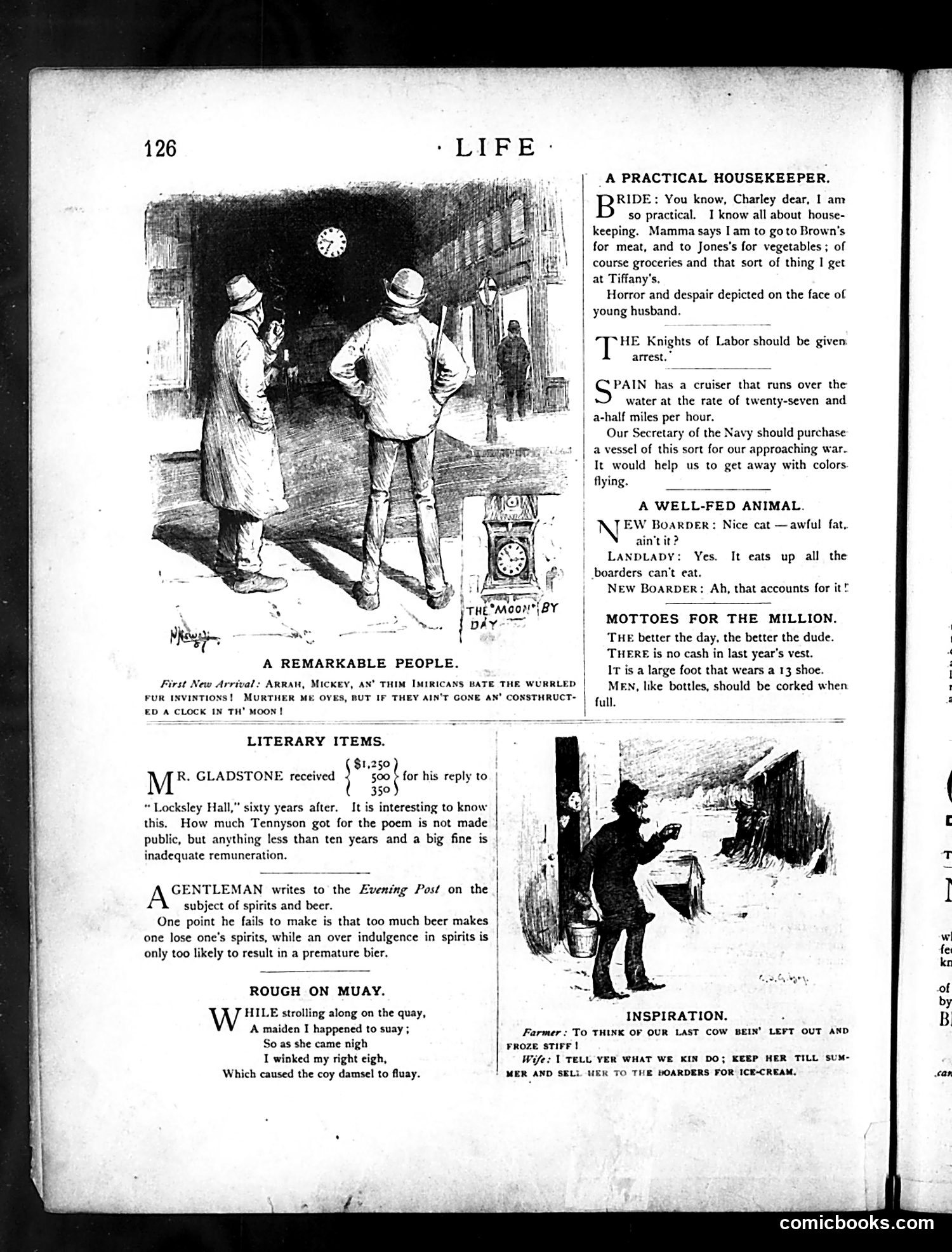
This page contains several brief satirical sketches mocking contemporary society: **"A Practical Housekeeper"** ridicules a young bride's pretentious approach to household management—she claims expertise yet merely repeats her mother's instructions, shopping at expensive places like Tiffany's for groceries. Her horrified husband's expression signals the joke: her "practicality" is actually naive snobbery. **"A Remarkable People"** features Irish immigrants (indicated by dialect) marveling that Americans built a clock on the moon—obviously fantastical, satirizing both immigrant credulity and American boastfulness about technological progress. **Other brief jokes** mock various targets: the Knights of Labor (a labor union), naval policy, landlords profiting from boarders' leftovers, and rural life. The cartoons reflect late-19th-century American anxieties: class pretension, immigrant stereotypes, labor unrest, and modernization. The humor relies on exaggeration and dialect to demean working-class and immigrant subjects while gently needling the wealthy.
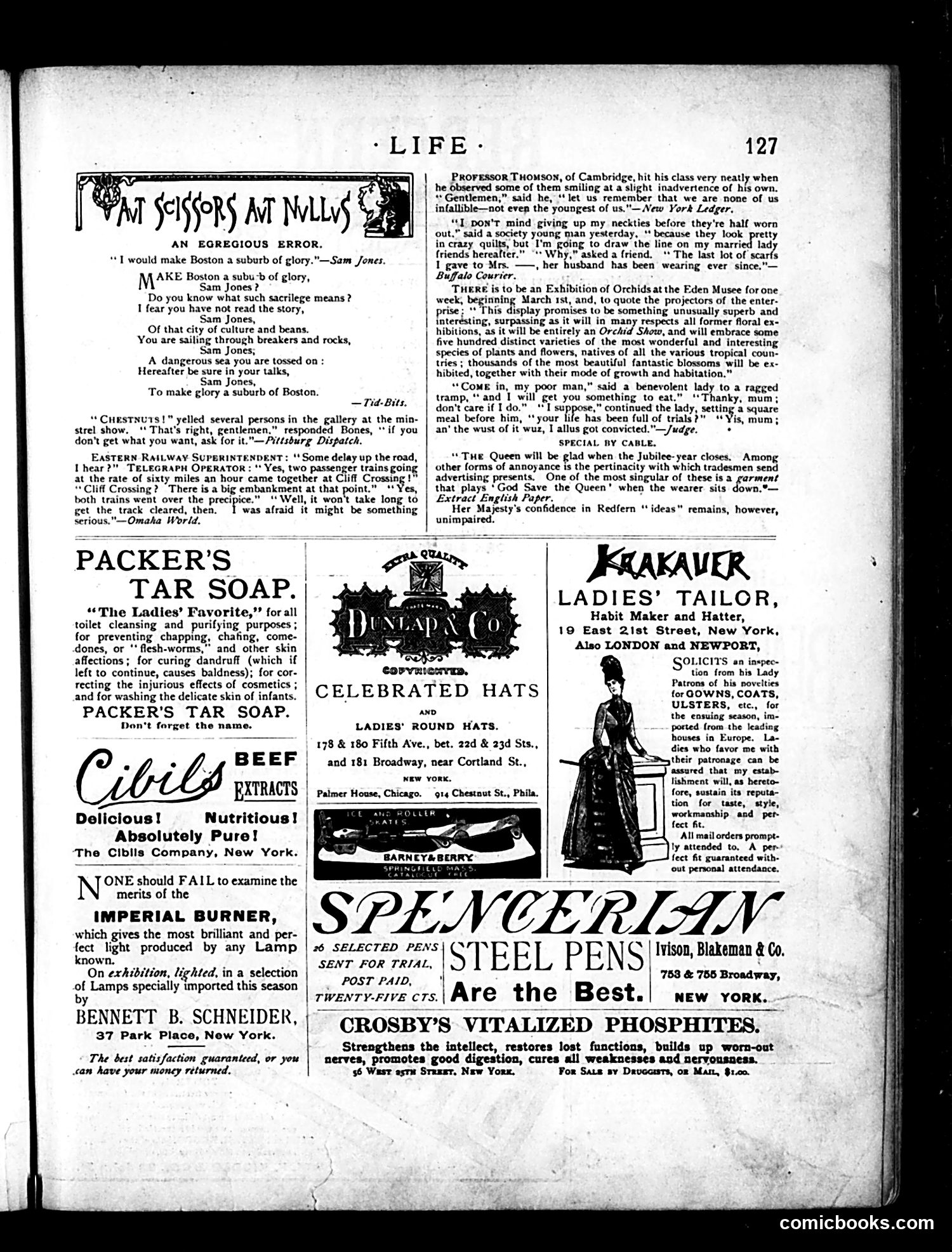
This page contains three brief satirical pieces poking fun at American pretensions and absurdities: 1. **"At Scissors and Mulls"** (top): A poem mocking Sam Jones (likely a popular preacher) for suggesting Boston become "a suburb of glory." The satire defends Boston's existing pride in its culture and history ("city of culture and beans"), arguing glory should serve Boston, not the reverse—a dig at overblown rhetoric. 2. **Three short jokes** follow, including one about a minstrel show, a darkly absurd railroad anecdote about a superintendent unconcerned with a train disaster, and a domestic humor piece about worn neckties being repurposed in quilts. The page is predominantly **advertisements** (Packer's Tar Soap, Cibils Beef Extracts, Bennett B. Schneider lamps, Krakauer Ladies' Tailor, Spencer & Ivison steel pens, Crosby's Phosphites). The satirical content is incidental filler between ads—typical of *Life* magazine's format mixing humor with commercial content.
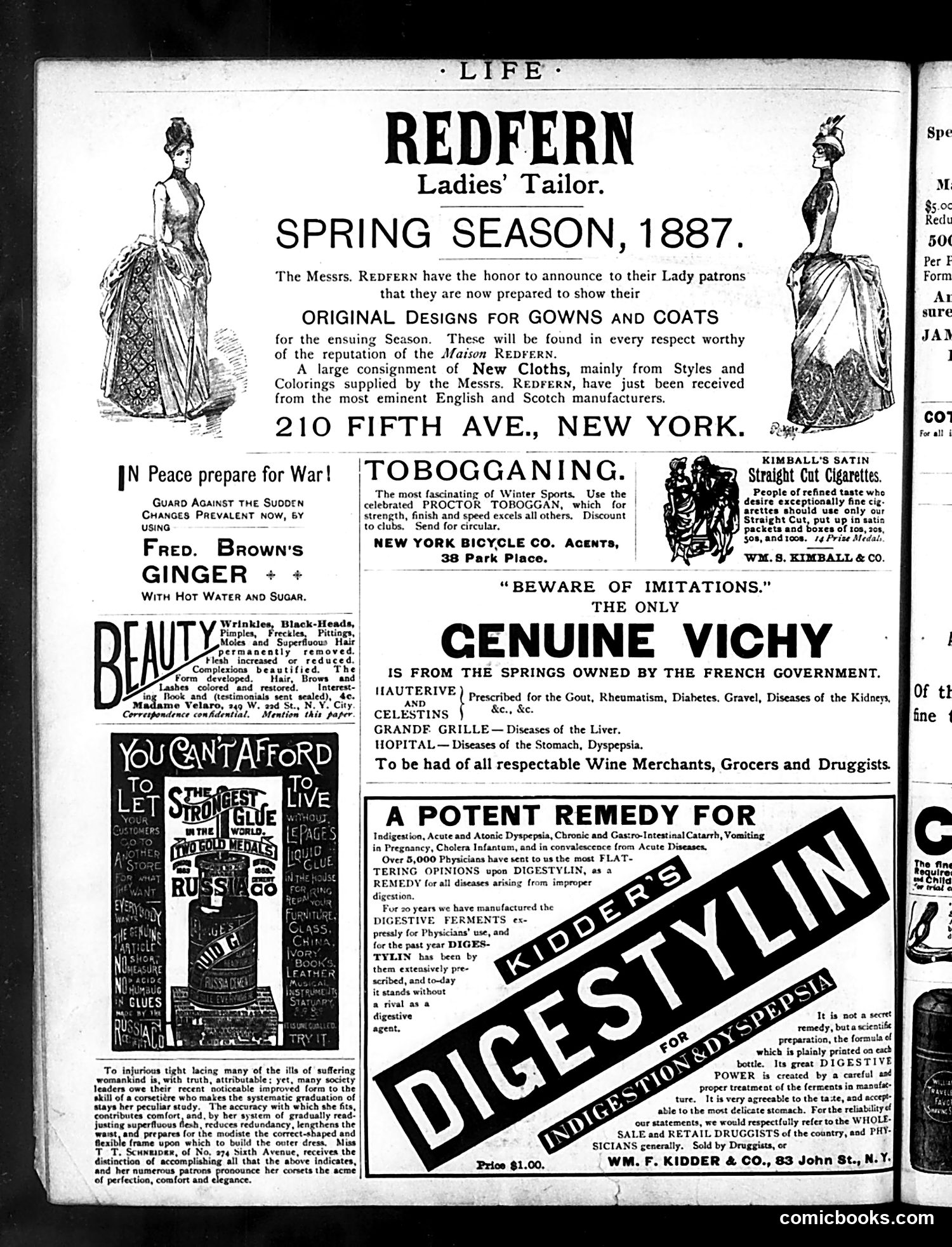
This page contains **no political cartoons or satire**—it is primarily a collection of advertisements for a luxury fashion magazine from 1887. The main content advertises **Redfern, a high-end ladies' tailor** on Fifth Avenue in New York, announcing their spring collection of original gowns and coats made from English and Scottish fabrics. The surrounding ads promote period-specific products: Fred. Brown's Ginger (a digestive aid), beauty treatments (wrinkle and freckle removal), corsetry services, and medicinal waters (Vichy water and "Digestylin," a digestive remedy claiming endorsement from 5,000 physicians). These ads reflect Victorian-era concerns with refined appearance, tight-laced fashion, and patent medicines—many later revealed as ineffective or dangerous. **The only humorous element** is a small ad for Russ's Glue with text reading "You can't afford to live without it," using exaggerated typography for comedic effect about an everyday product. This is a typical late 19th-century magazine page targeting wealthy, fashion-conscious readers.
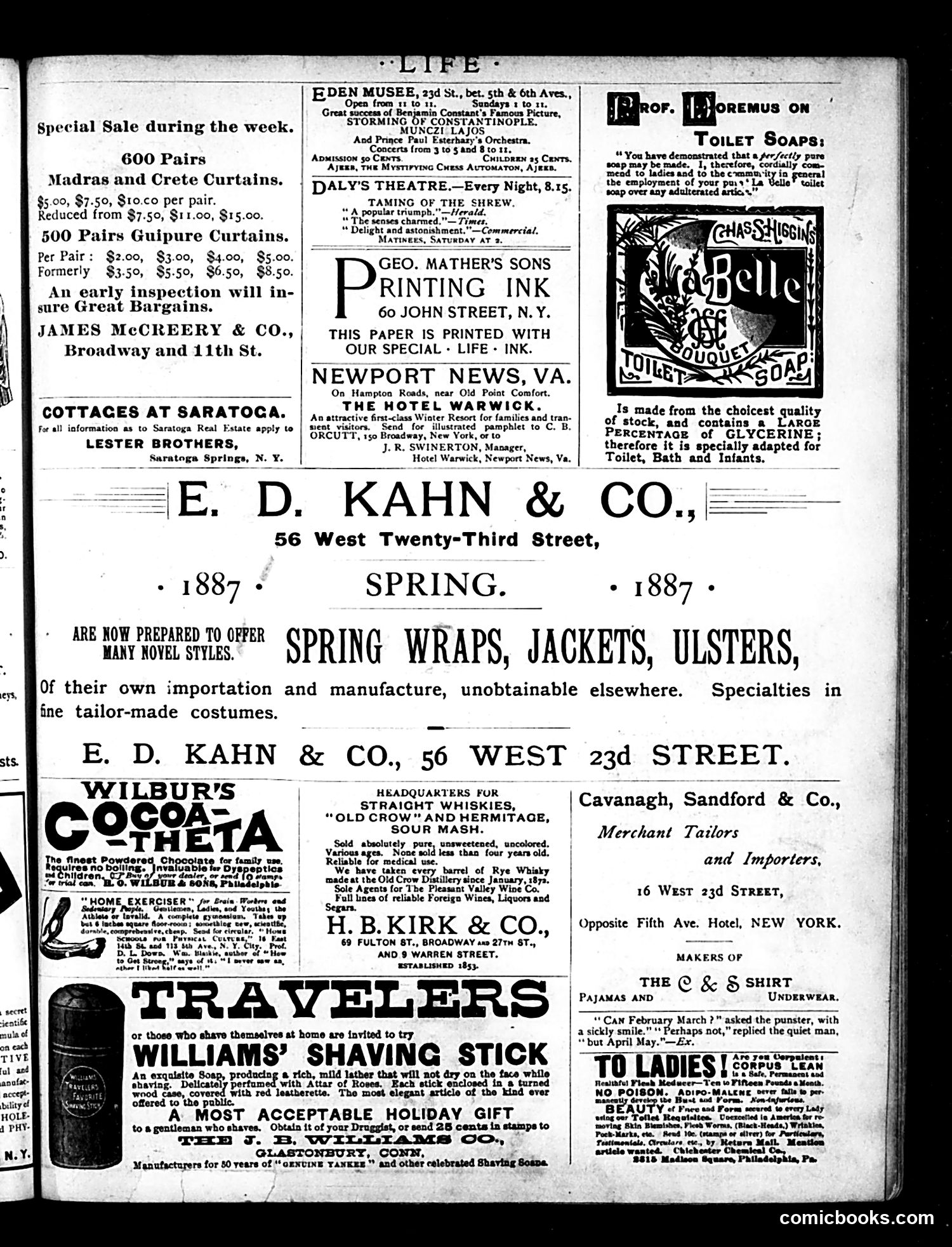
This is primarily an **advertising page** from Life magazine's Spring 1887 issue, containing no political cartoons or satirical content requiring historical context. The page features commercial advertisements for department stores (James McCREERY & CO., E.D. KAHN & CO.), hotels, theaters, whiskey distributors, and consumer products like soap, shaving sticks, and corset lacing. One notable advertisement is **"Williams' Shaving Stick,"** marketed to men who shave at home—reflecting 1880s domestic grooming practices before safety razors became standard. The **"To Ladies" corset advertisement** at bottom promises weight loss ("Ten to Fifteen Pounds a Month"), typical of Victorian-era body modification marketing that would be considered dangerous by modern standards. The **Prof. Boremus toilet soap endorsement** uses testimonial advertising, common in the period. Overall, this page documents 1887 consumer culture and retail practices rather than containing satirical commentary.
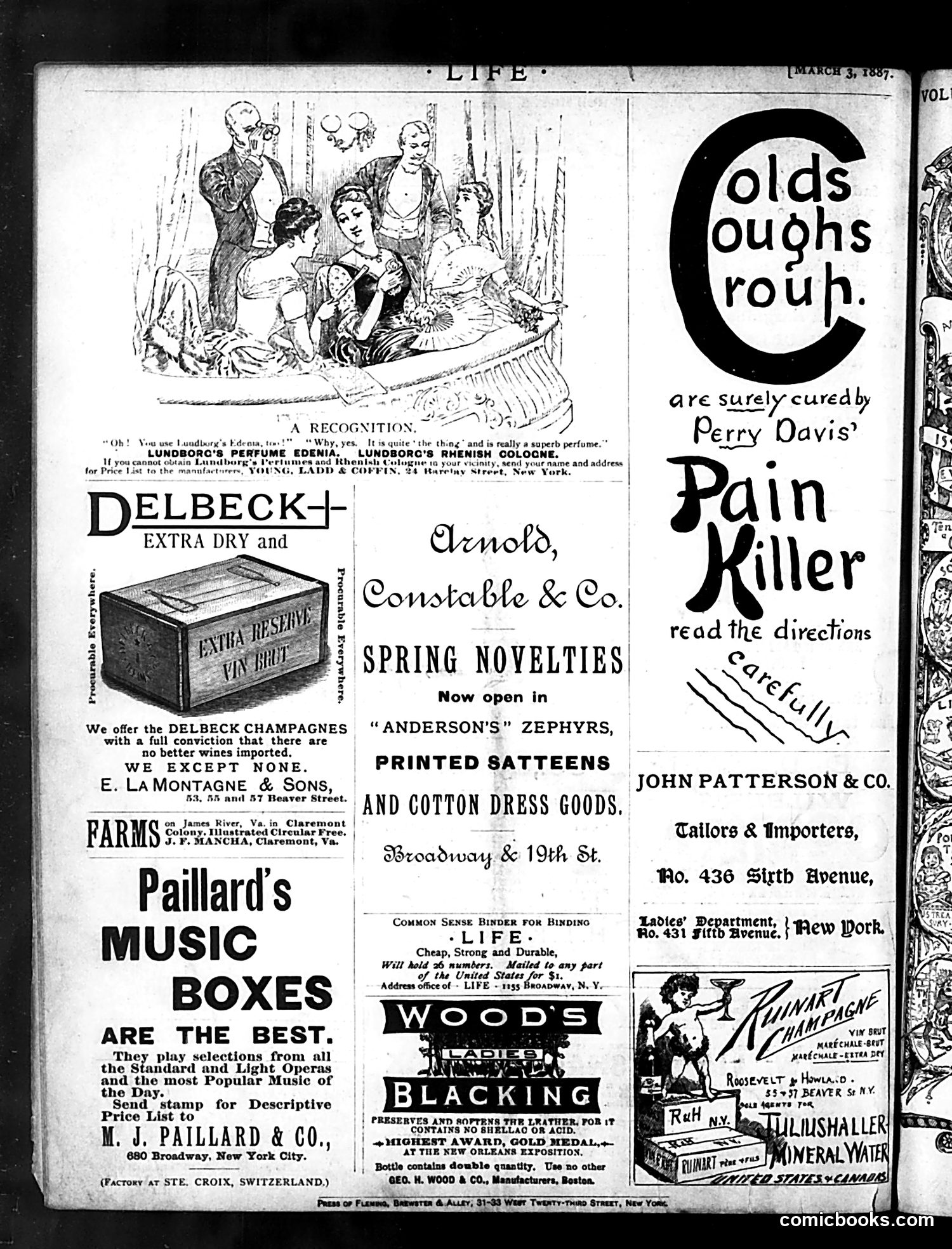
This page is primarily **advertising**, not political satire. The top cartoon titled "A RECOGNITION" appears to be a social scene depicting people in formal dress, likely illustrating a humorous social situation, but the caption is partially illegible in this reproduction. The bulk of the page consists of period product advertisements: champagne (Delbeck), music boxes (Paillard's), wine binders, ladies' clothing and novelties, tailoring services, and patent medicines like Perry Davis's Pain Killer. The cartoon itself seems to depict recognition or acknowledgment between society figures, but without clearer caption text, the specific social commentary is unclear. The advertisement-heavy layout was typical of Life's revenue model—the magazine mixed satirical content with commercial notices. Modern readers would primarily note the era's remedies (Pain Killer for coughs) and the formality of late-Victorian social conventions reflected in the illustration.