
Life, 1887-03-03 · page 10 of 16
Life — March 3, 1887 — page 10: what you’re looking at
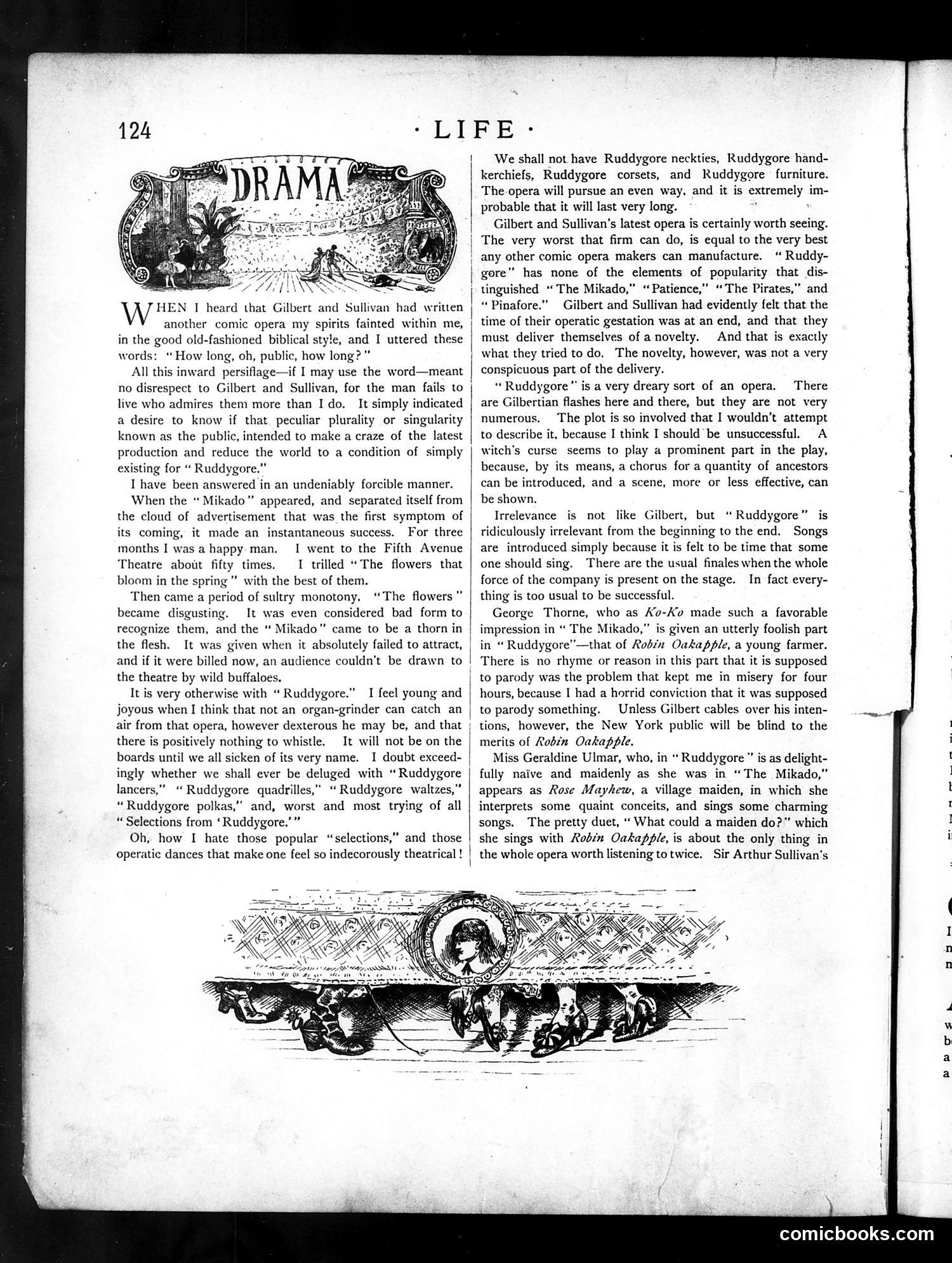
What you’re looking at
This page is a **drama review** of Gilbert and Sullivan's opera *"Ruddygore."* The author critiques the work as ultimately unsuccessful despite the composers' reputation, calling it "a very dreary sort of opera" with an overly complicated plot involving a witch's curse. The review criticizes the opera's irrelevant songs and excessive theatrical conventions (dance numbers, "selections"). The author praises supporting performer Geraldine Ulmar as "Rose Mayhew" but finds the main character Robin Oakapple poorly conceived—describing it as a failed parody of *The Mikado*. The illustrated header and decorative footer are typical period magazine design elements. This is straightforward theater criticism rather than political satire.
📄 Transcribed text from this page (OCR, searchable)
Machine-transcribed from the original scan — historical spelling and the odd misread are preserved.
- LI 2ST : 2 HEN | heard that Gilbert and Sullivan had written another comic opera my spirits fainted within me, in the good old-fashioned biblical style, and I uttered these | words: “ How long, oh, public, how long?” All this inward persiflage—if 1 may use the word—meant no disrespect to Gilbert and Sullivan, for the man fails to | live who admires them more than I do. It simply indicated a desire to know if that peculiar plurality or singularity known as the public, intended to make a craze of the latest production and reduce the world to a condition of simply existing for “ Ruddygore.” I have been answered in an undeniably forcible manner. When the * Mikado” appeared, and separated itself from the cloud of advertisement that was the first symptom of | its coming, it made an instantaneous success. For three months I was a happy man. I went to the Fifth Avenue Theatre about fifty times. I trilled “The flowers that bloom in the spring ” with the best of them. Then came a period of sultry monotony. “The flowers” became disgusting. It was even considered bad form to recognize them, and the “ Mikado” came to be a thorn in the flesh. and if it were billed now, an audience couldn’t be drawn to the theatre by wild buffaloes. It is very otherwise with “ Ruddygore.” I feel young and joyous when I think that not an organ-grinder can catch an air from that opera, however dexterous he may be, and that there is positively nothing to whistle. boards until we all sicken of its very name. ingly whether we shall ever be deluged with “ Ruddygore lancers,” “ Ruddygore quadrilles,” “ Ruddygore waltzes,” “Ruddygore polkas,"" and, worst and most trying of all “Selections from ‘Ruddygore.’” Oh, how I hate those popular “selections,” and those operatic dances that make one feel so indecorously theatrical ! It was given when it absolutely failed to attract, | It will not be on the | I doubt exceed- | FE: | We shall not. have Ruddygore neckties, Ruddygore hand- kerchiefs, Ruddygore corsets, and Ruddygore furniture. The opera will pursue an even way, and it is extremely im- probable that it will last very long. : Gilbert and Sullivan's latest opera is certainly worth seeing. | The very worst that firm can do, is equal to the very best | any other comic opera makers can manufacture. “ Ruddy- | gore” has none of the elements of popularity that dis- tinguished ‘The Mikado,” “Patience,” “The Pirates,” and “Pinafore.” Gilbert and Sullivan had evidently felt that the time of their operatic gestation was at an end, and that they must deliver themselves of a novelty. And that is exactly what they tried to do. The novelty, however, was not a very conspicuous part of the delivery. “Ruddygore” is a very dreary sort of an opera. There are Gilbertian flashes here and there, but they are not very numerous. The plot is so involved that I wouldn’t attempt to describe it, because I think I should be unsuccessful. A witch's curse seems to play a prominent part in the play, because, by its means, a chorus for a quantity of ancestors can be introduced, and a scene, more or less effective, can be shown. Irrelevance is not like Gilbert, but “ Ruddygore” is ridiculously irrelevant from the beginning to the end. Songs are introduced simply because it is felt to be time that some one should sing. There are the usual finales when the whole | force of the company is present on the stage. In fact every- thing is too usual to be successful. George Thorne, who as Ao-Xo made such a favorable | impression in “ The Mikado,” is given an utterly foolish part in “ Ruddygore”—that of Robén Oakapple, a young farmer. | There is no rhyme or reason in this part that it is supposed | to parody was the problem that kept me in misery for four | hours, because I had a horrid conviction that it was supposed | to parody something. Unless Gilbert cables over his inten- tions, however, the New York public will be blind to the merits of Robin Oakapple. Miss Geraldine Ulmar, who, in “ Ruddygore ” is as delight- | fully naive and maidenly as she was in “The Mikado,” appears as Rose Mayhew, a village maiden, in which she interprets some quaint conceits, and sings some charming songs. The pretty duet, ‘What could a maiden do?” which she sings with Robin Oakafppile, is about the only thing in | the whole opera worth listening to twice. Sir Arthur Sullivan's comicbooks.com