
A complete issue · 16 pages · 1887
Life — January 13, 1887
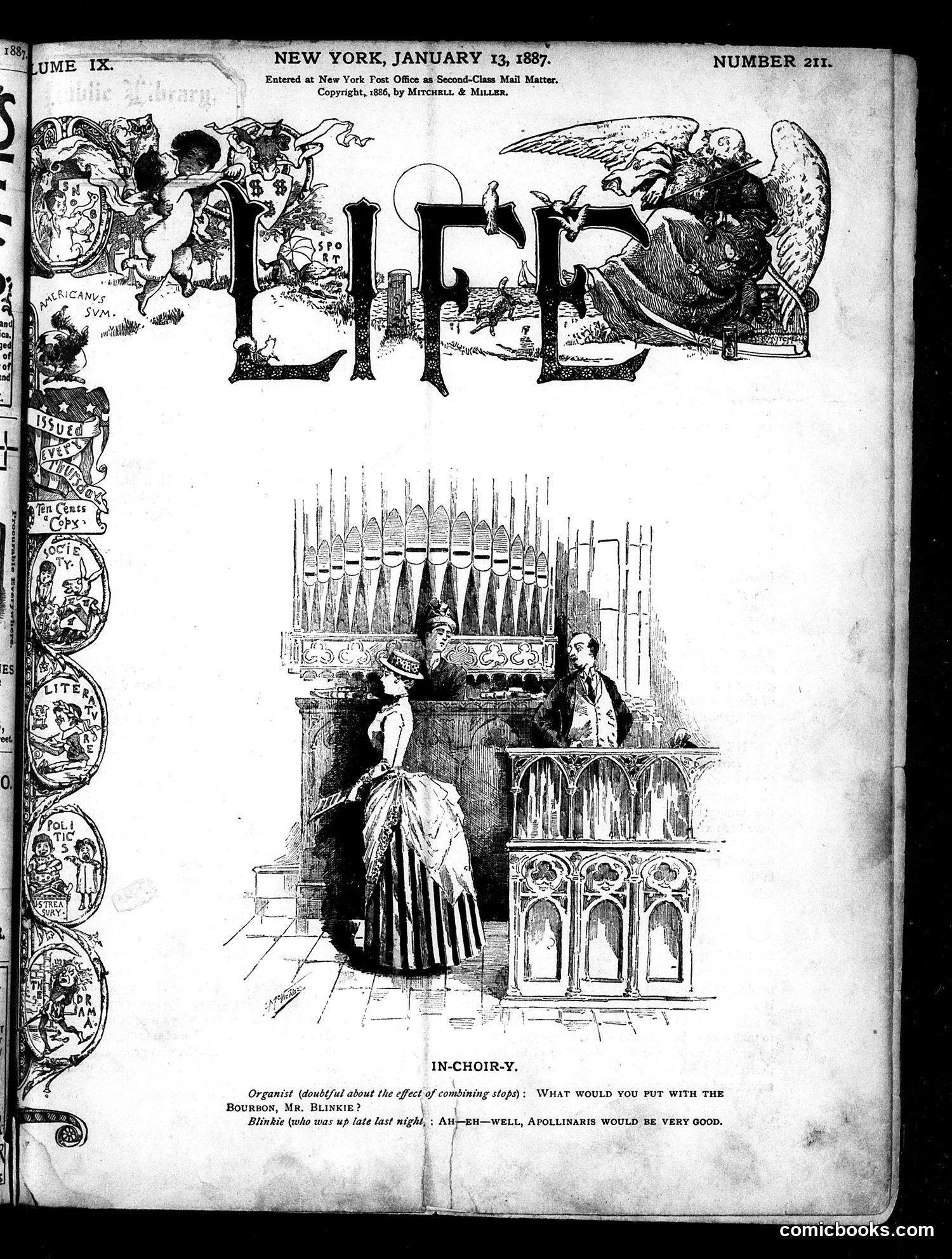
This page contains two satirical pieces: **Top illustration:** An elaborate decorative header reading "LIFE" with allegorical figures—angels and demons—surrounding it, typical of the magazine's ornate Victorian style. **Bottom illustration titled "IN-CHOIR-Y":** Shows two figures in a church choir loft. The caption presents a dialogue: an organist (doubtful about combining stops) asks a Blinkle what to pair with the Blinkle, who responds that "Apollinaris would be very good." This appears to be advertising satire, likely promoting Apollinaris mineral water by creating a humorous pun—"in-choir-y" (inquiry) set in a church choir. The joke plays on product placement through absurdist dialogue, common in 1880s advertising humor.
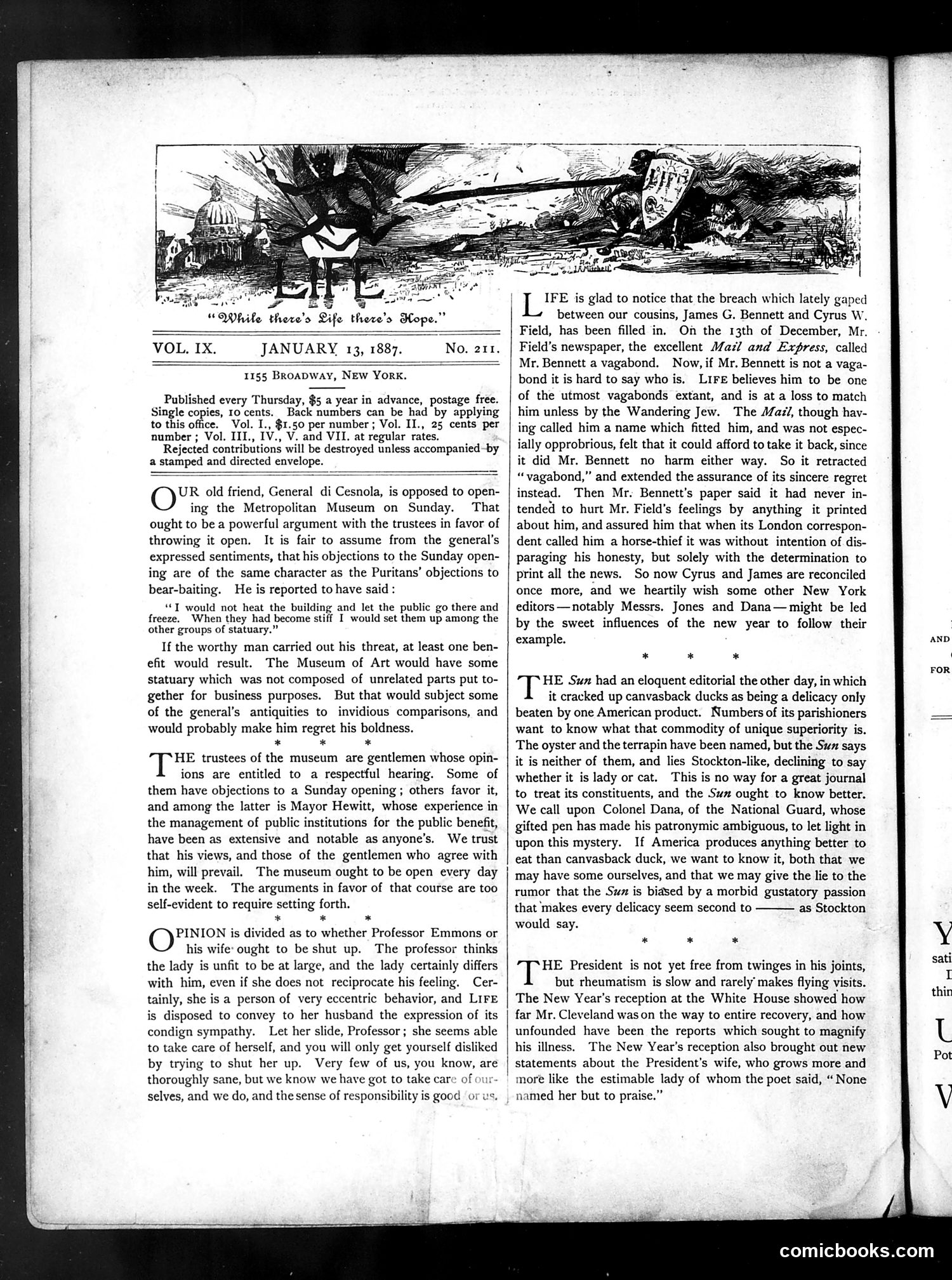
The cartoon titled "White there's Life there's Hope" appears to show two figures in a landscape with classical architecture (possibly St. Paul's Cathedral) visible in the background. The specific identities of the figures are unclear from the image alone. The text discusses General Cesnola's opposition to opening the Metropolitan Museum on Sundays—a cultural controversy of the era. It also covers a dispute between newspaper editors James G. Bennett and Cyrus W. Field, where Bennett called Field a "vagabond" in print. The piece humorously notes that reconciliation between the feuding editors would be remarkable. Additional commentary addresses debates about propriety, public institutions, and editorial ethics typical of 1880s journalism.
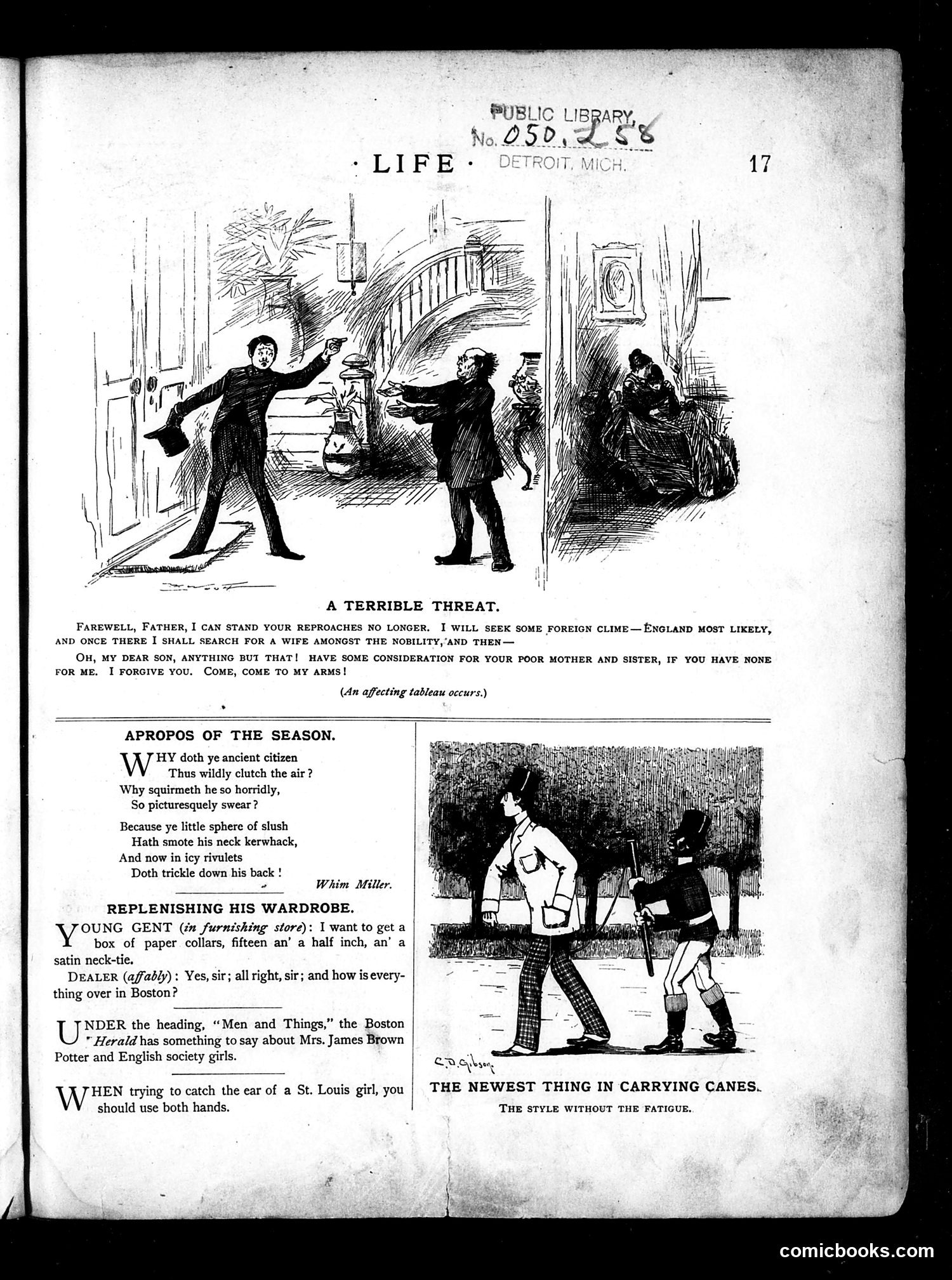
**"A Terrible Threat"** (top cartoon) depicts a dramatic domestic scene where a son announces he'll seek "some foreign clime—England most likely" to escape his father's reproaches and restore the family's reputation. The father and other family members react emotionally. This appears to satirize the Victorian melodramatic trope of the disgraced son fleeing to England as the ultimate shame-remedy—mocking both family scandal narratives and the period's emigration patterns. The remaining content includes humorous short items: poetry about slush in winter, jokes about men's fashion (paper collars, satin neckties), and witty observations about regional courtship customs. An illustration shows fashionable young people with canes, captioned as the "newest thing in carrying canes." The overall tone is light social satire targeting contemporary manners and fashions.
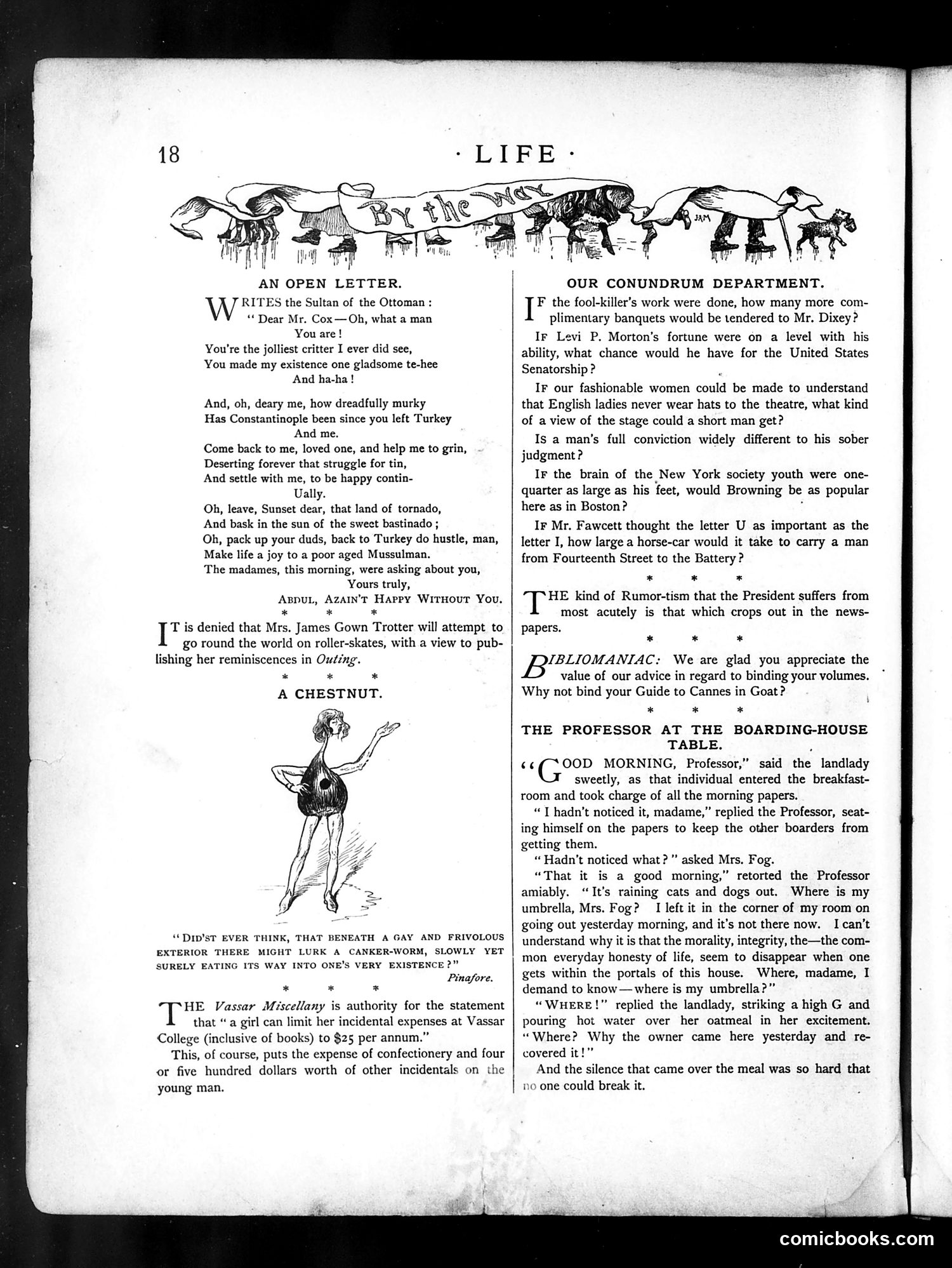
This page contains satirical commentary and humor pieces typical of Life's editorial style. The left column features "An Open Letter" mocking someone named Mr. Cox (likely a public figure), using humorous complaints about his absence from Turkey. Below is a section titled "A Chestnut" with an illustration of a woman doing a backbend or acrobatic pose, accompanying a Juvenal quote about hidden character flaws. The right column's "Conundrum Department" presents absurdist rhetorical questions poking fun at various social pretensions—theater etiquette, New York society, and transportation logistics. "The Professor at the Boarding-House Table" depicts a comedic domestic dispute over a missing umbrella, illustrating the magazine's focus on everyday social absurdities and human foibles rather than explicit political commentary.
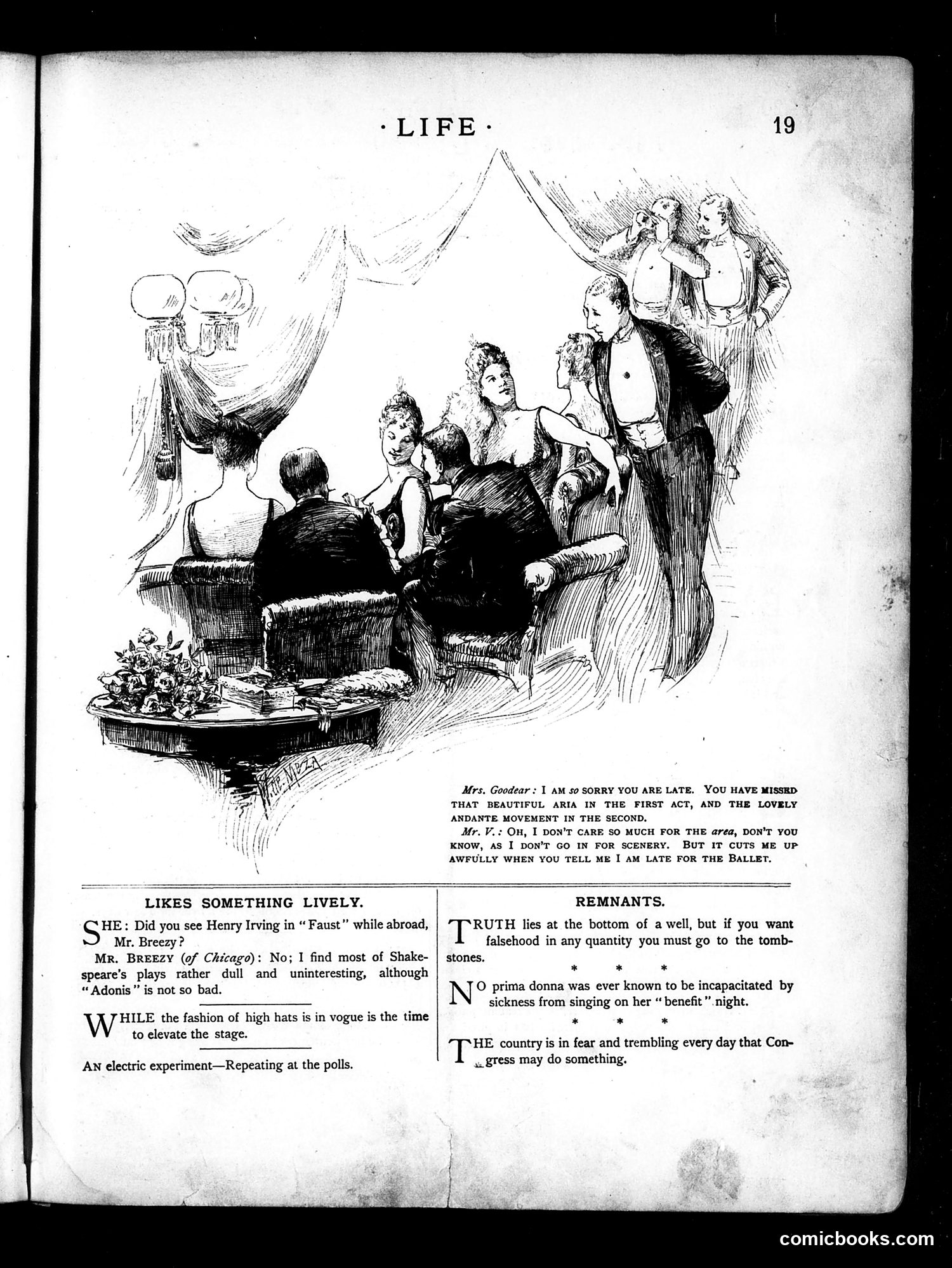
The main illustration depicts a theater scene where Mr. V. arrives late to a ballet, interrupting Mrs. Goodear mid-conversation. The satire centers on Mr. V.'s indifference to missing the performance—he claims he doesn't attend for "scenery" but finds it "cuts me up" when told he's late for the ballet. The joke plays on masculine affectation: men of the era affected disinterest in artistic pursuits like ballet as "unmanly," yet this character reveals his actual investment by being upset about missing it—exposing the pretense of his indifference. Below are brief humorous remarks about Henry Irving's "Faust," Shakespeare productions, high fashion in theater, and political commentary ("electric experiment—Repeating at the polls"), typical of Life's satirical format mixing theatrical and political commentary.
This page contains literary commentary rather than political cartoons. The main content includes: **"A New Theme"** — A poem criticizing poets who write about drinking and escapism rather than addressing serious social issues. **"A Foolish Habit"** — A brief satirical dialogue mocking anti-prohibition advocates' arguments. A temperance advocate challenges an opponent's claim that drink harms women and children, with the anti-prohibitionist defending alcohol consumption. **"A Defence of Critics"** — An essay defending literary critics against charges they're useless. It argues honest critics serve literature by appealing to readers' intellect and moral judgment. The decorative "Book Thyself" header suggests a books/literature section. **Note:** No identifiable political cartoons appear on this page; the satire is textual rather than visual.
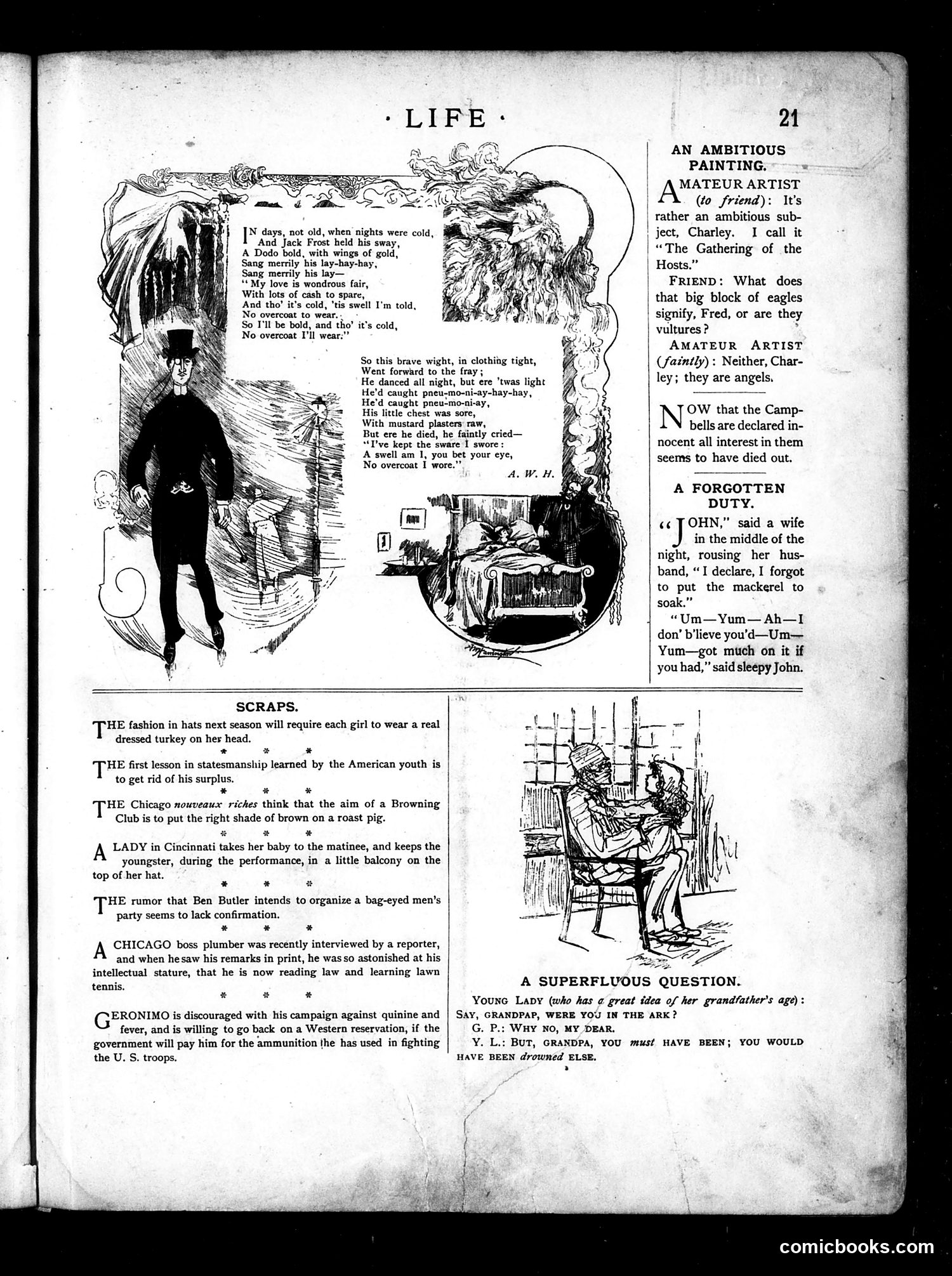
This page contains several short humorous items typical of early 20th-century satirical magazines: **"An Ambitious Painting"** presents a dialogue between an amateur artist and friend about a painting titled "The Gathering of the Hosts." The friend asks what "that big block of eagles" signifies, and the artist admits they're actually vultures—a joke about the painting's unintentional poor execution or dark subject matter. **"Scraps"** section offers brief social observations, including satirical comments about fashion (wearing dead turkeys), American youth behavior, and military matters. **"A Superfluous Question"** humorously depicts a young lady asking her grandfather if he was in "the ark," with his witty retort that he would have "drowned else"—a joke about extreme old age. The remaining items are brief, typical magazine filler jokes with no clear political reference.
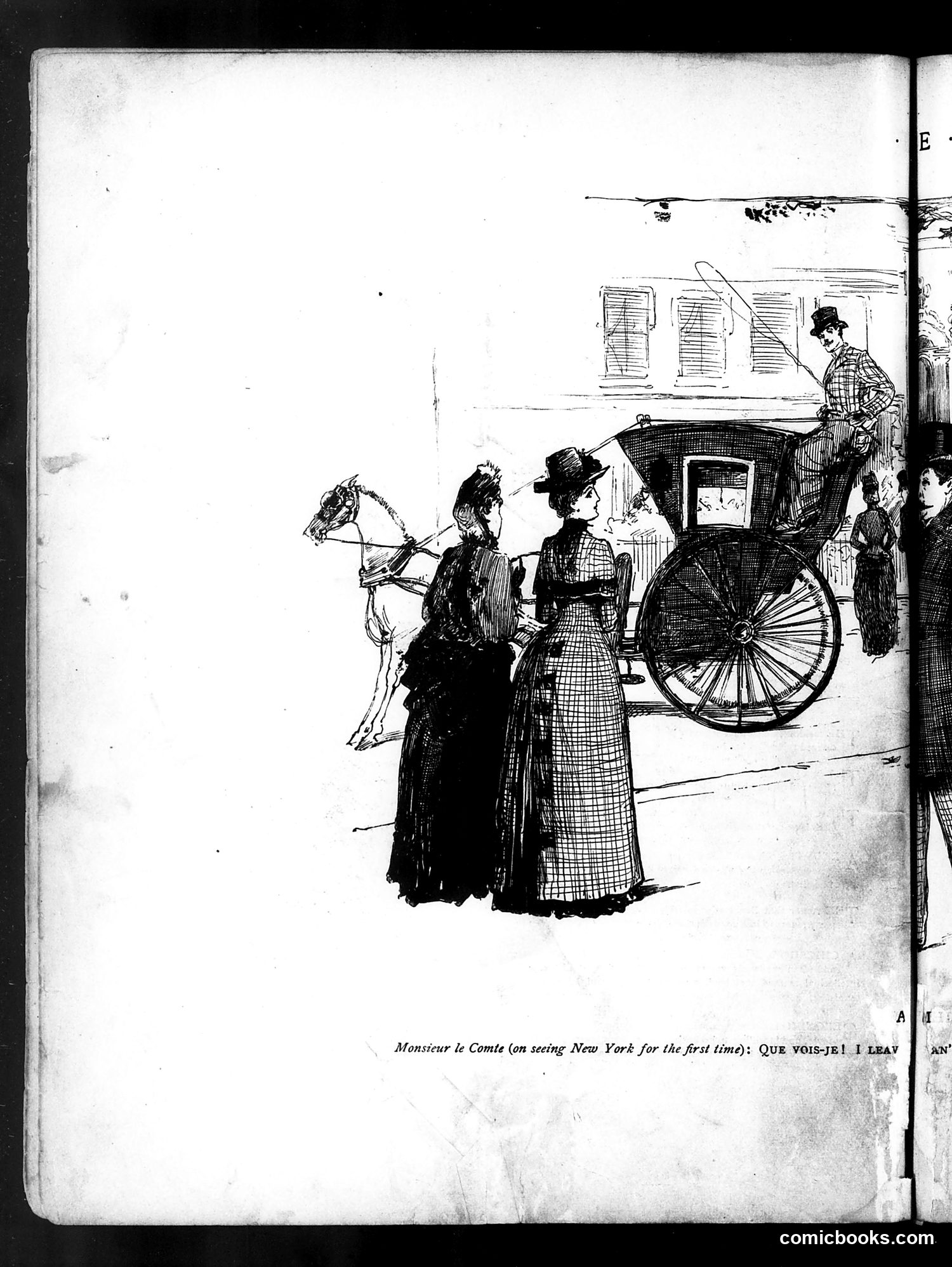
This illustration depicts **Monsieur le Comte** (a French nobleman) experiencing New York City for the first time. The caption reads: "Que vois-je! I leave" (What do I see! I'm leaving). The satire mocks the contrast between European aristocratic sensibilities and American urban reality. The French visitor, dressed formally with a top hat, recoils in apparent shock at the bustling New York street scene—featuring a horse-drawn carriage, various pedestrians, and ordinary commercial activity. The joke suggests that refined European nobles found American cities crude, chaotic, or otherwise offensive to their refined tastes. This reflects early 20th-century American attitudes mocking European pretension while simultaneously displaying anxiety about American sophistication relative to European standards.
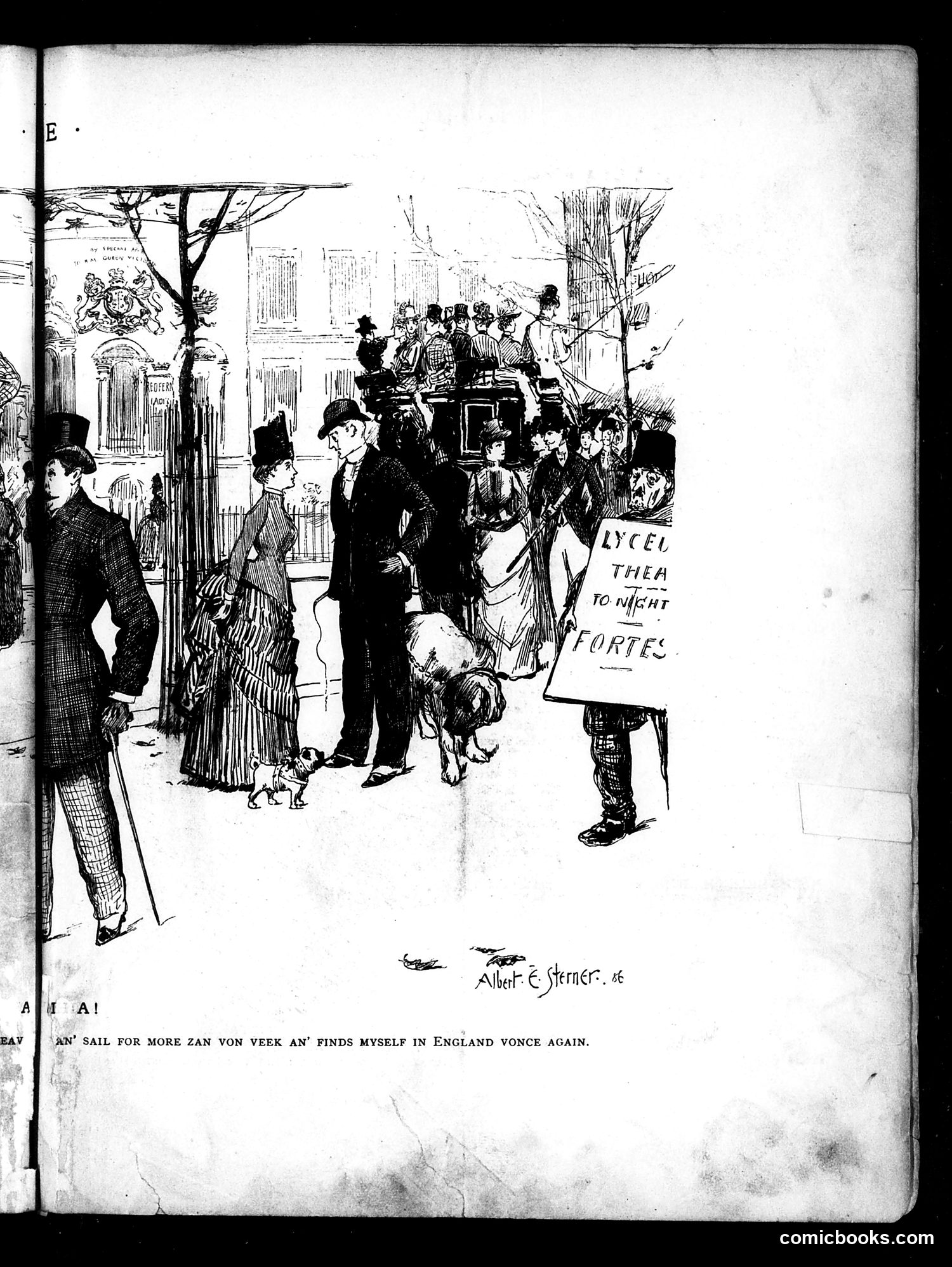
This is a satirical illustration by Albert E. Sterner depicting a street scene outside what appears to be a theater or opera house ("Lyceum Theatre" is visible on a sign). The caption references "Zan Von Veek" and England. The cartoon shows well-dressed Londoners gathered outside, with a child holding a sign advertising "Lyceum Theatre to Night Fortes" (likely "Fortes" or a performance). The satire appears to mock either: a foreign theatrical personality's arrival in England, or theatrical pretension among the British upper classes attending evening performances. The specific reference to "Zan Von Veek" remains unclear without additional context, though the Germanic-sounding name suggests a continental European performer or figure. The cartoon humorously captures fashionable society attending culture.
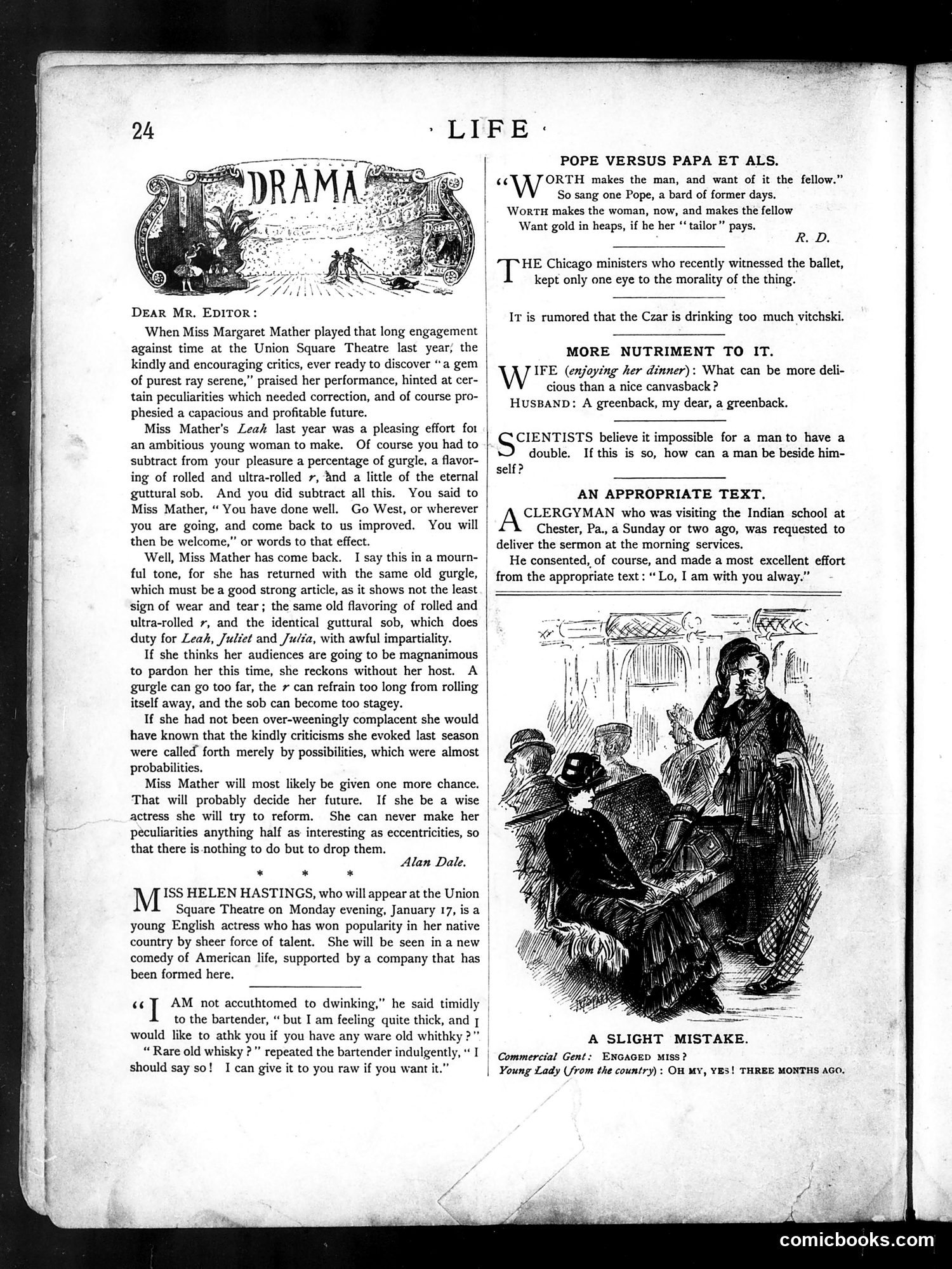
This page contains theater criticism and satirical commentary rather than political cartoons. The main content discusses Margaret Mather's theatrical performance in *Leah* at Union Square Theatre, critiquing both her acting and the critical reception. The illustration titled "A Slight Mistake" depicts a commercial gentleman accosting a young woman from the countryside, who apparently misunderstood his intentions—he's an "engaged miss" when he asked if she was. This is social satire mocking both urban sophistication and rural naiveté. Additional brief jokes appear, including commentary on Pope versus Papa (religious authority), Chicago ministers' reaction to ballet, and the Czar's drinking habits. The humor targets Victorian social pretensions and emerging modern conflicts.
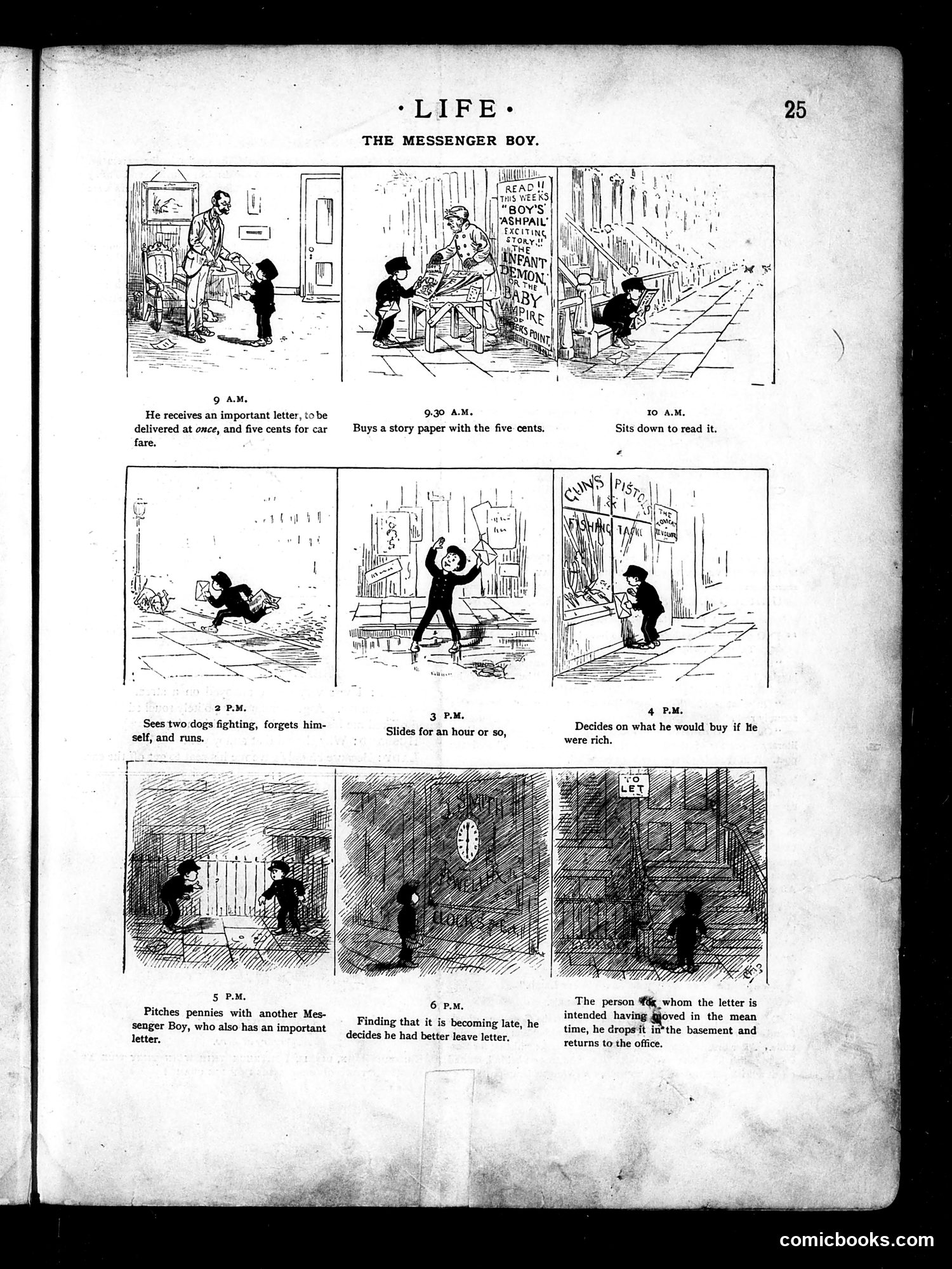
This is a satirical comic strip chronicling a messenger boy's workday, mocking his irresponsibility and the inevitable failure of his delivery mission. The narrative follows a young boy tasked with delivering an urgent letter and given five cents for carfare. Instead of completing his job, he squanders the money on a story paper, gets distracted by street dogs, wastes hours sliding on pavement, daydreams about wealth, and pitches pennies with another negligent messenger boy. By evening, realizing the hour is late, he abandons his responsibility entirely—discovering the recipient has moved, he simply drops the letter in the basement and returns to report. The satire ridicules working-class youth's lack of work ethic and attention span, while implying broader incompetence in service industries. It's a humorous commentary on the unreliability of errand boys—a common occupation for poor children in early 20th-century America—and indirectly critiques the system that depended on such undisciplined labor.
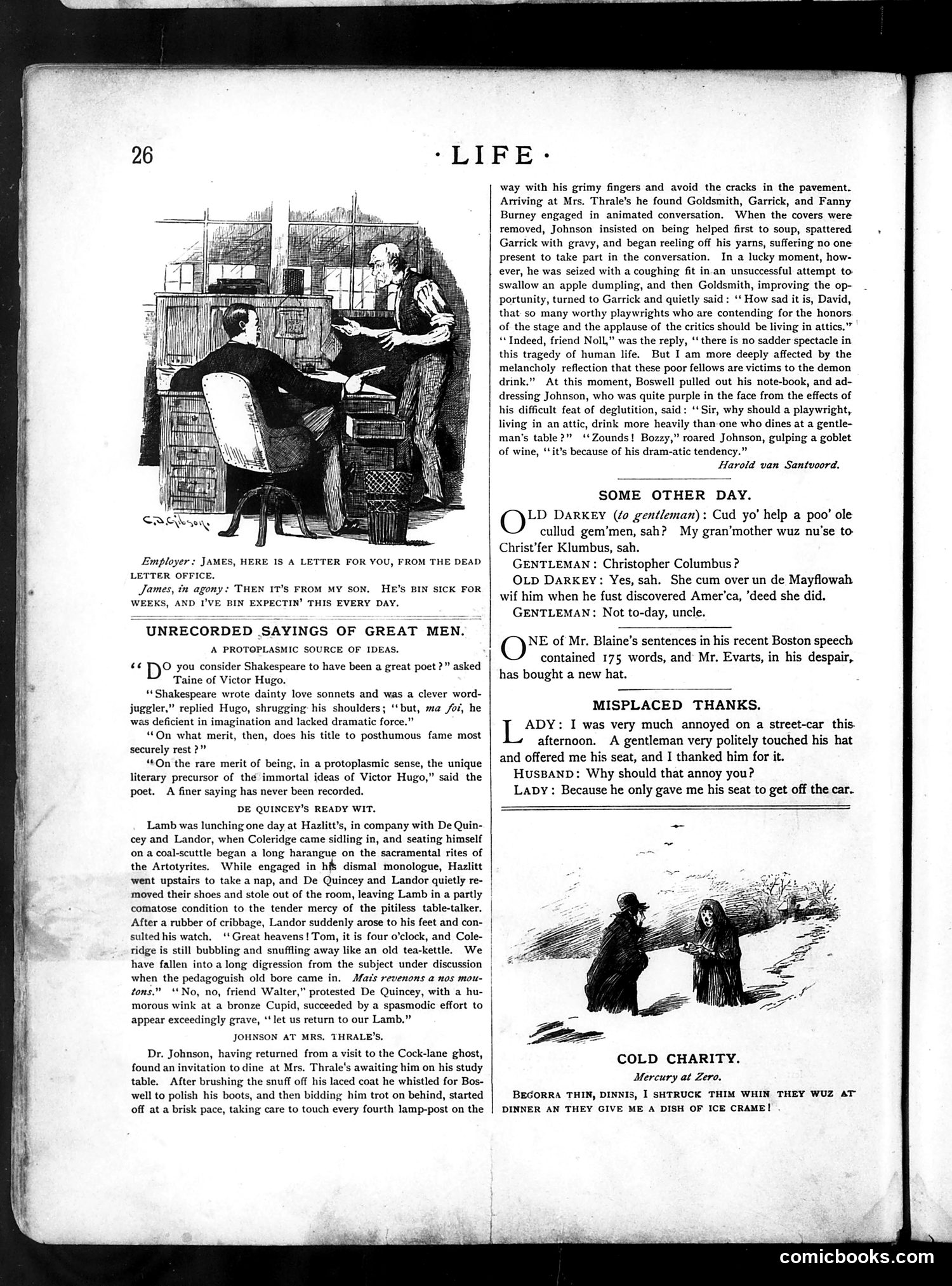
This page from the satirical magazine *Life* contains fictional anecdotes mocking famous literary figures through invented dialogue. The main content includes fabricated "witty" exchanges between celebrated writers and thinkers—Hugo dismissing Shakespeare, De Quincey abandoning Coleridge mid-lecture, and Dr. Johnson dominating dinner conversation at Mrs. Thrale's house. The humor relies on readers recognizing these historical figures and finding comedy in exaggerated character traits: Johnson's rudeness and gluttony, Coleridge's tedious monologues, and Hugo's pomposity about his own literary importance. The cartoons show an employer receiving a "dead letter" from his sick son, and a winter scene labeled "Cold Charity" depicting homelessness. These satirize social indifference and poverty. The satire targets both the pretensions of famous intellectuals and broader social callousness of the era.
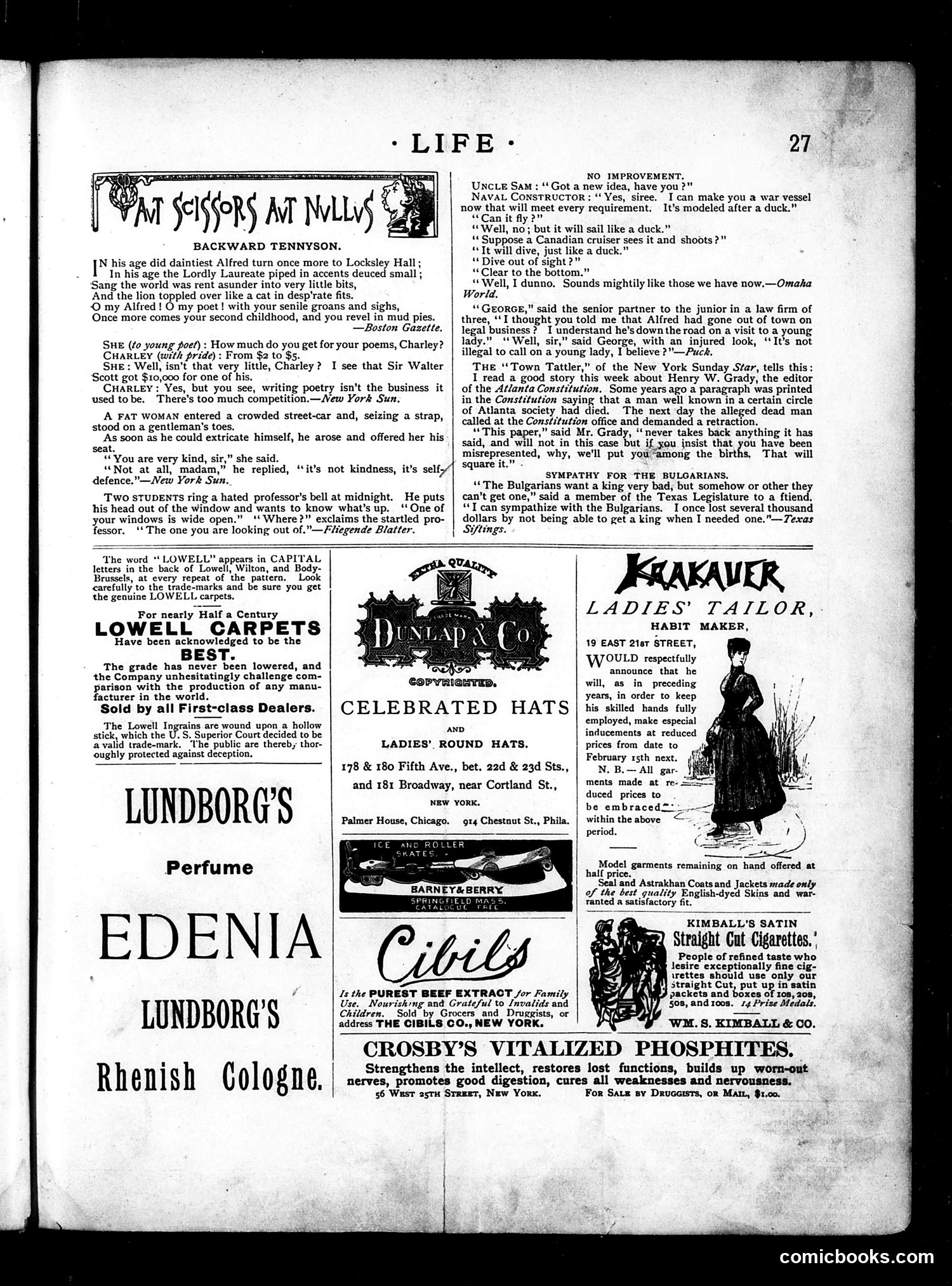
This political cartoon satirizes American naval design and military preparedness. Uncle Sam questions a Naval Constructor about a new warship "modeled after a duck." The joke hinges on absurdity: the constructor claims the vessel can "sail like a duck," "dive like a duck," and even "dive out of sight" to the bottom—all desirable military features. Uncle Sam's final response—"Sounds mightily like those we have now"—delivers the punchline: American warships are already so poorly designed and unreliable that comparing a new one to a duck (implying uselessness) is no worse than existing vessels. This reflects late 19th-century concerns about American naval capability. The cartoon mocks both the Navy's actual ship designs and the Constructor's ridiculous explanations, suggesting American military technology lagged dangerously behind competitors like Britain.
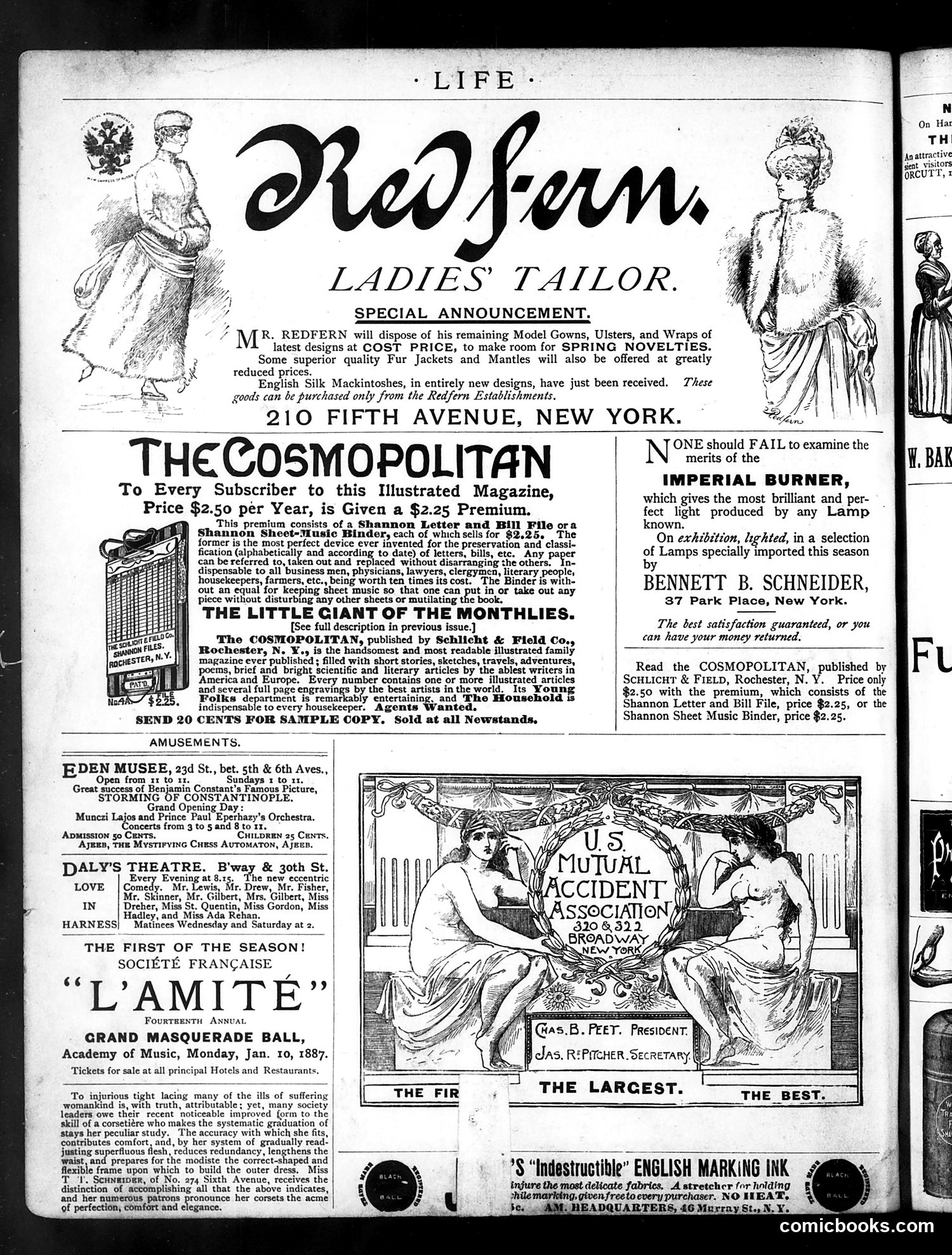
This is primarily a **commercial advertisements page**, not satirical content. The page showcases turn-of-the-century consumer goods and entertainment venues aimed at middle/upper-class readers. Key advertisements include: - **Red Fern Ladies' Tailor** (top): A fashionable dressmaker clearing winter inventory for spring designs - **The Cosmopolitan Magazine**: Promoting subscriptions with premiums like sheet-music binders and bill files - **Imperial Burner lamp**: Advertising a new lighting technology - **Eden Musee** and **Daly's Theatre**: Entertainment venues advertising shows and attractions The **U.S. Mutual Accident Association** advertisement (center) features classical female figures promoting insurance products. The content reflects Gilded Age consumer culture, emphasizing manufactured goods, commercial entertainment, and emerging technologies. The tone is straightforward promotion rather than satire—typical of Life magazine's revenue model of mixing editorial with advertising during this period.
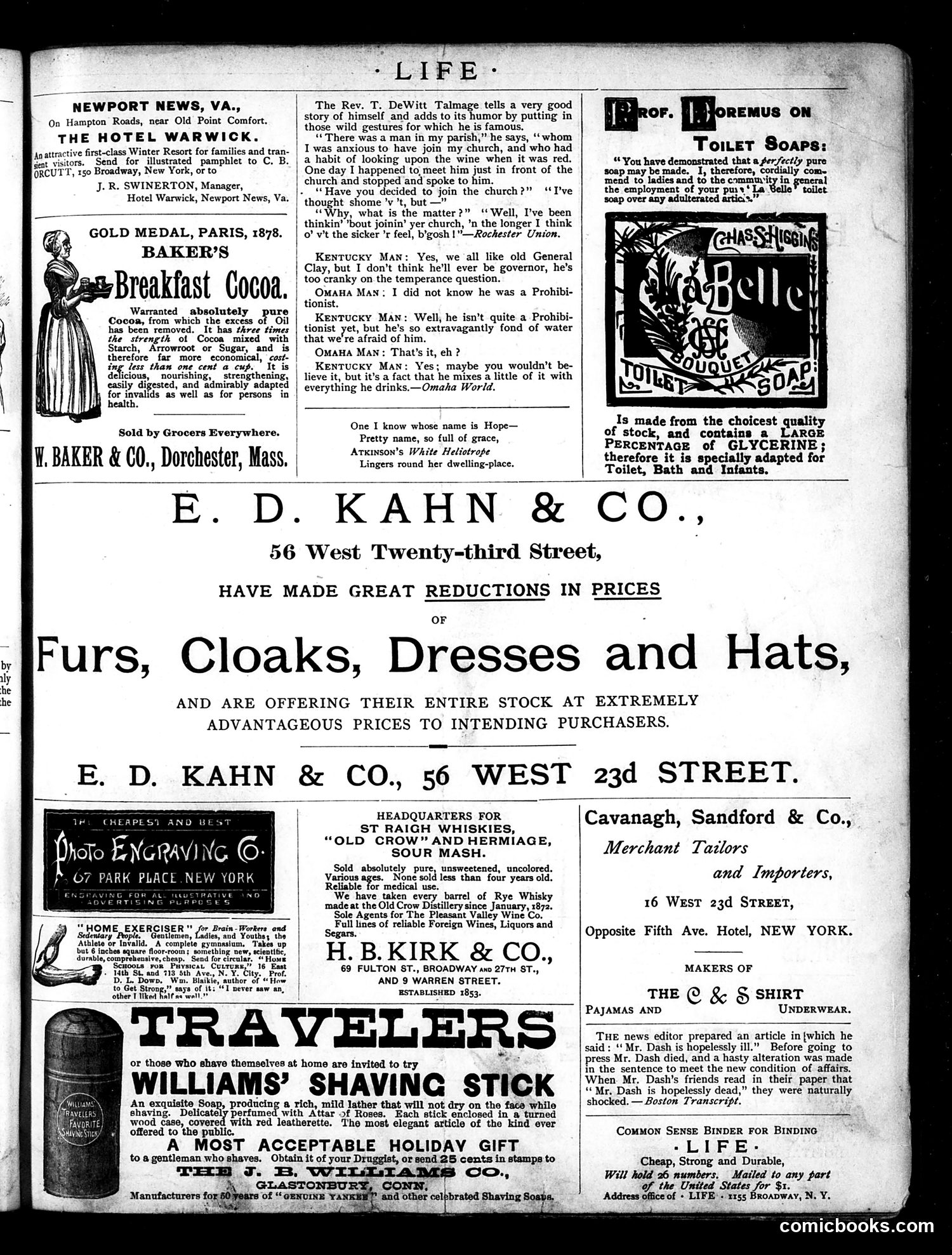
This page is primarily **advertising** with minimal editorial content. The notable non-commercial material includes: **"Prof. Boremus on Toilet Soaps"**: A brief testimonial framed as expert endorsement, praising pure soap with high glycerine content—typical 19th-century advertising disguised as authority. **Three humorous anecdotes** (likely by Life staff): - Rev. T. DeWitt Talmage's church recruitment story about a parishioner whose drinking makes him "sicker" thinking about joining - A dialogue between Kentucky and Omaha men joking that a General Clay's love of water (mixed into drinks) makes him dangerously temperate - A brief poem about a woman named Hope wearing perfume These jokes play on **temperance sentiment** and **alcohol culture** of the era—mocking both drinkers and teetotalers. The humor is gentle, conversational satire typical of 1880s-90s Life magazine's style. The page otherwise consists entirely of Victorian-era commercial advertisements for cocoa, furs, shaving products, and hotels.
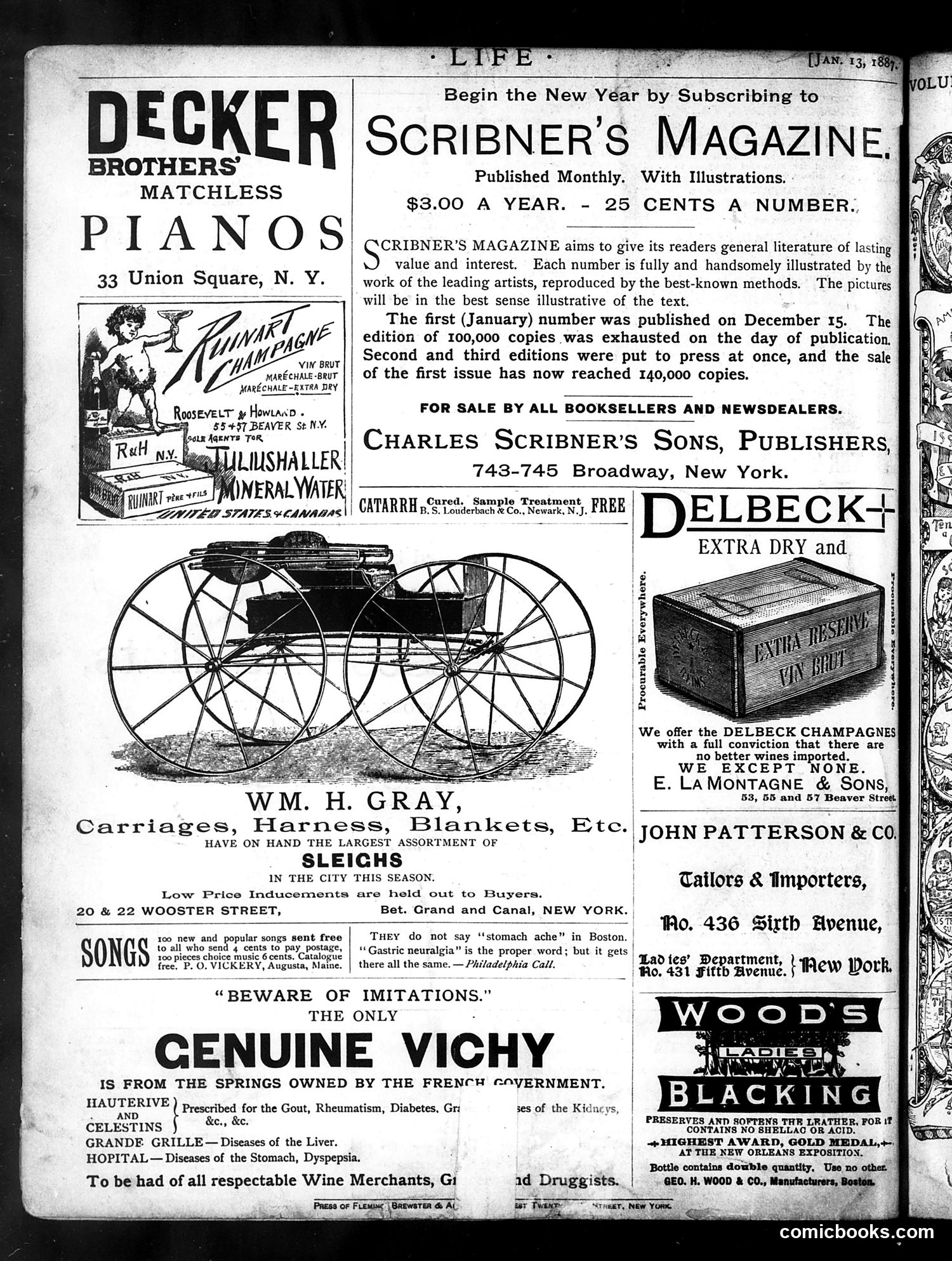
This is primarily an **advertising page** from Life magazine (January 13, 1889), not a political cartoon page. The dominant content includes ads for luxury goods: Decker Brothers pianos, Scribner's Magazine (promoting its successful January debut), champagne brands (Delbeck, E. LaMontagne & Sons), W.M. Gray's carriages and sleighs, genuine Vichy water (with French government authentication), and Wood's shoe blacking. The only satirical content is a small item mocking Boston's euphemistic speech—Bostonians say "gastric neuralgia" instead of "stomach ache," credited to the Philadelphia Call newspaper. The page reflects Gilded Age consumer culture: advertisements target wealthy readers with imported wines, fine carriages, and quality pianos, while Scribner's boasts of commercial success (100,000+ copies sold).