
Life, 1887-01-13 · page 12 of 16
Life — January 13, 1887 — page 12: what you’re looking at
What you’re looking at
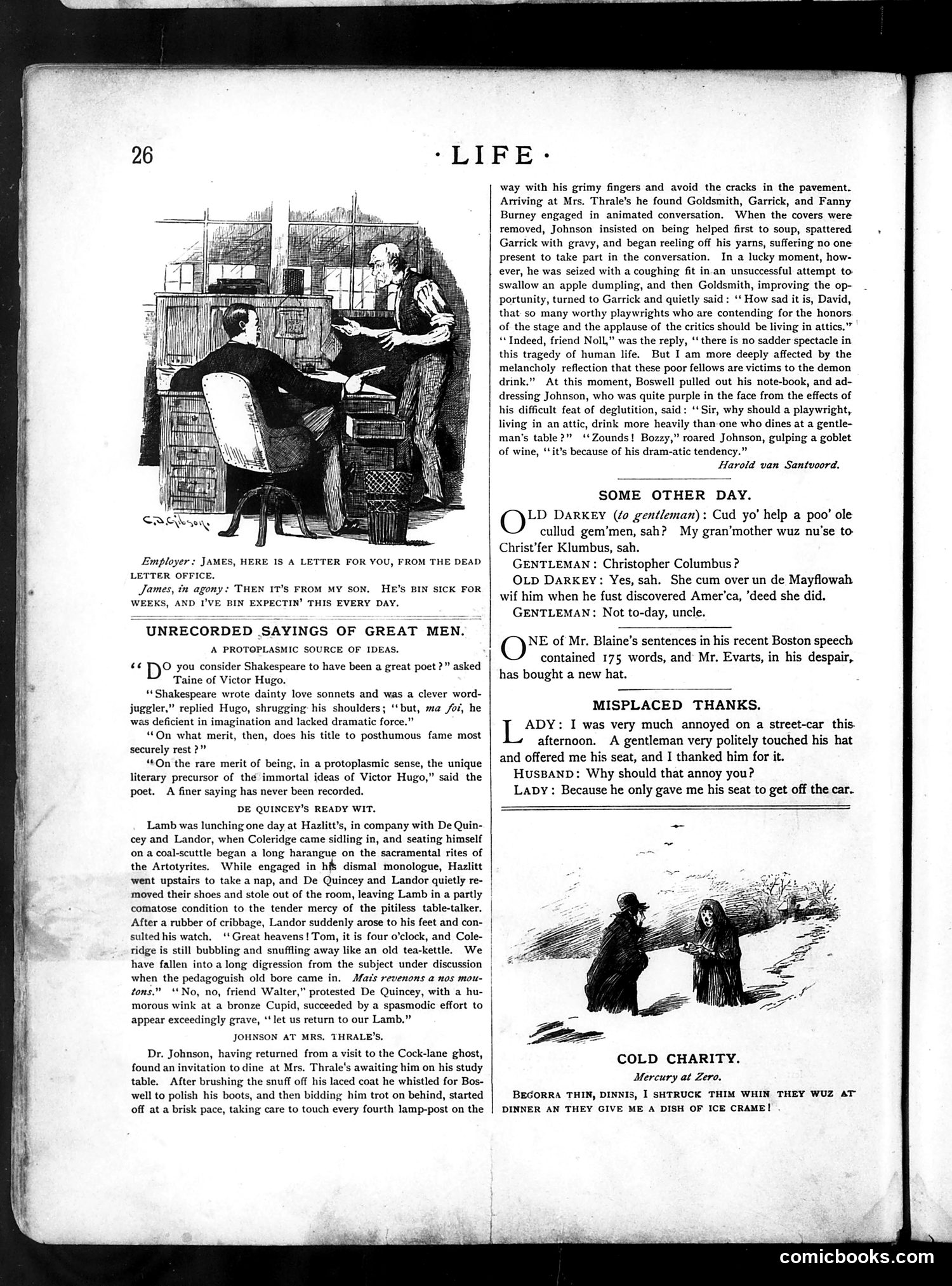
This page from the satirical magazine *Life* contains fictional anecdotes mocking famous literary figures through invented dialogue. The main content includes fabricated "witty" exchanges between celebrated writers and thinkers—Hugo dismissing Shakespeare, De Quincey abandoning Coleridge mid-lecture, and Dr. Johnson dominating dinner conversation at Mrs. Thrale's house. The humor relies on readers recognizing these historical figures and finding comedy in exaggerated character traits: Johnson's rudeness and gluttony, Coleridge's tedious monologues, and Hugo's pomposity about his own literary importance. The cartoons show an employer receiving a "dead letter" from his sick son, and a winter scene labeled "Cold Charity" depicting homelessness. These satirize social indifference and poverty. The satire targets both the pretensions of famous intellectuals and broader social callousness of the era.
📄 Transcribed text from this page (OCR, searchable)
Machine-transcribed from the original scan — historical spelling and the odd misread are preserved.
‘LIFE: Employer : JAMES, HERE 1S A LETTER FOR YOU, FROM THE DEAD LETTER OFFICE. James, in agony: THEN IT's FROM MY SON. HE’s BIN SICK FOR WEEKS, AND I'VE BIN EXPECTIN’ THIS EVERY DAY. UNRECORDED SAYINGS OF GREAT MEN. A PROTOPLASMIC SOURCE OF IDEAS. «€ JO you consider Shakespeare to have been a great poet?” asked Taine of Victor Hugo. “Shakespeare wrote dainty love sonnets and was a clever word- juggler,” replied Hugo, shrugging: his shoulders; ‘but, ma fo, he was deficient in imagination and lacked dramatic force.” “(On what merit, then, does his title to posthumous fame most securely rest ?” “On the rare merit of being, in a protoplasmic sense, the unique literary precursor of thé immortal ideas of Victor Hugo,” said the poet. A finer saying has never been recorded. DE QUINCEY’S READY WIT. Lamb was lunching one day at Hazlitt’s, in company with De Quin- cey and Landor, when Coleridge came sidling in, and seating himself on acoal-scuttle began a long harangue on the sacramental rites of the Artotyrites. While engaged in his dismal monologue, Hazlitt went upstairs to take a nap, and De Quincey and Landor quietly re- moved their shoes and stole out of the room, leaving Lamb in a partly comatose condition to the tender mercy of the pitiless table-talker. After a rubber of cribbage, Landor suddenly arose to his feet and con- sulted his watch. ridge is still bubbling and snuffling away like an old tea-kettle. We have fallen into a long digression from the subject under discussion when the pedagoguish old bore came in. Mais revenons a nos mou- tons.” ‘*No, no, friend Walter,” protested De Quincey, with a hu- morous wink at a bronze Cupid, succeeded by a spasmodic effort to appear exceedingly grave, “let us return to our Lamb.” JOHNSON AT MRS. THRALE’S, Dr. Johnson, having returned from a visit to the Cock-lane ghost, found an invitation todine at Mrs. Thrale's awaiting him on his study table. After brushing the snuff off his laced coat he whistled for Bos- well to polish his boots, and then bidding him trot on behind, started off at a brisk pace, taking care to touch every fourth lamp-post on the ‘Great heavens! Tom, it is four o'clock, and Cole- | way with his grimy fingers and avoid the cracks in the pavement. Arriving at Mrs. Thrale’s he found Goldsmith, Garrick, and Fanny Burney engaged in animated conversation. When the covers were removed, Johnson insisted on being helped first to soup, spattered Garrick with gravy, and began reeling off his yarns, suffering no one present to take part in the conversation. In a lucky moment, how- ever, he was seized with a coughing fit inan unsuccessful attempt to- swallow an apple dumpling, and then Goldsmith, improving the op- portunity, turned to Garrick and quietly said: ‘ How sad it is, David, that so many worthy playwrights who are contending for the honors. of the stage and the applause of the critics should be living in attics.” “Indeed, friend Noll,” was the reply, ‘there is no sadder spectacle in this tragedy of human life. But I am more deeply affected by the melancholy reflection that these poor fellows are victims to the demon drink.” At this moment, Boswell pulled out his note-book, and ad- dressing Johnson, who was quite purple in the face from the effects of his difficult feat of deglutition, said: Sir, why should a playwright, living in an attic, drink more heavily than one who dines at a gentle- man’s table?” “Zounds! Bozzy,” roared Johnson, gulping a goblet of wine, ‘it’s because of his dram-atic tendency.” Harold van Santvoord. SOME OTHER DAY. LD DarKEy (¢o gentleman): Cud yo’ help a poo’ ole cullud gem’men, sah? My gran’mother wuz nu’se to Christ’fer Klumbus, sah. GENTLEMAN : Christopher Columbus ? OLD DarKEy: Yes, sah. She cum over un de Mayflowah wif him when he fust discovered Amer’ca, ‘deed she did. GENTLEMAN: Not to-day, uncle. NE of Mr. Blaine’s sentences in his recent Boston speech contained 175 words, and Mr. Evarts, in his despair, has bought a new hat. MISPLACED THANKS. ADY: I was very much annoyed on a street-car this. afternoon. A gentleman very politely touched his hat and offered me his seat, and I thanked him for it. HUSBAND: Why should that annoy you? Lapy : Because he only gave me his seat to get off the car. COLD CHARITY. Mercury at Zero. BEGORRA THIN, DINNIS, I SHTRUCK THIM WHIN THEY WUZ AT DINNER AN THEY GIVE ME A DISH OF ICE CRAME! comicbooks.com