
Life, 1887-01-13 · page 6 of 16
Life — January 13, 1887 — page 6: what you’re looking at
What you’re looking at
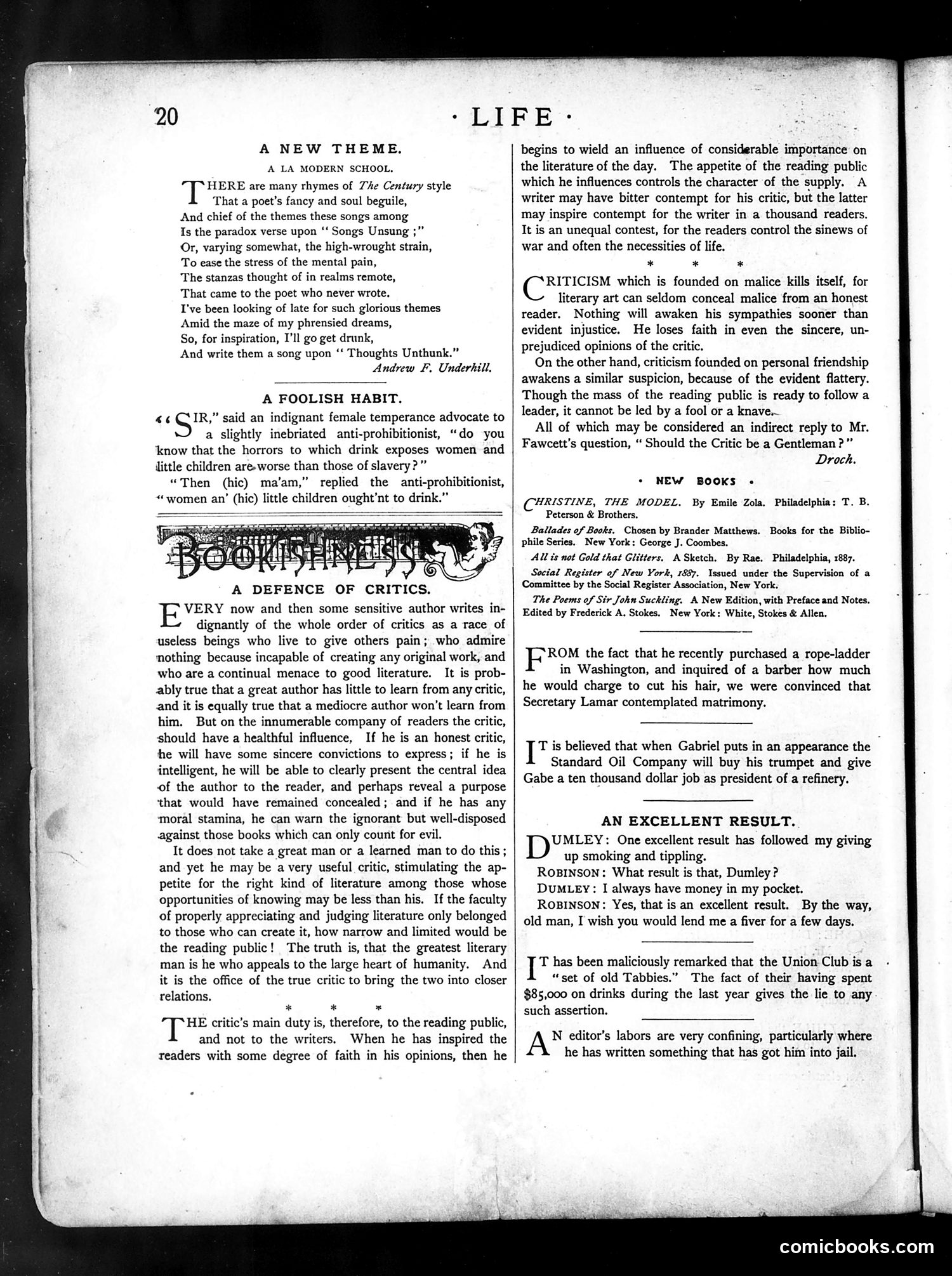
This page contains literary commentary rather than political cartoons. The main content includes: **"A New Theme"** — A poem criticizing poets who write about drinking and escapism rather than addressing serious social issues. **"A Foolish Habit"** — A brief satirical dialogue mocking anti-prohibition advocates' arguments. A temperance advocate challenges an opponent's claim that drink harms women and children, with the anti-prohibitionist defending alcohol consumption. **"A Defence of Critics"** — An essay defending literary critics against charges they're useless. It argues honest critics serve literature by appealing to readers' intellect and moral judgment. The decorative "Book Thyself" header suggests a books/literature section. **Note:** No identifiable political cartoons appear on this page; the satire is textual rather than visual.
📄 Transcribed text from this page (OCR, searchable)
Machine-transcribed from the original scan — historical spelling and the odd misread are preserved.
“LIFE A NEW THEME. A LA MODERN SCHOOL, HERE are many rhymes of Zhe Century style That a poet’s fancy and soul beguile, And chief of the themes these songs among Is the paradox verse upon ‘‘ Songs Unsung ;” Or, varying somewhat, the high-wrought strain, To ease the stress of the mental pain, ‘The stanzas thought of in realms remote, That came to the poet who never wrote, I've been looking of late for such glorious themes Amid the maze of my phrensied dreams, So, for inspiration, I'll go get drunk, And write them a song upon ‘“‘ Thoughts Unthunk.” Andrew F, Underhill, A FOOLISH HABIT. «¢ CIR,” said an indignant female temperance advocate to a slightly inebriated anti-prohibitionist, “do you ‘know that the horrors to which drink exposes women and little children are-worse than those of slavery?” “Then (hic) ma’am,” replied the anti-prohibitionist, «women an’ (hic) little children ought’nt to drink.” A DEFENCE OF CRITICS. VERY now and then some sensitive author writes in- dignantly of the whole order of critics as a race of useless beings who live to give others pain; who admire nothing because incapable of creating any original work, and who are a continual menace to good literature. It is prob- ably true that a great author has little to learn from any critic, and it is equally true that a mediocre author won’t learn from him. But on the innumerable company of readers the critic, should have a healthful influence, If he is an honest critic, he will have some sincere convictions to express; if he is intelligent, he will be able to clearly present the central idea ‘of the author to the reader, and perhaps reveal a purpose ‘that would have remained concealed; and if he has any ‘moral stamina, he can warn the ignorant but well-disposed against those books which can only count for evil. It does not take a great man or a learned man to do this ; and yet he may be a very useful critic, stimulating the ap- petite for the right kind of literature among those whose opportunities of knowing may be less than his. If the faculty of properly appreciating and judging literature only belonged to those who can create it, how narrow and limited would be the reading public! The truth is, that the greatest literary man is he who appeals to the large heart of humanity. And it is the office of the true critic to bring the two into closer relations. * * * HE critic’s main duty is, therefore, to the reading public, and not to the writers. When he has inspired the readers with some degree of faith in his opinions, then he begins to wield an influence of considerable importance on the literature of the day. The appetite of the reading public which he influences controls the character of the supply. A writer may have bitter contempt for his critic, but the latter may inspire contempt for the writer in a thousand readers. It is an unequal contest, for the readers control the sinews of war and often the necessities of life. * * * RITICISM which is founded on malice kills itself, for literary art can seldom conceal malice from an honest reader. Nothing will awaken his sympathies sooner than evident injustice. He loses faith in even the sincere, un- prejudiced opinions of the critic. On the other hand, criticism founded on personal friendship awakens a similar suspicion, because of the evident flattery. Though the mass of the reading public is ready to follow a leader, it cannot be led by a fool or a knave.— All of which may be considered an indirect reply to Mr. Fawcett’s question, “ Should the Critic be a Gentleman?” Droch. + NEW BOOKS - (CHRISTINE, THE MODEL. By Emile Zola. Philadelphia: T. B. Peterson & Brothers, Ballades of Books. Chosen by Brander Matthews. Books for the Biblio- phile Series. New York: George J. Coombes. Al is not Gold that Glitters. A Sketch. By Rae. Philadelphia, 1887. Social Register of New York, 1887. Issued under the Supervision of a Committee by the Social Register Association, New York. The Poems of Sir John Suckling. A New Edition, with Preface and Notes. Edited by Frederick A. Stokes. New York: White, Stokes & Allen, prom the fact that he recently purchased a rope-ladder in Washington, and inquired of a barber how much he would charge to cut his hair, we were convinced that Secretary Lamar contemplated matrimony. T is believed that when Gabriel puts in an appearance the j Standard Oil Company will buy his trumpet and give Gabe a ten thousand dollar job as president of a refinery. AN EXCELLENT RESULT. UMLEY: One excellent result has followed my giving up smoking and tippling. ROBINSON: What result is that, Dumley? DuMLEY: I always have money in my pocket. ROBINSON: Yes, that is an excellent result. By the way, old man, I wish you would lend me a fiver for a few days. T has been maliciously remarked that the Union Club is a “set of old Tabbies.” The fact of their having spent $85,000 on drinks during the last year gives the lie to any such assertion. N editor's labors are very confining, particularly where he has written something that has got him into jail. comicbooks.com