
A complete issue · 16 pages · 1886
Life — December 16, 1886
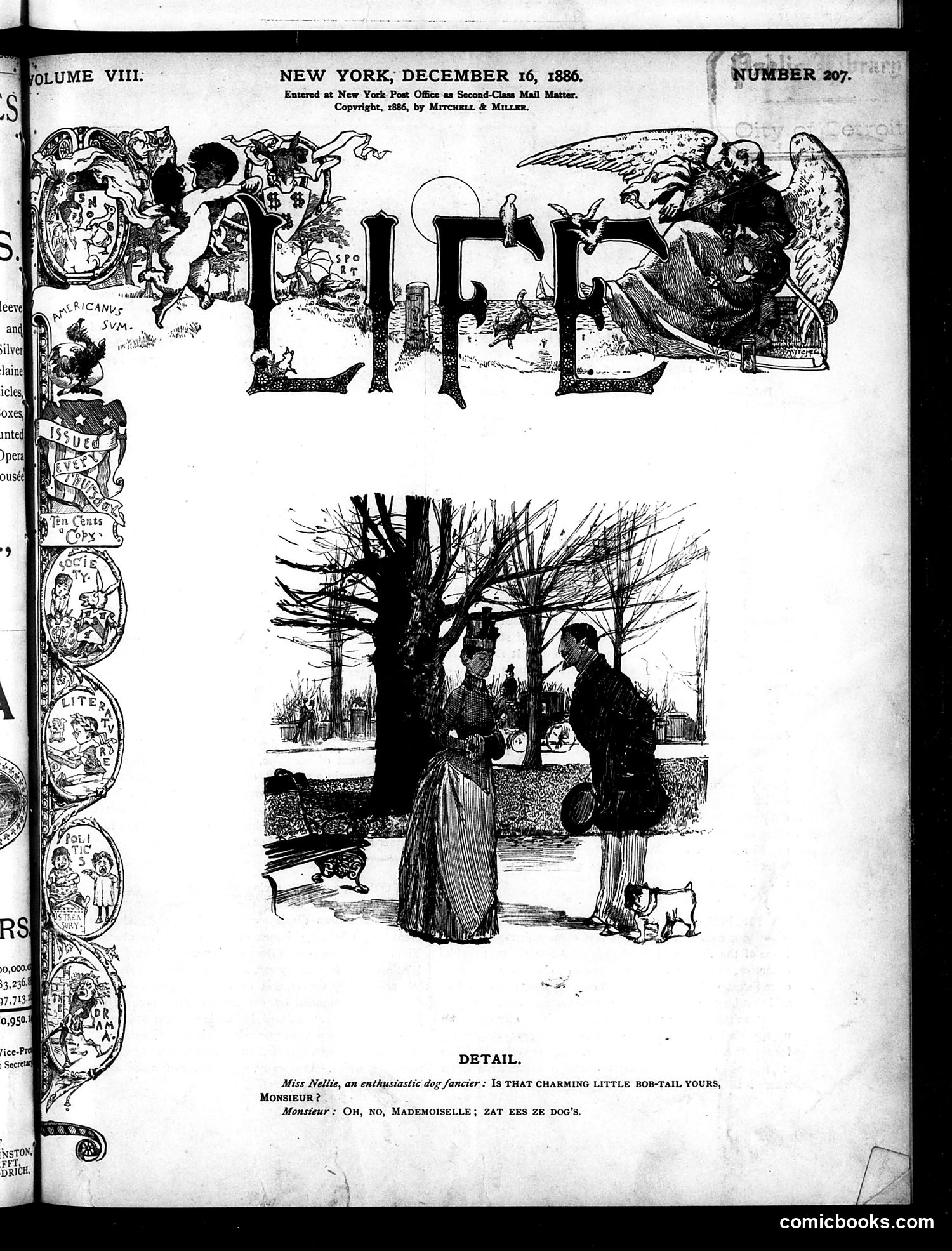
This page features a single illustration titled "DETAIL" depicting a domestic scene in a park. A well-dressed woman and man stand beneath a bare tree with a small dog nearby. The caption presents dialogue in French and English: The woman (identified as "Miss Nellie, an enthusiastic dog fancier") asks the man if he admires her "charming little bob-tail" dog. The man responds dismissively in French: "Oh, no, Mademoiselle; zat ees ze dog's." The joke appears to be a pun or flirtation misunderstanding—the woman may be fishing for a compliment about herself, but the man deliberately misinterprets her question as being solely about the dog's tail. It's a lighthearted commentary on Victorian courtship conventions and social awkwardness.
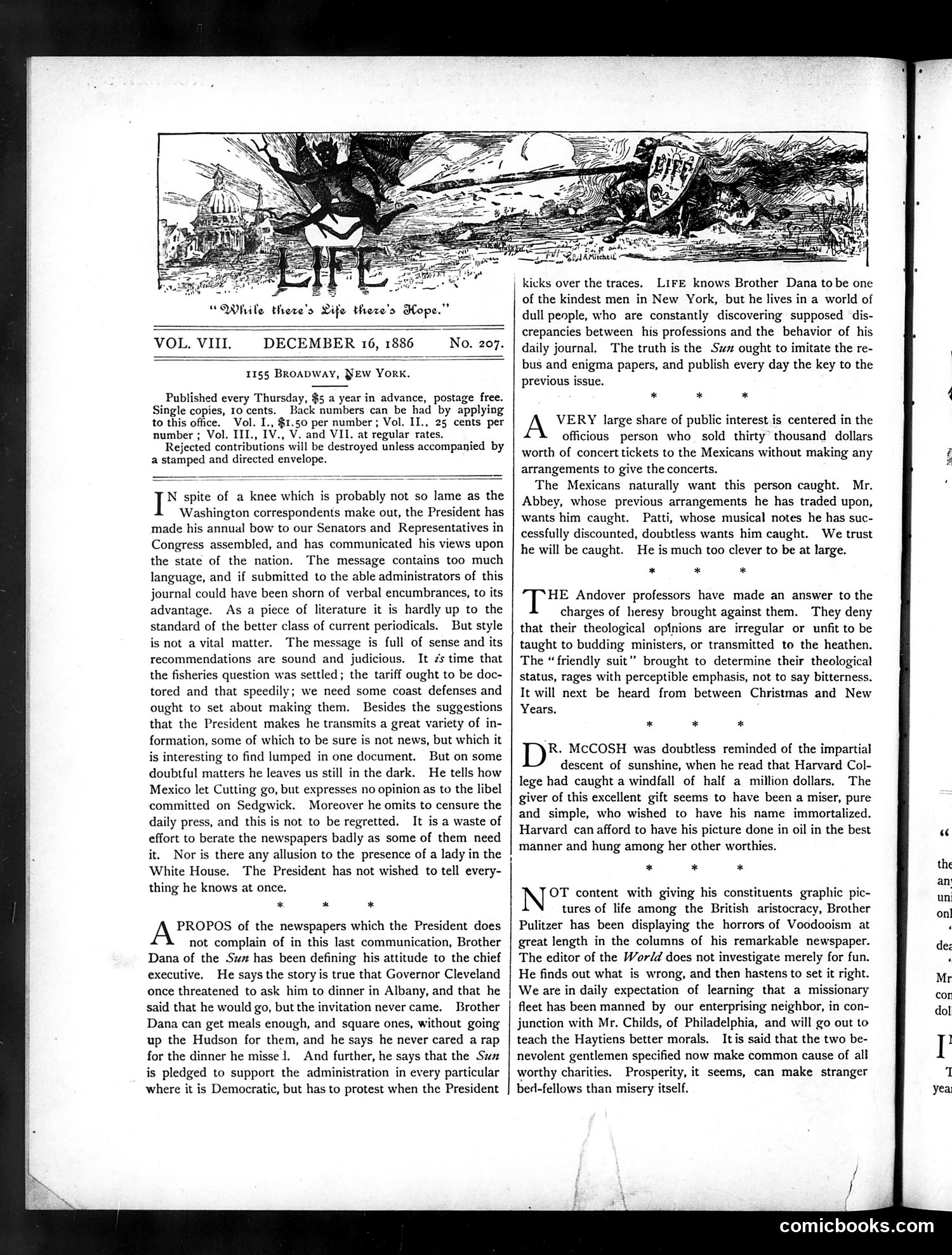
The masthead cartoon depicts **Death (skeleton figure) riding above a landscape**, with the caption "While there's Life there's Hope"—a dark pun on the magazine's name. The text critiques **President Cleveland's annual message to Congress**, praising its substance while noting its verbose style. The editorial defends the *Sun* newspaper's editor Brother Dana against accusations of disloyalty, arguing he supports Democratic principles while rightfully protesting when the President overreaches. Other brief items mock **Harvard College's large windfall donation**, ridicule the *World* newspaper's sensationalism, and comment on theological disputes at Andover Seminary. The overall tone is political commentary typical of 1880s satirical journalism—defending press independence while supporting selective presidential criticism.
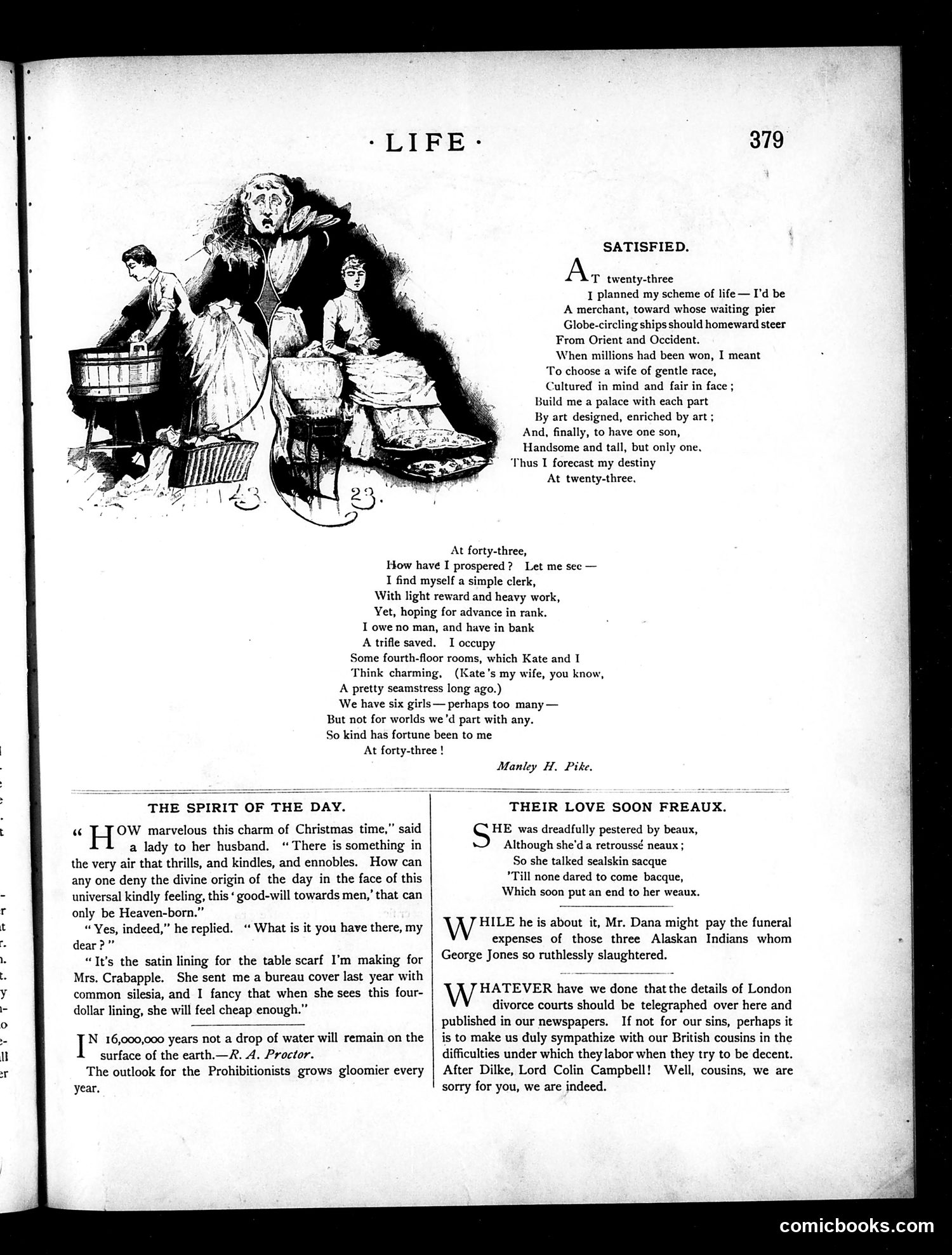
The page contains three distinct pieces: 1. **"Satisfied"** — A poem by Manly H. Pike describing life plans at age 23 (becoming a merchant with ships, a beautiful wife, a palace) versus the reality at 43 (a simple clerk with modest fourth-floor rooms, a wife named Kate, and several children). The satire mocks the gap between youthful ambitions and middle-class adult reality. 2. **"The Spirit of the Day"** — A dialogue between husband and wife about Christmas. She defends the holiday's "divine origin" despite commercialism; he counters that in 16,000,000 years, no water will remain on Earth. The satire targets both sentimental Christmas sentimentality and pessimistic scientific determinism. 3. **"Their Love Soon Freaux"** and **"Whatever"** — Brief items about London divorce court scandals and Indian killings, presented with sardonic tone mocking public interest in sensational news. The illustration shows a Victorian family group, reinforcing themes of domestic life and social aspiration.
The top illustration depicts a line of animals (appears to be elephants or similar creatures) labeled "By the Way," serving as a decorative header for this satirical commentary page. The left column contains brief satirical verses mocking current events: Cleveland's foreign policy ("backhanded thrusts"), a psychologist's views on love in the Campbell family, a book about tailors, Cleveland's naval proposals regarding Liberia, and Socrates. The right column's main piece, "Concerning Cliques," attacks *Harper's Magazine* and *Century Magazine* for editorial bias—claiming they're controlled by specific cliques of wealthy contributors who exclude working professionals like plumbers and tailors. The author argues these magazines should publish diverse voices, not just established literary figures and King Roswell Smith's associates. The satire targets exclusionary editorial practices and class-based publishing hierarchies of the era.
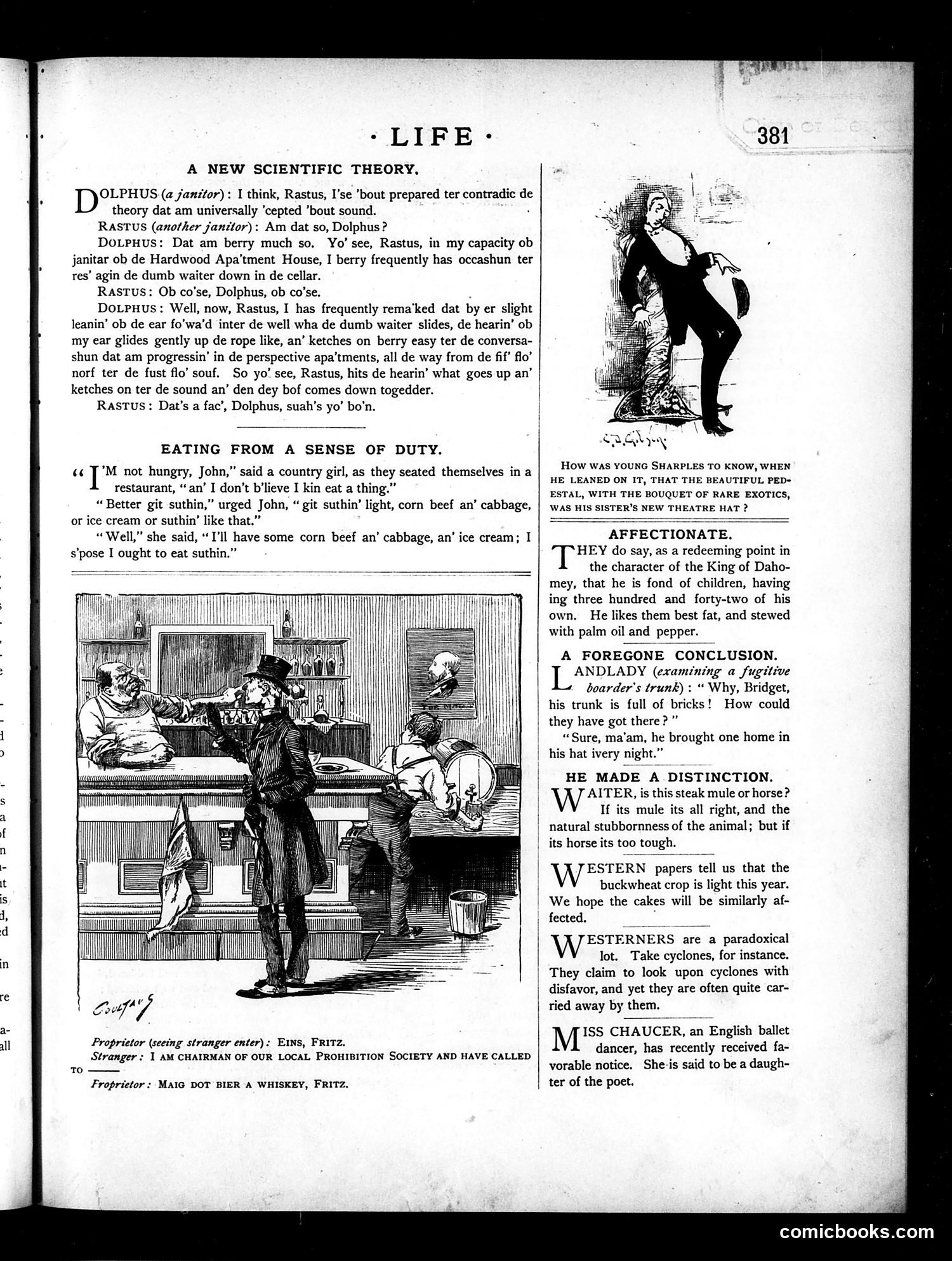
This page contains several satirical humor pieces rather than a unified political cartoon: **"A New Scientific Theory"** mocks pseudo-intellectual working-class speech through a dialogue between Dolphis and Rastus about sound traveling through pipes in tenement buildings—absurd folk "science" presented as discovery. **"Eating from a Sense of Duty"** satirizes working-class dietary constraints, where someone grudgingly eats cheap food (corn beef and cabbage) without genuine appetite. **The main illustration** (signed by Cesare) shows a bar scene where a "Stranger" (likely a Prohibition Society official) confronts the proprietor about liquor sales, with the proprietor denying it was "whiskey." This satirizes Prohibition enforcement and proprietors' transparent evasions. The remaining sections are brief jokes about theater hats, animal stubbornness, Western crops, and a ballet dancer—typical period humor with no specific political content.
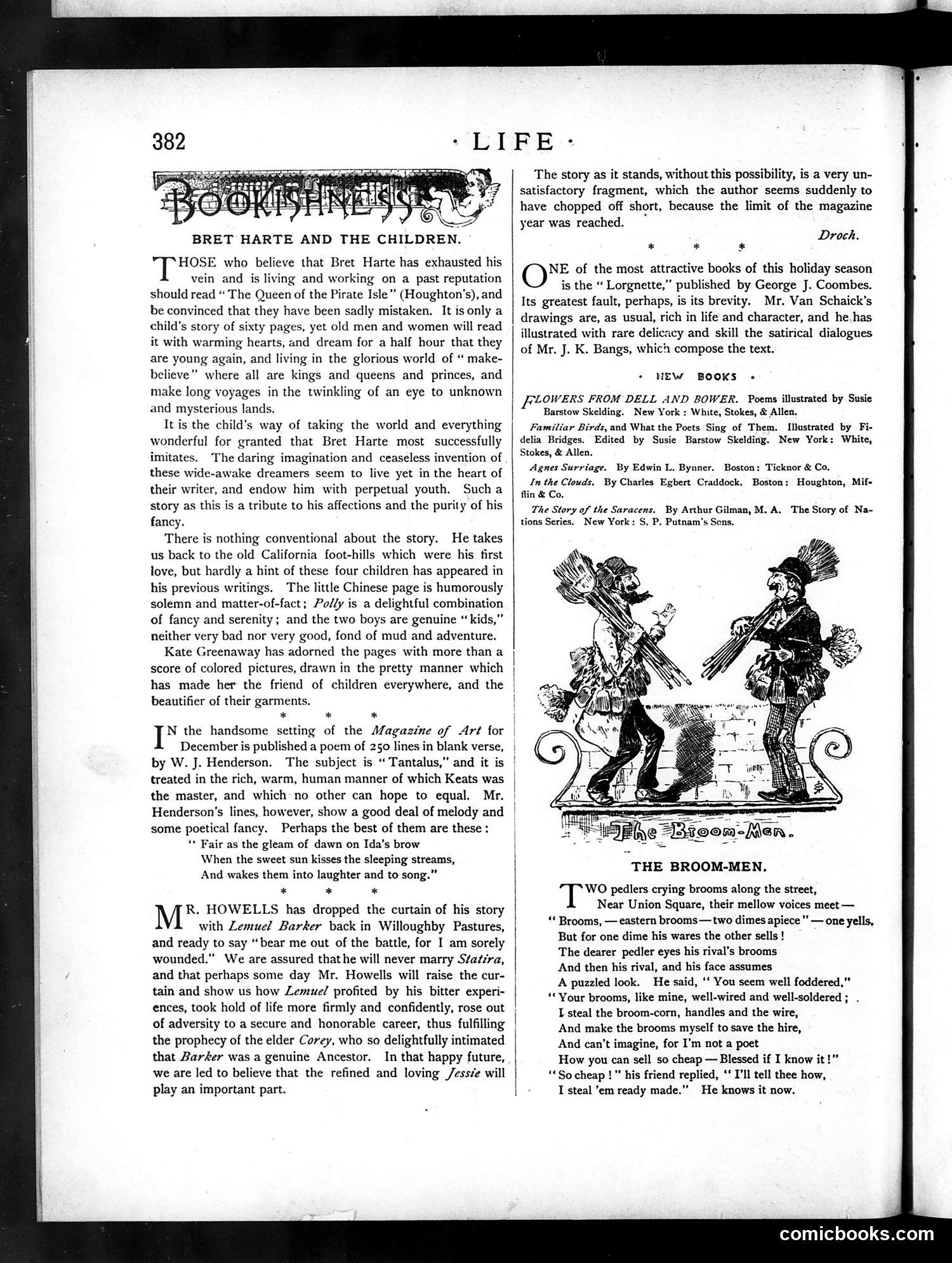
This page from *Life* magazine contains a satirical poem titled "The Broom-Men," illustrated with a cartoon showing two street vendors arguing over broom sales near Union Square. The satire depicts competing street peddlers hawking brooms, each trying to undercut the other's price and claims about product quality. One boasts his brooms are cheaper; the other counters that his are superior. The poem mocks their rivalry and desperation to make sales—one even admits to stealing materials to reduce costs. The humor targets working-class street vendors and their petty competition. It's gentle social satire about urban commerce and the struggling poor trying to survive through street peddling, a common sight in early 20th-century American cities.
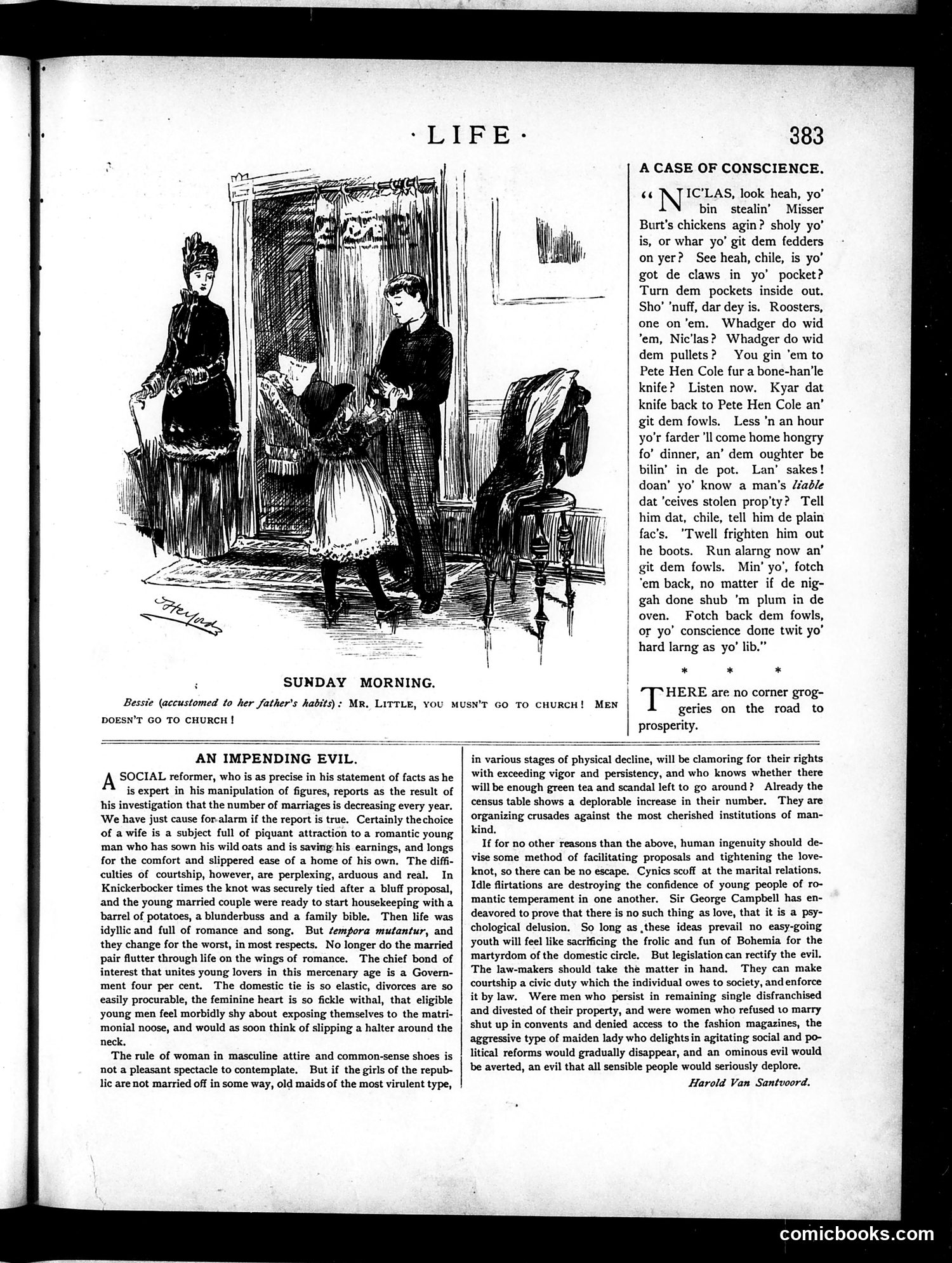
This cartoon depicts a domestic scene where a young woman (Bessie) is being scolded by her father about missing church. The caption reads: "Bessie (accustomed to her father's habits): Mr. Little, you must go to church! Men doesn't go to church!" **The satire:** The humor relies on hypocrisy—the father demands Bessie attend church while he himself doesn't. Her cheeky response calls out his double standard, suggesting women are held to stricter moral/religious standards than men. **Social context:** This reflects late-19th/early-20th century gender norms where women faced greater social pressure to demonstrate respectability and piety, while men enjoyed more freedom from such expectations. The cartoon satirizes both paternal authority and gendered moral standards of the era.
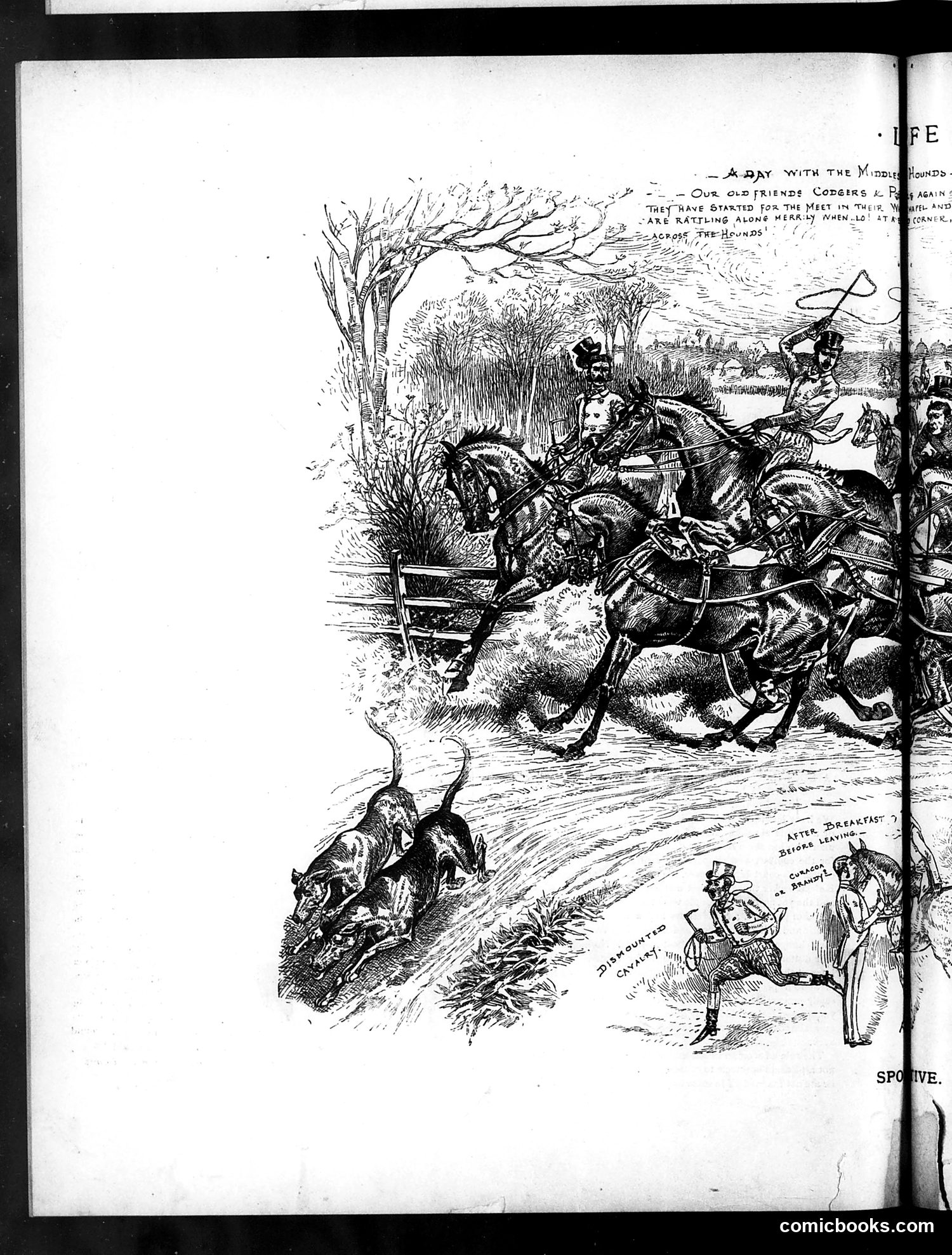
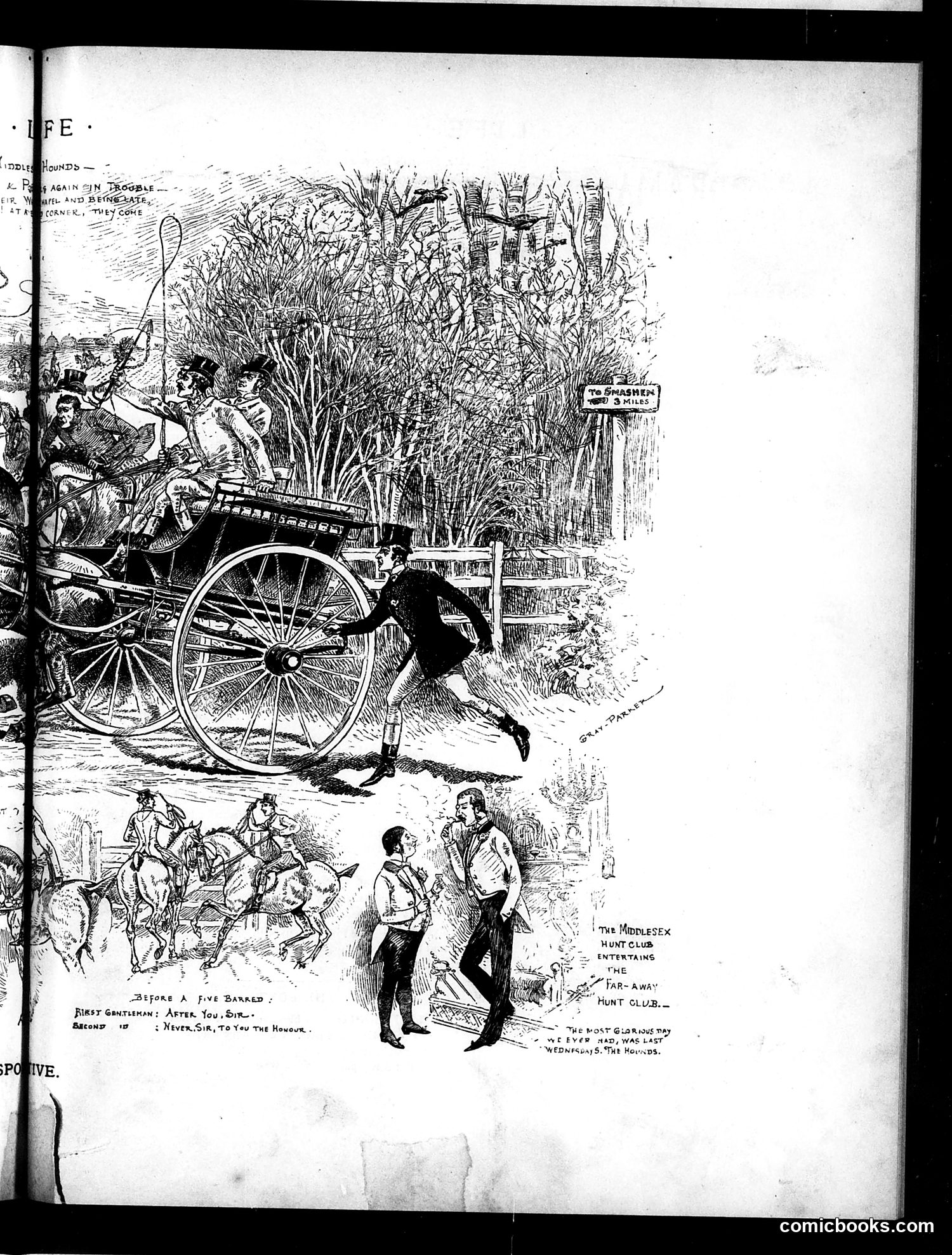
This is a sporting illustration titled "A Day with the Misses Hounds" (fox hunting). The sketch depicts a fox hunt scene with mounted riders on horseback pursuing hounds across countryside terrain. The caption references they've "started for the meet in their white and black, rattling along merry-go-round across the hounds." Below are additional vignettes labeled "After Breakfast" and "Dismounted Cavalry," showing hunting-related activity and spectators. The satire appears gentle—poking fun at the social pretension and theatrical nature of fox hunting among the genteel classes ("misses" suggests upper-class women participants). The "merry-go-round" comparison suggests the repetitive, somewhat absurd formality of the sport. This reflects Life magazine's typical satirical approach to mocking upper-class leisure activities and social conventions of the era.
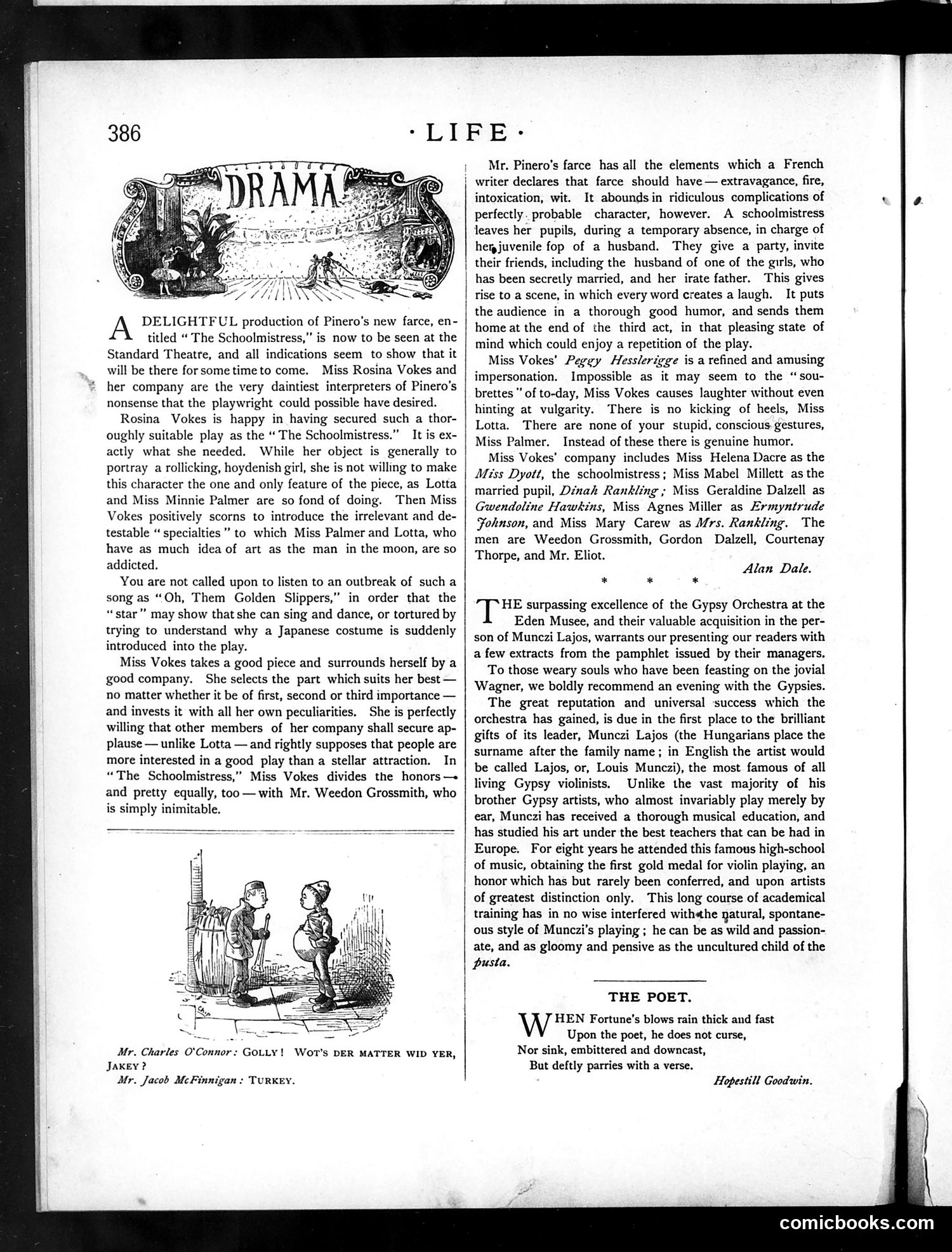
This page from *Life* magazine contains three distinct sections: 1. **"DRAMA" section** reviews Pinero's farce "The Schoolmistress," praising actress Rosina Vokes's comedic performance and the ensemble cast. It's a straightforward theater review. 2. **Small illustration** (bottom left) shows a dialogue between characters identified as Mr. Charles O'Connor, Golly, Wot's der matter wid yer, Jackey, and Mr. Jacob McFinegan as Turkey. The caption suggests this is satirizing working-class or immigrant dialect speech, likely mocking lower-class characters' speech patterns—a common form of period satire. 3. **"THE POET" section** begins with a poem by Hapshill Goodwin about Fortune and poets, unrelated to the cartoon. The page lacks explicit political satire; instead it reflects late-19th-century American humor based on ethnic/class stereotypes.
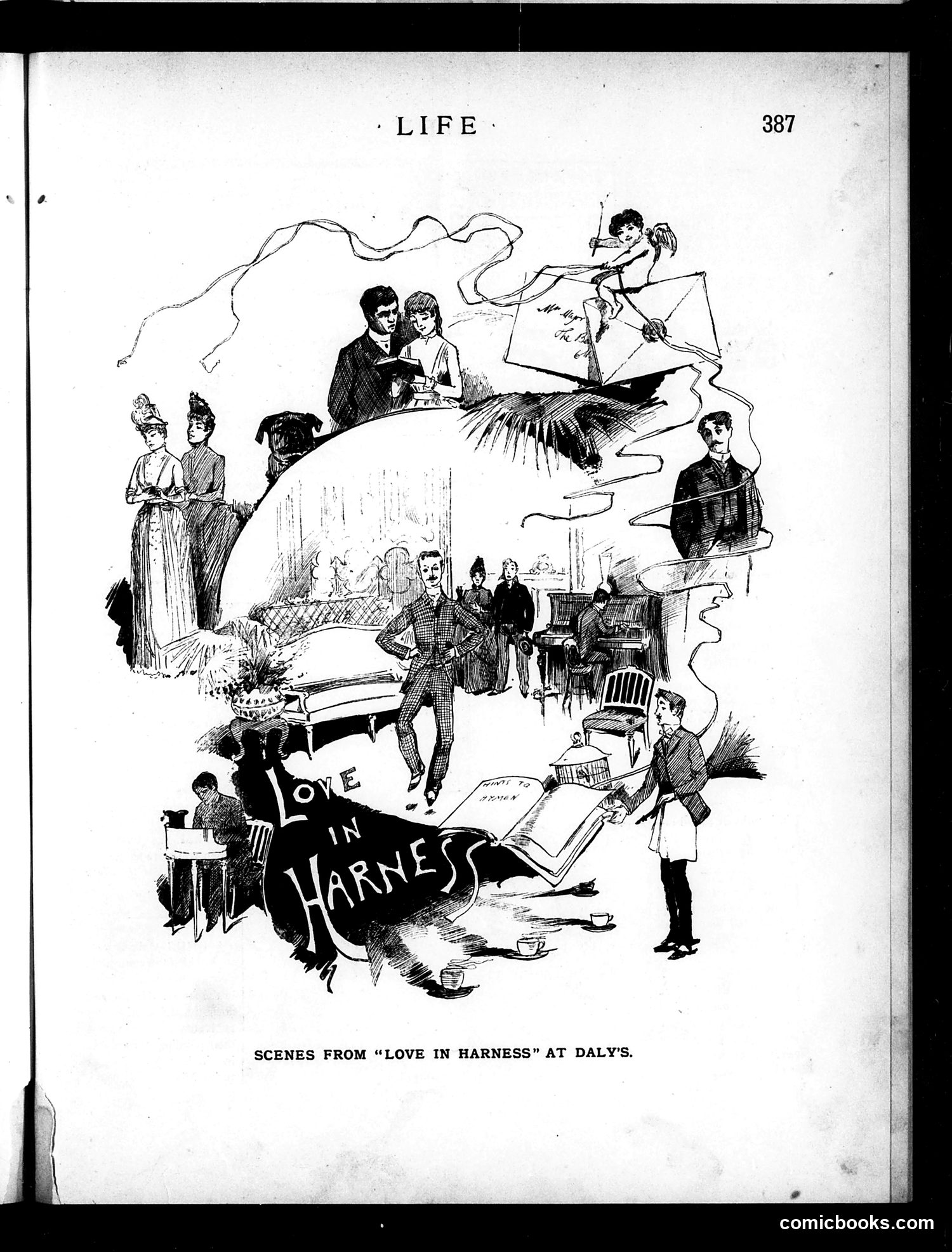
This page from *Life* magazine (page 387) shows illustrated scenes from a theatrical production titled "Love in Harness" performed at Daly's Theatre. The composite illustration depicts various moments from the play through a collage of sketched figures and scenes arranged within an outline of a horse's head—a visual pun referencing the "harness" in the title. The drawings show characters in period costume engaged in dramatic moments: couples embracing, people in formal dress, domestic interior scenes, and theatrical poses. The style is typical of late 19th or early 20th-century theatrical illustration, documenting the play's content for *Life*'s readers. Without additional context about the specific production, the satire or social commentary—if any—remains unclear from the image alone.
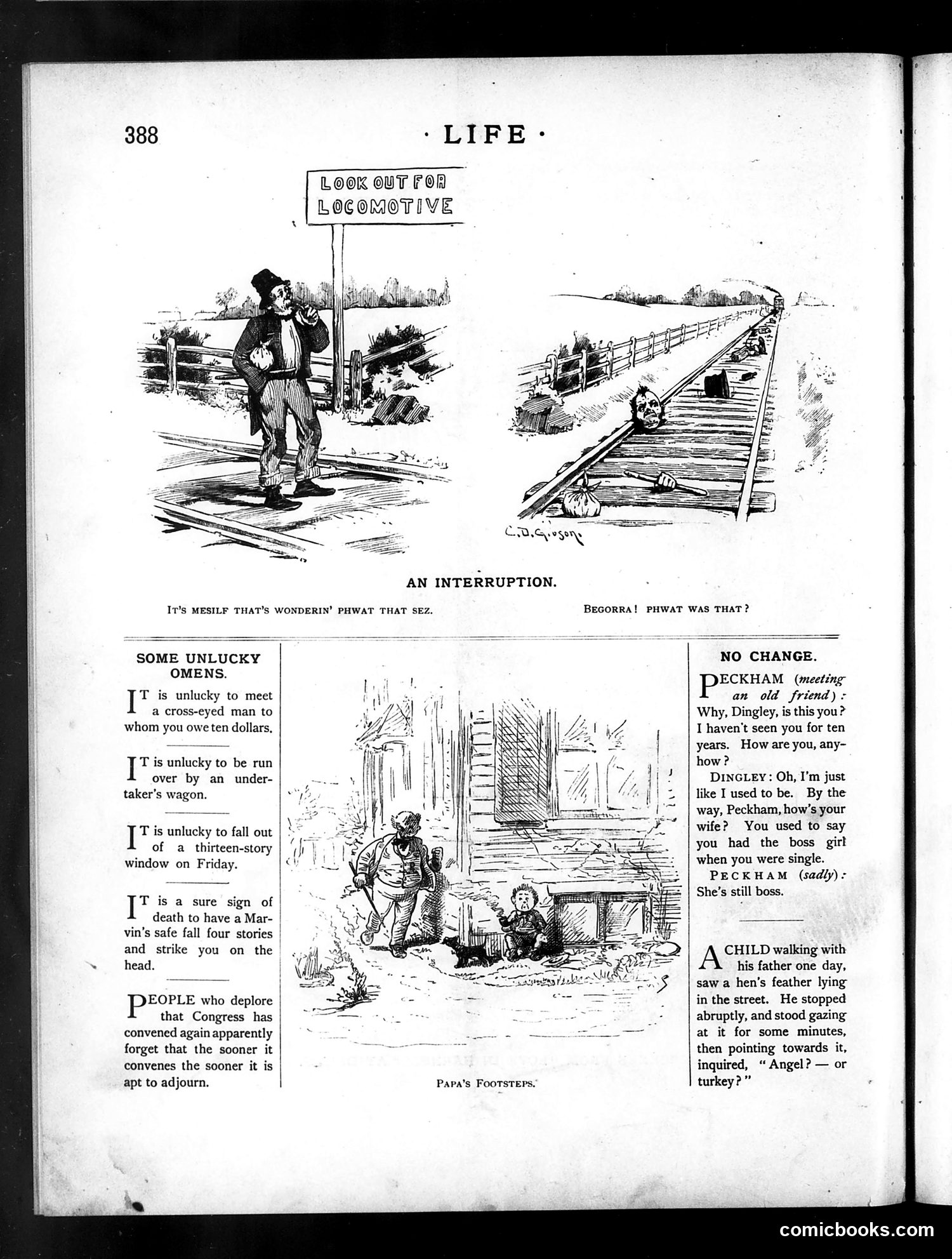
This page contains three distinct humorous pieces: **"An Interruption"** (top): Two comic panels depicting Irish railroad workers with exaggerated dialect ("Mesilf," "Phwat," "Begorra"). A worker spots something on the tracks, likely a locomotive—a setup for dark humor about workplace danger. **"Some Unlucky Omens"** (bottom left): A satirical list mocking superstition. The final item takes a jab at Congress, suggesting that since Congress inevitably adjourns, its reconvening is actually fortunate because adjournment will follow sooner. **"No Change" and "Papa's Footsteps"** (right): Two brief anecdotes. The first depicts a reunion where a married man admits his wife still dominates him (the "boss girl" of bachelorhood). The second shows a child innocently asking whether a feather belongs to an "angel" or "turkey"—gentle humor about childhood misunderstanding. The page employs period stereotypes (Irish immigrant dialect) and targets marriage, superstition, and congressional absurdity—typical Life magazine satire of the era.
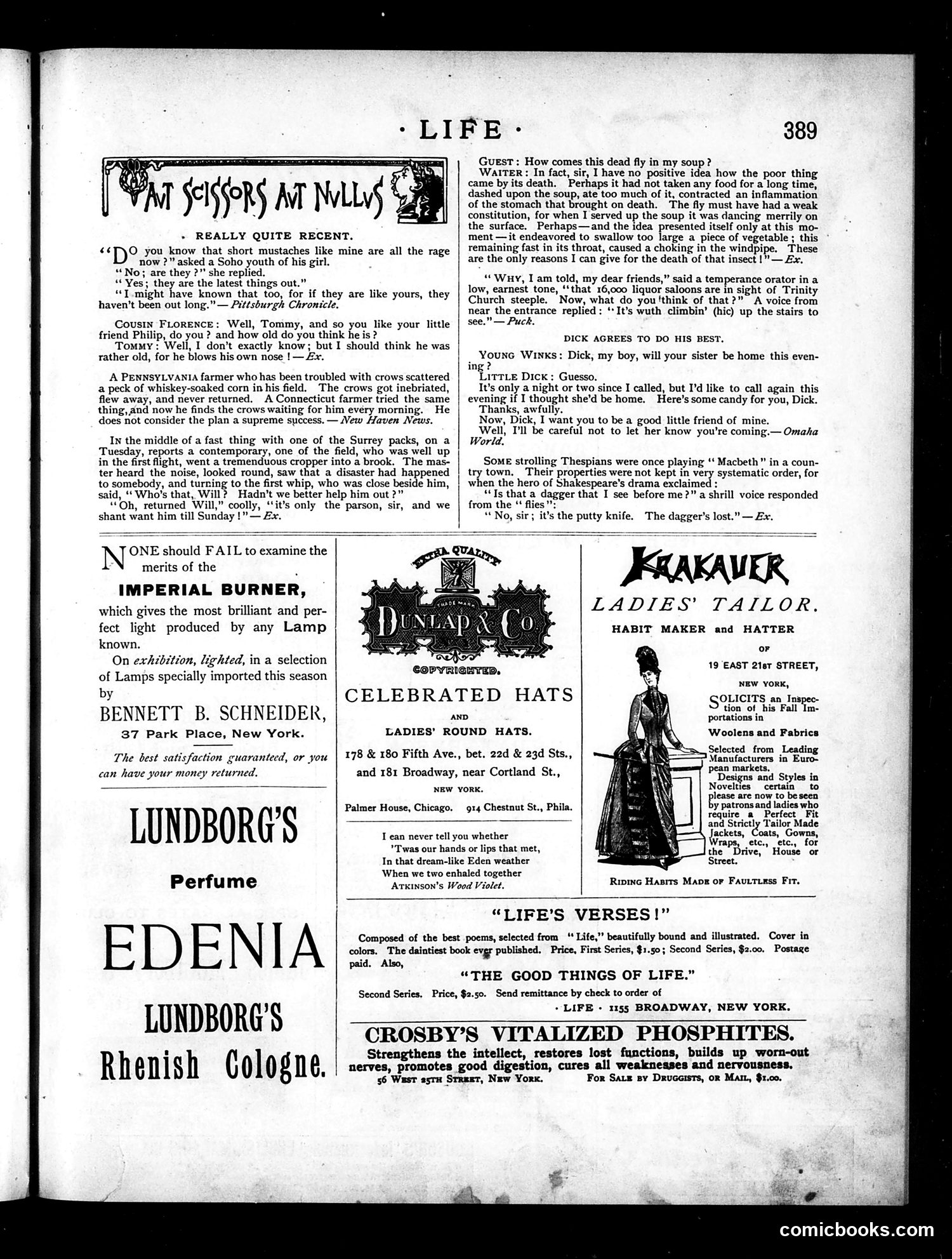
This page is primarily **advertising and humor anecdotes**, not political cartooning. The content consists of: **Humor Pieces:** Several short jokes targeting Victorian-era social conventions: - A young man's boast about fashionable mustaches gets mocked - A child's observation that his friend is "rather old" because he blows his own nose (implying dependence on adults) - A farmer's failed crow-control experiment using alcohol - A fox-hunting anecdote where a clergyman takes a spill, dismissed as unimportant - A temperance speaker's statistic about saloons near Trinity Church gets crude heckling **The Satire:** These jokes mock pretension, naïveté, class attitudes (clergy being disposable), and moral hypocrisy (temperance rhetoric undercut by drunken audience members). **Advertisements:** The page is dominated by product ads for perfume, lamps, hats, and tailoring services—typical of *Life*'s revenue model. No identifiable political figures or specific historical events are referenced. This appears to be a standard issue of miscellaneous social commentary typical of late-19th-century American humor magazines.
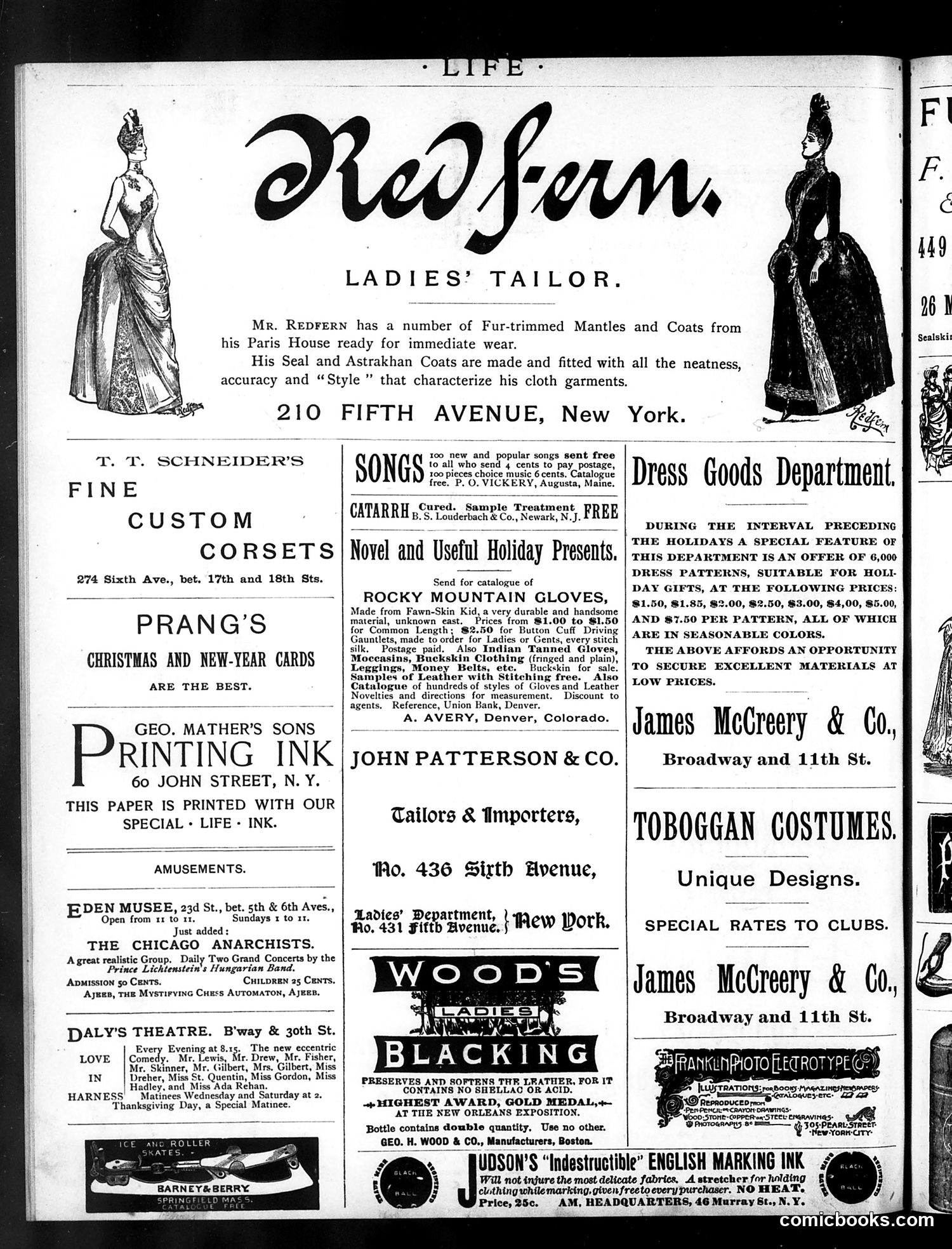
This is primarily an **advertising page** with no political cartoons or satirical content. The page consists entirely of commercial advertisements from late 19th-century New York businesses. The ads reflect the era's consumer culture: ladies' fashion (Redfern's fur coats, dress goods), theatrical entertainment (Daly's Theatre, Eden Musee), and specialized products (printing ink, corsets, gloves, shoe polish). One notable reference: "The Chicago Anarchists" advertisement mentions a "great realistic Group" exhibition—likely referencing the 1886 Haymarket bombing aftermath, when anarchist trials dominated American discourse. This suggests Life's readership included those interested in sensationalized depictions of contemporary social unrest. The page otherwise offers no satirical commentary, merely showcasing consumer goods and entertainment available to wealthy New Yorkers in the 1880s-1890s.
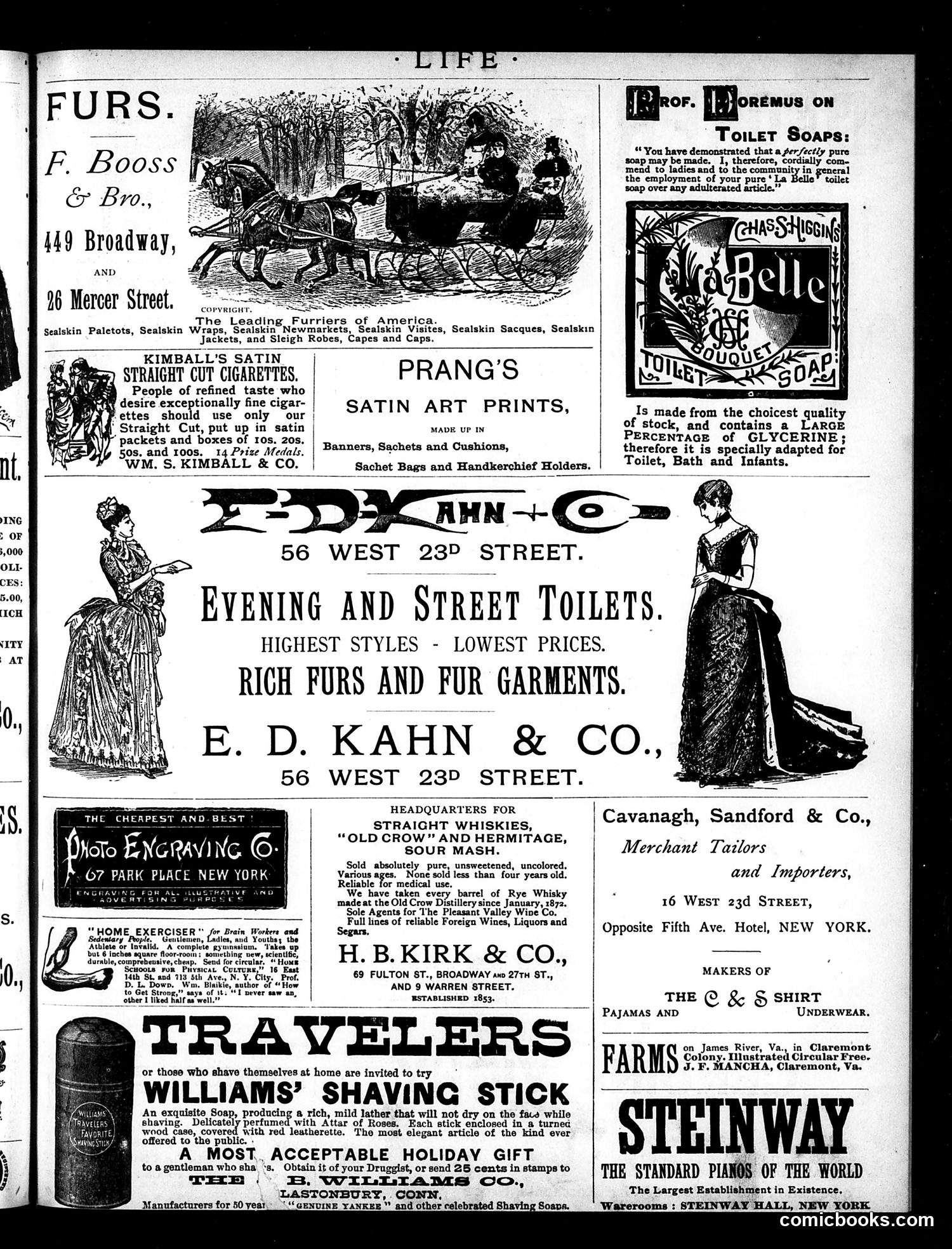
This is primarily an **advertising page** with no editorial cartoons or satire. It contains approximately 15 commercial advertisements typical of late 19th-century Life magazine. The ads target affluent urban consumers with luxury goods: fur garments (F. Booss & Bro., E.D. Kahn & Co.), fine cigars (Kimball's), art prints, toiletries, whiskey, and pianos. Notable is the repeated emphasis on "highest styles—lowest prices" and claims of purity (pure soap, pure whiskey "sold absolutely pure, unsweetened"). The illustrated figures are generic period fashion drawings showing elegant women in elaborate dress—standard imagery for luxury goods marketing, not specific satirical caricatures. The page reflects Gilded Age consumer culture: advertisements claim scientific authority ("demonstrated that a perfectly pure soap"), target genteel audiences ("people of refined taste"), and use aspirational imagery. There is **no political satire or social commentary** present—this is straightforward period advertising reflecting Victorian-era mercantilism and class-conscious marketing.
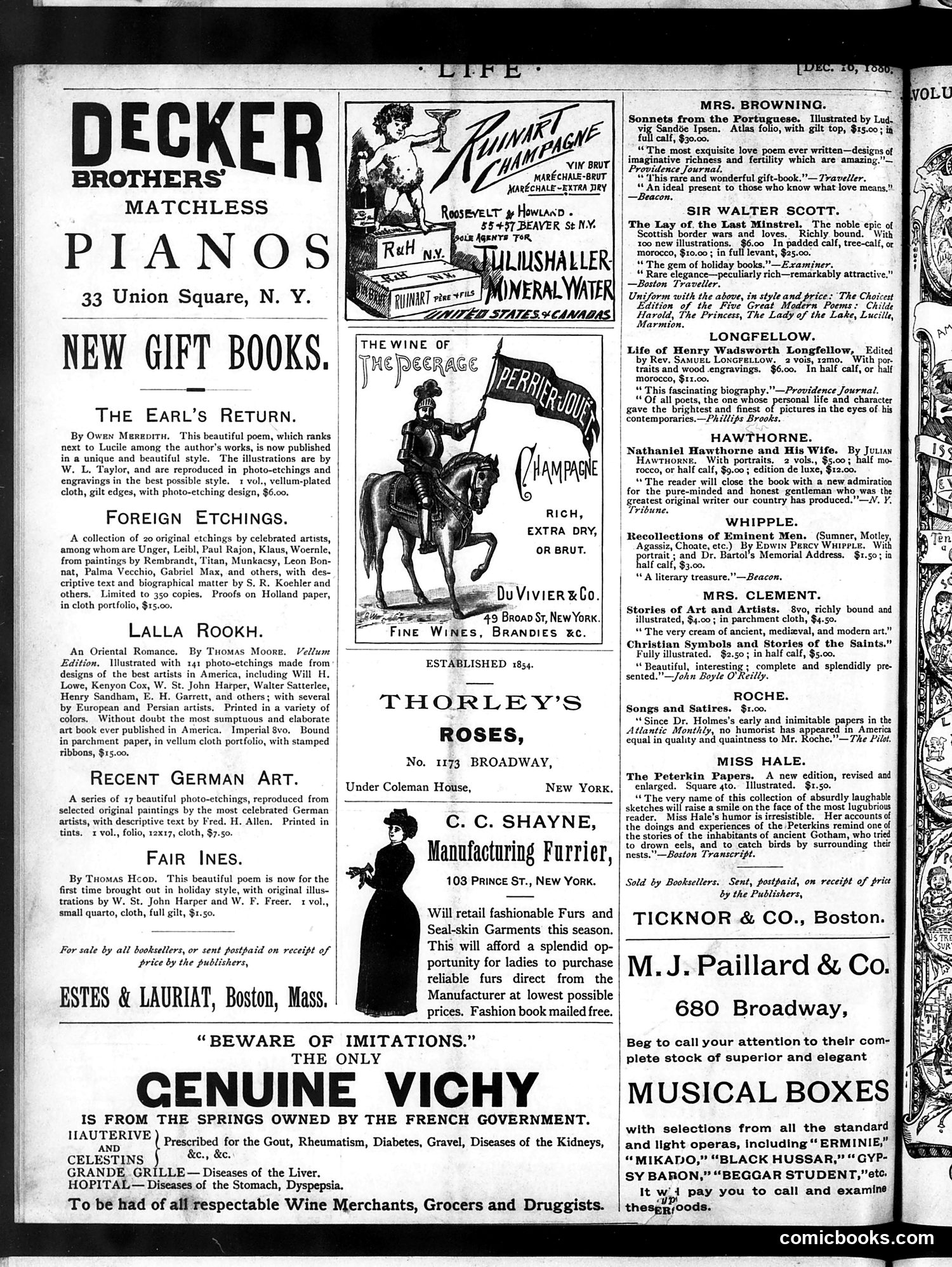
This is a page from *Life* magazine's advertising section, not editorial content with cartoons or satire. The page contains commercial advertisements for luxury goods popular in the 1880s: Decker pianos, illustrated gift books (poetry editions of works by Byron, Moore, and Scott), French mineral water and champagne, fine wines and brandies, furs, musical boxes, and manufacturing services. The only illustrated elements are product advertisements, including what appears to be a champagne label and a furrier's advertisement featuring a woman in period dress. These are standard commercial imagery, not political cartoons or satirical commentary. The page reflects late-Victorian consumer culture and gift-giving traditions rather than editorial satire or political commentary.