
Life, 1886-12-16 · page 6 of 16
Life — December 16, 1886 — page 6: what you’re looking at
What you’re looking at
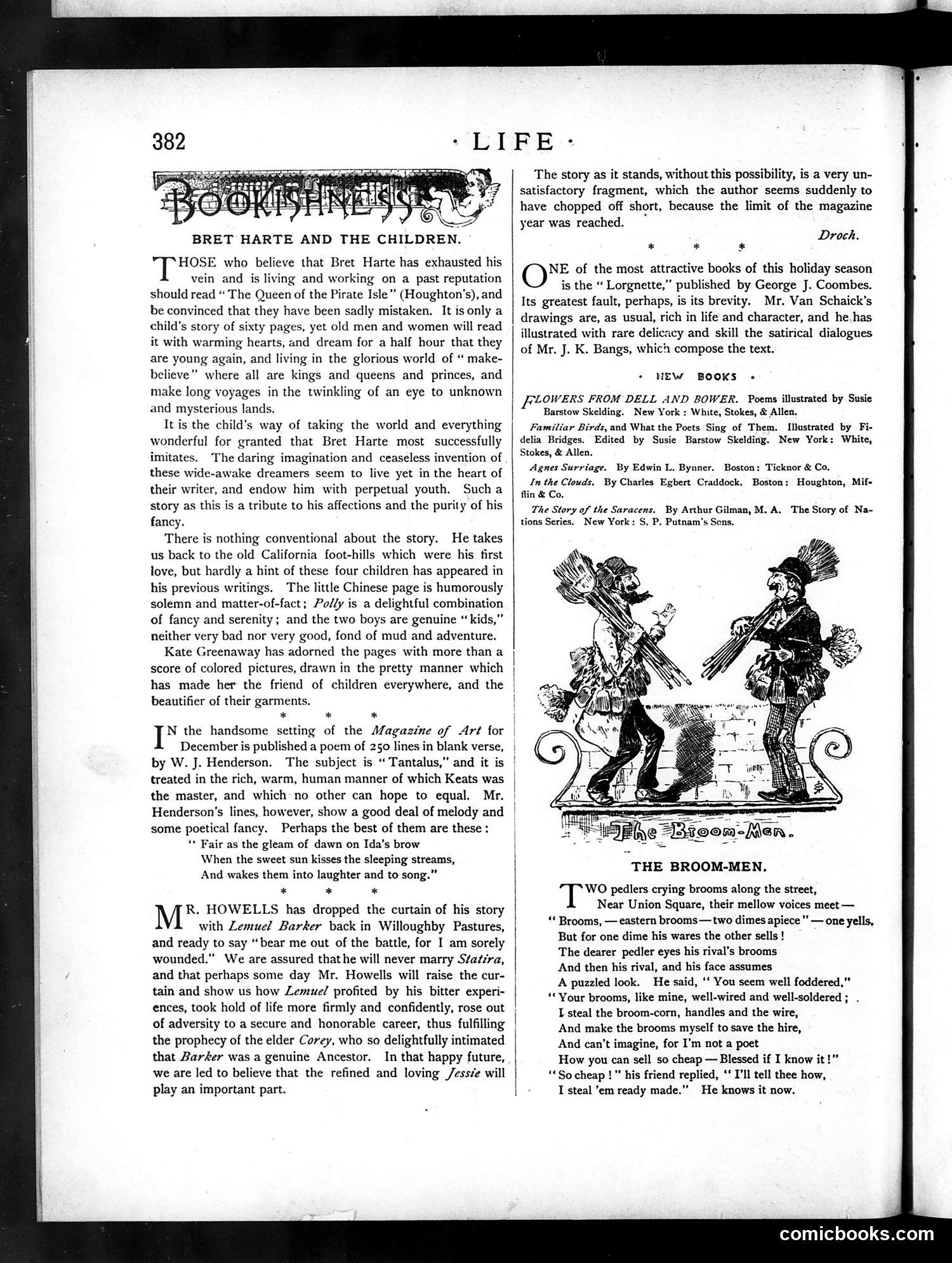
This page from *Life* magazine contains a satirical poem titled "The Broom-Men," illustrated with a cartoon showing two street vendors arguing over broom sales near Union Square. The satire depicts competing street peddlers hawking brooms, each trying to undercut the other's price and claims about product quality. One boasts his brooms are cheaper; the other counters that his are superior. The poem mocks their rivalry and desperation to make sales—one even admits to stealing materials to reduce costs. The humor targets working-class street vendors and their petty competition. It's gentle social satire about urban commerce and the struggling poor trying to survive through street peddling, a common sight in early 20th-century American cities.
📄 Transcribed text from this page (OCR, searchable)
Machine-transcribed from the original scan — historical spelling and the odd misread are preserved.
‘LIFE: HOSE who believe that Bret Harte has exhausted his vein and is living and working on a past reputation should read “ The Queen of the Pirate Isle” (Houghton’s), and be convinced that they have been sadly mistaken. It is only a child’s story of sixty pages, yet old men and women will read it with warming hearts, and dream for a half hour that they are young again, and living in the glorious world of ‘ make- believe” where all are kings and queens and princes, and make long voyages in the twinkling of an eye to unknown and mysterious lands. It is the child's way of taking the world and everything wonderful for granted that Bret Harte most successfully imitates. The daring imagination and ceaseless invention of these wide-awake dreamers seem to live yet in the heart of their writer, and endow him with perpetual youth. Such a story as this is a tribute to his affections and the purity of his fancy. There is nothing conventional about the story. He takes us back to the old California foot-hills which were his first love, but hardly a hint of these four children has appeared in his previous writings. The little Chinese page is humorously solemn and matter-of-fact; Podly is a delightful combination of fancy and serenity; and the two boys are genuine “kids,” neither very bad nor very good, fond of mud and adventure. Kate Greenaway has adorned the pages with more than a score of colored pictures, drawn in the pretty manner which has made her the friend of children everywhere, and the beautifier of their garments. * * * N the handsome setting of the Magazine of Art for | December is published a poem of 250 lines in blank verse, by W. J. Henderson. The subject is “Tantalus,” and it is treated in the rich, warm, human manner of which Keats was the master, and which no other can hope to equal. some poetical fancy. Perhaps the best of them are these : “ Fair as the gleam of dawn on Ida’s brow When the sweet sun kisses the sleeping streams, And wakes them into laughter and to song.” * * * M R. HOWELLS has dropped the curtain of his story with Lemuel Barker back in Willoughby Pastures, and ready to say “bear me out of the battle, for I am sorely wounded.” We are assured thathe will never marry Sta¢ra, and that perhaps some day Mr. Howells will raise the cur- tain and show us how Lemuel profited by his bitter experi- ences, took hold of life more firmly and confidently, rose out of adversity to a secure and honorable career, thus fulfilling the prophecy of the elder Corey, who so delightfully intimated that Barker was a genuine Ancestor. In that happy future, we are led to believe that the refined and loving /essée will play an important part. Mr. | Henderson's lines, however, show a good deal of melody and | The story as it stands, without this possibility, is a very un- satisfactory fragment, which the author seems suddenly to have chopped off short, because the limit of the magazine year was reached. Droch. * * * ON of the most attractive books of this holiday season is the “ Lorgnette,” published by George J. Coombes. Its greatest fault, perhaps, is its brevity. Mr. Van Schaick’s drawings are, as usual, rich in life and character, and he.has illustrated with rare delicacy and skill the satirical dialogues of Mr. J. K. Bangs, which compose the text. + HEW BOOKS « FLOWERS FROM DELL AND BOWER. Poems illustrated by Susie Barstow Skelding. New York : White, Stokes, & Allen. Familiar Birds, and What the Poets Sing of Them. Illustrated by Fi- delia Bridges. Edited by Susie Barstow Skelding. New York: White, Stokes, & Allen. Agnes Surriage. By Edwin L, Bynner. In the Clouds. flin & Co, The Story of the Saracens, By Arthur Gilman, M.A. The Story of Na- tions Series. New York: S. P, Putnam's Sons. Boston: Ticknor & Co, By Charles Egbert Craddock. Boston: Houghton, Mif- THE BROOM-MEN. WO pedilers crying brooms along the street, Near Union Square, their mellow voices meet — “« Brooms, — eastern brooms — two dimes apiece” — one yells, But for one dime his wares the other sells ! The dearer pedler eyes his rival’s brooms And then his rival, and his face assumes A puzzled look. He said, ‘‘ You seem well foddered,” “* Your brooms, like mine, well-wired and well-soldered ; . I steal the broom-corn, handles and the wire, And make the brooms myself to save the hire, And can't imagine, for I'm not a poet How you can sell so cheap — Blessed if I know it!” ‘*So cheap !" his friend replied, ‘‘ I'll tell thee how, I steal ’em ready made.” He knows it now. comicbooks.com